Suche:para x

Styles
Alle
Donnacha Costello - Together Is The New Alone  (2021 Remaster) 2x12"

For its 20th anniversary, Keplar presents an absolute milestone in the history of IDM and ambient music for the first time in its definite form: »Together Is the New Alone« by Donnacha Costello was originally released on Mille Plateaux in 2001 as the second LP under the Irish producer’s given name and firmly established him as one of the leading artists in the field of forward-thinking electronic music after he had primarily made a name for himself with house and techno releases under the Jayrod moniker. This vinyl reissue with an entirely new artwork comprises all ten tracks originally only included on the CD version in their edited and final form in which they were last presented on the digital re-release under the name »Together,« remastered by Stephan Mathieu and self-published by Costello, in 2015.

Truly prescient artists rarely opt for introspective sounds, however that was the case when Costello set out to produce »Together Is the New Alone« during nightly session in his hometown Dublin between April and July in 2001, and it also explains the album’s enduring appeal and unwavering radiance twenty years on. While many of his contemporaries dedicated themselves to explore the musical zeitgeist and notions of the future in conceptual terms, Costello made them emotionally tangible, allowing his audience to feel their underlying ambiguity rather than just reflect on it. »Together Is the New Alone« is an album that wordlessly speaks of the paradoxical sense of social alienation and isolation expressed by its title and thus seems even more topical today than it did at the time of its release.

Working with elements from techno culture, glitch aesthetics, intricate IDM rhythms and lush ambient textures, Costello never once throughout the album adheres to tried and tested formulas and conventions, but holistically moulds complex compositions out of distinct and discrete parts. The result is a record that is at once easily accessible and deeply affecting, but also infinitely rich and stunningly sophisticated in musical terms. A personal record expressing a universal sentiment—a truly timeless statement that will reverberate for decades to come.

(Kristoffer Cornils)

nicht am Lager

Bestelle jetzt und wir bestellen den Artikel für dich beim Lieferanten.

26,68

Last In: vor 4 Jahren
Richard Ojijo - MO_RO_20

Richard Ojijo

MO_RO_20

12inchMAGAZINEMORO20
Magazine
26.11.2021

20 YEARS OF MUSIC FOR MARCEL ODENBACH

Richard Ojijo’s music for the films of german video artist Marcel Odenbach not only underscores and accentuates the imagery and motion, but also serves to propel the narrative too. The compositions are auditory distillations of the visual and create a synergy between music and image that draws the observer ever deeper.

With Odenbach’s and Ojijo’s collaboration now entering its 3rd decade, Ojijo was recently inspired to revisit and remix some of the themes contained within the extensive body of work.

— Matt Karmil, Aug 2021

Die Musik von Richard Ojijo für die Videoarbeiten des Künstlers Marcel Odenbach sind eindrucksvolle Beispiele dafür, wie Klänge Filmbilder nicht nur untermalen oder deren Wirkung atmosphärisch verdichten können, sondern neben dem Visuellen ein gleichberechtigtes Eigenleben entwickeln, das auf das Gesamterlebnis des Films zurückwirkt: plötzlich auftauchende innere Bilder oder Assoziationen, die das Gesehene mit noch größerer Komplexität und Mehrdeutigkeit versorgen.

Wenn sich etwa in „Innerer Sicherheit“ oder „In stillen Teichen lauern Krokodile“ sphärische Flächen und Soundeffekte ausbreiten, erinnert dies zuweilen an elektronische Stimmungen der späten 90er Jahre, obwohl die Thematiken der Filme in gänzlich andere Richtungen weisen. Dabei wird nie der Spannungsbogen der filmischen Dramaturgie vernachlässigt. Vielmehr kommt es zum Wechselspiel von dienender und freier Funktion, in dem die Musik nicht nur ihre schöne, sondern – den Themen der Filme angemessene – beunruhigende Wirkung ausbreiten kann. So tauchen wie aus dem Nichts Stimmen auf oder Geräusche, etwa von Stiefeln in „Beweis zu nichts“, die parallele Narrationen auf die Audiospur legen, um die zum Teil bedrohliche Wirkung der Bilder zu verstärken und womöglich Bereiche des Unterbewussten zu berühren.

Die Zusammenarbeit von Ojijo und Odenbach dauert mittlerweile über 20 Jahre an. Ojijo hat nun seine Arbeiten für die Filme Odenbachs neu zusammengestellt und neu gemischt. Die Platte erscheint im Herbst 2021 aus Anlass der großen Odenbach-Retrospektive im Düsseldorfer K21-Museum. Dort werden auch sieben Videoarbeiten zu sehen sein, von denen fünf in Zusammenarbeit mit Richard Ojijo entstanden sind.

— Michael Kerkmann, Aug 2021

vorbestellen26.11.2021

erscheint voraussichtlich am 26.11.2021

140,29
Chiara Civello - Chansons

The Italian singer Chiara Civello and the French producer Marc Collin are back together for a second time. After Eclipse, they present « Chansons: Chiara Civello Sings International French Standards ».


A tracklisting of 12 classic songs dating from 1945 to 1975 all by French song writers.

From Michel Legrand to Charles Aznavour, Charles Trénet, Édith Piaf, Jacques Brel or Gilbert Bécaud and Francis Lai. Household names for French music lovers, but not necessarily so for international audiences.

vorbestellen26.11.2021

erscheint voraussichtlich am 26.11.2021

25,50
Ka Baird & Pekka Airaksinen - FRKWYS Vol. 17: Hungry Shells

Hungry Shells, the seventeenth entry in RVNG Intl.’s intergenerational collaborations series FRKWYS, brings together vocalist, multi- instrumentalist, and sound artist Ka Baird with avant-garde composer and radical performance art pioneer Pekka Airaksinen. Recorded six months before Pekka’s passing, Hungry Shells alchemizes separate but similar spiritualistic practices, canvassing Baird’s voice and synthesizer rituals and Airaksinen’s lysergic sound explorations into startling, surreal landscapes.

Pekka Airaksinen, who left this realm for another in May 2019, is recognized as a pioneering composer both in and outside his native Finland’s fringe art community. A founding member of the late 60s art and music collective The Sperm, Airaksinen discovered Buddhism in the early 1970s, eventually establishing a number of meditation centers around Finland. Throughout his career Airaksinen embraced a degree of obscurity and anonymity that was inspired by his Buddhist learnings, and afforded him complete creative freedom. As he explained, “The less success you have, the more time there is to develop things.”

Ka Baird, who found her musical footing in Chicago playing in Spires That In The Sunset Rise before moving to New York to pursue her solo career, has developed a practice based in forms of active and engaged embodiment. Inspired by Charlemagne Palestine’s Body Music, Baird’s performances explore physical extremes as a catalyst for charged immediacy and presence. “I’m interested in the

places between precision and something unrestrained,” she told The Wire in 2019. Drawing on minimalism’s ecstatic deployment of duration and endurance, her recordings explore the outer limit sounds of her voice and its synthesis with developing music technology.

Airaksinen and Baird convened in Utrecht in the fall of 2018 to write, rehearse, and record Hungry Shells ahead of a performance at the Dutch festival institution Le Guess Who? Sessions took place between contemplative walks along the city’s medieval canals, and, for Airaksinen, lengthy meditations in his hotel room. Early on in the trip, Pekka shared ODO with Ka, a collection of Buddhist parables that he divinely received while meditating. After translating several of these texts from Finnish to English the duo used them as text for the album, and a sort of psychic foundation.

vorbestellen26.11.2021

erscheint voraussichtlich am 26.11.2021

29,12
PAUL PARAY / DETROIT SYMPHONY ORCHESTRA - THE MUSIC OF CHABRIER

Rarely has the DSO sparkled as in the fresh, exuberant music of Emmanuel Chabrier. Included on this album are the Chabrier compositions ‘España,’ ‘Suite pastorale,’ ‘Fête polonaise,’ ‘Gwendoline’ Overture and ‘Danse slave.’ Recorded in the Cass Technical High School auditorium, November 18, 1960 with three Schoeps M201 microphones.

vorbestellen26.11.2021

erscheint voraussichtlich am 26.11.2021

32,73
Hedvig Mollestad - Tempest Revisited

Hedvig Mollestad must surely be one of the hardest working musicians on the Norwegian music scene at the moment, with “Tempest Revisited” being her third album in a mere 18 months, all at a consistently high artistic level. Her first solo album, “Ekhidna” (2020), received a Spellemannpris (Norwegian Grammy), appeared on several jazz and rock best of the year lists and got her into Downbeat´s “25 for the future” selection. “Tempest Revisited” draws lines back to 1998 and the very beginning of Rune Grammofon. This was the year we released “Electric”, the collected electronic works of Arne Nordheim, one of Norway´s greatest composers. It was also the year when parts of “The Tempest”, possibly his most cherished and well-known work, was chosen to be performed at the opening of Parken, the new cultural house in Ålesund, birthplace of Hedvig Mollestad. To celebrate 20 years, the culture house was ready for a new storm, and the first name that came to them was Hedvig, a local artist that was already making waves on the international scene with her power-trio. Hedvig took inspiration from the front of the house, adorned with Nordheim´s score for “The Tempest”, at the same time making a direct connection to the sometime heavy weather conditions of this coastal area in the northwest part of Norway. One could say it´s a big paradox that over all this might be Hedvig´s most lyrical and less aggressive collection of music. On the other hand it´s quite a dynamic record, lots of light and shade and enough sonic parts at work to evoke the elements, the mighty Gran Cassa drum only one of them. The music included here was adapted from the initial performance in 2018 and produced by Hedvig in the studio the following year for this album release. The musicians included are old friends Marte Eberson from the Ekhidna band, Ivar Loe Bjørnstad from her trio and Trond Frønes (Red Kite) on bass as well as three sax players. Yet another triumph in a more than impressive discography.

vorbestellen26.11.2021

erscheint voraussichtlich am 26.11.2021

27,44
White Stains - Make Me Sick

"If you look at the band photo on Make Me Sick’s insert, you’ll see people from pretty much all the best and most popular hardcore punk bands in Pittsburgh for the past few years. These people know how to make great hardcore punk, and Make Me Sick is White Stains doing just that. While White Stains isn’t as as blistering as Loose Nukes or as brutally intense as Blood Pressure, that’s only because they’ve taken a different tack here, channeling the snotty, punky hardcore of bands like the Circle Jerks, Sick Pleasure, and Chronic Sick. Of those bands, Circle Jerks is the most apt comparison given how White Stains’ snottiness comes along with so much catchiness and rhythmic density. And like Group Sex, the drum parts are almost catchier than the riffs here… I need to be careful listening to this while driving because these songs might make steering seem less important than air drumming" (Daniel Lupton)

vorbestellen26.11.2021

erscheint voraussichtlich am 26.11.2021

24,08
Skydive Trio - Sun Sparkle

Skydive Trio

Sun Sparkle

12inchHUBROLP3537
HUBRO
26.11.2021

Skydive Trio: Thomas T Dahl, gitarer, Mats Eilertsen, kontra- og elbass, Olavi Louhivuori, trommer. SkyDive Trio’s second album ‘Sun Sparkle’ - which arrives three years after its acclaimed predecessor, ‘Sun Moee’ - presents the listener with an intriguing set of paradoxes. A power trio who use full throttle only very sparingly, the band can appear to play loud music quietly, and quiet music, loud, countering jazz subtlety with rock attack. They also partner the relatively clean and melodic sound of Thomas T. Dahl’s guitar with the mountainous riffs and deep, seismic explosions of Mats Eilertsen’s bass, rather as if Pat Metheny was being accompanied by Peter Hook, of Joy Division and New Order. The great Finnish drummer Olavi Louhivuori somehow bridges the aesthetic gap, alternating crunching four-square rhythms with delicately shimmering percussive strokes.

vorbestellen26.11.2021

erscheint voraussichtlich am 26.11.2021

25,59
ALEX MALHEIROS - TEMPOS FUTUROS LP

Stargazing from the sands of the Niterói beach, Tempos Futuros is low-end-led Brazilian futurism from one of Brazil’s most prolific and influential bassmen. As one third of legendary trio Azymuth, Alex Malheiros has pioneered a unique fusion of space-funk, samba and jazz since the early seventies. His playing can be heard on the records of Jorge Ben, Milton Nascimento, Roberto Carlos, Marcos Valle, and Mark Murphy (to name a few), and he’s performed and toured with everyone from Stevie Wonder to Chick Corea.

Written and recorded in Niterói, Brazil, overlooking Guanabara and the beaches, mountains and forests of Rio de Janeiro, Tempos Futuros has deep roots in Brazilian soil. The rhythms of Malheiros’ homeland have always permeated his music. But just like the Oscar Niemeyer designed Niterói Contemporary Art Museum which stands spaceship-like over the water, Tempos Futuros - while inspired by terrestrial forms, reaches out, deep into the great unknown.

Produced by acclaimed London-based producer Daniel Maunick, who has worked with Marcos Valle, Azymuth, Terry Callier, and Ivan Conti, the funk comes full circle. Daniel’s father Jean-Paul “Bluey” Maunick and Alex Malheiros shared a reciprocal stream of influence throughout the 80s, between London and Rio; Azymuth and Incognito; brit-funk and samba-funk. But just as with Azymuth’s music, you can also hear the influence of stateside jazz-funk masters like Roy Ayers, Weather Report, Lonnie Liston Smith, Mtume and Pleasure.

Tempos Futuros features Alex’s daughter, a Brazilian star in her own right, vocalist Sabrina Malheiros, Brazilian percussion master Sidinho Moreira, London based saxophonist Sean Khan, Marcos Valle’s go-to drummer Massa, and Brazilian keyboard player Dudu Viana. Featuring the late Azymuth keyboard maestro Jose Roberto Bertami on Fender Rhodes, the title track “Tempos Futuros” was originally recorded as a demo in 1995. On this finished version, Alex Malheiros used Bertami’s original keyboard take, explaining the posthumous release.

nicht am Lager

Bestelle jetzt und wir bestellen den Artikel für dich beim Lieferanten.

21,81

Last In: vor 4 Jahren
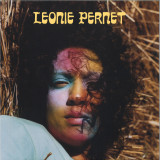
LEONIE PERNET - Le Cirque de Consolation

Léonie Pernet's second album Le Cirque de Consolation, to be released November 19th on InFiné & CryBaby, inhabits a world where borders dissolve and everyone makes their own unique and singular utopia. Hereby, the record questions the links between pop music, African cultures and electronic music, neo-classical music or the role of voice, whether human or synthetic. Sophomore albums can be a painful process for an artist - how refreshing it is to hear one so decidedly optimistic.

Textextext - (add your write up)

The sought after whirlwind of French Pop that exploded onto the scene with her debut "Crave", Leonie Pernet, returns with her second album, "Le Circque de Consolation", a sort of double negative of her first. While the yearning that sat at the center of "Crave"might not have been resolved, the young multi-instrumentalist and singer has found a new perspective - a more open and positive outlook on her own life and work. Perhaps telling, then, that the title was the first element of the album to exist: as it is and has always been a journey of personal (and collective) consolation first, a musical confrontation with the self.

"This record parallels my life's journey," confirms Léonie, "it reflects what has happened in my life since 'Crave' came out and how I feel today. There's still a lot of melancholy, but a lot more sunshine and light. In four years, I've become sober, which has saved me; I've worked a lot on my voice, which is a part of a desire to speak, to address my audience more directly, and also a more pronounced pop desire." In line with her new-found "openness", Leonie invites another musician into her creative process for the first time on "Le Cirque de Consolation": Jean Sylvain le Gouic, who lended his coproduction and perspective to her, while Leonie still plays almost all instruments herself with an astounding prowess.

Leonie's voice oozes with a new-found self-confidence and takes center stage amidst eclectic, distinctively fun and open-minded production. Sometimes she sings in English, mostly in French: "I worked a lot on my voice," confirms Léonie, "I didn't dare to sing before, neither live, nor on record, nor in the studio." Surrounding her astounding, intoxicating voice are forays into any direction imaginable: from harsh, experimental electronics to the more sombre, organic and quiet moments - and everywhere, there is the vision of Africa, (also Middle East) it's many sonic gifts and cultures.

Leonie has found a universal utopia that she craves for - a musical, cultural amalgamation that is decidedly non-western, political and poetic, rooted in self-discovery and the connection with other humans: African and oriental percussion, synthesizers, drum-machines; Léonie mixes genres and instruments with ease and precision. The French novelist and philosopher Édouard Glissant - whose work and writing had a big influence on Pernet - coined the term "Creolization ", the "bringing together of several cultures or at least several elements of distinct cultures, in one part of the world, resulting in new data, totally unpredictable in relation to the sum or the simple synthesis of these elements."

From "Hard Billy ", a techno-influenced rebellious anthem, to "Les Chants de Maldoror," a club and dance song propelled forward by feverish derboukas, to the deeply moving "A rebours" and its Afro-electronic rock. Léonie Pernet inhabits a world where borders dissolve and everyone makes their own unique and singular utopia. Hereby, the record questions the links between pop music, African cultures and electronic music (Intérieur Négro), neo-classical music (Le Cirque de consolation, Dandelion), or the place of the voice, whether human or synthetic as in the atmospheric "Vowel". Sophomore albums can be a painful process for an artist - how refreshing it is to hear one so decidedly optimistic.

nicht am Lager

Bestelle jetzt und wir bestellen den Artikel für dich beim Lieferanten.

18,45

Last In: vor 4 Jahren
Paula Schopf - Espacios en Soledad

Does returning to a place have a sound? Can the ear have a memory? And what if places which we return to are just empty shells? Choreographed rooms which we need to play, fill from scratch each time with fragments from the past and present, layer upon layer, familiar and still somehow always new and differently assembled. Paula Schopf’s Espacios en Soledad are acoustic walks around present day Santiago de Chile, the city where she was born - which she always left, had to leave and to which she always returns - but more than anything also through her own memories which resonate throughout the public places, squares, streets though still in their own way remain strange.

„Every immigrant in the world has a piece like this - a kind of missing link, something which is incomplete. And every time one returns to the home country you are looking for it. For me it was a matter of sound.“ (Paula 2019).

In the mid 70s leaving Santiago was a flight of exile as a child with her family. Leaving in 1990 was an autonomous decision to head for Europe, Berlin, where the wall fell, where the heavens opened up all at once and electronic music became a kind of new home to so many. Paula Schopf belonged there. For her the Ocean Club at Tresor club was a central place where friends and mentors like Gudrun Gut and Thomas Fehlmann made it possible for her to get really into it. Dancing, being and feeling your body, forgetting oneself in the bass and beats, who one is and where one’s from, to becoming the DJ Chica Paula. Chile was very far away during this time, Latin America was more just a code, a musical and habitual cliche to be cautious of. This was especially true for the culture of the Chilean exile, the pathos of the “Canto Nuevo”, the sound and ideologically charged instruments of the „música andina“, for example the Zampoña, Quena or Charango. Techno was the greatest thinkable alternative to this even if or perhaps because so many kids exiled from Chile became key figures in the German and European scene: Ricardo Villalobos, Dandy Jack, Cristian Vogel, Matias Aguayo and many more.

How does returning to a place sound? Does the ear have its own memory? The field recordings which were recorded in Santiago de Chile in 2016 and form the central sonic material for Espacios en Soledad represent the paradox for Schopf’s return to her home country after emigrating: the inevitable drifting apart of her own lived time from that of her former home. Already the Venezuelan and Colombian hawkers are unmistakable signs of the deep change in Chilean society which has happened in recent years due to immigration. Which is in contrast to the old lady who sits on the floor in a pedestrian zone and without break sings the same three songs by Violeta Parra and then keeps falling asleep while doing so. The fragile presence of her voice is joined with a repertoire which is almost mythologically timeless in Chile in a particularly moving way.

By layering, ordering and conjoining such found sounds from modern day Santiago this piece become about the urban sound of Chile’s present. But more than anything by doing this Paula Schopf becomes an arranger of her own sonic memory or sound-triggered memories of returning to this city. Just as techno and Berlin helped her for such a long time to get away from too strong of an identification as a Chilean in exil, now with Espacios en Soledad she has found a way to bring these two seemingly disparate lives and remembered worlds together.

Matthias Pasdzierny

nicht am Lager

Bestelle jetzt und wir bestellen den Artikel für dich beim Lieferanten.

15,08

Last In: vor 10 Monaten
Sóley - Mother Melancholia LP

Red Vinyl

nown for her delicate compositions, soaked in dream-like surrealism, Icelandic musician Sóley has attracted a huge following since launching her solo career back in 2010. Her 2012 single ‘Pretty Face’ went on to generate an enormous amount of buzz, and quickly became a viral sensation. Now, with three solo LPs under her belt, Sóley is preparing to debut a completely new sound via the release of her new concept album, Mother Melancholia, on October 22nd.

Described by the artist as "Nosferatu meets Thelma and Louise in a vampire church under the watchful eye of David Lynch", Mother Melancholia is the soundtrack to the end of the world as we know it. As a self-confessed news addict, Sóley became obsessed with the idea that the world is ending. Having surrounded herself with real-life stories of global warming and patriarchal politics she couldn’t shake the feeling that she was going to die. This feeling was so all encompassing that it sparked the idea for a new project. Could there be a soundtrack for the last days of humans on earth? How would that sound?

“I read books about possible dystopian worlds and started writing poems about irrational and in love characters who live in gray and cold imaginary loneliness. In each other’s burning arms. Walking in circles with no way out” she explains. “After all, the album reflects our life here and now. Our life and reality is a kind of dystopian world.”

Whilst writing the album, which serves as a tongue-in-cheek eulogy to our planet, Sóley began reading about ecofeminism, a branch of feminism which uses the concept of gender to analyse the relationship between humans and the natural world. Ecofeminism emphasizes that both women and nature must be respected but also separated. Since the beginning of time, the natural world has been synonymous with female identity, phrases like Mother Nature are commonplace. “The patriarchy views women as volatile and hysterical. Earth and women are either our saviours or our destroyers,” explains Sóley. “It’s so easy to abuse the earth, like the patriarchy has abused women since the dawn of time, then ask for forgiveness afterwards and promise they´ll never do it again”.

The new album sees Sóley move away from the indie-pop of her previous releases. She began by experimenting with writing songs on the accordion, allowing her a new sense of freedom in her writing. The process allowed her to broaden her horizons even further and experiment with a whole range of new and exciting sounds. “I bought myself a theremin as I was really excited about the unpitched sound and there is no perfect pitch during the end of days,” she laughs. “I also bought a mellotron, my first moog and a cello and taught myself how to play each of them. All of these new instruments are particularly suitable for the kinds of aesthetic inconveniences which I have learned to embrace.”

Album opener ‘Sunrise Skulls’, one of the most cinematic moments on the album, was inspired by the Me Too and SlutWalk movements and tells the story of a group of women who rise up and fight the patriarchy. ‘Blows Up’, a track that would be at home on any horror soundtrack, is a sarcastic love letter from the Earth to humans. Standout track ‘Desert’ is an incredibly moving song dedicated to the next generation. “It’s about the guilt you feel, as a mother, for having children and leaving them on the frontline. My daughter, for example, will take over this inevitable war” explains Sóley.

In true soundtrack style, the album flows through the end of the world in chronological order, closing with the Earth’s final moments. ‘Sundown’ is a dark piano ballad detailing human kind’s final day on Earth. “And everyday, I dig my own grave, and as I dive in you´ll hold my hand” she sings, over twinkling piano and swirling synths. We then hear the world end on ‘XXX’, a dark and swirling soundscape that swells before fading to silence. On ‘Elegía’ the silence then turns to the sound of the ocean, as we hear the Earth, like a woman finally free from a violent relationship, healing on her own.

Mother Melancholia is the mark of an artist confidently striding into more experimental territory. With a lengthy and successful career behind her, Sóley felt compelled to try something new and express the real her. The music might be shrouded in darkness but it’s a move that fills her with joy and freedom. “I hope that people not only enjoy the new sound, but also that Mother Melancholia might raise some questions in people, particularly women,” she says. “I’m under no illusions that this album will change the world but I hope that people can connect with the idea”.

nicht am Lager

Bestelle jetzt und wir bestellen den Artikel für dich beim Lieferanten.

22,65

Last In: vor 4 Jahren
Paradiso Infernal - Paradiso Infernal

Line-up
Chra / Christina Nemec: electronics, field recordings, effects
Christian Schachinger: guitar, effects

Editions Mego recording artist Chra/Christina Nemec and Christian Schachinger spark off abstract electronic/guitar noise-layers in reminiscence of Italian avantgarde composer Giacinto Scelsi.
As a trio together with Peter Rehberg - SHAMPOO BOY - they have previously released two albums on Blackest Ever Black.

Paradiso Infernal was recorded and processed by Christina Nemec and Christian Schachinger at TROST Waldviertel Studios 2020–2021. Mastering by Martin Siewert. Artwork by Susi Klocker.

vorbestellen19.11.2021

erscheint voraussichtlich am 19.11.2021

17,10
Bush Tetras - Rhythm and Paranoia: The Best of Bush Tetras

Flashes of light rarely burn for long. Bush Tetras exploded into
New York in 1979 and flamed out just a few years later. Yet
somehow this lightning-quick band have risen from their own
ashes again and again for four decades. The spark that ignited
Bush Tetras tapped into a deep grid of power, fuelled by
guitarist Pat Place, singer Cynthia Sley and drummer Dee Pop.
 That chemistry is palpable on ‘Rhythm and Paranoia: The Best
of Bush Tetras’, which features 30 tracks across 2CDs in a 4-
panel digipack / 29 songs across 3LPs pressed onto 180gram
vinyl in a rigid lift-off box with lift ribbon, remastered by Carl
Saff, plus a 40-page (2CD) / 46-page (3LP) book with neverbefore-seen photos, an original essay on the band by Marc
Masters and micro essays by Sonic Youth’s Thurston Moore,
R&B legend Nona Hendryx, The Clash’s Topper Headon and
more.
 From the band’s earliest recordings to their current, vital-asever incarnation, ‘Rhythm and Paranoia’ - for the first time ever
- showcases their unique, influential and body-shaking meld of
rock, punk, funk, reggae and more in one cohesive, immersive
and meticulously constructed box set.
 “Coupled with ‘Too Many Creeps’’ dancey arrangement, Sley’s
monotonous tone signaled that within the Tetras’ newly staked
safe space, misogyny wasn’t a threat: it was just a boring,
predictable damper on the party. Like the rest of their peers, this
band was over it.” - Pitchfork (The History of Feminist Punk in
33 Songs)
 “The Bush Tetras are a national treasure” - VICE
 “Renowned at the dawn of the eighties for pairing the disjoined
guitar skronk of the inaccessible No Wave scene with
irrepressible, funk-infused rhythms, the Bush Tetras were
remarkably influential without ever really receiving their due” -
The New Yorker
 “Bush Tetras bridge the gap between the Ramones and Sonic
Youth.” - NY Post


[e] 5 Cold Turkey [Live in London]


[p] 16 Mr. Lovesong [Alternate Version]


[xd] 30 Run Run Run [Live in San Francisco]

vorbestellen19.11.2021

erscheint voraussichtlich am 19.11.2021

102,48
Chapelier Fou - Meridiens

Chapelier Fou

Meridiens

12inchIDA144LP
ICI D'AILLEURS
19.11.2021

We used to enjoy presenting Chapelier Fou's work using the idea of music in the form of a treasure hunt. However, while the phrase in itself it still just as relevant today, we would never have imagined that it would become such an integral part of one of his albums. Or two of his albums to be perfectly exact - Méridiens and Parallèles. Two records with twelve songs each which answer each other back in the form of anagrams. They are like the two sides of the same planet - similar but simultaneously so different. They need to be discovered one after the other taking the time necessary to travel through the sound territories produced by his imagination. The starting point is a sombre night in Uqbar… Chapelier Fou's opening reference to Borgès was obviously not made by chance. He subsequently confided in us the objective of his diptych, namely to combine reality with fiction to question certainties and our relationships with the imaginary sphere. He has continued with his traditional classical-contemporary electronic approach which, although now known to a wide audience, has the advantage of opening up a whole range of possibilities right up to the infinite scale. Moving away from an "État Nain" (Dwarf State) to take refuge on an asteroid...Throughout Méridiens, each composition can be seen as a universe in itself or a specific landscape with its own temporality. Proof of this is the introduction to the chamber music format composed for and performed by only strings which can only be given the date we want to give it. This is "État Nain" in which violins are played like guitars. In some parts we find the spirit of the Penguin Cafe Orchestra and the idea of cheering up classical instruments and not taking everything too seriously. In other parts, we find something close to a mischievous and childish unplugged grunge anthem that could be from the French series Les Shadoks. This mischievous view of things is shown to full effect in Am Scharchtensee. The introduction shows Chapelier Fou's whole classical universe and mastery of orchestration in which "modular" electronics provide a subtle and discreet backdrop. Then, the record suddenly switches to a surrealist dialogue between these classical sounds and modular synthesizers with the flavour of the German pioneers Kluster/Harmonia to name but one example. Timelessness and imaginary places. La vie de cocagne confirms this choice of total freedom. It's traditional music with old sounds, a kind of forgotten bourrée (old French dance) in which electronic sounds disturb the established order and thus reach another musical dimension. Le méridien du Péricarde followed by Désert de Sonora push this idea of a trompe l'oreille and a hall of mirrors even further. The latter track ends almost like a catchy 80s melody and we can no longer find any logical meaning. We let ourselves be carried away by this profusion of madness and are a little amazed by this mastery of sound, composition and space. It sometimes all seems like a succession of conjuring tricks. Chapelier Fou takes not being serious very seriously indeed. The end song Everest trail is the perfect conclusion, a deadpan track in which the primary aspect of a totally classical melody in all its straightness is underpinned by a permanent exchange of electronic tweets which mocks the main musical posture. This impertinence harks back to Pierre Schaeffer who directed the ORTF's very serious experimental department in another era and allowed the development of Jacques Rouxel's series Les Shadoks thus introducing the general public to the notion of concrete music. This is also perhaps why Louis Warynski's stage name is French – because he has opted to use his French musical heritage. Thus the first singles selected from this album, Constantinople with its groovy and jazzy allure and Le Triangle des Bermudes evoke composers like Michel Magne or Michel Colombier both of whom have totally open minds and consider all music to have the same importance, namely that of sound. In absolutely all the tracks that make up Méridiens, you will find at least one detail - a pattern, melody, sometimes a simple sound - that will draw you back to explore it a little more. And the words are carefully weighed for sure. It's quite simple. This is undoubtedly his most hypnotizing and catchy album. Chapelier Fou has become a complete master of his own universe. He draws the start and finish lines himself and no one can follow him in a field that now belongs to him alone. Composed imaginary spheres, illustrated territories...Music is just as meaningful as the more visual arts. Therefore the artwork of Méridiens had to project each of the twelve tracks considered individually and not just the whole album as such. Chapelier Fou therefore asked his old friend the contemporary artist Corentin Grossman to create twelve windows to represent glimpses of the twelve worlds composed for the record. Windows or mirrors when it comes to that? You can never be sure of anything...Space OK. But what about time? The years go by and sometimes we forget that fact. But a simple glance back is often enough to gently touch the time that has passed. It is over 10 years since his first official record and he has been composing, recording and sharing his music for almost 20 years. 20 years is a long time. It makes some people look old while others fall into reassuring but sterile nostalgia. Chapelier Fou, on the other hand, has released his most ambitious project and tried to take a higher view of his discography that was itself nevertheless irreproachable. Although the journey is over we can see Parallèles universes on the horizon. Chapelier Fou has announced 12 additional tracks which are like echoes of the compositions on Méridiens' and will be released on the album Parallèles next spring. They are neither twins nor opposites – they are instead totally original new compositions which go further in exploring a universe which is already richly abundant.

vorbestellen19.11.2021

erscheint voraussichtlich am 19.11.2021

23,74
Automatisme - Alter 2x12"

ALTER- : A REACTION TO THE ALTERMODERNISM IN SOUND ART
For the Automatisme - Alter- album. I am inspired by how the art historian Nicolas Bourriaud defines the Altermodernism. Bourriaud understands the term "Alter" as a way to mean "other". The altermodernism would be another modernity that is different from the avant-garde modernism and post-modernism. More precisely, this is a new paradigm from the XXIe century with alternative ways to motivate artists to be more radical in art by traveling in the physical and digital world, by cutting the frontiers and by creating other time lines. I apply the "alter" subject to time and to landscape and those, to the rhythmic and the ambient glitch music.

1- THE ALBUM HAS A RHYTHMIC SIDE AND A LANDSCAPE SIDE.
1- a : The rhythmic tracks are named Alter-Rate. That means that I offer other types of rhythms by calculating beats with time rate experimentations. The form of the rhytmic tracks, expresses a course, a wandering, which, in the altermodern life, is not just in a standard 4/4 , or just grid based or non-grid based, but it's in a complex hybrid of all of those.

1- b : The ambient tracks are named Alter-Scape. That means that I offer another type of landScapes by a paused temporality and not by a random time or by the time of the nature. Alter-Scape tracks mimic the saturated globalized soundscapes of the XXIe century.

2- THE GLOBALISED AND SATURATED TIME
For Bourriaud, the artists respond to a new globalised perception. They traverse a cultural landscape saturated with signs and create new pathways between multiple formats of expressions and communications1. The Alter- album tracks have saturated rhythms Rates and static ambient soundScapes. The specific context within which we live is the age of globalisation2. In this album, it means that globalised or always evolving rhythm Rates are in constant movements and are also different every time an Alter-Rate track is exported or performed. On the other hand, a globalised landScape is an ambient track with a motionless temporality. In the era of the altermodern, displacement has become a method of depiction3. The movement of the sound in the Alter- album is two sound spaces. The first is the rhythms that make time movement become apparent and the second is an ambient paused or static time that makes possible to feel and to analyze the movement effect of our surroundings.

3- THE CONSTANT TENSION STATE OF ART
For Gilles Deleuze, art is in a constant state of tension, in as much as it oscillates between the poles of chaos and order4. The Alter- album is a tension between chaos and order in rhythmic beat tracks and ambient soundscapes tracks. It is a deterritorialization of the rhythms and the ambiences of today's natural and digital landscapes and it brings them into the computer glitch music format.

By pushing new softwares to their limits, I push at the extreme the software capacity to calculate and to generate sounds. The Alter-Rate tracks are experimentations with time rates and rhythms with the use of probability and artificial intelligence based sequencers. The partition signal starts from a master sequencer that gets into all instruments on a track. Each instrument receives this signal and modulates it with other sequencers that are each programmed differently for every instrument. Finally, all the instruments signals return to a master output that contains a stutter effect. This master channel is sequencing all other channels into one single rhythm. In short, a single rate merges and expands into a vast archipelago of rates and the transformed signal becomes a new single rate. The Alter-Scape tracks are experimentations with midi triggers that give the sensation of a timelessness. Multiple reverb effects are also routed into each other to create soundscapes of continuity. About the type of sounds created in this album, I do experimentations with deep frequency modulation synthesises (FM) on all Alter-Rate and Alter-Scape tracks.

I put a few layers in the tracks to be able to focus on the time space and perception. The tracks are generative and every parameter uses probabilities to be programmed. This is something that was not possible some years ago. The computers are enough powerful to generate that now. I export many times the tracks and i push the computers to their limits by making hard for them to calculate and to generate the tracks with a deep, a pointillist and an extreme software programming. These techniques do different versions every time that I export or perform a track and in my opinion, that opens a fresh and innovative way to do new experimental club music and ambient music. The computer has its own limits too.


Reviews in The Wire, Gonzo, A Closer Listen, Datacide, African Paper, Silent and Sound, and more

nicht am Lager

Bestelle jetzt und wir bestellen den Artikel für dich beim Lieferanten.

18,45

Last In: vor 5 Jahren
THULSA DOOM - AMBITION FREEDOM

Their roots are firmly planted in heavy rock, melodic aggression and
despair. They have conquered the stoner rock kids and breathed fiery life
into the classic rock snobs.
Now Thulsa Doom’s branches are growing with twigs of Kiss and
Crimson; strong wooden arms hold Skynyrd, Ween and Bob Dylan, and
progressive leaves of soulful, poignant, intricate gems cover the ground.
And there are nuts, lots of nuts. ...and with the release of their new album
“Ambition Freedom” the tree itself will
stretch right in through your bedroom
window and grab you. Just like the one in
Poltergeist.
The band’s sophomore “…And Then Take
You To A Place Where Jars Are Kept”
(2003) earned them two Norwegian
Grammy nominations, and is widely recognized
as one of the best rock-releases
from Norway ever.
«A Keen Eye for the Obvious» was released
in 2018 and was instantly recognized
as the greatest comeback since
Batman.
The band that once was a cherished but
well-kept secret has now become a national
treasure because of the timeless qualities
of their albums and unforgettable live
shows. Relentlessly rehearsing and playing
shows all over Norway and for dubious but
welcoming crowds in central Europe
has once again inspired Thulsa Doom to
make new music. “Ambition Freedom”
will not harm you in any way, but it might
rearrange your heart and refurbish your
belief in Rock.
“Ambition Freedom” will confuse many,
but for others it will lead the way. You will
wish it never stops, and it doesn’t have to.
It’s a record. Spin it again

vorbestellen19.11.2021

erscheint voraussichtlich am 19.11.2021

34,41
Exodus - Persona Non Grata 2x12"

Exodus

Persona Non Grata 2x12"

2x12inch4065629608743
Nuclear Blast
19.11.2021

When we think of the phrase Bonded By Blood, we think of two things: a brotherhood that is meant to outlast the trials of war, pain, and time... and the almighty EXODUS. With a bond forged in youth and decades-old friendship, the undisputed masters of thrash metal return with their eleventh studio album: PERSONA NON GRATA. Literally translating to “an unwelcome” or “unacceptable” person, PERSONA NON GRATA touches on themes of modern societal disgust and degradation. “The people that disgust you - cut ‘em out like cancer,” explains guitarist Gary Holt. “Who is that person? It could be anybody. That’s up to the listener. Who is ‘Persona Non Grata’ to them?”

For decades, EXODUS has impressed us with the ability to attract opposing factions to their music because of its intensity and versatility. A track like “The Beatings Will Continue Until Morale Improves” was inspired by the riots both in theme, and sound. “Without seeming insensitive to the riots, the song is tongue in cheek about what the people beating on the rioters were expecting to happen. Did you think you would beat a smile onto their face? At 3 minutes in length, it’s probably the shortest EXODUS song we’ve ever done. It gets in, gets out, and is just crushing,” describes Holt. While most of the songs do run on the shorter side, this album also comes equipped with crushing, epic tracks.

Whether it’s the music industry gossip sites, or the big players like CNN and FOX, we’re all aware of how news outlets love to set little rat traps; “Clickbait” discusses their methods of picking things out of context to grab your attention, add to their page views, and increase their revenue all while riling up your emotions. “It’s all journalistic dishonesty,” explains Holt, “it’s a modern-day version of Al Capone’s vault, everyone tunes in, and then there’s NOTHING.“ Evenly balanced with extraordinary speed and tremendous, catchy choruses, “Clickbait” is a song that explodes with vigorous energy. “As heavy as this album is, and it’s heavy as fuck, if times were different and there was still metal radio, this song, and probably over half the album, has single capabilities.”

Sitting as the second to last song on the album, “The Fires of Division” keeps PERSONA NON GRATA strong all the way through. “This album doesn’t operate on the normal parameters,” describes Holt, “we didn’t frontload this one, it’s strong right through to the end. It’s supposed to be a musical journey as the songs segway together.”

For the third time in the band’s history, EXODUS returned to Swedish artist Par Olofsson to create the album artwork PERSONA NON GRATA. “After this album, I feel like we probably won’t work with anyone else again, Par just gets it,” states Holt. A three-faced, winged creature sits atop a bloody pile of diseased and rotting humans as they scream in pain and reach their hands up desperately towards the beast. Undead riot cops beat mercilessly, and senselessly upon this pile of the dying and the world is red with fresh, sopping blood. “Is it an angel, a demon? Is the world being created or destroyed,” asks Holt, “you don’t really know.”

EXODUS don’t fall into the usual recording slump that most bands get stuck in. Gathering at Tom Hunting’s house up in the mountains, they avoided the need to book studio time or adhere to a certain schedule. “At first it was just Tom, myself, a half stack, and a drum kit; we call it jam camp. We lived there. We built the studio, we immersed ourselves in it. Number one, because we still enjoy each other’s company enough to do it. When we’re not actively rehearsing or recording, we’re still sitting there talking about the songs, working on them, plucking on acoustics until things really work,” explains Holt, “we’re not settling.” Working from three home-built studios, the band recorded PERSONA NON GRATA themselves with the help of Andy Sneap on mixing and mastering and with Steve Lagudi at the helm of engineering.

“As a band, I’m super grateful. I’ve seen a lot of things around the world and we’re still a band that loves each other, have each other’s back, and we genuinely like to hang out with each other,” explains Holt. “Take it how you will, but I’m this band’s biggest fan. We write songs that are designed to make us feel fired up - that’s why it’s still heavy.”

vorbestellen19.11.2021

erscheint voraussichtlich am 19.11.2021

36,56
Artikel pro Seite:
N/ABPM
Vinyl