For roundabout a decade now, The Lavender Flu has been pumping their inimitable, underground group-sound way past all manner of lesser modern muck, moving only and always as their varied inspirations prompt them. As players, Chris Gunn, Ben Spencer, and Scott Simmons remain open to where any given moment might take them, which has resulted in thrilling experiences both live and on record at every turn. Tracing The Sand By The Pool, their latest album for In The Red, finds The Flu firing at their most crisp and direct, a full-band collection of meander-free hits triumphantly captured to tape by the lads themselves. Moments will tug, others will stun, but there can be no doubt this new communiqué is their mightiest. The record unfolds from “Within,” born out of a Kiwi brightness that is methodically guided through a series of near-crashes and sly, inward moves, spotlighting the key pillars of the band’s songcraft and tailored to convert the uninitiated. Gunn’s guitar work continues to fascinate and marvel, boasting too many moments of both melodic sweetness and violent shattering to detail here. Their cover of the hangmen’s “I’m Gonna Love You” capably inverts Suicide’s menace to a hopeful, romantic sheen. Of critical note are a pair of guest contributions from The Spatulas’ Miranda Soileau-Pratt, who lends vocals to multiple songs including the deceptive 80s dosed pop of “Snail On The Map”, and The Tube Alloys’ Shelby Jacobson, who takes lead on a cosmos-injected cover of Fleetwood Mac’s “That’s Alright,” as well as “Patron Eyes (Cocoon 2069),” the most vicious, smashingly punk moment the band has unleashed to date. From the jump to its final rest, the album is boundless and full of gifts.
Buscar:pat san
*press Release From David Katz*
The Hardest Working Reggae Band In Southern England, Dubheart Is On A Mission To Spread Messages Of Peace, Love, Unity And Resistance Through A Heady Stew Of Contemporary Roots Reggae, Delivered On Live Instruments With A Hefty Dose Of Dub In The Mix. Cool Under Pressure, Their Latest Offering, Is The Band's Most Compelling Set To Date, A 'showcase'-style Album Where Every Vocal Track Is Followed By Its Dub Counterpart, And The Vital Contribution Of The Brassica Horns—from Rising London Ska Band Chainska Brassica—is Another Intriguing Element That Makes This Album Tougher Than The Rest.
Drawing On The Foundations Laid By Jamaican Stalwarts Such As Burning Spear, Dennis Brown And Culture, Dub Pioneers Like Scientist And Jah Shaka, Plus Newer Vanguards Such As Tarrus Riley, Grounation And Conscious Sounds, Dubheart Has Crafted A Distinctly Appealing Style That Is Very Much Their Own, Based On The Organic Presentation Of Their Musical Vision. Indeed, This Fully Self-contained Five-piece Is Firmly Engrained In The Neo-roots Movement Of The Present, With A Sound That Faces Ever Forwards.
The South Coast-based Band Was First Formed Back In 1999, And Slowly Built A Following Through Their Intense Live Performances, Which Always Harnessed A Live Dub Element. Their First Ep, the Solid Foundation Rhythm,' Issued On Their Own Karnatone Label In 2011 And Featuring Dub Mixes By Russ D Of The Disciples, Became A Regular Part Of Jah Shaka's Live Playlists. It Was Followed By The 7' 45, we Chant,' Featuring The Band's Charismatic Bristol-based Lead Singer, Tenja (who Originally Hails From France), The Track Becoming An Underground Anthem In Japan (via Rob Smith, Aka Rsd). Dubheart's First Album, Mental Slavery, Was Released In 2013, A Momentous Year That Also Saw The Band Win The European Reggae Contest Staged By Rototom Sunsplash, Leading To A European Tour With Festival Appearances At Summerjam (germany), Reggae Sun Ska (france), Overjam (slovenia), Sudoweste (portugal), United Islands (czech Republic) And The Sardinia Reggae Festival, As Well As Rototom In Spain. Then, In 2015, Karnatone Issued The Dub Companion To Mental Slavery, Mixed Down In A Heavy Dubwise Fashion By Drummer Gavin Sant, Otherwise Known As Fullness, The Band Was Then Invited To Participate In The Bbc Television Show, The Uk's Best Part-time Band, Leading To Their Ep Of Cover Tunes, 2016's full Time Pressure,' Again With Dub Versions From Fullness. part Of The Band's Appeal Lies In Its Tightness As A Recording And Performing Unit, When You See Them Live, You Understand That This Band Of Brothers Is On A Higher Mission, United In Their Wish To Use Music As A Means Of Upliftment. And That Sentiment Is Entirely Evident On Cool Under Pressure. The Melodic Bass Grooves Of Mark Shepherd Act As The Perfect Buffer To The Furious Rolls And Expressive Drum Patterns Of Fullness, David 'daddy U' Mountjoy Adds Scintillating Melodies On Keyboards, Including Some Delightful Wurlitzer Lines, And Richard Ramsey's Guitar Licks Tend Towards The Understated, Aside From The Occasional Solo Pyrotechnics, As Heard Here On rocky Road.' And On Songs Like can't Wait,' watcha Gonna Do' And The Title Track, The Brassica Horns Add Further Melodic Depth Through Fanfares Of Treble Brass Texture. with The Rhythms Laid Entirely Through Live Recording Sessions Cut At Fullness' Home Studio In Bournemouth (with Horn And Wurlitzer Overdubs Done Elsewhere), Cool Under Pressure Reveals Dubheart As A Band On The Rise, Heading For Unstoppable Heights.
The Dub Deconstructions On The Disc Allow The Listener To Hear The Exceptional Quality Of Their Playing, Emphasizing Each Member's Individual Talent, While The Lyrics Tackle Subjects We Can All Relate To, With watcha Gonna Do' Addressing Social Inequalities, can't Wait' Alluding To The Refugee Crisis, rocky Road' Imploring Everyone To Hold Strong In Trying Times, And rise Up' Calling For Direct Action Against The Unjust System That Rules Our Lands. Overall, The Outstanding Title Track cool Under Pressure' Really Sums Up The Band's Ethos: The System May Burden Us With The Stresses Of Censure And Control, But Our Obligation Is To Stay True To Ourselves And Resist. And The Music Can Help Us To Achieve This.
- Roller Rink Skate Date
- Hill
- Switch
- Ladyfinger
- Lot 235
- Crispin Glover Weekend
- Slingshot
- Alone
- Trunk
- Dark Island
- Iris
- Backseat Boat
- Slow Down
- Jingle Dell
- Last Good Growth
- Shepherd
- Five Lined Skink
- Phil The Water Sweep
- Pathos Delay
- Breach
- Norman
- Midnight Manager
- Last Stop On The Way To Vegas
- Last On The Drive
- 1: 0/98
- Sunset Ridge
- From Phoenix At Four
- Tumbleweed
- Here Comes Rolling
- Thinner Runs Through Her
- Bluebird
- Used To Be
- Beseme Mucho You Fucker
- Drained Nonsense
- Mobile Home
- Why Is Grandma On The Roof?
- Slow Down
- Sleeping Arms
- Switch _91X
- Slingshot
- Trunk (Live At Che Fest)
Color Vinyl[77,94 €]
From the frayed loop of San Diego's white belt `90s scene, Boilermaker provided a subtle counterpoint to the Gravityobsessed post-hardcore landscape. They called it Leucadia-core, a hybrid of major chord riffs, emotive yelps, angular bass chug, and pounding rhythms, building and releasing with the Swami tides. NotEnough Time To Get Anything Halfway Done compiles the trio of Terrin Durfey, Tim Semple, and Richard Sanderson complete discography_three albums, singles, and rarities_into a 41-song/ 4xLP box set, with annotation and illustration in the accompanying 24-page book. Surfs down. Hang zero.
- Roller Rink Skate Date
- Hill
- Switch
- Ladyfinger
- Lot 235
- Crispin Glover Weekend
- Slingshot
- Alone
- Trunk
- Dark Island
- Iris
- Backseat Boat
- Slow Down
- Jingle Dell
- Last Good Growth
- Shepherd
- Five Lined Skink
- Phil The Water Sweep
- Pathos Delay
- Breach
- Norman
- Midnight Manager
- Last Stop On The Way To Vegas
- Last On The Drive
- From Phoenix At Four
- Tumbleweed
- Here Comes Rolling
- Thinner Runs Through Her
- Bluebird
- Used To Be
- Beseme Mucho You Fucker
- Drained Nonsense
- Mobile Home
- Why Is Grandma On The Roof?
- Slow Down
- Sleeping Arms
- Switch _91X
- Slingshot
- Trunk (Live At Che Fest)
- 1: 0/98
- Sunset Ridge
Black Vinyl[71,85 €]
From the frayed loop of San Diego's white belt `90s scene, Boilermaker provided a subtle counterpoint to the Gravityobsessed post-hardcore landscape. They called it Leucadia-core, a hybrid of major chord riffs, emotive yelps, angular bass chug, and pounding rhythms, building and releasing with the Swami tides. NotEnough Time To Get Anything Halfway Done compiles the trio of Terrin Durfey, Tim Semple, and Richard Sanderson complete discography_three albums, singles, and rarities_into a 41-song/ 4xLP box set, with annotation and illustration in the accompanying 24-page book. Surfs down. Hang zero.
- A1: Gigante De Vidrio
- A2: Playa Para Dos
- A3: Llora Como Un Bebé
- A4: La Lluvia De Tus Ojos
- A5: Amor Imposible
- A6: Phi Fenómeno
- B1: Séptima Patrulla
- B2: Play Boy
- B3: Blanco Es Blanco
- B4: Aurora
- B5: Quirófano
- B6: Una Luz En El Alma
Los Belking emerged during the British Invasion, capturing Peru’s fascination with instrumental rock. In 1966, they became Peru’s first fully instrumental band, inspired by The Ventures and The Shadows. Founding member Raúl Herrera formed the band in response to the wave of rock sweeping through Lima, blending surf and rock sounds that defied prevailing trends. Managed by disc jockey Gustavo Galliani, Los Belking secured a contract with the El Virrey label. Their unique lineup, including guitarist Willy Sandoval and bassist Jerry Lam, resonated with Peruvian youth, particularly within the Cantonese community, marking them as a revolutionary force in the history of Peruvian rock.
- 1: Seems Right
- 2: Monte Jacinto
- 3: The Reason
- 4: Forest
- 5: Silver Lining
- 6: Turning Back
- 7: If I Ever
- 8: Remember
- 9: Nice Liquor
- 10: All I Got
Mount Jacinto is the creative vision of Costa Rican artist Sonya Carmona, formerly a member of Colornoise and Las Robertas. Inspired by the majestic Mount San Jacinto in Palm Springs and the expansive landscapes of Northern California, Sonya sought to embody a sense of freedom and openness in her new musical project.
The band lineup includes Gini Jungi of Annie Taylor on guitar, drummer Adrian Oesch, and a touch of Latin American flair with Peruvian Joel Morales on bass and Mexican Yan-Cey on synthesizer.
In their music, chamber music elements intertwine with gentle bass lines reminiscent of Air’s Moon Safari and melodic compositions rooted in raw alternative rock. Their debut EP, Outward Signs, released in March 2023, explores modern pop-rock psychedelia with a groovy touch of twang.
The album was recorded with JooJoo Ashworth from Froth and mixed by Alex Newport (Bloc Party etc.).
The title track, Silver Lining, is a standout on the album, showcasing the evolution of Mount Jacinto's sound over recent years. Sonya explains:
"This song is my favorite at the moment from the album. I think it kind of represents it well and reflects that there is always a 'Silver Lining' in everything, where something good can come from a difficult or bad situation. It’s very exciting to play it live and marks the evolution of our sound through this last year. It has its own character and creates its own sonic universe. It’s a homage to the synth wave era, a mix between Depeche Mode, Eurythmics, and Lebanon Hanover."
The debut album Silver Lining is more than a collection of songs—it’s a deeply personal journey through love, loss, and self-discovery. Created during a period of transformation in Sonya Carmona's life, it captures raw emotions and the resilience required to find one’s true self. Tracks like Forest delve into the path to self-acceptance and the importance of confronting inner struggles, whileThe Reason explores the inner dialogues we have during pivotal moments. The album blends heartfelt, intimate lyrics with lush, soulful soundscapes.
Musically, Silver Lining combines classic 60s and 70s influences with a modern indie vibe. It reflects the profound changes Carmona has experienced, offering listeners a moving musical journey.
- A1: Maxx Mann - Just Like A Razor
- A2: Boytronic - Tonight (Alternate Mix)
- A3: Muzak - The Happy Song
- A4: Dereck Higgins - This Was Something
- A5: Transistor Jet - Master Of The Universe (Bw's F-W)
- B1: Patrick Cowley - Love Me Hot (Feat Paul Parker)
- B2: Polar Praxis - (I Want) To Be Different
- B3: Nightmoves - Nightdrive
- B4: Megamen - Designed For Living
- B5: Bachelors Anonymous - A Stranger's Bed
Dark Entries has raided the bathhouse to bring us Deep Entries: Gay Electronic Excursions 1979-1985, 10 tracks of obscure queer synth bliss. One of Dark Entries' most important missions has been illuminating neglected facets of gay musical history, with crucial archival works by legends like Patrick Cowley, Sylvester, and Man Parrish. On Deep Entries, the label spans 6 years of gay electronics - from sultry to angsty to camp, these songs are overflowing with snappy 808 snares and sinewy analog synth leads. The '80s were a difficult period for many in the gay community as they grappled with the horrors of the HIV/AIDS crisis. The 10 tracks on Deep Entries, varied in genre and vibe, are united in their portraiture of 1980s gay life, and the hope for love or fleeting romance. Previously unreleased cruising soundtracks come courtesy of Patrick Cowley’s “Love Me Hot” featuring vocalist Paul Parker and Boytronic’s “Tonight (Alternate Mix)” set on Hamburg’s famous “Mile of Sin.” Brisbane-based Megamen deliver the proto-electroclash number “Designed for Living,” which prefigures Madonna’s Marlene Dietrich rap in “Vogue.” Trans vocalist Paula "Ula" Villagrá declares, “Everyone is gay!” on Muzak’s “Happy Song,” a skittering tecnopop anthem. Dereck Higgins' “This Was Something” rings like a lost Joy Division cut draped in bizarre effects, and Polar Praxis’ “(I Want) To Be Different” is a seething ode to alterity. Nightmoves’ “Nightdrive,” is best known as the brooding instrumental B-side to their epochal “Transdance.” Transistor Jet’s “Master Of The Universe (BW's f-w)”, Maxx Mann’s “Just Like a Razor” and Bachelor’s Anonymous’ “A Stranger’s Bed” are mood music for the pleasures of BDSM and one-night stands. The record comes housed in a retro bathhouse fantasy sleeve designed by Gwenaël Rattke and includes a double-sided poster with photographs and lyrics. Deep Entries arrives on December 1st in honor of World AIDS day, and proceeds will go to the San Francisco AIDS Foundation.
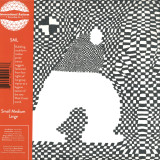
SML is bassist Anna Butterss (Jeff Parker, Daniel Villarreal, Makaya McCraven), synthesist Jeremiah Chiu (Ariel Kalma, Marta Sofia-Honer), saxophonist Josh Johnson (Jeff Parker, Makaya McCraven, Nate Mercereau, Marquis Hill), percussionist Booker Stardrum (Amirtha Kidambi, Carl Stone, Lee Ranaldo, Patrick Shiroishi), and guitarist Gregory Uhlmann (Sam Wilkes, Meg Duffy, Perfume Genius). Their debut album Small Medium Large began as a collection of long-form improvisations recorded during two
separate two-night stands at beloved Highland Park venue ETA, a major development site for the burgeoning new LA jazz & improvised music sound, which unfortunately closed its doors permanently at the end of 2023.
The venue, perhaps best known outside of LA for Jeff Parker’s 2022 album Mondays at the Enfield Tennis Academy, was the perfect location for the start of SML, especially given that both bassist Anna Buterss and saxophonist Josh Johnson are in the quartet featured on that record. Small Medium Large was engineered and recorded in stereo direct to Nagra by Bryce Gonzales and compiled, arranged, and edited with additional production, recording, and
studio composition by SML.
While editing, chopping, and rearranging stereo mixed improvisations is hardly a new concept (for a modern and relevant example we can look to Makaya McCraven’s output on IARC) these results are a stunning expansion of the Teo Macero / Miles Davis editing concept explored on classics like Bitches Brew, On The Corner, and Get Up With It. Stylistically though, these recordings have more in common with the proto trance repetitions of Harmonia, and with Holgar Czukay’s re-assemblage technique used in his work with Can. Throw in a supremely intuitive utilization of Susumu Yokota’s floating patterns polyrhythm concept and we have a truly entrancing take on time-clocked electronic rhythms augmenting with live percussion, yet maintaining that elusive human sway.
DJ Support: Sharam, Hot Since 82, Cid Inc, Groove Armada, Shadow Child, Technasia
In 2015, two remixers on their respective thrones in techno and house were contacted to rework the classic.
Matador and Shiba San both delivered compelling renditions that capture the original's darkness, paired with their unique styles of delivery.
Matador's remix extends the dark subversiveness of the original, incorporating sweeping, reverb-drenched textures and ominous synth patterns. The looming mix is a sure-tobe room filler at this year's ADE.
The second remix is exactly what you'd expect from Shiba San a distinctly G-house groove built around gigantic bass and a distinct sexiness that will resonate with crowds regardless of their appreciation for house music.
- A1: Birds Of Fire
- A2: Miles Beyond
- A3: Celestial Terrestrial Commuters
- A4: Sapphire Bullets Of Pure Love
- A5: Thousand Island Park
- A6: Hope
- B1: One Word
- B2: Sanctuary
- B3: Open Country Joy
- B4: Resolution
"Birds Of Fire" - John McLaughlin (g); Jerry Goodman (v); Jan Hammer (keyb, synth); Rick Laird (b); Billy Cobham (dr)
Of the three 'incarnations' by the spiritually inspired Mahavishnu Orchestra, the first is the most full-bodied. The enlightened John McLaughlin and his musicians were immortalized through their début album "The Inner Mounting Flame", which was included in the list of the 100 Best Jazz Albums; a short time later they recorded their highly concentrated studio compilation "Birds Of Fire". Long before today's saleably labelled World Music, the quintet set the standards for a meaningful amalgamation of dynamic rock with complex Indian rhythms and occidental conventions. Already in the title piece, the musicians combine a sharpened Hendrix style with expansive melodies, and with smacking grooves and fine riffs draw all that is grand in jazz ("Miles Beyond") into the musical centre. With almost chamber-music-like density, "Thousand Island Park" blossoms out in soft colours, whilst as a contrast unremittingly flowing cascades in "Hope" search desperately for their destination.
It is thrilling how finely weighed patterns ("One Word") escalate to techno-like violin playing and how the listener is invited to take part in an inner procession in the following "Sanctuary". After such soaring heights, we are brought back to earth with a familiar funky sound in a popular, pastoral vein ("Open Country Joy") before taking off abruptly once again: in the final piece, "Resolution" with its slowly rising carpets of sound, all that is sublime in New Music conquers over world cultures.
- The James Bond Theme - Ray Barretto
- The Silencers - Patti Seymour
- Mexican Flyer - Ken Woodman And His Piccadilly Brass
- Mister Kiss Kiss Bang Bang - Dick Hyman
- Lady Chaplin - Bobby
- You Only Live Twice - Ronnie Aldrich And His Two Pianos
- The Ipcress File / John Barry
- The Liquidator / Sherley Bassey
- The Monkey Farm / Henry Mancini
- 99: Barbara Feldon
- Search For Vulcan - Ray Barretto
- Mission Impossible - Roland Shaw And His Orchestra
- Goldfinger Part1 - Jimmy Smith
- Mister Kiss Kiss Bang Bang - Santo & Johnny
Limitiert auf 500 Stk. – 100 Stk.
OSS! Spy vs. Spy! MI6! All operating in the shadows of darkness and danger... listen...underneath that double-trouble of uncertainty lays the groove. The exotic and the erotic sounds. 007! The music with a license to kill and thrill. When the clock strikes five and it is cocktail time, no man is a match for the soundtrack of the Femme fatale of the underworld. Shake that thing baby-don"t stir it....and the Martini too. The spy universe has been quite an inspiration for composers and orchestras. Lounge music, Exotica and symphonic, this record will have you spinning the globe hitting every longitude and latitude from Bangkok to Rio. So drop that needle and get on board this second volume as this jet is leaving the gate right on time.
- From Outside A Window Sill
- Side By Side
- The Bug
- Amama
- Genie
- Crushxd
- Nighlty News
- (Alone In) Brussels
- Sleep Talk
- Dust Bunny
- Swarmed
- Xxx
New York psych-pop band Crumb return with AMAMA, their most carefree and open-hearted album to date. A soundscape full of playful and patchwork experimentation _ glitchy pitch-shifted vocals, cell phone recordings, nautical blips, sax mouthpiece solos, blasted drum samples, and piano strings dampened with Silly Putty _ AMAMA continues to deepen the band's hypnotic sound in a cohesive line back through 2021's Ice Melt, 2019's Jinx, and breakout EPs Locket and Crumb. Without a doubt, AMAMA is Crumb _ singer and multi-instrumentalist Lila Ramani, keyboardist and saxophonist Bri Aronow, bassist Jesse Brotter, and drummer Jonathan Gilad _ at their most animated.AMAMA exists at the crossroads of psychedelia, pop, jazz, and rock, and cements Crumb as a band uniquely their own. Released independently on Crumb Records and produced alongside Johnscott Sanford and Jonathan Rado in Los Angeles, AMAMA is an incandescent statement about searching for solid ground, connection, and clarity in a life of nomadic upheaval.
The Equatoguinean Norberto de Nöah established in Madrid in the early 80s, where he became a firebrand of African culture in the vibrant Movida. In 1988 he self-released his first solo album, a blend of homeland sounds —modern and traditional— with new synth and drum machine touches. The vanished album finally gets its well-deserved reissue.
Edition of 500 albums on vinyl (Bandcamp download code included) - Original artwork with new 14 pages insert and poster
In the mid-1980s, the European media, music industry and public became increasingly interested in African music. This was a period of international success for King Sunny Adé, Salif Keita, Youssou N’Dour, Ray Lema, Touré Kunda, etc. Spain, with its own particular conditions, wasn’t oblivious to the phenomenon and the Equatoguinean Norberto de Nöah may be its best exponent.
Norberto moved in the early eighties from his hometown in the island Fernando Po (now known as Bioko) to its former colonial capital, Madrid. While studying dramatic arts, he created and led the band Nohkis, made up of African and Spanish musicians. In 1985 they released the maxi-single “Mujer española” / “África, ¿dónde está tu gloria?”, and the song “El loco”, was released on a compilation LP called Esto es increíble, both on the label Lollipop. According to the journalist Patricia Godes, they were first artists to record an African music record in Spain. It received positive reviews and a great impact on the most independent side of Madrid’s La Movida movement. Very soon afterwards, Nohkis’ band split up.
Afterwards, Norberto would concentrate on his solo career, and Norberto de Nöah and The Böhöbé Spirits Müsic was released in 1988, definitely a solo album. Norberto created his own label, Kilimandjaro Productions, and composed, arranged and produced all the songs of the LP. Moreover, he sang and played all the instruments: a vast selection of organic instruments, a Yamaha RX-5 drum machine and a Roland D-50 synthesizer.
In the album he exposed his deepest roots, updating the lexicon of traditional Bubi music, the musician’s ethnic group, a compendium of ceremonial melodies that ancient troubadours composed for the court. Doing so he showed new possibilities to one of the oldest ethnic groups in the world. Besides all this, he was also inspired by American music such as funk, R&B, Latin American music and also by a wide range of African and Caribbean rhythms.
Mixing the traditional and the avant-garde in a spontaneous and natural way, the music contained in the record’s grooves flows freely and takes you to places full of magic and mystery, while still transmitting new and exciting sensations. Even more, according to the Equatoguinean musician and writer Baron Ya Búk-Lu based in Madrid, the album’s sound was “the perfect combination of all characteristics that defined the Equatoguinean Afropop music made in Madrid during the 1980s”, a story that still needs to be told in all its depth and intensity!
Following the release of two LPs and several singles, the activity of Norberto de Nöah and Kilimandjaro Productions (and the subsequent Bananas Podridas) ceased. Nevertheless, Norberto’s links to music continued, as a promoter and DJ in Madrid’s nightlife.
Norberto de Nöah contributed greatly to changing Spain’s musical landscape, breaking barriers and mental frameworks. He was the first to make contemporary and popular Guinean music known to the Spanish public.
The repercussions in the African market of a Spanish (and Bube) speaking African musical project, where English and French dominate, was very difficult. In addition, the passage of time and changes in phonographic formats have diluted the memory of Norberto's legacy. Now it’s time to reverse the situation and break all the outdated frontiers!
Norberto de Nöah and The Böhöbé Spirits Müsic, as every important music piece, was at the same time part of a universal phenomenon of recognition of African music and a very personal project, based on the artist’s nostalgic and heartfelt need to show and homage his ethnic group, the Bubis. In this process he also refreshed his hometown music legacy, giving it a new air and opening the door to lots of other great Equatoguinean artists coming afterwards, as well as being an inspiration for many musicians in Spain.
The Bongo Hop is back with another highly danceable, genre bending and colorful effort. Always navigating back and forth across the Atlantic in search of his musical dreamland, he offers a deeper insight into the making of his music, an organic sounding, almost live approach to his infectiously groovy compositions, topped with impeccable collaborations.
(feat Nidia Gongora, Lucas Santtana, Moonlight Benjamin, ...)
- A1: Êcclabô De Libertá
- A2: Çegaorâ
- A3: Xancla Lebantá - Pepe Begines
- A4: Tû Cadenâ
- B1: Dime Dónde Bâ -A Bemdêh Tomatêh
- B2: Pintora Feat.andrea Santalusía, La Plazuela
- B3: Libre Çoy -Tarantô De Libertá- Featuring – Francisco Javier Torres Simon, Lole (3)
- C1: Er Patio De Lô Hirger?
- C2: De La Frontera
- C3: Vampiro Güeno
- C4: Êl-Laboné - Featuring – Perrate
- D1: Pipâ Del Elefante
- D2: Andalucé Yorá - Hierofanía De Los Moriscos Y El Gran Expolio- Featuring – Andres De Jerez
- D3: Çilençio
In addition to the unique musical proposals and the large body of work that they have developed separately, Amelia Cuni and Werner Durand have been performing together as a duo as well as in collaborations (Tonaliens, Born of Six) for more than 20 years. Fusing her Indian Raga singing in the Dhrupad style with his minimalist and experimental approach, they have expanded the reach of their soundworlds as well as proposed new paths for contemporary music.In this occasion, Uli Hohmann joins them in a range of hand drums from the Middle East and North Africa, plus a dulcimer-sounding hammered guitar. Durand's various self-made wind instruments, soprano sax, and blown kalimba shine along with Cuni's astounding vocals, which are sometimes sung through a mirliton (a medieval type of kazoo). Clearing is the trio's first published recording.
Seconds of Thirst, recorded in one session at Uli´s studio in Bavaria in early 2014, is truly a conjuring where distinctive balances come to gather. A deep drone unfolds patiently in a hypnotic manner, comprised by Werner's characteristic PVC clarinets, a hammered guitar played by Hohmann, and subtle electronic tones. Above all, Amelia's singing voice, filtered through the mirliton, drifts buzzing along the gradually shifting harmonic waves, meandering through serpentine melodic lines and microtonality.
In the middle pieces, vocals turn into an ethereal multi-layered chorus, an exotic and astonishing instrument pulsing delicate and vaporously, like a gliding silk sail without a mast to bind it. Misty ambiances linger on as the soft atmosphere disperses the weight of undelivered syllables. Just intonation aligns the pan-ney's winds with vocal navigation. Foe to scattering, hurry, and affectation, Clearing's pace has lifted a fog translucent enough to reveal treetops calmly appearing, efficiently condensing damp into definite drops that fall drumming, forecasting what's yonder.
With a condensing sound going from Buddhist morning chants down to Indian festive traditional music, the title track, which closes the album, is the most vibrant of all, permeating a bit of commotion through buzzing drones and galloping percussion. Without disorder, yet without measure. Clearing is therefore this shuttle into the distance, this space that weaves, unites, and tenses the different cords that we are made up of.
When the clouds advance silently, gray, until they become dark in a few minutes, it means that the monsoon is coming. It reaches us without apparent noise, but then resounds in its images, leaving behind lightness, freshness, clarity, and a tremendous luminosity that comes from so far away: from the Himalayas, from so ancient, from Sanskrit, from a sound where the darkness and the divine, where the concrete and the landscape, where the rock and the humidity leave a mark that brings together and ties a sky loaded with new clouds.
"This is the time that we, who have benefitted from the Last Poets shouldbe able to say, 'it's the Last Poets. It's them we should be honouring, because we did not honour them for so many years_"
KRS One wasn't just addressing the hip hop fraternity when he uttered
those words by way of introducing the video for Invocation - a poem
written thirty years ago, around the time of the Last Poets' last significant comeback. He was speaking to everyone who's been affected by the word, sound and power issuing from the most revolutionary poetry ever witnessed, and that the Last Poets had introduced to the world outside of Harlem at the dawn of the seventies.
In 2018 the two remaining Last Poets, Abiodun Oyewole and Umar Bin
Hassan, embarked on another memorable return with an album -
Understand What Black Is - that earned favourable comparison with theirseminal works of the past, whilst showcasing their undimmed passion andlyrical brilliance in an entirely new setting - that of reggae music. Trackslike Rain Of Terror ("America is a terrorist") and How Many Bullets demonstrated that they'd lost none of their fire or anger, and their essential raison d'etre remained the same.
"The Last Poets' mission was to pull the people out of the rubble o f their lives," wrote their biographer Kim Green. "They knew, deep down that poetry could save the people - that if black people could see and hear themselves and their struggles through the spoken word, they would be moved to change."
Several years later and the follow-up is now with us. The project started when Tony Allen, the Nigerian master drummer whose unique polyrhythms had driven much of Fela Kuti's best work, dropped by Prince Fatty's Brighton studio and laid down a selection of drum patterns to die for. That was back in 2019, but then the pandemic struck. Once it had passed, the label booked a studio in Brooklyn, where the two Poets voiced four tracks apiece and breathed fresh energy, fire and outrage into some of the most enduring landmarks of their career. Abiodun, who was one of the original Last Poets who'd gathered in East Harlem's Mount Morris Park to celebrate Malcolm X's birthday in May 1968, chose four poems that first appeared on the group's 1970 debut album, called simply The Last Poets. He'd written When The Revolution Comes aged twenty, whilst living in Jamaica, Queens. "We were getting ready for a revolution," he told Green. "There wasn't any question about whether there was going to be one or not. The truth was many of us still saw ourselves as "niggers" and slaves. This was a mindset that had to change if there was ever to be Black Power." He and writer Amiri Baraka were deep in conversation one day when Baraka became distracted by a pretty girl walking by. "You're a gash man," Abiodun told him. The poem inspired by that incident, Gash Man, is revisited on the new album, and exposes the heartless nature of sexual acts shorn of intimacy or affection. "Instead of the vagina being the entrance to heaven," he says, "it too often becomes a gash, an injury, a wound_" Two Little Boys meanwhile, was inspired after seeing two young boys aged around 11 or 12 "stuffing chicken and cornbread down their tasteless mouths, trying to revive shrinking lungs and a wasted mind." They'd walked into Sylvia's soul food restaurant in Harlem, ordered big meals, then bolted them down and run out the door. No one chased after them, knowing that they probably hadn't eaten in days. Fifty years later and children are still going hungry in major cities across America and elsewhere. Abiodun's poem hasn't lost any relevance at all, and neither has New York, New York, The Big Apple. "Although this was written in 1968, New York hasn't changed a bit," he admits, except "today, people just mistake her sickness for fashion." Umar is originally from Akron, Ohio, but had arrived in Harlem in early 1969 after seeing Abiodun and the other Last Poets at a Black Arts Festival in Cleveland. That's where he first witnessed what Amiri Baraka once called "the rhythmic animation of word, poem, image as word- music" - a creative force that redefined the concept of performance poetry and stripped it bare until it became a howl of rage, hurt and anger, saved from destruction by mockery and love for humanity. When Umar's father, who was a musician, was jailed for armed robbery he took to the streets from an early age where he shined shoes and raised whatever money he could to help feed his eight brothers and sisters. By the time he saw the Last Poets he'd joined the Black United Front and was ready to join the struggle. Once in Harlem, Abiodun asked him what he'd learnt in the few weeks since he'd got there. "Niggers are scared of revolution," Umar replied. "Write it down" urged Abiodun. That poem still gives off searing heat more than fifty years later. In Umar's own words, "it became a prayer, a call to arms, a spiritual pond to bathe and cleanse in because niggers are not just vile and disgusting and shiftless. Niggers are human beings lost in someone else's system of values and morals." And there you have it. It's not just race or religion that hold us back, but an economic system that keeps millions in poverty and living in fear - a system born from political choice and that's now become so entrenched, so bloated on its own success that it's put mankind in mortal danger. It was many black people's acceptance of the status quo that inspired Just Because, which like Niggers Are Scared Of Revolution, was included on that seminal first album. Along with their revolutionary rhetoric, it was the Last Poets' use of the "n word" that proved so shocking, but it would be wrong to suggest that they reclaimed it, since it never belonged to black people in the first place. There's never any hiding place when it comes to the Last Poets. They use words like weapons, and that force all who listen to decide who they are and where they stand. Umar's two remaining tracks find him revisiting poems first unleashed on the Poets' second album This Is Madness! Abiodun had left for North Carolina by then where he became more deeply enmeshed in revolutionary activities and spent almost four years in jail for armed robbery after attempting to seize funds related to the Klu Klux Klan. Meanwhile, the 21 year old Umar was squatting in Brooklyn and had developed close ties with the Dar-ul Islam Movement. A longing for purity and time-honoured spiritual values underpins Related to What, whilst This Is Madness is a call for freedom "by any means necessary," and that paints a feverish landscape peopled by prominent black leaders but that quickly descends into chaos. "All my dreams have been turned into psychedelic nightmares," he wails, over a groove now powered by Tony Allen's ferocious drumming. Those sessions lasted just two days, and we can only imagine the atmosphere in that room as the hip hop godfathers exchanged the conga drums of Harlem for the explosive sounds of authentic Afrobeat. Once they'd finished, the recordings and momentum returned to Prince Fatty's studio, since relocated from Brighton to SE London. This was stage three of the project, and who better to fill out the rhythm tracks than two key musicians from Seun Anikulapo Kuti's band Egypt 80? Enter guitarist Akinola Adio Oyebola and bassist Kunle Justice, who upon hearing Allen's trademark grooves exclaimed, "oh, the Father_ we are home!" Such joy and enthusiasm resulted in the perfect fusion of Nigerian Afrobeat and revolutionary poetry, but the vision for the album wasn't yet complete. He wanted to create a new kind of soundscape - one that reunited the Poets with the progressive jazz movement they'd once shared with musicians like Sun Ra and Pharoah Sanders. It was at that point they recruited exciting jazz talents based in the UK like Joe Armon Jones from Mercury Prize winners Ezra Collective, also widely acclaimed producer/remixer and keyboard player Kaidi Tatham, who's been likened to Herbie Hancock, and British jazz legend Courtney Pine, whose genius on the saxophone and influence on the UK's now vibrant jazz scene is beyond question. The instrumental tracks on Africanism are in many ways as revelatory and exciting as the Last Poets' own. It's important to remember that the kaleidoscope of styles and influences we're presented with here aren't the result of sampling but were played "live" by musicians responding to sounds made by other musicians. That's where the magic comes from, aided by Prince Fatty's peerless mixing which allows us to hear everything with such clarity. Music fans today have grown accustomed to listening to all kinds of different genres. Their tastes have never been so broad or all- encompassing, and so the music on this new Last Poets' album is as groundbreaking as their lyrics, and perfectly suited to the era that we're now living in. John Masouri
- A1: Heaven, Or Paradise; And Hell (Ft Adrien Soleiman)
- A2: Our Dead Can’t Rest (Old Jugha Flute Dance)
- A3: Miracle
- A4: The Crane Has Lost Its Way Across The Heaven
- A5: Unraveling (Interlude)
- B1: Zephyr
- B2: Far From The Eye, Far From The Heart
- B3: What Solace Can I Give (Ft Adrien Soleiman)
- B4: …Nothing Matters More Than Touching You Although I Haven’t Touched You Yet
Lara Sarkissian’s long-awaited debut full-length, ‘Remnants’ is an ornate patchwork of ancient and modern sonic shapes that uses the vernacular of electronic music to reformulate Armenian traditions and memories. Taking digitally modeled instruments (such as the kanun, a large zither, and the duduk, an ancient double reed woodwind instrument), vocals, davul and dhol drums, tenor saxophone (from acclaimed Paris-based player Adrien Soleiman) and myriad electronic elements and techniques, Sarkissian tangles the old and the new, creating an immersive, narrative-driven experience that’s powered by history, mythology and her own familial connection to the West Asian landscape. It’s an album that’s best absorbed like a film; only multiple encounters can reveal its layered themes and references to industrial music, noise, various club styles, ambient and traditional folk.
Born and raised in San Francisco and currently based in Los Angeles, Sarkissian has developed her unique approach to composition over years of relentless experimentation across various disciplines. Her interest in music production initially stemmed from her filmmaking and video editing work, when she began to sculpt her own sound collages and scores to accompany the visuals. Since then, she’s constantly blurred the boundary between dance and experimental music, DJing around the world, producing AV installations and scoring film and video projects that have been exhibited in Berlin’s Gropius Bau, Montréal’s Musée d’art contemporain, the Music Center Los Angeles and other prestigious institutions, and releasing music with labels such as Tresor, Knekelhuis, All Centre, Silva Electronics and CLUB CHAI, the label and event series she co-founded. In recent years, she’s also been able to advance the theory behind her art, publishing a conversation with ethnomusicologist Sylvia Alajaji in the Journal of the Society of Armenian Studies in 2021, and unveiling her methodology in Norient’s ‘This Track Contains Politics – The Culture of Sampling in Experimental Electronica’ a year later.
‘Remnants’ is a new stage in Sarkissian’s evolution as an artist; not only is it her first proper album, but it’s the inaugural release on her new platform btwn Earth+Sky. She sees the label as a place to encourage collaborations between musicians and producers and prioritize sound in visual arts realms, and ‘Remnants’ is the ideal proof of concept. It opens with ‘Heaven, or Paradise; and Hell’, a track that’s inspired by the layout of the Armenian sharakan (or hymn) ‘Aravot Luso’. Sarkissian imagines the original piece’s harmonies and melodies as parts of a dreamy electronic opera, using digital kanun sounds to punctuate her woozy, evocative synths. Soleimen joins on tenor sax in the third act, while Sarkissian repeats the chant and Jace Akira adds ghostly traces of electric guitar and bass. And on the rousing ‘Our Dead Can’t Rest (Old Jugha Flute Dance)’, Sarkissian chops urgent davul and dhol drum rhythms with spine-chilling shvi woodwind sounds lifted from a documentary about Old Jugha. The title is a reference to the moving of graves by Armenian families; the area initially housed over 10,000 elaborately carved khachkars (cross stones), one of which is pictured on the album’s cover, provided by historian Argam Aivazian’s archive.
On ‘Miracle’, Sarkissian samples atmospheres from the post-Soviet Armenian comedy film ‘Կիսանդրի’ (Kisandri). She takes this opportunity to lighten the mood a little, powdering her smudged samples with tightly edited breaks and bass thumps. It’s not until the album’s middle section that the duduk, perhaps Armenia’s best-known instrument, makes its appearance. Its familiar reedy tones, popularized by Djivan Gasparyan on his many Hollywood soundtrack appearances, emerge on ‘Unraveling (Interlude)’, weaving through the acidic ‘Zephyr’ and ‘Far from the eye far from the Heart’, a post-punk inspired stomper. Sarkissian mutates the instrument almost beyond recognition, pitching and layering it into a voice-like wail that creeps between her woody, dancefloor-primed percussion on the former, and turning it into a gentle, ghostly moan on the latter. And she brings ‘Remnants’ to a close with two of her most cryptic tracks, marrying digital kanun strings with Soleiman’s resonant tenor hums on ‘What Solace Can I Give’, and looping the same saxophone sounds until they dissolve into the air on the beatless closer ‘…nothing matters more than touching you although i haven’t touched you yet’.
It’s an album that ties up Sarkissian’s various interests and experiences, finding a romantic, poetic glimmer of light in history’s darkness. But most of all, ‘Remnants’ is about the optimism of starting anew, and rebuilding a life from the pieces of everything that’s been left behind.
- 1: Pura De Venta
- 2: Leyes Narcos
- 3: Sacrificio
- 4: Santa Lucía
- 5: Matando Güeros
- 6: Seis Seis Seis
- 7: Cruza La Frontera
- 8: Greñudos Locos
- 9: Chingo De Mecos
- 10: Narcos - Satánicos
- 11: Desperado
- 12: Culeros
- 13: Misas Negras (Sacrificio Iii)
- 14: Chinga Tú Madre
- 15: Verga Del Brujo / Estan Chingados
- 16: Molestando Niños Muertos
- 17: Machetazos (Sacrificio Ii)
- 18: Castigo Del Brujo
- 19: Cristo De La Roca
BRUJERIA is an extreme Mexican-American metal band founded in 1989 in Los Angeles. Under cover of pseudonyms, its original members were the guitarist Dino Cazares ( FEAR FACTORY ), Jello Biafra ( DEAD KENNEDYS ), the drummer Pat Hoed, bassist Billy Gould ( FAITH NO MORE ) and singer Juan Bruno. BRUJERIA first appears as a terrorist group having kidnapped the bosses of Roadrunner Records in order to be able to release a record. This joke having been denied, the group appears as a parallel project that is characterized by the themes of satanism, terrorism, sex, rebellion, and politics. The group forges a reputation of psychopaths by playing on stage , with hooded or masked with scarves, titles called "Marijuana" or "Brujerizmo ( the word "Brujeria" which means "witchcraft" ). BRUJERIA is Mexican hence the name and lyrics in Spanish. Dino Cazares ( exFEAR FACTORY ) was the guitarist. The musicians of BRUJERIA keep their identities secret but it is known that ex-FEAR FACTORY's Dino Cazares, FEAR FACTORY's Asesino and Raymond Herrera, as well as Billy Gould, ex-FAITH NO MORE, have worked on guitar, drums and bass, Nicolas Barker ( ex-CRADLE OF FILTH etc ) takes also part of the butchery, just to name a few...
Just as his basslines never stay within the limits of the obvious, so Joe Sanders" life as a bassist, composer, band-leader and educator has never followed the single, most discernible pathway. A Midwest native, he"s studied and played jazz on the opposite coasts of California and New York: a master of the acoustic bass, he"s equally at home producing in the digital realm; embedded deep in the living tradition of American jazz; and living, teaching and creating in Europe. All these separate strands come together on his third headline release, "Parallels". The album presents a set of live recordings from a dream line-up that matches the leader"s full-bodied acoustic bass presence with Seamus Blake, Logan Richardson and Gregory Hutchinson in performances that capture all the daring and drive of the East coast scene. Alongside them is a set of studio self-productions with guests Jure Pukl and Taylor Eigisti that capture the laid-back dreamy adventurousness of the West Coast.