Wir haben gehört, dass Post-Punk es bis auf die Frühlingsseiten der Sunday Times geschafft hat. Oh, bleibt da dran - Desperate Journalist wüten schon seit gefühlten Äonen mit ihrer melodramatischen Mischung aus traumatisierten Gitarren und kunstvoll gebrochenem Gesang gegen den Konzern-Apparat. Sechs Jahre sind vergangen seit dem Erscheinen des teuflischen "Desperate Journalist"-Debuts in 2015. Das stürmische zweite Album "Grow Up" erschien 2017, während 2019 das stellare "The Search For The Miraculous" weit und breit zu hören war. "Maximum Sorrow!", das komplett in Crouch End inmitten der Covid-Pandemie aufgenommen wurde, strotzt nur so vor Alt-Rock-Muskeln, die in sieben Jahren unermüdlicher Auftritte und Veröffentlichungen aufgebaut wurden, wie ein wilder Panther auf der Pirsch. Angetrieben von Simon Drowners ohrwurmverdächtiger Bassline zeigt sich das Quartett schon beider Lead-Single "Fault" in makellos brutaler Form, mit Banshee-Heulen und selbstzerfleischenden Texten von Sängerin Jo Bevan: "And those teenage hangups are hard to beat / When your closet is piled up with defeat", schnauzt sie an einer besonders stacheligen Stelle, während ihr Gitarrist Rob Hardy und Schlagzeuger Caz Hellbent nur noch feuriges Öl in die akustischen Flammen gießen können. Wie ein Großteil des restlichen Albums ist "Fault" sowohl verspielt als auch voll mit Wut. Das sind Desperate Journalist in hyperdynamischer Form, superglatt, aber nie krankhaft glatt; ambitioniert und expansiv, aber immer noch selbstverliebt und durch und durch DIY. Es gibt traditionelle verzweifelte Reisen in das Herz der Dunkelheit - siehe die doomig-prägnanten Desintegrationen von "Armageddon". Und es gibt brillant beleuchtete Lichtblicke: die ohnmächtige Eleganz von "Utopia", die sardonische, melodieverliebte Frechheit von "Personality Girlfriend", die Ruhe von "Formaldehyde", ein tragisches Finale auf jedem anderen Album - hier als Opener. Ein Lob auch für die raumgreifenden, epischen Chorschübe von "Everything You Wanted" und die spektakulär bittersüßen Sehnsüchte von "What You're Scared Of", die mit verstreuten Zuckerwürfeln bestückt sind.
Search:persona
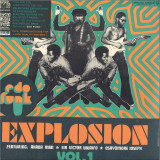
- A1: Africa Is My Root - Osayomore Joseph And The Creative Seven
- A2: Ta Gha Hunsimwen - Akaba Man The Nigie Rokets
- A3: Popular Side - Akaba Man And The African Pride
- B1: Iranm Iran - Victor Uwaifo And His Titibitis
- B2: Sakpaide No 2 - Victor Uwaifo And His Titibitis
- B3: Ta Ghi Rare - Akaba Man The Nigie Rokets
- C1: My Name Is Money - Osayomore Joseph
- C2: Ogbov Omwan - Akaba Man The Nigie Rokets
- C3: Aibalegbe - Victor Uwaifo And His Titibitis
- D1: Who Know Man - Osayomore Joseph And The Ulele Power Sound
- D2: Obviemama - Victor Uwaifo And His Titibitis
- D3: Ororo No De Fade - Osayomore Joseph And The Ulele Power Sound
Analog Africa Presents Edo Funk Explosion Vol. 1, available on
2xLP/Gatefold LP with 20-page booklet / CD with 36-page booklet. It was
in Benin City, in the heart of Nigeria, that a new hybrid of intoxicating
highlife music known as Edo Funk was born.
It first emerged in the late 1970s when a group of musicians began to experiment with different ways of integrating elements from their native Edo culture
and fusing them with new sound effects coming from West Africa s night-clubs.
Unlike the rather polished 1980 s Nigerian disco productions coming out of the
international metropolis of Lagos Edo Funk was raw and reduced to its bare
minimum.
Someone was needed to channel this energy into a distinctive sound and Sir
Victor Uwaifo appeared like a mad professor with his Joromi studio. Uwaifo
took the skeletal structure of Edo music and relentless began fusing them with
synthesizers, electric guitars and 80 s effect racks which resulted in some of the
most outstanding Edo recordings ever made. An explosive spiced up brew with
an odd psychedelic note known as Edo Funk.
That’s the sound you’ll be discovering in the first volume of the Edo Funk Explosion series which focusses on the genre’s greatest originators; Osayomore
Joseph, Akaba Man, and Sir Victor Uwaifo: Osayomore Joseph was one of the
first musicians to bring the sound of the flute into the horn-dominated world
of highlife, and his skills as a performer made him a fixture on the Lagos scene.
When he returned to settle in Benin City in the mid 1970s - at the invitation of
the royal family - he devoted himself to the modernisation and electrification
of Edo music, using funk and Afro-beat as the building blocks for songs that
weren’t afraid to call out government corruption or confront the dark legacy of
Nigeria’s colonial past.
Akaba Man was the philosopher king of Edo funk. Less overtly political than Osayomore Joseph and less psychedelic than Victor Uwaifo, he found the perfect
medium for his message in the trance-like grooves of Edo funk. With pulsating
rhythms awash in cosmic synth-fields and lyrics that express a deep personal
vision, he found great success at the dawn of the 1980s as one of Benin City’s
most persuasive ambassadors of funky highlife.
Victor Uwaifo was already a star in Nigeria when he built the legendary Joromi
studios in his hometown of Benin City in 1978. Using his unique guitar style as
the mediating force between West-African highlife and the traditional rhythms
and melodies of Edo music, he had scored several hits in the early seventies,
but once he had his own sixteen-track facility he was able to pursue his obsession with the synesthetic possibilities of pure sound, adding squelchy synths,
swirling organs and studio effects to hypnotic basslines and raw grooves. Between his own records and his production for other musicians, he quickly established himself as the godfather of Edo funk.
What unites these diverse musicians is their ability to strip funk down to its
primal essence and use it as the foundation for their own excursions inward to
the heart of Edo culture and outward to the furthest limits of sonic alchemy.
The twelve tracks on Edo Funk Explosion Volume 1 pulse with raw inspiration,
mixing highlife horns, driving rhythms, day-glo keyboards and tripped-out guitars into a funk experience unlike any other.
Following the release of Limewax's Untitled and Speed Dealer Moms' SDM-LA8-441-114-211, Trickfinger and Aura T-09's Evar Records imprint is keeping its foot on the gas, officially introducing the arrival of its sub-label, RAVE4EVAR. Embracing more of an outlaw mindset, RAVE4EVAR was created as a place for rebellion to collide with rave, offering refuge for off-the-cuff releases, special projects and occasional one-off collaborations.
Ushering in the sub-label's inaugural release, RAVE4EVAR is proud to present Chicago-based DJ, producer and new media artist S4M23's debut EP, Angelface. The five-track project, set to arrive on July 2nd via a limited edition cassette and digital download, combines haunting vocals with pounding kicks and rave synths to create a moving take on hardcore. Written and recorded during a weeklong session in April 2020, the creation of Angelface took place during a period of processing grave personal loss juxtaposed with the collective state of chaos, grief and fear brought on by the covid-19 pandemic.
Within that specific period of time, S4M23 channeled intense emotion to reflect how cathartic it can be to honor the connections we build with one another despite how frenetic and heart-wrenching the circumstances of a particular moment or experience can be. Pouring an immense spectrum of emotions into Angelface, these productions eschew simple repetition to create unexpectedly complex rhythms and textures that evoke the sounds of British club music and '90s rave, while simultaneously creating something entirely new.
I first discovered khroniky – Ukranian folk songs – in the Highlands of Scotland. I was watching a screening of Bajka, a mesmerising documentary made by the filmmaker Lucia Nimcová and sound artist Sholto Dobie. I knew nothing about these ballads beforehand, but I was fascinated by these odd, beautiful songs, especially the easy way in which they mixed misery and levity, where gentle melodies blend with tales of dark violence. The folk songs describe hardship, murder, torture, death in gulags, heavy drinking, outsmarting men, love affairs. But they’re often very funny too – many of the songs make fun of marriage, and there’s an amazing subcategory of khroniky songs called potka (vagina) songs.
The khroniky have never been properly documented because they were considered too crude, or contained lyrics that were problematic, politically. When Ukrainian folk songs have been archived in the past, it’s normally a sanitised, more polite version of the ones that Lucia remembers from her childhood. Lucia grew up on the other side of the Ukrainian border in Slovakia. She is part of the Rusyn (Ruthenian) minority ethnic group found in the borderlands of Slovakia, Hungary, Romania, Ukraine and Poland. Rusyn is a centuries-old Slavic language, looked down upon as a poor, uneducated dialect by the neighbouring Ukraine and Slovakia. It was forbidden to talk about Rusyn culture at Nimcova’s primary school, but the khroniky stayed in her memories.
“I remember weddings when I was young,” says Lucia, who now lives in Addis Abeba, Ethiopia. “At the end of the night, when everyone was drunk and the young couple would go around their guests, people would sing in Rusyn. There was singing and dancing, and songs about being in prison or falling in love. I picked up the lyrics and sometimes my mum would make my sister and I sing them for people we met on the train. I was about five or six but the lyrics still come back when I sing to my kids.”
Determined that these rich, nuanced, unique songs shouldn’t be forgotten, she decided to record them. Over two years, Lucia, joined by experimental musician Sholto Dobie, visited Rusyn villages high in the Carpathian mountains to rediscover the songs and make the documentary. It was at the beginning of war breaking out in Ukraine in 2014.
“The Rusyn community is a very closed one,” explains Lucia. “Sometimes we’d have to wait several days to hear someone sing; we had to earn their trust before they shared something very personal to them. We’d stay up ‘til 5am at a wedding, then go straight to a morning baptism, or collect haystacks with the villagers, hoping they’d sing while they were working.”
DILO is named after an important independent Ukrainian daily newspaper that was shut down when the Red Army entered Lviv in 1939. The four long tracks on DILO blur field recordings with song; an unpolished, privileged glimpse into a private world. We hear dogs barking and insects buzzing in the summer heat, then a blast of hurdy gurdy or violin will drift in, or a plaintive song soars softly over the rural background noise, with casually harrowing lyrics about a cuckoo, “lifeless in a world of misery”, as translated in the album’s booklet.
For both Lucia and Sholto, it was important not to tamper too much with what they heard. “When you think about ethnography,” Lucia explains, “you have to have a lot of time, love and respect to document it with sensitivity.”
“The songs all have their own atmosphere and intimacy from the spaces they were recorded in and it was important to maintain these particularities and move with them,” adds Sholto, who now lives in Vilnius, Lithuania. “They guide and sometimes interrupt a journey between interiors – domestic spaces; in kitchens, by the fire – and exteriors; marketplaces, cow sheds. We used contact microphones to record metal bridges and fences, and we spent one afternoon recording a wool processing machine, the details of the rattling and tuning wheels are the ground layer for the third track.”
Lucia took rough notes and diary entries during the recording process, which are now shared in the booklet alongside a selection of lyrics, loosely translated, but revealing the depth and astonishing beauty that sometimes lies in the language of these folk songs.
The feel of the album is intimate, flipping between laughter, where a woman sings about selling her pussy to buy a cow in one track, then shifts to a raw, painful truth; an adult son asks his mother why his dad won’t be back for dinner, as he’s gone to war.
Since Lucia and Sholto began working together in 2014, they have shared the audio recordings on radio and film and shown photos in gallery spaces, making sure these special, smutty, poignant songs don’t get lost. This new record and booklet joins that same continuum, another glorious fruit from the same rare tree.
A fantastic little record – and very much the kind of set that the Strata East label was created to represent! The music here would hardly have found a home on the bigger jazz labels of the period – not because it's too avant-garde or non-commercial, but just because it's so deeply personal and powerful – the boldest vision on record of trombonist John Gordon, who composed a mind blowing suite of tracks for the first side of the album, as well as some equally great tunes for the second half! Gordon leads the group on trombone – with solos that are soaring and soulful, alongside work by the great James Spaulding on alto and flute, Waymond Reed on trumpet, John Miller on piano and keyboards, Lyle Atkinson on bass, and Frank Derrick on drums! If you know some of the other players here from their own work of the time, you know you're in for a treat – as the music has this fantastic sound of strong individual voices coming together, instruments lifted high on a mission of music – with results that are as fantastic all these many years as they were in the 70s.
(gatefold 2LP with spot gloss finishing) Regal's debut album! His staunch productions have garnered support from techno's well-established vanguard, including noted collaborations, projects and remixes with Amelie Lens, Hadone, Nina Kraviz, Ellen Allien, Emmanuel Top and Len Faki. "Remember Why You Started is meant to be a message for everyone, including myself, to look back to your roots -where anything you do is influenced by nothing but passion" -Regal
- A1: Grandmaster Flash & The Furious Five - It's Nasty (Geni
- A2: Boogie Down Productions - The Bridge Is Over
- A3: Afrika Bambaataa, Zulu Nation & Cosmic Force - Zulu Nat
- A4: Nitro Deluxe - Journey To Cybotron
- A5: Tuff Crew - My Part Of Town
- A6: Blowfly - Blowfly's Rap
- A7: Funky 4+1 - King Heroin
- A8: (Mc) Rock Lovely - One Time Two Time Blow Your Mind
- A9: Double Trouble - Stoop Rap
- B1: Choice M.c. - This Is The "B" Side (True Blue Mix)
- B2: The Fatback Band - King Tim Iii (Personality Jock)
- B3: Fly Guy - Fly Guy Rap
- B4: Cybotron - Clear
- B5: Cold Crush Brothers Vs Fantastic Freaks - Basketball Th
- B6: Willie Wood & Willie Wood Crew - Willie Rap
- B7: Hashim - We're Rocking The Planet
- B8: Maggotron - Bass Invaders
- B9: Cold Crush Brothers - Feel The Horns
- B10: Madam Funkyfly - The Crazy Mule Saloon
678 records are proud to present an historical concert recording of the legendary ethnic kraut-jazz formation Pork Pie. It is difficult to define the music of Pork Pie. It ranges from rhythmic Jazz-rock and meditative Indian sounds to Brazilian songs, and from acoustic improvisations to electric “space” sounds. Paris, December 1973: Pork Pie was founded by piano player Jasper van 't Hof (then 27 years old) and guitarist Philip Catherine (then 31 years old). They had met up with Charlie Mariano, who was 51 years old then, and whom they knew from his playing with Charles Mingus in the fifties and sixties. He had left America, lived in India for some years and founded his new home in Europe. Jasper and Philip were nervous to ask him if he would like to start a band with them but he immediately accepted the invitation. After some concerts in Holland, Germany and France the group recorded their debut album Transitory in May 1974 in the studio of the legendary engineer Conny Plank for MPS-BASF. It became an immediate success and Pork Pie were subsequently booked for many European jazz festivals. Their legendary concert on the first of November 1974 in the Berliner Philharmonie during the Berliner Jazztage was a milestone in the bands existence. The concert hall was packed to the rafters with 2500 over enthusiastic people who were totally overwhelmed by the amazing live sound of Pork Pie in which each of the five individual musicians took his own part, but never once lost the unique togetherness.
In the past 44 years Jasper van 't Hof always retained fond memories about this special concert. Fortunately, in his personal archive (which was for a while stored under a tarpaulin in his garden!) a master tape was discovered & had survived intact. P-Dog & Zembie (a.k.a. Sander Huibers & Frank Jochemsen) dug it up, played it on a tape machine, were totally blown away by the music and initiated this limited vinyl only release. It comes in a hand silkscreened cover designed by Piet Schreuders.
line up
The Miami Maestro is back with a superb slice of moody, mid-tempo Latin Soul. Anyone who has had the pleasure of seeing one of Jason's passionate live performances can attest that he exudes raw energy and emotion on a level seldom seen on today's soul scene - attributes that Jason delftly applies to the pen.
Drawing from personal experience, “Se Acabó” is a bilingual lament about the challenges of navigating mental illness within the context of a romantic relationship. Jason pleads "Her heart was a butterfly flying through the winds of the hurricane of her mind" as he comes to grips with the fact that in spite of his undying love she may never return.
Accompanied by a grooving, unrelenting beat, he distills the pain down to an elixir of high-proof soul sure to requite the lovelorn among us. Yet another Penrose playbox essential by one of the hardest working players in the game.
Biz's Set Me Free EP is an adventurous and personal exploration of techno which is composed for the dance floor but also sparks the heart. The grinding grooves of opener 'Set Me Free' immediately shows a pairing of a tough mentality with a supreme sense of soul. The exquisite 'Don't Stop' builds with an enthralling techno tension that finally lets up and will immerse the listener in liberation. Last but not least 'Autumn Blues', a perfectly melancholic journey through deeper techno that lifts the spirits with optimistic synths.
On her second album Ursgal Mongolian singer Enji creates a unique blend of Jazz and Folk with the thousand-year-old traditions of Mongolian music. Currently based in Munich, her lyrics tell personal stories about unbearable distances, the oddness of being on earth and the simple truths in life.
She's accompanied by Paul Brändle on guitar and Munguntovch Tsolmonbayar on double bass.
Born in Ulaanbaatar, Enji grew up in a yurt to a working-class family. Having always been drawn to music, dance and literature, she initially wanted to become a music teacher with little ambitions to compose or be on stage. A program by the local Goethe Institute sparked her passion for Jazz and eventually led her to become a performing artist. Inspired by the music of Carmen McRae, Ella Fitzgerald and Nancy Wilson, Enji started writing songs of her own, cherishing this newfound means of expression. Ursgal is the first record featuring her original compositions.
Something wicked this way comes. Following singles 'Know The Future' b/w 'Digital Warfare' in 2019 and 'Hypersocial' b/w 'Safety Test' in 2020, ESP’s own Patrick Conway has now teamed up with the illustrious Appleblim (of Skull Disco and Apple Pips fame) for a meaty self-titled debut 2xLP under the new collaborative moniker, Trinity Carbon. There is something to be said for art created in the face of global unraveling, while mass transgression and the friction of culture shifting produce poignant commentary, but more often than not, it’s the personal coping mechanisms within our work that have the power to speak directly to the receiver. After a number of sessions resulting in wild imaginative beginnings, it was the untimely passing of Andrew Weatherall and a coming to terms with that loss that moved the two Brits-via-Berlin to herd their roaming sketches into a more narrative statement. In the uphill struggle to retain some sense of individualism, it’s always outsiders like Weatherall whose risks illuminate the roads of creativity less traveled, and when those beacons go dark there is a disorientation felt far and wide. Conway and Blim concede to the internal inquiry, “What would Weatherall do?” bringing to mind the man’s pervading morale, always soldiering onward through mediocrity, as it was undoubtedly an impetus for the duo growing steadfast and chiseling 'Trinity Carbon' into completion. While employing trusted machines in the bass department, they established a warm euphonic home base from which they could stray in a variety of tonal and rhythmic directions without straining a tether to the album’s core. However, as soon as any hint of familiarity may arise, or listeners begin to mentally assign stylistic epithets, the duo boldly change course to remind us that while the banal stay safely defined, it’s the iconoclasts, the outsiders who make us feel.
Kryptox records was born to show what's happening in the new scene in germany. And David Nesselhauf is the next upcoming artist. Kryptox will release his 6 track EP.?Nesselhauf is a multi-talented artists: bass player, composer, bandleader and man of very original ideas. He was already featured on the Kryptox' Kraut Jazz Futurism compilation vol 1 (2019) and now delivers his first solo EP for the label.
This EP is a follow up in a longer musical evolution that the Hamburg born talent has been making over the past years. A journey that's basically a style he is building that he calls afro-kraut. Before joining Kryptox he already released 2 albums under the Afrokraut title on his own (Bandcamp) before meeting Mathias Modica (head of Kryptox) and they decided to work together.
So on the "Rituals EP“ Nesselhauf salutes his personal pantheon of musical gods once again, leading the listener through his musical Jungle encompassing Krautrock, Downbeat, Drone, Electronica, Afrobeat, Lo-Fi, Shoegaze, Funk and Ambient textures in the blink of an eye.?The 6 new tracks share a common feel, but are colorful individuals at the same time. Some more organic, others with electronic elements.
About Nesselhaufs workflow: Four of these composition are based on quick, playful, raw jams recorded live within hours by a group of Nesselhauf's inner circle musicians. Great grooves played by a heavy rhythm section that he uses also for his live gigs. Just on a few songs Nesselhauf exchanged the human musicians with a legendary Vermona Drum Synthesizer as the main rhythm ingredient.
Guests: One more track was recorded with Julian Gutjahr, Drummer for The Drawbars. Some tracks feature guest appearances by Dennis Rux (he also mixed the EP) and Graeme Currie on guitar. Soulamadou made his way to one of the tracks just by incidentally leaving a very groovy voice message on David ´s phone ("Zeit").
The material was later bewitched into deep, organic swirls: Trippy, psychedelic somnambulistical. The rather mystical, nocturnal reworking process of the recording added even more dimension and depth, leaving the 6 Tracks ready for home listen, but also for an open minded dancefloor and an otherworldly listening experience at the same time.
The next generations of jazz are just waking up. And Davd Nesselhauf and his bunch are one of these new interesting phenomena. Working in the underground since few years, now hopefully there will be more spotlight on these great new innovators.
clear blue vinyl
Stockholm native Viggo Dyst joins Shall Not Fade's roster for their new Classic Cuts series, serving up ear candy and sparkling sounds on Everything Else Is Secondary EP. Fresh from a successful release with Swedish label Vivrant, he is also joined by stalwarts of the scene Baltra and 1800-GIRLS for two gorgeous reworks.
The title track is a breathless, hopeful opener that overflows with feel good energy, sunshine melodies and personality. Baltra flips the lead melody into a hazey, UKG style club remix, maintaining the shimmering core - while 1800-GIRLS creates something tenser, a persistent beat and a warped breakdown.
On the B side, "Time After Time" carries strong Aphex Twin influence pairing sombre orchestral instrumentation with a hurtling yet delicate break throughout. "Weekend Special" is a classic Shall Not Fade sound; gentle, swelling house that needs to be danced to, closing out the record on a high.
- A 1: Sixty Years
- A2: Don't Trust A Woman (In A Black Cadillac)
- A3: When The Bells Don't Chime
- A4: That Someone Just Ain't You
- A5: Rat Pack Boogie
- A6: Drink Whiskey And Shut Up
- B 1: Ring, Ring, Ring
- B2: Smokin' 'N Burnin
- B3: Wild Wind
- B4: St. Jude
- B5: To Be Loved
- B6: When The Bells Don't Chime (Banjo Mix)
- B7: Luck Be A Lady (Single Version)
Surfdog Records and Brian Setzer have announced that for the first time, Setzer’s classic 2003 album Nitro Burnin’ Funny Daddy will be issued on vinyl. It will be released on limited edition 180 gram, red transparent vinyl on 25th June 2021.
Only Brian Setzer could cut an album with more lyrical honesty and musical diversity than anything he's ever done and then title it Nitro Burnin' Funny Daddy. Not that the name is misleading; Nitro is in fact packed with explosive performances. There's more than enough volatile picking and singing to mark this as a highlight of a catalog already crowded with great albums he's delivered as leader of the history-making Stray Cats and on his own too.
But there's more: street-corner doo-wop, heartbreak balladry, a foot-stomp hoedown, several lyrics that will shock and stun longtime fans, and always, somewhere in the mix, the blues. Every track is distinctive, none sounds like any of the others, yet all of them are pure Setzer. And it's all compressed into a tight trio format -- Setzer and his big band colleagues, standup slap-bass powerhouse Johnny Hatton and rhythm dynamo Bernie Dresel on snare and cymbals -- whose sound evokes Les Paul, Junior Parker, and even Earl Scruggs as much as Louis Prima or Eddie Cochran.
Originally released in 2003, Nitro Burnin’ Funny Daddy was Brian Setzer’s eleventh solo album and when it was released he said it was the most personal record he had ever done. The album followed his big-band release Boogie Woogie Christmas from the previous year and saw him back to his rockabilly best, taking in doo-wop (“To Be Loved”), bluegrass (“When The Bells Don’t Chime”), rootsy-rock (“Don’t Trust A Woman (In A Black Cadillac)”) and going on a cinematic Wild-West romp (“Wild Wind”).
Etta James: The Montreux Years is released as part of a brand new Montreux Jazz Festival and BMG collection series “The Montreux Years”. The collections will uncover legendary performances by the world’s most iconic artists alongside rare and never-before-released recordings from the festival’s rich 55-year history, remastered in superlative audio. Each collection will be accompanied by exclusive liner notes and previously unseen photography.
‘Etta James: The Montreux Years’ is a treasure trove of timeless classics, powerful and electrifying performances and raw, soaring vocals by one of the greatest ever female vocalists. The collection, featuring recordings from James’ Montreux Jazz Festival concerts in 1977, 1978, 1989 1990 and 1993, encapsulates and reflects Etta’s dynamic artistry and long-lasting impact. Spanning performances from across three decades, ‘Etta James: The Montreux Years’ offers deeply personal and intimate snapshots into James’ acclaimed musical journey, highlights and her phenomenal career.
From one of Etta James’ earliest successes, the infectious and endlessly elegant Something’s Got A Hold On Me, a medley that consist of At Last, Trust In Me and Sunday Kind of Love, which is a fusion of highlights from the early 60s, to the raw and emotional I’d Rather Go Blind and soulful horn-driven Tell Mama. The collection closes with Baby What You Want Me To Do, James’ homage to Jimmy Reed and the encore of her 1979 concert.
In 1975, Montreux Jazz Festival captured a significant moment of musical history – Etta James’ very first concert in Europe, performing at the festival’s 9th edition. The CD edition of ‘Etta James: The Montreux Years’ will include this special landmark concert, held at Montreux Casino on 11 July 1975.
Los Angeles-based singer, songwriter, and producer Tilian releases his brand-new full-length album, Factory Reset, via Rise Records:
Earlier this week, he shared his latest single “Caught in the Carousel” along with a new visualizer. They psychedelic visual emulates the introspective and thought-provoking lyrics of the song, “Am I good enough?”
Factory Reset is both highly personal and wholly universal. Tilian began writing the album just a few weeks after the pandemic forced California into lockdown. “I was searching for meaning in isolation and found it in creating this album,” Tilian shares about the process. He decided to write, record, and produce the album himself, eventually remotely bringing in drummer/frequent collaborator Kris Crummett to help button it up.
Having full creative control allowed Tilian to experiment more than ever, and truly be himself in the process. “I wanted to make the album that I want to hear. ‘What would be my favorite band?’ as opposed to, ‘What is everyone’s favorite band?’” This resulted in his most thrillingly eclectic work to date: a falsetto-laced brand of alt-pop that spans everything from trippy psychedelia and heavy prog riffs to warped hip-hop beats and dembow grooves.
Recently, Tilian released two other singles from the album – “Anthem” and “Dose.” These were first offerings since the release of his 2018 album The Skeptic, which debuted on the Billboard charts at #1 Alternative New Artist, #2 Top New Artists, and #5 Alternative. To date, the project has garnered over 40M global streams and two music videos with over 1M views each, proving the excitement and potential for the burgeoning alt-pop artist. More recently, he collaborated with Marigolds+Monsters and Travis Barker on the exciting single “Falling out of Rhythm.”
Tape
It might be easy to assume that the distinctly focused compositional voice unveiled on Rose Bolton's The Lost Clock is the product of its creator's rigorous, almost hermetic dedication to her own particular aesthetic universe. A quick survey of Bolton's artistic career, however, reveals that her carefully sculpted approach to abstract electronica has been forged through a longstanding engagement with a wide range of intertwining creative activities.
This album—coming out on Important Records' cassette imprint, Cassauna—demonstrates both the Toronto-based composer's unique mastery of colour and her gift for breathing a tactile, organic quality into synthetic landscapes. Bolton's distinctive sensibility is akin to that of a painter—every hue has been carefully mixed so as to imbue its accompanying gesture with its own life and personality. This tangible dimensionality her electronic work assumes, however, can be traced back to the work Bolton has been doing since the 1990's. She has produced a large and varied catalogue of work that includes pieces for solo performers, chamber ensembles, orchestra, electronics, voice, and to accompany installations and films. A number of her works reside in several of these zones simultaneously, such as Song of Extinction, an ambitious collaboration between herself, filmmaker Marc de Guerre, poet Don McKay, and multiple live ensembles, that was mounted in an abandoned power station for Toronto's Luminato Festival.
This quasi-instrumental vitality isn't the only feature of The Lost Clock that reflects Bolton's diverse artistic practice. It can also be heard within the structural realm. Each of the collection's four tracks trace a patient unfolding and favour a certain roundness of timbre, even as finer details begin to fidget along the perimeter of the music. As with her writing for the concert hall, Bolton doesn't shy away from the evocative here, yet she doesn't pursue this poignancy through conventional, direct or quasi-narrative means. Her compositions lead the listener gradually through their impressionistic sonic scenery, but neither the path they take nor their ultimate destination are at all predictable. The ostensible gentleness each piece exudes dissolves as dissonances slowly insinuate themselves, obscure textures writhe just out of earshot, percussive lattice work materializes, or as the overall blend begins to exert a heavier weight. Her lucid-dream vision of form functions in tandem with her acute micro-level attentiveness to engender a vivid and elusive soundworld that resists classification.
Over more than two decades Rose Bolton has been garnering acclaim and enthusiasm from audiences and major collaborators alike. Last year, her brooding string quartet The Coming Of Sobs was nominated for Classical Composition of the Year at the JUNO Awards, following earlier accolades such as SOCAN Awards for Young Composers, and the Canadian Music Centre's Norman Burgess Fund. Her music has been commissioned by the likes of the CBC, stalwart experimental music festival the Sound Symposium, as well as key interpreters and ensembles such as percussionist David Schotzko, accordionist Joseph Petric the Esprit Orchestra, Continuum, Arraymusic, the Kitchener-Waterloo Symphony, and guitar quartet Instruments of Happiness (led by Tim Brady). Together with Marc de Guerre, she produced an 8-speaker sound and video installation for Toronto's Nuit Blanche Festival. She's also been featured by the likes of revered pianist Eve Egoyan, The Vancouver Symphony, L'ensemble contemporain de Montréal, The Music Gallery, and AKOUSMA, while appearing in concert alongside the likes of Jerusalem in My Heart (Constellation Records), Tanya Tagaq, and Francis Dhomont. Bolton is also a respected film composer, notably contributing music to the highly regarded documentary Anthropocene: The Human Epoch (co-directed by Jennifer Baichwal, Nicholas de Pencier and Edward Burtynsky).
As a performer, she variously employs electronics, violin, and viola. Parallel to her engagement with exploratory approaches, she's invested in the fiddle traditions of the British Isles, and various Canadian regions. She teaches this repertoire at the Royal Conservatory of Music. Bolton has also performed with Rhys Chatham, Owen Pallett, opened for Charlemagne Palestine, and appears on recordings by the likes of Chatham and Aidan Baker. In 1999 she joined the Canadian Electronic Ensemble, whose fifty-years together make them the world's longest-running live-electronic music group. In February 2020, the CEE held a residency and provided guest lectures at Carnegie Mellon University's music department. Bolton has also led workshops at the Banff Centre, also founded the SOCAN/ Moog Audio-sponsored program EQ: Women in Electronic Music, which worked to foster community and mentorship among (trans/cis) women and non-binary individuals.
On their new studio album, The Murlocs share a
collection of songs reflecting on the people who
leave a profound imprint on our lives, the saviours
and hellraisers and assorted other mystifying
characters.
The Murlocs (whose line-up includes two members
of King Gizzard & The Lizard Wizard) recorded at
Button Pushers Studio in Melbourne, Australia,
dreaming up a prismatic sound that pinballs from
sunshine-pop to blues-punk to wide-eyed
psychedelia.
What emerges from these 11 infectious tracks is
their most personal and boldly confident work yet.
LP pressed on ‘Blue Eyed Runner’ Edition white
with baby blue splatter vinyl.
My Morning Jacket’s ‘Evil Urges’ is now available as a
beautifully coloured 2-LP set, pressed on cream coloured vinyl
with a black blob and housed in a premium gatefold jacket. My
Morning Jacket’s Grammy-nominated ‘Evil Urges’ is the band’s
most ambitious and controversial album to date. On their fifth
studio album, an emboldened My Morning Jacket created a
fiercely uncompromising, highly eclectic and deeply personal
album that catapulted the band into public consciousness and
solidified their place as innovators and titans of indie rock