The collaborative debut of American minimal techno pioneer Troy Pierce and Colombian audiovisual artist Natalia Escobar aka Poison Arrow was conceived in reverse: first they created a collection of shadowy surrealist videos, then wrote music inspired by them. This inverted process proved remarkably fruitful. Shatter is a simmering, slow-burn noir odyssey inspired by the Greek myth of Echo and Narcissus, traversing subtle shades of sleepwalker dub, metallic lament, broken beats, and erotic negative space. It's an effectively unsettling evocation of the legend's core theme: “There is nothing more complex than a shattered heart, or a heart that can't love.”
Considering their shared background trafficking in darkened dance floor modes, what's most striking about Pierce with Arrow's partnership is its rhythmic restraint. The album's 10 tracks seethe and shudder between glamor and gloom, with only occasional dread-steeped metronomes mapping the malaise to a grid. They speak of pursuing a “spatial approach” with this project, which manifests in the music's immersive design and patient execution, each mangled clang and rippling pool of bass allowed to reverberate
its full flickering waveform.
Suche:pierce with arrow
- 1
The collaborative debut of American minimal techno pioneer Troy Pierce and Colombian audiovisual artist Natalia Escobar aka Poison Arrow was conceived in reverse: first they created a collection of shadowy surrealist videos, then wrote music inspired by them. This inverted process proved remarkably fruitful. Shatter is a simmering, slow-burn noir odyssey inspired by the Greek myth of Echo and Narcissus, traversing subtle shades of sleepwalker dub, metallic lament, broken beats, and erotic negative space. It's an effectively unsettling evocation of the legend's core theme: "There is nothing more complex than a shattered heart, or a heart that can't love." Considering their shared background trafficking in darkened dance floor modes, what's most striking about Pierce with Arrow's partnership is its rhythmic restraint. The album's 10 tracks seethe and shudder between glamor and gloom, with only occasional dread-steeped metronomes mapping the malaise to a grid. They speak of pursuing a "spatial approach" with this project, which manifests in the music's immersive design and patient execution, each mangled clang and rippling pool of bass allowed to reverberate its full flickering waveform. Guest appearances by austere techno producer Konrad Black ("Obsidian Glass") and drum n bass institution dBridge ("It's A Love Story, After All") flow seamlessly into the whole, subtle sculptural accents on a dimly lit descent through purgatories of longing and lust. But the shadows recede for the record's closing cut, "Narcissus," which swells elegiacally in a mass of devotional drones over a muted heartbeat, like Narcissus gazing upon his reflection in holy awe: elusive true beauty, finally beheld, by itself.
The collaborative debut of American minimal techno pioneer Troy Pierce and Colombian audiovisual artist Natalia Escobar aka Poison Arrow was conceived in reverse: first they created a collection of shadowy surrealist videos, then wrote music inspired by them. This inverted process proved remarkably fruitful. Shatter is a simmering, slow-burn noir odyssey inspired by the Greek myth of Echo and Narcissus, traversing subtle shades of sleepwalker dub, metallic lament, broken beats, and erotic negative space. It's an effectively unsettling evocation of the legend's core theme: “There is nothing more complex than a shattered heart, or a heart that can't love.”
Considering their shared background trafficking in darkened dance floor modes, what's most striking about Pierce with Arrow's partnership is its rhythmic restraint. The album's 10 tracks seethe and shudder between glamor and gloom, with only occasional dread-steeped metronomes mapping the malaise to a grid. They speak of pursuing a “spatial approach” with this project, which manifests in the music's immersive design and patient execution, each mangled clang and rippling pool of bass allowed to reverberate
its full flickering waveform.
BLUE & WHITE COLOUR IN COLOUR VINYL
In the culinary arts, it’s easy to overcomplicate the final product. Theme, presentation, texture…they’re important but should work to complement the raison d'etre of any food. At the end of cooking a dish, it should taste good and feed people. Some dishes, like barbeque or provoleta, resist the tendency towards hollow showmanship. One of their expressions can be more or less aesthetic, but the first purpose is to be simple and tasteful. Argentinian provoleta goes so far as to blur the line between ingredient and dish. It relies on the inherent flavor of provolone being heated at the right speed for the perfect amount of time. You can add garlic or chives or red pepper to the slice, but ultimately they serve to bring out an essence that’s already there.
Los Angeles’ Cousin Feo has developed his rapping acumen in the five years since releasing Provoleta, but returning to the project today shows that he always had the penmanship, grit and delivery that christens an emcee worthy of remembrance. Like the bubbles rising up in the appetizer that is the album’s namesake, Feo showed that true profundity is found in the simple gestures.
Since dropping the project in 2019, Cousin Feo has expanded his vision of a world where hip-hop and football, two proletarian art forms, mingle in creative and compelling ways. He has collaborated across multiple continents, chronicled football histories, aided in canonizing legends, kept the flames high in age-old rivalries and constantly forced his audience to search for the last time they heard bars this hard. In anyone else’s hands it would be too great a task.
The maturity he showed on Provoleta wasn’t nascent, it was an inherent quality forcing itself to the surface. The songs refract his experience as a working class Angeleno through the archetypes of Argentinian football legends. The kernel that unites the two worlds is hustle. When Feo was coming up, missteps had greater consequences than crashing out in the group stage and street deals had the weight of a Boca-River Plate match.
Each track uses slightly different ingredients to let Feo’s underlying talent shine. “Maradona” feels salvific, fitting for a football legend canonized from the Andes to the Alps and a Los Angeles rapper looking to inspire similar hope in the neighborhoods that raised him. On “Di Stefano” Feo massages the instrumental with the same composure of the late forward, until he pierces through the headphones like one of Di Stefano’s arrows. It’s also refreshing to hear a song celebrating Messi before his meme-ification, focusing on the universal truths contained in his footballing talent instead of using number 10 as a stand-in to make a point in a fruitless argument. And he still finds space to show deference to Batistuta, Kempes and other members of the Argentinian pantheon who’ve been erased from the popular imagination by the national team's contemporary success.
Real ones know that true players, true rappers, and true artists will always stand the attacks of time and consensus. In Provoleta’s first verse, Cousin Feo says he moves with the hand of God. Maybe one day he’ll tell the whole truth and let us know how he was able to wrestle the pen away too. Limited edition of 300 hand-numbered copies.
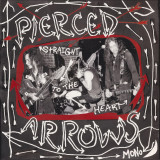
Pierced Arrow's first record! Fred And Toody Cole's post Dead Moon band with Legendary rocker Kelly Haliburton on drums. Most musicians get softer with age, but Fred and Toody brought a harder edge to Pierced Arrow's than their earlier bands. A legendary record back in print for the first time since it initially came out in 2008. A killer!
Incredible jazz / prog / folk score to groundbreaking tattoo film by maverick filmmaker. Unreleased until now, so don’t go saying it’s a reissue because it isn’t, but I’m sure some people will because they always do.
John Samson (1946 - 2004) was a truly great documentary maker. He must be as I’ve been obsessed with his work for many years. Educated first at Glasgow School Of Art (circa 1963) and then finally in the art of film making at The National Film And Television School in Beaconsfield - he headed there in its opening year of 1971 having made a short film that got him a scholarship.
It was at the NFTS that Samson met Mike Wallington, who was to become his right hand man and eventual producer; together as a quite brilliant team they made a handful of inspiring, entertaining and hugely prescient films about important, overlooked, unseen and marginal fringes in society. Tattoo (1975) Exploring the rather clandestine world of tattooing in the UK. Dressing For Pleasure (1977) Exploring the rather clandestine world of festish in the UK. Brittania (1979) A film about railway enthusiasts and a steam train restoration.
Arrows (1979) The life of dart player Eric Bristow. Drag Ball (1981) An unreleased film about the annual Porchester Hall Drag Ball. The Skin Horse (1983) BAFTA winning film about The Outsiders Club, a dating agency for disabled people. The subject matter in all films was always unusual for the time, and Samson managed to navigate his way with compassion, interest and subtlety, immersing himself in the chosen scene and producing moving, fascinating and sometimes darkly amusing situations. His documentaries also do not rely on traditional voiceovers, with stories, facts and narrative threads being dictated by the subjects.
I’ve tried for a long time to find the music for a couple of his early films (there was actually an original 7” for Arrows) - so far this is the only unreleased soundtrack I have found. This one was written by Steve Jolliffe, who met Samson at the NFTS. Joliffe was the resident composer and had a room at the college complex where he could work on scores for the fledgling film makers. Jolliffe was and still is a multi-instrumentalist and prolific composer who had met Edgar Froese at the Berlin Konservatorium in the late 1960s and played in an early incarnation of Tangerine Dream. He toured with blues rock outfit Steamhammer, before hanging out at the NFTS, making this recording (and many others) and eventually rejoining Tangerine Dream in the late 1970s. Jolliffe still writes, records and releases today and once i had made contact with him we traced the original Tattoo master tape to a box at his brother’s house. Musically it’s charming, slightly folky, a touch baroque, there’s a whiff of prog too, and it perfectly suited this early documentary about the art and desire of tattoos. I only wish it was longer. But the film is only 16 minutes long. Seek it out if you can. Try and find all the Samson films, they really are a joy.
As well as featuring intimate footage of tattooed people, the film also includes a rare and very early interview with Alan Oversby (better known as Mr Sebastian), a seminal character in the development of tattoos and body modifications worldwide - it was he who eventually was to tattoo and pierce Genesis P-Orridge.
The images for this vinyl release were all found in Mike Wallington’s Tattoo documentary research folder from 1974, and were photos sent in to Mike and John by people who wanted to feature in the film. Most answered an advert in Time Out, and others included people from my home town of Aldershot where tattooist Bill Skuse and his wife, Rusty (the most tattooed woman in Britain at the time, and featured in the film) were based. His parlour was situated at the back of the arcade where we all used to lose all our pocket money in the slot machines.
The Musicians:
Steve Jolliffe - keyboards, flute, sax Geoff Jolliffe - bass guitar Julian Furniss - guitar Mick Kirby - drums
The Nonesuch debut of Hurray for the Riff Raff (aka Alynda Segarra), LIFE ON EARTH, is a departure for the Bronx-born, New Orleans-based singer/songwriter. Its eleven new “nature punk” tracks on the theme of survival are music for a world in flux – songs about thriving, not just surviving, while disaster is happening. Hurray for the Riff Raff tours North America this spring, beginning March 19 in Atlanta and continuing through April 20 in Nashville, with stops in Austin, Chicago, Los Angeles, and New York, among others. International tour dates will be announced shortly.
For her eighth full-length album, Segarra (they/she) drew inspiration from The Clash, Beverly Glenn-Copeland, Bad Bunny, and the author of Emergent Strategy, adrienne maree brown. Recorded during the pandemic, Life on Earth was produced by Brad Cook (Waxahatchee, Bon Iver, Kevin Morby).
Life on Earth’s first single, ‘RHODODENDRON’, is about “finding rebellion in plant life. Being called by the natural world and seeing the life that surrounds you in a way you never have. A mind expansion. A psychedelic trip. A spiritual breakthrough. Learning to adapt, and being open to the wisdom of your landscape. Being called to fix things in your own backyard, your own community,” says Segarra.
Of the ‘Rhododendron’ video, which was directed by New Orleans-based artist Lucia Honey, Segarra says: “It is really far out and fun. I got this bodysuit that just looks like the inside of the human body. It looks like you’re skinless. It’s in a scene where I’m playing to an audience of plants. Just really absurd, but I put that suit on and I was like man, this feels really good. It feels like, ‘This is who I am. Let’s just take the skin off.’
“It reminds me a little bit of Kids in the Hall,” they continue. “With this ‘Rhododendron’ shoot, something clicked in me where I was like, ‘All I have to do is be myself.’ I had been thinking that I had to be something bigger than myself. I felt like I was just never quite making the mark and then something clicked where I was like, ‘I just gotta be me. I could do that. I could show up and be me. And if people don’t like it, then I don’t know what to fucking tell them.’ It was like a brain shift of, ‘Oh, this can be fun. It doesn’t have to be suffering.’ With so many videos and photo shoots before, it really felt like suffering. I felt so uncomfortable being perceived. I didn’t know who I was.”
Honey adds: “We wanted to create something surreal, playful, and saturated that indulged heavily in the aesthetic of the early ‘90s. Alynda and I had many overlapping visual and philosophical references which sparked the initial collaboration. We wanted to make this video an homage to Gregg Araki’s Teenage Apocalypse trilogy but as a nature documentary crossover. I came across Araki’s work as a queer teenager, and he’s always been a big inspiration. Sex, blood, punk rock, camp, etc.
“We live in a moment where the future is bleaker and more unknown than ever, so there becomes a deep comfort in nostalgia and reliving the past. Through our talks, I realised Alynda’s new album touches on many of these same subjects, but perhaps in reverse; running from a past that is always haunting you. Shifting into a more refined self/identity through confronting one’s trauma and baggage. It was easy to reach collaborative synergy for this video project because we’re both interested in tackling similar issues.”
Alynda Segarra was born and raised in the Bronx, which they left at the age of seventeen, running away from everything and everyone they knew, hopping freight trains or hitchhiking across the country in the company of a band of street urchins. Segarra moved to New Orleans in 2007 and formed two bands: Dead Man’s Street Orchestra and Hurray for the Riff Raff. In 2015, Segarra decamped to Nashville, then to New York, to make her most recent album, 2016’s critically praised The Navigator, an ambitious and fully realized concept album that was her quest to reclaim her Puerto Rican identity. Segarra’s previous records as Hurray for the Riff Raff are Crossing the Rubicon (EP, 2007), It Don’t Mean I Don’t Love You (2008), Young Blood Blues (2010), Hurray for the Riff Raff (2011), Look Out Mama (2012), My Dearest Darkest Neighbor (2013), and Small Town Heroes (2014).
- 1