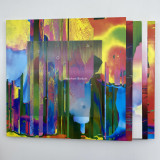
Germany-based metal band OBSCURA launch trilogy concept on stunning new album “A Valediction”. The group’s first (sixth overall) album for Nuclear Blast pivots on many fronts. Advanced, elegant, and yet refreshing, “A Valediction” sums up past endeavors effortlessly as it gazes with purpose and conviction into the future. OBSCURA are fan-renowned and critically acclaimed for challenging and then expanding upon norms. From “Cosmogenesis” (2009) through “Diluvium” (2018), the band flourished and made significant progress in a musical genre unprepared for a creative shot of German invention. “A Valediction” spearheads OBSCURA into a new era of extreme metal.
Guitarist/vocalist Steffen Kummerer founded OBSCURA in 2002. Early on, he set out to improve, redefine, and push forward. Under his self-label creation, the Bavarian released debut album “Retribution” (2006), followed by heavy touring throughout Europe. Word quickly spread that a brand-new band from the south of Germany was on the rise. Buzz lead to a deal with U.S.-based Relapse Records. The first record out was “Cosmogenesis”. In Europe, Metal Hammer Germany awarded the album 6/7 while in the U.S., “Cosmogenesis” hit the Billboard charts at #71. The cross-continental praise and fevered momentum landed OBSCURA on high-profile tours in Europe, North America, and Japan.
When follow-up “Omnivium” arrived in 2011, they upped their chart success (Billboard #11; Media Control #14), received more accolades from publications like Terrorizer, Rock Hard, and Decibel, had another massive round-world tour cycle, while enhancing and making progress on their clever brutality. OBSCURA further developed their sound on “Akróasis” (2016). Moored by jaw-dropping tracks like ‘Sermon of the Seven Suns,’ ‘Ode to the Sun,’ and the title track, “Akróasis” elevated OBSCURA to the highest levels of international renown, having climbed up the Billboard charts (#5) as well as earning top marks in Rock Hard (8.5/10), Metal Hammer Germany (6/7), and Revolver (4/5). The Germans toured the world yet again, playing over 100 shows in support of “Akróasis”.
OBSCURA’s most significant accomplishment was, however, just around the corner. The final part of a tetralogy, “Diluvium” (2018), fiercely pursued OBSCURA’s multi-album transformation into musical innovators and metal powerhouses. Music videos for the title track, ‘Emergent Evolution’ and ‘Mortification of the Vulgar Sun,’ in concert with a substantial interest in virtuosic, forward-thinking metal, posited OBSCURA in the good graces (yet again) of the worldwide press in addition to rocketing up, for the very first time, the official album charts in Germany (#58) and Switzerland (#93). The Germans also topped out at #3 on the Billboard Heatseekers chart with “Diluvium”.
OBSCURA‘s stats have been impressive: Twenty years active; six highly prized albums; over 600 shows on four continents. Worldwide fan and press engagement—the videos for ‘The Anticosmic Overload,’ ‘Akróasis,’ and ‘Diluvium’ have over 4.5 million views—is only getting stronger the longer OBSCURA continue to offer up and interact with (via play-throughs and member/gear spotlights) their very captive audience. This is only the tip of Kummerer’s custom ESP guitar, however. A Valediction finds OBSCURA turning the page to a new chapter in the band’s evolution. A year in the works, the songwriting sessions followed a new approach, where the framework was relaxed, allowing new inspirations, imagining, and opportunities to arise. Songs like the opening epic ‘Forsaken,’ the '80s-tinted ‘When Stars Collide’ (featuring Soilwork/The Night Flight Orchestra frontman Björn Strid), the brutal groove of ‘Devoured Usurper,’ the ethereal artistry of ‘Heritage,’ and the fleet-fingered title track benefitted compositionally (refined structures) and aesthetically (more dynamism) from OBSCURA’s restyled songwriting stratagem.
OBSCURA wrote, recorded, and finalized “A Valediction” during the pandemic. The stipulations of working during this time allowed OBSCURA to work cross-country, tracking each respective part—drums, guitar, and bass—in national studios across The Netherlands, Austria, and Germany. Once the pieces were completed, the recordings were shipped off to award-winning producer Fredrik Nordström and Studio Fredman (In Flames, Architects) in Gothenburg, Sweden, where Kummerer and Münzner completed vocals and acoustic guitars using custom-built ENGL amps. Nordström was also tapped to mix and master. The final result is a deeper, heavier, yet more rounded production.
Lyrically, “A Valediction” is layered in structure and meaning. The word ‘valediction,’ by definition, deals with goodbyes and farewells. In a way, this is auf wiedersehen to the four-part album series while also addressing complex topics of Kummerer’s personal life. Instead of obscuring issues of loss, death, and abandonment in metaphor and allusion, the German laid bare his torment across songs like ‘Forsaken,’ ‘Solaris,’ ‘In Unity,’ ‘The Neuromancer,’ and ‘In Adversity.’ But for every line of desperation, he also offers positivity. Indeed, new beginnings—physical, emotional, or environmental—can provide light in the darkness. Lauded artist Eliran Kantor (Testament, Helloween) was brought on board to visualize the leitmotif. The bronze-themed colourway Kantor used exemplifies OBSCURA’s resistance to individual and sonic corrosion.
In 2021, OBSCURA will lighthouse their musical prowess, thematic complexity, and lyrical ambition on “A Valediction”. The group continue to be a beacon for change. No doubt OBSCURA’s new stats will amaze, but what they’re focused on is the release of “A Valediction” and then taking it on the road. Several high-caliber tours of Europe, North America, and Asia are planned through to 2023, with routes are in the works for the band to visit Australia, South America, and beyond. Truly, there is no band quite like OBSCURA. “A Valediction” proves that persistence, perseverance, and enterprising minds can achieve anything. Welcome to the next level!
Cerca:play out music
- A1: Kestrel
- A2: Necrofauna/The Garden Of Eden (Feat. Wayne Coyne)
- A3: Horse Latitudes
- B1: A Selving
- B2: Respect My Eccentricity Pt.1
- B3: Respect My Eccentricity Pt. 2
- B4: Miasma Field Modulator(Trafalgar Square 3.3.2020) ± F∝V + Field Recs (Blackbird/House Martin)(Feat. Oliver Wilde)
- C1: Tv Bra™️
- C2: See Damage (Зона)
- C3: Election Day
- D1: Dread./Tkoe (Feat. Bells)
- D2:
- D3: Slow Joe
- D4: The Black Swell
Operating on a plane between avant-garde indie, bubbling electronica and cosmic psychedelia, London group Voka Gentle have an addictive, amorphous sound. A three limbed beast made up of twins Ellie and Imogen Mason, and William J. Stokes, each is a multi-instrumentalist, songwriter and producer with an imperious understanding of three dimensional sound.
The newest single ‘Necrofauna / The Garden of Eden’ - features Wayne Coyne from The Flaming Lips.
The hallucinatory mix of squelching synth bass and rhythmic samples, three-tiered harmonies playing off against William’s sprechgesang, and a cutting, full-bodied drum beat is reflected in the oneiric themes.
“This song is a dream sequence about the narrator entering the Garden of Eden, the emblem of an idealised pastoral relationship with the natural world, and realising they can’t stand it and want t o consume and bring destruction to it (I see a deer pass me by and I break its neck / Rip off its hind leg and take a bite through fur, sinew and bone).”
‘Necrofauna / The Garden of Eden’ - recorded with neo - metal battalion Pigsx7 guitarist and producer Sam Grant - is the first release in earnest since 2019’s acclaimed debut album ‘Start Clanging Cymbals’, released via Nude Records. Having come through the dues - paying gestation period that leads up to a debut record, there’s a sense of liberation around this new phase for Voka Gentle - a subtle confidence in their craft. It’s well earned too - with high praise from the likes of UNCUT, MOJO and The Line of Best Fit at press. Support comes too from BBC 6 Music - including presenting an edition of Stuart Maconie’s Freak Zone - and Radio 1. Tracks from that album also featured on FIFA 19 and The Sims 2020, aiding in recognition.
A live set at the prestigious Pitchfork Avant Garde festival, as well as a clutch of tastemaker festivals in the UK (Dot to Dot , Live At Leeds, The Great Escape, Kendall Calling, Bluedot, Neighbourhood), alongside the serendipit ous shows with The Flaming Lips and
[l] d2 [When We Go, We’re Taking You All With Us!]
Ltd White vinyl LP w/ printed inner sleeve lyric insert (1000 copies ww)! Emma Ruth Rundle's forthcoming Engine of Hell is stark, intimate, and unflinching. For anyone that's endured trauma and grief, there's a beautiful solace in hearing Rundle articulate and humanize that particular type of pain not only with her words, but with her particular mysterious language of melody and timbre. The album captures a moment where a masterful songwriter strips away all flourishes and embellishments in order to make every note and word hit with maximum impact, leaving little to hide behind. "I really wanted to capture imperfection and the vulnerability of my humanity," Rundle says of the album's sonic approach. "Here are some very personal songs; here are my memories; here is me teetering on the very edge of sanity dipping my toe into the outer reaches of space and I'm taking you with me and it's very fucked up and imperfect.'" Emma Ruth Rundle has always been a multifaceted musician, equally capable of dreamy abstraction (as heard on her album Electric Guitar: One), maximalist textural explorations (see her work in Marriages, Red Sparowes, Nocturnes or collaborations with Chelsea Wolfe and Thou), and the classic singer-songwriter tradition (exemplified by Some Heavy Ocean). But on Engine of Hell, Rundle has opted to forego the full-band arrangements of her previous albums in favor of the austerity of a lone piano or guitar and her voice, which creates a kind of intimacy, as if we're sitting beside Rundle on a bench, or perhaps even playing the songs ourselves. It's an extremely up-close and personal confessional with a focus on the rich subtleties and timbre of Rundle's graceful performances. "For me this album is the end of an era to the end of a decade of making records. Things DO have to change and have changed for me since I finished recording it." In essence, Engine of Hell signifies a major turning point for Rundle as both an artist and as a person. The catharsis of this type of songwriting has effectively served its purpose, and to continue ruminating on the past going forward is less of a healing process and more like picking at a scab and refusing to let it heal. This may help explain why Rundle is less than enthusiastic about divulging the details about her muses, but it doesn't alter the fact that these songs served a purpose in their creation, and that they may continue to bring comfort to others.
- A1: Eric Burdon & War - Spill The Wine
- A2: Eric Burdon & War - Tobacco Road
- A3: All Day Music
- A4: Get Down
- A5: Slippin' Into Darkness
- B1: The World Is A Ghetto
- B2: The Cisco Kid
- B3: Gypsy Man
- B4: Me & Baby Brother
- B5: Why Can't We Be Friends?
- C1: Low Rider
- C2: So
- C3: Don't Let No One Get You Down
- C4: Smile Happy
- C5: Summer
- D1: La Sunshine
- D2: Galaxy
- D3: Cinco De Mayo
- D4: You Got The Power
- D5: Outlaw
Blue[55,04 €]
WAR’s head-nodding mix of music and message started a revolution 50 years ago that continues to win over the hearts and hips of fans around the world. “Greatest Hits 2.0” will be available 29th October and is a new, career-spanning collection that expands on WAR’s platinum-certified 1976 greatest hits album, featuring the legendary songs “Spill The Wine,” “Low Rider,” “Galaxy,” and “Why Can’t We Be Friends?”
WAR’s “Greatest Hits 2.0” 2LP contains 20 tracks, 2CD contains 24 tracks recorded between 1970 and 1994, including the gold-certified singles “Slipping Into Darkness,” “The World Is A Ghetto,” “The Cisco Kid,” and “Summer.” Another gold single, “Why Can’t We Be Friends?” stayed on the charts for 31 weeks and became the soundtrack to the US-Soviet space mission where astronauts and cosmonauts linked up in the spirit of friendship. In the modern era, it has been streamed more than 100 million times. Also included is the #1 R&B smash “Low Rider,” which was inducted into the Grammy Hall of Fame in 2014.
In the collection’s liner notes, Los Angeles Times columnist Gustavo Arellano says GREATEST HITS 2.0 does more than capture WAR at its creative and commercial peaks. He writes: “All the big hits are here, of course, in chronological order from the Eric Burdon days up through cuts from 1982’s underrated Outlaw…But what I love about this collection is that it’s a symphonic suite for a perfect Southern California Sunday afternoon, the kind the rest of the world wants to experience but can only dream about. You can envision it by playing these albums from start to finish.”
Repress!
With Robyn, South London's cktrl shares his most ambitious work yet, collaborating with the likes of Duval Timothy, Coby Sey (Micachu, Tirzah, Dean Blunt) and Purple Ferdinand to create a vital exploration of contemporary-classical from the black perspective; out via Errol and Alex Rita's Touching Bass. Spurred on by the overpowering feelings of heartbreak, Robyn impressively creates emotive and heartfelt clarinet and saxophone-led soundscapes about the all-consuming power of love. On the project, cktrl says: "'Robyn' at its core is heartbreak and is just really sentimental. It's a journey of losing a love but it ends with optimism as you find strength to love again." Born and bred in Lewisham, cktrl aka Bradley Miller is an integral part of London's pioneering musical underground. One of the only remaining original DJs on NTS, cktrl has previously worked with and played alongside the likes of Sampha, Sango, Kelela and Dean Blunt. Throughout his career to date, cktrl has also been recognised and heralded by fashion and film VIPs including Virgil Abloh, Bianca Saunders, Tremaine Emory, Nicholas Daley and Jenn Nkiru who recently secured him a cameo in Beyonce's heralded 'Black Is King'. With a shared ethos of elevating and amplifying leftfield black music, he partners with London based label, Touching Bass, themselves a key cog within the city's bubbling musical underbelly.
- A1: The Mebusas Good Bye Friends
- A2: Georges Happi Hello Friends
- A3: Black Reggae Darling I'm So Proud Of You
- A4: Christy Essien I'll Be Your Man
- A5: The Lijadu Sisters Bobby
- B1: Tala Andre Marie Hop Sy Trong
- B2: Essama Bikoula I'll Cry
- B3: Carlos And Miki All This Nonsense
- B4: Pasteur Lappe Babette D'o (Rastawoman)
On 18th April, 1980, after decades of anti colonial struggle, the Zimbabweian flag was finally raised at midnight at the Rufaro Stadium in Harare. Not long after, the words "Ladies and Gentlemen, Bob Marley and The Wailers!" rang out, and Zimbabwe's independent future began.
In the years that followed, Africa was to produce it's own reggae superstars, as the likes of Alpha Blondy, Majek Fashek and Lucky Dube swept across the continent and beyond, and there's no doubting Bob Marley's explosive impact on this particular narrative.
Marley's unswerving commitment to liberation and unity ranged from the sweeping spiritual sentiments of iconic hits such One Love and Redemption Song to the galvanising, focused tone of 1979's 'Zimbabwe', and his status as global superstar ensured that his (self funded) part in the countries' epochal celebrations meant that the history of reggae in Africa would always be viewed through the prism of his influence ( Wiki/African Reggae : "In 1980, world-famous Jamaican reggae musician Bob Marley performed in Harare, Zimbabwe, and that concert is often credited as marking the beginning of reggae in Africa")
But in fact, the recorded history of reggae produced in Africa stretches back over a decade before Marley's arrival on the continent, and showcases broad pan - diasporic interflows between the Carribean and Africa, with the UK and the US communities playing influential supporting roles, all helping shape the evolution and development of the genre in Africa from late 60's inception to Marley's arrival in 1980, and then well beyond.
Reggae Africa : Roots and Culture, 1972 - 1981 tries to capture a sense of that evolution, starting in 1972 as Mebussa's ultra rare 'Good Bye Friends' effortlessly captures triangular, transatlantic cultural interflows, with the short lived Nigerian group's bitter sweet chords echoing classic US soul, but laid over a gritty, skanking Jimmy Cliff - esque proto reggae rhythm.
Trying to work out the precise provenance of Black Reggae's 'Darling I'm So Proud of You' (1975) isn't easy, but involves Paris based / African focused label Fiesta, some proper OG co-branding exercise with Bols Brandy ( "Bols Brandy presents Black Reggae") - and deeply infectious, lilting Rocksteady.
By 1976, glorious Nigerian sister duo Lijadu Sisters are echoing the chunky roots of a Dennis Brown or U Roy on 'Bobby', and in 1977, bespoke Nigerian drummer Georges Happi is introing 'Hello Friends' with the soon to be universal signature reggae tom roll intro, before veering leftfield with snatches of spoken Afro - English vocal in between the hooky choruses.
Nigerian giant Chrissy Essien's 'I'll Be You Man' (1979) combines floaty Lovers vibes with catchy ska shuffle, and in the same year, Cameroonian afro-funk/disco heavyweight Pasteur Lappe' drifts seamlessly into skanking, Lovers infected reggae on 'Babbette D.O. ( Rastawoman )' (before a sprawling electric guitar solo reminds us how unselfconsiously eclectic so much African music of the era was.)
And finally bookending the compilation, in chronological terms, fellow Cameroonian Tala AM also swaps his funk and soul for the rootsy and infectious 'Hop Sy Trong' (1981), again highlighting the diverse and eclectic approach to this timeless Carribean musical genre taken by African musicians in the years before that Bob Marley year zero event in Zimbabwe.
Malamanya burst onto the recording scene with their self-titled debut in 2017, a bonafide tribute to the traditional sounds of Afro-Latin music in Cuba and the Caribbean, and perhaps more notably, that tradition's evolution into New York City's quintessential '70s street sound,la salsa. At first glance, you might wonder how this 9-piece orchestra out of Minneapolis of all places would manage to tap into such a sound, but the group's pedigree and vintage recording chops tell the real story. Tracked and mixed inpuroanalog at bass player and engineer Tony Schreiner's Brown Bag Studios, and featuring a multi-national mix of players from around the world, the group's first two original compositions make for an impressive debut on Names You Can Trust. Led by the fiery female voice of Cuban immigrant Zusel Balbìn, "La Tormenta" is one of the finest examples of modern-daysalsa durato come out in recent years. The recipe here includes huge orchestration complete with dual trombones and a rhythm section entirely in step with the group's impressive following ofsalseros —and the flavor is nothing butauthentico. The B-Side "Frio" features the group's complimentary lead male voice incantadorandcongueroLuis Ortego Castrellon. It's a double shot of peak dance floor design, and a prime example of the group's growing international appeal, wherever the taste for the sauce is desired.
In 1981, The Ex started squatting Villa Zuid, an estate overlooking abandoned Van Gelder paper factory in the village of Wormer, Netherlands. Formerly the home of the factory's manager, the Villa briefly served as the band's base of operations and would inspire one of The Ex's most impactful, enduring albums in their 40+ year history.
Originally released in 1983, Dignity Of Labour is "our idea of improvised industrial punk noise," states Ex-frontman G.W. Sok, which not only offers a perfect summation of these idiosyncratic sounds, but also of the group's music in the decades to come.
During its heyday, Van Gelder employed over 1,000 workers. By 1981, it had gone bankrupt, following the takeover and divestment of a multinational corporation. Having saved the Villa from demolition through squatting, The Ex pored over newspaper articles, interviews and business records to tell the story of the factory and the people whose labor brought it to life – an unparalleled example of DIY archival action.
With new drummer Sabien Witteman bringing polyrhythmic accents and a supporting crew of agitators (credits include piledriver, bus engine, printing press, etc.), The Ex recorded eight tracks in-studio and then played them back in the ruins of the factory while recording the playback – giving Dignity Of Labour a haunting sense of space that is at once cavernous and decaying.
This first-time vinyl reissue (configured as single LP) comes with 24" x 18" poster and 24-page booklet.
Purple Vinyl
"In this album I was trying to explore the idea of pop music on PCP. PCP has fantastic lore around it and I think the most fascinating thing about it is that it seems as if many people have had these experiences where they took PCP, it presented them with an alternative reality, and they accepted it without question. It's as if that umbilical cord of knowing that you're high is cut, and the person taking it is fully immersed in the trip. Not only that but from some of the accounts, the alternate reality seems quite twisted and perverse. There are reports of people disemboweling and eating each other, or deciding that the best course of action is self-mutilation or castration, and then emerging from the trip still convinced it was the right choice. Or even the accounts of people gaining superhuman strength and fighting off 5 or 6 cops at once. It seems like there's something quite dark on the other side of that door. So for this album I tried to write what I imagine the pop music of that alternate reality might sound like. What would happen to the sugary sweet, wet dream, corporate sponsored top 40 hits, if we dipped 'em in angel dust and got "wet". What would happen if we slopped all of those fun summer hits into the meat grinder of the PCP reality tunnel, and just pushed them through. I like to imagine an intersection under an overpass in a cyberpunk dystopian future. It's midnight and you can see the neon's from the storefronts on the other side through the thick smog. A modded AE86 Corolla pulls a left turn and you can hear the music pounding from the sound system as the rubber peels underneath it. As it's drifting through the intersection, smoke pouring out of the tiny gap at the top of the tinted windows, the music pours out of the car like a thick syrup, engulfing us as we stand frozen for a moment as they pass. This is what they were playing."
There is something magical about the synergy of the voices of a couple; they gel, they interweave, they lift each other. Remember classic duets sung by partners over the years; so much is said, more than just words.
'Warm You' is the collaboration between Mandaworld (aka Amanda Hicks) and partner Matthew Tavares (aka Matty of BADBADNOTGOOD fame). It is a song about your lover getting out of bed in the middle of the night because they can't sleep and you telling them to come back to where it’s warm and safe and they’re loved.
It was written in their Montreal apartment a few months after they moved in. Matty described the writing process "We just spontaneously decided to make music, and the idea came out pretty much immediately. I laid down some guitar and then Amanda played the synth line over it and I edited the guitar so the timing was more interesting. We worked on it for a few days getting the chorus and the verses to feel right and, for the most part, everything fell into place super intuitively. Amanda wrote the lyrics."
This heartfelt, dream-pop song, with a mellow shoe-gaze sensibility, lets the pair trade verses whilst the instrumentation builds to a crescendo and the duo's voices finally combine. Lush, passionate and personal, a beautiful song, rich in evocative memories.
On the ‘B-side’, Mandaworld takes centre stage. 'Spoonfeed' is a spacey synth bass-led ambient ballad with smokey hazy vocals, calming like a bubble bath. Produced with a timeless quality, the song leaves you with a sense of tranquility and a feeling of being submerged underwater.
Like all the best music this 7" is deeply personal, yet these are universal themes that are relatable to any listener as they recognise their own experiences within the mood of the songs.
Recorded in Havana’s famed Egrem Studios, the group displays a cohesion forged by an intense performing and touring cycle. The musical conversation that began in the Areito studios three years earlier blossomed into an easy, intimate dialogue between good friends - allowing full, fearless musical expression and risk-taking outside of their comfort zones.
Building upon Perez Prado’s dissonant, near avant-garde vision of the mambo, and highlighting the Lucumí subtext of Cuban rhythms and styles, the band continues to explore, develop and expand the island’s rich rhythmic palette and repertoire - pushing the conventions of what is considered “mambo” - and drawing deeply from folkloric and religious traditions seldom heard in popular music. 16 Rayos is here to shine its musical rays on us, warm our hearts, and irresistibly move our bodies.
When Orquesta Akokán burst onto the global music scene a mere three years ago, their no-holds-barred 21st century take on the venerable Cuban mambo lit up stages around the world with a fierce and unremitting joy. Singer José "Pepito" Gómez, Chulo Records producer and multi instrumentalist Jacob Plasse, and arranger Michael Eckroth joined forces with a carefully curated selection of Havana’s most extraordinary musicians as Orquesta Akokán, polishing Cuban mambo’s golden sound to a luminous, contemporary sheen. Along the way Orquesta Akokán imbued these legendary Cuban grooves with a renewed vitality and powerful sense of akokán ---the Yoruba word used by Cubans to mean “from the heart” or “soul.”
On the Cuban side of the equation the Orquesta boasts some of the island’s greatest instrumentalists culled from members of near-mythical groups such as Los Van Van, NG La Banda, and Irakere (notably César Lopez, Orquesta Akokan’s point man in Havana). The ensemble for 16 Rayos shines a light on Cuba’s musical families and multigenerational legacy with the participation of two fabled Vizcainos on percussion - Roberto "Tato" Vizcaino Jr. and his father Roberto Vizcaino Guillot, a member of Chucho Valdes’ seminal 90’s quartet. Another family duo added their masterful legacy to the recording, with trumpeter Reinaldo “Molote” Melián bringing in his son, Reinaldo Melián Zamora, to play trumpet on several tunes alongside lead trumpet Harold Madrigal Frías. The winds and brass are rounded out with a rich saxophone section made up of young lion Jamil Shery and Germán Velazco (musical director for Pablo Milanés)on tenor, with Evaristo Denis on baritone and César López on alto, along with Yoandy Argudin and Heikel Fabián Trimiño on trombone. Coros were sung by Eddie Venegas and Luis Soto. Significantly, Orquesta Akokán added strings to the ensemble for the first time, with the participation of violinists Amelia Febles Díaz, Jenny Peña and Anabel Estévez Acosta, whose virtuosity stems from the classical training for which Cuban musicians are so renowned. The power and grace of Pedro "Tata" Francisco Almeida Barriel’s vocals lead the way on “4 de Octubre” and “Llegue con mi Rumba,” evincing why he is considered one of the Cuban rumba’s premier exponents. Another highly recognized singer, legendary guarachera Xiomara Valdés - who’s shared the stage with legends such as Beny Moré and Omara Portuondo and received the Ministry of Culture’s Distinción por la Cultura Nacional de Cuba as a significant contributor to Cuba’s musical legacy - is the featured guest on the title track.
Every once in a while, a band emerges ready to take on the world. Sweden's own Knights Of The Realm bring the thunder and deliver the goods (pun intended). From the first note of the intro, to the last on the outro, they deliver their own lovingly crafted blend of classic 80's metal. Knights Of The Real is many years of heavy metal experience combined into a pure vicious heavy metal machine. Larry "The Hammer" Shield (Lars Sköld) has toured the globe and recorded with legendary band Tiamat for as long as he can remember, and is without a shadow of a doubt the band's backbone. Megalomagnus (Magnus Henriksson) has been making history with his band Eclipse since the end of the 90's and is a bonafide guitar hero, who's both capable of some heavy duty riffage as well as delivering gorgeous melodies. Mean Machine (Marcus Von Boisman) has been working in the shadows of metal for many years, and played with Swedish bands Windupdeads and Stormen. And as far as the Mean Machine goes, well, the name says it all! He delivers the soaring rock vocals we all love, with attitude and feeling. The love for classic heavy metal is the driving force behind this band. The aim from the beginning was to write heavy metal hits that should, or could, have been on the albums they grew up listening to. When the songwriting process began, it was like opening Pandora's box. The overall feeling was that those songs were calling out to be written and to be played, and the band's collective ideas, dreams and experiences merged into something new, something that can hopefully lure a new generation of rockers into that metal club we all love. Knights of the Realm is a Swedish heavy metal band, and their aim is to spread their music to as many metal heads as possible, all the while having a blast doing it. They are getting ready to go on a crusade, and to take their true place on the metal throne as Knights Of The Realm.
4 Reworked & Reimagined tracks from Motherhood and a cover of Deftone’s “Teenager”. Clear w/ Blue Glitter Colored Cassette Shell, with full pull-out J-Card artwork. Recommended If You Like : Bjork’s Live Box, The Deftones Cate Le Bon. Montreal’s No Joy—since 2009, a noisy four-piece shoegaze band, from 2015 onward, the sonic experiments of founding member and principal vocalist Jasamine White-Gluz has rejected convention, opting to find cohesion in vast, bold, indiscernible structures. In the beginning, the group excavated melodious riffs from squalling guitars, now, White-Gluz approaches songwriting with abstract meticulousness, no longer tethered to her six-string instrument. In 2018, it was the modular electronica of No Joy / Sonic Boom, an EP collaboration with Spaceman 3’s Pete Kember. In 2020, her first full-length as a soloist and No Joy’s first album in five years, Motherhood, her guitar returned for a genre-agnostic, maximalist treatise on aging. Fertility, family, death, birth, her voice heard loud in the mix, White-Gluz became a commanding force among the many-splendored sounds of trip-hop, trance, nu-metal, dance rock, and, of course, shoegaze, delivered through banjo, vibraphone, scrap metal, slap bass, even kitchen appliances. Who knew chaos could have such lucidity? Now, White-Gluz’s ever-expansive evolution has brought forth Can My Daughter See Me From Heaven, an EP reanimation of five songs from Motherhood, transformed by new orchestral instrumentalists: an opera singer, a cellist, a harpist, French horn musician. These songs, recorded entirely remotely, are not a correction. They are a spring rebirth—an opportunity to grow those tracks, similar to the transformation they would’ve undergone live, on stage. “Songs take on a new life when I’m on tour. These songs didn’t get that chance. I still had more to say with them,” White-Gluz explains. “I probably never would’ve been like ‘let’s get a bunch of classically trained players together,’ if it wasn’t for covid-19 canceling tours. This EP was an opportunity to do something that wasn’t obvious. It’s a bedroom recording, but it doesn’t sound like we recorded this in our bedrooms. I wanted to do something that sounded bigger than Motherhood did, and Motherhood was recorded before covid.” Where many musicians used last year’s disaster to look inward, releasing solitary, insular albums, No Joy did the opposite: “It was more, ‘Let’s try everything!’ Give me something to look at!”
Early, yet mysterious collaboration between Sun City Girls and Life Garden reissued on Unrock. Recorded live on Sept. 22, 1991 and originally released by visionary operator Nick Schultz on Majora Records, Tsunami .2↑ was, still is, and will remain a mysterious album. Because the music didn’t represent or sound like either of the bands involved, they decided to call the group Square 9 and chose to leave everybody’s names off of it. No further information was given, only "Recorded at Grand Theater, Buenos Aires, Argentina". Until today, nobody knows exactly who was behind the record. Rumors came up that is was part of the Sun City Girls legacy, but the "truth" lingered in the dark. So unusual and experimental the approach to record this album was, so remarkable it finally turned out. By the time it was released back in 1992 only a few dedicated core followers were aware of its existence. Everybody played anything and everything on this recording, no specific instruments are assigned to players. Different instruments, various percussion instruments, a piano and other sound sources. Insiders maybe recognize the voices of Su Ling and Alan Bishop or a piano sounding like Richard Bishop playing it. Some of the live sounds have been treated and processed live by W. David Oliphant. It was an impromptu series of improvisations by Sun City Girls and members of Life Garden (W. David Oliphant‘s main working group after Maybe Mental) and probably the last recordings made by members of Sun City Girls before the band fully re-located to Seattle. In retrospect it is a belonging and relevant part of the history of both bands, which needs to be broadcasted to a wider audience. 30 years after the recordings were made, a remastered version of the album is made available through Unrock. While the original release was two side-long tracks, the remastered version is split into 6 separate tracks, remixed and mastered by W. David Oliphant. Vinyl cut by Peter Koerfer at Ivory Tower. Square 9 were (in alphabetic order) Alan Bishop - Richard Bishop - Charles Gocher - Su Ling - W. David Oliphant - Peter Ragan
This album is a critical meditation on variations of Orientalism practiced by Arabs themselves, as well as those who were born and raised within the diaspora. It originally began as a documentation of extended drum techniques, but eventually morphed into a project of more ambitious scope. Having an open timeframe, Julius Masri gave himself reasons to include all the instruments he obsessively picked up and learned over the years. The work accumulated intentions and guiding principles, and it became rather autobiographical in nature. Some of the tracks either refer to or were recorded in the actual physical spaces he grew up near, in Tripoli, Lebanon during the 1980s. The "Arabic Room" of the title refers to the sitting room in his family‘s house that was decked out in hyper orientalist exoticism, mashing together furniture, fixtures, paintings from all over the Arabic speaking world. The sitting room, or salon, is common in Lebanese homes made specifically to host and entertain guests. Rimsky-Korsakov's Sheherazade and other western made Orientalist cultural artifacts not only had ubiquitous presence in the house, but also found their way onto tv shows and commercials. After moving to the US, his parents recreated this room in their home. Additionally, his father's generation was one that saw their country transform from a post-agrarian trading society after WWII to a center of banking and finance within the span of a few decades. The sense of some lost Eden like innocence of the interwar years permeated much of the media that was available to him growing up there. This album is neither ironic nor some judgmental pronouncement. Call it critical nostalgia. For Masri, there isn't much difference between this form of exotic fantasy creation, and his own adolescence steeped in comic books and listening to bands like Voivod. They both seem to him part of what's known in German as Fernweh, "a nostalgia for a place one's never been". All instruments are performed by Masri himself, (drums, Egyptian rababa, Azeri kamancheh, circuit bent electronics, keyboards, hammered dulcimer, and vocals). Genre-hopping is foundational to the album’s ethos; jazz, metal, experimental, electro-chaabi, and sound collage all appear within the framework of Arabic music, creating the sense of adventurous possibilities best associated with well curated mixtapes. Julius Masri is a Philadelphia based multi-instrumentalist and performer/composer, originally born in Tripoli, Lebanon. The Arabic Room is his debut solo-album. Currently he is working and playing with members of the Sun Ra Arkestra. The album will be released on vinyl only in an edition of 300 copies.
“I’ve lost track of how many times I’ve listened to Age of Exile in the past few weeks. I got a preview before it came out and on the first listen I was hooked. My first impression was that it sounded like Kaleidoscope (with whom Straw Man Army shares members), but it’s reaching toward something more like the song-oriented anarcho punk of Zounds and Crisis. I’ve been playing this record into the ground in the subsequent weeks, though, and there’s so much more to hear than a simple “this kinda sounds like this” comparison. One thing Straw Man Army shares with Kaleidoscope is a sense of rhythmic sophistication and inventiveness. We expect that a neo-anarcho band will have some interesting marching band snare patterns, but there’s so much more to the tracks on Age of Exile. Every song has a unique groove (or rather several of them, frequently overlapping), giving the album a sense of scope and breadth far beyond most contemporary punk records. And then there’s the sense of melody, which is equally sophisticated. While the interwoven rhythms make each song seem like a dense tapestry, the guitar melodies have a sense of sweetness and directness that makes Straw Man Army seem approachable and human. And then there are the lyrics, which I haven’t been able to dig into thoroughly, but are as dense, poetic, and vibrant as the music, focusing on how to live in the rubble of empire. Age of Exile is a striking album no matter which aspect of it you focus on, and it’s so distinctive and consuming that I can already tell it’s going to be a big part of the soundtrack to this part of my life.”
Stephan Bodzin proves once again why he is one of the most innovative techno artists in the world with new album Boavista. The expressive 17 track full length lands on Herzblut Recordings on October 8th 2021 and is proceeded by lead single 'Boavista' on the Afterlife label.
German icon Stephan Bodzin is globally recognised on a number of fronts - his live show is one of techno's most celebrated, his productions constantly push the genre forward with his own trademark sound. He has put out well-received solo long players Liebe Ist and Powers of Ten as well as worked on many other iconic projects under a range of aliases.
In the last year, Stephan had the chance to look back on the vast archives of music he has recorded but never finished. While spending time in Brazil, he picked his 25 favourites and finished them properly, with the best 17 making up Boavista. His simple aim was to tell stories with each track, to paint musical pictures that conjure up very real emotions in the listener. As always, playing the album live was in the back of Bodzin's mind throughout the creative process. This means each track is a powerful piece that is both emotional and honest, physical and straightforward, but also true to the authentic Bodzin sound. The lack of DJ gigs and club experienceshad no impact on the music: Stephan has long since done his own thing and has never tried to conform to expectations.
And so it proves. The album kicks off with the lush 'Earth' which pays homage to all the elements of life - water, fire, wind, as well as time, light and the rotation of the planet. 'LLL' is an electronic lullaby track defined by a sense of love for the people in Stephan's life and 'Astronautin' has a lead synth that came about after Stephan's daughter said she would like to be an astronaut when she grows up. It truly takes you to the stars before the simple but effective melodic patterns of the title track light up a night sky with real hope.
Elsewhere there 'Infinite Monkey' which was a freeform jam that was led by the music itself, the epic pads of 'Dune' and interstellar explorations of the more thoughtful and melancholic 'Cooper Station’. 'Nothing Like You' was written in a hotel room before Stephan's last pre-lockdown gig, then 'Isaac' is another powerful journey through space and time, different worlds and alternative realities.
Further hypnotising highlights come from the soft melodies but powerful basslines of 'Collider', the expansive synths of 'Trancoso' and the delicate beauty of 'Ataraxia', which references German composer Klaus Doldinger who was a huge influence on Stephan's understanding of melodies and harmonics. 'Breathe' is a second spindling vocal track featuring Luna Semara next to 'Nothing Like You' and closer 'Rose' isa heartbreaking piano piece.
Boavista is another exquisitely crafted album of rich, synth-heavy electronic music that takes you into new worlds of emotion and leaves you in awe
Channeling her innermost depths, Oshana reveals her widest body of work to date, “Disciples of Dystopia;” a multi-faceted expression of the emotions, influences, and sounds that have guided her on her musical journey. The album aptly marks the fourth release on her very own, Psionic label, and is the first double 12” in the catalogue.
As you lift into orbit, “Disciples Of Dystopia”, seduces your senses with an ominous vocal of what lies ahead. The opening track simmers gently with a progressively rising atmosphere as the down tempo vibe flows inside you-Automatic connection. “Mind Over Matter” is a futuristic breaks experience, familiar nostalgic hip hop scratches flash in and out, winding into a spiraled synth labyrinth that introduces you to dimensions unknown. Slowing the pace down a notch is “Labor Of Love;” emotional chords and floaty melodies work their way around the steady and pitched down body of the track.
As we coast into the B side, “Embrace The Wave” offers some italo energy; clean disco kicks meld into retro synths; this one cruises on a loose, irresistible, and unrelenting groove. “Take Me Away” sweeps you right off your feet and includes a feature from long time collaborative partner, Anthea. Anthea’s transcending vocals set the tone for a harmonious quest, enriched with positive and imaginative energy; the type you want to absorb as the night concludes. However, the night is far from over.
As we coast into part two, we’re introduced to “Odyssey,” a slow rising track that takes you from the intergalactic ocean all the way to the techno tides. As the track progresses, all of the mechanical cogs converse in absolute harmony. Who doesn’t enjoy a “Heated Moment?” Crisp and punchy drums drive the track as a trance bassline ripples throughout, making an impression on the most discerning of dancefloors.
Riding a squelchy, arpeggiated acid line from the start is “Astral Flight”, a psychedelic club room charmer that revolves around warm and direct bass. The closing track of the LP “Automated Beats,” is a raw, animated affair structured around chunky 808 arrangements and hip hop percussion; playful with a pinch of ghetto booty charm for good measure.
“Disciples Of Dystopia” is more than just an LP; each of the tracks feed off of the next, and Oshana’s never-ending creative energy shines as she bends through genres with effortless ease.
It's back-to-back hits with the return of the Names You Can Trust split single series featuring two new emerging artists and record debuts.
After years on the local New York scene as DJs, collaborators and permanent fixtures amongst the brightest of musicians and artists, Raspadura has spent a long time brewing behind the curtain, tucked away in the musical minds of real life partners Josue Granados (Sonidero Mixteco, Los Taxis) and Dayan Silva (Dayansiiita). Their coming out party as recording artists is a perfect encapsulation of the duo's raucous but delightful energy. "Pa Que Gocen" is pure punkera, but seasoned with a deep musical appreciation that abounds in the timeless tropical music universe, and surely a precursor to further recording adventures, as this debut should warrant. The appeal is obvious as soon as the needle drops. Silva's enchanting vocals grab you immediately, with tales of sweets upon sweets. Pure visions of dulce, panela and miel are chanted over the rhythm of Granados' low down ska-beat and hypnotizing tres cubano. For Raspadura, dessert is first!
Come fly with Grupo Pernil in this ode to the timeless vibes of gypsy rumba, merengue and guaracha. Featuring an international all-star cast of musicians from travelling adventures and collaborations of recent years, "Danza de la Cabra" was originally conceived at home in the NYCT studio, and later brought to life with additional sessions inside Amsterdam's Heat Too Hot and Barcelona's Nación Funk studios. This one-off instrumental recording turned into a case of severe psicodelica, under the influence and improvisation of the group's talented players and percussion professionals, then amped and electrified for maximum effect with a touch of studio magic and a taste for local iberico. Featuring members of Greenwood Rhythm Coalition, Conjunto Papa Upa, Fundación Tony Manero and Los Fulanos.
King Tubby's Hometown Hi-Fi was one the great Sound Systems in Jamaica. It also proved a fantastic outlet for the Dub Plate Specials cut at Tubby's studio, providing exclusive cuts to be played out and to intice the dance's audience. The tracks at the time were mainly cut over producer Bunny 'Striker' Lee rhythms, that Bunny stored at Tubby's studio which was in fact his home, 18 Drumilly Avenue,Kingston, Jamaica.The versions were given exclusive plays at Tubby's sound
before some finding their way on to vinyl, as the b-side version cut to it's a-side vocal, proving so popular that the records were often brought for its version side over its vocal counterpart. King Tubby and Producer Bunny 'Striker' Lee are intertwined in the birth of Dub Music, after discovering a mistake that made a 'serious joke' (more of which later...) they went on to release the first pressings of this new musical genre namely 'Dub Music'. Tubby's vast knowledge of electronics and Bunny's vast catalogue of rhythms would lay the foundations of what today is taken as a standard... the Remix / Version cuts to an existing vocal tune. Osbourne 'King Tubby' Ruddock was born in Kingston, Jamaica on 28th January 1941 and grew up n the High Holborn Street area of downtown Kingston. He studied electronics at Kingston's
Source: Declaration of Rights / Johnny Clarke
Source: Top Ranking / Johnny Clarke
Source: The Stal-O-Watt / Cornell Campbell
Source: Power Of Love / Ronnie Davis
Source: African People / Johnny Clarke
Source: Pumps And Pride / Leroy Smart
Source: Girl I Love You / Johnny Clarke
Source: King Of The Arena / Johnny Clarke
Source: Stealing Stealing / Johnny Clarke
Source: Satta Dread Wayne Jarrett
Source: Crazy Baldhead / Johnny Clarke
Source: Dread A Dread / Johnny Clarke
Source: No Love / Leroy Smart