Previously Unreleased Recording. Limited to 1200 copies on transparent cherry vinyl. Tip-on jacket, Download code. Insert featuring LP sized original art by Grungie O'Muck. Includes the original recording of Richard Tucker's "Are You Leaving For The Country", later covered by Karen Dalton, and the only song co-written by Karen & Richard, "Sleeping In The Garden". "Richard, Cam & Bert seem to have grasped The Great Harmony. That is, ensemble singing that is at once sweet, precise, funky and a bit sardonic..." -Mike Jahn / New York Times (1970) "For a few years in the late sixties and early seventies Richard Cam & Bert ruled MacDougal St. walking a fine line between the increasingly commercialized demands created by groups like Crosby Stills and Nash and the fierce integrity of earlier folk performers, the generation to which Richard belonged. They managed this with great aplomb, producing original tunes of great integrity and obvious folkloric origins, as well as those which expressed the anarchic omnipresent psychedelia of the moment. They also never abandoned the idea of including some traditional material in their performances. But for the usual random application of luck they could have been very big." - Grungie O'Muck / Artist, Bluesman, Cover artist for their first album and contributor to this one. Richard Tucker, Campbell Bruce, and Bert Lee coalesced as a trio in the spring of 1968, and by the end of that year had become regular performers at fabled Greenwich Village nightspots - The Gaslight, The Bag I'm In, Cafe Feenjon, among others. But mostly they were street singers, busking regularly in Central Park. Their only LP, Limited Edition, was released in 1970, and sold mainly at gigs and on the street. Somewhere in The Stars compiles earlier, previously unreleased recordings, when all three members were signed with Peer-Southern Music publishers as writers and began using their studio to make demos and experiment musically. Beautifully recorded by house engineer Charlie Mack (supervised by Jimmy Ienner), the demos capture a back room casualness and rustic, homespun quality. For me, listening to their songs and harmonies is like entering a world you always hoped existed but had never experienced. Some of the songs were re-recorded the following year for Limited Edition, but many are heard here for the first time. Among them is the original demo for Richard Tucker's song, "Are You Leaving For The Country", which Karen Dalton covered on her seminal 1971 release, In My Own Time. Richard and Karen were husband and wife for much of the 1960s, performing as a duo (initially as a trio with Tim Hardin), and navigating their time on the Village scene while alternating living in a small mining town outside Boulder, Co. before splitting up in 1967. Also making its debut, is the only song Richard and Karen ever wrote together, the haunting "Sleeping In The Garden". Also contains two epic songs by Cam "One Of These First Nights", and "Stockholm") not on their LP, but staples of their live performances, and noted in a gig review by The New York Times, and in a column by future A&R hero, Karin Berg, who was an early champion. Another rarity is the only cover of "Sweet Mama" by Fred Neil we've ever heard. Campell Bruce came to New York in 1967 as lead singer with a band from Washington, DC, The Natty Bumpo. They'd recently signed a record deal with Phillips, but were falling apart. Cam landed in the Village with an acoustic guitar and first started playing and singing in the basket houses, and shortly thereafter at The Gaslight, as the "Cam Bruce Trio" (which included Collin Walcott). After opening for Mose Allison, Cam's hero, the trio went their separate ways, and Cam returned to regular solo gigs at The Flamenco, and the basket houses on Bleecker. Richard and Cam met up on that scene and quickly found a musical kinship as well as becoming best pals. Bert Lee arrived in New York as a runaway the following winter, and began playing and sleeping wherever he could. His sometime accompanist, Ron Price, introduced Bert to Richard and Cam just as Bert's own songs were garnering attention from publishers. According to Bert, "I arrived on the New York scene during a time of great change, and it was the notion of change that influenced me. All around me I saw there were two sorts of songwriters, on the one hand dedicated to the traditions that had inspired them, folk, jazz, the American songbook. On the other hand were songwriters influenced by the wave of experimentation that The Beatles were the perfect example of. Mixing genres, writing lyrics that weren't just about ordinary love and loss. Richard Tucker was a country blues player, with a relaxed and melodic approach to the craft. Cam wrote something more akin to soul songs, with a hint of jazz in the changes. I was writing tunes that sometimes drew on classical structures with a tendency toward what I suppose would be known as prog-rock. But I was rather adamant about not being pinned down stylistically, and so I would write, for example, a song based on some complex classical chord structure, and then go right ahead and write a simple folk song, like Evelyn. Our band was popular locally, and it was this variety that made it distinct." Delmore is excited to present this unearthed treasure, fifteen years in the making. In the words of Richard Tucker, "Tap on your knee, roll on the floor; if you aint free, what's it all for?" "The trio's singing, playing, and writing have all withstood the test of time. Believe me, because I was there. In 1969 R,C&B, myself, Charles John Quarto, David Bromberg, Ron Price, and Keith Sykes were just a few of that year's crop of song-slingers. We were young turks back then, out on the prowl in New York's Greenwich Village for record deals, gigs, and beautiful young women to sleep with and maybe even write a song about. I've lost the names and numbers of those lovelies and I'm not sure what happened to Ron Price, but Richard, Cam, and Bert are back! - Loudon Wainwright lll
Buscar:player 1
Søren Skov Orbit's debut album, "Adrift," is at once subtle and profound. The saxophonist and his collaborators have created something quite special and consistently deep. This record may not easily be classifiable, but the most interesting music creeps between the lines
Danish tenor and soprano saxophonist Søren Skov (Debre Damo Dining Orchestra) and keyboardist Peder Vind co-founded the trippy quintet Søren Skov Orbit in 2016 to explore “more jazzy ideas,” as the saxophonist puts it. Joined by a rhythm section steeped in contemporary improvisation and psychedelia, bassist Casper Nyvang Rask, drummer Rune Lohse and percussionist Ayi Solomon of the legendary 80's Ghanaian roots/highlife band Classique Vibes, the Orbit belts out a richly focused helping of broadly African-inspired modern jazz with a hazy sheen.
On the opening “Notifications of Nothingness,” Skov digs in his heels, a steely but languid unspooling of burnished tenor lines atop condensed, quavering piano and the thick footfalls of bass and percussion. As a tenor player, Skov has done his homework and has a kinship with Albert Ayler, Archie Shepp, J.R. Monterose, and the Dutchman Hans Dulfer, but he clearly has got his own robust phraseology and expressiveness. He also cites multi-reedists John Gilmore, Yusef Lateef, and Bilal Abdurahman as, “some of the players I’ve been listening to the most for the last 10-15 years.”
A healthy dose of reverb is present throughout the album, echoing Alton Abraham’s studio wizardry with the Sun Ra Arkestra or the trance-inducing and compressed fidelity of certain Ethio-jazz and Mystic Revelations of Rastafari sessions. Skov notes that, “everything is recorded live at the same time in the same room. I wanted to do it that way in order to catch the dynamics and authenticity of the music.” There is, in fact, a complex teeter- totter between crisp and hazy execution, achieved by a delicately balanced mix that keeps the group’s sound simultaneously advancing and receding. Vind’s phrasing is terse and introspective, a vibrating echo that nudges and reflects on Skov’s brusque tenor in a dance of sonic displacement.
“Orbiting” pits a chunky backbeat and the teetering, taut hand-rhythms of Solomon against an infectious, almost microtonal piano riff, while Skov’s arpeggios are clean and florid as he patiently rises up from under a carpet of funky loops. Following the freer “Reflections of Rif,” “Naration” lilts with a wink at “Footprints” and tugs between up-tempo polyrhythmic drive, clanging keyboard accents, and the innately steadfast keenness of the bandleader. The coupling of Solomon and Lohse is a big part of the group’s detailed energy; as the leader puts it, “Ayi knows everything about regional differences in drum patterns. He is always listening and super responsive, and his and Rune’s dynamics are amazing.” The music both presents a “vibe” and keeps the door open for engaging well under the surface as repeated listens will be extremely rewarding.
You may recognise this fine fellow as the bass player for such acts as Spoon, Lee Fields' Expressions, Reigning Sound and The Jay Vons. Or perhaps you've heard the man himself wailing away on several well-received 45's released on Wick Records and compiled on the digital EP 'Hey Lovers'.
With 'Do You Still Think of Me?', his debut album for Wick Records, Trokan takes the listener through the full spectrum of 60s influenced music: the moody teen-beat bop of 'Save a Place', the garage dwelling angst of 'Nowhere to Be Found', to the sweet soul sound of the title track. But throughout the records, it's the unique sound of Benny's raspy, vulnerable lead vocal that carries us across this truly stunning collection of modern pop. 'Do You Still Think of Me?' is a breath of fresh air from a well-seasoned veteran. Unquestionably worth the wait.
You may recognise this fine fellow as the bass player for such acts as Spoon, Lee Fields' Expressions, Reigning Sound and The Jay Vons. Or perhaps you've heard the man himself wailing away on several well-received 45's released on Wick Records and compiled on the digital EP 'Hey Lovers'.
With 'Do You Still Think of Me?', his debut album for Wick Records, Trokan takes the listener through the full spectrum of 60s influenced music: the moody teen-beat bop of 'Save a Place', the garage dwelling angst of 'Nowhere to Be Found', to the sweet soul sound of the title track. But throughout the records, it's the unique sound of Benny's raspy, vulnerable lead vocal that carries us across this truly stunning collection of modern pop. 'Do You Still Think of Me?' is a breath of fresh air from a well-seasoned veteran. Unquestionably worth the wait.
Gregory T.S. Walker’s Minstrels & Minimoogs was self-published by a young, nomadic composer and virtuoso in 1988 to accompany an immersive multimedia performance at the University of Colorado Boulder’s Fiske Planetarium. Created with this outer, and other, world setting in mind, the four tracks find Walker stretching toward an ancient-to-future vision where Egyptian myths and Hieronymus Bosch-ian tableaus are rendered in a screaming three dimensional circuitry of electronic drums, synth guitars, and, of course, Minimoog. Given the musical terrains and outmoded topics traversed, and that this entirely DIY effort was originally released as a micro one-sided 12” edition, Minstrels & Minimoogs is as perplexing and euphoric a document lost-to-time as it is now found.
Born in 1961 into an intensely musical family spanning four generations, Gregory’s mother Helen Walker-Hill was a noted musicologist specializing in the rediscovery and work of historical Black female composers, while his father, George Walker, was the first African American composer to win the Pulitzer Prize for music. Both parents studied with the famed (and famously strict) Nadia Boulanger in Paris in the 1950s, and held to lofty aesthetic standards in their home life. Walker began studying the violin as a child, but when a burgeoning interest in the electric guitar and rock music as a teen manifested, it was largely verboten in the household. The rule was that the music played in the home was to be acoustic and classical. Although the elder Walkers eventually relented and allowed Gregory’s guitar to be plugged in for a brief interval on the weekends, the remaining days he settled for strumming it sans amplification.
Gregory, conditioned and eager for a life in music but looking to get out from under the influence and yoke of his famous composer father, ultimately chose to study computer music at the University of California at San Diego, where he earned a Master of Arts. This was followed by another MA in electronic music composition at that hotbed of West Coast experimental music, Mills College. Intermedia and multimedia in the arts was the rage in the 1980s, and Mills was one of the centers for it; audacious spectacle meeting visionary performance, such as one of the realizations for Anthony Braxton’s music for multiple orchestras a young Gregory performed in with his violin.
After a series of solo synthesizer concerts around California, Gregory followed a girlfriend on a mid-country move to Boulder, Colorado. After picking up yet another composition degree at University of Colorado Boulder, his life as a composer really started, writing a piece for extended technique for guitar, a passacaglia for vocoder and orchestra, as well as Minstrels & Minimoogs.
Envisioned as a multimedia performance such as the kind he’d experienced at Mills (which was all but unknown in Boulder at the time), Gregory roped in a number of college going or aged friends of varying skill levels and musical sympathies to accompany him with distorted sax or oblique spoken interludes. Confronted with a lack of finances, but driven to get his ideas captured in a complete musical package, the album was recorded in his brother’s apartment. If not every player assembled was on Gregory’s virtuosic level, so be it; it was more about capturing the spirit of his intentions and embracing the serendipity of mistakes.
An inspired attempt at world building, Minstrels & Minimoogs draws on the deep well of musical knowledge Gregory gathered from his parents and teachers, but all the while subverting that historical basis by incorporating mutant strains of prog and pop music. The work accumulated is not unlike the playful 1980s work of Gregorio Paniagua, where medieval estampies and rondeaus are wrenched into an anachronistic present where Hildegard Von Bingen and Kate Bush are contemporaries. Ars nova, new art, a 20th century minimalist jester and troubadour.
A one sided LP was the cheapest option Gregory found to have Minstrels & Minimoogs memorialized on vinyl, so somewhere between 50 to 100 copies were pressed. There was no distribution, outside of copies that were handed out to friends or sold at the performances at the planetarium. Gregory T.S. Walker’s cosmic-futuristic forays into oblique pop and baroque subversion could forever reside perfectly in both the domed simulacrum of our universe for which it was composed, in the formats it is being reintoduced now, and our own biblical firmament. For in the words of Gregory, straight from the original liner notes: “God Is A Minimoog”
Gregory T.S. Walker’s Minstrels & Minimoogs arrives again August 23, 2024 on vinyl and digitally as part of uncommon¢ (“uncommon sense”), an open-ended, serialized endeavor from Freedom to Spend that provides new meaning for rarefied recordings from music's outermost fringe.
Darren Hayman New Starts are a spikey, fresh sounding band recalling the poppier ends of new wave and angular guitar rock. Their influences include The Cars, Breeders, Bay City Rollers, The Velvet Underground and ZZ Top. Lead singer Darren Hayman has his own long career running from the late 90s with John Peel faves Hefner to his more recent thematic and historical albums dealing with the English Civil War, William Morris and forgotten rural idylls. “I wanted a band again,” says Hayman, “and not a band that just backed me up and played my old songs. When we form our first bands in our teens we just find some friends and work through the musical differences. I usually look for players who play in a way I’m used to. This time I looked for variance and was led by people’s personality.” Guitarist Joely Smith of South London’s noise-pop adults and recently DIY-punks Fresh was recommended by a mutual friend who said, ‘She makes everything better’. Hayman and Smith shared a coffee and agreed on the correct number of guitar pedals and decided to proceed without an audition. “There is a tendency for me to make my chords too pretty. Joely cuts against that and plays in the opposite direction.” Hayman is a fan of rules and constraints and employed a new, oblique strategy on this record. “Even though I wrote all the songs, I wanted the songs to belong to everyone during arrangement. I decided that I would say ‘yes’ to every suggestion from the band, regardless of my instinct.” This made the songs warp and bend into new shapes and ensured that the record was the product of four individuals. Bassist Giles Barrett and drummer Will Connor come from funky afro beat influenced band Tigercats. “Pretty much the only rhythm I use, left to my own devices, is the ‘road runner’ rhythm. Will takes to care to find where the drum beat can be and we always end up somewhere I didn’t expect.” More Break Up Songs is a collection of 12 Break Up songs because Darren broke up with someone. Again. “I suck’, he says, “But it’s never anyone’s fault. It makes me very sad but I do have to work through these things in song and there’s always something to learn. I try to make songs about breakups that could be understood by both parties. I’m not interested in nasty songs.” Opening song ‘Little Stone in my Heart’ blisters along with Joely’s wildest guitars. The protagonist will do anything to make things right, but nothing ever is. ‘Under the Striplights’ has driving, choppy, incessant riffs, and is about the need to be anywhere but somewhere other than here. We could be under the moon or under the strip lights as long as we have each other. Another barely kept rule that Darren instigated on this album was that each song would be a tonal equivalent to one from The Velvet Underground’s third album. To that end ‘Don’t Need Persuading’ is this record’s ‘Pale Blue Eyes’ with the narrator being unable to break free of a vortex, knowing they will stay the night against all better judgment. ‘I’ve had a long standing distrust of the guitar,’ says Darren, ‘despite it being my primary instrument for twenty years. I thought it was time I made a record with two guitars and drums and bass. I wanted it to be bright, immediate and young sounding, despite the fact I’m old. We recorded it in four days and I think this might be the record a lot of my audience has wanted me to make for a long time.’ “bold and unique" The Sunday Times. // “Hayman has hit a creative purple patch… a treat” Mojo // “uniquely intimate and very satisfying”
Nobuo "Hara", whose real name is Nobuo Tsukahara, is a Japanese saxophonist who became known in 1951 with his big band, the Sharp & Flats. Together they recorded more than a hundred album during their career. Hozan Yamamoto is, for his part, a Shakuhachi player, a traditional Japanese flute, enjoying such recognition in his country that he was awarded a Living National Treasure in 2002. The first record bringing together the two musicians is a live recorded in 1967 during the Newport Jazz Festival. It was a year later, in 1968, that New Jazz in Japan, their first studio recording, was released. Accompanied by the power of the Sharps & Flats, Nobuo Hara's tenor sax and Hozan Yamamoto's shakuhachi respond subtly to give this record, which had not been reissued since 1971, a completely unique style.
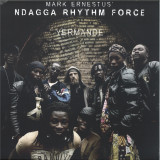
Five years into the project, Yermande announced a thrilling new phase for this Dakar-Berlin collaboration; a giant step forward.
The group of players is boiled down to twelve for recordings, eight for shows; sessions in Dakar become steeply more focused. ‘This time around I was better able to specify what I wanted right from the initial recording sessions in Dakar,’ says Ernestus; ‘and further in the production process I took more freedom in reducing and editing audio tracks, changing MIDI data, replacing synth sounds and introducing electronic drum samples.’
Right away you hear music-making which has come startlingly into its own. Rather than submitting to the routine, discrete gradations of recording, producing and mixing, the music is tangibly permeated with deadly intent from the off. Lethally it plays a coiled, clipped, percussive venom and thumping bass against the soaring, open-throated spirituality of Mbene Seck’s singing. Plainly expert, drilled and rooted, the drumming is unpredictable, exclamatory, zinging with life. Likewise the production: intuitive and fresh but utterly attentive; limber but hefty; vividly sculpted against a backdrop of cavernous silence.
Six chunks of stunning, next-level mbalax, then, funky as anything.
2024 Reiseue
In late October 2019, following a successful UK tour ending in a sold-out concert at the mythical Roundhouse in London, SUNN O))) entered studio 4 of the BBC Maida Vale. On invitation to record a live session for Mary Anne Hobbs to be broadcast on Samhain via her excellent radio show on BBC6. To enter the legendary John Peel studios was to enter a temple of music and experimentation, liberty in ideas and sound. The band was nearing the end of a long touring year around the Life Metal and Pyroclast albums. SUNN O))) had developed the compositions extensively, embracing the formative concepts of the Life Metal album conceptually and emotionally, but actualised and evolved into vast, open and bright hypersaturated arrangements. Particularly the pieces the band chose to perform on this recording: Troubled Air and Pyroclasts. The former enriched into a total aspect of the band's ethos and form in many ways, and Pyroclasts had evolved to become all-inclusive radiation of O))). The radiation embraces collaboration and freedom of interpretation by each player, within a structural format of the massive monuments of sound and distortion which define SUNN O))). Anna Von Hausswolf and her band had accompanied SUNN O))) on the UK leg, and Anna joined SUNN O))) in the studio on synths and with her tremendous voice on the Pyroclasts pieces.
Luminice Blue Transparent Vinyl. Can you hear the war drums beating? Prepare for battle! Lost In Cult Records, Black Screen Records, Gaziter and Deadpan Games are proud to present Wildfrost: the Original Game Soundtrack. For the first time on vinyl, enjoy the complete and unabridged orchestral score from composer Paul Zimmermann. Rich with folk roots and powerful crescendos, it's the perfect soundscape for your journey through the cold. No Pengoons were harmed in the making of this vinyl. Composer Paul Zimmermann on working on this soundtrack and vinyl: "Writing the music for Wildfrost was a blast. I loved mixing a ton of different instruments from all around the world to bring to life the colourful and unique setting of the game. The gameplay can get very challenging, so I wanted to make sure the music felt playful and uplifting, while also providing those big and heroic moments for our boss fights. I'm super pleased to partner with Lost in Cult and Black Screen Records to bring this soundtrack to vinyl. Seeing the positive response from players has been amazing and I hope this vinyl, with its unique artwork by Nuri Durr and the additional extras, provides fans of the game and its music another great way to connect with the world of the eternal winter!"
From 2019 to 2023 Lindsay Reamer worked as a field scientist. With a guitar and a bag of books in tow, she would leave her home in Philadelphia for the postcard scenes of the American landscape to gather data on visitation in National Parks. She counted cars and RVs, surveyed visitors, and made a temporary home for a few weeks at a time wherever she landed. All the while, she collected her own observations like specimens and slowly weaved the songs that would form her debut full-length, `Natural Science.' Recorded throughout 2023 by Lucas Knapp, `Natural Science' paints with a full spectrum. Humor rubs elbows with heartbreak. Acoustic guitars brush up against synthesizers, cradling Reamer as she sings about the American Chestnut tree extinction, employee gossip at a Day's Inn, fishing beside a power plant, turf grass farms, and waking up next to day-old take-out. The indifferent beauty of nature is held up next to the everyday as Reamer does her very best to find clues for navigating the latter by musing upon both. Following the release of her self-produced EP `Lucky' (Dear Life Records) in 2021, Reamer assembled a band with musicians from Philadelphia's vibrant music community and began working her once solo-acoustic songs into full band arrangements. After a brief flirtation with dance music which led to 2022's viral single "Touch Tank," Reamer settled into a sound that lies somewhere in the folkrock-pop matrix, explored with the humor and lightness of songwriters like Sheryl Crow or Melanie. Reamer reflects: "When I heard the songs with the band, I knew it was time to make the record. It felt like something I had been working towards my whole life. I grew up around musicians but I never thought I was good enough to be in a band or even to make my own music. My grandmother Joan gave me voice lessons after school, my mom was an opera singer, and my dad a guitar player. But it wasn't until a few years ago that I realized I could do it. It didn't matter if I could shred on the guitar or something. It was like some illusion shattered." Reamer is a sincere storyteller. The self-doubt and heartbreak expressed in songs like "Spring Song," "Sugar," or "Red Flowers" give way to the triumphant moments of self-acceptance and love in "Lucky," "Necessary," and "Figs and Peaches." `Natural Science' chronicles a path to confidence, an honest reflection of someone with the capacity to hold a deep well of emotion who also makes sure to not take it all too seriously. "Gardens on the land / Castles on the beaches / I trust my hand and / Pluck my figs and peaches," Reamer sings, as she works to reconcile the strange difficulty we have at finding happiness despite the obvious beauty all around us.
Pirates Press Records is proud to re-release Close My Eyes, the 2002 album by NYC ska-reggae legends The Slackers - a complex and nuanced album that shows the band's versatility and capacity for both commentary and introspection. It is often said - to the point of cliche - that New York City is a "character" in the work of the city's most noted filmmakers. A similar statement could be made about the artistic symbiosis between the city and The Slackers. From the Bronx-born accent of lead vocalist Vic Ruggiero to the band's embrace of cosmopolitan musical traditions from a melting pot of cultural origins, New York defines The Slackers at least as much as the band have contributed to defining the sound of New York for well over 30 years.Therefore, it bears mentioning that - aside from a 2002 collaborative album by "The Slackersand Friends" - Close My Eyesis the band's first proper studio LP released after the traumatic terrorist attacks on their home city in 2001, and the band took enough time to reckon with the global fallout of this tragedy. "So feel free go steal and rob, revolution ain't my job," sings Ruggiero on the title track. "And if I sing your happy song, please don't tell me I am wrong." It is the statement of an artist searching for a way to still sing about joy and life in uncertain times of great upheaval. And ultimately the band must reckon with these times. On "Real War," toaster Marq Lyn takes lead vocals as the band addresses the march to war that was omnipresent in those early days of the 21st century, stating in no uncertain terms that it was "Time to fight the real war_ Against hunger and poverty_ For racial equality." The Slackers make it clear that while the machinations of hawkish politicians grind on, the real needs of people all over the world are left behind. This tension between a dangerous world and the struggles of one's personal life are present throughout the record, and the band weaves stories from the whole spectrum of human emotion, war, heartbreak, joy, and everything in between. Bookended by instrumental tracks, opening with the energetic "Shankbon" and ending with moody dub reggae, these veteran virtuoso players ultimately take listeners on a masterful journey through the human experience.
goat (JP) are renowned for two albums released in 2013 and 2015 that took Kraftwerk’s man-machine concept back to its roots with swingeing, inch-tight drums, bass and guitar patterns that needed to be heard to be believed. For their long-in-the-making new album ‘Joy In Fear’, band leader Koshiro Hino (YPY, KAKUHAN) describes the process as “90 percent pain” - and we can well believe it - few other records we can think of transmute DAW-composed rhythmic precision into such an expressive instrumental performance. It really is a feat of determination, skill and execution that seems to defy human dexterity.
Make no mistake - an academic exercise it ain’t - in the most visceral sense, goat (JP) make BODY music, for dancing, flailing, for losing yourself in completely. As usual, Hino plays guitar, backed by bassist Atsumi Tagami, while Akihiko Ando joins on saxophone, while Takafumi Okada and Rai Tateishi step in to handle percussion, with the latter moonlighting on flute. Every sound is sculpted into a fragment of cadence: guitar and bass prangs alternately echo and dance between the drums, and Ando's sax is mutated into a respiratory slobber of guttural smacks and phantom breaths.
In some respects, it's tempting to label it jazz, but the kind of jazz that Miles Davis spearheaded on the game-changing 'On The Corner', the blueprint for so much post-punk, electronic music and avant rock. goat (JP) take that raw alloy and sharpen it like a blade, mangling the template with the knotty metrics of Autechre or Ryoji Ikeda. The accuracy is galvanic; it's almost impossible to comprehend each player keeping a mental note of the mathematical time signatures, and yet they floss them out with trills and icy stutters that seem to evaporate around the thick, taiko-like thuds.
They practically get our teeth gnashing with the bruxist rictus chatter of ‘III I IIII III’ , before ‘Cold Heat’ introduces subtly harmonised, new aspects to their sound with slivers of Hassellian flute and ringing overtones of their percussion, while the winding sensuality of ‘Warped’ slips down very nicely. Their links to OG no-wavers like Glenn Branca & Wharton Tiers’ Theoretical Girls - is manifest in the 8 mins of chipping stop/start pulse and parry to ‘Modal Flower’, while a total left turn into Mark Fell-meets-Ligeti-esque messed up metronomics in ‘GMF’ ties it off with a properly beguiling flourish.
- A1: Still Ridin' Clean (Feat. Juicy J)
- A2: The Porch 3 (Skit)
- A3: Fight
- A4: Weak Niggaz (Feat. Dj Paul)
- A5: Make Dat Azz Clap (Back Clap) (Feat. Juvenile)
- B1: Choose U
- B2: Smokin' Out (Feat. Lord Infamous)
- B3: Show Dem Golds
- B4: This Pimp
- B5: On Nigga
- C1: That Drank
- C2: Mc Flyjo
- C3: Posse Song (Feat. Hypnotize Camp Posse)
- C4: 90 Days
- C5: Shut Ya Mouth, Bitch (Feat. Dj Paul, Juicy J, Crunchy Black And Frayser Boy)
- D1: Take Da Charge
- D2: Smoke & Get High (Feat. Crunchy Black)
- D3: County Jail
- D4: I'm Mo (Feat. Lord Infamous, Dj Paul And Juicy J)
- D5: Outro
FIRST TIME ON VINYL! AVAILABLE IN A BROWN & WHITE COLORED VINYL PRESSING IN A GATEFOLD JACKET WITH OBI LIMITED TO 1000 NUMBERED COPIES.
Memphis Rap legend Project Pat released his third studio album Layin' Da Smack Down in 2002 on CD and Cassette via Loud/Columbia/Hypnotize Minds. Following up Mista Don't Play, Project Pat spits rapid-fire street tales of the dirty south over DJ Paul and Juicy J's signature Three 6 Mafia bangin' 808 beats. From rowdy club tracks to smoother pimp tales and true-to-life stories of being incarcerated, Project Pat delivers another Hypnotize Minds North Memphis classic. The album also contains the single "Choose U" which would be reworked in 2007 for UGK's "International Players Anthem." Get On Down in partnership with Sony Music's CERTIFIED is proud to present Layin' Da Smack Down for the first time on vinyl. Pressed on colored vinyl packaged in a gatefold jacket with a printed insert and numbered OBI limited to 1000 copies.
Vibes player Johnny Lytle was one of the heroes of the early acid jazz club circuit, with his cut 'Selim' being an anthem of the scene.
The Ohio born player had made his name at Riverside where his 1965 album "The Village Caller" made him a star. When Riverside ceased trading, owner Orrin Keepnews collaborated with Lytle on two albums which came out on the Detroit label, Tuba
Ace reissued the first album “The Loop” last year (HIQLP 115). We are delighted to now put out the second, “New And Groovy”. The line-up features Milt Harris (organ) Wynton Kelly (piano), George Duvivier (bass) “Peppy” Hinnant or Jimmy Cobb (drums) Montego Joe (congas) and Lytle on vibes. The band power through a selection of original material such as ‘The Snapper’, ‘The Pulpit’ and ‘Screamin’ Loud’. The album also contains Lytle’s radical reworking of Miles Davis' 'Miles' which Lytle retitles 'Selim'. With poor distribution, “New And Groovy” barely made it to the shops back in 1967 and was ignored for twenty years until DJs such as Bob Jones and Gilles Peterson started playing it in the 80s making it a sought-after LP.
The popularity of “New And Groovy” has remained, and this is first time it has been legally reissued on vinyl. “Snapper one up…!”
Born and raised in Richmond, Virginia, keyboard player Lonnie Liston Smith moved to New York in 1963 playing with the likes of Dakota Staton, Al Hibbler, Max Roach and Abbey Lincoln and Roland Kirk. He made his first recordings with Kirk and in 1968 entered into a mutually rewarding and instructive partnership with Pharoah Sanders and Leon Thomas. In 1971-2 he toured Europe with saxophonist Gato Barbieri appearing on his 1973 albums “Under Fire” and “Bolivia”. His growing reputation was also burnished by playing Fender Rhodes with Miles Davis electric band.
The second of these Barbieri LPs was released on Bob Thiele’s Flying Dutchman label. Thiele was quick to sign Smith and release Smith’s first album under his own name, “Astral Traveling”. Backed by his Cosmic Echoes band, Smith served up a beautiful spiritual and funky stew on tracks like ‘Let Us Go Into The House Of The Lord’, ‘Rejuvenation’, ‘I Mani (Faith)’ and ‘In Search Of Truth’.
Smith went on to record “Expansions” one of the greatest funky jazz albums of all time in 1975 but this debut really paved the way towards that musical milestone.
Ace are delighted to reissue “Astral Traveling” in a gatefold sleeve that, like the original pressing, has liner notes by legendary jazz critic Nat Hentoff.
It is our distinct pleasure to offer up two more killer sides from the critically acclaimed long-player Come Around and Love Me, now available on the convenient, DJ-friendly 45rpm format. "That's All I Wanted From You" is a hard-hitting, sophisticated dancer already making waves on the UK soul scene and abroad. On the flip is "So Glad I Found You", an earnest ballad that showcases Jalen's elegant voice and knack for writing world-class soul music. Grab one before they're gone!1
Reggae Charmers is the 1970 album by Lloyd Charmers, born Lloyd Tyrell. His career spans some of the most fertile periods of Jamaica's musical history. From the late-'50s era of Jamaican shuffle R&B and the subsequent ska boom, to the rocksteady and roots reggae of the late '60s and early '70s, Charmers made valuable contributions not only as a vocalist, but as a session musician and producer, as well. Charmers took up the piano in 1966. A few years later, he was an accomplished enough player to form a band of his own with a few friends. The band eventually backed Ken Parker, Max Romeo, Pat Kelly, John Holt, and Slim Smith & the Uniques (Charmers would also spend some time singing for the Uniques). Buoyed by their reputation for laying down some of the rawest and driving rhythms of the time. Charmers is joined by Byron Lee and the Dragonaires on this record, that is a must for all true fans of vintage Jamaican sounds. Reggae Charmers is available as a limited edition of 750 individually numbered copies on orange colored vinyl.
Itʼs been five years since the last BELONG long player, as the duo works slowly to organize their sound works. Both the time invested, and the wait, have been well rewarded with this return.
Common Era shows extraordinary progression from that first album of dense, scorched earth instrumentals, hints of a new direction having been revealed on the Colorless Record EP from 2008 which contained covers of four should-have-been classics from the original psychedelic era.
The new material has such common pop elements as “songs”, vocals and drum machines, but the results could hardly be called conventional and are like little else happening on the current “scene”. The songs themselves are akin to radio transmissions received from another time and place, just as likely to be the future as the past, or even from a contemporary alternate universe.
They are both passionate and dispassionate, grey yet technicolor, ghostly and palpable, distant yet immediate, grainy and focused. Upon listening these conceptual contradictions are dismissed with ease, as the recordings reveal that they fit all of these descriptors simultaneously, an extraordinary balancing act.
Isata Kanneh-Mason erkundet mit ”Mendelssohn” drei Facetten eines der berühmtesten Namen der klassischen Musik: das glanzvolle Klavierkonzert Nr. 1 von Felix mit den London Mozart Players, die lange verschollene ”Ostersonate” seiner Schwester Fanny sowie Transkriptionen von Mendelssohns berühmtester Musik durch andere Komponisten.
Im Jahr 2024 spielte Isata in dem von der Kritik hochgelobten Film ”The Other Mendelssohn” mit, der das Leben der außergewöhnlich talentierten, aber übersehenen Fanny Mendelssohn, später Fanny Hensel, beleuchtet. In dem Film wird die Tatsache aufgedeckt, dass die Ostersonate, ein seit 150 Jahren verschollenes Stück, in irklichkeit von Fanny und nicht von Felix geschrieben wurde. Isata war die erste
Künstlerin, die das Werk, das dem richtigen Komponisten ugeschrieben wird, aufführte.
Das Album enthält die Weltersteinspielung der neuen Urtextausgabe von Fanny Mendelssohns Ostersonate sowie wunderschöne Transkriptionen für Soloklavier von Liszt (”Auf den Flügeln des Liedes”) und Rachmaninoff (”Ein Sommernachtstraum”). Zwei der ”Lieder ohne Worte” von Felix und Fannys ”Nocturne”, ebenfalls für Soloklavier, werden auch von Isata auf diesem Album präsentiert.