Daniel Land's new album, "Out of Season", is his most ambitious record to date, a series of reflections on history, memory, and post-Brexit Britain, which was inspired by his return to the landscapes of his youth – the rugged, underpopulated west coast of Somerset. The album was written and partly recorded in Daniel’s studio in a static caravan, overlooking the coast, during the period when the UK was tearing itself apart over its relationship to Europe. "I didn't set out to write about Brexit", Daniel says, "I have a kind of horror of political music. But I couldn’t escape the atmosphere of the time – this strange, distorted version of ‘Englishness’ in the national psyche. I’ve always been interested in memory and nostalgia; Brexit illustrates the dangers of taking seductive, possibly false memories at face value”. Songs like “White Chalk”, “Island of Ghosts”, and the album’s title track, represent a series of attempts to reclaim an older, more peculiar idea of England which, Daniel says has been “Lost in the nationalist mythmaking of the past decades” – the island of misfits and outsiders exemplified by the works of Derek Jarman, for example, whom Daniel was rediscovering while working on the album. “I must have read 'Modern Nature' ten times over the years”, Daniel says. “What I love about Jarman is that he had a deep, abiding love for England, but it was a very complicated, critical and a very queer kind of love. That was very much my mood, going into the making of this album”. Like Jarman’s work, "Out of Season" probes national identity whilst also displaying resolutely queer themes throughout. Daniel’s voice – once described by The Guardian as "The spawn of Elizabeth Fraser and Anthony Hegarty” – is less heavily reverbed than before, bringing to the fore his often-confessional lyrics, inspired by the frankness of modern queer poets like Andrew McMillan, Seán Hewitt, and Ocean Vuong. A lyrical highlight is the gorgeous “Southern Soul”, a deceptively straightforward recounting of a decades-old hookup with a closeted guy from his hometown which, Daniel says, “Serves as a metaphor for everything I’m talking about in the album”. And in keeping with the album’s nods to the heroes of gay literature, Daniel’s self-styling of the album as a “Dream Pop Album on National Themes” deliberately references the full title of Tony Kushner’s era-defining play "Angels in America", whose central character is namechecked in the hook-laden “Lemon Boy” – a song which must surely stand as Daniel’s most deliciously pop moment yet. Lauded by Mark Radcliffe, Guy Garvey, Tom Robinson, and many others, Daniel Land makes music that, in the words of BBC Radio 1, "You can't help but think the late John Peel would have loved".
Buscar:poet
'“Nobody Move!”, so says Philippe Doray and his Asociaux Associés (the Antisocial Associates)! Having dynamited the end of the 70s with two radical albums – Ramasse-Miettes Nucléaires in 1976 & Nouveaux Modes Industriels in 1978, both reissued by Souffle Continu – Doray still hadn’t finished singing. Throughout the next decade he began his Composant compositeur which would document the “second period”, as he calls it, of his Asociaux Associés.
The record includes new schizo-electro songs which make the most of his association with Laurence Garcette, who also plays all sorts of keyboards. A prolongation of the first period of the Asociaux Associés, the duo updates Doray’s poetry: in reaction to the current overcast atmosphere, here are some hallucinatory fantasies to the rhythm of an infernal circle dance (« Le petit géant ») or an ecstatic waltz (“Bombés fluo”) or even coded messages stuffed into bottles and thrown into space (“Secoue le flipeur”, “Choc d’amour”).
On the bonus CD there are further iconoclastic examples: rare recordings (unpublished or even “inaudible”) of the Asociaux Associés but also by Crash, a duo that Doray formed with Thierry Müller (Ilitch, Ruth). At the controls of their experiment- bending machine the musicians multiply the possibilities: peripheral rock, arias in orbit, broken swing, industrial mantras and other joyful falsities. Enough to make you lose your mind? No... as Philippe Doray promised: it is the “jackpot qui frissonne” (the shivering jackpot) which is there to excite.'
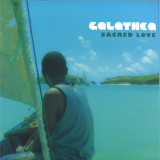
Two years after the release of his first self-titled album, DJ producer Massimo Napoli aka Galathea presents the new 'Sacred Love', in which he once again avails himself of the collaboration of his friend producer and bass player Salvo Dub, as well as a combo of respected musicians: singer Kadi Koulibaly - originally from Burkina Faso - already featured on the first album, Giulia La Rosa, author of the lyrics and performer of the title track, pianist Mario Pappalardo, percussionist Sergio Spitaleri and drummer Luciano Cantone.
'Sacred Love' is definitely a more mature, intense and profound journey than the previous album of the same name, which enhances the magical dreamlike and spiritual atmospheres of a certain African culture.
The album guides the listener along a path of multi-ethnic contaminations: "Divinité", "Ouaga" and "Koloko", well interpreted by Kadi, touch on the sacredness and mysticism of the African continent and blend well with the Spiritual Jazz sounds that have evolved in the West.
"Divinité", through the spoken word of French poet Diego Hernandez, tackles the themes of faith, life and the relationship with one's 'self', with references to French chanson productions, in which Kadi's spiritual song, at times 'Saharan', intersects and expands into cosmic space.
The title track, the first single from the album, also released on 7" (45rpm) in two versions, is an Afro-American gospel with a typically afrobeat rhythm, vaguely reminiscent of Nina Simone's 'See-Line Woman'.
North Africa is represented by "Equator", while we climb further north into the middle of the Mediterranean Sea with "Medican Blues", to land in Stromboli with the Deep Jazz of "Ginostra", whose title recalls the village of the marvellous island in the Aeolian archipelago.
Then we have the Cuban track "Caminito", a sort of Cha-Cha with a romantic piano melody (à la Chucho Valdez) well performed by maestro Mario Pappalardo; and then again "Eos", strongly Balearic with a Brazilian mood; "Impression", a dreamy journey of impact; "Sirens", already present on the first album and here reworked in a new Spiritual-Ambient version produced by Agosta.
"Sacred Love" is thus an original and musically borderless album, which expands a certain African sacred culture and naturally blends Afrobeat, Jazz and Blues atmospheres with the Balearic sounds of Mediterranean culture.
Enjoy listening!
Mirage is a cosmic collaboration between the Silver Apples and Makoto Kawabata of Japan's Acid Mothers Temple. Packaged in a deluxe jacket printed with metallic silver ink. This album is dedicated to the memory of Simeone Coxe who died September 8, 2020 while this project was being assembled. Dragonfly's First Flight, taking up the full side A, features Simeon Coxe and Kawabata Makoto jamming over familiar Silver Apples hypnotic rhythms. Fans of both groups will delight in the interplay between Simeon's keyboard and Makoto's drone guitar feedback soloing. Side B ranges from free-form freakouts to ambient poetry readings by Simeon with Japanese translation spoken by Makoto. Future Reminiscence, which closes side B, sounds like a long-lost Silver Apples
Das in Stuttgart ansässige Duo experimentiert mit Variationen von Cold Wave, Hip-Hop und Techno, den sie "Neo Grunge" nennen würden. Die beiden Musiker schreiben ihre Musik mit einer dunklen poetischen Handschrift, die durch eine starke Verwendung von Samples aus den 80er-Jahren-Wellen gekennzeichnet ist. Viel bis hin zu Metal und allem, was ihnen in den Sinn kommt. Ihre Texte tauchen oft in Themen wie gebrochene Herzen, Verluste und Tod ein und spiegeln ein sehr tiefes Gefühl wider mit einem dystopischen Blick auf die Außenwelt.
The new album Northwind was recorded with Adrija Tokic in Nashville with some of the most well-known session musicians in town. Spencer has been a featured ROOTS artist, a Pendleton artist, has toured US and Canada with City and Colour, Daniel Romano, Jenn Grant, and more. He has had press coverage fromAmerican Songwriter, Exclaim!, and Pop Matters Support tours with City and Colour, Old Man Luedecke, Dan Romano, and more
"the north wind really saved me over the past couple of years. It brought to me a new sense of life and a new urgency for it. I had thought my songwriting days were over, but with the help of this little guitar and a strong want for expressing my gratitude towards the north, I found myself writing again. Almost every song on this coming album was written on this guitar and in the north itself. A beautiful breeze it breathes and with every breath a song. I’m thankful for these wild places. I hope they never leave us. I’ll be here until the end of my days"
In den Jahren 1961 und 1962 hätte sich der Gitarrist Grant Green eigentlich auch gleich in Rudy Van Gelders Tonstudio in Englewood Cliffs als Untermieter einquartieren können. Denn in diesem Zeitraum war er dort an mehr als zwei Dutzend Einspielungen für Blue Note Records beteiligt. Die eine Hälfte machte er unter eigenem Namen, die andere Hälfte als Sideman von Größen wie Stanley Turrentine, Lou Donaldson, Hank Mobley, Ike Quebec, Horace Parlan und Baby Face Willette.
Um den Markt nicht zu übersättigen, sah sich Alfred Lion dazu gezwungen, einige von Greens Aufnahmen zu archivieren. Fünf von ihnen erschienen erstmals in den 1980ern. Darunter auch das im Januar 1962 entstandene Album “Nigeria”, das zu den unterbewerteten Juwelen des Gitarristen gehört. Zu erleben ist Grant Green auf ihm mit einer wirklich erstklassigen Band und einem ebenso exzellenten Repertoire (mit dem Sonny-Rollins-Klassiker “Airegin” und vier zeitlosen Standards).
BLUE NOTE TONE POET EDITION: Stereo, produziert von Joe Harley, komplett analog von Kevin Gray von den Originalbändern gemastert, RTI-Pressung (180g), stabiles deluxe tip-on jacket, wattierte Innenhülle.
Trystero comprises Scottish/Luxembourgish producer Thomas Lea Clarke (aka MR TC) and Low Bat, otherwise known as one half of the formidable duo Jean-Luc. Their debut album, Sfumare e Vedere, was conceived over three days aboard Urban Boat, a 1960s barge transformed into an arts and performance space. Moored along the river just outside of Paris, the duo embarked on a joint residency, discovering their complementary creative energies and a mutual passion for all things strange and psychedelic.
As frontman, Low Bat is a fire-powered poet, his unparalleled stage presence resonating through Trystero's music. The French native and fluent German speaker has a natural flair for languages. For this project, he sings in a combination of Italian and English about love, loss, and class struggle, constructing surreal wordplay about pelicans and puttanesca. Meanwhile, Clarke's drone-lead electronic accompaniment takes its cues from sizzling acid, 1990s snap rhythms, post-punk, krautrock and shoegaze. Firmly rooted in these tripped-out genres, Trystero journeys to entirely new cosmic dimensions.
Amazing floaty modern soul / disco goodness out of late 70s Queens, NY. 'Love Is The Same' two brilliant and different versions, both dancefloor fire…
Mark Beiner met Ben Iverson in 1976 when I was 17 years old, at the time he was a junior at Newtown High School in Elmhurst, Queens. Mark had taken a part time job as a Produce Clerk at Walbaum's Supermarket on Northern Boulevard in Jackson Heights, Queens, where I met Ben Iverson, the "Frozen Food Manager."
Back then Mark remembers, 'I was going to work early just to talk to him about his musical background and his time spent in the 50's and 60's with the Ohio Doo Wop Group, "The Hornets", or better known as, "Ben Iverson and The Hornets."'
In 1978 after Ben and I discussed getting together and composing music, I started writing poetry and expressing in writing my break-up with my college girlfriend, Paula. Ben and Mark went on to writing two albums worth of material, which in turn gave us a lot of time and presence on stage at our live gigs.
The regular Coast to Coast Band members consisted of Ben Iverson on Lead Vocals, Rhythm Guitarist and Co-Executive Producer, Joe Crowley, who is known today as "New York Congressman Joe Crowley." Carl (Woody Wood) Morton on Bass Guitar, Jimmy Johnson on Keyboards. Lead Guitarist, Lou Jimenez, currently owns his own recording studio, Music Labs in Elmont, Long Island. On Drums, Eddie Byam, on Alto Sax, Jay Cohen, who in the 70's used to record for "Gary U.S. Bonds." Gary Pevols on Trumpet. On Bone, Scott Burrows, Trumpet player, Steve Becker, along side Neil Levine, Stan Stockley, Tom Russo.
Musician/sound artist Mariske Broeckmeyer (MARIS) and author/poet Astrid Haerens found each other in their shared love of experimental music, improvisation and jazz. They discovered common ground in their artistic work, in their thinking, in their love for art and literature, and started a conversation that has not ceased.
They both make work that focuses on physicality, femininity and (the failure of) the voice, among other things. Their work revolves around the knowledge that a body carries, and how you can start from there instead of just the cerebral and analytical, aspects that are seen as predominantly masculine and often central to literature.
In 2022, the two worked together for the first time on their literary jazz project around the effects of power structures on a woman's body, bringing a breath of fresh air to the predominantly male jazz scene. MARIS and Astrid invited Jasmijn Lootens, a hybrid cellist who combines classical training with electronic music, to dive even deeper into the research and crossover between poetry, spoken word, performance, sound art and music together.
- 1: White Lady
- 2: Sis
- 3: The Bug
- 4: The American's Head
- 5: The Underground Man
- 6: Iron Drunk
- 7: Eve
- 8: Burning Palm
- 9: The Diplomat
- 10: Dirty Knife
- 11: Totaled
- 12: All Seeing Eye
- 13: Valley Of The Geysers
- 14: Kamikaze Heart
- 15: King Of Clubs
- 16: Book Burner
- 17: Permanent Funeral
- 18: Machiavellian
- 19: Baltimore Strangler
The undisputed kings of grind, PIG DESTROYER return with their long awaited fourth proper full length ‘Book Burner’. ‘Book Burner’ is a resounding statement of championship, as every element of PIG DESTROYER towers above their closest peers—a 32 minute, 19 song knockout punch of cerebral viciousness. Scott Hull’s guitar heroics sound like a mutant double speed hybrid of Slayer and the Melvins jacked up on amphetamines, new skinsman Adam Jarvis is the pinnacle of inhuman drumming, Blake Harrison delivers layer upon layer of suffocating atmosphere and JR Hayes remains the poet laureate of extreme metal. ‘Book Burner’ is the finest work of extreme music’s best band. Limited edition deluxe CDs and LPs available with bonus ‘Blind, Deaf and Bleeding’ EP, expanded packaging and the much talked about short story penned by JR Hayes. RECOMMENDED IF YOU LIKE: Napalm Death, Converge, Melvins, Discordance Axis, Wormrot
With their profound take on electronic music, Animistic Beliefs have steadily solidified their spot in the global underground. Influenced by cultural concepts such as ancestry, animism and mythology, as well as the languages of political techno, punk, bubbling and IDM, Linh Luu and Marvin Lalihatu consistently translate their visions into sensitive productions as well as high-octane live performances. On MERDEKA, the artists explore and embrace their cultural heritage in all of its pride, pain and complexity. It symbolizes Animistic Beliefs' breaking free, coming to terms with their changing selves and letting go of external expectations. The record rethinks childhood memories, confronts the generational trauma left by (post-)colonialism, and re-connects Linh and Marvin â?? respectively of Vietnamese-Chinese and Dutch-Moluccan descent â?? with their formative cultures. MERDEKA marks their first step in an overall departure from western club music. For its layered sound, Animistic Beliefs once again draw from the past, present and future of global club music, creating a sonic space where fast techno, warped breakbeats and ambient soundscapes make way for the augmented influence of (Southeast Asian) tribal music. The record incorporates Indonesian scales and recordings of the Tahuri (a wind instrument made out of a conch shell), Totobuang (Gamelan-like gongs) and Tifa drums, known as â??the Moluccan heartbeatâ??. In true Animistic Beliefs fashion, MERDEKA will set fire to sweltering clubs and (sleepless) dreams. Yet, for the artists, it is essential to amplify the stories that spark that flame and keep it burning. The release of MERDEKA follows CACHE/SPIRIT, their ongoing collaboration with visual artist Jeisson Drenth, which extensively explores the artistsâ?? intersectional identities. As such, the latest album is the next step within a bigger, introspective investigation. More unapologetic than ever, MERDEKA embodies a turning point on Animistic Beliefsâ?? ongoing journey towards self-acceptance â?? fuelled by the sound of urgency.
- A1: Wondrous Afternoon
- A2: Only When I Love
- A3: You’re Poetry To Me
- A4: My Careless Heart
- A5: Rolling The Dice
- A6: The Rampaging Sons Of The Widow
- B1: Cezanne Cezanne
- B2: Always Letting Go’
- B3: Love Is Just A Word
- B4: Narcissusb Intermezzo #7
PETE MOLINARI is a singer-songwriter from the Medway Delta. He was born into a large Maltese/ Italian/ Egyptian family in Chatham, Kent, where he was discovered by Billy Childish.
He’s got five critically-acclaimed albums’ worth of timeless folk, blues, rock and alt- country songs to his credit, plus a bunch more EPs.
He’s often described as a songwriter’s songwriter. Bruce Springsteen once publicly proffered: “Pete Molinari – if you don’t know anything about him, he’s great!”
Rome has a secret heartbeat, an underground and urgent pulsation whose memory is preserved within the walls of old recording studios, in the tales of veterans, and most of all in the grooves of the soundtracks of Cinecittà. Music that has always flirted with poetry.
Pete Molinari is a poet, and that's why his words perfectly blend with this pulsation.
That's why producer Luca Sapio chose to record "Wondrous Afternoon" among his Blind Faith Recordings and Maestro Piero Umiliani's Sound Workshop. The result is an album with a strong cinematic impact. The lesson of Motown applied to the sound of Rome.
Backed by Luca’s crack band better known as the Italian Royal Family, Pete Molinari sings with great expressiveness and soul, embedding his words like precious stones, exposing them in all their fragility and strength to the listener.
Sun Ra is better known to most as a musician than a poet, but he identified equally as both. My Words Are Music provides direct access to the sentiments of a poet who never called Earth home. The spoken word album hosts an inspired array of artists who personally chose their favorite Sun Ra poems to recite. Freed from the page, his poetry acquires an unexpected simplicity and poignance it possessed all along.
This all-star and intergenerational lineup of artists conjure wisdom from his words: spoken word elder Abiodun Oweyole of The Last Poets; rapper, and singer-songwriter Saul Williams; jazz experimentalist Melanie Charles; British-Trinidadian poet, novelist and musician Anthony Joseph; poet Mahogany L. Browne; poet, playwright, and conceptual artist Carl Hancock Rux; musician/digital composer L’Rain; singer, actor, and director Tunde Adibempe of TV on the Radio singer; British DJ and BBC radio host Zakia Sewell; ballistic hip-hop poet Jive Poetic; and longtime members of the Sun Ra Arkestra, Marshall Allen, Knoel Scott, and Tara Middleton.
Punctuated by impish electronic interludes composed and played by Marshall Allen, these voices bless Sun Ra’s poetry with new life My Words Are Music offers the opportunity to follow Sun Ra into a
better future. “Prepare for the journey,” he writes in his poem “The Cosmic Age”, “You have a rendezvous / With the living wisdom.” My Words Are Music is a project developed in conjunction with Living Sky, the all-instrumental Sun Ra Arkestra album released on Omni Sound in 2022
Superjock Records is proud to present the 20th Anniversary Expanded Edition of Connie Price & The Keystones’ cinematic Psychedelic masterpiece “Wildflowers” for the first time on vinyl!
Originally released in 2004 on Now-Again Records, the Expanded Edition features B-sides, EP cuts, and rarities from the vault.
Masterminded by producer/composer/multi-instrumentalist Dan Ubick, the album also features members of Breakestra, Orgone, Poets of Rhythm, L.A. Carnival, Funk Inc., Dap Kings, and The Heliocentrics!
An autumnal treasure, East Village’s Drop Out has spent the past thirty years finding new ears to bewitch and new hearts to melt. The only album from this British four-piece, recorded and released in the early nineties, it’s long been considered one of the hidden jewels of its time, and is talked of with hushed reverence by people who know. Bob Stanley of Saint Etienne once called it “an elegy for a particular brand of eighties guitar music, sweet minor chords and Dylanesque lyrics”, which captures what makes it so special; in summarising its era, though, it also effortlessly transcends it.
Like all great guitar gangs, East Village fell together as a four-piece; having relocated from High Wycombe to London in mid ‘80s, brothers Martin and Paul Kelly on bass and guitar, set on forming a group together, were joined by John Wood (guitar) and Spencer Smith (drums). Wood and the Kellys shared writing and vocal duties; it was an ideal combination, and one of the many charms of East Village is their various song writing voices, a tip of the hat, seemingly, to the 60s folk-rock groups who influenced them.
Originally influenced by garage-rock and freakbeat, the band eventually came through via the same scene as groups like Felt, The Go-Betweens, The Weather Prophets, and Primal Scream. They’d formed as Episode Four, releasing an EP, Strike Up Matches, in 1986, which has gone on to become one of most sought after releases of the C86 era. Their first two singles as East Village, ‘Cubans In The Bluefields’ (1987) and ‘Back Between Places’ (1988), were released on Jeff Barrett’s Sub Aqua label.
When it came time to record Drop Out, East Village found a supporter in Bob Stanley, who bankrolled the album sessions until Barrett re-signed the band to his new imprint Heavenly Recordings in 1990. The album that took shape is dusky, heartfelt, lamplit, full of chiming minor chords, close harmonies, rattling organs, all buoyed by a rhythm section that moves as one, steady and elegant. There’s melancholy here, certainly, on songs like ‘What Kind Of Friend Is This’, but also pleasure and freedom, on ‘When I Wake Tomorrow’ and ‘Silver Train’. The group were obsessed with Dylan’s Eat The Document at the time, and the album’s rich with references to the film; Drop Out’s character is also somehow close to the thin wild mercury sound of Blonde On Blonde, and the lambent light of the Byrds’ Notorious Byrd Brothers.
In one of life’s gentler surprises, ‘Silver Train’ became an unexpected radio hit in Australia when released there as a single in 1993. The story of East Village seems marked by such unexpected turns and surprising events. None was more surprising for their fans at the time, though, than their onstage split in 1991, leaving an unreleased album in the can. Encouraged by Jeff Barrett the band revisited the tapes two years on and while mixing the album for its posthumous release in 1993 invited Debsey Wykes (Dolly Mixture, Coming Up Roses, Saint Etienne, Birdie) to sing the quietly devastating album closer, “Everybody Knows”, a perfect, sad-eyed sign-off.
Listening now to Drop Out, its timelessness is clear. It could have been recorded by young folk-pop hopefuls in the late sixties, taking their shot at the big time; but it could just as easily have been recorded yesterday, by a group that’s both reverent to music’s past, but forward looking in spirit and temperament. It’s that kind of album. Drop Out’s pop poetry is fully formed, with a singular charm that takes in wistfulness, romance, and good times, and a clutch of deeply moving songs that are overflowing with melody and gracefulness. It’s pretty much everything you’d want from a guitar pop record.
It's also an album that’s slowly accrued its own legend. From its stunning cover art, photographed by Juergen Teller originally for a Katherine Hammett campaign, to the ten perfectly formed songs within, Drop Out’s significance in the scheme of things is such that, a decade ago, it was given a rare 10/10 rating in Uncut magazine, who called the album “the lost classic of its era”. Drop Out comes round every decade or so, each edition introducing new fans to its understated beauty, and this latest reissue is its most elegant and deluxe yet.
The 30th anniversary edition of Drop Out lands in two formats: an LP with tip-on style jacket and four-page insert, designed to partner with the 2019 vinyl reissue of their singles and rarities compilation, Hot Rod Hotel; and a double CD, featuring an extra disc compiling the group’s early singles and alternative versions. This CD edition previously has only been available in Japan, though it now features a new, superior mix of their second single, ‘Back Between Places’. Both feature new, typically eloquent liner notes from writer Jon Savage.
The members of East Village have all gone on to do inspired things: Martin Kelly joined Jeff Barrett at Heavenly and has managed label mainstays Saint Etienne since 1993; Paul Kelly formed Birdie with Debsey Wykes, and is now a renowned film director and graphic designer; both Paul and Spencer Smith played in Saint Etienne’s live band; John Wood moved to China to teach, and released a lovely, understated folk album, Quiet Storm, in Japan in 2006. But with the hazy perfection of Drop Out, they’ve all already etched their names in the firmament.
In the 1970s, Robert Cahen turned to the burgeoning field of video art, where he became a pioneering artist. He was originally trained in musique concrète, his creative background, and joined the Groupe de Recherches Musicales in 1972. The pieces on this record were composed in the GRM studios between 1971 and 1974. They testify to a lively inspiration and imagination combined with a precocious formal mastery that already carries the seeds of later developments, which the artist cleverly and inventively deployed in the field of visual arts. (François Bonnet, Paris, 2022)
--
«La nef des fous» (1974), 12’00
There are pieces of music whose title is obviously a mere label given afterwards to a finished product. And others, on the contrary, which develop in spiral around a bundle of images and impressions condensed into a few words. This is the case indeed with La nef des fous. However, this work by Robert Cahen oddly wraps itself around its title, with bends, breaks, and an impetus driven further every time to close a new circle, for such is the very essence of the spiral. This, at least, is the way I perceive the form of the work, with its theme-chorus which, in part one, both ponctuates and disrupts the emerging musical curve in various ways and at irregular intervals, as well as its broader and more open second part, which closes with a recollection of the beginning of the work. The challenge of a musical form justified by the topic it illustrates, right down to its gaps, its wanderings and its twists, and which would confer upon it the necessity of a profound logic, that of insanity, is the challenge attempted by Robert Cahen. In such a genre as tape music, so careful with respect to form, one can appreciate its audacity. La nef des fous, or Unity through heterogeneity, or Each to their own madness, but all in the same boat. This means that if we can listen to each of these sound characters, “broken chants”, which create the work for themselves, through the singularity of their delirium, we can also, from one to the other, trace the continuous chanting of a music that is inherently and spontaneously poetic, a music that carries “the unconscious under its skin” (Christiane Sacco). (Michel Chion, January 1976)
«Masques 2» (1973), 08’34
Concert version (for tape only) of an audiovisual work entitled Masques, in which the faces of old dolls and «masks», filmed during the Basel Carnival, were projected in 16mm. Masques 2 is a metaphorical version of Masques in which music is featured in its arcane musicality.
Through its concrete and suggestive music Masques 2 aims to bring to light hidden memories, buried within us, thus enabling an awakening, the resurgence of events from our own history. (R. C.)
«Plurielles» (1971), 08’35
Premiered at the Paris Biennale, 24 September 1971. Suite based on the score of a TV film directed by Sophie Talmon.
«Persona» (1971), 08’34
Premiered at the Paris Biennale, 24 September 1971.
«Passé composé» (1971), 05’29
"Over the past five years I’ve seen the darkness and now I’ve come to the light. I’ve learnt wisdom. It’s humbling to see where I’ve come from.”
The past half decade has seen Unknown T establish himself as among the most creative and authentic voices in British Rap. A string of seminal singles and mixtapes have pushed, and then shattered, the musical boundaries of UK Drill, his distinct voice offering stark yet poetic accounts of life in the overlooked corners of London. Now, he is ready to release his debut album Blood Diamond. 13-tracks long, Blood Diamond is a vivid journey into his mind, spirt and history, illuminating on the trials, traumas and triumphs he has met along the way. “It’s not easy to come through what I’ve been through, and making something out of it,” he says, “It’s a good feeling coming out of that environment and seeing what I’ve made possible.”"