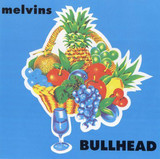
**BACK IN PRINT ON SINGLE LP**After three albums filled for the most part with quick song bursts and the occasional longer track, the eight-song long Bullhead found the Melvins stretching out a bit more at points, this time allowing the heavily stoned tempos plenty of time to really sprawl all over the place. There are fewer sudden shifts between fast and slow moments as well, and a lot more pure lava-flow beat-over-head feedback sludge and noise. It's not all ten mph deliberation, though - "Zodiac" shows the trio at full speed and blasting aside anything that might be so foolish as to get in its way, not to mention one unhinged Osbourne vocal lead. If grunge was achieving breakthrough status in Seattle, it was being perfected in its rawest sense on this album. Opening cut "Boris" does all this in excelsis - the band's longest recorded song at this point, nearly ten minutes long, it practically drips from the bongwater of eight million potheads, with Osbourne invoking his own brand of demons over the deep crawl of the music. Osbourne here really has got the dramatic, theatrical Ozzy Osbourne attitude down, with the occasional double-tracked vocals adding to the off-kilter intensity of the performances. Crover again shows his worth on the drums - he plays things slow most of the time but, crucially, never once sloppily - while Black keeps the bass going, however relatively unheard under Osbourne's guitar attack. "It's Shoved" is the not-so-secret highlight of Bullhead, Crover's brisker drum work and Black's sharp bass playing heralding a wild lead-guitar melody and a great ensemble performance. However, efforts like "Anaconda," with its slowly uncoiling power, and the intense "If I Had an Exorcism," which gets all the more wired and wound up as it goes (Black's bass here is some of her best), are no slouches. (All Music)
quête:point no point
Pointillist club rhythms and dense, porous dub clouds encircle the Wrecked Lightship as Laurie Osborne and Adam Winchester set sail for phantom islands once more. The nocturnal boatswains chart a course guided by pronounced percussive impulses, using physicality to navigate the looming atmospheric pressure that has become their signature style.
Opening tracks ‘Arial’ and ‘Third Law’ speak to the roots of Osborne and Winchester’s respective work as Appleblim and Wedge, dealing in dancefloor abstractions where techno, electro and dubstep once stood, but there’s much more at play than simple genre tags could ever express. ‘Third Law’s electro-static interference calls back to Winchester’s work in Dot Product, while the twitchy urgency and gnarly bass echoes Osborne’s ALSO project with Second Storey.
Wrecked Lightship is an anchorless concern, free to drift into experimental waters if the currents surge that way, and so ‘Kill Mirror’ and ‘Hydrotower’ head away from forthright structures to play around with sound design and full-frequency manipulation. It’s too kinetic and jagged to be considered ambient, even if it willfully shirks the dancefloor. But for every starboard swerve there’s a prevailing wind, and the likes of finely-tuned club weapon ‘Take It Back’ whip ahead with laser-eyed focus.
Nailing their split interests between immediacy and the avant-garde to the mast, Wrecked Lightship deepen the reach of their project on their second album. Whatever shape a specific track might take, Oceans & Seas serves as a paean to the art of sonic manipulation and spatial processing.
Written and produced by Adam Winchester and Laurence Osborne
Artwork by Chloe Grove
Layout by Takashi Makabe
Text by Oliver Warwick
Mastered and cut by Simon at The Exchange
2023 Repress
The reissue of classic and seminal releases from the Tresor catalogue comes round to Waveform Transmission Vol. 2 by The Vision aka Robert Hood which celebrates its 30th anniversary this year.
Released in the same year he left UR and his hometown of Detroit, Waveform Transmission Vol. 2 represents a pivotal moment in Hood’s career as his move to New York with fellow UR co-founder Je Mills led to Hood experimenting with a new work ethos through which he settled on his trademark sound.
Fast, aurally assaulting, yet funky - the release is techno as eective as it can possibly be; in this version, remastered by Thomas P. Heckmann, we see the first results of his transmutation as Hood manipulates the raw sounds he would soon distil into seminal works like Internal Empire and Minimal Nation.
Ever philosophical and spiritual, in the sleeve notes for the release Hood dedicated the release “to the form of simplicity, the reasoning of vision, the understanding of where we came from and how we got here and to the perspective we use to construct over destiny” - words which from our early 2020s vantage point almost foresee the influence this intuitive work would have on artists working from Birmingham to Berlin and beyond over the next three decades.
Blue Vinyl
4 bangers of a kind.
The cut is successful. That's a point.
It's a Format C : at 150 BPM selecta, with long kicking intros and crazy incoming amiances. There is "too much".
At a time you like when it's clear, minimal, banging, and well done.
This is Format C : an architect of Tekno.
150 to 170 BPM that sounds 140. Peur Bleue trap !
Format C had always been a bloody pleasure to mix... With that crazy master and loud cut you will get a bloody dancefloor weapon able to fill the blanks between Hard Techno classic sound (Drumcode 01) and powerfull 160 kickers like nowadays music.
With a bit of "never too much" feeling... out of darkness and shades !
Mattias Petersson debuts on the Swiss label Hallow Ground with »Triangular Progressions,« a suite in nine parts written entirely in the SuperCollider environment using additive synthesis. The starting point for the evocative piece is a magic number triangle that Petersson invented during his early composition studies and which has been an obsession of the artist for over twenty years, previously forming the foundation of many other of his works. By exploring the harmonic progressions found hiding within the triangle, »Triangular Progressions« at once emits a sense of introspective calm that fosters deep listening and evokes a whole spectrum of emotions, mediating between the abstract and the visceral.
The Stockholm-based Petersson, also known under the moniker Codespira1 and for his long-term collaboration with violinist George Kentros as There Are No More Four Seasons, has been active as a composer of computer music as well as an artist in the realms of live coding and modular synthesis for over two decades. Originally trained as a classical pianist, he also holds a diploma in electro-acoustic composition from the Royal College of Music in Stockholm, where he currently works as an associate professor. Besides his activities as a musician and teacher, Petersson is pursuing a PhD in composition at the Luleå University of Technology. Researching modular systems comprising both human and non-human modules, he is part of the GEMM))) Gesture Embodiment and Machines in Music cluster.
»Triangular Progressions« can be considered a perfect synthesis of Petersson’s academic interests and aesthetic ideas, combining a mathematical approach with artistic rigour. The magic number triangle highlights the beauty of symmetrical properties. By exploring its idiosyncrasies, the composer manages to translate them into engaging sounds. The lush melodies and harmonies of the music at times call to mind the intimate organ and drone works by label mates Kali Malone and Maria W Horn while also maintaining a unique signature sound. The addition of pure sinusoidal waves enables a deep listening exploration of the counterpoint between melodic and harmonic rhythms, chord structures and spectral harmonies that Petersson extrapolates from those magic numbers.
- A1: 1916 (1:11)
- A2: Elastic Rock (4:05)
- A3: Striation (2:14)
- A4: Taranaki (1:38)
- A5: Twisted Track (5:19)
- A6: Crude Blues (Part 1) (0:54)
- A7: Crude Blues (Part 2) (2:38)
- A8: 1916 (The Battle Of Boogaloo) (2:58)
- B1: Torrid Zone (8:41)
- B2: Stonescape (2:39)
- B3: Earth Mother (5:15)
- B4: Speaking For Myself, Personally, In My Own Opinion, I Think… (1:31)
- B5: Persephone’s Jive (2:14)
Nucleus's Elastic Rock is undisputedly a milestone in Jazz-Rock. A beautiful and vital debut album, it was first released on Vertigo in 1970. Original copies are now very tricky to score and, like all the Nucleus records, it’s aged ridiculously well. This Be With re-issue, re-mastered from the original analogue tapes, shows off just why this deserves to be back in press.
Genius trumpeter and visionary composer Ian Carr was one of the most respected British musicians of his era. He was a true pioneer and saw the potential in fusing the worlds of jazz with rock, just as Miles Davis and The Tony Williams Lifetime did in the US. In late 1969, following the demise of the Rendell-Carr quintet, and tiring of British jazz, Carr assembled the legendary Nucleus. Regarding music as a continuous process, Nucleus refused to “recognise rigid boundaries” and worked on delivering what they saw as a “total musical experience”. We can get behind that.
Under bandleader Carr, Nucleus existed as a fluid line-up of inventive, skilled musicians. This constant evolution and revolution was all part of the continuous musical exploration and discovery that took jazz to new levels. And the music has kept relevant. To steal a line from a review of our re-issue of Roots, when it comes to anything Nucleus “it’s basically already hip-hop”.
The very title Elastic Rock could be regarded as the group's MO, describing a melting point between their rock and jazz impulses. Indeed, housed in a memorable gatefold jacket designed by Roger Dean, the die cut molten teardrop shape on the front sleeve opens to reveal a fiery volcanic crater. On the back, Dean's drawing has Carr with saxophonist Brian Smith, guitarist Chris Spedding, drummer John Marshall, bassist Jeff Clyne and sax, oboe and pianist Karl Jenkins in a circle, the central core of a movement and the basis for its activity.
Recorded over four days in January 1970, Elastic Rock didn't sound like any other British jazz album. Exploding out the gate, "1916" opens with Marshall's frantic pounding before melancholic horns enter. The smooth title track, "Elastic Rock" is just a gorgeous electric blues track. Light drums, gentle melodic horns, piano and a solid bassline serve as the perfect bed for Spedding's graceful bluesy guitar melodies. The serene "Striation", a Clyne and Spedding collaboration, is led by bowed bass and is the epitome of calm before the late night laid back vibe of "Taranaki" breezes along sweetly and smoothly with great trumpet and tenor.
The truly emotional "Twisted Track" is elegant with horns, while guitar is gently played with drums and bass. Initially deeply soothing, it gradually builds with various solos and duets. "Crude Blues (Part 1)" features an excellent oboe part by Jenkins with laconic guitar helping out. "Part 2" is livelier, with a heavy backbeat and great wind parts. "1916 (Battle Of Boogaloo)" features a steady bassline and great call and response parts from the horn section.
The highly-charged centrepiece of the record, the mesmeric epic "Torrid Zone" features an hypnotic bassline and hi-hat with some of the ensemble's best soloing. Brilliantly encapsulating the jazz fusion aesthetic so desired by the group, the rhythm section is rock-influenced but magically retains a laid-back jazz vibe. Just perfection. Spacey jazz in the style of In a Silent Way, the semi-ambient "Stonescape" features smooth, muted brass, warm, smokey keys and a barely-there rhythm section. Heavenly.
The bubbling, fragile restraint of "Earth Mother" partially utilises the "Torrid Zone" bassline but takes the energy in a different direction with Marshall's frenetic drumming and Spedding's unpredictable riffing. Next comes the very idiosyncratic drum solo track by Marshall in the appropriately-titled "Speaking for Myself, Personally, in My Own Opinion, I Think." The album closes with the raucous "Persephones Jive", a track that ends the album frantically, riotously, just as it began.
This Be With edition of Elastic Rock has been re-mastered from the original Vertigo master tapes, Simon Francis’ mastering working together with Cicely Balston's cut at AIR Studios to weave their usual magic with these wonderful recordings. The stunning die-cut gatefold sleeve has been restored in all its molten glory.
Brussels-based producer Sagat’s highly anticipated debut album ‘Silver Lining’ lands on Vlek Records. Sagat takes us on a deep dive into a dense sonic universe: It’s bass music viewed from multiple vantage points, an explorative zoom onto contemporary dance music’s broad ranging cadences, paradoxically viewed from a distance. Silver lining bathes in cluttering rhythms that hover over corroded thumping grooves. Poly chrome synths emerge dramatically, interlocking with oddly timed techno syncopations. Yet all tracks are held together by firm, dubbed out beat repetitions and slabs of sub bass, not without a melodic sense of drama. Sagat’s disintegrated sound-design stands in between musical dichotomies, at once spaced-out, disorienting and emotive, but also explorative, colourful and full of tension. Moving, yet statuesquely standing idle. Silver Lining is an album longing for the dancefloor, but also about disconnection from it: A highly personal presentation of this producers’ singular take on bass oriented club music. From our standing point we love to see how Sagat’s music keeps evolving, toying with contemporary club music’s specific tropes, unbound by its normativeness. Silver lining is an album rich in contrast that works for personal listening experience as well as for the adventurous DJ with one foot firmly on the dancefloor, the other somewhere way out there.
»Picture a Frame,« the debut album by the Belgian composer Elisabeth Klinck, was born out of strict isolation and is nonetheless a result of a collaborative process that saw her working closely with artist Oscar Claus. Enriching her compositions for violin with electronic soundscapes and field recordings from their surroundings, the two entered an artistic dialogue that took place inside its own idiosyncratic space outside of conventional time. It is an intimate record in which Klinck’s expressive playing that incorporates unconventional techniques forms the basis of something much bigger: an invitation to inhabit a specific space at a specific time together with the two of them.
For an entire week in the spring of 2021, Klinck and Claus stayed at an abandoned monastery surrounded by beautiful gardens, but with no power or running water. The intention was to record some of Klinck’s musical ideas on violin, experiment with electronics and acoustic spaces and to get to know each other on a musical level. This proved to be an inspiring and deeply moving process—and the starting point for more. In the winter of that year, the duo set out to the Spanish Pyrenees to build a DIY studio in a small village on a mountain top and record the eight pieces that form »Picture a Frame.« The idea of losing track of time and space is a theme that found its way in these recordings. The two spent their days and nights reading, walking, talking, cooking and taking care of the animals living there but also experimenting with sound, improvising together and making field recordings.
This deep focus on being present in the moment, listening to the world around them and each other resulted in a holistic experience that was translated into music and sound. Klinck and Claus understand this album as a collage, an attempt to evoke the implicit, an essay that suggests a time and space, and a gentle collision between two people that deeply resonate with one another. It’s impossible to argue with that, and even harder not to be drawn into it.
It's a cohesive song cycle purpose-built for pit stops at points beyond along the California country corridor. Sonically, Stay In It feels equally at home in 2022 as it might in 1972, evidenced by nods to "After The Gold Rush"- era Neil Young, Jonathan Wilson,and The War on Drugs.
The singer-songwriter trucked Jerry Garcia's old console to the desert to embrace the analog. The kind where if you want to rip a guitar solo at 3am with the windows open, you go for it, cowboy. A flurry of calls reverberated back and forth until Eric and his producer Damien Lewis (Kevin Parker, JamesBay), crash-landed in the tiny high desert outpost of Landers, California...in August.
"Stay In It" is a way of saying be present, it's "Be Here Now" says Silverman, an accomplished veteran of the Bay Area live music scene (with appearances at festivals such as Outside Lands and Noise Pop under his belt). "So the record is really about just finding that moment where it all locks in and flows. Get there and stay there."
This is music that picks up influences and imagery and shapes and colors as it encounters them on Interstate 62, before dropping them off as they turn into specks of dust on the horizon. There's the two-step lilt of "Better Days", where we start awash in melancholy synths but end up hopeful for possibility. There's the synthesizer summoning courtesy of first- call session keyboardist Adam MacDougall (Black Crowes, Circles Around The Sun) on "All In My Head" where
things get fully cosmic.
But no matter the track, there's something bigger happening here.
Autokinetic’s techno roots reach back to 1993 when Mike McClure and John Golden formed Auto K in Minneapolis, forming the vibrant MPLS rave scene alongside Freddy Fresh, Woody McBride, and DVS1. Auto K then changed their name to Auto Kinetic, and now Mike McClure is ripping hypnotic modular techno in hyperspace solo as Autokinetic. These tracks have been secret weapons in DVS1 sets for the past couple years.
“great stuff as always” - Decoder
“Very cool” - Justin Cudmore
“It bangs!” - CMD
“Really good” - 2Lanes
“Great release!” - PlayPlay
“Sounds great!!” - Golden Medusa
“Big blend potential with these trax!” - Escaflowne
The A side consists of “Sidewinder” and the cheekily titled “Didgeradont”. Both of these are bonafide heady techno hits. I mean, the production on these…higher consciousness inducing dancefloor rolling mania. For the old ears and fresh feet alike.
The B side opens up with “File003”, which has a robotic restraint and up-beat bassline to keep you locked in for the never ending tunnel ride of a track. “Wakeword” ends the EP with a proper, slightly acidic challenger to meet all late night crowds with taste. But no chin scratching here. This is techno at its tastiest. Mike is a pro who knows how to kick and punch with full peak euphoric power. He’s been in the game for three decades at this point, and is still pushing his craft and himself to new heights.
300 copies pressed worldwide. Not to be missed out on.
Produced and performed by Mike McClure in MPLS, MN USA
Mastered by Dietrich Schoenemann.
Design by Nick Owen.
Distributed by One Eye Witness.
- A1: Forget Me
- A2: Wish You The Best
- A3: Pointless
- A4: Heavenly Kind Of State Of Mind
- A5: Haven’t You Ever Been In Love Before?
- A6: Love The Hell Out Of You
- B1: Burning
- B2: Any Kind Of Life
- B3: The Pretender
- B4: Leave Me Slowly
- B5: How This Ends
- B6: How I’m Feeling Now
Schottlands hottest Superstar Lewis Capaldi meldet sich mit seinem langersehnten 2. Album zurück - nachdem er mit seinem Überhit ”Someone You Loved” 2019 alle UK Rekorde knackte und sein Debüt ”Divinely Uninspired To A Hellish Extent” weltweit wie heißeste Semmeln über die Ladentheken ging (7fach Platin in UK, Gold in DE und aktuell wieder #4 in den UK Albumcharts).
”Broken By Desire To Be Heavenly Sent” enthält neben der Uptempo Single ”Forget Me” auch die aktuelle Ballade ”Wish You The Best”, die Lewis zum mittlerweile das fünfte Mal auf den UK Singlechart Thron
katapultierte.
Nahezu täglich nimmt er seine über 6,5 Millionen Instagram Follower auf unterhaltsamste Art und Weise mit auf seine Reise und beherrschte zuletzt sogar wochenlang die #1 der UK Netflix Charts mit seiner sehr berührenden mental health Doku ”How I’m Feeling Now”.
Niemand vereint herzzerreißende Songs, eine einzigartige Stimme, Humor und die Zerbrechlichkeit aufgrund andauernder mental health und Tourette Erkrankungen wie der 26-Jährige. Trotz aller Widrigkeiten spielt er weltweit in den größten Hallen und mit befreundeten Kollegen wie Niall Horan, Sam Smith, Jonas Brothers und zählt u.a. Elton John und Harry Styles zu seinen Fans.
Manchester's Avant-Jazzy-Funk outfit Swamp Children were enviably eclectic and Taste What's Rhythm is their mini masterpiece. Flitting gracefully through a feast of genres with consummate ease, the band were almost indefinable and, accordingly, nigh-on impossible to market. So whilst this cult EP, originally out in 1982 on Factory Benelux, remains in demand for those in the know, it has also glided under the radar of many otherwise clued-up heads for over 40 years. If you don't know, get to know...
The Taste Whats Rhythm EP was originally released in 1982 on Factory Benelux (an informal partnership between the legendary Manchester-based Factory Records and Belgium-based Les Disques du Crépuscule). With it's kaleidoscopic brightness, silky panache and superb execution, it remains one of the most startling documents of a remarkable time and place.
The EP opens with the oh-so-Balearic title track. "Taste Whats Rhythm" gently unfolds with a Spanish guitar, hazy, drifting vocals and sun-bleached Latin percussion. After this most sumptuous of intros, the tempo is raised, the rhythms grow in complexity as horns jostle amidst the restrained chaos quite wonderfully. And then it winds down again. Proper fluctuating rhythms and tempos throughout. I guess that was the point - taste the variety!
“You’ve Got Me Beat” is a *perfect* piece of post-punk pop-jazz. A mysterious, after dark jazz-dancer, the aching vocals serve as a touching, tender resignation to love. A guitar hook which seems to elegantly reference The Blackbyrds' "Rock Creek Park" and a flowing pulse from New York's No Wave scene. It still sounds so fresh all the years later.
Closing out this most perfect of EPs, the twisted synths and nimble rhythms of bass-heavy roller "Softly Saying Goodbye" combine to create a super-slinky gem; Brit-Funk of the highest order.
Swamp Children formed in Manchester in 1980, around core members Ann Quigley (vocals), Tony Quigley (bass, metalaphone, percussion), John Kirkham (electric & acoustic guitars, metalaphone, percussion), Ceri Evans (keyboards, bass, percussion, background vocals), Cliff Saffer (saxaphone, clarine) and Martin Moscrop (drums, percussion, trumpet). They initially practised at a rehearsal space shared with fellow post-punk funkers A Certain Ratio and Joy Division/New Order. Young and relatively inexperienced upon getting together, the ages of Swamp Children's members ranged from just 16 to 19. Talk about the brilliance of youth.
From the outset, Swamp Children shared DNA with A Certain Ratio. Martin Moscrop was a founder member of Ratio, while Ann provided artwork for them. Although the close association with ACR led some to assume that Swamp Children were simply a splinter group, the new band pursued a more overt latin and jazz tinged direction, at the same time adopting a post-punk attitude towards making music, influenced by the records they were listening to at the time: Miles Davis, Brazilian jazz fusion and heavy funk dancefloor sides.
The band made their live debut at Manchester's infamous Beach Club in May 1980. Thanks to a double-booking blunder another support band turned up and were turned away, having travelled all the way from Dublin for a string of British dates. The name of the unlucky band was U2...
With arrangements that emphasised Tony Quigley’s darkly-coloured basslines (and Ann Quigley’s impressionistic vocals as another instrument in the mix) Swamp Children possessed an easygoing grace and a bubbling energy which indicated that the band's true strength was as an ensemble. The band’s musical sophistication (a fusion of funk, jazz, and bossa nova) would prove to be a strong influence on later UK acts like Sade. Indeed, Swamp Children themselves later mutated into the more known and acclaimed latin jazz outfit Kalima.
Working directly with James Nice, custodian of Factory Benelux, means that the audio for this re-issue of the classic EP comes from the original tapes. Cut at 45 RPM and released in the house Be With disco sleeve, we’ve made sure this record is well up to the job of having a permanent place in every DJ’s bag. As far as we’re concerned, this is essential stuff.
Harte Gitarren gepaart mit emotionalen Gesangsdarbietungen und pointierter Melancholie: Mit "Red Light Habits" wandeln die aufstrebenden Jungs von BIRD'S VIEW auf den Spuren von Bands wie Foo Fighters und Turnstile.
Das Quartett beeindruckt mit einem Debüt von höchster Qualität, das Alternative-Rock-Liebhaber rund um den Globus begeistern wird.
"Red Light Habits" ist das Debüt der neuen deutschen Überflieger BIRD'S VIEW. Die vierköpfige Rockband ist eine messerscharfe Truppe junger, fesselnder Musiker, die darauf brennt, klangliche und ideologische Grenzen einzureißen! "Red Light Habits" enthält 13 frische Alternative-Rock-Songs bei denen man heraushören kann, wer die Jungs musikalisch geprägt hat. BIRD'S VIEW ist aber auch eine Band, die es trotzdem verstanden hat, dabei unverkennbar zu klingen und ihren ganz eigenen Style in ihr Werk einfließen zu lassen.
Dieses Debutalbum wird mit Sicherheit einigen Staub aufwirbeln und sollte in keiner Plattensammlung fehlen!
Harte Gitarren gepaart mit emotionalen Gesangsdarbietungen und pointierter Melancholie: Mit "Red Light Habits" wandeln die aufstrebenden Jungs von BIRD'S VIEW auf den Spuren von Bands wie Foo Fighters und Turnstile.
Das Quartett beeindruckt mit einem Debüt von höchster Qualität, das Alternative-Rock-Liebhaber rund um den Globus begeistern wird.
"Red Light Habits" ist das Debüt der neuen deutschen Überflieger BIRD'S VIEW. Die vierköpfige Rockband ist eine messerscharfe Truppe junger, fesselnder Musiker, die darauf brennt, klangliche und ideologische Grenzen einzureißen! "Red Light Habits" enthält 13 frische Alternative-Rock-Songs bei denen man heraushören kann, wer die Jungs musikalisch geprägt hat. BIRD'S VIEW ist aber auch eine Band, die es trotzdem verstanden hat, dabei unverkennbar zu klingen und ihren ganz eigenen Style in ihr Werk einfließen zu lassen.
Dieses Debutalbum wird mit Sicherheit einigen Staub aufwirbeln und sollte in keiner Plattensammlung fehlen!
Ten years ago, Parish Bracha anonymously released his Disconscious album Hologram Plaza, significantly influencing the still nascent Vaporwave scene. He continued producing a number of disparate anonymous projects until Cascade II was released in 2020 on Arca's Mutant Mixtape.
Cascades of Refinement, which includes the single Cascade II, is Parish's debut album released under his own name and his focus on the dialogue between the digital and the organic continues. The techniques that defined his influential early sound have been refined into a flawless hybrid of analog and digital textures which give his post-minimalist compositions an unmistakably personal expressivity.
Classical instruments are mutilated and transmuted into razor-sharp shards of glass suspended on piano wire above warped opalescent metal while never losing sight of their tonal integrity. Much like the impartial juxtaposition Parish employs in his timbral exploration, each composition explores the concepts of beauty and gentleness through and with extremity, violence, and chaos as equal counterparts, with each successive piece refining and relieving the artificial tension between these states. Employing use of the Una Corda, prepared piano, bowed piano, plucked piano, harpsichord, church organ, untuned violin, voice, synthesizers, and resampled field recordings, Cascades of Refinement lies somewhere in the indefinite space between acoustic and electronic and is beholden to neither.
Parish's initial electroacoustic experiments with piano and strings were interrupted by the pandemic lockdown when he was limited to sampled instrumentation and digital processing available on a computer. Out of this necessity evolved an appreciation for the incidental nature of digitally sampled acoustic instrumentation and the unpredictability of its interaction with digital signal processing.
As work on Cascades of Refinement continued and acoustic recording was reintroduced, the focus turned to the tension between recorded and sampled instrumentation, with the goal of integrating the two into a singular indistinguishable material to be warped and shaped together. Each of the four pieces of the Cascade series explore this tension, successively integrating and collapsing their distinction with each piece.
The subtle artifacts of digital processing and incidental mechanical sounds of the acoustic are amplified and given presence alongside the tonal elements of each piece until a point of indivisibility is reached. The sound of a bow scraping along a string or a granular buffer freezing are neither discarded nor hidden, but selected as the ripest material to accompany and structure each composition. Cascades of Refinement is a dialogue between organic and digital, between the mercurial and infinitely reproducible, not as opposites, but as mereologically cohabiting counterparts with equal expressivity.
Layton Giordani’s two-track stunner ‘Life Moves Fast’ continues his inspiring run of form.
The young New Yorker begins the year in a similar vein to how he ended 2022; working tirelessly to push his sound forward, while delivering captivating studio results in the process. Case in point, ‘Rabbit Hole’ his collaboration with HI-LO, that not only topped charts to end the year as one of 2022’s standout techno tracks, but also marked a definitive step in the development of his sound signature.
His latest offering ‘Life Moves Fast’ continues in this adventurous vein. First tested at Warehouse Project and at the Gashouder for Awakenings late last year, the title track is characterised by a distinctive lead, which is both playful and pensive and arouses a dramatic energy, before a series of magnetic drops lobs it into peak-time dancefloor territory.
‘Heart is King’ is an elegant, rhythmic slice of techno that balances euphoria and tension on a knife’s edge, while showcasing Giordani’s classy sound design.
Total Annihilation Beach is the latest collection from Caveman LSD, one of the handful of monikers of Special Guest DJ / uon / sometimes just shy. Their releases under this name have always had the character of sonic transmissions – crushed sine-waves hurtling out of a wormhole, remote pirate radio bandwidths, whale-song picked up on radar, and so on. Here, the signal seems to come from a place whose remoteness is not defined by distance, but adjacency: these are alternate reality bops.
What does it sound like? Kind of solarpunk, but dirty; not at all an artifact from a hopeless culture. Percussion at the forefront; warm timbres and tones – never have I heard this producer play with tabla and tambourine loops as they do in “Lost Hours,” the opening track of the EP. The buildup holds tension and dynamics tight, with a vocoder-smoothed moan – sampled from the caveman’s own voice, on the low – alternating between two notes; when the beat decompresses for the first time two and a half minutes in, one hears the amorphous and cavernous pads we know so well from shy. “Bottle Service Angels” picks up with another acoustic drum loop, and a clap entering 18 seconds in swings the rest of the track into your hips – there’s even an alternate percussion interlude
sandwiched in the middle. The drums are turned over by a distorted and delayed wave, almost like a cop siren, which finds an answer in the track’s final seconds: we hear them blaring, but distantly (the demo version of this track, from spring 2020, was called “ACAB Beat”).
The B side begins with a textured, heaving slab of ambience: “The Sun Will Sink Into the Ocean.” It is perhaps the sun one sees setting over “Total Annihilation Beach” – a phrase that came to shy while tripping on LSD in San Francisco, which felt to them like a post-apocalyptic haven for the rich. Seems on point. There is a machinic repetition to the track, but also sweeping curtains of sound that move like mist. But what comes at nightfall? Not cops, not raiders nor bottle service angels – nothing, actually. Just a void into which one lobs praise. “H6 Remix” adapts a Mesopotamian hymn to the divine wife of a moon deity, dated to 1400 BCE; the strings of the sampled oud playing it out are rich and trail beautifully with reverb. Caveman LSD’s gesture of remixing such a song reads sincere – the reality we inhabit is likely just as brutal as the one to which these transmissions belong; however, in both, honor exists. Love follows.
Vol.1 Black Vinyl[28,15 €]
Vol.2 Grey Vinyl[33,19 €]
Vol.2 Black Vinyl[31,51 €]
Crass Records, alongside One Little Independent Records, reissue
their iconic three volume compilation series, ‘Bullshit Detector’, on LP,
available in both classic black and special edition grey vinyl.
‘Bullshit Detector’ was the name of a series of compilation LPs put
together by the anarcho-punk band Crass and released on their own
label. Three editions were released between 1980 and 1984,
consisting of demo tapes, rough recordings and artwork that had
been sent to the band.
The sound quality of the ‘Bullshit Detector’ series was mixed and
often basic, or even poor, as Crass would master the tapes directly to
record without any additional production or enhancement. For Crass,
the expectation of a polished performance was missing the point.
After punk had already been co-opted, re-packaged and sold back to
us, ‘Bullshit Detector’ volumes 1-3 were, and still are, seen by many
to capture the purest ethos of punk culture, an event that inspired
hundreds to take to their bedrooms and garages and join the DIY
revolution.
Crass believed in the power of community and that their movement
was for everybody. These compilations are an admittedly harsh but
important part of that story; when Crass gave punk back to the
people.
Sleeve notes from ‘Bullshit Detector Three’ read: “Don’t expect music
when the melody is anger, when the message sings defiance, three
chords are frustration when the words are from the heart.”
Vol.1[29,83 €]
Vol.2 Grey Vinyl[33,19 €]
Vol.2 Black Vinyl[31,51 €]
Crass Records, alongside One Little Independent Records, reissue
their iconic three volume compilation series, ‘Bullshit Detector’, on LP,
available in both classic black and special edition grey vinyl.
‘Bullshit Detector’ was the name of a series of compilation LPs put
together by the anarcho-punk band Crass and released on their own
label. Three editions were released between 1980 and 1984,
consisting of demo tapes, rough recordings and artwork that had
been sent to the band.
The sound quality of the ‘Bullshit Detector’ series was mixed and
often basic, or even poor, as Crass would master the tapes directly to
record without any additional production or enhancement. For Crass,
the expectation of a polished performance was missing the point.
After punk had already been co-opted, re-packaged and sold back to
us, ‘Bullshit Detector’ volumes 1-3 were, and still are, seen by many
to capture the purest ethos of punk culture, an event that inspired
hundreds to take to their bedrooms and garages and join the DIY
revolution.
Crass believed in the power of community and that their movement
was for everybody. These compilations are an admittedly harsh but
important part of that story; when Crass gave punk back to the
people.
Sleeve notes from ‘Bullshit Detector Three’ read: “Don’t expect music
when the melody is anger, when the message sings defiance, three
chords are frustration when the words are from the heart.”
RP Boo's essential first album, 2013's ‘Legacy’ caused a storm of acclaim worldwide as people finally started to piece together his true place in Footwork and the powerful legacy of his work as an innovator. In parallel with productions, his always on-point DJ sets have lit up festivals and clubs worldwide and continue to do so to this day, notably leading to him being named one of the ‘100 World’s Best DJs’ in a recent book by DJ Mag. Now on its 10th anniversary ‘Legacy Vol.2’ continues his story. Featuring tracks created between 2002 and 2007, this is a wonderous selection of material, some known, some unknown. The album kicks off with the dark and epic ‘Eraser’ created in September 2007, during a time RP was going to underground Footwork club War Zone on the west side of Chicago. The track was inspired by, and created to fuel, the “taunting words of intimidation” between dancers.” And now it makes for one intense album opener. Some cuts are inspired by everyday life – take for example 2005's ‘Pop Machine’, which was inspired by the time he was working at Speedway Oil Change who had a temperamental soda/pop machine. One day, a customer put money in the machine and nothing came out, so he continued to press the button, and for some reason RP found this funny so he went over to the machine and started pressing the buttons himself and everyone he touched started saying “Work!.” Inspired once he was back home in his studio he made ‘Pop Machine’ in tribute to the defunct machinery. When he came back to work the next day and played the track for all this co-workers it blew their minds and they also laughed with at how creative RP could get using things from his everyday life as inspiration. ‘Pop Machine’ also illustrates how RP’s Footwork uses repetition and minimalism as fuel. Years later RP Boo is still inspired by Foot Work – the art of dancing and working for dancers. He continues to shake up clubs and isn’t afraid to get out from behind the decks and drop some Foot himself. We’ll let the man himself have the final word - “What inspires me to keep going is seeing the people having an awesome time moving on the dance floor, as well as playing music that is a recognizable part of my life. I’m one with it.”


