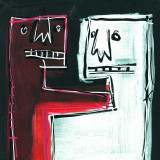
Hailing from Queens, NY, the original members of Onyx were discovered by the legendary Jam Master Jay of Run-D.M.C Onyx released their ninth studio album, Onyx Versus Everybody. Almost 30 years since their debut, Onyx still have raw energy, undeniable boldness and their pulse on the culture. The 10-track LP is a cohesive body of work that is full of street tales featuring appearances by Big Twin, Ricky Bats, Harrd Luck and Termanology. If you're a diehard fan of Onyx, this is one of the group's best projects in their legendary career. According to Sticky Fingaz, the album was completed in just two weeks thanks, in part, to the group's new songwriting process. "We didn't really write anything," he recalls. "We wrote a little bit but you know, we got a new technique where we just vibe and get on it. We recorded everything in the Batcave. That's Fredro's studio." Fredro says their classic "Last Dayz" from their sophomore album, was the inspiration behind the production on their new album. "'Last Dayz' is a Hip Hop classic beat you know? It was in 8 Mile and that made it even more legendary so I wanted to get the vibe on the album," he says. "I know what I know when it comes to making beats and my style never changed. That's why it sounds like 1996 because I didn't change the way I make my beats. When it comes to producing, Fredro claims to have the hardest tracks in the game and he brought that same energy to the new album. "I don't get nothing from a beat machine," he added. "I don't even use a hi-hat. I got my own drums. I play my own drums. My shit is dirty. I need it to be dirty. My shit is filthy. I got the nastiest, grimest, beats in Hip Hop." With their signature hardcore lyricism and gritty production, Onyx Vs Everybody makes a strong case for being named among the best albums of 2022 so far, but that isn't the recognition they seek. "Onyx Vs Everybody is the hottest, grimmest, dirtiest album of the year," Sticky Fingaz boasts. "I don't want the best album of the year. They can have that. This is the grimmest album of the year." Coming off a Versuz beating Cypress Hill at the forum in LA and now on a international tour, for fans of Cypress Hill, Public Enemy, Run DMC
Buscar:process
Florence Cats is a poet, visual artist, sound composer, performer and acupuncturist. Born in Vilvoorde (Belgium) in 1985, she is currently living and working where Brussels merges with the Sonian forest.
Florence Cats’ working process involves things about to appear or disappear, and echo one another : air, light, wind, tone, print, voice, water, color, dust, junk, rumor… She creates eclectic pieces related to travel, porosity, natural energies and celestial events. Each proposal is in tune to a context, a space, an environment.
Ys is a generous debut. Raw, courageous.
Sunken Cathedral is Florence interpreting Claude Debussy’s La Cathédrale Engloutie (trans. the Sunken Cathedral). The track reminds me of one of those fabled Charles Ives home recordings. Where he records himself on Speak-O-Phone - an old brand of recordable aluminium phonograph discs - while practicing and composing his music. But unlike Charles Ives treating these home recordings as personal sketches, Florence Cats shares her captured moments as compositions for the public.
Similar to the Speak-O-Phone recordings, we now meet the piano as a physical expression - not as an archetype. We are together with Florence in a room. The pedal. The keys. The hiss of the room. Learn, repeat.
Trough Florence’s hands and feet, La Cathédrale Engloutie is brought out of its pupa stage to become a presence. Instead of being grounded in luxurious concert halls or on high end recordings, the piece is now natural. Sunken Cathedral is a template, an affirmation for amateurs.
The piece was originally created for the group exhibition "Here Comes the Wave” at Project(ion) room, Brussels, February 2020.
In Fall Call, we find ourselves at QO2, a sound art initiative in Brussels. This piece was captured during a residency Florence took over the summer of 2022. We listen to the moment when a summer storm just washed the city.
Fall Call is a testament to Florence’s magical - humanistic way of playing her custom-made theremin. By pushing the controls of the instruments so high, her whole body starts to control the instrument - instead of just her hands. So when she walks around in the room, the instrument answers in full color.
And then, a phone-call. Giving it a bit of a Poulenc vibe.
For the last piece, Drop Out, we find ourselves in Florence’s apartment. When Florence opens the windows, the ambience of the surrounding Sonian Forest seeps in. This is an adorable moment. It predicts new beginnings. The smell of wet dirt and dripping leaves in the air. The poetry of rain.
Jon K and Elle Andrews’ MAL imprint returns with a new LP from one of the London experimental underground's best kept secrets, Rory Salter aka Malvern Brume. His music is rare, eccentric and mysterious - somewhere between Coil's bleak ritual magick and the BBC Radiophonic Workshop's most experimental, minimal fringes.
Malvern Brume operates just beneath the radar, occasionally turning up at Café OTO lineups and on a smattering of releases for Low Company, Alter, Infant Tree and Kasual Plastik - but he’s never one to shout too loudly about his work. ‘Body Traffic’ is his most interesting set to date, laying bare a process melting found sounds, field recordings and spoken word into throbbing, pulsing rhythms. It’s an evocation of a fraught mindset during the early weeks of lockdown in 2020; sequestered in his flat next to a trainline, the infrasonic - and more audible - rumbles of rolling stock and a nagging sense of dread infecting his ambiguously discomfiting recordings.
Operating in a headspace that values world-building and vivid, visual emotionality, Salter’s careful melodies are familiar - the distant, weeping melancholia of 1970s British TV hangs off the recordings like net curtains, and his atmosphere loops into experiments that weave through bare traces of industrial music, blank-faced electro pop, and hedonistic Brummie techno, all reduced to a cinder.
The mood is set on the bellyaching resonance and crawling walls of the title tune, while 'Through Beaked Fog Horns' is drowned beneath morning mists: lopsided synth drones choke and drift, percussion mutates into inebriated bubbles, and tape-f*cked environmental whirrs create an atmosphere that’s hard to decipher in one take.
‘Moss Spines Clenched’ follows cryptic stains on peeling flocking, and the icy creep of ‘Tense Branches Waver’ quivers beyond a cracked windowpane. The artist’s voice appears from beneath a cardboard box fort in the imaginary world of ‘Cornered Into Sleat’ as a distant drum beats out a marching thud and traffic squeals are sculpted into chirpy whistles, before ‘Bri Dun’ resolves the eerie tension in an OOBE-like ascent above the dado-rail and across the tracks, watching himself fade into a dissociative bliss.
"All chatter falls quiet…” Salter murmurs thru saturation and white noise. It’s a sound that’s gonna stick with us for a while.
10 year anniversary edition on orange & red marble vinyl. While his formative years were spent listening to everything from Yes to Photek, Scott Hansen didn't get his hands on an actual guitar or drum machine until he left his native Sacramento for San Francisco in 1995. "Encountering this whole new world at 20 years old was a profound experience," says Hansen, better known by his musical pseudonym Tycho and as the graphic artist ISO50. "At the time, I was just learning the processes of design and music; both felt very similar, and have flowed back and forth for me ever since."As seamless as his two creative outlets have been, nearly a decade passed before the release of Hansen's first proper Tycho LP, Sunrise Projector (later expanded and reissued under the title Past Is Prologue). And while three striking singles have emerged since then, the sum of all those sepia-toned parts is nowhere near the double-exposed soundscapes of Dive. The product of a prolonged break from IS050's design work and blog, it pays tribute to Tycho's prismatic past (the dense, guitar-guided turning points of "Daydream" and "Adrift") but spends most of its time pointing to the project's not-so-distant future.That can mean any number of things, really, from the halcyon hooks and hopeful horizons of "A Walk" to the expansive, wildly expressive tone poetry of the title track, an eight-minute epic that unfolds like a compressed concept album. Or at the very least, a restless vision of prog-rock - one that's been coated in neon colors and filtered through a thick piece of blotter paper. And then there's "Elegy," a spare curtain closer that pairs a vulnerable crescendo with a fitting bridge to future works.And with that, Dive establishes its position as the most diverse musical statement of Hansen's multi-medium career; the point where his skills as a performer finally catch up with his vaporized vision of a world that doesn't belong to any particular time or place."Nostalgia is a common thread in my work," says Hansen, "but this album wasn't driven by that idea. I see these songs as artifacts from a future which might have more in common with our past than our present."
Following Notte Infinita's 'I Lost All My Data' release on INDEX:Records, the Berlin-based artist mediates the balance between dub-laced frequencies, introspective melodies and atmosphere on the next Oscilla Sound release. His propulsive Atmosfera three-tracker focuses on digital signal processing and embraces the shimmery, hyper-realistic synthetic quality of FFT manipulation. Notte Infinita explores emotional narratives through sonic gestures and textures, taking inspiration from spaces, dreams and the experience of manipulating digital artefacts.
Each of the three hundred covers is different! All are numbered.
After two well-received albums of Normal Bias, the time has come for a solo debut in U Know Me of the half of this valued dub dub, i.e. Piotr Krupiński, better known as YAC.
The starting point for "We Have Much More In Common Than What Divides Us" was the rhythm, and on the one hand synthetic sounds of classic analog synthesizers with the legendary EMS VCS3 at the forefront, and on the other hand the organic hypnotic sound of Tibetan bowls and tubular bells. All together strongly processed and traditionally ground with dub techniques and marked by the tape's noise.
The amazing graphic design was created by Bartosz Szymkiewicz.
The cover design is the result of an attempt to graphically represent the album's minimalist but full of lively nuances music. Each of the forms on the cover corresponds with its surface area to the length of the work it depicts. The composition was procedurally generated by a computer program, resulting in 300 unique covers. Interestingly, the program definitely preferred to arrange the forms close together, which is an unforeseen reference to the title of the album.
Leaving established paths to explore mysterious spaces below the surface.
Connecting with the elements to escape the hypnosis.
Drifting on a psychedelic trip to wake up the warrior.
repress !
Wax’o Paradiso Recordings presents its debut outing on vinyl, OK EG’s Intertidal Zone EP. The new label from the long standing Naarm (Melbourne) party is set to explore hi-fidelity, landscape-driven and cerebral music from the antipodes and beyond.
After sold out pressings on local imprints Animalia and Steeplejack, this EP explores a more contemplative side of OK EG, suitable for discerning dancefloors and meditative home listening alike.
Conceived in 2019 and completed in 2020, Intertidal Zone was recorded in collaboration with percussionist Phil Stroud. The rhythm tracks are a fusion of drum machines and hand drums, loose percussion, human voices and tuned percussion immersed in water. Joined by analog synthesisers, layered vocals, processed guitar and field recordings, the music evokes solastalgia and a reverence for nature.
The final track, Golden Hour, came from an improvisation with multi-instrumentalist Adam Halliwell on flute and jazz musician Jack Doepel on Korg bass, later transposed to modular synthesiser.
Wax’o Paradiso and OK EG acknowledge the traditional owners of the land on which this music was recorded, the Wurundjeri people of the Kulin nation, and pay their respects to elders past, present and emerging.
At the start of the pandemic, Carrellee turned to the microKORG and Yamaha DX7 synths after finding traditional folk music to fall a bit flat in expressing the personal intensity of the year including the dissolution of her marriage. Following her weekly demo videos amassing nearly one million streams on Facebook in 2021, Carrellee teamed up with producer Brett Bullion (Low, Poliça, Now Now), Con Davison (Bad Bad Hats) and Huntley Miller (Lizzo, Slyvan Esso) in Minneapolis to distill 40 demos down to 10 cohesive album tracks. The resulting album conjures crushed artifacts of desire, with each instrument processed through crumpled and scorched analog tape. Carrellee draws inspiration from 80's new wave icons Cockteau Twins and Kate Bush, as well as a wide variety of Italo disco and synthwave artists. The single and music video "Morning Sun" by Doug Pray (Hype, The Defiant Ones) will be released in advance of the album on Negative Gain (Mr Kitty, Twin Tribes) with tour dates to follow.
"Hyaline" is the debut album from Ohio-born, Oakland, CA-based artist and songwriter, Maria BC. Their classically-trained mezzo-soprano voice soars over raw, etherial guitars; audio samples from Prospect Park - now almost unrecognizable - settle alongside tender, transformative harmonies. Mixing together different sessions, tracks recorded directly into their phone and samples collected over the years, Maria BC likens "Hyaline" to a "sonic collage." It"s a project of patience and trusting the process.
Clear Vinyl
Originally released in 2020 on cassette and digitally. more eaze is the nom de plume of Austin, TX mainstay m.maurice, a roving experimentalist who’s explored an astoundingly diverse range of sounds, from drone and computer music to avant-pop and beyond. claire rousay is a San Antonio, TX-based percussionist/composer/sound artist who uses physical objects and their potential sounds as a way to explore queerness, human physicality, and self perception. Together—through a suite of deeply personal aural collages—two of Texas’ most vital and vibrant sonic searchers beg the eternal question: If I Don't Let Myself Be Happy Now Then When?
Although only their debut album together, If I Don’t Let Myself… reveals a profound and fruitful relationship between m and claire. But the symphonic symbiosis goes even deeper still. Outside of musical breakthroughs, the pair helped each other conquer intensely personal changes, with m and claire transitioning and coming out as non-binary and trans, respectively.
As m explains, “to me this record is very much about this process of becoming—trying to reach something and getting there but sometimes not being quite where you want to be but at least getting closer. It’s about feeling alternately empowered and insecure socially as you transition and trying to cope with these conflicting emotions.”
Musically, the album showcases startlingly sincere sets of serrated but sedative situational music. A-side epic Drunk is a sprawling but taut rove of aural duality. Passages of exquisite elegance subtly clash with shimmering shards of sound. Pre-op is a poised and pensive piece of solemn reflection, harrowingly honest and delivered with clarity and composure, while Post-op closes out the set in a wholly uplifting and optimistic flair.
If I Don't Let Myself Be Happy Now Then When? is ultimately about coping during the respective transitioning phase in both of their lives, obliquely blissful and fraught with freedom.
Social Joy Records presents Natural Lateral's new album "Tapestry of life", a superb excursion in fusion jazz with a wonderful blend of electronics and subtle elements of spiritual Jazz.
Undeniably on the rise after the success of their first album, "Cogito Ergo Jam", which received support from the British Jazz scene and was featured on Gilles Peterson's BB6 broadcast,the North London Based collective goes a step further this time by carefully crafting a new release of a tapestry of music stemming from rich jam sessions at the Lazy Robot Studio and representing the band's phenomenal musical canvas. Echoing jazz legends like Azymuth, Roy Ayers, Alice Coltrane and Miles Davis by paying tribute to those who paved the way but always searching for new musical territories, this six-track LP is moving, thought-provoking and engaging. It is a musical questing where each band member searches for meaning through sounds and rhythms - giving a new life to Jazz music and dropping the full spectrum of a vibrant tapestry of life into the listener's ears.
The band's work ethic is based on a sense of freedom in the studio filled with live jam sessions where it's all about "catching a moment" and letting the inspiration flow. "We just want to feel a sense of freedom and connection through playing. In the studio, it's the music which connects us all, and we just want to allow that process to unfold".
"Music gives us the illusion that time is not time, but space. It is then that the music transforms from process to object, which I find a very interesting thought; a materialisation of the sound process. Sound is matter." - Noémi Büchi
Noémi Büchi's debut album 'Matter' captures the tension between growth and decay, consonance and dissonance, mirroring Büchi's own catharsis through music. Her most personal material to date, 'Matter' is an opus of refined, sculpted beauty, one that aims to blur the distinction between ephemerality and physicality. Inspired by late romantic classical music and early 20th century contemporary music, 'Matter' is driven by the compositional methodologies of Igor Stravinsky, Alexander Skrjabin, Gustav Mahler and György Ligeti to modern sound forms, adapting and expanding upon their ideas in an awe-inspiring exploration of cutting-edge potency and tactility.
Büchi structures the electronic works that constitute 'Matter' in movements, stratifying myriad instrumental parts like the constituent sections of an orchestra. During her work on the album, Büchi engaged in extensive research, obsessively studying specific chords and progressions, and searching for transcendent intonations with resonant properties; complexions of sound with the ability to connect with the listener's body. Transforming our inner worlds into zones of suspension and levitation, Büchi exposes the listener to intoxicating slipstreams of sound. Prominent voices ascend, tectonic disturbances threaten the foundations, perception and sensation becomes subject to elemental countercurrents and inversions. 'Matter' illustrates the fraught pursuit of momentary equilibrium, and makes the fragility of euphoria tangible.
Composer & sound artist Noémi Büchi creates electronic, symphonic maximalism. Her music is defined by delicate electronic-orchestral forms and textural rhythms. She strives for a combination of harmonic and dissonant sonorities, to evoke both intellectual and emotional euphoria. Büchi has appeared on the Light of Other Days and Visible Dinner labels, and is now an affiliate of -OUS, releasing 'Hyle' her debut EP on the label in spring 2022. As well as her solo output, Noémi Büchi is currently working with Feldermelder on their collaborative project Musique Infinie. Their debut album will also be released via -OUS in the near future.
Recently discovered in the vaults - 10 previously unreleased and virtually unheard studio recordings.
Including covers of Bob Dylan, Sly & The Family Stone, The Smiths, Led Zeppelin, Bukka White and Jevetta Steele, in addition to the first ever studio recording of his signature song 'Grace' and 'Dream Of You And I', an unheard original recording which informs the deeply intimate and profoundly personal mood of the album. These recordings represent the breadth of Buckley's influences and talent for interpretation.
Recorded prior to the sessions which would become his seminal debut album 'Grace', these tracks offer a unique insight in to the creative process of a developing genius and inimitable immerging talent.
The Columbia/Legacy release of Jeff Buckley's You and I has been overseen by the artist's mother, Mary Guibert.
Flox is square. Square, precise, direct.
He goes straight to the point, and doesn’t waist his time with useless considerations. “I have no time to shit around”, he says. So, his seventh album is called Square. Square represents a major turning point in the career of the pioneer of nu reggae. An extraordinary architect of studio production and multi-instrumentalist who records, mixes and produces but also, for several years, performs on stage with his musicians. After recording Square, he started touring alone, equipped with a machine he designed and built with Midi controllers to launch original samples and loops - an autarky assumed from one end of the process to the other. “You have to master all the tools to deliver what you want”, he has been saying for years...
Yet, this Square is wide open: old school rhythms or techno-like approaches, vintage dub or futuristic take offs, thick sound basses and melodies, scraped to the bone...
Originally released in 2014, “Instruction Booklet N. 1232” marks the first cassette release on Dauw for Tatersall under his The Humble Bee moniker. Taking advantage of the format, each side on “Instruction Booklet N. 1232” is reserved for a single piece nearing the 20-minute mark.
“Exploding View” (aka Side A) swells into existence with a very grand sounding synth-driven melody. Of course the other thing that’s present is the decaying sound of the tape loop that’s working to bring that music to life. At first, the melody grows and grows, fairly undisturbed, but eventually the sound of so-much tape warble threatens the rising nature of the piece until it sounds as though it is one loop away from total decay and simply fluttering out of existence.
But of course that’s the point. There’s a tension between that grand melody that opens these moments and that warble. It’s a lesson in opposites: the mechanics of a tape loop, guaranteed to break down, placed in contrast with those signature Tatersall melodies, which somehow seem eternal. And just as that tension seems too much to bear — the melody dies to be replaced by something altogether new. What comes next is something much quieter, driven by a sub-aquatic bassline, some rhythmic tape hiss and some gentle piano.
It’s a very dramatic and sudden break. The technical elements of that could be attributed to Tattersall’s understanding of how far a melody can be pushed before it succumbs to the abuse of being processed out of existence — perhaps the tape had been looped and processed to its breaking point. Regardless of whether it was a technical or artistic choice, that hard break serves an important narrative function. Frequently in instrumental music, musicians play with opposites (quiet-loud, clean-distorted) to create a narrative to their work since they don’t have words/lyrics as a tool. In the case of The Humble Bee’s use of tape loops, one set of opposites in tension is always driven by the fragility of the melodies and the limitations of a machine guaranteed to inevitably decay the media it is designed to support. And where one thrives, the other takes a backseat. As side A winds down, the melodies are much more sparse — appropriate for en ending, yes; but it also gives more space for those hisses and crackles to claim their moment.
Side B is filled out by “Manual with Foot Pedal” and it begins as gently as its predecessor ended. Slowly eking outing it existence – it’s as if watching Tatersall set the board, showing his players on opposite sides of the table before really setting them in motion to do their thing. By the piece’s midpoint, melody has taken centre stage as a glitchy, piano-led rhythm marches its way forward, clearly carving out its space and claiming its territory. And almost immediately following that: the decay takes over again and those tape loops seem processed to near death — the melody almost barely decipherable as it flutters under the weight of the history of being looped/played ad nauseum. And in the very final moments, the melodies are sparse again, giving the tape hiss room to play its part — it’s as if Tatersall is giving both players enough space to take their final bows.
- 1: The Hosting Of The Shee (2022 Remaster)
- 2: Song Of Wandering Aengus (0 Remaster)
- 3: News For The Delphic Oracle (2022 Remaster)
- 4: A Full Moon In March (2022 Remaster)
- 5: Sweet Dancer (2022 Remaster)
- 6: White Birds (2022 Remaster)
- 7: The Lake Isle Of Innisfree (2022 Remaster)
- 8: Mad As The Mist And Snow (2022 Remaster)
- 9: Before The World Was Made (2022 Remaster)
- 10: September 1913 (2022 Remaster)
- 11: An Irish Airman Foresees His Death (2022 Remaster)
- 12: Politics (2022 Remaster)
- 13: Let The Earth Bear Witness (2022 Remaster)
- 14: The Faery's Last Song (2022 Remaster)
- 15: A Faery Song (We Who Are Old) (Demo)
- 16: The Four Ages Of Man (Demo)
- 17: Our Father Rosy-Cross (Demo)
- 18: Do Not Love Too Long (Demo)
- 19: The Travelling Man And The Tree (Demo)
- 20: News For The Delphic Oracle (Demo)
An Appointment with Mr Yeats sees the words of W B Yeats, one of Ireland's greatest literary sons, merged with the music of The Waterboys, one of Britain and Ireland's greatest rock bands, in a truly unique and ambitious musical undertaking. The album was originally released in 2011, and has been fully remastered for re-issue, and now contains 6 previously unreleased bonus tracks. The Waterboys vocalist Mike Scott, first delivered a new dimension to Yeats' poetry in 1988, when he wrote a musical accompaniment for the classic poem The Stolen Child, during the making of the Waterboys seminal album 'Fisherman's Blues'. Five years later he set another Yeats poem to music, Love and Death, which appeared on their 'Dream Harder' album. Over the years, Scott had been quietly crafting a wealth of material similarly based on the writings of Yeats. A number of these were performed by him at the Abbey Theatre during the Yeats International Festival in 1991, but most had remained in Scott's private songbook awaiting the right vehicle. An Appointment with Mr. Yeats was that long-awaited context. Scott's love of literature is firmly embedded throughout the work of The Waterboys. He has also put the writings of Robert Burns, James Stephens, Kenneth Grahame and George MacDonald to song. Speaking on his literary influences and loves, Scott explained: "I grew up in a house full of books so literature - and language - have always been important to me. Working with other peoples' words is something that comes as natural to me as working with my own. In a way it's even more immediate; I've always found writing music an easier process than the writing of lyrics, and setting words of the quality of Yeats' to music is an enormous privilege and treat." An Appointment with Mr. Yeats is a unique and memorable opportunity for lovers of great music and great literature to celebrate the union of song and word in one spectacular record.
In hugo, there’s a central question that Loyle Carner keeps coming back to: “I’m young, Black, successful and have a platform - but where do I go next?” The answer is explored in this epic scream of a third album. With urgent delivery and gloriously widescreen production, Carner confronts both the deeply personal (“You can’t hate the roots of a tree, and not hate the tree. So how can I hate my father without hating me?) and the highly political (“I told the black man he didn’t understand I reached the white man he wouldn’t take my hand”). Cinematic in scale and scope, hugo is both a rallying war cry for a generation forged in fire and a study of the personal internal conflict that drives the rest of the album - as a mixed-race Black man, as an artist, as a father and as a son. With Mercury and Brits nominations, NME Awards and appearances in global brand campaigns (Nike, YSL, Timberland), Carner has undoubtedly had a meteoric rise to the top, culminating with his second album Not Waving, But Drowning charting at number 3 in the UK albums chart in 2019. However, hugo sees Carner taking a sharp detour from his previous work, putting it down to lockdown and the “hedonistic side of career being stripped away. There were no shows, no backstage, no festivals, no photoshoots”. By continuing to write in these tumultuous times with a renewed clarity and sense of artistic freedom, Carner reached deeper beneath the surface than he ever had before. The result is his most cathartic and ambitious record yet, a coruscating journey into the heart of what it means to be alive in these tumultuous times, and one which looks set to neatly cement his position as one of the most potent and vital young talents around today. Working alongside renowned producer kwes. (Solange, Kelela, Nao), Carner leaves no stone unturned on this album, in both its sound and its stories. In a 10-track album that moves from gorgeous neo-soul moments to thundering hip hop, with immediate, infectious bangers and sampled interludes from non musicians (mixed-race Guyanese poet John Agard and youth activist and politician Athian Akec) Carner shifts seamlessly from micro to macro, confronting everything from strained relationships with family to the societal tears caused by class stratification. It also lays bare bruises in his personal life that he has never revealed before – often in painful, deeply uncomfortable ways, focusing on Carner's experience of becoming a father in the context of growing up without contact with his biological father. With the song “Polyfilla”, against the backdrop of a warm melodic beat, Carner explores his desire to “break the chains in the cycle” of dysfunctional Black fatherhood, commenting on the narrative of fatherhood in the genre, and saying a key part of the process was realising that his father “grew up in a world where nobody showed him how to love or nurture”. The follow up track “A Lasting Place” is an exploration of the MC’s failure and inability to be perfect in this mission. The album closer is a powerful statement of love and forgiveness; with his signature lyrical dexterity, Carner declares his relentless commitment to his son and sees forgiving his father as a key part of this. The song closes with an emotional ending of Carner telling his dad “still I’m lucky yo that we talk”. There’s a striking duality of hugo’s bold, multilayered tracks and its often starkly intimate and tender lyricism, and that dichotomy is deliberate - it is a message for young Black men, but really, anyone, who is listening. Cognizant of the immense pain and fear and confusion that we are faced with everyday, Carner has thrown down the gauntlet, defying us not to rise above the fray, wake up each day and be ambitious. Ambitious in building strong personal relationships. Ambitious in our pursuit of our goals. Ambitious in never refusing to back down against injustice. Rejecting the title of leader, Loyle Carner sees himself “as holding up a mirror”, and that clearly translates into the album's universal messages.
- 1: Runner: I. Sixteenths
- 2: Runner: Ii. Eighths
- 3: Runner: Iii. Quarters
- 4: Runner: Iv. Eighths
- 5: Runner: V. Sixteenths
- 6: Music For Ensemble And Orchestra: I. Sixteenths
- 7: Music For Ensemble And Orchestra: Ii. Eighths
- 8: Music For Ensemble And Orchestra: Iii. Quarters
- 9: Music For Ensemble And Orchestra: Iv. Eighths
- 10: Music For Ensemble And Orchestra: V. Sixteenths
‘Runner is a calmly luminous orchestral piece with the pulsating, propulsive
rhythms that animate much of Mr. Reich’s music.’ – New York Times
‘Reich interweaves the two groups to create a dense textural tapestry that sounds like his most native orchestral thinking to date. A beautiful and dramatically charged masterpiece.' – San Francisco Chronicle
Nonesuch Records releases the first recordings of Steve Reich’s Runner (2016) and Music for Ensemble and Orchestra (2018), performed by the Los Angeles Philharmonic and conducted by Susanna Mälkki.
Reich says Runner is written “for a large ensemble of winds, percussion, pianos, and strings. While the tempo remains more or less constant, there are five movements, played without pause, that are based on different note durations. First, even sixteenths, then irregularly accented eighths, then a very slowed-down version of the standard bell pattern from Ghana in quarters, fourth a return to the irregularly accented eighths, and finally a return to the sixteenths but now played as pulses by the winds for as long as a breath will comfortably sustain them. The title was suggested by the rapid opening and my awareness that, like a runner, I would have to pace the piece to reach a successful conclusion.”
“Music for Ensemble and Orchestra is an extension of the Baroque concerto grosso where there is more than one soloist,” the composer continues. “Here there are twenty soloists – all regular members of the orchestra, including the first stand strings and winds, as well as two vibraphones and two pianos. The piece is in five movements, though the tempo never changes, only the note value of the constant pulse in the pianos. Thus, an arch form: sixteenths, eighths, quarters, eighths, sixteenths. Music for Ensemble and Orchestra is modeled on my Runner, which has the same five movement form.”
Nonesuch has recorded every new piece of music by Steve Reich since 1985, beginning with The Desert Music and continuing through 2018’s Pulse/Quartet, resulting in 22 albums and the two box sets Phases in 2006 and Works: 1965-1995 in 1997. Most recently, the label released his Reich/Richter, performed by Ensemble intercontemporain and conducted by George Jackson, in June 2022. The Times said, ‘What a delight to be able to focus on the music, delivered here with a clever mix of pinprick precision and reverberant haze by 14 members of Ensemble Intercontemporain. The more intently you listen, the more subtleties emerge among the shifting, criss-crossing textures and phrases, sometimes coloured with gentle melancholy but decisively upbeat by the end. Reich/Richter is an ear-tickling tonic and a happy companion to Reich’s newly published book, Conversations.’ Nonesuch will put out a collection of Reich’s complete works in 2023.
Reich released a book earlier this year, Conversations, that includes dialogues with past collaborators, fellow composers, musicians, and visual artists who have been influenced by his work, including: David Lang, Brian Eno, Richard Serra, Michael Gordon, Michael Tilson Thomas, Russell Hartenberger, Robert Hurwitz, Stephen Sondheim, Jonny Greenwood, David Harrington, Elizabeth Lim-Dutton, David Robertson, Micaela Haslam, Anne Teresa de Keersmaeker, Julia Wolfe, Nico Muhly, Beryl Korot, Colin Currie, and Brad Lubman. The Wall Street Journal called the book ‘a testament to the influence of an idea – one that triggered a cultural turning point,’ and the New York Times said, ‘The joy of the book is to hear artists from a variety of disciplines and backgrounds rhapsodizing about their relationship to Reich’s music and how it influenced their own creative processes.’
Steve Reich has been called ‘America’s greatest living composer’ (Village Voice), ‘the most original musical thinker of our time’ (New Yorker), and ‘among the great composers of the century’ (New York Times). His music has influenced composers and mainstream musicians all over the world. Music for 18 Musicians and Different Trains have earned him two Grammy Awards, and in 2009, his Double Sextet won the Pulitzer Prize. Reich’s documentary video opera works – The Cave and Three Tales, done in collaboration with video artist Beryl Korot – have been performed on four continents. His recent work Quartet, for percussionist Colin Currie, sold out two consecutive concerts at Queen Elizabeth Hall in London shortly after tens of thousands at the Glastonbury Festival heard Jonny Greenwood (of Radiohead) perform Electric Counterpoint followed by the London Sinfonietta performing his Music for 18 Musicians.
In 2012, Reich was awarded the Gold Medal in Music by the American Academy of Arts and Letters. He has additionally received the Praemium Imperiale in Tokyo, the Polar Music Prize in Stockholm, the BBVA Award in Madrid, and the Golden Lion at the Venice Biennale. He has been named Commandeur de l’Ordre des Arts et des Lettres and has been awarded honorary doctorates by the Royal College of Music in London, The Juilliard School, and the Liszt Academy in Budapest, among others. ‘There’s just a handful of living composers who can legitimately claim to have altered the direction of musical history and Steve Reich is one of them,’ states the Guardian.
Redefining what an orchestra can be, the Los Angeles Philharmonic (LA Phil) is as vibrant as Los Angeles, one of the world's most open and dynamic cities. Led by Music & Artistic Director Gustavo Dudamel, this internationally renowned orchestra harnesses the transformative power of live music to build community, foster intellectual and artistic growth, and nurture the creative spirit. This is the third recent recording by the orchestra on the label; the others were the Louis Andriessen pieces The only one and Theatre of the World. Additionally, the Los Angeles Philharmonic’s recordings of The Gospel According to the Other Mary and Must the Devil Have All the Good Tunes?, with Yuja Wang, released on Deutsche Grammophon, are included in this year’s John Adams Collected Works boxed set. Nonesuch also released an LA Phil recording of Adams‘ Naïve and Sentimental Music in 2002.
Susanna Mälkki is sought-after at the highest level by symphony orchestras and opera houses worldwide. About to embark on her final season as Chief Conductor of the Helsinki Philharmonic Orchestra, she concludes a seven-year tenure with a distinctive dynamism and imaginative flair to her programming. In addition to a full season in Finland, she will lead the Helsinki orchestra on tour to the prestigious Lucerne and Edinburgh festivals, New York’s Carnegie Hall, and Washington’s Kennedy Centre this season.
SoiSong is the stunning but short-lived partnership of Coil co-founder Peter "Sleazy" Christopherson and veteran Russian electronic experimentalist Ivan Pavlov. Though friends since 1997, the project birthed roughly a decade later in Bangkok, where Christopherson relocated following the death of his Coil collaborator John Balance in 2004. Named after the Thai word for `two' along with a notorious red-light district street nearby, the duo dialed into a cryptic language of lurching synthetics, Eastern minimalism, and interdimensional glitch, oscillating between elegance and mayhem. qXn948s collects some of their earliest recordings, and remains as transgressive and transcendent a listen now as it was upon its release a decade and a half ago. Pavlov characterizes SoiSong as less a musical group than a "utopian, semi-alien platform for collaboration, devoid of pronounced personality or centralized authority_ more like a message from elsewhere that anyone is welcome to participate in and spread." Every facet of the project was disruptive and oblique: self-released CDs packaged in elaborate origami that had to be destroyed to be accessed; a website with password protected sections, where different passwords were provided for different events, objects or releases; performance merchandise of headphones and a Walkman melted shut so the music can only be heard as long as the set of batteries last. Theirs was a muse as unprecedented as it was uncompromising, equal parts pranks and profundity. qXn948s began with samples and software composed intuitively in tandem before a large monitor, then progressively processed and scrambled into bewildering arrangements of digital frequencies, alternately spartan and claustrophobic, uneasy and uncanny. Vignettes of small melody emerge and are obliterated; gamelan-esque tones spiral above cybernetic pulse programming and funereal didgeridoo; skeletal piano meanders in the distance while flickering circuitry pummels patterns of white noise. Pavlov describes his and Christopherson's chemistry as "unspoken and sincere, and very efficient." That music this aggressively disorienting and complex congealed in a smoothly organic fashion is testament to the rare vision of its creators.