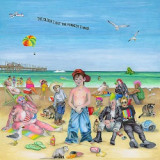
From their new millennium rise to MTV superstardom through pop-punk’s modern resurgence that has introduced their iconic, multi-platinum sound to new audiences around the world, SIMPLE PLAN have been an indelible part of pop culture for more than two decades because they’ve never lost sight of what got them there in the first place: their fans.It’s this same sense of mutual respect that’s fully on display on “The Antidote,” the first single from their sixth studio album, HARDER THAN IT LOOKS., their first new music since 2016’s Taking One For The Team, and the most authentically Simple Plan album since 2004’s Still Not Getting Any. Free agents for the first time in their storied career, the band kept their circle tight during the recording process, enlisting longtime songwriting partners like We The Kings’ Travis Clark and producers Brian Howes and Jason Van Poederooyen (who worked on the band’s 2011’s album Get Your Heart On!) and Zakk Cervini (blink-182, Good Charlotte). From the skyscraping choruses of “Congratulations” and “Ruin My Life” (ft. Sum 41’s Deryck Whibley) to the unflinching poignancy of the album-closing “Two,” which instantly ranks alongside “Perfect” and “Untitled (How Could This Happen To Me?)” as one of the band’s best closers ever, HARDER THAN IT LOOKS certainly respects Simple Plan’s storied career – and the same spirit that helped the band sell 10 million albums worldwide – without being overtly reverent. The album-opening “Wake Me Up (When This Nightmare’s Over)” is a cathartic rush of familiarity and freshness – not to mention a bit lyrically prescient, as the COVID-19 pandemic hit shortly after the band wrapped the album. (“We certainly didn’t set out to write a pandemic album,” Bouvier says with a laugh. “It’s funny how some of the songs might seem like that, though.”) There are even spiritual successors to early material, like the glass-half-full skate-punk-leaning “Best Day Of My Life,” quite a 180 for a band who put a song called “The Worst Day Ever” on their genre-defining, Platinum-selling 2002 debut No Pads, No Helmets...Just Balls. But you won’t find an ounce of fat on the 10-song album, no obvious plays to recapture the radio waves they claimed in the early aughts with smash hits like “I’d Do Anything,” “I’m Just A Kid” and “Addicted.”
Search:process
As three souls plunge down from the heavens, death and destruction can be felt hanging in the air like a foul stench. Red clouds swirl around a black sun that never sets and an erratic clock ticks off-tempo, moving faster and slower before rewinding and starting anew.
“Let me paint you a picture…” vocalist Mikey Arthur sings, welcoming listeners with a dramatic opening scene. It takes a skillful guide to navigate the darkest depths of hell. And, as The Gloom In The Corner depict in their second full-length album Trinity, death is merely the beginning of the series of chilling adventures
Purposefully aligning their song count with unlucky number thirteen – a reoccurring symbol in the ever-unfolding Gloom Cinematic Universe or GCU – it comes as little surprise to longtime fans that each of the Australian quartet’s enticing tracks intertwine to form an interlocking tale; this time centered around the appropriately labeled unholy trinity.
Comprised of previously deceased characters Rachel Barker, Ethan Hardy, and Clara Carne, the group’s bloody battle is woven throughout the album as the anti-heroes determinedly claw their way back to Earth from the Rabbit Hole dimension, slashing, shooting, and extinguishing anyone who dares to oppose their quest. Yet, for the Girl of Glass, Ronin, and Queen of Misanthropy, there is clearly more to the story than what can be contained within a single package.
Projecting a wide and complex web of lore, plot twists, and tongue and cheek humor, frontman Mikey Arthur, guitarist Matt Stevens, bassist Paul Musolino, and drummer Nic Haberle, have been producing highly detailed concept releases since their formation. And, consistently filling in more missing pieces of the puzzle with every body of work, the band equate each new record to a fresh season of The Umbrella Academy dropping on the streaming service of your choice. Because, just as a great TV series captivates viewers with its music and storytelling, the quartet’s work provides a complete experience designed to allow fans to check in with their favorite characters, all the while enjoying a cinematic new soundtrack.
For those just joining the GCU, as well as those looking for a quick refresh, 2016 debut album Fear Me introduced listeners to main protagonists Julian “Jay” Hardy, a Section 13 agent consumed by anger over his girlfriend Rachel’s death, and Jay’s gloom (later known as Sherlock Adaliah Bones), a demonic entity who at times takes over Jay’s body as a host vessel. 2017 EP Homecoming tells the tale of Jay’s brother Ethan, a war veteran suffering from PTSD, who upon discovering his brother’s struggle, kills himself as part of a Dante-style rescue mission to bring Rachel back to life. In 2019 EP Flesh and Bones, we’re introduced to Clara Carne, a past witness to one of Jay and Sherlock’s crimes, who instead of taking revenge, began a twisted love story with Sherlock, only to be murdered by his forced hand. And 2020’s Ultima Pluvia EP where we finally learn of Sherlock’s past as an ancient warlord under the tyrannical King Baphicho, and see Sherlock and Jay’s deaths ushered in by Section 13 opponent and New Order leader Elias DeGraver and his gloom Atticus Encey.
After 2016’s Fear Me, the band admit that their original intention was to jump straight into the events of Trinity before pivoting to create Homecoming, Flesh and Bones, and Ultima Pluvia. However, upon reflection, primary storywriter Mikey Arthur believes that pushing the timeline back actually provided greater opportunity for the group to properly flesh out the songs and plotlines for their sophomore studio record.
Indeed, while Trinity re-introduces the three central “heroes” of this new arc, it’s important to understand that while familiar, the characters are not carbon copies of who they were earlier in the story. And neither is the band who brought them to life.
Fully embracing the weird and whacky has never been a struggle for The Gloom In The Corner. Rather, it’s together with this attitude that the group come away with special moments such as the fascinating old and new dynamic between neighboring tracks “Red Clouds” – a song whose initial version predates the formation of The Gloom In The Corner as an official band – and “Gravity” in which a demo intended for future material was adjusted to fit the sonic drop.
Mirroring this evolution in the band’s musical approach, a sense of growth can also be seen projected in the characters and story that the quartet chronicle across the thirteen tracks.
Classifying their individual sound as an intricate form of “cinema or theater-core” due to the depth and breadth of their musical approach, features, samples, symphonic elements, and conceptual nature, The Gloom In The Corner continue to prove that they’re more than just a simple concept band.
In fact, similar to character theme music in movies and video games, the group seamlessly play off their diverse sonic story in a variety of ways. Continuing to breathe new life into older staples from their catalog, the quartet reworked their infamous “Oxymøron” breakdown from Fear Me into an impactful moment in Trinity’s “Nor Hell A Fury” and sprinkled audio easter eggs of this sort all throughout their new music for fans to discover.
Listeners are also brought further into the world of the GCU with the help of what The Gloom In The Corner call their “casting process.” Like picking actors for a musical, the band meticulously selected eleven different vocal features and several additional voice actors to bring the album and characters to life. Described as a 50/50 split between notable talents such as Ryo Kinoshita (Crystal Lake), Joe Badolato (Fit For An Autopsy), and Lauren Babic (Red Handed Denial), as well as talented friends and family like Elijah Witt (Cane Hill) and Mikey’s sister Amelia Duffield, each featured artist brought their own touch and realistic spark to the characters they portrayed.
For in the end, as much as Trinity and it’s cast live within the confines of their own supernatural worlds, themes such as falling out of love (Gatekeeper), battling depression (Obliteration Imminent), and standing behind women’s empowerment (Nor Hell A Fury), are ones that many can relate to or understand. And, while most individuals may avoid drowning their woes by way of transforming into full-on egotistical murderers like the Queen and King of Misanthropy and the gang, The Gloom In The Corner have illustrated that time and time again, life’s a little more fun when you can crack a smile. Taking a page from the trinity’s playbook: try to avoid the end of the world. But if you can’t…at least spend it with a killer soundtrack.

Recital publish an album of lost Derek Bailey sessions recorded with his friend and collaborator Charlie Morrow. In 1982, Bailey and Morrow organized a series of live concerts and studio sessions around New York. This new LP is a boiled-down rendering of the master tapes that lived dormant in Charlie’s archive, until now.
Throughout the album, Bailey and Morrow are joined by a rotating cast of New Wilderness players including frame drum percussionist Glen Velez, sound poet Steve McCaffery, publisher and artist Carol E. Tuynman, composer Patricia Burgess, and multimedia artist Michael Snow. The results are surprising and marvelous.
The energy of the live concert, which makes up the first half of the record is particularly exciting, with Morrow and McCaffery’s visceral sound poetry and Glen’s frame drum echoing off of Derek’s fret stabs, and Carol, Patricia, and Michael’s horns swirling through the air between. A very raw and intense recording.
The second side of New York 1982, is a session recorded at The Record Plant, and is clearly more ‘produced’ with panning and tape echo processing, plus experiments with water whistles and other devices.
Derek Bailey stands out for personal achievements as a guitarist and for his way of bringing together performance meetings ranging from duos to large ensembles. Working across style and genre, his music and musical unions have inspired the breakdown of boundaries, embracing all flavors of musicians as improvisers. Players focusing on the moment, “without memory.”
LP Edition of 400 copies on 175gram black vinyl, including an 8-page booklet with program notes and artwork.
Derek Bailey - Acoustic Guitars
Charlie Morrow - Trumpet, Ocarina, Voice
Glen Velez - Percussion
Patricia Burgess - Saxophone (1,3,6)
Steve McCaffery - Voice, Saxophone (1,3)
Carol E. Tuynman - Trumpet (1,3,6)
Michael Snow - Trumpet (3)
blue marbled vinyl
One of the most revered and respected artists to ascend in the immediate wake of the Autonomic wave - Sam KDC's innate understanding of depth and emotive layering has marked his path as one that leaves an indelible impression.
While his innovative adventures with Grey Area and the outer edges of Techno continue unabated, a collaboration with like-minded artist Flaminia has drawn Sam back to his original home in 170bpm.
Flaminia is a versatile and extremely skilled musician who has lent her talents to luscious dark ambient, and experimental Techno and continues to work on rediscovery and innovation. In our view, Flaminia is one of the more interesting artists currently rising in prominence in the electronic music scene.
Sam and Flaminia are an apt pairing and Grounding brings out a new side to both of them. Textures are applied with considered discernment, never overdone, and always embellishing the delectable grooves. Grounding has a truly ethereal, almost mystical overlay, while also brandishing dance-floor potency - a now inherent skill both artists have spent years assimilating into their construction processes.
New album from the acclaimed singer and songwriter Nerina Pallot. Written and produced by Pallot, the album was recorded over a three-year period, due in part to the pandemic but mainly as a result of her painstaking production process. If her previous album was more live in sound and feeling, I Don't Know What I'm Doing involves a large cast of supporting musicians, intricate orchestrations and
dedicated attention to detail.
The result is expansive and lush, with her trademark classic song- writing front and centre.
Low Company presents Yuta Matsumura’s Red Ribbon, a sequence of introspective, lavishly melodic dream-songs and amphibian atmospheres recorded in scattered periods over 2018-21. Having played in bands like Low Life, M.O.B. and Orion, and the duo Jay & Yuta (with Jay Cruikshank), Red Ribbon is Matsumura’s first solo outing, and represents a conscious effort to move away from guitar-based songwriting. He composed its nine tracks mostly on piano - layering vocals, bass, keyboards, flute (courtesy of Maeve Parker), violin/cello (Laurence Quinn) and clacking drumbox rhythms into dynamic, dubwise avant-pop structures which are supple and spacious but fizzing with detail and vivid inner life. The laconic 4/4 pulse, heat-warped synth-tones and haunting vaporous melodica of opener ‘Box Garden’ set the tone: its surreal psychedelic patternings barely concealing a deep sting of longing and regret. The cryptic lyrics suggest chance encounters, hidden logic, missed opportunities, fatalism, serendipity. A city submerged: everyone else paused mid-movement, while you’re allowed to swim free and fish-like through the streets, over the rooftops...‘Tangled Orchid’ is a tense night-drive through dry desert heat and into the unknown, running away from your old life, chased down by dust-devils of half-baked schemes and abandoned plans, while ‘Myth Machine’ drops the tempo and something mind-altering, guiding us on a tripped-out dub-disco scuba among alien flora and fauna, a world of impossible shapes and sensations. At which point, the mood of the album decisively shifts, firstly with ‘Sake No Otoh’, sung in Japanese by Haruka Sato: an instant-classic, breathtakingly intimate lover's lament that sounds like it got lost on its way to heaven and is now doomed to orbit the earth forever. The songs that follow continue in this more confessional, imploring mode. As if the travelling's done, the baggage has been cast off, and we’ve arrived at our destination, where the real process of rebirth and repair can begin. The music’s textures become less overtly dubby and electronic, with more of an organic, earthy, chamber-pop/avant-folk feel, at once sad and hopeful-sounding. Three songs in particular bear the influence of Eno’s 70s work (and its mutant bedsit offspring Lifetones, Flaming Tunes, etc): ‘‘E. Potential’, where baroquely chorused vocals - half-agonised, half-beatific - teeter on top of simple oscillating piano loops, and the stately, dawntreading ballads ‘Tabula Rasa’ and ‘No Sleep For Birds’. The bulk of the album was made prior to lockdowns and all of that; its themes of reset, self-examination, the need to f**k it all off and take spiritual stock, are timeless. Though they perhaps have a more bittersweet resonance now the world has returned pretty much to how it was, only worse. Track list: 1. Box Garden 2. Tangled Orchid 3. Myth Machine 4. Red Ribbon 5. Soko No Ato 6. Tabula Rasa 7. E. Potential 8. No Sleep For Birds 9. Zookeeper's Trial
JARV IS... have written & performed the original soundtrack for the critically acclaimed BBC TV series "This is Going to Hurt" based on Adam Kay"s award-winning international multi-million selling memoir of the same name. The soundtrack was recorded at Narcissus Studios, London by Drew Dungate-Smith during various sessions throughout 2021. Most of the performances are live takes featuring the entire band - often recorded whilst they watched the playback of key sequences from the series. Each episode features at least one song with lyrics by Cocker, who had access to the scripts (adapted by Adam Kay from his own book) from an early stage in the production process. JARV IS... is a band comprising Jarvis Cocker, Serafina Steer, Emma Smith, Andrew McKinney, Adam Betts & Jason Buckle. The soundtrack consists of a mixture of songs & instrumental pieces, with Cocker & Steer being the main composers. Cocker is quoted as saying "It"s our love song to the NHS".
RAW SPACE" is rooted in chaos and chance, sensuality and intensity - it's an album that's able to sound alarmingly freeform and tightly controlled simultaneously. Already established as a genre-disrupting DJ, and even dubbed "demon of the Nile" by Ugandan politicians after an exuberant performance at Nyege Nyege festival in September 2019, Kampala-based sonic hypnotist Authentically Plastic brings a digger's literacy, an activist's intent, and an artist's playfulness to their jagged debut album. As both a DJ and a producer, Authentically Plastic is drawn to the idea of chance as a creative tool - to push against the idea of the all-knowing genius, and approach artistry instead as a facilitator, unraveling parallel mismatched rhythmic events. Their musical process is to start with chaos, then attempt to mold those fleshy structures into polyrhythmic mutations, pulling influence from East Africa's innovative musical landscape and augmenting it with an exploratory sense of surrealism. On opening track 'Aesthetic Terrorism', rough-hewn industrial rhythms chug mechanically against course, dissonant synth blasts and acidic arpeggios. There's a faint sparkle of Detroit's chrome-plated Afro-futurism, but bathed in neon light, reflecting Africa's contemporary electronic revolution. Authentically Plastic's productions have a sense of thematic coherence, but their myriad influences are torched into cinders, leaving inverse impressions and ghost rhythms: the tuned overdriven clatter of 'Anti-Fun' echoes Ugandan kadodi modes, yet simultaneously mirrors the rugged out-zone grit of Container or Speaker Music; standout centerpiece 'Buul Okyelo' meanwhile is as rhythmically cross-eyed as Slikback or Nazar, but juxtaposes kinetic dancefloor thumps with chaotic microtonal ritual cycles. Writing "RAW SPACE", Authentically Plastic found themselves fascinated by sonic flatness. They realized that in Western art, there's an obsession with depth of field that carries into music, robbing it of intensity. The album is an example of the power that can be reclaimed when you let go of depth, letting sounds rub together carnally and spawn something fresh and unexpected.
AI-32 signals the arrival of ‘The Fifth World Recordings’, by Son of Chi (Hanyo van Oosterom) and long-term collaborator Arthur Flink. A tribute to the late Jon Hassell, who passed away in 2021, the album connects a deep running thread that goes back to the source of Chi project. Carrying on from where Hassell left off, the album takes inspiration and references from his Fourth World music concept and the ancient Hopi tradition of Native America. Illuminating the subliminal space of the arising Fifth World, Son of Chi pays respects to an inimitable force in contemporary music.
Hassell’s ‘Dream Theory in Malaya’ forms a touchstone to Hanyo van Oosterom’s musical journey, which soundtracked long, deep and reflective periods living in the cave of the Kallikatsou (Patmos, Greece) back in the early 80s. This period resulted in Hanyo’s track as Chi - ‘Hopi’ - in 1984. Hanyo met Hassell shortly after in 1987 at his “The Surgeon in the Nightsky” concert in Rotterdam - it wasn’t until twenty years later that Hanyo invited him for two magic nights of “Instant Composing Sessions” with the Numoonlab Orchestra (with a host of other artists) at the LantarenVenster, the very same stage where Hassell had performed in 1987 and also where Chi did their first live performance.
Dreamful, mysterious, prophetic, the Fifth World Recordings features the quiet yet elaborate sound of Chi awash with rich instrumentation, field recordings, and old stories by the firelight. Sketches were created with drones, loops, and soundscapes, with which Arthur Flink (also a member of the Numoonlab Orchestra) jammed on trumpet. Channelling Hassell’s idiosyncratic style, floating melodies and lyrical improvisations are parsed into the mix, where Hanyo has processed and manipulated the recordings, also referencing Hassell’s exotic scales and unique harmonics.
Additionally, the wah Bamboo flute at the closing piece is an homage to the works of Chi co-founder Jacobus Derwort (1952-2019). For this piece Hanyo used his first bamboo flute he made at the cave of the Kallikatsou in 1984. Arthur Flink answers in counterpoint with the wah trumpet, almost like the intuitive communication of the nightbirds..
Yazzus follows up her appearance on the Tresor 30 compilation with a new EP named BLACK METROPOLIS.
Within its, at times, rough-hewn textures lies a core
that explores joy and energy within the roots of black techno. In her words: “I want this release to be black and beautiful, to be queer, and playful, a nostalgic nod to the 90s but also reimagining it in the current times.”
The Ghana-born, London-bred, now Berlin-based producer’s research into afro-futurism, envisaging a path forward for science, technology and culture through the black experience, has impressed a deep
vision on this EP. Yazzus sets like a cartographer, using her tracks to explore a technologically advanced world, each representing dierent regions and environments.
Human Error Processor introduces an ear-worming percussion pattern nearly swamped by distorted bass drums and a vocal sample screwed just beyond recognition. Perforated leads with a 150bpm four to the floor stomp, infectious and supercharged. Gluey synth
motions soak in an otherworldliness, where industrious,
mechanical rhythms map out futurist structures in all directions.
Metro City Bay Area exhibits a ghettotech soul, lean and bouncy - this part of the galaxy is an infinite source of fun, with the heart of groove at it’s core. Three Deities brings adventurers of its region towards higher powers, its ravey synths and an engulfing bass provoke a complete NRG release, ascending into a spiritual trance where dense melodies bubble and fizz.
Digital-only track United By Fate meddles busy vocal samples with searching melodies, a fitting end to the kaleidoscopic that is BLACK METROPOLIS.
The Older I Get, the Funnier I Was, which follows Thomas’ brilliant 2020 HBO special The Golden One and his Can't Believe You're Happy Here EP released earlier this year, surveys a range of emotion and offers a broad sonic palette, moving between pop punk, electro, and the obvious influence of the singer-songwriters he grew up listening to in early childhood. It conjures the ennui of Bright Eyes alongside the barefaced storytelling of John Prine, the overstuffed lists of Fred Thomas with the lackadaisical humor of Colleen Green, among many others.
Thomas attributes the dexterity of the record to Duterte, who recorded and engineered most of it in addition to serving up plenty of encouragement when Thomas got down on the process. “As a comic, I used to test out new songs during sets to see if the funny bits were hitting, but since I wrote this in isolation I ended up writing lyrics and worrying less about making jokes,” Thomas says. That said, the album’s plenty funny. Stand-out and lead single “Rigamarole” opens with a Thomas-voiced infomercial that recalls his oft-cited lookalike Jim Carrey as the Grinch, before launching into a buoyant pop song about being depressed.
Whitmer Thomas will admit that when he traveled home to small town Gulf Shores, Alabama to record his HBO stand-up special, The Golden One, he expected to be greeted as a returning hero, a conquering king, or at minimum, a guy with a moderately successful career as an entertainer in Los Angeles. “I expected a big welcome home, open arms, but when I went back I realized: nobody fucking knows me. Nobody remembers me,” Thomas says. “In the years I’d been performing that show, I’d been romanticizing my childhood in this mythologized place, but the visit made me see that I’m not really from there anymore.”
The sense of alienation compounded when Thomas recognized how few people in town remembered his mom, to whom The Golden One is dedicated and largely about. Thomas grew up watching her perform with her twin sister at the legendary Flora-Bama Lounge, where he set the special, and still counts her as one of his musical influences. His new album, The Older I Get, the Funnier I Was, isn’t overtly about his mom, her presence is deeply felt throughout. While in Gulf Shores, Thomas discovered dozens of her old recordings, all of which had been wrecked by Katrina, but upon returning to LA, Thomas paid “a fancy place in Hollywood” to fix the tapes and hired Melina Duterte (Jay Som, Bachelor, Routine) to mix them. The two struck up a collaborative friendship, and Thomas had the sound of his mom’s voice back. “I was listening to songs she recorded when she was about my age, just these heartfelt, sweet Americana songs,” he says. “I decided then that I wanted to lose the Ian Curtis voice I always sing with; I wanted to do what came naturally, because my mom always sounded like herself, even when she was singing some cheesy reggae song about, like, Jamaica.”
Thus he went into The Older I Get, the Funnier I Was knowing it was time to retire his darkwave persona, and leaning into his natural, chirpier voice, which he says sounds “like a 12-year-old’s.” It makes sense: much of the album chronicles what Thomas calls “being a kid and feeling like you have no control and overcompensating by being annoying.” “So much of the album is about witnessing drug and alcohol addiction as a kid and seeing what it does to people, but also realizing that there's nothing you can do about it,” Thomas says. It’s familiar territory (see: “Partied to Death”) but the methodology is different this time around; true to its title, The Older I Get, the Funnier I Was isn’t always looking for laughs. Thomas might’ve left his hometown behind, but his kid self is still tagging along, a Peter Pan shadow he can’t untether himself from. The first line he sings on The Older I Get, the Funnier I Was is: “There should be a room at every party where you can just sit and watch a movie.” Find a 12-year-old who wouldn’t say the same.
On his debut album producer and Squama co-founder Martin Brugger hovers through Ambient, (upbeat) Downbeat and unfulfilled build-ups.
Conceptualized as a blank soundtrack, the music was sent to fellow artists who shared their visual and verbal associations which became the source for the artwork and tracktitles, effectively making the album a collective effort.
Evident in all of his recent projects is Brugger's passion for working and thriving within closely set limits.
The only audio sources in the process of making the album were his record player and a Dave Smith Prophet 08 synthesizer. In an antithesis to most sample-based music, Brugger takes the more ephemeral moments of recorded music and uses pitching tools as a magnifying glass to dive deeper into the sound and bare layers that normally remain unheard.
Following the compass of an entrancing debut, Flore Laurentienne’s Volume II presents another palette of rich orchestral sound, where changing forces of water inspire metaphorical markers that navigate passages of life and loss.
Mathieu David Gagnon resumes his voyage into environment and emotion with Volume II, drawing inspiration from the rivers and rugged wilderness of the composer’s native Quebec. In his return as Flore Laurentienne – the namesake of an inventory documenting St. Lawrence Valley flora – Gagnon assembles vivid melodic motifs and delicate modulation with a vast string ensemble to emulate the tides of human experience.
Listeners of Volume I will recognise Gagnon’s signature approach towards reworking and reframing an emblematic melody or concept across a series of works inVolume II, a process he likens to that of a painter creating multiple sketches of the same view. Continued from the first album, the enigmatic “Fleuve” series is conjured to evoke the multiple personalities of the great St. Lawrence River, and the “Navigation” works (“III” and “IV”) wade through dappled progressions and expansive streams of string, the latter of which harbors the gentle meanderings of improvised clarinet.
First ever vinyl release of this tribal ambient gem. A plethora of exotic rhythms and sonic meteorological phenomena. Loops, leftfield beats, and all kinds of textures from the 4th world and beyond. Originally released in 1994 on CD, it is a true beauty of electronic hypnotism and sonic exoticism. Through a highly developed process of layering, Jeff composes and performs music rich in texture, depth, mood, and subtle detail. His blend of electronic and acoustic instruments and textures produces haunting yet inviting soundscapes with a strong sense of place that hover somewhere between the exotic and the familiar. Moreover, you will find here collabs from other great artists: Dennis Rea (Savant) on guitar and Rob Angus with drum programming.
Jeff Greinke began composing and performing music in 1980 while studying meteorology at Pennsylvania State University. After moving to Seattle in 1982, Jeff formed the production company and recording label, INTREPID, through which he produced his first LP, Cities in Fog. He has since released twenty other recordings on various U.S. and European labels. He has composed music for film, video, dance, theatre, radio, and art installations. Jeff has toured throughout the United States and Europe and has performed in China, Canada, and Mexico. He has also been a member of numerous ensembles and is founder of the group LAND.
An original and particular approach to rhythmic electronics, with an incredible sound, like in all of Potter's works. Six hypnotic tracks from Colin's archive of rarities, for the first time on vinyl, perfect to play really loud.
These six pieces were recorded between the late 80s & mid-90s at IC Studio, which was then located in Tollerton, North Yorkshire.
“I wanted to make some tracks which were much more rhythmic. By then the studio was a 16-track and I had acquired more equipment for making sounds and changing sounds. There was an Akai S950 sampler, an Emulator II, Roland TR727 and Yamaha RX11 digital drum machines, a Roland Juno 60, and some new effects processors. I even, briefly, used an Atari for MIDI sequencing, but using a computer in the studio felt a bit weird in those days. Ironic really, given the situation now. There were a lot of new methods to learn and the tracks on this album were the result of some of these experiments, during which I also found ways of integrating the old analog synths with the newer machines. Mixing was still done hands-on, in real-time, with alternative and often radically different takes being made of the same multitrack. Very different to the way things are done now. Better or worse? Who knows? But different.” - Colin Potter, IC Studio, London 2022.
Colin Potter is a sound engineer and musician currently based in London. He has worked within the fields of electronic and experimental music for over 40 years, collaborating with the likes of Current 93, The Hafler Trio, Organum, Andrew Chalk, and most notably as a key part of Nurse With Wound alongside Steven Stapleton. He started the esteemed ICR (Integrated Circuit Records – still active today) label in 1981 releasing a several wonderful home studio recordings of his own, as small run cassette releases.
Today Chicago-based percussionist, composer and producer Makaya McCraven announces the details of his new album In These Times, which is set for release on September 23rd via International Anthem / Nonesuch / XL Recordings. The first offering from the new album is a song tiled "Seventh String," which encapsulates the various musical dimensions present on McCraven's new album, a career-defining body of work that is a remarkable new peak for the already-soaring McCraven. In These Times is a collection of polytemporal compositions inspired as much by broader cultural struggles as McCraven's personal experience as a product of a multinational, working class musician community. It's the recording that he's been trying to create for 7+ years, as it's been consistently in process in the background while he's put forth a prolific run of releases including: In The Moment (2015), Highly Rare (2017), Where We Come From (2018), Universal Beings (2018), We're New Again (2020), Universal Beings E&F Sides (2020), and Deciphering the Message (2021). With contributions from over a dozen musicians and creative partners from his tight-knit circle of collaborators - including Jeff Parker, Junius Paul, Brandee Younger, Joel Ross, and Marquis Hill - the music was recorded in five different studios and four live performance spaces while McCraven engaged in extensive post-production work at home. Featuring orchestral, large ensemble arrangements interwoven with the signature "organic beat music" sound that's become his signature, the album is an evolution and a milestone for McCraven, the producer. But moreover, it's the strongest and clearest statement we've yet to hear from McCraven, the composer. Profiled in the New York Times, Vice, Pitchfork, Rolling Stone, the Guardian, and NPR, among other publications, Makaya and the music he makes today is what Passion of Weiss explains, "is part of a necessary conversation about the next evolution of the Black improvised music known colloquially as 'jazz.' He's found the threads connecting the past with the present, and is either wrapping them with new colors and textures, or he's plucking them gleefully like the strings of a grand instrument." McCraven, who has been aptly called a "cultural synthesizer" and "beat scientist," has a unique gift for collapsing space, destroying borders and blending past, present, and future into poly-textural arrangements of post-genre, jazz-rooted 21st century folk music. In These Times encompasses his artistic ethos, his experiences, identity and lineage, while pushing his music to new heights.
On the 19th of October 2021 Random Numbers invited Bear Bones, Lay Low and Polonius to play at the Circolo Dev. The show was recorded now here it is in a beautiful cassette edition (Limited copies available).
Side A is a shamanic potion cooked by improvisation artist Bear Bones, Lay Low. 45 minutes of slow brewing of hypnotic sounds originated from tapes, synths and various effects. A meditating process that slowly morphs into a tribal dance that ends with estatic liberation.
On side B 37 minutes of the magical improvisation of Polonius, that after a slow spelling brings you in to his world of samples and repetition, in a schizophrenic representation of modern world. A live composition on a laptop and a keyboard where every sample is played live.
South-east Turkey born DJ, sound artist and producer Banu uses music as a political tool. For her, the strong message carried through sound is a vehicle to express emotions as well as a means of fighting against oppression. Using participation, social design, ecology, feminist and queer theory to create multimedia installations with sound as a main element, Banu‘s practice is closer to contemporary art and activist spaces than the club realm.
Banu‘s debut album TransSoundScapes is an exercise in female solidarity between her as a migrant woman and her sisters from the trans community, where an artist from one marginalised group is showing support towards her trans sisters, using her platform to help them amplify their voices and building a bridge towards a mutual understanding of femininity.
Conceptually, TransSoundScapes comes in continuation of Banu‘s previous research-based work, using music as a positive tool for change while working with various marginalised communities. The album originated from the very real experience of being confronted with verbal harassment in Berlin on a daily basis, particularly aimed at her transfeminine friends and companions. As a queer woman of Turkish and Kurdish origin, Banu did not only observe the verbal aggression directed at her friends, but also understood most of the insults shouted in languages such as Arabic. Seeing how she got signifi cantly more verbal violence directed at them when in company of trans people made a lasting impression on her, so she wanted to try and use her relative privilege to amplify transfeminine voices through her music.
Coming from a very conservative family, making music has been her lifelong dream. It was the moment she had the opportunity to work with the iconic Arp 2600 synthesiser (a younger sibling to Eliane Radigue‘s infamous 2500 machine) that all her disparate interests came into place to create an empowering soundscape with the aid of analogue drum machines. TransSoundScapes has a very full, porous sound, where every element that comes into play sounds soft yet clear. Across the 7 tracks, Banu conjures pounding subterraneous bassy techno („Surgery“), slithering tentacular EBM („First Time“) and pulsating cavernous soundscapes („Harem“), where oversized dancefl oor elements are woven with poetic spoken word passages, resulting in sensusous yet political anthems. Banu artfully merges loosely related genres such as techno, electro, dub and sound poems into a sound that is at once deeply personal and extremely compelling.
All of the tracks are collaborative efforts, Banu seeing the process as an exchange of care and shared experiences, while integrating research into her writing process. The lyrics in „Transition (part 1+2)‘‘ are an adaptation of Sara Ahmed’s “Living a Feminist Life”, while „Surgery“ was born out of series of interviews with trans people, channeling the metallic sounds of a surgery room to refer to society‘s perception of transness as a medical condition. Tracks like „First Time feat. Patricia“, „Harem feat. Prince Emrah“ or „We feat. Aérea Negrot“ document her encounters with various trans women, centering their life experiences while also developing a deep dialogue through the process of making music together.
The darkest and perhaps the most emblematic track is ‚‘Bianka (In Memory Of)‘‘, dedicated to the late Bianka Shigurova, a 22-year old Georgian actress found dead in her apartment. It was her Tbilisi photographer friend George Nebriedze who told her Bianka‘s tragic story, whose death is suspected to be an assasination due to transphobia. Banu chose one of Nebriedze‘s analogue photos of Bianka as the album‘s cover art.
"Good music never dies!" - This was Diane Ellis' mantra when she set out to produce this, her first record, in 1979. She recalls hearing the Rose Royce classic Love Don't Live Here Anymore on the radio and instantly thinking it would make for a great reggae cover, immediately envisioning the sound she was looking for. Drafting in the legendary Boris Gardiner and vocalist Sharon Forrester they created this timeless version of a perennial classic - now available here in it's full extended discomix glory for the first time on 12" since it's original outing, and backed with hornsman cut placing Dean Fraser's sax front row center.
The record was made when Ellis was studio manager for the world-famous Tuff Gong studios, but wanted her outing as a record producer to be a totally independent venture - gaining the great Bob Marley & the TG team's blessings in the process. And so Aquarius Studio in Half Way Tree was where it was all laid-down. Diane credits the Legendary owner and pioneering producer, Herman Chin Loy, as also being of great help on the record, providing a guiding ear throughout the process.
Despite this the evident strength of this first production, Ellis would follow up with only one other production, Junior Tucker's cover of "One of the Poorest People" (this time one recorded at Tuff Gong studios, and releasing the 56 Hope Road subsidiery). While both records performed well on local radio and charts, Diane exited the music industry shortly after. Now 43 years later, Diane is overjoyed her production is having a comeback, saying that "the support and love felt during the project can never be replicated, and I give thanks to all who supported then and now".
Hand Stamped, Hand numbered, Limited press, with insert.
An oddly familiar/familiarly odd entity floating about the relatively cohesive surface of contemporary electronic music, Belgium-via-Italy based duo Front De Cadeau has been knocking genres askew and blowing overused terminologies out of the water with unrelenting panache over the past decade. Championing a sound unmoored by vanishing trends and cross-pollinating approaches, F2C punch back in on Antinote with their anticipated debut album, “We Slowly Riot”, an 8-track mishmash of tunes previously released and not.
Bastardizing tried-and-tested rave tropes by slowing the tempo down to barely recognizable shapes and contours, Hugo Sanchez and Maurizio Ferrara dish out a new high in their ever expanding discography. Free-falling down the K-hole with no parachute on, “La Ketamine” burns slow but steady. A practically immersive dub filled with processed minutiae and vibrational drums out a mystic forest, it’s a helluva trippy post-industrial joint that unfolds, heady and empyreumatic to the bone. “We Slowly Rot” puts on offer a buggy script-like swing, adorned with F2C’s trademark blend of spoken word and jacuzzi-warm vibes, whereas “There is Something Wrong” steers us into further sizzling, syncopated groove territories through a fevered meshwork of sliced-and-diced vox samples, overheated machine talk and primitive percussions on a African Headcharge tip.
Draped in eerie, 8-bit-infused layers and Arabian Nights ambiences, “Slam is Slam” treats us to a spookily fun Oriental mix of hot-tempered darbukkahs and FX-soaked riffs. The outrageously sensual “Ouvre Ta Bouche” is a tactile invitation to get down in some dark alcove of sorts and more if you hit it off. A steely dub primed for post-party divagations, “Climate Change” slowly veers off into verbed-out industrial jazz as bars run by, while “Legal Illegal” cuts a path of acid-dipped dancehall from outer-space across the club. Last but not least, Jewish clarinets quietly move along waves of sedated bass on “Casa Gaza”, rounding it all off on a dreamy, cinematic note that serenely phases into a liquid-like roller over one solidly deeper-than-deep home stretch.