Cerca:professor
- A1: Mackjunt - Mira D'ouro 222
- A2: Mackjunt - Sea Walk
- A3: Mackjunt - Pacific Breeze
- A4: Mackjunt - Everlasting Fade
- A5: Mackjunt - Playa Principle
- A6: Tracisgrey - Only U (Interlude)
- A7: Tracisgrey - Enamorado
- A8: Tracisgrey - Pink & Tight
- A9: Tracisgrey - Sweet Thing
- A10: Tracisgrey - Wonderful
- A11: Tracisgrey - You Don't Have To Leave
- B1: Dom - Alphabetical Alchemy
- B2: Dom - Not Like 'Them
- B3: Dom - Strive 2 Survive
- B4: Dom - Sundaynight
- B5: Dom - People Of Da Night
- B6: Lil Creepshow - Eccowax
- B7: Lil Creepshow - Headline Hustler
- B8: Lil Creepshow - Cup Of Earth
- B9: Lil Creepshow - Hustler's Commandments
- B10: Lil Creepshow - Astral2.0
- B11: Lil Creepshow - Styles (Skit)
A real Black Ark flavoured recording, even though recorded in London at Ariwa by Mad Professor.
Supernatural finds our hero in a very good mood on a very spooky recording. “I escaped from the mud hut” Classic!!!
Coupled with Psychopath, a recording from the same session, with the same intensity as Supernatural Taken from “Lost Tapes from the 80’s”
Born the seventh child and the youngest of Rev. and Mrs. Clougies Young in the city of Lake Charles, La.Raised in the Church of God in Christ in Lake Charles, La. Earl began singing in church as early as six years of age.
He performed in my church choir and high school Gospel Choir in San Francisco under the mentoring of Professor Johnny Land.
Before forming his own group Earl did background vocals for Patti Labelle's song Quiet Time in 1978 after which he formed his small group and recorded this one solitary single in 1983.
Probably one of the finest gospel bangers every cut to vinyl, that's all that needs said.
MAUGLI blends vibrant sounds and driving rhythms from all over the globe. With a background as a drummer and of various styles, his genre-bending music blends sampling and recording into a lively collage. His crisp arrangements balance an electronic yet organic feeling. His debut album “Alba” (translated from Italian as “sunset“) is inspired by traditional music and the dance rituals of various Afro cultures and their diaspora such as capoeira, work songs or gnawa. While seeking to translate their spirit into the present day, MAUGLI combines these elements with electronic music, wobbling synthesizers and stomping beats. “Ladainha” is a soulful homage to the capoeira culture featuring Professor Chipreu PDM and "Baksheesh" to the rich American blues tradition, with hypnotic synth riffs and chopped up guitar licks resolving in a south african chant (recorded in the late 1950`s). “Mizan” opens with a pounding Guembri (a traditional gnawa three-stringed lute) accompanied by it’s descendant the ’banjo‘, allowing the sampled berber vocals to shine through. “Rawa’s” striking guitar riff is set up against biting synth blobs and piano chords, Nigerian fiddles and chants that swing us deeply into the groove. Get your ticket, for this album is an outernational roundtrip.
For his MPS album ‘Rass’, Monty returned to Jamaica to turn out a jazz-funk groover. Recorded in Kingston in 1974, the date assembled some of the island’s most in-demand sessions musicians, including Ernest Ranglin and Jackie Jackson. Sort after for Alexander’s heavily sampled Al Greene cover, ‘Love and Happiness’, forming the backdrop to productions by Pete Rock, Large Professor, Q-Tip and The Beatnuts. The session has remained unissued on vinyl since the 70s and is presented here on 45 for the first time, cut directly from the master tape. On side B we find ‘Yellow Bird’, a traditional Caribbean melody played with funky calypso-reggae-ska inflections.
- A1: Ghetto Priest - Hercules (North Street West 'Late Night Tales' Dub) *Exclusive Remix
- A2: Prince Fatty &Shniece Mcmenamin - Black Rabbit
- A3: Wrongtom Meets The Rockers - Dub In The Supermarket *Exclusive Remix
- A4: Gaudi Meets The Rebel Dread Ft. Emily Capell - E = Mc2 *Exclusive Track
- A5: Rude Boy - Superstylin' *Exclusive Remix
- B1: Capitol 1212 Ft. Earl 16 - Love Will Tear Us Apart (Full Vocal Dub) *Exclusive Remix
- B2: Quantic Presenta Flowering Inferno - All I Do Is Think About You (Far East Dub) *Exclusive Remix
- B3: Zoe Devlin Love Ft. Tim Hutton - Caroline No
- B4: John Holt - You'll Never Find Another Love Like Mine (Mad Professor 2021 Dub) *Exclusive Remix
- B5: Cornell Campbell - Ital City Dub *Exclusive Remix
- B6: Matumbi - (I Can't Get Enough Of) That Reggae Stuff (Dennis Bovell Remix) *Exclusive Remix
- C1: Gentleman's Dub Club Ft. Kiko Bun - Use Me (Ben Mckone Dub)
- C2: Black Box Recorder - Uptown Top Ranking
- C3: Obf - Sixteen Tons Of Dub
- C4: Yasushi Ide - Ain't No Sunshine (Space Dub Mix) *Exclusive Remix
- D1: The Tamlins - Baltimore
- D2: 15 16 17 - Emotion (Dennis Bovell Remix) *Exclusive Remix
- D3: Ash Walker - There's Nothing Like This *Exclusive Track
- D4: The Senior Allstars - Slipping Into Darkness
- D5: Easy Star All-Stars - Within You Without You
- D6: Khruangbin - Dern Kala (Khruangbin Dub Mix) *Exclusive Remix
Born in Brixton, a child of the Windrush Generation, Letts’ slippery and unorthodox career is somewhat hard to define, without taking a few detours around London, New York and Jamaica. He began his working life managing the dauntingly hip Acme Attractions on Chelsea’s Kings Road, where he made a mark with his attitude, dress and, especially, the pounding dub reggae that vibrated the shop’s walls. His first gig as a DJ at the short-lived Roxy in Neal Street, became mythical for turning a generation of punks on to reggae. They in turn hipped him to their DIY ethos resulting in his reinvention as a filmmaker. This led to a shed-load of music videos (Linton Kwesi Johnson, The Clash, Bob Marley) not
to mention documentaries on the likes of Gil Scott-Heron, George Clinton and Sun Ra.
In the ’80s, he was part of Mick Jones’ new venture, Big Audio Dynamite and his innovative use of samples were a core part of their sound. Listeners of his weekly 6 Music radio show are taken on a musical safari that moves seamlessly between time, space and genre. It’s not called Culture Clash Radio for nothing. So this latest bulletin from Letts HQ is merely one angle of a multifaceted personality, his take on the JA tradition of the cover version.
The history of Caribbean music owes a debt to R&B as many of the early island releases were cover versions of US 45s. Ska’s breakthrough commercially, Millie Small’s ‘My Boy Lollipop’, was originally recorded by Barbie Gaye in ’50s New York. Cover versions became quite a thing in Jamaica and Don, following in that tradition, has dug deep with a selection of interesting dubbed out covers including thirteen exclusives.
“A disciple of sound system, raised on reggae n’ bass culture my go to sound was dub. Besides being spacious and sonically adventurous at the same time, its most appealing aspect was the space it left to put yourself ‘in the mix’ underpinned by Jamaica’s gift to the world - bass. But that’s only half the story as the duality of my existence meant I was also checking what the Caucasian crew were up to not to mention the explosion of black music coming in from the States. That’s why this version excursion crosses time space and genre, from The Beach Boys to The Beatles, Nina Simone to Marvin Gaye, The Bee Gees to Kool & The Gang, The Clash to Joy Division and beyond. You’d think it impossible to draw a line between ‘em but not in my world. Fortunately, the ‘cover version’ has played an integral part in the evolution of Jamaican music and dub covers were just a natural extension.”
There’s a diverse mix of classic and new, with legendary figures like John Holt, The Tamlins and Cornell Campbell, mixed in with British veterans Mad Professor and the irrepressible Dennis Bovell, while (relatively) young striplings Kiko Bun, Emily Capell and Prince Fatty deliver the goods, with laidback Texan groovers Khruangbin also offering an exclusive bass heavy-delight.
The song choices are diverse, from French dubsters’ OBF’s renditions of ‘Sixteen Tons’, the miners’ paean popularised by Tennessee Ernie Ford in the 1950s, to Ash Walker’s refix of Omar’s ‘There’s Nothing Like This’ and ‘All I Do Is Think About You’, immortalised by the ill-fated Tammi Terrell and preserved here by Quantic (the latter two both exclusives). Being a Rebel Dread compilation, there’s a cover (by Wrongtom Meets The Rockers) of The Clash’s ‘Lost In The Supermarket’ while Don’s exclusive, naturally, is a rendition of Big Audio Dynamite’s debut hit, ‘E = MC2’.
“Truth be told I’ve wanted to work with the Late Night Tales crew from the get go. We’re talking nearly two decades such was the allure of their musical aesthetic typified by curators like Nightmares on Wax, The Flaming Lips, MGMT, Trentemoller, Khruangbin and countless others. Now being as old as rock n’ roll (born in ‘56) and having nearly 20 years of Culture Clash Radio under my belt I figured I was tooled up to musically juggle with the best of ‘em. But I wanted to carve out a space that was distinctly my own - something that reflected my musical journey and the culture clash that’s made me the man I am today.”
'The Works and Days: The Black Sections' is a sound collage album that emerged out of the production material of the film, The Works and Days (of Tayoko Shiojiri in the Shiotani Basin). The film — winner of the Encounters Golden Bear for Best Film at the 2020 Berlinale — is the second feature of C.W. Winter & Anders Edström. It is an eight-hour fiction shot for a total of twenty-seven weeks, over a period of fourteen months, in a village population forty-seven in the mountains of Kyoto Prefecture, Japan. It is a geographic description of the work and non-work of a farmer. A portrait, over five seasons, of a family, of a terrain, of a sound space, and of a duration. The film was named one of the Ten Best Films of the Year by critics at: Artforum, Cargo, Cinema Scope, Desistfilm, Filo, La Internacional Cinéfila, Mubi, Nobody, Senses of Cinema, and Sight & Sound.
The film is accompanied by this LP, TheWorks and Days: The Black Sections, by C.W. Winter, and the photo book, Shiotani, by Anders Edström. The album features musical excerpts from Tim Berne & Bill Frisell, Tony Conrad, Graham Lambkin, Mary Jane Leach, Alvin Lucier, Phill Niblock, Folke Rabe, Éliane Radigue, and Akio Suzuki. Producing, editing, and recordings by C.W. Winter. Mastered by Stephan Mathieu.
Winter & Edström’s first feature, The Anchorage, won a Golden Leopard at Locarno Film Festival and won the Douglas E. Edwards Independent/Experimental Film/Video Award from the Los Angeles Film Critics Association. It was named one of the Ten Best Films of the Year by critics at Cinema Scope, Film Comment, Senses of Cinema, Variety, and Indie Wire and was named Best First Film of the Year by The New York Times. Their first film, a documentary short called One Plus One 2 was made in collaboration with the late British guitarist, Derek Bailey. Their film/video work has shown at such venues as the Institute of Contemporary Art (Boston), Centre national de la photographie (Paris), Kunstmuseum Wolfsburg, Fotomuseum Winterthur, NRW-Forum (Düsseldorf), the Harvard Film Archive, Anthology Film Archives, the Wexner Center for the Arts (Columbus), Centre de cultura contemporània de Barcelona, the Tokyo Metropolitan Museum of Photography, and the National Museum of Modern Art (Kyoto).
C.W. Winter was born in California. In 2020, he completed his DPhil in Art Practice & Theory at The Ruskin School of Art at the University of Oxford. He received his MFA from California Institute of the Arts where he studied closely under Thom Andersen, James Benning, and Allan Sekula. His writing has appeared in Cinema Scope, Moving Image Source, Purple, and Too Much. He lives in the United Kingdom where he is currently a Visiting Professor at the Royal College of Art and a Lecturer at the University of Oxford.
Side A excerpts:
“Thursday, May 5, 1977 & Friday, May 6, 1977: Part 4” Performed by Tony Conrad. Used by arrangement with The Tony Conrad Estate
“Sethwork” Performed by Phill Niblock. Used by arrangement with Phill Niblock
“What?? (Second Version)” Performed by Folke Rabe. Used by arrangement with the Folke Rabe Estate
“Pipe Dreams” Performed by Mary Jane Leach. Used by arrangement with Mary Jane Leach
“What?? (Second Version)” Performed by Folke Rabe. Used by arrangement with the Folke Rabe Estate
“2011” Performed by Tim Berne & Bill Frisell. Written by Tim Berne. Published by Party Time Music BMI. Recording courtesy of Minor Music Records/Screwgun Records
Side B excerpts:
“Ceremoniolose” Recorded by Graham Lambkin. Used by arrangement with Graham Lambkin
“Kugiuchi” Performed by Akio Suzuki. Recorded live for TheWorks and Days Used by arrangement with Akio Suzuki
“Music on a Long Thin Wire (Side A)” Performed by Alvin Lucier. Used by arrangement with Alvin Lucier
“A Third Trombone” Performed by Phill Niblock. Used by arrangement with Phill Niblock
“Triptych: Part 1” Performed by Éliane Radigue. Used by arrangement with Éliane Radigue
- A1: We Don’t Look In The Mirror
- A2: Painting
- A3: Goodbye Old Town
- A4: Doodle Book
- A5: If God Made Everyone
- A6: Weekend
- A7: Professor Perplexity
- B1: George’s Tower
- B2: I Don’t Want To Leave England
- B3: The Winning Side
- B4: Mistaken Identity
- B5: The Union
- B6: The New Torch Song
- B7: Here Comes The Dawning Day
Ocean Colour Scene came to be one of the biggest bands in the mid-90’s UK indie/rock scene
with the release of their second album that went multi-platinum accumulating a large and loyal
following.
• ‘Painting’ is the band’s 2013 album and is release on vinyl for the very first time
• 14 tracks pressed on 180g White vinyl with original artwork and printed inner sleeve. Singles
include ‘Doodle Book’ and ‘Painting’
- A1: Main Title From Dracula
- A2: Arrival At Castle Dracula
- A3: Plan Revealed/ Plea For Help/ Dracula's Rage
- A4: The Mausoleum/ Harker Stakes The Bride/ Empty Casket
- A5: The Diary/ Van Helsing Finds Harker
- A6: Sleep Well/ Dracula Seduces Lucy
- B1: Lucy's Second Encounter/ Garlic Flowers
- B2: Aunt Lucy/ Lucy Is Released
- B3: Mina Ensnared/ It Was There
- B4: Allergic Reaction/ Mina's Submission
- B5: Bloodstained Mina/ The Cellar
- B6: The Final Battle
- B7: Rhapsody For Lucy (Lucie)
- C1: Main Title From The Curse Of Frankenstein
- C2: A Brilliant Intellect/ It's Alive
- C3: The Gibbet
- C4: An Offer Of Help/ Goodnight Professor/ The Professor's Brain
- C5: The Creature/ He's Gone
- D1: The Creature And The Blind Man/ You Shoot Well/ I'll Give You Life Again
- D2: Justine's Fate
- D3: Get Up/ Final Confrontation/ The Guillotine
Hammer Films has long held a special place in the hearts of horror fans, defining the British genre during the 1950’s with classics such as Dracula and The Curse of Frankenstein. Composer James Bernard scored both and went on to compose the music to a host of horror films for Hammer during the Sixties and Seventies. His distinctive clashing harmonies, often doubling the musical theme a tone higher, raise the on-screen action to a frenzied pitch, terrifying 20th Century cinema goers to the degree that his scores have become synonymous with the titular monsters.
‘Concordance’ is Susan Howe’s and David Grubbs’s fifth album in the
fifteen years of their unexpected and richly satisfying collaboration. Here
they’ve pared down their materials to voice and piano, aspiring to the
hushed intensity of their live performances. What had previously resulted
from Grubbs’s recomposition of recorded materials now arrives as
unadorned duo performance.
“Howe is a poet who has spent her career reminding us that our
experiences of meaning and sound are synchronous.” - Tess Taylor, The
New York Times
‘Concordance’ is Susan Howe’s and David Grubbs’s fifth album in the
unexpected and richly satisfying collaboration that began with ‘Thiefth’
and includes ‘Souls of the Labadie Tract’, ‘Frolic Architecture’ and
‘WOODSLIPPERCOUNTERCLATTER’. Where these works feature the
fragmentation and multiplication of Howe’s recorded voice - in a style
akin to her celebrated text collages - with ‘Concordance’ they’ve pared
down their materials to voice and piano, aspiring to the hushed intensity
of their live performances. After fifteen years of working together, the
subtleties of inflection and interaction that previously resulted from
Howe’s nuanced delivery and Grubbs’s composition using recorded
materials now arrives as unadorned duo performance.
One of America's greatest living artists, Bollingen Prize-winning poet
Susan Howe’s text for ‘Concordance’ originates in a collage poem of the
same name published by Grenfell Press, which then became the title
work in her most recent book, published to acclaim by New Directions in
2020. She has continued to rework the text for this performed version,
incorporating material from her 2015 book of essays, ‘The Quarry’. Her
source material is scissored from print concordances of the poetry of
Milton, Herbert, Arnold, Browning, Dickinson and Coleridge, as well as
old field guides to birds, rocks, trees, moths and mushrooms; Howe’s
fiery commitment to placing these echoes of the past in dialogue with the
present speaks to her position as one of America’s essential artists.
David Grubbs is Professor Of Music at Brooklyn College and The
Graduate Center, CUNY. He is the author of ‘The Voice in the
Headphones’, ‘Now that the audience is assembled’ and ‘Records Ruin
the Landscape: John Cage, the Sixties, and Sound Recording’ (all
published by Duke University Press) and, with Anthony McCall,
Simultaneous Soloists (Pioneer Works Press). Grubbs has played in
Gastr del Sol, The Red Krayola and Squirrel Bait and performed with
Tony Conrad, Pauline Oliveros and Will Oldham, among many others.
‘IIUII’ is essentially a re-imagining, a reminiscence
and a unique take on the Best Of format, with the
band re-recording key Fink tracks from 2006-2016
- “that whole arc, from my bedroom to having a
proper hit, playing the big festival stages with big
production, and all the rest,” according to Fin
Greenall aka Fink.
In 2019, after heavy band touring for three years,
Fin did a solo acoustic tour which took him full
circle back to the simplicity of those early days.
Making an album that reflected this seemed like a
beautiful way to tie the whole story together.
Fink has previously collaborated with artists such
as Bonobo, Amy Winehouse, John Legend,
Professor Green and more.
For fans of Bon Iver, The National, Nick Mulvey,
Jose Gonzalez, Iron & Wine.
CD in a gatefold sleeve. Comes protected by
recyclable bio-based shrinkwrap.
Gatefold 140gram black double vinyl in a printed
inner sleeve. Comes protected by recyclable biobased shrinkwrap.
DNA Records is proud to present a Cambodian reggae 7” release to showcase some of the talent from this wonderful country and the power that Jamaican music has around the globe.
DUB ADDICTION - Founded in the tropical heat of Cambodia's capital Phnom Penh in 2011 by Sebastien Adnot and Jan Mueller (AKA Professor Kinski), Dub Addiction features a combination of
Cambodian, French, German and Nigerian members. They quickly captured the hearts of local Cambodians and Western expats in a beat.
Cambodian national and vocalist, toaster DJ Khla, is a political activist and is now living in exile in Europe after having fled his country because of military pressure on him and his family. He was able
to escape Cambodia while on tour with Dub Addiction in Denmark.
Their fusion of reggae combined with traditional Cambodian instruments like tro (violin), chapey (traditional Cambodian string instrument) and Roneat (xylophone), along with the toasting of
Cambodian vocalists DJ Khla (Nhem Palla), MC Curly (Kosal Dang) and a variety of traditional female vocalists and international MCs creates a very unique blend.
After all, though South-East Asia and The Caribbean might be far apart on the map, they both get light from one sun.
VIBRATONE - Also a multinational reggae band with members from Cambodia, France, The Philippines, and Brazil, Vibratone formed in Phnom Penh in 2013 with one aim: No cover songs, strictly original creations. With insightful lyrics, they embracing true roots to new roots reggae…with a touch of blues and soul thrown inna di mix! Text edited by Brian Offenther.
- A1: Woman Is The Root Of All Evil
- A2: Shoo Ra
- A3: Tipitina
- A4: One Night Tale
- A5: A Little Closer To My Home (Bonus Track)
- A6: Go Ahead On (Bonus Track)
- A7: Make Your Own (Bonus Track)
- A8: Mama Roux (Bonus Track)
- B1: She's Just A Square
- B2: Bald Headed
- B3: In The Night
- B4: Helping Hand
- B5: Mean Cheatin' Woman
- B6: The Ear Is On Strike (Bonus Track)
- B7: I Pulled The Cover Off You Two Lovers (Bonus Track)
- B8: Did She Mention My Name (Bonus Track)
Cutting his teeth on New Orleans session work while still a teen in the 1950s, pianist and singer Dr. John (born Mac Rebennack) emerged in the late 1960s with GRIS-GRIS, a blend of snaky rhythms, Crescent City funk, and swampland voodoo flair. Since then, he has remained one of New Orleans’s prime musical ambassadors, an artist with his own trademark sound and style. These sessions actually have a feeling not unlike his early-'70s work. Most of the titles are self-penned, and there are also a few Professor Longhair covers. If you like vintage Dr. John, this is almost mandatory.
First ever vinyl reissue of rare private pressed Florida Funk/Soul from 1980. Featuring founding members of 'The Winstons' (the 'Amen Break', most sampled track in electronic/hip hop music). 180g Black Vinyl Edition limited to 500 copies, comes with obi strip and insert featuring unseen pics & liner notes. Streetlife was a short-lived soul-funk band from the Tampa Bay area and released just one album in 1980. The group was composed out of several dynamic musicians (ranging from street players to college professors) but at that time nobody knew (yet) that their Nite Songs LP would become such a much sought-after private pressed holy grail within the record collecting community! Streetlife was founded in 1979 by Sonny Pekerol and Phil Tolotta who were both members of the top-selling 1960s Washington DC Grammy Award-winning hit band 'The Winstons'. Their track Amen, Brother is the most widely sampled instrumental in the history of the electronic music & hip hop genres_it would become known as the Amen Break. When `The Wintstons' story came to an end, Sonny Pekerol (founding member and originally playing the bass - then successfully evolving into the manager and promoter) and pianist/vocalist extraordinaire Phil Tolotta would continue their musical friendship/collaboration under the name `Streetlife'. Their high-energy sound got the attention of local crowds in no time_so the decision to record and cut a vinyl album came as a natural thing. Nite Songs (produced by Sonny & Phil, who also wrote the bulk of the songs) saw the light in 1980 and quickly gained attention and airplay (receiving radio & television coverage nation-wide). Described as the hottest band from the state of Florida, `Streetlife' had the magnetism to captivate you, be it on concerts, nightclubs or on vinyl. Other members included: Octavia (responsible for the amazing lead & backing vocals on the album), Mark Halisky (on keyboards & the writer of two songs on Nite Songs), Ray Butler (on drums), Mike Milhoan (on trumpet), Bryan Mann (on the guitar) and Stephen Nathan (playing the trombone, flugelhorn & doing the arrangements). Charles Davis also played bass in the band for a while (he and bandmate-drummer Ray Butler were members of the `Washington Jamb Band' back in 1977). Mike Flore (Sax) and Ramon Lopez (from the well-known `Stan Kenton Orchestra') would also join them on the Nite Songs recordings. Collectively `Streetlife' had more than 75 years of experience_and these extraordinary talents (with almost as many varying backgrounds) are meticulously coming together on the album we are presenting you today. The entire album is filled with sexy (yet strong) unique vocals that make the listener experience a lot of emotions, aggressive `slap & thumb' bass lines & small yet groovy horn sections _one can clearly hear the influences of artists like Otis Redding, Curtis Mayfield, as well as several Motown, acts like Marvin Gaye softly slipping in. If you like your songs either slow, sexy and groovy or prefer them fast-paced and more experimental & cosmic_look no further, Nite Songs has it all. This is THE perfect combination of slick soul, blasting Hammond B-3 organ funk, smooth jazz and melancholic R&B piano works. This album just begs for a prominent space in record collections fans and crate diggers worldwide!
Having already unearthed three collections of archival ‘70s recordings by Catherine Christer Hennix, Blank Forms continues their annual illumination of the visionary Swedish composer’s music by turning to more recent work with this first-time vinyl edition of Hennix’s “Blues Alif Lam Mim in the Mode of Rag Infinity/Rag Cosmosis,” a 2014 piece first released as a CD in 2016 (Important Records).
The double album captures the April 22, 2014 premiere of Hennix’s composition by by the Chora(s)san Time-Court Mirage, her expanded just intonation ensemble, featuring a brass section of Amir ElSaffar, Paul Schwingenschlögl, Hilary Jeffery, Elena Kakaliagou, and Robin Hayward; live electronics by Stefan Tiedje and Marcus Pal; and voice by Amirtha Kidambi, Imam Ahmet Muhsin Tüzer, and Hennix herself. Intended to reveal the blues’ origins in the eastern musical traditions of raga and makam, “Blues Alif Lam Mim in the Mode of Rag Infinity/Rag Cosmosis” has its roots in Hennix’s 2013 realization of an “Illuminatory Sound Environment,” a concept developed in 1978 by anti-artist Henry Flynt on the basis of Hennix’s own “The Electric Harpsichord.”
As Hennix explains in Other Matters, Blank Forms’ 2019 collection of her writings:
“Rag Infinity/Rag Cosmosis presents fragments of ‘raga-like’ frequency constellations following distinct cycles and permuting their order, creating a simultaneity of ‘multi-universes.’ When two such ‘universes’ come in proximity of each other and begin unfolding simultaneously along distinct cycles, there is a kaleidoscopic exfoliation of frequencies as one universe is becoming two, but not separated—the effect of cosmosis is entrained, binding two or more frequency universes into proximity where their modal properties interact and blend, creating in the process entirely new microtonal constellations in an omnidirectional simultaneous cosmic order with phenomenologically ‘transfinite’ Poincaré cycles (cyclic returns to initial conditions).”
As with Hennix’s best work, the organic unfolding of this quivering drone belies a precision that opens onto the infinitesimal. Upon its mesmerizing ebb and flow, the vocalists incant a devotional poem written in Arabic by Hennix and featuring quotations from the Quran. Also reproduced on the album’s gatefold jacket, Hennix’s reduction of the sacred text to its most elegant formulation invites the contemplator to bring their inner knowledge to the composition for use as a prompt for meditation. Yet the piece offers depth to even the most secular listener willing to immerse themselves in music brimming with such serene intensity.
Catherine Christer Hennix (b. 1948) started her creative life playing drums with her older brother Peter, growing up in Sweden where she heard jazz luminaries, such as John Coltrane, Eric Dolphy, Dexter Gordon, Archie Shepp, and Cecil Taylor perform from 1960 to 1967. Directly after high school, Hennix went to work at Stockholm’s pioneering Elektronmusikstudion (EMS), where she developed early tape music, incorporating computer generated speech done at the Royal Technological University (KTH), where she was an undergraduate student. After traveling to New York In 1968, she met artists Dick Higgins and Alison Knowles who invited her to stay at the Something Else Press Town House where she had the opportunity to meet, among others, composers John Cage, James Tenney, and Phil Corner. During the following years she developed fruitful collaborative relationships with many composers in the burgeoning American avant-garde, including, most significantly, Henry Flynt and La Monte Young. Young introduced Hennix to Hindustani raga master Pandit Pran Nath and she would later study intensively under him as his first European disciple. While Hennix continued to make music performing alongside Arthur Russell, Marc Johnson, Henry Flynt, and Arthur Rhames, she also served as a professor of Mathematics and Computer Science at SUNY New Paltz and as a visiting Professor of Logic (at Marvin Minsky’s invitation) at MIT’s Artificial Intelligence Laboratory. In recent years Hennix has led the just-intonation ensemble the Chora(s)san Time-Court Mirage, which has featured musicians Amelia Cuni, Amirtha Kidambi, Chiyoku Szlavnics, Hilary Jeffrey, Amir El-Saffar, Benjamin Duboc and Rozemarie Heggen. She currently resides in Istanbul, Turkey pursuing studies in classical Arabic and Turkish makam.
Fryars - dubbed the “mad professor of pop” by the FADER - is the musical brainchild of Benjamin Garrett, whose peerless sound has won him fans from Kanye West to Lily Allen to Depeche Mode. Following the buzz around his early work, Fryars released his debut album Dark Young Hearts in 2009, while his second studio album Power - a journey through the imagination built around a story that spans three continents and deals with all the deliciousness of life; love, greed, loss and death - arrived 5 years later through a plethora of difficulties to critical acclaim. Dazed called it “a dazzling electro-pop construct”, while The Guardian praised Fryars for “mixing regret and basic human desires to create something strangely uplifting”. Since the release of Power, Garrett has worked extensively with Lily Allen, co-writing tracks on her number one album Sheezusand 2018’s Mercury nominated No Shame, as well as writing and producing for Rae Morris’ acclaimed 2018 record Someone Out There. God Melodies will be his third album, to be released on 16th July.
- A1: Fantas Variation For Voices (Feat Evelyn Saylor, Lyra Pramuk, Annie Garlid &Amp; Stine Janvin)
- A2: Fantas For Saxophone And Voice (Feat Bendik Giske)
- A3: Fantas For Two Organs (Feat Kali Malone)
- A4: Fantas For Electric Guitar (Feat Walter Zanetti)
- B1: Singeli Fantas (Feat Jay Mitta)
- B2: Fantas Hardcore (Feat Baseck)
- B3: Fantas Resynthesized For 808 And 202 (Feat Carlo Maria)
- B4: Fantas Morbida (Feat Kara-Lis Lis Coverdale)
Fantas is the epic opening track on Caterina Barbieri’s acclaimed 2019 release Ecstatic Computation. The original Fantas laid out a magical path of patterns leading the listener on a journey into the sound itself. Fantas Variations maps out eight new potentials sprung from this initial path as constructed by a diverse mix of artists lending to a wide spectrum of new works extrapolated from the original work. For this project Barbieri invited friends and long time collaborators from a variety of musical backgrounds to create a more sustainable and inclusive landscape in terms of stylistic, geographical, gender and generational balance. The results are a diverse array of approaches and instrumentation which blur the boundaries between the acoustic and electronic.
Fantas Variations embraces a platform for mutual exchange and support between like-minded artists, where active and collective re-imagination is prioritised over the traditional model of remixes, which is often strategic, functional and more passive.
Longtime friend and collaborator Kali Malone rearranged Fantas to a slowed-down, austere and eerie version for two Organs. Evelyn Saylor created a piece for a vocal ensemble consisting of her, Lyra Pramuk, Stine Janvin and Annie Garlid, joining forces to express the choral, psychedelic and vitalistic nature of the piece. Barbieri’s former guitar professor at the Conservatory in Bologna, Walter Zanetti, composes Fantas for electric guitar, by translating every single gesture of the original electronic piece into a personal, nuanced and detailed interpretation. Bendik Giske’s reinterpretation for Saxophone and Voice captures the atmospheric essence of Fantas and its psychic meteorology. Longtime collaborator and along with Barbieri the other half of the outfit Punctum, Carlo Maria, resynthesizes Fantas for TR808 and MC202, bringing a more club-oriented dimension of the piece to life whilst unveiling the sonic continuum between rhythm and pitch through a sensitive timbral approach. Jay Mitta’s Singeli reinterpretation of Fantas transpires with pitched-up percussion and turbo-fast polyrhythmic patterns unleashing the frenetic, shifting, transformative matter within the piece to a higher plain of euphoric dance. Baseck’s variation is a rave fantasia, where the prismatic trance of the original is channeled into fierce, uncompromising hardcore, whilst Kara-Lis Coverdale’s take is a phantasmagoria for piano that gently, yet inexorably, captures the relentlessness chimerical qualities of the original, unveiling its spectral backbone.
Evelyn Saylor (feat. Lyra Pramuk, Annie Garlid & Stine Janvin) - Fantas Variation for Voices (7’38’’)
Composed by Evelyn Saylor. Performed by Evelyn Saylor, Lyra Pramuk, Stine Janvin and Annie Garlid. Recording, mix and additional production by Bridget Ferrill at Real Surreal Studio, Berlin 2021.
Bendik Giske - Fantas for Saxophone and Voice (7'31'')
Adapted and performed by Bendik Giske. Recorded, mixed, and produced by Bendik Giske in Funkhaus, Berlin 2020.
Kali Malone - Fantas for two Organs (10'21'')
Arranged for The Utopa Baroque Organ, The Sauer Organ and tuned sine waves. Recorded by Benny Nilsen at Orgelpark, Amsterdam 2020.
Walter Zanetti - Fantas for Electric Guitar (7'27'')
Recorded by Walter Zanetti, Bologna 2020.
Jay Mitta - Singeli Fantas (12'03'')
Recorded by Jay Mitta in Sisso Studios, Dar Es Salaam 2020.
Baseck - Fantas Hardcore (4'44'')
Mixed by Anthony Baldino, Los Angeles 2020.
Carlo Maria - Fantas resynthesized for 808 and 202 (4'29'')
Recorded by Carlo Maria, Milano 2020.
Kara-Lis Coverdale - Fantas Morbida (3'04'')
Performed, recorded and mixed at The Shop in Valens, Ontario by Kara-Lis Coverdale, January 2021. Engineering assistance from Robert Coverdale and Adam Feingold.
- A1: Africa Is My Root - Osayomore Joseph And The Creative Seven
- A2: Ta Gha Hunsimwen - Akaba Man The Nigie Rokets
- A3: Popular Side - Akaba Man And The African Pride
- B1: Iranm Iran - Victor Uwaifo And His Titibitis
- B2: Sakpaide No 2 - Victor Uwaifo And His Titibitis
- B3: Ta Ghi Rare - Akaba Man The Nigie Rokets
- C1: My Name Is Money - Osayomore Joseph
- C2: Ogbov Omwan - Akaba Man The Nigie Rokets
- C3: Aibalegbe - Victor Uwaifo And His Titibitis
- D1: Who Know Man - Osayomore Joseph And The Ulele Power Sound
- D2: Obviemama - Victor Uwaifo And His Titibitis
- D3: Ororo No De Fade - Osayomore Joseph And The Ulele Power Sound
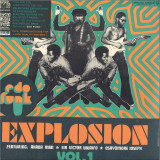
Analog Africa Presents Edo Funk Explosion Vol. 1, available on
2xLP/Gatefold LP with 20-page booklet / CD with 36-page booklet. It was
in Benin City, in the heart of Nigeria, that a new hybrid of intoxicating
highlife music known as Edo Funk was born.
It first emerged in the late 1970s when a group of musicians began to experiment with different ways of integrating elements from their native Edo culture
and fusing them with new sound effects coming from West Africa s night-clubs.
Unlike the rather polished 1980 s Nigerian disco productions coming out of the
international metropolis of Lagos Edo Funk was raw and reduced to its bare
minimum.
Someone was needed to channel this energy into a distinctive sound and Sir
Victor Uwaifo appeared like a mad professor with his Joromi studio. Uwaifo
took the skeletal structure of Edo music and relentless began fusing them with
synthesizers, electric guitars and 80 s effect racks which resulted in some of the
most outstanding Edo recordings ever made. An explosive spiced up brew with
an odd psychedelic note known as Edo Funk.
That’s the sound you’ll be discovering in the first volume of the Edo Funk Explosion series which focusses on the genre’s greatest originators; Osayomore
Joseph, Akaba Man, and Sir Victor Uwaifo: Osayomore Joseph was one of the
first musicians to bring the sound of the flute into the horn-dominated world
of highlife, and his skills as a performer made him a fixture on the Lagos scene.
When he returned to settle in Benin City in the mid 1970s - at the invitation of
the royal family - he devoted himself to the modernisation and electrification
of Edo music, using funk and Afro-beat as the building blocks for songs that
weren’t afraid to call out government corruption or confront the dark legacy of
Nigeria’s colonial past.
Akaba Man was the philosopher king of Edo funk. Less overtly political than Osayomore Joseph and less psychedelic than Victor Uwaifo, he found the perfect
medium for his message in the trance-like grooves of Edo funk. With pulsating
rhythms awash in cosmic synth-fields and lyrics that express a deep personal
vision, he found great success at the dawn of the 1980s as one of Benin City’s
most persuasive ambassadors of funky highlife.
Victor Uwaifo was already a star in Nigeria when he built the legendary Joromi
studios in his hometown of Benin City in 1978. Using his unique guitar style as
the mediating force between West-African highlife and the traditional rhythms
and melodies of Edo music, he had scored several hits in the early seventies,
but once he had his own sixteen-track facility he was able to pursue his obsession with the synesthetic possibilities of pure sound, adding squelchy synths,
swirling organs and studio effects to hypnotic basslines and raw grooves. Between his own records and his production for other musicians, he quickly established himself as the godfather of Edo funk.
What unites these diverse musicians is their ability to strip funk down to its
primal essence and use it as the foundation for their own excursions inward to
the heart of Edo culture and outward to the furthest limits of sonic alchemy.
The twelve tracks on Edo Funk Explosion Volume 1 pulse with raw inspiration,
mixing highlife horns, driving rhythms, day-glo keyboards and tripped-out guitars into a funk experience unlike any other.
Limited coloured marbled vinyl edition of this album
Spencer Davis was born in Wales in 1939. He studied languages and spoke fluent German, French and
Spanish. This was one of the reasons why he was later called „Professor“ in music circles. While studying
in Birmingham, he began performing as a musician and was together with Christine Perfect, who later
became a world star with Fleetwood Mac. Together with Steve and Muff Winwood and Pete York, he
formed his first Spencer Davis Group, with which he had numerous hits in Europe and the United States.
At the end of the 1960s, the four musical geniuses parted ways and each went his own way. Spencer
Davis continued as a solo artist, founded several new bands, including other Spencer Davis Groups with
different lineups, reworked old and new songs and released numerous other records. In the meantime, he
taught at the University of California. He also hosted a talk show and was in the management of Island
Records. He collaborated with Bob Marley, Robert Palmer and Eddie and the Hot Rods, and also
promoted the solo career of former Spencer Davis Group member Steve Winwood. On October 19, 2020,
Spencer Davis died of pneumonia in Los Angeles at the age of 81.
A year before Wild Pitch Records properly introduced us to the trio of Queens native Large Professor and Toronto’s Sir Scratch and K-Cut, the soon-to-be-legendary group self-released their own debut single. Dropping on Actual Records, the 12” of ‘Think’ and ‘Atom’ was soon a sought after rarity, with scarce originals still fetching upwards of three figures.
On it, they only hint at the greatness to come, while simultaneously showing that they’d already mastered the three-minute rap single – this is concise brilliance with no flab whatsoever.
Engineered by the late, esteemed Paul C, ‘Think’ is a study in how to turn well-worn samples into something new. The combination of several James Brown snatches, along with bits lifted from Lyn Collins and Jimmy Castor Bunch, could have been tired and almost parodic by 1989, but instead the group weave something interesting from old fabric.
‘Atom’ is arguably even better, built around a brace of elements from Marvin Gaye and Tammi Terrell’s 1967 duet ‘Little Ole Boy, Little Ole Girl’. On it, Large Pro gives the first real hints that he’ll not just be a super-producer, but a committed MC to watch. Mixing threats with humour, positivity with braggadocio, it’s a calling card performance on a track that could have still sat comfortably on 1991’s ‘Breaking Atoms’ album.
Heavily bootlegged, this is the first official double-sided 7” release bringing together both these foundational cuts.
Another all-time classic from the extensive back catalog of the legendary Miami songstress Gwen McCrae.
"90% Of Me Is You" is instantly recognizable, it's been sampled countless of times by some of the most seminal Hip Hop artists ever (Large Professor, Jaylib, Mobb Deep & more) & is a bonafide "Rare Groove" sure-shot that never loses it's appeal & is always in demand with DJ's & producers. Perhaps it's the pairing of the languid guitar & strings, or Gwen's sultry vocals & that steady breakbeat that keeps people hooked some 40 years after it's original release Whatever it is, it's classic material from start to finish!
Backed here with it's original b-side slow jam "It's Worth The Hurt" this super-rare 45 has been re-mastered, re-pressed & brought back for 2015's dance-floors in conjunction & with the permission of T.K. Disco / Henry Stone Music, Miami USA.
This journey, this slowly drifting sonic meditation, is an 'inner soundscape', a dialogue between the senses, the conscience and the world, inside / outside, interconnected. Like waking up from a long dream, and being stuck into its echo. The April Sessions immerges the listener into a drone-ish universe, full of random acousmatic events, inner monologues and a vast and unwritten subjective map to be drawn.
The April Sessions has been living in a seedy hotel in Brussels for a few months. She listens to the sparse traffic outside her window, locked in and locked down. 'Everything is constructed', she says to herself, 'even the sound of a solitary aircraft at 25,000 feet traverses the sky no further out than the inside of my skull'. Other weird sonic phenomena criss-cross the inner cosmos of her brain and streak across her private sky like comets. And then there is the unshakeable presence of that inner monologue, known to her variously as the Tacit Dictator, the Subvocaliser and, nightmarishly enough, the voice of the Merlucid Hake. (Anthony Moore, St Leonards, 10th of March 2021)
Anthony Moore, Dirk Specht and Tobias Grewenig have known each other and worked together since the early 2000s. They have collectively participated in a number of projects including live performances and recordings. In 2016, as part of The Missing Present Band, they released the live LP 'The Present Is Missing' on A-Musik. The following year they released 'Ore Talks', a double LP, realised in collaboration with Therapeutische Hörgruppe Köln.
Anthony Moore was born in 1948, founded the band Slapp Happy (circa 1972) with Peter Blegvad and Dagmar Krause, then worked alongside a.o. Fred Frith and Tim Hodgkinson in the unclassifiable band Henry Cow. He released several solo albums, composed soundtracks for experimental movies. His path also crossed Kevin Ayers's, Pink Floyd's, Richard Wright's. He was appointed professor for research into sound and music in the context of new media at the Academy of Media Arts in Cologne, Germany. He still continues to write and perform.
Dirk Specht is a sound artist, musician and curator. He studied architecture and media art and is active in the fields of sound works for choreography, radio drama, sound art, film and video art soundtracks. He published releases with several bands and projects. He has been an assistant for research into sound from 2011 to 2016 at the Academy of Media Arts in Cologne, and is a founding member of Therapeutische Hörgruppe Köln.
Tobias Grewenig studied at the Academy of Media Arts in Cologne. He primarily deals with non-linearity in his audiovisual installative works and performances, including projects with the artist group 'Therapeutische Hörgruppe Köln', the ensemble 'The Knob, The Finger & The It' and the improvisation collective "Frequenzwechsel". The conception and development of electronic instruments and code is a key component of his artistic work. He lives and works in Cologne.
Stiletti Ana, part of the dreamy sunbathed electronic duo “Jesse” and top tier in Finnish music production is releasing a new solo album, “I’m an arpeggiator” on Höga Nord Rekords. This album carries similarities to Jesse in both production and sounds but hides more ancient wisdom. A refined sound but with more edges left sharp and more of a mysterious vibe.
As the sound professor he is, Stiletti Ana takes you in a tour of his vast collection of vintage synthesisers and in centre of attention sits the arpeggiator (hence the album title) which gives the sound much of its repetitive character. Recorded in the legendary Haista II-studio outside Helsinki, “I’m an arpeggiator” channels the energies from the waters and forest surrounding the studio, giving the music its’s escapistic and romantic character.
This record is a transcendental trip down the paths of Boards of Canada and Manuel Göttsching, dedicated to the ancient Babylonian fishing god, Dagan.
There’s something new under the sun. If you look at it closely,
something new is only (and always) created at crossroads –
when different and signi¦cant traditions are connected and
combined. On their own, these traditions have often existed
for a while. However, in this new form they have never
appeared together. The latest manifestation of something
new can now be found on the album “No Future Dubs”, the
interpretations of “No Future Days” – the most recent album
by German band Messer – by Finnish producer and old
friend of the group Kimmo Saastamoinen aka Toto Belmont.
The intentional traditions that merge on this grand and
digni¦ed album are post-punk, dub and techno. A new
chapter in the culturally constant narrative of dub is written
here. Through their past and parallel activities in hardcore
and post-punk bands, Messer drummer Philipp Wulf met and
befriended Kimmo, originally a drummer too. In their
continuous dialogue discussing their musical journey, Philipp
and Kimmo over the years more and more immersed
themselves in the aesthetic possibilities of dub and reggae.
Indeed, lots of musicians do not listen to the type of music at
home that they write and play in their respective projects
(Take me as an example: House is the music that I produce
and put on as a DJ. On my own, I listen to various stuff,
music by Monk and Messer for example). The same applies
to the protagonists involved here. By discussing dub und
through Toto Belmont’s steadily increasing producingexpertise, the idea of creating dub versions of selected
Messer tracks was born. The Messer album “No Future
Days”, released in 2020, proved to contain the perfect raw
material as the songs on this album are already produced in
a much more transparent way than on previous LPs – and
are hence more suitable for dub. Still, it’s a giant leap from
the originals to the dubs. These add a third dimension to the
described character of the post-punk/dub amalgam: techno.
The result is a sound that hasn’t existed before, especially
not with German lyrics (which scarcely, however, carry
meaning or messages here. Hendrik Otremba’s voice is used
more like an instrument, as if he was the ghostly ¦gure which
he often sings about and which now §oats and screams
through the sound space). The history of mutual contact and
in§uence of (post-)punk and dub (reggae), which Messer
have kept on writing, is glorious and reaches back far in
musical history. Still, it has always been a rather marginal
chapter not only in punk but also in dub history. But already
in the beginnings of punk (the British version, less the
American one), the presence and in§uence of reggae was
obvious in many places as both are united in their resolute
attitude as rebel music. This is how the two genres
recognized each other – especially the punks regarded
reggae as rebellious. As is known, already Johnny Rotten
mainly listened to dub in private. By using the name John
Lydon, he then – together with bass player Jah Wobble –
established the group PiL as one of the most exemplary
bands at the crossroads of dub and punk. The Slits, Pop
Group, Killing Joke, The Ruts and last but not least The Clash
along with the Mick Jones offshoot Big Audio Dynamite –
the thriving British music scene in the early 80s was full of
dub-in§uenced acts. The echoes meandered everywhere. In
the USA, it took longer until the in§uence of dub became
noticeable and it has never been as distinctive as in the UK.
The history of US hardcore, however, cannot be told without
bands like Bad Brains from Washington D.C. who on their
albums occasionally inserted conscious reggae and dub
tracks between breakneck hardcore tracks. Another
important group is Blind Idiot God who similarly included
dub tracks on their LPs – the contrast between densely
droning rock tunes and widely breathing dub versions can be
experienced very vividly here. In the 90s, dub’s in§uence on
post-punk decreased while turning up even more distinctively
somewhere else: Techno was in many respects susceptible
to dub, to say nothing of the music from the so-called British
hardcore continuum (jungle, drum & bass etc.), which directlydeveloped from dub and reggae. But also “pure” techno –
meaning techno without breakbeats – discovered its a¨nity
for the possibilities of dub at an early stage, in England for
instance in projects like Left¦eld or The Orb. In addition, the
project Rhythm & Sound was established in Berlin with close
ties to the Hardwax record store. With regard to this project,
you can’t really say where dub ends and where techno begins
(or vice versa) because of the interconnection of the two
genres here – everything is based on the steppers pulse
which links the two styles like a common DNA. With dub
techno a new genre was created. Until the present day, there
are producers who don’t produce anything else and DJs who
don’t put on any other music. The Messer dubs are
characterized by a grand majestic manner and force that
presumably someone like Mad Professor is able to produce
and that is also inherent in many Scandinavian productions
of the last 15 years; a crystal-clear aesthetic which locates
itself far away from Kingston or Brixton, but features a pulse
referring clearly to Berlin and Helsinki. The songs appear in a
completely new and deconstructed form, the instruments are
exclusively used as particles and raw material, not as riffs;
merely glaring guitar textures ¦ll the wide dub space. There
are many new elements that were added by Toto Belmont,
especially synthesizer sounds and drums. The ¦nal result
creates an enormous aesthetic power and dignity, and an
atmosphere you don’t want to leave anymore. “No Future” is
a well-chosen title as a reference to the protagonists’ punk
association; as a main thrust of the album, however, a
comma between these two words is imaginable as well.
First-ever official re-issue of the Ecuadorian composer's stunning electroacoustic composition "Oeldorf 8" on vinyl and CD. Remastered by KASSIAN TROYER at D&M, Berlin.
MESÍAS MAIGUASHCA (b. December 24th, 1938 in Quito / Ecuador) is a composer of Neue Musik, especially electroacoustic music, who studied at the Conservatorio Nacional de Quito, at the Eastman School of Music in Rochester, NY (1958–65), with ALBERTO GINASTERA at the Instituto di Tella in Buenos Aires, at the Hochschule für Musik in Cologne and, after a short return to Ecuador, attended the Internationale Ferienkurse für Neue Musik in Darmstadt and the Fourth Cologne Courses for New Music in 1966–67 where he studied with KARLHEINZ STOCKHAUSEN. From 1968 to 1972, MAIGUASHCA worked closely with STOCKHAUSEN in the Electronic Music Studio of the Westdeutscher Rundfunk in Cologne and joined STOCKHAUSEN's ensemble for performances at the German Pavilion at the Expo '70 in Osaka. In 1971 he became a founding member of the OELDORF GROUP of composers and performers, and began work at the Centre Européen pour la Recherche Musicale in Metz, at IRCAM in Paris, and at the ZKM in Karlsruhe. From 1990 – 2004 MAIGUASHCA was Professor of Electronic Music at the Musikhochschule of Freiburg im Breisgau where he still lives today.
The OELDORF GROUP, named after the small village 40 km away from Cologne where they lived and worked in a rented farmhouse where they set up their own studio for electronic music and studio productions, was a musicians' collective active during the 1970s. In the adjacent barn, the group held concerts for audiences up to 300 people with an emphasis on live-electronic music and other kinds of new and avant-garde music. Thanks to a long-standing contact with the Westdeutscher Rundfund, the core members of the OELDORF GROUP (PETER EÖTVÖS - electronics and keyboards, the violinist/violist and composer JOACHIM KRIST, electronics specialist and composer MESÍAS MAIGUASHCA, who also played keyboards, and his wife GABY SCHUMACHER – cello) received commissions for compositions, invitations to perform in the Musik der Zeit concert series, as well as having many of their summer concerts recorded for the late-night broadcasts of WDR3.
One of these commissioned compositions is "Oeldorf 8": a retrospective portrait of the OELDORF GROUP consisting of a series of ten short pieces for four instrumentalists (clarinet, violin, cello, electric organ/synthesizer) and tape which may be played either simultaneously or continuously without a break. It premiered in 1974 at the Darmstädter Ferienkurse and was released on LP two years later and turned into a sought-after, but not very well-known rarity achieving collector's prices., and was later unofficially reissued on KEITH FULLERTON-WHITMAN's Creep Pone CDr label.
Conceived as a sonic diary with an edge to encompass radical electronic synthesis, the 48 minute composition proves " … a thing of wonder; from the outset, MAIGUASHCA's spoken introduction of the players & concept gets slowly eroded by errant, pointillist electronic sound … which then lets loose for a good 10 minutes before a swarm of slowly rising held tones c/o the players acoustic arsenal slowly comes to the fore. On the second side, the acoustic sounds - patiently, elegantly state their cases across a good half of the segment until a rising pulse-wave drone essentially annihilates the more nuanced phrasing & slowly builds to an almost ROLAND KAYN-esque climax of raw oscillator gristle" (Soundohm).
44 years after its original release, MAIGUASHCA's stunning album finally sees its deserved and overdue re-release on CD and LP, carefully remastered by KASSIAN TROYER at D&M, Berlin.
"Maiguashca … is part of the first generation of South American maverick sound explorers that in the 1960s paved the way for a tradition of innovation that persists in the present noise and psychedelic scenes of the continent. Along with Edgar Valcárcel, César Bolaños, Beatriz Ferreyra, Mauricio Kagel or José Vicente Asuar, he contributed to expand the possibilities of musical language beyond the dominant Western canon …"
David Jarrin / Kraak Festival
Saturations is a composition by Danish multidisciplinary artist Niels Lyhne Løkkegaard, and features a clarinet choir consisting of 19(!) clarinet players.
Niels Lyhne Løkkegaard (b. 1979) considers his work to be a basic research in realities working within the domains of imaginary & physical sound as well as other non-sonic media, and since 2012 Niels Lyhne Løkkegaard has experimented with creating music that lets the instruments transcend their inherent sonic norms and reappear in another form by way of multiplication of sound.
His work with multiplication of sound has led to numerous compositions in which one instrument is multiplied a number of times: One piece is written for 9 pianos, another for 10 hi-hats and yet another for countless triangles and so on.
The multiplication brings out bodily timbral phenomena, interference of sound waves and vibrations, and brings out what Niels Lyhne Løkkegaard calls the sound’s potential of transformation. He describes this as the quality in a musical piece, when you no longer hear recognizable instruments, but instead the individual sound, as well as the individual musician, is dissolved into the collective sound.
A sonic as well as human synthesis.
He explains the concept of this sound as follows:
“Imagine you enter a room with vibrant acoustics, such as a cafe full of people having conversations, and when you’re close to those conversations you hear the language and understand the words. If you step away from the tables, however, and stand in the doorway, you begin to loose the ability to distinguish the words from one another. Now instead of hearing the individual conversations, melts all the conversations together, and transform into a one new sound. A sound of people without words and language. Just as when you hear a group of geese squawk, or the wind in tree tops, a kind of nature given sound of people. Once the language is dissolved and the words stop making sense, what is left, is the sound."
The work of NLL has been presented at a variety of different venues and museums such as MoMA (NY - as a part of the René Magritte exhibition The Mystery of the Ordinary, 2013), Imaginary West Indies (Overgaden Copenhagen, 2017), ISCM (Vancouver, 2017), Radiophrenia (Glasgow’s Centre for Contemporary Arts, 2017), CPH:DOX (Copenhagen, 2017), Roskilde Festival (2017), Harpa (Reykjavik, 2017), G((o))ng Tomorrow Festival (Copenhagen 2016, 2018), Nordic Music Days (Norway, 2019), Akusmata (SF, 2020) and his works has been released on labels such as Topos (DK), Archive Officielle (CA) and Important Records (US). NLL is associate professor at RMC in Copenhagen, and has given lectures at the California Institute of the Arts (CalArts), Goldsmiths University of London a.o.p. NLL has been awarded with several prizes a.o. from the Danish Art Foundation and the Sonning Foundation.
British artist Robin Rimbaud (Scanner) traverses the experimental terrain between sound and space connecting a bewilderingly diverse array of genres. Since 1991 he has been intensely active in sonic art, producing concerts, installations and recordings, the albums Mass Observation (1994), Delivery (1997), and The Garden is Full of Metal (1998) hailed by critics innovative and inspirational works of contemporary electronic music. Committed to working with cutting edge practitioners he has collaborated with Bryan Ferry, Wayne McGregor, Mike Kelley, Carsten Nicolai, Michael Nyman, Steve McQueen, Laurie Anderson and Hussein Chalayan, amongst many others.
Rimbaud first met Belgian artist Hans Op de Beeck at Le Fresnoy Studio national des Arts Contemporains when they were both Visiting Professors in 2012. Op de Beeck lives and works in Brussels, Belgium and creates sculpture, installations, video, photography, animated films, drawing, painting, and writing. His various works show the viewer non-existent, but identifiable places, moments and characters that appear to have been taken from everyday life.
The artists found an immediate creative connection, and a year after meeting Staging Silence (2) was completed. In 2019, they returned to the theme and created Staging Silence (3).
Each of the films is realised through the same principles, as two pairs of anonymous hands construct and deconstruct fictional interiors and landscapes on a mini film set of just three-square metres in size. The films take the viewer on a visual journey through depopulated, enigmatic and often melancholic, but nonetheless playful, small-scaled places, which are built up and taken down before the eye of the camera.
Ranging from hyper-realistic fictional land and cityscapes to absurd, almost surreal, dreamscapes, the various locations are connected by the sense of mystery and melancholy that pervades them. And at every moment Rimbaud's score is amplifying and illustrating these moments, from tragedy to nostalgia, witty to optimistic.
Introspective and lyrical, Staging Silence offers us a world of mystery and intrigue, held together by nature and time. This is a very humane works experienced at a time when many of us feel disconnected from the world around us. The peculiar silence that permeates this hauntingly beautiful work is very much an illustration of our times, anticipating a future in the past. Staging Silence is an exquisite study in dreamlike abstract ambience, a kaleidoscope of sounds and tones that engage the head and the heart.
- A1: Overture
- A2: Why Can’t The English?
- A3: Wouldn’t It Be Loverly
- A4: The Flower Market
- A5: I’m An Ordinary Man
- A6: With A Little Bit Of Luck
- B1: Just You Wait
- B2: Servants’ Chorus
- B3: The Rain In Spain
- B4: I Could Have Danced All Night
- B5: Ascot Gavotte
- B6: Ascot Gavotte (Reprise)
- B7: On The Street Where You Live
- B8: Intermission
- C1: The Transylvanian March
- C2: The Embassy Waltz
- C3: You Did It
- C4: Just You Wait (Reprise)
- C5: On The Street Where You Live (Reprise)
- C6: Show Me
- C7: The Flowermarket
- D1: Get Me To The Church On Time
- D2: A Hymn To Him
- D3: Without You
- D4: I’ve Grown Accustomed To Her Face
- D5: End Titles
- D6: Exit Music
My Fair Lady is a 1964 American musical drama film adapted from the 1956 Lerner and Loewe stage musical that was based on George Bernard Shaw’s 1913 stage play Pygmalion. It stars Audrey Hepburn as Eliza Doolittle, a Cockey working-class girl whom phonetics professor Rex Harrison (played by Henry Higgins) attempts to transform into someone who can pass for a cultured member of high society. The film became an instant classic, winning
8 Academy Awards and achieving commercial successes well. This soundtrack features all the songs from the film, plus 11 bonus tracks. It is released as a limited edition of
1000 individually numbered copies on transparent purple swirled vinyl.
Main Source’s paean to the simple pleasures of relaxing with friends is built over two tried-and-tested samples. The dreamy, swoony sounds of Vanessa Kendrick’s timeless ‘90% of Me is You’ is ever-present during this stone-cold classic, while Sister Nancy’s unmistakeable ‘Bam Bam’ lends several elements to the mix. Throw in some Skull Snaps and Sweet Charles and you’ve got the perfect soundtrack for a roll call of Large Professor’s nearest and dearest.
There are plenty of reasons why so many regard ‘Breaking Atoms’ as an all-time classic album, and the sheer variety of singles lifted from it is chief among them. Large Professor was happy to roam over varied topics at a time when many rappers had a manic focus on one thing.
And where better to hang out with friends than at a barbecue? ‘Live at the Barbecue’ is rightly regarded as one of the best posse cuts of all time, and famous for showcasing the debut of one Nasty Nas. While he delivers a dope verse full of quotables over drums from Bob James’ oft-plundered ‘Nautilus’, credit is also due to the other guests. Fatal and Akinyele aren’t disgraced in this company, and Large Professor tops it off with a rare verse of pure brag-rap.
An undisputed entry in the pantheon of head-nod hip-hop, this is its first official UK release, and another debut on 7”.
• Samples Sister Nancy’s unmistakeable ‘Bam Bam’
• Taken from the all-time classic album ‘Breaking Atoms’
• Features the debut of Nas
When the film ‘White Men Can’t Jump’ was released in 1992, an EP of music from the film was dropped almost simultaneously. That EP, cheekily titled ‘White Men Can’t Rap’, featured a couple of exclusive gems, notably Gang Starr’s ‘Now You’re Mine’ and a cut from Main Source called ‘Fakin’ the Funk’.
The only single borne of that six-track EP was the Main Source track, released in remixed form on Wild Pitch records the same year. No surprise, it was head and shoulders above the rest.
Opening with those unmistakable harmonies from Main Ingredient’s ‘Magic Shoes’, the intro segues into a crisp beat borrowed from Grady Tate’s frequently sampled ‘Be Black Baby’ from 1969. Throw in a sprinkle of Kool & The Gang and you’ve got a track that would fit seamlessly onto Main Source’s masterpiece of an album, ‘Breaking Atoms’.
Instead, it’s the group’s last hurrah, the final collaboration between K-Cut, Sir Scratch and Large Professor before the latter departed the trio. It’s fitting that he saves one of his best vocal performances for last, railing at sell-outs with the assistance of his long-term collaborator Neek the Exotic.
Never released before on an official 7”, it’s a track that has lost none of its appeal, and the remix is the definitive version of this classic.
• Samples Main Ingredient’s ‘Magic Shoes’ and Grady Tate’s frequently sampled ‘Be Black Baby’
• First ever 7” release of the Remix
• Also available on Limited Edition Neon Green vinyl
We’ll get to the vocal content in a second, but first it’s time to acknowledge what a patchwork tapestry of genius ‘Peace is not the word to play’ is in terms of production. Large Professor being a prodigy on the SP-1200 is well established, but the way he flips parts of MFSB’s ‘TLC’ and Milly and Silly’s obscure ‘Gettin’ Down for Xmas’ with a sprinkling of Lyn Collins here establishes his credentials in the top tier.
Lyrically, it’s a tour de force, with Main Source taking exception with the misuse of the word ‘peace’ by the hip-hop fraternity. With even the most homicidal of gangster rappers dropping it at the end of tracks at the time, time was overdue for some regulation.
The album version makes its point pithily in a single verse, while the remix, included on the flip of this first ever 7” release, expands on the topic with new verses and some new samples too. It’s a welcome reminder of the time when remixes were remixes – not just the identical track with the latest hot rappers joining in.
Most of all, Main Source once again walk the fine line between lyrical lecture and head-nodding banger – the rare example of a track with a point to make that can still fill a dancefloor and get necks snapping.
• Samples MFSB’s ‘TLC’; Milly and Silly’s obscure ‘Gettin’ Down for Xmas’ and Lyn Collins
• First ever 7” release of the Remix
Main Source’s paean to the simple pleasures of relaxing with friends is built over two tried-and-tested samples. The dreamy, swoony sounds of Vanessa Kendrick’s timeless ‘90% of Me is You’ is ever-present during this stone-cold classic, while Sister Nancy’s unmistakeable ‘Bam Bam’ lends several elements to the mix. Throw in some Skull Snaps and Sweet Charles and you’ve got the perfect soundtrack for a roll call of Large Professor’s nearest and dearest.
There are plenty of reasons why so many regard ‘Breaking Atoms’ as an all-time classic album, and the sheer variety of singles lifted from it is chief among them. Large Professor was happy to roam over varied topics at a time when many rappers had a manic focus on one thing.
And where better to hang out with friends than at a barbecue? ‘Live at the Barbecue’ is rightly regarded as one of the best posse cuts of all time, and famous for showcasing the debut of one Nasty Nas. While he delivers a dope verse full of quotables over drums from Bob James’ oft-plundered ‘Nautilus’, credit is also due to the other guests. Fatal and Akinyele aren’t disgraced in this company, and Large Professor tops it off with a rare verse of pure brag-rap.
An undisputed entry in the pantheon of head-nod hip-hop, this is its first official UK release, and another debut on 7”.
• Samples Sister Nancy’s unmistakeable ‘Bam Bam’
• Taken from the all-time classic album ‘Breaking Atoms’
• Features the debut of Nas
• Limited Edition Purple vinyl
We’ll get to the vocal content in a second, but first it’s time to acknowledge what a patchwork tapestry of genius ‘Peace is not the word to play’ is in terms of production. Large Professor being a prodigy on the SP-1200 is well established, but the way he flips parts of MFSB’s ‘TLC’ and Milly and Silly’s obscure ‘Gettin’ Down for Xmas’ with a sprinkling of Lyn Collins here establishes his credentials in the top tier.
Lyrically, it’s a tour de force, with Main Source taking exception with the misuse of the word ‘peace’ by the hip-hop fraternity. With even the most homicidal of gangster rappers dropping it at the end of tracks at the time, time was overdue for some regulation.
The album version makes its point pithily in a single verse, while the remix, included on the flip of this first ever 7” release, expands on the topic with new verses and some new samples too. It’s a welcome reminder of the time when remixes were remixes – not just the identical track with the latest hot rappers joining in.
Most of all, Main Source once again walk the fine line between lyrical lecture and head-nodding banger – the rare example of a track with a point to make that can still fill a dancefloor and get necks snapping.
• Samples MFSB’s ‘TLC’; Milly and Silly’s obscure ‘Gettin’ Down for Xmas’ and Lyn Collins
• First ever 7” release of the Remix
On her third album Welsh Music Prize winner Georgia Ruth returns to her roots. Having moved back to her native Aberystwyth ‘Mai’ was recorded in the town’s Grade-II listed Joseph Parry Hall over the course of one week in Spring 2019. Named after the renowned composer and professor, the room was used as a venue for chamber concerts throughout the twentieth century and offered musicians a view of the sun setting over the castle as they worked.
But despite this setting Mai (meaning May) is an intimate collection of songs written from within the depths of a house during stolen moments. At its heart sits a beautiful and simple setting of Eifion Wyn’s poem – ‘Gwn ei ddyfod, fis y Mel’ (I know it’s coming, month-of-honey).
Mai is a meditation on finding hope and renewal in the seasons, in a world where the certainty of Spring feels increasingly fragile.
The album was produced with Iwan Morgan (Meilyr Jones, Cate Le Bon, Richard James) who also engineered mixed and mastered. Additional parts were recorded at his studio in Liverpool. With improvised strings, pedal steel and saxophone sitting alongside harp, the album presents a sound which is both lush and sparse in turn.
Nils Frahm announces the release of Encores 3 on 20 September 2019, the third and final instalment of his Encores series. The three EPs will be available as one full length release titled All Encores featuring 80 minutes of music on 18 October, to follow his masterful 2018 album All Melody. Whilst Encores 1 focused on an acoustic pallet of sounds with solo piano and harmonium at the core, and Encores 2 explored more ambient landscapes, now Encores 3 sees Nils expand on the percussive and electronic elements in his work.
“The idea behind All Encores is one we had from before All Melody; to separate releases each with their own distinct musical style and theme, perhaps even as a triple album. But All Melody became larger than itself and took over any initial concepts. I think the idea of All Encores is like musical islands that compliment All Melody.”Moulded during All Melody but refined by his live performances, All Encores is testament to Nils’ exceptional ability to craft his art on stage.
Artificially Intelligent which showcases his ‘mad professor’ organ, and All Armed which has been a live favourite for some time, appearing on set lists since 2015, are now available to hear on record for the very first time. The final track of Encores 3, as well as the whole series, Amirador, perhaps aptly nods to the Spanish word for ‘lookout’ and hints at what’s to come.
Frahm has been touring extensively following the release of All Melody, bringing his spectacular live show all around the world with sold out performances including the Hammersmith Apollo in London, L.A.’s Disney Hall, Brooklyn Steel, Le Trianon in Paris and Funkhaus in Berlin. Nils returns to the UK capitol for The Hydra’s summer 2019 series, headlining Printworks on August 23, with further European dates following the release of Encores 3 and All Encores. For all dates and tickets: nilsfrahm/concerts.
One thing hip-hop has never been great at – and certainly something for which it has zero reputation – is nuanced emotion. Enter Large Professor and ‘Looking at the Front Door’, the group’s first single on Wild Pitch Records and the lead out for their stunning ‘Breaking Atoms’ album.
Wrapped around a loop from Donald Byrd’s Blue Note classic ‘Think Twice’, bolstered by the infectious chorus of ‘Chick A Boom’ by The Pazant Brothers and Beaufort Express, it’s a melancholy tale of love gone wrong. It was a brave choice of lead single in the 1990 hip-hop landscape, plucked from an album full of genuine head-nodders and standout tracks. It was also the right choice – a piece of production perfection laced with romantic honesty.
The B-side also strikes a different tack, a tale of a brother who “doesn’t fight, his brain is his left and right.” Using a solid foundation of drums from Funkadelic’s ‘You’ll Like It Too’ (most famously used on Eric B & Rakim’s ‘I Know You Got Soul’), Large Pro weaves his tale of an ambitious, studious man over an original organ line (by JD Drumsticks) that wouldn’t sound out of place at a hockey rink. The theme is sledgehammer subtle – don’t sell drugs, stay in school – but delivered with the lightness of touch that would be Main Source’s signature.
This is the first official UK release, and the first time both sides have been together on a 7”.
A year before Wild Pitch Records properly introduced us to the trio of Queens native Large Professor and Toronto’s Sir Scratch and K-Cut, the soon-to-be-legendary group self-released their own debut single. Dropping on Actual Records, the 12” of ‘Think’ and ‘Atom’ was soon a sought after rarity, with scarce originals still fetching upwards of three figures.
On it, they only hint at the greatness to come, while simultaneously showing that they’d already mastered the three-minute rap single – this is concise brilliance with no flab whatsoever.
Engineered by the late, esteemed Paul C, ‘Think’ is a study in how to turn well-worn samples into something new. The combination of several James Brown snatches, along with bits lifted from Lyn Collins and Jimmy Castor Bunch, could have been tired and almost parodic by 1989, but instead the group weave something interesting from old fabric.
‘Atom’ is arguably even better, built around a brace of elements from Marvin Gaye and Tammi Terrell’s 1967 duet ‘Little Ole Boy, Little Ole Girl’. On it, Large Pro gives the first real hints that he’ll not just be a super-producer, but a committed MC to watch. Mixing threats with humour, positivity with braggadocio, it’s a calling card performance on a track that could have still sat comfortably on 1991’s ‘Breaking Atoms’ album.
Heavily bootlegged, this is the first official double-sided 7” release bringing together both these foundational cuts.
Unbegrenzt is the third in an ongoing series of archival records of the unheard music of Swedish composer Catherine Christer Hennix, co-released by Blank Forms Editions and Empty Editions. It follows Selected Early Keyboard Works and Selections from 100 Models of Hegikan Roku (named the #1 archival release of 2019 by The Wire), in addition to a two-volume collection of Hennix’s writing titled Poësy Matters and Other Matters.
Recorded in February of 1974 and featuring Catherine Christer Hennix (recitation, percussion, and electronics) and Hans Isgren (bowed gong), Hennix’s realization of Karlheinz Stockhausen’s “Unbegrenzt” (German for “unlimited”) from Aus den Sieben Tagen is an elaboration both rigorous and radically different from the canonical 1969 recording issued by Shandar. The collection of 15 text pieces written in Paris during May of 1968, Aus den Sieben Tagen, denies its performers notated direction and instead provides poetic cues that hinge upon Stockhausen’s conception of “intuitive music,” a Eurocentric perspective on improvisation antithetical to the vernacular forms Hennix had engaged with as a young drummer performing in Stockholm jazz clubs with musicians like Bill Barron, Cam Brown, Hans Isgren, Lalle Svenson, Allan Vajda, Bo Wärmell, and many others. While both Hennix and Isgren saw the formal prospect of Aus den Sieben Tagen as a productive development of and beyond La Monte Young’s event scores, she here steadfastly counters his rationalization of intuition with the Principle of Sufficient Reason. (Cf. Brouwer’s Lattice.) Eschewing the busy, conservatory-addled lapses into idiomatic citation of Stockhausen’s 1969 recording, Hennix’s alternative realization of the “Unbegrenzt” score’s instructions to “play a sound with the certainty that you have an infinite amount of time and space” is based on her concept of Infinitary Compositions, the trademark of her ensemble The Deontic Miracle which, at one time, considered adding Stockhausen, La Monte Young and Terry Jennings scores to its repertoire. Taking a mature, minimal iteration of Stockhausen’s compositional method of “moment-forming” to heart, her version’s dark, controlled feedback and amplified bowed gong subtly shift through an immanent sequence of formative moments, step by step. Its bubbling computer noise, percussion, and repeated ominous transient sounds of temple blocks over the bowed gong terminate with the integrated recitation of exotic text fragments from Hevajra Tantra which faithfully take Stockhausen’s score into deeper vistas of the unconscious and a more devastating opening to the unlimited time and space of a dreaming mind.
Audio restoration and mastering by Stephan Mathieu, with an essay by Bill Dietz.
Catherine Christer Hennix (b. 1948) started her creative life playing drums with her older brother Peter, growing up in Sweden where she heard jazz luminaries, such as John Coltrane, Eric Dolphy, Dexter Gordon, Archie Shepp, and Cecil Taylor perform from 1960 to 1967. Directly after high school, Hennix went to work at Stockholm’s pioneering Elektronmusikstudion (EMS), where she developed early tape music, incorporating computer generated speech done at the Royal Technological University (KTH), where she was an undergraduate student. After traveling to New York In 1968, she met artists Dick Higgins and Alison Knowles who invited her to stay at the Something Else Press Town House where she had the opportunity to meet, among others, composers John Cage, James Tenney, and Phil Corner. During the following years she developed fruitful collaborative relationships with many composers in the burgeoning American avant-garde, including, most significantly, Henry Flynt and La Monte Young. Young introduced Hennix to Hindustani raga master Pandit Pran Nath and she would later study intensively under him as his first European disciple. While Hennix continued to make music performing alongside Arthur Russell, Marc Johnson, Henry Flynt, and Arthur Rhames, she also served as a professor of Mathematics and Computer Science at SUNY New Paltz and as a visiting Professor of Logic (at Marvin Minsky’s invitation) at MIT’s Artificial Intelligence Laboratory. In recent years Hennix has led the just-intonation ensemble the Chora(s)san Time-Court Mirage, which has featured musicians Amelia Cuni, Amirtha Kidambi, Chiyoku Szlavnics, Hilary Jeffrey, Amir El-Saffar, Benjamin Duboc and Rozemarie Heggen. She currently resides in Istanbul, Turkey pursuing studies in classical Arabic and Turkish makam.
After our last release with Dub Keyboarder Ao Inoue from Dry&Heavy Tokio/Japan we now are super proud to announce;
Our next Ep coming up in November is done by TURMSPRINGER + 2 heavy weights Producers. QUENUM labelhead of Cadenza delivered an superb minimal 80´s sounding remix and we could convince no further then Neil Fraser aka MAD PROFESSOR to join the Mole Audio Project He´s done a few “versions” on his old smokey dusty console which will come out within the next few month , Keep your ears open for this !