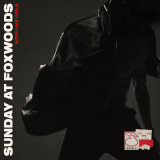
Burn Out - the latest release from Mini Trees - is a defiantly euphoric EP with the sonic and emotional bandwidth of a full-length record packed neatly into five new songs from Los Angeles-based songwriter Lexi Vega. Inspired by a relentless touring schedule that followed the release of her 2021 debut album Always In Motion, the songs of Burn Out confront questions of identity, exhaustion, and how to navigate creating art in an industry fixated on commodifying it.
A month away from music sparked Vega’s creativity and inspired her to return with long-time friend and producer Jon Joseph. Together they determined to push the limits of Mini Trees’ “bedroom pop” description, opening the door to a number of new
collaborators - keys from Zac Rae (Death Cab for Cutie, Lana Del Rey), arrangements from James McAllister (Sufjan Stevens, Taylor Swift), and even bass from longtime family friend Jimmy Johnson (James Taylor, Phil Collins). These songs shimmer in production, even as they’re saturated with the pervasive sense of fractured identity, disillusionment, and otherness that has shaped much of Vega’s sense of self. The overwhelming weight of these disparate identities is reflected in the EP’s cover art - a bed cluttered with clothes she’s chosen not to wear, familial heirlooms and mementos strewn at her feet.
Cerca:pull
Box Version[44,50 €]
Repress!
Mr Bongo are delighted to present an officially licensed re-issue of this underground Japanese rock rarity 'Uganda (Dawn of Rock)' by Akira Ishikawa & Count Buffaloes. This album has become highly sought-after amongst psych, prog and acid rock collectors and due to the rare nature of original copies they come at a hefty price tag.
The respected Japanese jazz drummer Akira Ishikawa was not messing around when he recorded the 'Uganda (Dawn of Rock)' album with his band the Count Buffaloes. For this offering, originally released in 1972 on Toshiba Records, Akira Ishikawa takes us on a deep tripped-out journey. 'Uganda (Dawn of Rock)' is a fusion of progressive and psych rock with African percussion workouts, dergy-wah wah blues-funk, and jazzy sensibilities; with different genres morphing and uniting as they progress.
A long way from his funk and afrobeat album 'Back To Rhythm’, re-issued on Mr Bongo in 2019, this record has a darker, deeper, abstract and experimental stoned tone with the listener being pulled into its vortex for the ride. This record doesn’t pull any punches.
For this album, Akira is joined by Hideaki Chihara on bass, guitarist Kimio Mizutani, sounding at times like an early 70s Peter Green, percussionist Larry Sunaga and composer Takeru Muraoka.
The album has become highly sought-after amongst psych, prog and acid rock collectors and due to the rare nature of original copies they come at a hefty price tag.
We are delighted to present an officially licensed re-issue of this underground Japanese rock rarity.
Available in 2 formats: Original LP in Box version & Tip-on Sleeve with OBI version.
• Highly sought-after underground Japanese rock rarity, originally released in 1972.
• Feat. Hideaki Chihara, Kimio Mizutani, Larry Sunaga and Takeru Muraoka.
• Available as the original LP in Box version & Tip-on Sleeve with OBI version.
From out of nowhere - if nowhere is the febrile, warped and twilit imagination of Julia McFarlane - comes Whoopee, the second album by J.McFarlane’s Reality Guest. Whoopee is an esoteric, kaleidoscopic movie in music form directed by Julia McFarlane and co-conspirator Thomas Kernot. Full of life, breakbeats and smokey vignettes on the fragile nature of interpersonal relationships, Whoopee is a stylistic evolution from everything McFarlane has done before. Surreal, beautiful in parts and replete with the aching wisdom McFarlane’s songwriting has always promised, this Reality Guest pulls back the curtain on a whole scene of naked truth. Recorded in Melbourne in bursts since the release of 2019’s Ta Da, Whoopee features a new sound palette and band member in Kernot. The duo dive deep into electronic pop tropes, mining digital synths, samples, breakbeats and deep bass grooves, largely dispensing with live instrumentation. If Ta Da took twists and turns with your expectations, offering a Dada-ist, monochromatic take on pop music, Whoopee is McFarlane’s subterranean love-sick pinks, reds, greens, purples and blues. Becoming something of a tradition, the album starts with an instrumental intro pilfered from a 90s’ spy film or cinema intro music, puffing up the listener for the heart-squeezing bathos of Full Stops. Over a bleary backdrop of walking bass lines, jazz- inflected keys and smoked-out atmosphere, McFarlane’s poetry narrates the fragile state of a relationship: “You put a full stop where I thought there’d be a comma, I want the story to continue even with all the drama.” Over a palpable pain, the narrator is revelling in the drama of a relationship, addicted to tumult and heightened emotion. On Sensory, a space age bachelor lounge pad ballad, the converse state of the previous song is explored, here the narrator is battling the numbness of being out of the drama, stuck in a sensory-deprivation tank, anaesthesized and battling to emerge from the fog. Wrong Planet explores an otherworldly pop music, hewing a bright hook out of a sense of confusion. A bona-fide, sing-along chorus bursts out of the narrator musing on the absurdity of existing in this reality. It speaks of one of Julia McFarlane’s main talents, her knack of inspecting human relationships and states with a clear perspective, like an alien visiting Earth and realising everything we are is really, really strange. Whoopee is both more accessible than previous Reality Guest work and somehow more obfuscated. Where the production on Ta Da was dry, sharp and strange, this Reality Guest is blurred, almost smeared with the effluvium of 90s+00s culture and existence. Through it all, it’s hard to deny the undeniable pull of the songs. Precious Boy carries on the lounge theme with a whole sampler of cut up sounds fading in and out of the haze as McFarlane’s voice is right up to the speaker cooing and free- associating, maybe in love or maybe in confusion... maybe they’re the same thing? Sometimes the listener is invited to just bathe in the tone of the vocal, as on Apocalypse, where the texture and timbre of the vocal is luxurious, bathing in piano tinkles and double bass throb. On lead single Slinky, a cut up beat reminiscent of Washingtonian Go-Go drum patterns leads, the song slipping through your fingers, elusive and presenting sound as pure pleasure. Closer Caviar jumps back into the broken breakbeats of a surreal funk, fuelled by the sensory pleasure of the music, a hedonistic whirl in rapture, the narrator now living life to the fullest in all its giddy heights and deep troughs. This is the album’s main character fully-actualised and in the terrible, beautiful moment.
Co-Accused Records kick off 2024 with some sonic grooves from French duo Human Rebellion. Their 'Kosmik Trip EP' has four spacey, electro cuts with wicked remixes from Sync 24 & Co-Accused.
Human Rebellion launch the EP with the title track 'Kosmik Trip' a mind-bending intergalactic destroyer. Sync 24s remix sees the trip take a dark turn with sinister vocals and hypnotic builds. Co-Accused take it into techno territory with a relentless, high energy take on the original. 'Censored Truth' opens the portal to the B side with free-radical synths intertwining with dark machine funk. The punchy drums in 'Hybridization' pull you towards a distress beacon, with face-hugging builds and chest bursting drops. Human Rebellion round off the release with the dystopian, driving sounds of 'Jupiterians'
The oblique and annihilating transmissions emanating from the workshop of Polar Inertia have been issued intently and surely over the last decade and more. Environment Control grants access to the biggest consignment to date, with eight tracks of mesmeric play that are fraught with clinical impulsiveness and astringent rushes.
Opening with a didactic panegyric to transmutation, Polar Inertia swiftly counter our recoil with an ominous display of pressure on 'Smothering Dreams'. The intensity is sustained—as if to suggest that there's now no way back—until the menace relents on 'Artic Horizon', its shimmering gravitational pull amounting to an idealism after the unease that delivered us here.
Champagne Vinyl[28,53 €]
Boys Like Girls have enjoyed a meteoric rise after forming as teenagers in 2004. The b& was forged from the very beginning in the damp basements, garages, & VFW halls of the Massachusetts coastline over tattered lyric books, guitars, drums, & a collective dream. A half-billion Spotify streams later it‘s clear this was a fairy tale in its first act. Their self-titled debut album 2006 is nearing Multi-Platinum RIAA certification, while its chart-topping successor Love Drunk 2009 bowed at #1 on the Top Rock Albums Chart & Top 10 on the Billboard 200. A slew of successful singles abounded, including Platinum-certified hits “The Great Escape” & “Love Drunk,” as well as Gold-certified hits “Hero/Heroine” & “Thunder.” There was the Platinum-certified, BMI award-winning Hot 100 duet with Taylor Swift: “Two Is Better Than One.""""
By 2012 lead singer & songwriter Martin Johnson was beginning to feel the universe pulling him into a new arena, where he crafted hits for Swift, Ariana Grande, Pentatonix, & more. That led to a years-long hiatus for Boys Like Girls. But in 2016, the b& would return to the road for the 10th Anniversary tour of their debut record. While fans across America were ecstatic for the reunion they’d been waiting for, internally it felt more like a farewell. But it wasn't. In 2019, Boys Like Girls plotted another return to the road Down Under. Those plans were delayed due to the global events of 2020. After making good on their promise to return in 2022 & punctuating the tour by playing both weekends at the lauded Las Vegas When We Were Young Festival, Boys Like Girls meant more than ever not only to the band’s members, but to the fans as well.
Rock Sound Cover band / confirmed for Slam Dunk UK Festival 2024 / support from Kerrang! and NME "
Black Vinyl[28,53 €]
Boys Like Girls have enjoyed a meteoric rise after forming as teenagers in 2004. The b& was forged from the very beginning in the damp basements, garages, & VFW halls of the Massachusetts coastline over tattered lyric books, guitars, drums, & a collective dream. A half-billion Spotify streams later it‘s clear this was a fairy tale in its first act. Their self-titled debut album 2006 is nearing Multi-Platinum RIAA certification, while its chart-topping successor Love Drunk 2009 bowed at #1 on the Top Rock Albums Chart & Top 10 on the Billboard 200. A slew of successful singles abounded, including Platinum-certified hits “The Great Escape” & “Love Drunk,” as well as Gold-certified hits “Hero/Heroine” & “Thunder.” There was the Platinum-certified, BMI award-winning Hot 100 duet with Taylor Swift: “Two Is Better Than One.""""
By 2012 lead singer & songwriter Martin Johnson was beginning to feel the universe pulling him into a new arena, where he crafted hits for Swift, Ariana Grande, Pentatonix, & more. That led to a years-long hiatus for Boys Like Girls. But in 2016, the b& would return to the road for the 10th Anniversary tour of their debut record. While fans across America were ecstatic for the reunion they’d been waiting for, internally it felt more like a farewell. But it wasn't. In 2019, Boys Like Girls plotted another return to the road Down Under. Those plans were delayed due to the global events of 2020. After making good on their promise to return in 2022 & punctuating the tour by playing both weekends at the lauded Las Vegas When We Were Young Festival, Boys Like Girls meant more than ever not only to the band’s members, but to the fans as well.
Rock Sound Cover band / confirmed for Slam Dunk UK Festival 2024 / support from Kerrang! and NME "
This vinyl re-pressing of Martin Carthy's Debut album is released to commemorate Topic's 85th anniversary in 2024 - Limited edition of 1000 copies - Black vinyl, standard weight with black, polylined inner sleeves. In the early 1960s, the approach Martin Carthy took to folk music was nothing short of revolutionary, albeit a relatively quiet revolution befitting of his humble nature. You wouldn't find Carthy's music clambering up the singles charts; his was not a face adorning the teen magazines. Instead, his influence was felt at a grass-roots level. He plied his trade in the folk clubs, which is where the likes of Bob Dylan and Paul Simon sought him out, enamoured of his traditional repertoire and keen to learn songs like 'Scarborough Fair' and 'Lord Franklin' directly from him before adapting them for their own purposes.
His debut eponymous album, re-released here, on vinyl by Topic Records as part of their ongoing Topic Treasures series, is a snapshot of the work he was doing at the time.
Originally finding its way into the world in 1965, courtesy of Fontana Records, Martin Carthy pulled together 14 songs from his burgeoning repertoire. Produced by Terry at the Philips Recording Studios in Marble Arch, the album was a must-learn checklist for budding guitarists and folk club orgas, and, to this day, remains an essential listen for anyone attempting to find their way into traditional English folk music. Most people turn up for 'Scarborough Fair', very few leave without getting hooked on 'High Germany', 'Sovay' and 'Ye Mariners All'.
The album also introduces Carthy's earliest collaborations with Dave Swarbrick, an enduring and much-copied partnership that lasted, off and on, until Swarbs death in 2016, and became a blueprint for how guitar and fiddle duos ought to sound. While Carthy had been building up his solo repertoire over the previous five or six years, several of the duo arrangements on this album ('Lovely Joan', 'A Begging I Will Go', 'Broomfield Hill') were thrown together in the studio, adding a fizz and freshness to the recordings. This became the pair's standard way of working. "We used to rehearse on stage, in front of the audience," he explains today.
In the years since, Martin Carthy has become the veteran of over 40 studio albums and a veritable beacon for musicians and music lovers seeking "the real stuff." Pressed to name his favourite, he needs no time to think it over. "I always stand by the first album," he says of his 1965 debut. "I love it. There are some things on it I think I couldn't have done better. There was a clarity of purpose."
And, with this re-release, we can be sure that newcomers get to hear that sense of purpose in the best possible quality, as clearly as Bob Dylan, Paul Simon and a generation of folk lovers did six decades ago.
Big Crown Records is proud to present Zero Grace, Liam Bailey's sophomore album on the label. Following the success of 2020's Ekundayo album, the tried and true chemistry of Bailey and producer Leon Michels (El Michels Affair) is on full display again as they take the sound they established and push it further. On Zero Grace they lean more into the bleeding heart singer-songwriter side of Liam. The result, much like Bailey himself, is impulsively honest without reserve. Born and raised in Nottingham, England, the son of an English mother and 2nd generation Jamaican English father, Liam will admit his early childhood was fairly chaotic and filled with "all the cliche racism that happens when people started mixing up in the '80s in England." Liam got his early influences from his mom's record collection. Bob Marley and Dillinger, Stevie Wonder and The Supremes, The Beatles and Jimi Hendrix would eventually shape the singer/songwriter we know today. Fast-forward to 2005, Liam is in London performing at every open mic and acoustic night he could, hustling with hopes of landing a record deal. It was through this time that Liam first teamed up with Michels, musician/producer luminary, and the co-founder of Brooklyn's own Big Crown Records. Liam flew out to New York and those first sessions together produced the now classic tunes "When Will They Learn" and "I'm Gonna Miss You" which still gets spins at Reggae spots around the globe and were co-signed by heavy hitters like David Rodigan & Don Letts. That first trip to NYC brought a lot of industry attention to Liam, including being noticed by a just-famous Amy Winehouse who heard one of Liam's apartment-made, lo- recordings, and liked what she heard. Regardless of the audio quality, Liam's particular sound shone through - all guitar, warm-rough and genuine soul. Eventually Liam signed to Polydor and wound up bumping against the typical major label industry obstacles. They already had an idea of the Liam they wanted to make, promote, and push With the typical large advance enticement, Liam did his best to trust that path. "Maybe I can make it work,' that's what you're thinking," Liam remembers, "but, you quickly find out that you can't." Zero Grace is full of freedom and love, in fact, working with Leon Michels and Big Crown Records has encouraged Liam to be himself. On album opener "Holding On '' Bailey speaks to his observations & fears when looking out at the world in front of him and also to the dedication it has taken to get on the other side of his personal trials & tribulations. "Dance With Me" is an instantly infectious two-stepper that nods to those incredible soul records that were coming out of Jamaica during the early Reggae days. Bailey steps into the dance with hopes of finding a new love and pulls us all out on the dance oor with him. "Disorder Starts At Home" is another close to the chest tune that addresses the difficulties he struggles with from his early chaotic childhood and his progress in getting past them. "Mercy Tree" is a powerhouse of Reggae Rebel Music. Bailey addresses the racial tensions that plague humanity and encourages everyone to step up and do their part to help foster equality. What starts out as a declaration of injustice turns into a call for action and an inspiration for hope.
Dean McPhee’s fifth full length album 'Astral Gold' sees the Yorkshire-based electric guitarist's music continue to evolve beyond the spacious folk-inspired fingerpicking that typified his earlier releases into a heavier sound combining deep bass, textured reverbs and waves of saturated delay. 'Astral Gold' brings together several now out-of-print tracks that were originally released on the Reverb Worship and Folklore Tapes labels, along with two brand new pieces – all recorded live in single takes. There is a cosmic theme throughout, including a track based on the local lore of The Ilkley Alien (The Second Message), a trance-inducing drone piece inspired by the orbit of the 'doomed moon' Triton (Neptune) and a meditation on lunar volcanism combining baroque melodies, EBow bass and found recordings of a crackling fire played through guitar pickups (Lunar Fire). Throughout this intricately layered and beautifully crafted album McPhee draws on a wide range of influences from Kosmische Muzik and Dub to Stoner/Doom Rock, British Folk and underground electronic music, and the result is both intoxicatingly atmospheric and sonically inventive. ‘Astral Gold’ was mastered and cut by Anne Taegert at Dubplates & Mastering in Berlin and is pressed on 180g heavyweight vinyl. ‘Astral Gold’ follows Dean McPhee’s recent appearances this year on several well received compilation albums ‘I Thought I Told You: A Yorkshire Tribute to Michael Chapman’ on the Tompkins Square label, ‘Ballads of Seduction, Fertility & Ritual Slaughter’ released by Wasistdas, and Folklore Tapes’ limited edition cassette ‘A Web of Braided Willow (The Folklore of the Wickerman)’. "His take on the late folk guitarist’s ‘Caddo Lake’ could have you believing the pinch of callous on string was birdsong – a meditative gem" (Noel Gardner, The Quietus) "Magpahi's synth-drizzled Maypole, Dean McPhee's Sunset and Meg Baird's Willow's Song are particularly gorgeous" (Jude Rogers. The Guardian) "An excellent new single from UK guitarist Dean McPhee...the A-side is an echo-laden slice of smoldering instrumental guitar, pulling at the mind like taffy and living up to its cosmic title" (Raven Sings the Blues) "Absolutely lovely stuff; shimmering, gorgeous, delicate electric guitar playing of the very highest quality
Danielle Boutet’s P »Pièces« is a mysterious artifact of Quebecois marginalia, self-released in 1985. Moving from languid ennui to high drama, »Pièces« is a dreamy gestalt, an album that borders Chanson, spoken-word, jazz noir, and minimalism, conjured from the chasm between acoustic and electronic realms. »Pièces« allows us a window into the highly intimate songcraft and compositional skill of an artist who longed to linger not in the public eye, but in relation with others and the world around her.
Born in Quebec City, Boutet studied music at the University of Montreal, where she focused on composition and percussion, before becoming involved in Montreal’s feminist and lesbian art scene. Primarily written, performed, and recorded by Boutet, with voice, guitar work, and technical assistance by Sylvie Gagnon, Pièces was created during a paradigm shift in home recording. Originally composed for the piano, Boutet and Gagnon utilized a consumer-friendly Tascam 4-track Portastudio and versatile Yamaha DX-7, alongside guitar, bass, marimba, and the human voice, to expand and contemporize the original composition’s scope.
Inspired by prog rock and British poet and musician Anne Clark, »Pièces« translates Boutet’s influence by moving between sunny, wistful fairytale and dark, wintry dirge. Filled with longing marimba, vertiginous, startling synth pads, and folk guitar, each track on Pièces offers a wholly unique proposition. Some are modal and rife with the ethereal psychological tension of a sci-fi soundtrack, while others are more like entering a smoke-laced lounge, the entertainer embodying seduction.
With the sprechgesang of artists like Serge Gainsbourg, there is an intense intimacy to Boutet’s delivery, sometimes as if she is performing for an audience of one. As one lyric goes, translated to English from French: “Like holograms/ Images from a world/ That inhales souls/ And exudes drama.” Another song contains an excerpt from The Tao of Physics: “The eastern sages specify clearly that they do not identify an ordinary void, but rather, a void having an infinite creative potential.”
To English-language audiences, the album’s title, »Pièces«, might seem to simply refer to the eleven different pieces. The title can also, of course, refer to parts of a larger whole, but Boutet is keen to point out that there is also another meaning: In French, a pièce is a room. On the cover of the original cassette, Boutet is seen sitting on a chair, alone in an empty apartment, a cable snaking at her feet. Listening to »Pièces« is like entering eleven different rooms: whether a study encased in shadow, a greenhouse left to wither in an eternal frost, or a divine nave.
Boutet sold a few dozen copies around Montreal, a scene mostly occupied by the new wave explosion de rigueur, but the inclusion of Pièces in the 1987 issue of Ladyslipper—the North Carolina-based mail order catalog that championed women musicians of all calibers and careers—led to more exposure throughout North America. “In the catalog,” Boutet says, “they included it in the New Age section, but I was, and still am, aware that this album is relatively unclassifiable.”
Boutet would release one more album, titled Musiques Urbaines, before getting pulled in the direction of interdisciplinary art and theory. “Although I never stopped making music, I lost all interest in public diffusion or performance,” Boutet says. Despite her departure from performance and publicly releasing music, she left behind a strange and enthralling document of Montreal’s 1980s feminist fringe, an aural document of the historic moment when self-recorded music and its practical potential became a prismatic reality.
Danielle Boutet’s Pièces arrives February 16, 2024 as part of uncommon¢ (“uncommon sense”), an open-ended, serialized endeavor from Freedom to Spend that provides new meaning for rarefied recordings from music’s outermost fringe.
J. Robbins on Basilisk:
2020 gave us the pandemic, which despite all its awfulness also gave me a lot of opportunities to write and demo music - but everyone was terrified to get into the same room together to play. Finally, around February of 2021, I called up Brooks Harlan and Darren Zentek and asked if they would be down to meet me at the studio and do a 2-day session and see how it turns out. Brooks and Darren were into the idea - we were all in full cabin fever mode at that point and dying to do anything - so I sent them the demos and we did it. The musical connection had always already been there, but the energy that came from all being in the same room doing this together - something we had just spent a year wondering if we’d ever get to do again - was wonderful. It felt like having been lost in the desert, and then finding an oasis. I’ve never been so happy with a session - both the results and the experience, and the outcome was exactly what I had wanted: something more stripped down and very immediate.
We were all fired up and we did a second session in March 2022. In the interim I enlisted some collaborators:Gordon Withers to add cello and second guitar to a few songs, Janet Morgan and her two sisters to sing some harmonies, Dave Hadley to play pedal steel on “Not The End,” and Chicago punk legend John Haggerty to add an actual blazing guitar solo to the song "Exquisite Corpse." And I went on working on vocals and overdubs at home. The lyrics were (as always) somewhat therapeutical: “Automaticity” came out of thoughts on aging and remaining present in a world increasingly going on auto-pilot; “Last War” and “Dead Eyed God” work out fears prompted by January 6th and the rise of neo-fascism. More personal matters were trying to work themselves out as well. Recurring childhood dreams ("Deception Island"), surrealist games ("Exquisite Corpse"), and trephination guru Amanda Feilding ("Open Mind") were also in the mix.
Another result of pandemic isolation was that I had also been working on more abstract, electronic based music(inspired by my love of film soundtracks, Peter Gabriel’s music, and by studio work I had done not long ago with the band Locrian), using granular synthesis, sampling, and software synths. So as Basilisk came together, I wanted to see if I could pull those sounds into the flow of the record, open up its vocabulary a little and still make something cohesive. Connection has always been the whole point of music making for me. There are so many ways to come at it, and i don't want to close any of those doors. Going forward, I only want to open more of them.
Warehouse find!
With '100% Dope' we find Central Processing Unit bringing up their hundredth catalogue number, and you'd struggle to find a more fitting artist to ring in a century of releases for the label than Cygnus. The one born Phillip Washington has been with CPU since the very beginning, his 2012 LP 'Newmark Phase' representing the first record ever released on the imprint. That album's combination of textured techno and grizzly Drexciyan electro set the tone for CPU perfectly, and it's no surprise that Cygnus has returned to the Sheffield imprint several times down the years.
While '100% Dope' is an expert demonstration of what Cygnus and CPU do, this EP also shows just how much both artist and label have grown over the past nine years. At its heart '100% Dope' is a set of prime machine-funk from a master of the form, but these are also some of the most daring and innovative tracks that Cygnus has ever produced.
Take opening cut 'Bad RGB Controller'. In the undulating synth lines we have a ghost of grime as well as Drexciyan drive, and as such the track reminds one as much of Mr. Mitch or Last Japan as it does, say, Dopplereffekt. Furthermore, 'Bad RGB Controller' shifts gear around the halfway mark into a highwire electronica mode which has the wit and spark of prime Bogdan Raczynski. Entries like 'Float Back To The Surface' are similarly unpredictable. There's some lovely industrial techno bite to this one - the snare drum will echo in your head long after the party's died down - but Cygnus periodically pulls out the rug from underneath us with passages of impressionistic texture that almost border on sound art.
'Float Back To The Surface' is one of a trio of vocoder-led jams here. On 'Throwing Shade' we hear I-F and Egyptian Lover, with Cygnus' vocals clattering around like pronouncements from some funked-out robot overlord atop hissing-piston drums. Then there's the enticingly-titled 'CPU Records'. 'CPU Records' delivers all the crisp electro snap we've come to expect from a record emblazoned with that signature black-and-white artwork, yet this thing is also widescreen and cinematic in ways that demonstrate the maturation of the Cygnus sound. With a wicked vocoder vocal that celebrates the label's many achievements, 'CPU Records' is a victory lap tune if ever we've heard one.
Central Processing Unit keep it 100 on for this new EP. '100% Dope' by Cygnus is CPU's 100th catalogue number, and the Texan producer delivers on the promise of the record's title with a collection of brilliantly unique electro joints.
Milanese club experimentalist Piezo takes a novel approach for his label’s seventh release: for the first time, the label head takes himself out of the equation entirely, instead donning his curatorial hat to pull together a vital selection of mind-bending club weapons spanning the 150-160 bpm bracket, bringing together a global crew of trailblazing sound adventurers.
Three years on from the desolate beauty of their debut, Quindi Records is proud to present the second album from Dead Bandit. The ghosts of their past endeavours still haunt their guitars, but on Memory Thirteen the duo's delicately dishevelled Southern gothic feels tonally distinct from their prior outing.
Dead Bandit is Ellis Swan and James Schimpl - the former a noted solo singer-songwriter from Chicago with a penchant for eerie, witching hour murder ballads and the latter an accomplished Canadian multi-instrumentalist with a bias towards heartworn, roaming soundscapes. Their instrumental collaboration has an open, lyrical quality which says as much as any spoken line, and on this album they've especially embraced the power of contrast as we're guided between scenes, sometimes within the confines of one track.
'Peel Me An Orange' is especially instructive in this regard, beginning as a blown-out paean to sonic degradation and the acute sense of hopelessness it projects, only to yield to a lilting tape loop of twanging guitar before entirely widening out in an emphatic burst of post-rock optimism.
Post-rock isn't noted for its banal cheeriness as a genre, and Dead Bandit aren't about to lay down feel-good drive-time anthems, but the sense of pulling at extremes of energy and introspection show Swan and Schimpl to be testing the emotional limits of their weatherbeaten sound. The cautiously sentimental mood of 'Blowing Kisses' hints at the hard-won light which can be encountered while pointedly driving into darkness.
Sometimes noise is a subtle device - a looming bed of unease under the forthright pluck of Swan's distinct guitar tone or the cracking round the edges of a beaten up drum machine. On 'Memory Thirteen' the distortion on the bass becomes a central figure in its haggard waltz, while 'Staircase' and 'Perfume' leave the signal wet until the delay feedback becomes the body of the riff. Either way, the sound is never left untouched as Swan and Schimpl grow more comfortable in their exchange, blurring their respective sonic languages as they expand their shared vocabulary to create an album of depth, difference and devoted distortion.
In den letzten 20 Jahren hat der in Berlin lebende irische Künstler David Hedderman eine beeindruckende Karriere als bildender Künstler hingelegt. Sein markanter, eigenwilliger Stil überträgt sich nahtlos auf sein Songwriting, wie sein Debütalbum belegt. 'Pulling At The Briars' fängt die Übergangszeit ein, in der er von Dublin nach Berlin zog. Die erste Zeit war geprägt von intensiven Schaffensperioden und dem Aufbau einer kreativen Community, samt regelmäßigen Sessions in seinem Kreuzberger Studio. Aufgenommen wurden die zehn Songs live in 5 Tagen mit Brendan Jenkinson (Aoife Nessa Frances, John Francis Flynn, Villagers) in den Dubliner Sonic Studios. Als Produzent diente Heddermans Jugendfreund Conor O'Brien von den Villagers, mit dem er früher die Band The Immediate gründete. Die üppigen Arrangements sind von einer anrührenden Verletzlichkeit getragen, die sich in Heddermans Texten widerspiegelt. In kraftvollen Bildern singt der Ire von seinen Erfahrungen über Trauer, das Scheitern von Beziehungen und das Zurechtfinden in einem neuen Land.
- A1: Passage Through The Spheres
- A2: All Life Long (For Organ)
- A3: No Sun To Burn (For Brass)
- B1: Prisoned On Watery Shore
- B2: Retrograde Canon
- B3: Slow Of Faith
- C1: Fastened Maze
- C2: No Sun To Burn (For Organ)
- D1: All Life Long (For Voice)
- D2: Moving Forward
- D3: Formation Flight
- D4: The Unification Of Inner & Outer Life
Kali Malone's anticipated new album "All Life Long" is a collection of music for pipe organ, choir, and brass quintet composed by Kali Malone, 2020 - 2023. Choral music performed by Macadam Ensemble and conducted by Etienne Ferschaud at Chapelle Notre-Dame-de-L'Immaculée-Conception in Nantes. Brass quintet music performed by Anima Brass at The Bunker Studio in New York City. Organ music performed by Kali Malone and Stephen O'Malley on the historical meantone tempered pipe organs at Église Saint-François in Lausanne, Orgelpark in Amsterdam, and Malmö Konstmuseum in Sweden. Kali Malone composes with a rare clarity of vision. Her music is patient and focused, built on a foundation of evolving harmonic cycles that draw out latent emotional resonances. Time is a crucial factor: letting go of expectations of duration and breadth offers a chance to find a space of reflection and contemplation. In her hands, experimental reinterpretations of centuries-old polyphonic compositional methods become portals to new ways of perceiving sound, structure, and introspection. Though awe-inspiring in scope, the most remarkable thing about Malone's music is the intimacy stirred by the close listening it encourages. Malone's new album All Life Long, created between 2020 - 2023, presents her first compositions for organ since 2019's breakthrough album The Sacrificial Code alongside interrelated pieces for voice and brass performed by Macadam Ensemble and Anima Brass. Over the course of twelve pieces, harmonic themes and patterns recur, presented in altered forms and for varied instrumentation. They emerge and reemerge like echoes of their former selves, making the familiar uncanny. Propelled by lungs and breath rather than bellows and oscillators, Malone's compositions for choir and brass take on expressive qualities that complicate the austerity that has defined her work, introducing lyricism and the beauty of human fallibility into music that has been driven by mechanical processes. At the same time, the works for organ, performed by Malone with additional accompaniment by Stephen O'Malley on four different organs dating from the 15th to 17th centuries, underscore the mighty, spectral power that those rigorous operations can achieve. All Life Long simmers in an ever-shifting tension between repetition and variation. The pieces for brass, organ, and voice are alternated asymmetrically, providing nearly continuous timbral fluctuation across its 78-minute runtime even as thematic material reiterates. Each composition's internal framework of fractal pattern permutations has the paradoxical effect of creating anticipated keystone moments of dramatic reverie and lulling the listener into believing in an illusory endlessness. On an even more granular level, the historical meantone tuning systems of each organ used, and the variable intonation of brass and voice, provide further points of emotional excavation within the harmony. The titular composition "All Life Long" appears twice on the album, first as an extended canon for organ and again in the final quarter, compactly arranged for voice In the latter, Malone pairs the music with "The Crying Water" by Arthur Symons, a poem steeped in language of mourning and eternity. For organ, "All Life Long" moves with a patient stateliness, the drama concentrated in moments when shifting tonalities generate and release dissonance and ecstasy. For voice, each word is saturated with feeling, the singers swooping gracefully downward to capture the melancholy of the narrator's relationship to the timeless tears of the sea. "Passage Through The Spheres," the album's opening piece, contains lyrics in Italian pulled from Giorgio Agamban's essay In Praise of Profanation. In it, Agamban defines profanation as, in part, the act of bringing back to communal, secular use that which has been segregated to the realm of the sacred, a process Malone enacts each time she performs on church organs. This is not music of praise, or of spiritual revelation, but it is an artistic enactment of translating the indescribable. It carries the gravity of liturgical chant, and its fixation on the infinite, but draws its weight from the earthly realm of human experience. A music that draws the listener into the present moment where they can discover themselves within the interwoven musical patterns that can come to resemble the passage of days, weeks, years, a lifetime.
The latest release on An’archives, Suikyō, documents a first-time meeting between three Japanese improvisers: Takashi Masubuchi on guitar and harmonica; Ayami Suzuki on voice and electronics; and Tomo on hurdy-gurdy. Recorded at Permian on the 29th of January, 2023, it’s a stunning, forty-minute long improvisation of rare artistic sympathy. Notably, it was the first time the trio had performed together, though Masubuchi and Suzuki have prior form as a duo; on the evening itself, the trio performance was preceded by solo sets from Suzuki and Tomo, which served as a kind of introduction, of sorts, to the broader aesthetic visions of two of the musicians on Suikyō.
Masubuchi, Suzuki and Tomo make for a fascinating trio, not only due to the shared musical sympathy that’s clear from their performance, but also due to their histories, and the way these dovetail on the music you hear on Suikyō. Masubuchi has recorded a number of stunning solo albums for guitar and has also improvised with a number of musicians: you can hear his responsiveness and thoughtful playing on albums alongside Suzuki, Taku Sugimoto, Straytone, Shizuo Uchida, Takahiro Kawaguchi, and more. Suzuki’s work for voice has been documented on several solo cassette releases, and in consort with Tetuzi Akiyama, Rob Noyes, Leo Okagawa, Aidan Baker and Tobias Humble. And Tomo’s music can be heard on a small clutch of solo CDs, as a member of Tetragrammaton and Archeus, and in collaboration with Junzo Suzuki.
The way their instrumental voices meld together on Suikyō, though, is evidence of a capacity both to draw from these histories, and to take these collective knowledges to new places. And sometimes, unexpectedly old places: Masubuchi notes that his guitar on this set took him back to the rock and blues he used to play, perhaps in earlier groups like Pelktopia, which he suggests contributes to “the psychedelic mood” of Suikyō. Tomo’s hurdy gurdy matches this by pulling drones out of the air or allowing melodies to slowly morph and envelop the listener – their development, at times, reminds me of troubadour music from Occitanie.
Suzuki’s presence is equally compelling and curious. Her voice is an eternally flexible instrument, and whether it sits unadorned within the soundworld magic’d into space by Masubuchi and Tomo, or slips between the cracks thanks to subtle use of electronic effects, it has a quality about it that is both otherworldly – at times, the voice soars and pirouettes – and thoroughly, deeply grounded, of this earth, a most human and intimate encounter. There is a lovely consort between Suzuki and Tomo, the voice and hurdy-gurdy shadowing each other: as Tomo notes, “the hurdy gurdy has been an instrument played to accompany singing since the Middle Ages.” For Suzuki, the performance was “psychedelic and hedonistic in a good way,” but it wasn’t simply given in to that experience: “we were at the same time looking at it from an objective point of view.”
That feels like the right way to approach Suikyō: as a performance that both sets the mind and ears spinning, but with a careful, thoughtful, and considerate objectivity to its moment-by-moment development. It’s also incredibly gorgeous. As a first encounter, it’s surprising in both its comfort and its challenge: and as Masubuchi says, the playing together feels just the way it had to be: “instinctive, unintentional, and inevitable.”
Dog Eat Dog is an American band founded in Bergen County, New Jersey. All Boro Kings is their first full-length album, released in 1994. It is the first time they brought their trademark saxophone sound to the foreground on singles like “If These Are Good Times, “Who’s The King” and “No Fronts”, of which the latter two became their biggest hits and received heavy rotation on MTV. The band were even voted Breakthrough Artists of the Year at the MTV Europe Music Awards. Dog Eat Dog became highly popular, especially in Europe, where they played large festivals and arena-sized shows. The songs released from All Boro Kings also charted on Europe's top forty heavy metal charts.
The album is available as a limited edition of 2000 individually numbered copies on gold coloured vinyl, and contains an insert.