The latest installment of Four Flies' exclusive 12-inch vinyl series for DJs features Neapolitan-born producer pAd putting a dance-floor spin on "Manhattan" and "Philadelphia", both from Alessandro Alessandroni's soundtrack to Alfonso Brescia's Sangue di Sbirro (aka Knell, Bloody Avenger, 1976), a pulp/noir score that perfectly embodies Alessandroni's take on the Italian approach to blaxploitation (the main theme is clearly inspired by Isaac Hayes's music for Shaft).
pAd gives each Alessandroni original the double treatment, with a "daylight" and a "nightclub" version. His daylight "Manhattan" combines disco-funk with elements of 80s electro, while his nightclub one is more openly nu-disco/nu-soul and incorporates hip-hop and jazz-funk sounds. In its turn, "Philadelphia" is reworked into a delicate, soulful downtempo track (nightclub), as well as into a dub/leftfield & slow funk version with a sprinkling of Arab influences (daylight).
pAd's brilliant reworks fully respect the spirit of the originals while giving them new life in the present, where the music of a genius like Alessandroni is finally getting the recognition it deserves.
Buscar:put it on
After enduring a year like 2020, no one could have possibly expected Al Jourgensen to stay silent on the maelstrom of the past 12 months. As the mastermind behind pioneering industrial outfit Ministry, Jourgensen has spent the last four decades using music as a megaphone to rally listeners to the fight for equal rights, restoring American liberties, exposing exploitation and putting crooked politicians in their rightful place—set to a background of aggressive riffs, searing vocals and manipulated sounds to drive it home.
As Jourgensen watched the chaos that befell the world during the height of a global pandemic and the tensions rising from one of the most important elections in American history, he seized on the opportunity to write, spending quarantine holed up in his self-built home studio—Scheisse Dog Studio— along with engineer Michael Rozon and girlfriend Liz Walton to create Ministry’s latest masterpiece, Moral Hygiene (out October 1 on Nuclear Blast Records). Anchored by last year’s leadoff track “Alert Level”—which asks listeners to internalize the question “How concerned are you?”—the 10 songs on this upcoming 15th studio album cover the breadth of the current dilemmas facing humanity, while ruminating on the sizable impact of COVID-19, the inevitable effects of climate change, consequences of misinformed conspiracies and the stakes in the fight for racial equality. And most importantly doing so with the lens of what we as a society are going to do about it all.
Moral Hygiene comes on the heels of Ministry’s acclaimed 2018 album AmeriKKKant (hailed by Loudwire as Jourgensen’s own “state of the union” address) that was written as a reaction to Donald J. Trump being elected president—though Jourgensen says this new album is more informational and reflective in tone. “With AmeriKKKant I was in shock that Trump won. I didn’t know what to do, but I knew I had to do something. Because I believe if you are a musician or an artist you should be expressing what’s going on around you through your art. It’s going to happen whether you do it consciously or unconsciously. Moral Hygiene however has progressed even further into a cautionary tale of what will happen if we don’t act. There’s less rage, but there’s more reflection and I bring in some guests to help cement that narrative.”
In addition to recruiting long-time cohort Jello Biafra (Jourgensen’s partner in the side project Lard) for the quirky earworm “Sabotage Is Sex,” other guest appearances include guitarist Billy Morrison (Billy Idol/Royal Machines) on a rendition of The Stooges hit “Search & Destroy.”
Another standout track is “Believe Me,” featuring a throwback vocal style from Jourgensen that harkens back to his singing on Twitch and cult classic “(Every Day Is) Halloween.” The song came out of a jam session with Morrison, Cesar Soto and sampling from Liz Walton, and reminded Jourgensen of his formative days at Chicago Trax Studios where communal ideas were constantly informing early Ministry records. “’Believe Me’ had such an old school vibe I wanted to bring back old school vocals. …It’s funny how things come back to you,” says Jourgensen, also reflecting on Ministry turning 40 in 2021.
With the release of Moral Hygiene, Jourgensen is more positive than before. “This may sound crazy but I’m more hopeful about 2021 than I have been in two decades at least,” he says. “Because I do see things changing; people are starting to see through all the bullshit and want to get back to actual decorum in society. We could just treat each other nicely and be treated nicely in return. I never thought Ministry would be in the position of preaching traditional values, but this is the rebellion now.”
»Dog Mountain« is the second release by the Zurich-based producer and composer Laurin Huber on Hallow Ground. After last year’s »Juncture« saw the Edipo Re co-founder work mostly with synthesizers and programmed rhythms, the four tracks are much more restrained, drawing on tape loops and feedback, recordings of acoustic guitar and synthesizers such as the Korg MS-10 as well as field recordings that relate to the overarching topic that informed the making of the record. While »Juncture« had previously aimed at deconstructing the binaries and dualities that shape our lives and thinking, »Dog Mountain« is dedicated to geographical divisions that result from political processes and social constructions. »›Here‹ means one nation, ›there‹ another,« writes Huber in a literary piece that accompanies the record. »Being in sound, such a separation seems odd.«
While treating the metaphor of the border as a »membrane, registering and translating the vibrations of its surroundings« and thus as something that is constantly (re-)defined, maintained and defended however, the artist also takes into consideration that »one cannot escape one’s standpoint,« as he puts it. The music on »Dog Mountain« may transcend and overcome certain borders, but it does not deny the realities that they impose on each and every one of us – whether in our political lives or in the realm of sound. This is mirrored in Huber’s engaging in the structural and sonic interplay of repetition and difference. Working with slowly evolving and modulating elements that are exposed to slight shifts, »Dog Mountain« puts a focus on the interaction between small elements that together form a bigger whole which is marked by constant evolution and change.
Opener »Raja« (»border« in Northern Sami and Finnish) starts off with a two-note melody played on an out-of-tune guitar. Different field recordings and synthesizer sounds drop in and out of the mix until the dynamic shifts and Huber starts playing more notes on his instrument, thus increasing the tension. It’s a meditation on minimalism, but also a piece that mediates between notions of what constitutes the difference between noise and music or referentiality and abstraction in sound. After »Nickel« (named after a Russian monotown near the border to Norway) dedicates itself to explore the friction between hissing white noise and melancholic tape loops, »A Town Is Not a Town« (a phrase taken from the documentary »Kiruna – Rymdvägen«) structurally mirrors the experiment of »Raja« with very different sonic means.
Closing the record, »Storskog-Borisoglebsk« (the title refers to the northernmost land border between Schengen-Europe and Russia) is the longest and most challenging piece, working with both long-form drones and musique concrète elements. It proposes a synthesis of the opposites that are explored patiently and with much attention to detail throughout this record.
- A1: The House Song - Lee Hazlewood
- A2: If Only She Had Stayed - Chris Gantry
- 3: Endless Miles Of Highway - Jerry Reed
- A4: The Back Side Of Dallas - Jeannie C Riley
- A5: Way Before The Time Of Towns - Hoyt Axton
- A6: Strawberry Farms - Tom T Hall
- B1: Down From Dover - Dolly Parton
- B2: July 12, 1939 - Charlie Rich
- B3: What Am I Doing In L.a.? - Nat Stuckey
- B4: Mr Stanton Don’t Believe It - Rob Galbraith
- B5: Saunders’ Ferry Lane - Sammi Smith
- B6: Four Shades Of Love - Henson Cargill
- C1: Drivin’ Nails In The Wall – Waylon Jennings & The Kimberlys
- C2: Ruby, Don’t Take Your Love To Town – Kenny Rogers & The First Edition
- C3: Why Can’t I Come Home - Ed Bruce
- C4: Mr Walker, It’s All Over - Billie Jo Spears
- C5: Harlan County - Jim Ford
- C6: Widow Wimberly - Tony Joe White
- D1: Belinda (Alt Take) - Bobbie Gentry
- D2: Joanne - Michael Nesmith & The First National Band
- D3: Mr Jackson’s Got Nothing To Do - John Hartford
- D4: Alone - Lee Hazlewood & Suzi Jane Hokom
- D5: Fabulous Body And Smile – Sir Robert Charles Griggs
- D6: I Feel Like Going Home - Charlie Rich
• “Choctaw Ridge” explores a new country sound, one that emerged at the end of the 60s in the wake of Bobbie Gentry’s ‘Ode To Billie Joe’, a shock number one hit in 1967. When singers like Gentry, Jimmy Webb, Michael Nesmith and Lee Hazlewood moved from the south to Los Angeles to make it in the music business, they were not part of the Nashville in-crowd and they forged a new direction.
• ‘Ode To Billie Joe’ was the tip of the iceberg, and its success helped a bunch of singers and storytellers to emerge over the next three or four years. Some of the tracks on this collection bear that song’s stamp more clearly than others: Sammi Smith’s moody ‘Saunders’ Ferry Lane’ had a similar mystery lyric, and Henson Cargill’s ‘Four Shades Of Love’ is a portmanteau, with one (or possibly two) of the theoretically romantic situations ending in death.
• Suddenly, character sketches of southerners became a lot more rounded – women didn’t have to stay home, or take abuse at the office, and darkness wasn’t only found at the bottom of a bottle. Storytelling is the link between all of the songs on this collection. We have cautionary tales about what could happen to someone who heads for the bright lights and doesn’t make it, ending up in the grasping hands of ‘Mr Walker’ (Billie Joe Spears), or on the ‘Back Side Of Dallas’ (Jeannie C Reilly), or on a mortuary slab in the case of the songwriter with the ‘Fabulous Body And Smile’ (Robert Charles Griggs). And there are stories about wanting to go home – Nat Stuckey’s ‘What Am I Doing In LA?’ and Charlie Rich’s ‘Feel Like Going Home’ – and others from Ed Bruce and Lee Hazlewood, who know that their home isn’t home anymore.
• The tracklist and fulsome sleeve notes have been put together by Bob Stanley (Saint Etienne) and Martin Green (Smashing, The Sound Gallery), who have been collecting these records for decades.
• The voices are resonant and relatable, and the productions take in the best of what pop had to offer in the late 60s and early 70s. Before the factionalism between smooth pop-conscious Nashville and the hedonistic ‘outlaws’ made it look inward again, this was a golden era for an atmospheric, inclusive and progressive country music. It began on the third of June, another sleepy, dusty Delta day.
Andre Navarra,Josef Suk,Czech Philharmonic Orchestra
BRAHMS: CONCERTO FOR VIOLIN, CELLO AND ORCHESTRA
This LP is extracted from the CD “Cello” box set which received rave
reviews. Awarded the first prize at the Conservatoire de Paris by
unanimous decision of the jury when he was only 13, Andre Navarra was
barely 20 years old when his soloist career began, taking him across Europe
as he performed with the finest orchestras to play all the concertos
of the repertoire.
Navarra took first prize at the Vienna International Competition in 1937. But
the war put a temporary obstacle in the way of his ascension. Unlike some of
his fellow musicians, he refused to collaborate with the occupiers and he took
refuge behind his music stand, playing as an ordinary member of the Paris Opera orchestra. From 1945 onwards, he could again be heard in the capitals of
Europe, conducted by the likes of Munch, Paray and Barbirolli, and later Mehta,
Ristenpart and Ancerl.
A parallel career opened up for him: teaching. He taught in Paris, Sienna, SaintJean-de-Luz, Nice, London, Vienna, Sion and Detmold. His mastery of the bow
was unique: he borrowed the technique used by violinists. It revolutionized
the method of cello playing, bringing roundedness, sensitivity and strength. He
pursued his two callings with equal intensity, one career enriching the other, as
this collection shows so clearly.
He approached every repertory with the same passion: contemporaries such
as Jolivet and Schmitt; classics such as Bach, Boccherini and Haydn; romantics
such as Dvorak, Brahms, Schumann, Bruch and Bloch; and early 20th century
composers such as Prokofiev, Kodaly and Martin.
Navarra died under the Tuscan sun that was so dear to him, his legacy a school
of cello playing that is unique in the world and whose technique and phrasing can still be recognized in the playing of those who use it, from Heinrich
Schiff, Frederic Lodeon, Philippe Muller, Roland Pidoux, Marcel Bardon, Rene
Benedetti, Anne Gastinel, Valentin Erben, Dominique de Williencourt, Marcio
Carneiro, Yvan Chiffoleau and Christophe Coin to Gautier Capu on, Yan Levionnois, Xavier Phillips, Taeguk Mun, Victor Julien-Laferriere and Bruno Philippe.
His perpetual, intense energy notwithstanding, Navarra leaves us with the image of a warm-hearted, unassuming man, who could, after a day alone with his
cello, invite his students on the spur of the moment to fun-filled spaghetti parties. Pablo Casals, who admired Navarra’s free spirit, said to him at a competition in Mexico City, “Ah, there you are, Andre. The man who never comes when
I invite him. I thought you were afraid of me. But no, the cello is your only love.”
If your brain has a shortlist of bands that instantly evoke New Wave, Suburban Lawns deserve a slot right next to the likes of Devo, Talking Heads and the B-52's. After putting out two singles on their own Suburban Industrial imprint, the Lawns signed to I.R.S. Records and released their debut LP in 1981. While the band gained cult status thanks in part to a Jonathan Demme-produced music video which aired on Saturday Night Live, their self-titled album would sadly be the five-piece's only full-length statement.
Suburban Lawns' asymmetrical aesthetic is personified by co-vocalist Su Tissue, whose mesmerizing stage persona was at once childlike and terrifying. Her unique style embodies the awkward/arty female singer of the Reagan era, while the group's male vocals – courtesy of Frankie Ennui, Vex Billingsgate and John McBurney – maintain the satirical themes of Southern California's postwar mirage of limitless sprawl.
Suburban Lawns' catchiness can be attributed to their drum-tight performance and taut songwriting. Listen to the vocal trade-offs on "Anything," which could have easily come out on any purely Punk label from LA at the time, while Tissue's deadpan delivery on "Janitor" glides into the best art-warble this side of Lene Lovich, broaching the possibility of nuclear annihilation with a murmured "Boom, Boom, Boom, Boom."
From a West Coast scene dominated by 7-inch singles and EPs, the Suburban Lawns' lone LP remains in a class with precious few. It's not surprising that they found acceptance in the Hollywood punk scene, despite their Long Beach roots, and would influence other bands such as Minutemen. This is not a disc that will get parked in your collection hoping to get pulled once in a while; this is a record you will play.
For the Perth group, creativity and production hasn’t stopped in 2020. Despite
much of this year’s tour plans being put on pause, Psychedelic Porn Crumpets have used their time off road to continue preparing themselves for the release of their fourth studio release, and an eventual blistering return to stages
around the world with a heavy-hitter of an album primed for the live space.
Psychedelic Porn Crumpets have already given fans an early taste of the forthcoming SHYGA! era, with ‘Mr. Prism’ in August. The creation of SHYGA! The
Sunlight Mound, especially off the back of 2019’s huge LP And Now For The
Whatchamacallit, came together in a different environment for McEwan and
the results speak to the band’s evolution and McEwan’s evolution as a songwriter.
“For the first time in a long time I was home without any tours booked, no
work, no deadlines and I felt free to create. My writing process became ritualistic; every morning starting with a small walk to the local bottle shop at 11am
and writing whatever flowed, allowing myself to design in all styles without
boundaries, and not trying to theme the album early on. I haven’t had the luxury of writing this way since the first record, which I spent almost a year working
on. It felt like I was myself again, creating without opinion or constraints. I was
gliding through weeks with a day seeming to pass.
- A1: A Planet
- A2: Going In
- A3: Engineers
- A4: Life
- A5: Weyland
- A6: Discovery
- B1: Not Human
- B2: Too Close
- B3: Try Harder
- B4: David
- B5: Hammerpede
- B6: We Were Right
- C1: Earth
- C2: Infected
- C3: Hyper Sleep
- C4: Small Beginnings
- C5: Hello Mommy
- C6: Friend From The Past (Contains “Theme From Alien”)
- C7: Dazed
- D1: Space Jockey
- D2: Collision 3
- D3: Debris
- D4: Planting The Seed
- D5: Invitation
- D6: Birth
Café Society opened the 69th annual Cannes Film Festival to rave reviews. Woody Allen became the first and only director to have three opening night films selected for the Cannes Film Festival.
It’s New York in the 1930s. As he has more and more trouble putting up with his bickering parents, his gangster brother and the family jewelry store, Bobby Dorfman feels like he needs a change of scenery. He decides to go and try his luck in Hollywood where his high-powered agent uncle Phil hires him as an errand boy.
In Hollywood he soon falls in love, but unfortunately the girl has a boyfriend. Bobby settles for friendship - up until the day the girl knocks at his door, telling him her boyfriend just broke up with her. All of a sudden Bobby’s life takes a new turn, and a very romantic one at that. The soundtrack features a great collection of the music from the 1930’s. The music is featured prominently in the movie and has been chosen by Woody Allen himself and features newly recorded jazz standards by Grammy Award winners Vince Giordano & The Nighthawks and classic recordings from Ben Selvin, Benny Goodman and Count Basie.
Woody Allen says about the soundtrack: “The soundtrack consists of music from the 1930s since that’s when the picture takes place. Most of the material is Rodgers and Hart who is very dominant in those year and Lorenz Heart have that bitter sweet romantic quality that defines the spirit of the movie itself.”
This is a limited edition of 500 individually numbered copies on blue coloured vinyl. A 4-page booklet with pictures from the film and credits is included.
- 01: Seki Taneko - Akemi&Apos;S Poems
- 02: Kusunoki Shigeo - Longing For The Shadow
- 03: Yayoi Tanaka - Sad Gull
- 04: Akasaka Koume - Please Forgive Me
- 05: Ichimaru - If You Go Down The Tenryū
- 06: Mitsuko Nemoto - Cosmos Elegy
- 07: Ichirō Fujiyama - Tokyo Daughter
- 08: Chiyako Sato - Skyscraper
- 09: Yayoi Tanaka - The Dream Is Short Lived
- 10: Ichirō Fujiyama &Amp; Masao Koga - Is Sake Tears Or Sighs?
- 11: Otomaru - Yoneyama Sanri
- 12: Hamako Watanabe - I Don&Apos;T Forget
- 13: Akasaka Koume - Asama Smoke
- 14: Yoshio Tabata - Farewell Ship
- 15: Ichirō Fujiyama - Farewell Youth
- 16: Kouta Katsutaro - Stand Up Tomorrow
DEATH043LP[11,56 €]
Emerging during the early stages of the recording industry in Japan, the ryūkōka style adopted western classical, blues & jazz elements into traditional and classical Japanese music.
This collection of 1920s & 30s ryūkōka recordings follows on from the Kouta Katsutaro tape we put out a couple of years back, and further captures the hauntingly unique sound of a cultural merging that was starting to reflect itself via popular song, ahead of the widespread influence of western pop music during post-war US occupation.
The Staples do it again with another Ska classic that is guaranteed to get you singing along. This song is something of a good time anthem with happy vibes contrasting with some of the negatives that are around right now. With this song Neville and Sugary Staple really know how to put a smile on people’s faces. I can see this becoming a live favourite.
Dr Pete Chambers BEM, Coventry Observer
My goodness, the best of two huge talents. Husband and wife team Sugary & Neville Staple haven’t disappointed again! Feel good ska-based melody, toe-tapping and butt-shakingly good!TRISH ADUDU, BBC RADIO CWR
Well known for changing the face of music not once, but three times, 2Tone music legend Neville Staple (From the Specials), also known as the ‘Original Rude Boy’ and his super sidekick wife, Sugary Staple, release their brand new song, ‘Be Free Baby’, on the highly respected, Pickout Records.
A super ska track which mixes the original influences of Jamaican sounds, along with the 2Tone style that this dynamic ska duo, take on tour with them globally, alongside their top band of musicians.
Written by Neville Staple, who has scores of music awards from 40 years of 2Tone & Ska hits and albums, and his super talented sidekick, Sugary Staple and acclaimed record producer Lloyd ‘Pickout’ Dennis this song is a truly happy song, to take our minds away from the difficult days of Covid lockdowns, into a party mood of freedom and dancing. Fans will love the irresistible skanking beat, along with super feel-good lyrics to sing along to.
“After recently writing a song about the Lockdown, which related to the tough days of staying home and following rules and so on, I decided we needed some uplifting music too.” Explained Sugary, Frizzle TV Award Winner and Skamouth Festival Founder. “There is so much doom and gloom about in the news and we know how music can really be so good for the human soul. This tune has a lot of love and feeling behind it, as it encompasses all the fun, freedom and thrills that we have on stage, when we perform live. A whole year of global touring has been postponed, so we put the vibrance of a live show into this song.
Neville agrees, “I love writing with Sugary, as we are both on the same wavelength. We feed off each other. We were both in need of getting out there and performing for the masses but have had all our 2020 shows moved to next year, so we decided to bring the party to everyone through this song. We love the traditional sound and the bluebeat vibes too, with a twist of 2Tone magic. It makes me think about our holidays back home in Jamaica and beach parties, street carnivals, gigs and festivals. This is a happy tune for dancing away the blues!”
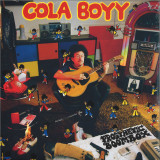
There’s liberation on the dance floor in the songs of Matthew Urango – glimpses of revolution that glimmer beneath the disco ball. “I want my music to bring people together,” says the Californian pop innovator, best known as Cola Boyy. “Because standing together is our best chance at fighting this shit show.” The shit show in question is a broken, brutal system the acclaimed multi-instrumentalist has witnessed up-close. Urango was born with spina bifida and scoliosis in Oxnard, California: a town in which almost 30,000 are estimated to live in poverty. Prosthetic Boombox, his eagerly awaited debut album, might at first glance seem a joyous confetti-burst of pop eclecticism, engineered to sound like “scanning between stations on a car radio, landing on all these different sounds and styles” as Urango puts it. Dig deeper, though, and you’ll discover a simmering sense of rebellion. “The working class are injured, struggling to pay rent and struggling to put food on the table,” he says. “I want to represent that.” Prosthetic Boombox
achieves that goal in a thrilling flurry of inventive indie, funk and soul: take Urango’s car radio analogy, place it in a time-travelling Delorean with Prince in the passenger seat, and you’re half-way there.
Look no closer than Prosthetic Boombox’s euphoric opener, the Avalanches-assisted ‘Don’t Forget Your Neighbourhood.’ The track – which Urango says mixes “the Beach Boys, French disco, house keys and ragtime piano, kinda like the Cheers soundtrack!” – ends with lyrics urging listeners to “fight for your town with your fist closed, strike it and make it more than just a memory.” It’s a reminder that the working classes need to “turn our fists against our oppressors instead of each other,” he explains. After that emphatic introduction comes a horn-laced funk wig-out titled ‘Mailbox’ – a song that gives Dua Lipa’s Future Nostalgia a run for its Studio 54-themed money, featuring rising Londoner JGrrey. Elsewhere, ‘Song for the Mister’ ventures into smooth R&B territory, before ‘Roses’ – a collaboration with Myd of Ed Banger fame – offers a bouquet of bustling disco guitars and infinite bisous of Connan Mockasin’s band drops in on the immaculate ‘Go the Mile’. Urango saves his most introspective moment for the album’s starry closer. ‘Kid Born in Space’, a cosmic collaboration with MGMT frontman Andrew VanWyngarden, sees the artist reflect on what he once had to overcome as a disabled person of colour. “I see them looking down on my dreams of being,” he sings tenderly. “I hear them making fun of my voice, but I keep on moving forward, I refuse to live in anyone else’s shadow.” Prosthetic Boombox, on this subject, is more than an album title – it’s a statement of intent.
“The message of my music is that our class is exploited, oppressed and murdered on the daily. That’s not right, and the system that enables that deserves to be wiped off the face of the earth,” he says. “The only way that happens is if we’re united. That’s the point of my music – to relate to people and unite them.” And what unites more than raucous, irresistibly danceable pop? Prosthetic Boombox is a riot of joyous grooves and catchy hooks for good reason. “I want to reach and spread my message to as many people as possible. You can’t do that if you’re some obscure motherfucker, you know?” he laughs. Don’t bet on him being an “obscure motherfucker” for long.
If Shelter swam through the serene side of the Library experience on GBR016, CV Vision blasts off in the opposite direction, riding an explosion of funk breaks and frazzled synths into the event horizon on his retro-futurist opus ‘Insolita’.
As contemporary life accelerates way past peak-weird, CV Vision leans into uncertainty and leaves Earth in the rear-view. Strung out on Simulacron-3, World On A Wire and Omaggio Ad Einstein, the Berlin-based musician imagines his own Brave New World, an alternate eXistenZ in a secret simulation.
Using the space age obsession of the Italian libraries as a launch pad, Dennis Schulze slathers a sonic storyboard with ferocious percussion, psychedelic fuzz and the pastoral electronics of Germany’s Kosmische movement. But this is less Can, more uncanny - and Schulze perfectly renders the cognitive estrangement of a simulated reality through his adventurous production. The monolithic live drums, recorded in a Neukölln garage on a battered Soviet kit are smeared with tape hiss, compressed to death and fired through LFOs, re-materialising on record in impossible scale. Time slips out of joint under the wow and flutter of the reel to reel, drum computers add digital interference to organic rhythms and the unfaltering slew of the 303 lends the hallucinatory thrill of the club sound system to an already psychedelic affair.
As Schulze’s imagination runs free, we’re taken through epic space battles and narrow escapes, moments of reflection and affection and a final resolution, all expressed through a dexterous control of movement and mood. For every explosion of break-fuelled adrenaline, there’s a cruise into cryo-chamber music and holodeck exotica. For each neck-snapping blast of acid funk, there’s a zero gravity lullaby waiting just around the corner.
So put isolation on ice and surrender to the strange, this is a trip you don’t want to end.
Shall Not Fade champions its hometown of Bristol for this next release on the Time Is Now White Label series; Daffy has built a name for himself on the local scene putting out forward-thinking garage on labels to watch like Dim Sum Records and Equal People. This will be his first full vinyl EP and it's not one to miss.
Run Around EP builds up the tension throughout; starting off with "Put Your Feet Up", a ghostly atmospheric piece with a sparse beat, sprinkling of ear candy and crescendo of headsy melodies. The title track oozes a growling bassline beneath staccato vocal snatches - it's a deconstructed style of garage that maintains tension while adding a dreamlike quality. More tension encompasses "Nerves" alongside teases of low end wobbles and harsh breaks that coalesce into a punishing jungle track.
"Lost Again" brings in the B-side with this same energy, an explosion of rolling breaks forming the backbone of this rouch and ready Metalheadz style crowd pleaser, calling out to the rave. "Mishap" serves up ragga vocals, impenetrable sub bass and pouncing two-step ripe for a reload, all rounded off with "Wasp's Nest" - a raucous, no holds barred climax to the EP.
Dead Nature, the solo project of former Spring King singer and prolific producer (The Big Moon, Calva Louise, Circa Waves, Dream Nails, Genghar, Police Car Collective) Tarek Musa, is announcing the release of debut album Watch Me Break Apart, and sharing the video for new single “Hurricane”. It follows the boisterous, sky-high indie-pop dramatics of recent single “Red Clouds”, which drew support from BBC Radio 1, BBC 6 Music, Clash, DIY, Dork, The Line of Best Fit, NME, The Independent, and The i Paper.
Producer and songwriter Tarek Musa has for a long time placed himself at the centre of other artists’ worlds, helping to hone sounds and build scenes through his production work for artists such as The Big Moon, Genghar, and Dream Nails, Calva Louise, Police Car Collective - as well as providing remixes for the likes of Circa Waves. As BBC Radio 1's Jack Saunders noted recently on-air, "we owe a lot to him out here... he's putting the passion from Spring King into the future of the alternative music that we love." With Dead Nature, Musa allows himself to step back from his role as architect for others and set about pursuing his own creative impulses.
Throughout Watch Me Break Apart, internal anxieties are made external, and re-purposed into a carnival of multi-coloured, fuzzed-up indie-pop. The strain of social media and a whirlwind news-cycle compound on the album’s cartwheeling title track, pairing thoughts of sleepless nights with isolated imagery (“A car waits at the lights, no one’s in the driver’s seat / In the ocean stands a tree”). "50 Foot Wall" and the paradoxically light-hearted "Hurricane" were both written against the backdrop of a growing climate crisis, and "Ladlands" zeroes in on social and political struggle, the rate at which change is happening, and the reality-warping nature of the echo-chamber.
Guro Gikling from All We Are sings backing vocals across the whole album, except for Hurricane which Jess Allanic from Calva Louise appears on.
Dead Nature, the solo project of former Spring King singer and prolific producer (The Big Moon, Calva Louise, Circa Waves, Dream Nails, Genghar, Police Car Collective) Tarek Musa, is announcing the release of debut album Watch Me Break Apart, and sharing the video for new single “Hurricane”. It follows the boisterous, sky-high indie-pop dramatics of recent single “Red Clouds”, which drew support from BBC Radio 1, BBC 6 Music, Clash, DIY, Dork, The Line of Best Fit, NME, The Independent, and The i Paper.
Producer and songwriter Tarek Musa has for a long time placed himself at the centre of other artists’ worlds, helping to hone sounds and build scenes through his production work for artists such as The Big Moon, Genghar, and Dream Nails, Calva Louise, Police Car Collective - as well as providing remixes for the likes of Circa Waves. As BBC Radio 1's Jack Saunders noted recently on-air, "we owe a lot to him out here... he's putting the passion from Spring King into the future of the alternative music that we love." With Dead Nature, Musa allows himself to step back from his role as architect for others and set about pursuing his own creative impulses.
Throughout Watch Me Break Apart, internal anxieties are made external, and re-purposed into a carnival of multi-coloured, fuzzed-up indie-pop. The strain of social media and a whirlwind news-cycle compound on the album’s cartwheeling title track, pairing thoughts of sleepless nights with isolated imagery (“A car waits at the lights, no one’s in the driver’s seat / In the ocean stands a tree”). "50 Foot Wall" and the paradoxically light-hearted "Hurricane" were both written against the backdrop of a growing climate crisis, and "Ladlands" zeroes in on social and political struggle, the rate at which change is happening, and the reality-warping nature of the echo-chamber.
Guro Gikling from All We Are sings backing vocals across the whole album, except for Hurricane which Jess Allanic from Calva Louise appears on.
- A1: Music Box / Struggling Man
- A2: So Can Woman
- A3: Putting Life Together
- A4: You've Been My Rock
- A5: Thrills Of Love
- B1: Love Girl
- B2: As You Die: Music Box
• Warlock is a super rare funk/rock release on the Holland Dozier Holland’s label Music Merchant
• Influenced by Funkadelic and MC5
• This is the first time ever this album has been reissued on vinyl since it’s release in 1972
• Pressed on 140g black vinyl with original artwork and printed inner sleeve
Café Society opened the 69th annual Cannes Film Festival to rave reviews. Woody Allen became the first and only director to have three opening night films selected for the Cannes Film Festival.
It’s New York in the 1930s. As he has more and more trouble putting up with his bickering parents, his gangster brother and the family jewelry store, Bobby Dorfman feels like he needs a change of scenery. He decides to go and try his luck in Hollywood where his high-powered agent uncle Phil hires him as an errand boy.
In Hollywood he soon falls in love, but unfortunately the girl has a boyfriend. Bobby settles for friendship - up until the day the girl knocks at his door, telling him her boyfriend just broke up with her. All of a sudden Bobby’s life takes a new turn, and a very romantic one at that. The soundtrack features a great collection of the music from the 1930’s. The music is featured prominently in the movie and has been chosen by Woody Allen himself and features newly recorded jazz standards by Grammy Award winners Vince Giordano & The Nighthawks and classic recordings from Ben Selvin, Benny Goodman and Count Basie.
Woody Allen says about the soundtrack: “The soundtrack consists of music from the 1930s since that’s when the picture takes place. Most of the material is Rodgers and Hart who is very dominant in those year and Lorenz Heart have that bitter sweet romantic quality that defines the spirit of the movie itself.”
This is a limited edition of 500 individually numbered copies on blue coloured vinyl. A 4-page booklet with pictures from the film and credits is included.
Techno isn't a genre that has birthed many consistent albums, and the dub techno subgenre even less so, but one indisputable classic is Porter Ricks' debut 'Biokinetics'. Originally issued on the legendary Basic Channel sub-label Chain Reaction in 1996 following a trio of 12"s, 'Biokinetics' was the first of the label's album releases, and still stands as its crowning achievement. Porter Ricks are Thomas Köner and Andy Mellwig, and between them they re-framed the techno sound, imbuing the spacious ambience pioneered by label bosses Mark Ernestus and Moritz Von Oswald with a frosty, isolated experimental bent, and combining it with the sort of haunted minimalism of early Plastikman.
What separated 'Biokinetics' from other albums at the time was its unwavering narrative - the exact sound has been interpreted countless times since, but the immersive qualities of this singular record have rarely been touched. Maybe it is down to the silvery underwater concept that ties each track together - the bubbling pads, sub-aquatic basses and muffled kick drums. But as with any great album, it's hard to exactly put your finger on what makes it a classic. Simply put 'Biokinetics' is one of the most important records in the genre and one of techno's finest albums. It has been re-released ten years ago by Type Records, and now Mille Plateaux is celebrating Porter Ricks' and Biokinetics' 25th anniversary with this sumptuous double viny edition.
Makèz have come a long way since they first sneaked into Amsterdam’s studio 80 at the age of 17 to hand over their demos to Dam Swindle. Those demos led to their debut EP ‘Different planets’ on Heist in 2019 which gained major support from artists like Seth Troxler and Chez Damier. Quickly after, they signed two records on New York based label Let’s Play House. Fast forward two years, and here we are: the release of their debut album “City of all”.
"City of all” shows an admirable level of sophistication and matureness and effortlessly bridges genres across its 13 tracks. You can feel the amount of thought that has been put into this record, with songs happily blending into each other as Makèz submerge themselves in their concept of accidental encounters, inclusiveness and what it means to live in a city like Amsterdam.
On “City of all”, Makèz bring together all the musical influences they’ve picked up in their life as music fans, clubbers and art students. The jazz-funk of opening track “The entrance” feels breezy, casual almost, like the freeform rhythms that are played in a jazz club during soundcheck. That energy also oozes from “Not so different”, which features the smooth vocals of LYMA. There’s a hint of the house-meets-R’n B vibe that made Anderson .Paak the star that he is now. The song is brilliantly funky and shows the songwriting and arrangement talent of Makèz, who cleverly use pop & soul cues to create one of the album’s highlights.
What follows is 4 cuts ranging from the syncopated Balearic funk of “Orbit”, the strings of album title track “City of all”, the organ-led jam “Gonna getya" and the downbeat “Sonder”. Allysha Joy -best known for performing in Melbourne Hip Hop collective 30/70 - is featured on the deep and jazzy cut “Looking up”. If Makèz and Allysha are all looking up, it’s clear they’re seeing the same thing. These kindred spirits perfectly complement each other on this track, where the deep bass, warm harmonies and jazzy percussion prove to be a perfect foundation for Allysha’s rhymes.
Is it an album all about jazz and soulful tracks to listen to at home? Far from that. There’s a nice bit of dance floor-oriented tracks, where the distorted filter funk of “Roselane” featuring Fouk proves to be a highlight along with what is arguably the heaviest cut of the album: “Bent with funk”.
In an EP context, these house tracks would surely do their work, but they really come to life in this album format. No compromise has been made to storytelling and the house tracks all play their part while still standing their ground as powerful club tracks. It’s the expert production and smart arrangement that gives this album its casually funky feel. On “City of all”, Makèz showcase their remarkable talent for writing an album that goes to so many different places, but most of all, just really feels like home.
Enjoy the music,
Maarten & Lars
A limited edition of 500 copies on white vinyl. First ever reissue of Alternative TV's "Action Time Vision", compiled in 1980 and featuring the group's 7"es from 1977 to 1979. Including bonus track "You Bastard" and new liner notes by ATV singer Mark Perry, the founding editor of punk fanzine Sniffin' Glue.
What Mark Perry says:
"It wouldn't be an exaggeration to say that Punk turned my world upside down! In July 1976, after hearing and seeing the Ramones, I went from just another music fan, avid reader of the NME and Melody Maker, to become editor of punk's premier fanzine, Sniffin' Glue. It was almost an instant success and by December 1976, through our no nonsense approach, our position as the 'punk Bible' was assured. But it was never enough for me. As I saw the initial punk explosion subside into a succession of third-rate copycats, I wanted to have a go myself.
My first attempt at forming a band was in late '76. We called ourselves the 'New Beatles' and it ended after a couple of rehearsals. It wasn't until I met guitarist Alex Fergusson, a mate of Sounds writer Sandy Robertson, in early 1977, that I started putting together some more interesting ideas for a band. I worked on a bunch of lyrics and, pretty quickly, Alex had put tunes to them. Eventually calling ourselves Alternative TV, we had our first rehearsals at Throbbing Gristle's Industrial Studios in March '77.
That initial line-up was just me singing and Alex on guitar, with Genesis P-Orridge helping out on some bass and drums. We did ask Gen to join fulltime, but he decided against it and stuck with Throbbing Gristle. After more rehearsals, we played our first gig at the Nottingham Punk Festival in May 1977, joined by Mick Smith on bass and John Towe (ex-Generation X) on drums.
I started thinking about doing a record almost from the start because, by this time, I was running the Step Forward record label with Miles Copeland, who was also to become the band's manager. It seemed like a natural move to put out my own record, but it instead ended up on Deptford Fun City, another of Miles' labels. Before that actually happened, we made a slight detour by recording a demo for EMI. They didn't want to sign us, but we did end up with the tapes…"