Search:radical g

Styles
All
Takayanagi Masayuki New Direction for the Art - La Grima

Famed free jazz concert registration of an early New Direction for the Art performance. Recorded in 1971. Old-style Gatefold LP, with rare photographs & extensive liner notes by Alan Cummings.

The performance by Takayanagi Masayuki New Direction for the Art at the Gen’yasai festival on August 14, 1971 was an intense, bruising collision between the radical, anti-establishment politics of the period in Japan and the febrile avant-garde music that had begun to emerge a few years before. The ferocious performance that you can hear here was received with outright hostility by the audience, who responded first with catcalls and later with showers of debris that were hurled at the performers. Takayanagi though described the group’s performance to jazz magazine Swing Journal as a success, “an authentic and realistic depiction of the situation”.

In 1962, Takayanagi, bassist Kanai Hideto and painter Kageyama Isamu went on to form an AACM-style musicians’ collective called the New Century Music Research Institute. Every Friday, members gathered at Gin-Paris, a chanson bar in the fashionable Ginza district of Tokyo, to push the outer limits of jazz creativity.

But the pivotal moment for his music was the creation a new trio version of his New Directions group in August 1969, with the free bassist Yoshizawa Motoharu and a young drummer Toyozumi (Sabu) Yoshisaburō. Experiments eventually led to the creation of two basic frameworks for improvisation that Takayagi referred to as Mass Projection and Gradually Projection.

“La Grima” (tears), the piece that was played at the Gen’yasai festival, is a mass projection and listening to it, you can get a clear sense of what Takayanagi was aiming at. Mass projection involves a dense, speedy and chaotic colouring in of space that destroys the listener’s perception of time, and thus of musical development.

The ferocity of the performance of “La Grima” at the Gen’yasai Festival in Sanrizuka on August 14, 1971 was consciously grounded by Takayanagi in a particular historical moment, ripe with conflict and violence. A month after the festival, on September 16, three policemen would die during struggles at the site. This was the context that the three-day Gen’yasai Festival existed within. The line-up reflected the radical politics of the movement, with leading free jazz musicians like Takayanagi, Abe Kaoru, and Takagi Mototeru appearing alongside radical ur-punkers Zuno Keisatsu, heavy electric blues bands like Blues Creation, and Haino Keiji’s scream-jazz unit Lost Aaraaff.

New Direction for the Arts trio topped the bill on the opening day, playing an aggressive, uncompromising “mass projection” set of polyphonic improvisation. Alongside drummer Hiroshi Yamazaki and saxophonist Kenji Mori, Takayanagi soloed hard and continuously for forty minutes. This was performance as precisely calibrated metaphor: three musicians responding to the demands of the moment with instinctive force and fury, untethered by rules, leaderless yet not rudderless (the direction part of the group’s name was no accident). The piece was entitled La Grima – tears - and the fusion between the palpable anger of the performance and hopeless sadness of its title were also perfectly apt for the situation. This was a fight that the state was always going to win. Yet, by all accounts, the band’s set went down like a fart at a funeral. The band were showered with catcalls and debris throughout, and by chants of “go home” when the music finally came to an end.

However, looking back at the event in the year-end issue of Japan’s leading jazz magazine, Swing Journal, Takayanagi was surprisingly upbeat: New Directions brought a solid political consciousness to our performance and succeeded in an authentic and realistic depiction of the situation. But journalism revealed its superficiality in its inability to penetrate the core of the music. I don’t know much about anyone else, but we at least left behind a competent record.

It’s a fascinating statement in many ways. Perhaps on one-hand it can be read as stubborn, solipsistic and self-justifying, yet in conjunction with his statement in 1971 there are points that guide us towards an understanding of just what Takayanagi intended with his performance at the festival. As Kitazato Yoshiyuki has argued, it becomes an almost religious act, directed at the earth deities of the land. A union of anger, sorrow and malevolence that can be placed nowhere effective, all it can do is find expression and channeling. The forcible land seizures at Narita, the eviction of farmers from land that had been in families for generations, the destruction of communities: none of this can be prevented, not least by an artistic action. All that can be done is an attempt to mark the land itself, to soak it with the combined force of emotions and the volume of the performances, to bury something there that cannot be drowned out, even by the coming roar of jet engines.

pre-order now06.05.2022

expected to be published on 06.05.2022

25,17
Seikatsu Kojyo Iinkai - Seikatsu Kojyo Iinkai

Ferocious JP / US free jazz bomb. A rare meeting between the NYC free jazz scene and the Japanese free music scene. Old-style Gatefold LP, with rare photographs & liner notes by Alan Cummings.

Following hot on the heels of the first, mid-sixties generation of Japanese free jazz players like Kaoru Abe, Masayuki Takayanagi, Yōsuke Yamashita, Motoharu Yoshizawa, etc., an exciting second wave of younger players began to emerge in the seventies. Two of its leading members were the saxophonist Kazutoki Umezu and multi-instrumentalist Yoriyuki Harada. Both were post-war babies and immigrants to the city, Umezu from Sendai in the north and Harada from Shimane in the west. They first met as students in the clarinet department at the Kunitachi College of Music, a well-known conservatory in western Tokyo. Harada was already securing sideman gigs on bass with professional jazz groups and was active in student politics, making good use of his connections to set up jazz concerts on campus. It was around this time that the two began to play together in an improvised duo, with Umezu on clarinet and bass clarinet and Harada on piano. They also experimented with graphic scores and prepared piano.

These experiments eventually led to the creation of a trio, with a high-school student called Tetsuya Morimura on drums, that they decided to name Seikatsu Kōjyō Iinkai (Lifestyle Improvement Committee) in joking reference to the Marxist discourse of the student radicals of the time. Around 1973, Umezu and Harada decided to call it a day and go their separate ways. Umezu began playing with the Toshinori Kondo Unit and Harada with the Tadashi Yoshida Quintet. In 1974 Harada formed his own trio and began to play at jazz coffeehouses across Japan.

Then, in September 1974 Umezu travelled alone to New York, where he set about building connections with the loft jazz scene in the city. It was a fortuitous moment to arrive in New York. Rents were cheap in the Lower East Side, possibilities for squatting existed, so many musicians and artists had moved to the area. Umezu soon became known on the scene as Kappo and he started to make connections with some of the young musicians like David Murray, Arthur Blythe, and Oliver Lake. He recalls making the rounds of the lofts every evening, checking out the performances, and getting the chance to sit in with many groups including Juma Sultan’s Aboriginal Music Society and trumpeter Ted Daniel’s orchestra.

Things were going so well that Umezu wrote to Harada and invited him to come to New York. He accepted and arrived in the city in July 1975. Harada and Umezu took the opportunity to resume their artistic collaboration. Their first concert together in over two years took place on July 20th at another loft, Sunrise Studios at 122 2nd Avenue. Umezu remembers Sunrise as an unusually sunny loft with the rarest of things, a grand piano. He invited along Ahmed Abdullah, a trumpeter he had got to know while playing with Ted Daniel. Abdullah led his own group and was a long-term Sun Ra sideman. William Parker, one of the key figures in the loft jazz scene of the period, was on bass. Abdullah also brought along Rashid Sinan on drums. Sinan drummed in Abdullah’s units throughout the seventies, but he had also played on Frank Lowe’s immortal Black Beings album and collaborated with Arthur Doyle, playing on Doyle’s Alabama Feeling album. By all accounts the evening was a huge success, with speed and dynamism of Harada’s piano playing gaining him lots of support.

Since they had managed to save some money from their day jobs, Umezu and Harada decided to set up a recording session with the same line-up on August 11 at Studio We, where there was a well-equipped studio on the third floor. Umezu recalls the session as follows, Of course, we recorded our performances in one take, with zero retakes as far as I remember. On all the tracks we recorded, we moved as one unit, sharp and fast. That was the nature of Lifestyle Improvement Committee, New York Branch.

Umezu and Harada would later become known for the elements of parody and entertainment that they brought to their music, a freewheeling blend of pastiche, humour and on-stage performativity that paralleled the approaches of the Art Ensemble, Sun Ra, and Holland’s ICP. But here, on their first recordings, the humour element is not yet present. Instead, there is a febrile sense of joy in creation and connection. On the Umezu-penned “Kim”, for example, Harada opens the piece with a speedy exploration of the full-range of the keyboard, hitting hard on the bass keys to create a rhythmic bed out of which patterns begin to emerge. Umezu enters at a much slower pace, longer held notes that at first float weightlessly over the urgency of the piano before they begin in splinter and accelerate. When Parker and Sinan kick in, it’s a rollicking tempo with Parker plucking deep and hard and the left-handed Sinan skittering hard across the topside of his kit. Abdullah kicks in a glorious solo twelve minutes in, bright and breathy at once. The piece slows and grows more spacious towards the end, giving Parker a chance to showcase some arco work that shades beautifully into the air against Abdullah’s trumpet.

pre-order now06.05.2022

expected to be published on 06.05.2022

25,17
Muddy Monk - Ultra Dramatic Kid LP

Muddy Monk was revealed alongside Parisian artists Myth Syzer, Ichon and Bonnie Banane on 'Le Code'. From his native Switzerland, he imposes a fine, synthetic universe that plays a major role in the renewal of French-language song. The journey began in 2018 with 'Longue Ride', a cathartic first album that he describes as 'a kind of therapy' and that was unanimously acclaimed by the critics. In 2020, he returns with 'Ultra Tape', a mixtape which, with the benefit of hindsight, is the first step towards his second album. We discover a more raw universe. Darker too. A superb launching pad for his second album.

With Ultra Dramatic Kid, Muddy Monk delivers a radical new piece, a bubble of just over thirty minutes in which he manages to work his magic and make us dance on the edge of his emotions. As if everything could change in an instant towards happiness or chaos. An electric album and a sublime dive into his universe, which draws equally from Daft Punk, Rage Against The Machine and Travis Scott. A project that takes the form of a global experience, both auditory and visual, since almost all the tracks on the tracklisting have been put into images by Felix de Givry, the whole forming a short film to be discovered with the release of the project. In the end, Ultra Dramatic Kid is an uncompromising album in which it is a pleasure to get lost. An album that further establishes the Swiss artist as one of the artists capable of redefining the contours of French-speaking music for many years to come.

out of Stock

Order now and we will order the item for you at our supplier.

20,13

Last In: 3 years ago
Arovane - Tides LP

Arovane

Tides LP

12inchKEPLARREV10LP
Keplar
02.05.2022

»Tides« marked a radical change in direction for Arovane. After Uwe Zahn had made a name for himself with cutting-edge IDM rhythms and slick ambient textures on a slew of releases, his sophomore album saw the prolific producer opt for a sample-based approach that resulted in a more organic sound and laid-back downbeat grooves. Having reissued Arovane’s seminal »Atol-Scrap« as a double LP in 2021, the Berlin-based Keplar label now makes »Tides« available on vinyl for the first time since its original release in 2000 through the legendary City Centre Offices. The new version has been remastered by Kassian Troyer at Dubplates & Mastering and comes with a brand new cover artwork. It shines a new light on a release for which Zahn quite literally ventured into previously unknown territory — »Tides« is an album that emits a timeless, quiet calm and nonetheless stays constantly in motion.

»The idea for the album came to me after a vacation in France«, says Zahn. Inspired by the landscape, especially the coastline and the sea, he made field recordings throughout his trip that were also used on the record, giving it its sensual feel. The foundation of the album however, the loose yet gripping grooves at the heart of every track, result from Zahn working extensively with samples. »I wanted to make use of drum sounds and small excerpts from old jazz vinyl records«, he explains. He maintained the unique sound signatures and rhythmic flutter of the source material while building intricate beats with them. Most of the material was culled from the record collection of Christian Kleine, whose spontaneous guitar improvisations over the first musical sketches were recorded and edited by Zahn and can be heard on four tracks. Also employing the occasional cembalo or spinet sound, he worked with a hardware sequencer and a delay to integrate the different, discrete elements into nine tracks that feel both dense and light at once.

What’s astonishing still 22 years later is how spacious »Tides« sounds. This is due to the fact that Zahn not only paid close attention to the sonic idiosyncrasies of his source material, but also to what happened in between those sounds. »Mark Hollis’s solo album was a huge inspiration at that time«, says Zahn. »What I find fascinating about it until this day is how silence and the subtle hiss of the mixing boards were being used on that record.« Silence was also an important stylistic element on »Tides« and adds greatly to the overall atmosphere of an album that with the appropriately named »Theme« immediately sets the mood with intricate spinet melodies: Zahn opens a door for his listeners and invites them to follow him to see a specific part of the world through his very own lens.

As a whole, the album mirrors Zahn’s trip that took him along the steep cliffs on a foggy day (»Seaside«), to an abandoned house in which he found old maps (»A Secret«), along the coastline during a long car ride (»Deauville«), to a sleepy village and the slowly moving sea (»Tides«) and finally back home to his native Germany where he started reflecting upon his experiences, ultimately deciding to translate them into music (»Epilogue«). »Whenever I listen to this album now, the images and memories it evokes are incredibly vivid and vibrant«, he says. It’s not hard to see — or rather hear — why. »Tides« may have been a deeply personal project, but it effortlessly evokes universal feelings by (re-)building an entire world in the course of only a few pieces of music.

out of Stock

Order now and we will order the item for you at our supplier.

18,95

Last In: 23 months ago
Parov Stelar - Moonlight Love Affair LP

MONLIGHT LOVE AFFAIR is a love relationship in which there are no boundaries. The moon colors the world in a different light and makes us see and feel things with different eyes. So in a perfect digital world it is inevitable to let the organic flow in, to look at the other side and to unite. This is exactly what Parov Stelar does to perfection with this album. He takes the digital and organic worlds, combines them into one massive masterpiece and is not willing to compromise, because in compromise both sides always lose.

Parov Stelar completes another phase of his artistic development with the album Moonlight Love Affair. Radical honesty, openness to himself and his environment pave this path. I CAN SEE MUSIC, I CAN HEAR ART...the album artwork designed and painted by Parov Stelar himself closes the circle and completes the total work of art of all senses.

The album MOONLIGHT LOVE AFFAIR will be released on 29.04.2022 and shows all facets of the artist. Raw and unvarnished, thereby vulnerable, powerful and beautiful.

out of Stock

Order now and we will order the item for you at our supplier.

21,98

Last In: 9 months ago
Dälek - Precipice LP 2x12"

Dälek, “the subversive indie hip-hop outfit” (Pitchfork), release their eighth album, ‘Precipice’, via Ipecac Recordings.

 Forged in the fires of the East Coast underground music
scene of the late ‘90s, experimental hip-hop pioneers
Dälek have spent the past two decades carving out a
unique niche fusing hardcore hip-hop, noise and a
radical approach to sound. Their brutal sonic
temperament pushes rap music’s capacity for noise and
protest to exhilarating conclusion.

 Following in the footsteps of Public Enemy while drawing
influences from My Bloody Valentine and Faust, Dälek
have succeeded in adding completely new textural and
structural dimensions to rap music.

 Predominantly the work of Brooks and Manteca (aka
Mike Mare), ‘Precipice’ was recorded and mixed by the
two band members at their Deadverse Studios in Dälek’s
hometown of Union City, N.J.

 Tool’s Adam Jones guests (guitar / synth) on ‘A Heretic’s
Inheritance’. The band have supported Tool on tour
previously.

 The album’s cover was created by Paul Romano
(Mastodon, Withered) with interior packaging featuring
the art of Afrofuturist painter, Mikel Elam.

 The band have toured with and supported a wide range
of acts in the hip-hop, rock, metal and experimental
genres, including KRS One, Tomahawk, The Melvins,
Grandmaster Flash, Jesu, Dillinger Escape Plan,
Pharcyde, RJD2, De La Soul, Flying Lotus, The Bug,
Mastodon and Fantomas, among many others.

pre-order now29.04.2022

expected to be published on 29.04.2022

36,56
Mall Girl - Superstar LP

Mall Girl

Superstar LP

12inchJANSEN129LP
Jansen Records
29.04.2022

Mall Girl: «Superstar» Jansen Records 2022 «Superstar», the debut record from Norwegian art-pop outfit Mall Girl, represents an exciting new chapter for the buzzed-about band. The release follows a string of successful singles, including their 2018 track “Slay Queen,” which introduced them as an act to watch in the alt-pop arena. The chaotic year of 2020 brought a string of infectious, vibey singles, including “My Sweet Mall Girl” and the fierce “Bad Girl." Members Iver Armand Tandsether, Hannah Veslemøy Narvesen, Eskild Myrvoll and Bethany Forseth-Reichberg were forced to get creative when the pandemic hit, sidelining best-laid plans to flesh out some songs before heading into the studio together. "Because of COVID regulations and the four of us living in two different cities, we changed the way we worked with the songs quite radically in the months leading up to the studio recording,” Narvesen says. "We’ve always been very oriented towards the live performance of the songs, including when we compose them together in our rehearsal space. That way of working has led to some challenges when recording, as you end up listening to the songs in a different manner and might figure out you should have done everything differently." While others put their creative endeavors on hold, Mall Girl opted to try something different. Many of the songs on «Superstar» were tracks that the band regularly performed, but they wanted to seize the opportunity to evolve their sound even more. “We actually ended up ‘remote composing’ big parts of the album, with everyone working from their own home studio and bouncing ideas back and forth,” Narvesen explains. "This was a very welcome change of workflow for us, and it lead to us making some songs which probably wouldn’t have turned out that way had we been together in the same room." This experimental shift in their creative process led to the creation of songs bursting with infectious hooks, hypnotizing grooves and punchy lyrics.

pre-order now29.04.2022

expected to be published on 29.04.2022

28,36
Fennesz - Hotel Paral.lel LP 2x12"

Hotel Paral.lel, released in 1997, marks the full length debut release from Austrian Christian Fennesz, originally released by MEGO, following the twitching drone as found on the 1995 EP Instrument, also included in this deluxe 2LP reissue. Once launched, Hotel Paral.lel was to instigate a sublime exploration of a wide variety of forms, from formal abstraction to shimmering drone around to ground zero glitch pop.

Recorded just before mobile computing devices became omnipresent it was an investigation into the sonic possibilities residing in guitar based digital music. Sz launches the career with a constantly buzzing sound that resembles a fax machine encountering a G3 laptop for the first time, realising the game is up. Nebenraum is the first foray into the style for which one would attribute to Fennesz. A glacial drone unexpectedly morphs into a gorgeous melody and microscopic groove. Adding pulse and melody was hearsay in the radical end of experimental music up until this point and with this single gesture, everything changed, for everyone. Blok M nails this trajectory home with a straight up 4/4 beat. Such rhythm also features on Fa with a euphoric mix of a thudding beat, sharp splinters of noise and a devastating exploding melody. Repetition plays heavily through this album as the hyper metronomic beat on traxdata lays a bed for all manner of buzzing electronics. On the closing “Aus” we see a glimpse of what was to come in the future works of Fennesz, an experiment in popping, bubbling pulse pop. A far more darker and experimental work than Fennesz’ subsequent work. This is an exquisite radical field of freeform noise, sliced techno beats and subtle ambient texture all coming together to create a timeless work. There’s little out there in the world of music, still to this day, that sounds remotely like Hotel Paral.lel.

With a radical reinvention of music Hotel Paral.lel is an essential addition to collectors of pioneering music in the late 20th Century and sounds as enthralling today as it did to the shocked ears occupying 1997.

Remastered by Stephan Mathieu.

out of Stock

Order now and we will order the item for you at our supplier.

30,21

Last In: 4 years ago
Fischer-Z - Til The Oceans Overflow

The new album ‘Til The Oceans Overflow’
connects with the 40th Anniversary of Fischer-Z’s
iconic ‘Red Skies Over Paradise’ album. It is set
once again in Berlin and contrasts the personal,
political and social changes between 1980 and
2020. The internet and social media have radically
affected people’s freedoms and manipulability and
characters mentioned in the 1980s songs are
brought forward 40 years in their lives to illustrate
some of these changes.

The basics of this new album were recorded by
founding member / frontman John Watts in the
famous Hansa Studios in Berlin but the pandemic
put just about everything on pause. His
international band contributed parts from home
across the internet to John in Brighton, who
included them in his production.

John Watts, the heart and soul of the ever-evolving
Fischer-Z - by definition a live performer - has
spent the last year and a half getting his teeth into
making this new themed band album. He is more
eager than ever to promote the new songs, along
with all his classic hits, with a gigantic list of
upcoming shows.

Fischer-Z are stronger than ever. Their last album,
‘Swimming In Thunderstorms’ (2019), put them
back on the map big time with many festivalappearances and sold out club shows:

pre-order now15.04.2022

expected to be published on 15.04.2022

20,71
Katalin Ladik - Water Angels

Katalin Ladik

Water Angels

12inchPLANA-L45NMN162
Alga Marghen
15.04.2022

Alga Marghen proudly presents "Water Angels", an LP with previously unreleased tracks by Katalin Ladik, following the monumental "Phonopoetics" from 2019. "Water Angel", the title track, is a side-long work from 1989. It began its life containing a plice of "O Fortuna" from Carl Orff's "Carmina Burana" and was first staged in an artificial fog on a lake at the 1989 Spoleto Festival in Italy. The texts include fragments of her own lyrics mixed with parts from James Joyce and Lewis Carroll in a kind of sonic-textual collage of processed sounds superimposed to environmental field recordings. one can also hear the composer Erno Király, her first husband, playing his self-built instrument called "Zitherphone", a 58-stringed huge engine of sounds assembling five zithers in a single body, with pick-ups placed on some of the strings. The first part of "Water Angel" was used as a starting point for "Three Orphans", another composition juxtaposing electronically modified voice with recordings of folk songs, this time Hungarian. It's a kind of "adaptation of a Hungarian folk ballad", utilizing recordings done in Transylvania in 1940, registered with a wax cylinder phonograph and gathered by Radio Novi Sad. Thanks to the collaboration with Boris Kovac, the sound engineer for this project, the quality of Katalin Ladik's screams, whispers, chants, laughter, giggles is now significantly improved, and in some ways the subtle nuances of her virtuoso interpretation find here their most powerful rendition. Also presented on this record are three and never before issued works created by Katalin Ladik in collaboration with the composer Svetlana Marasch at the electronic studio of Radio Belgrade in 2019, "Electric Bird", "White Bird" and "Ice Bird". combining extended vocal techniques, processing and modular synthesis, these tracks confirm the artist's radical temperaments that helped to define her work during the 60s and 70s, while pushing it further into new territories thus revealing an artist with almost no peer in the experimental landscape today.

pre-order now15.04.2022

expected to be published on 15.04.2022

24,83
Kalme - Neue Sprache

Kalme

Neue Sprache

12inchAVM073LP
Altin Village & Mine
08.04.2022

The artistic oeuvre of Berlin-based Sonja Deffner is as extensive and diverse as its contexts are high-profile: If the classically trained musician could in recent years be heard as a member of the groups Jason & Theodor, Die Heiterkeit, Globus and PTTRNS, as part of Christiane Rösinger's touring band, or as a recording musician on Andreas Spechtl's (Ja, Panik) albums, she has at the same time produced an acclaimed graphic work, video works and made her theater debut. Under the name Kalme, Deffner now presents her solo debut »Neue Sprache«, which feels like a culmination: Deffner doesn't need much space to present an artistic position of spectacular incisiveness and maturity.

The formal language of Kalme's debut evolves with reference to experimental pop and R&B, but equally informed by ambient electronics or dub techno. Analog and digital sound synthesis meet Deffner's characteristic use of field recordings, acoustic instrumentation (clarinet, percussion) meets musical post-production, sampling meets expressive synthesizer playing. At the center of the album, however, are Deffner's remarkable lyrics, written in German for the first time. Deffner creates a language of stark, emotional poignancy that is as conspiratorial as it is precise. The themes of the tracks develop between the poles of movement and stagnation, understood as motifs of biographical as well as musical ways of being or relating. In this forcefield, personal and political considerations coincide again and again, for example when Deffner reflects on her experiences with the social conditioning of femininity and motherhood.

The album title »Neue Sprache« (»New Language«), then, describes a search for forms of articulation of solidarization: language as a tool of a new relationship to the world that allows testimony to individual experience without reproducing categories of repression. In this way, Kalme's debut simultaneously achieves a radical intimacy, just as, on the other hand, the confrontation of language and sound repeatedly opens up fissures that deny any semblance of comfort. »Neue Sprache« does not stop at this modernist gesture, however, but unquestionably takes a stand. That's what Kalme's »Neue Sprache« ultimately is: the taking of a position. A statement.

pre-order now08.04.2022

expected to be published on 08.04.2022

22,98
Prima Materia - La Coda Della Tigre

Prima Materia was a vocal improvisation ensemble, founded by Roberto Laneri in 1973. Composed entirely of vocalists with no academic training, the group developed various techniques – revolving mostly around the use of overtones – that would embody their unique sound. No instruments nor electronic manipulations were ever employed within the group's physiognomy, which was realized purely through the human voice.

La Coda Della Tigre, the group's sole album, was recorded in 1977 by Alvin Curran and released on Ananda, an artist-run label founded by Laneri, Curran and Giacinto Scelsi.

As the original liner notes state, "The music of Prima Materia may sound radically new, yet at the same time it is likely to ring some distant bell and evoke ancient emotions. This is not due to chance: indeed, the very name of the group points to a specific path, namely, the unfolding of the potential implicit in the alchemical symbol as embodying a process of transmutation of consciousness."

Prima Materia's four members (Laneri, Claudio Ricciardi, Gianni Nebbiosi and Susanne Hendricks) combine voices to create a singular, beautiful drone that is (as the group's name suggests) both impossible to define and fundamentally simple.

This first-time standalone reissue is recommended for fans of La Monte Young, Terry Riley and Disques Ocora.

pre-order now08.04.2022

expected to be published on 08.04.2022

23,40
Funkadelic - Maggot brain LP 2x12"

1971 and Black America was luxuriating in the soft soul
of the O’Jays, the Temptations had just left behind their
flirtation with psychedelia, James Brown was
explaining Soul Power, Sly & the Family Stone were
having a Family Affair, and Marvin Gaye was asking
‘What’s Going On’.

• In their own inimitable way, Funkadelic were laying
down their own statement about the ecology of the
planet in the opening of lead and title track ‘Maggot
Brain’, turning it into an elegy for the Earth in the
ensuing heart-wrenching extended Eddie Hazel guitar
solo – one of the most radical records of the period.

• The album also spawned two Top 50 singles with the
usual Funkadelic wry observational humour of ‘You
And Your Folks, Me And My Folks’ and ‘Can You Get To
That’. And just in case you think things have
normalised, the set closes with nine minutes of the
chaotic sound collage ‘Wars Of Armageddon’.

• This 50th anniversary edition includes a second 12”
with two versions of the title track. Side A features the
live version from Meadowbrook from the same year that
the studio album came out. Jump forward 46 years to
the “Reworked by Detroiters” release and side B has
the BMG Dub, showing the enduring quality of one of
the great guitar records of all time.

• This issue is mastered from fresh transfers of the tape.

• Facsimile gatefold sleeve

out of Stock

Order now and we will order the item for you at our supplier.

39,71

Last In: 4 years ago
GINA X PERFORMANCE - NICE MOVER + VOYEUR LP 2x12"

Les Disques du Crepuscule presents a new double vinyl remaster of two seminal albums by German synth wave pioneers Gina X Performance, whose groundbreaking singles Nice Mover, No G.D.M. and Kaddish remain enduring electroclash staples after four decades of club supremacy.

Remastered for vinyl in 2021 by Zeus B. Held and Lars Lafeyette Fassbender, the double album set is housed in a gatefold sleeve with new artwork and pressed on clear and green vinyl + digital copy. This pressing is limited to 1000 copies only worldwide. The inner sleeve features a brand new interview with Zeus.


Formed in Cologne in 1978, the core of Gina X Performance composed vocalist Gina Kikoine and producer/keyboard/vocoder wizard Zeus B. Held. ‘I had in mind science fiction-inspired tracks,’ explains Zeus.‘Really cold sounding music, with no blues-ey chords or melodies, no guitar and nothing rocky.’

Originally issued on German imprint Crystal 1979, icy, noirish debut album Nice Mover spawned two radical Eurodisco hits, with gender-bending single No G.D.M. becoming a firm favourite at the legendary Blitz Club in London’s Soho. At the same time Zeus B. Held also became an in-demandproducer, working with John Foxx, Fashion, Rockets and Dead or Alive.

The third GXP long player, Voyeur, from 1981, followed a brief spell on EMI and saw the duo return to their experimental, avant-gardist roots, the material by turns seductive, provocative and confrontational. Since then countless electronic artists have acknowledged or betrayed the influence of Gina X Performance, including Depeche Mode, Propaganda, Ladytron and Peaches.
Critical praise for Gina X Performance: “Pioneering electro-pop from 1979 with hints of Kraftwerk, Nico and Studio 54-era Grace Jones” (Mojo); “Like an artier Moroder” (Uncut); “No G.D.M. is one of the most influential songs to come out of the Continent” (Q); “Disco for the intellect” (NME)

out of Stock

Order now and we will order the item for you at our supplier.

22,48

Last In: 19 months ago
Various - LÈSPRIT KA: NEW DIRECTIONS IN GWOKA MUSIC FROM GUADELOUPE 1981-2010 LP (2x12")

2LP with a 4-page colour insert

As Guadeloupean vocalist and composer Marie-Line Dahomay writes in her liner notes to the compilation, gwoka is more than a style of music, it is “a way of living and thinking.” Rooted in the social, musical and ritual practices of enslaved African people and their descendants on Guadeloupe, gwoka has always sought to express the spirit of independence and resistance authentic to the island.Building on its traditional call-and-response form and the ideas of pivotal figures like Gérard Lockel and Christian Laviso, modern gwoka evolved throughout the second half of the twentieth century to include funk, jazz and electronic influences.

Defined by its propensity for innovation and experimentation, this compilation charts the most radical changes to modern gwoka, capturing a sensory riot of traditional répertoires, rhythms and makè techniques fused with genre-defying experimentation.Whether heard in the deeply cosmic, spiritual music of Dao, Freydy Doressamy and Gaoulé Mizik, or the jazz funk inflections of Gui Konket and Horizon, the music here is united by the feeling of santiman ka, crucial not only to gwoka music but the identity of Guadeloupe at large.

As co-curator Cédric Lassonde (Bueaty & The Beats) writes: “What unifies these selections is the depth of the compositions, the experimentation around the santiman ka, and the spirit of resistance and liberation against slavery, be it modern or ancestral. With a thirst for innovation typical of the island’s creole culture, the ka spirit is deeply rooted in collective history and in a quest for identity.”

Co-curator Brandon Hocura (Séance Centre) continues: “The creative energy of these musicians is powerful and demonstrates a universal pursuit of resistance, freedom and identity. Their voices are distinct, but the chorus rises high and carries their message far across the sea.”

Lèsprit Ka: New Directions in Gwoka Music from Guadeloupe 1981-2010 is the first compilation of its kind to bring the sound of modern gwoka to a wider audience, with many of the featured musicians still active today. Presented as a double LP, the release features a specially commissioned essay by Guadeloupean musician Marie-Line Dahomey, and extensive liner notes from Cédric Lassonde and Séance Centre’s Brandon Hocura.

True to the hybrid nature of the music, the compilation seeks not to provide a definitive sound, but express the variety of contemporary forms that have evolved from gwoka. Just as Guadeloupean trailblazers Kassav fused gwoka with funk and cadence to create zouk, so did the musicians on this collection push gwoka in new directions rarely heard beyond its shores.

In the words of Gérard Lockel, “gwoka is the soul of Guadeloupe”

out of Stock

Order now and we will order the item for you at our supplier.

28,36

Last In: 4 years ago
Joshua James feat. Leigh Bowery & Minty - Fist

“Boot licking, piss drinking, finger frigging, tit tweaking, love biting, arse licking, shit stabbing, motherfucking, spunk loving, ball busting, cock sucking, fist fucking, lip smacking, thirst quenching, cool living, ever giving…”

There’s no fairer introduction to ‘Fist’, Joshua James’ latest contribution to Phantasy, than to advise one simply to prepare themselves. Sampling iconic performance artist, club promoter and designer Leigh Bowery, James connects the expert dancefloor pressure he exacts each weekend as one of London’s best-loved club residents with the unapologetic, defiant legacy of a personal hero. None other than Peaches then takes up the remix mantle for ‘Fist’, intertwining the provocations of two radical performers and connecting three generations of underground queer culture in one sonic menage-a-trois, perhaps the straight-up rudest club record in recent memory.

On the original production, James shifts his sound in a heavier direction still since last summer’s euphoric Amber Rush, which was remixed by labelmate and friend Daniel Avery. A bouncing industrial tilt underscores the heavy-duty production, as Bowery, originally recording alongside Richard Torry in their band Minty, espouses a catalogue of sexual acts - some specialist, all sensational - as James pushes dancers further down into the belly of some revolting rave beast.

A multi-faceted match to Bowery themselves, Peaches continues a decades-long journey dedicated to genre and gender deconstruction with her wild and playful take on ‘Fist’. Dripping in cybernetic club juice, Peaches wraps herself around Bowery’s own teaches on the mic, easily matching his demands as she careens towards a system-rattling techno conclusion.

out of Stock

Order now and we will order the item for you at our supplier.

12,56

Last In: 3 years ago
Heiko Voss - 3:30 Minutes To Live LP

Heiko Voss has earned near mythical status as a torchbearer for the emotional, deeply felt and quietly radical style of electronic music. The blissed-out radiance of his Kompakt Pop single, “I Think About You” remains one of the label catalog highlights and a stellar run of collaborative singles as Schaeben & Voss; others might know him for his stewardship of the excellent, much-underrated Firm imprint. But with his new album, 3:30 Minutes To Live, released by Michael Mayer’s label Imara, Voss returns after a long silence with a beautiful collection of songs that hymn heartbreak with a lusciously melodic touch.

There is something definitive and newly confident in 3:30 Minutes To Live that has it feeling like a real statement of intent if compared to his earlier releases. “Although it’s not, 3:30 Minutes To Live feels like my debut album,” Voss reflects. “All releases before were more song sketches or electronic dance tracks.” Bunkering down in Teary Eyes Studio, Voss worked up somewhere between thirty and forty sketches of songs, which he whittled down to the twelve collected here, all of them situated in a unique space, but very much in accord with Voss’s defining aesthetic, which he describes as “indie pop music with a lot of guitar, electronic elements and a great love for melancholic ‘80s synth-lines.”

Voss is sensitive to both variety and consistency – 3:30 Minutes To Live sits together as an assured, vibrant collection of pop songs, but it’s marked by all kinds of surprising incident, like the guitar solo that erupts out of “This Is My Life”, or the acoustic guitar-led melancholy of the closing “This Summer”. It’s all borne of the alchemy of the studio process and the intimate romance of music-making. “If you constantly feel a little bit like you’re in love while writing and producing your music – simply because of the sound of the synth flowing warmly and gently through the room, or because the sequence of notes awakens something in you, or even a randomly arising groove in the loop of a guitar lick makes you shout, ‘Ha!!’ – then it usually becomes a beautiful song,” Voss nods. “Those moments make me happy.”

There’s also a delicious tension between the push of the music, its melodic lushness and gliding, ballerina-like movement, and the darker currents that pull through Voss’s lyrics, inspired by a “short, dramatic and toxic love affair.” This may read like familiar terrain for a pop album, but the way Voss weaves language through both the extra-linguistic joys of music and the inarticulate speech of the heart somehow allows for direct communication that is simultaneously plain-spoken and deeply profound. “Say It” is a simple, devastatingly effective plaint of alienation; “She Wasn’t Lonely” a simple portrait of everyday living set to chiming, clacking guitars, the music in the bridge taking astral flight as the titular character ‘lets herself go.’

A smart and sharp collection of songs that captures you with its gorgeous melodicism just as it blindsides you with its aching heart, 3:30 Minutes To Live is Heiko Voss at his most assured and open-hearted best.

Heiko Voss hat sich als Fackelträger einer emotionalen, von ganzem Herzen kommenden und nicht auf den ersten Blick radikalen Spielart von elektronischer Musik einen nahezu mythischen Status erarbeitet. Das schiere Glück, welches seine Kompakt Pop-Single "I Think About You" aus dem Jahr 2003 immer noch ausstrahlt, macht sie nach wie vor zu einem der Highlights des Label-Katalogs, wo sie neben einer ganzen Reihe hervorragender Singles als Schaeben & Voss steht; andere kennen Heiko vielleicht durch das tolle und vielfach unterschätzte Label Firm, für das er zusammen mit Thomas Schaeben verantwortlich war. Mit seinem neuen Album “3:30 Minutes To Live”, das am 4. März 2022 auf Michael Mayers Label Imara erscheint, kehrt Voss nun nach einer langen Pause mit einer wunderschönen Sammlung von Songs zurück, die den Herzschmerz – getragen auf den Schwingen unwiderstehlicher Melodien – ausgiebig besingen.

“3:30 Minutes To Live” kommt mit einer gehörigen Portion Überzeugung und Selbstbewusstsein daher, was im Vergleich zu seinen früheren Veröffentlichungen wie ein bewusstes Statement wirkt. "Obwohl es das nicht ist, fühlt sich ‘3:30 Minutes To Live’ wie mein Debütalbum an", meint Voss. "Alle meine vorherigen Veröffentlichungen waren eher Song-Skizzen oder elektronische Dance-Tracks."

Im Teary Eyes Studio arbeitete Voss zwischen dreißig und vierzig Songskizzen aus, die er auf die zwölf hier versammelten Songs reduzierte, die alle ihren eigenen Raum einnehmen, dabei aber sehr gut mit Voss' übergeordneter Ästhetik harmonieren, die er als "Indie-Pop-Musik mit viel Gitarre, elektronischen Elementen und einer großen Liebe für melancholische 80er-Jahre-Synthies" beschreibt.

Voss ist sowohl für Abwechslung als auch für Konsistenz empfänglich - “3:30 Minutes To Live“ ist eine selbstsichere, lebendige Sammlung von Popsongs, die aber auch von allerlei Überraschungen geprägt ist, wie dem Gitarrensolo, das aus “This Is My Life” herausbricht, oder die von einer Akustikgitarre getragene Melancholie des abschließenden “This Summer”.

Das alles ist entstanden aus der besonderen Alchemie des Studioprozesses und der intimen Romantik des Musikmachens. "Wenn du beim Schreiben und Produzieren deiner Musik ständig das Gefühl hast, ein bisschen verliebt zu sein – einfach weil der Klang des Synthesizers warm und sanft durch den Raum fließt, oder weil die Notenfolge etwas in dir weckt, oder sogar ein zufällig auftauchender Groove im Loop eines Gitarren-Licks dich ein 'Ha!' ausrufen lässt – dann wird daraus meist ein schöner Song", nickt Voss. "Diese Momente machen mich glücklich."

Es entsteht eine besondere Spannung zwischen dem positiven Elan der Musik, ihrer melodischen Verschwendungssucht, den gleitenden, Ballerina-artigen Bewegungen und den dunkleren Strömungen, die durch Voss' Texte ziehen, die von einer "kurzen, dramatischen und giftigen Liebesaffäre" inspiriert sind. Das mag sich wie ein vertrautes Terrain für ein Pop-Album anhören, aber die Art und Weise, wie Voss die Sprache sowohl durch die nonverbalen Elemente der Musik als auch durch den nicht artikulierten Ausdruck des Herzens verwebt, ermöglicht eine Art direkte Kommunikation, die gleichzeitig ausgesprochen klar und trotzdem tiefgründig ist. “Say It" ist eine erschütternd einprägsame Anklage von Entfremdung; "She Wasn't Lonely" ist ein einfaches Porträt des alltäglichen Lebens, untermalt von klappernden Gitarren, in dem die Musik einen astralen Flug unternimmt, während die Titelfigur sich "gehen lässt".

“3:30 Minutes To Live“ ist eine kluge und scharfsinnige Sammlung von Songs, die den Zuhörenden mit ihren wunderschönen Melodien fesseln, aber auch mit einer Menge schmerzenden Gefühlen konfrontiert. Ein Album, auf dem Heiko Voss ganz bei sich ist und Euch dabei mehr als nur sein Herz öffnet.

out of Stock

Order now and we will order the item for you at our supplier.

21,81

Last In: 4 years ago
Reinhard Voigt - Cha Cha Club EP

It’s time for a new Reinhard Voigt EP on Kompakt? It doesn’t feel like it was that long ago since we last heard from him but then again, time is running! His latest release on Kompakt "Was wir spüren" (KOM 402) was released in May 2019. From there we encountered Reinhard's musical work mainly in the form of various digital reissues or in union with his brother Wolfgang together as Voigt & Voigt. Then in August of 2021, a glimmer of musical life from Reinhard reached his loyal fans in the form of a continuation of his RV ultra-minimalist concept series as "RV 05 / RV 06" via our KX imprint.

So that brings us to the present. Two new tracks that preach and spin on the classic Reinhard Voigt sound. Tracks that are as relentless as they are consistent to his signature stoic, radical, minimal techno. "Cha Cha Club" creaks and stomps along so mercilessly that they leave us impatient for the reopening of a dark, foggy club room and to have the bitter taste of gin and chemicals on our palates. Bass drum in, bass drum out - sometimes that's all it takes to be happy.

With "Die Frau, die nach Deutz ging" Reinhard discloses a small tale in the title...that this is the continuation of "Der Mann, der nie nach Deutz kam", a track from “Was wir spüren”. Elements recall Reinhard Voigt's SPEICHER tracks; sovereign, modern techno, monotonous in principle, but here and there interrupted and structured by unexpected signals and sounds in such a way that the track will also work on larger dance floors.

Eine reguläre, brandneue Reinhard Voigt 12inch? Das ist nicht nur gefühlt schon eine ganze Weile her. Time ist ja bekanntlich running. Seit “Was wir spüren” (KOM 402), erschienen im Mai 2019, begegnete uns Reinhards musikalisches Schaffen vor allem in Form diverser digitaler Wiederveröffentlichungen oder im Duett mit seinem Bruder Wolfgang als Voigt & Voigt. Im August letzten Jahres erreichte die treue Fangemeinde dann wenigstens ein kleines Lebenszeichen in Form der “RV 05 / RV 06”, der Fortsetzung seiner ultra-minimalistischen Konzeptreihe auf KX.

Nun also zwei neue Tracks, die so unerbittlich wie konsequent den klassischen Reinhard Voigt-Sound predigen und weiterspinnen – stoisch, radikal, minimal. “Cha Cha Club” knarzt und stampft dabei so gnadenlos voran, dass wir die Wiedereröffnung von geschlossenen Räumen voller Nebel und Dunkelheit und mit dem bitteren Geschmack von Gin und Chemikalien an unseren Gaumen kaum erwarten können. Bassdrum rein, Bassdrum raus, mehr braucht es manchmal nicht zum glücklich sein.

Mit “Die Frau, die nach Deutz ging” erzählt uns Reinhard zumindest im Titel die Fortsetzung von “Der Mann, der nie nach Deutz kam”, einem Track von “Was wir spüren”. Hier erinnert manches an Voigts SPEICHER-Tracks, souveräner, moderner Techno, vom Grundsatz her monoton, aber hier und da von unerwarteten Signalen und Tönen so unterbrochen und strukturiert, dass er auch auf größeren Tanzflächen funktioniert.

out of Stock

Order now and we will order the item for you at our supplier.

10,88

Last In: 19 months ago
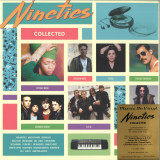
Various - NINETIES COLLECTED 2x12"
 
26
also available

Black Vinyl[37,19 €]


The Decades Collected compilations are part of the new Collected compilation series, which is a collaboration between Universal Music and Music On Vinyl. The compilations bring together the biggest names of each decade, combined with forgotten hits and less discovered gems, giving the listener an experience of listening to their favorite tunes while uncovering new musical grounds at the same time.

Various Artists - Nineties Collected features R.E.M “Man On The Moon”, Freddie Mercury “Living On My Own”, Texas “Say What You Want”, Lenny Kravitz “Always On The Run”, Erykah Badu “Tyrone (Live)” and Blind Melon “No Rain” amongst others.

out of Stock

Order now and we will order the item for you at our supplier.

37,19

Last In: 4 years ago
Doug McKechnie - San Francisco Moog: 1968-72 Vol. 1

San Francisco Moog: 1968-72 documents a missing link in the history of electronic music, as well as the little-known moment when psychedelic music went electronic.

In 1968, Bay Area native Doug McKechnie got hold of one the very first modular Moog synthesizers ever made and began finding his own way to play it. Soon, he was hauling the finicky instrument around to perform improvised concerts at colleges and ballrooms, as well as an ill-fated appearance on the bill at Altamont. Many of the performances were recorded, and the surviving tapes—never before released—capture a free- flowing, transportive sound that fills in the gap between the austere mid-century academic avant garde and the expansive cosmic suites of Tangerine Dream and the rest of the Berlin School in the ‘70s.

This is not another corny old Moog record. San Francisco Moog sounds as fresh as anything by today’s analog-synth heads while bringing to life a lost moment in the development of the music.

All pieces were created improvisationally in an atmosphere of exploration and discovery on a Moog Modular Series III synthesizer and recorded live with no overdubbing to Ampex PR-10, Nagra 3, or TEAC four-channel recorders.

Produced by Doug McKechnie, Lee Gardner, and PJ Dorsey
Mastered by A.F Jones at Laminal Audio
Art direction by Frank Hamilton and Nolen Strals
Mandala art by Richard Winn Taylor

out of Stock

Order now and we will order the item for you at our supplier.

20,71

Last In: 4 years ago
Items per Page:
N/ABPM
Vinyl