The sixth release on Phoq U Phonogrammen, the sordid and rash U-TRAX sublabel, may be from its least known artist, but it is our personal favorite Phoq U release. The style can perhaps best be described as acid funk. Though the drums and bass lines generally are rather tight, all tracks have these quirky synth lines that give them a rather funky, dark 'cyborg feel'.
Lynx is Reyer Caderius van Veen - and he didn't chose that name himself. Reyer is from Groningen, the mayor city in the most northern region of The Netherlands. It's a vibrant student town, with lots of music going on.
In the 90s, Reyer participated in a techno-foundation, together with Thee J. Johanz (Ballyhoo Records) and Johan Sagel, who released a 12" as Jo-I on U-TRAX in 1995. Together with Johan, Reyer also formed a band called L.A.P. 01 (Live Acid Performance), which released a 12", a 10" and a remix on Jan Liefhebber's Highland Beats and a track on Ballyhoo Records (BALL 100).
Harsh starts off with some terribly hard and high tones, that sound like a nuclear plant is going to melt down. The ferocious bassdrum and grunting acid bass line add to the uncomfortable mood.
What makes us really happy is Sex On Jupiter. It's a rushed track that completely opens up around the 1:20 mark with a desolate, yet funky sawtooth 303 bassline.
On the flipside, Changes brings a nice pumping rhythm combined with a rolling bassline with all sorts of disturbing sounds on top.
The EP closes off with another highlight of darkness: Dark Mission. The track has a lovely flow, but really starts to space you out as soon as a hoarse sounding pulsating synth spreads it wings across the deliciously bubbling 303.
To be short: this is an uncomfortable record, and we love it!
Original release date: August 1996.
Search:ras p
- A1: Natty Dub
- A2: Lee's Dub
- A3: Wonder Why Dub
- A4: I'm Gone Dub
- A5: Country Boy Dub
- A6: True Believer Dub
- A7: Care Free Dub
- A8: Rasta Train Dub
- B1: Move Out Of Babylon Dub
- B2: Give A Little Man A Great Big Hand Dub
- B3: Feel So Good
- B4: For The Rest Of My Life Dub
- B5: When You Will I Find My Way Dub
- B6: I'm Leaving Dub
- B7: Feel Lost Dub
- B8: Dawn Dub
King Tubby and Producer Bunny ‘Striker’ Lee are intertwined in the birth of Dub Music. After discovering a mistake that made a ‘serious joke’ they went on to release the first pressings of this new musical genre namely ‘Dub Music’. Tubby’s vast knowledge of electronics and Bunny’s vast catalogue of rhythms would lay the foundations of what today is taken as a standard...the Remix / Version cuts to an existing vocal tune. Sit back and enjoy this historic set of sounds. These releases were the first to carry the name of King Tubby and the first to credit the great musicians that contributed so much to the rhythms that made these albums possible.
- A1: Wildcat
- A2: Elevator Shaft
- A3: Salal Harvest Chant
- A4: Broken (Everything Is Broken) (Everything Is Broken)
- A5: My Nest
- A6: I'm Crowded
- A7: Blue Ears
- A8: Baked Potato
- A9: Lucifer Peacock Raven
- B1: Oyster Mushrooms
- B10: Chase The Badger
- B11: Polecat That
- B2: Tukwila Joe
- B3: That Big Thing
- B4: Orange Peel
- B5: High Falutin' Blue Rasputin
- B6: Silver Moon Duck
- B7: Bobcat & Turkey
- B8: Ocean Trip (Ocean Shores) (Ocean Shores)
- B9: Railroad Maypole
Originally released on cassette in 1993 and now for the first time on vinyl, this is an incredible document from a teenage Arrington de Dionyso. All the seeds of his 30+ career are engrained on these fully formed Tascam recordings. "Bobcatflamethroat" was originally released as "Pine Cone Alley Cassette #9" in August of 1993. The songs were recorded on a Tascam Porta-One 4 Track cassette studio inside a secret area in the basement of the College Activities Building at the Evergreen State College, known as "Happyland". This album has never before seen a digital release of any kind, however there is one song "Everything is Broken" which later became part of the original "canon" of Old Time Relijun after that band was formed in 1995. That song was re-recorded on the first Old Time Relijun album "Songbook Vol. I" released in 1997. I still dig most of the tunes on this one- these were all written and recorded while preparing to welcome a new young life into the world (my daughter Lucinda, born August 22, 1993). So while not specifically "Children's Music" per se, the tunes are wild, hopeful, optimistic yawps of playful abandon for all ages. There are a number of "inside jokes" that only would have made sense to the very tight knit inner circle hat I considered my "core" group of friends at that point in my life. I also think there are more than a few "hits" on here. I was 18 years old! Anyone who has followed the last thirty years of my musical career should find something of interest and delight on this album. For some reason I chose to record most of the guitar and bass parts "direct" without an amplifier- I'm not sure why I did that but it's a unique sound in retrospect. There's a decent dose of throatsinging and other odd vocal techniques, proving that I dove deep into this territory of vocal exploration at a very young age. Also plenty of mouth harps, flutes, kazoos, and clarinet, although this was just BEFORE I bought my first bass clarinet. The song "Kite Dragon Hypnosis" showcases the very first time I EVER recorded anything with a saxophone! The lyrics are reflective of my interests in the theories of "Ethnopoetics" as put forth by Jerome Rothenberg in many of his books such as "Shaking the Pumpkin" and "Technicians of the Sacred", as pathways to understanding the universality of myth and shamanism as connective threads through human poetic expression. And yes, if you know something about the Evergreen State College, I did indeed receive 16 credits for working on this album.
Tete Mbambisa has performed and recorded with many of the giants of South African Jazz (Bazil ‘Manenberg’ Coetzee, Johnny Dyani, Dick Khoza, Duku Makasi, Gideon Nxumalo, Dudu Pukwana, etc...), and is one of the very few South African jazz musicians that can claim to have played with the three jazz generations of the last fifty years. His work as a pianist, vocalist, composer and arranger is a landmark on South African jazz history.
After a recording hiatus, Mbambisa returned in 1974 with an octet album, 'Tete's Big Sound' released on a newly formed label, As Shams or The Sun, established by South African record store owner and independent producer Rashid Vally. 'Tet's Big Sound' included tracks like 'Unity' and the 'Black Heroes Lamentation', now considered a classic in the South African jazz underground. The sound that Mbambisa carved in this period was wholly acoustic, and is a style that now is often loosely labelled spiritual jazz, a sound that alludes to deep African textures and rhythms balanced with clear nods to American hard bop and modal jazz, sometimes edging toward free improvisation in echoes of John Coltrane and Pharaoh Sanders.
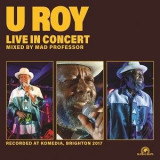
“And now for a gentleman who’s come all the way from Kingston, Jamaica and a place called Cling Cling Avenue. We present to you the one and only, the Originator, the Godfather, Daddy U Roy!”
U Roy had visited Brighton before but there was something special about that balmy night in August 2017, when he walked out on stage at the Komedia to a hero’s welcome and immediately got the crowd cheering and dancing. There was so much warmth and excitement generated that night, and it’s all captured on this final live album of the reggae superstar’s illustrious career.
U Roy wasn’t quite the originator, but he was the first Jamaican deejay to dominate the Top 3 places on both radio stations and turn his predecessors’ simple exhortations into an artform – one that evolved into a global phenomenon. It was his performances on King Tubby’s Hometown Hi-Fi that made him the talk of Jamaica and led him to Treasure Isle studio, where he voiced hits like Tide Is High and Wear You To The Ball. From then on his catchy, uplifting rhymes could be heard on radios and jukeboxes throughout the island, as well as from behind the control tower of his King Stur Gav sound-system, where MCs like Josey Wales, Brigadier Jerry and Charlie Chaplin learnt their craft. The veteran deejay, who died in February 2021, continued recording and touring into his late seventies, and without abandoning either his musical standards or Rastafarian beliefs. At his peak, U Roy voiced for Jamaica legends like Lee “Scratch” Perry, Bunny Lee and Channel One, in addition to several European labels. What most of his recordings have in common is a sense of hope and often joy, because even Get Up Stand Up is delivered with optimism. They are the qualities that come across on this life-affirming set, recorded in front of an appreciative audience, and backed by some of the UK’s finest reggae musicians.
During the mid-1970s, the Aggrovators could do no wrong. This ace team of session musicians that was forged as an off-shoot of the Soul Syndicate were responsible for some of the biggest hits of the decade, recorded with Bunny Lee's rising stars, such as Johnnie Clarke and his rival, Cornell Campbell. Following on from the great Shalom Dub set of 1975, Rasta Dub '76 is another truly magnificent dub set culled from Aggrovators hits (by Johnny Clarke, Cornell Campbell and others), this time, the entire album was given a scintillating mix-down at King Tubby's studio by the great Prince Jammy, and the sonic excellence has stood the test of time. Another must-have for all connoisseurs of dub.
Selectors Choice is a collection of Reggae tunes from some of the best producers and artists cut to limited edition vinyl. The 7"s feature new releases, remixes and classics that deserve to be repressed and tunes that have never been pressed to vinyl.
The 12"s concentrate on compiling tracks of the same riddim that have never been released together that include unreleased versions and brand new releases.
They are specifically catered for any Reggae collector, selector and DJ.
This release features the Rasta anthem ‘Picture on the Wall’ by the Natural ites by the dub and the vocal and dubs for I Want Your Love
- Melody
- Ballade De Melody Nelson Valse De Melody
- Ah! Melody
- L’hotel Particulier
- En Melody
- Cargo Culte
- Je Suis Venu Te Dire Que Je M’en Vais
- Vu De L’extérieur
- Panpan Cucul
- Par Hasard Et Pas Rasé
- Des Vents Des Pets Des Poums
- Titicaca
- Pamela Popo
- La Poupée Qui Fait
- L’hippopodame
- Sensuelle Et Sans Suite
- Nazi Rock
- Tata Teutone
- J’entends Des Voix Off
- Eva • Smoke Gets In Your Eyes
- Zig Zig Avec Toi
- Est-Ce Est-Ce Si Bon ?
- Yellow Star
- Rock Around The Bunker
- S.s. In Uruguay
- L’homme À Tête De Chou
- Chez Max Coiffeur Pour Hommes
- Marilou Reggae
- Transit À Marilou
- Flash-Forward
- Aéroplanes
- Premiers Symptômes
- Ma Lou Marilou
- Variations Sur Marilou
- Meurtre À L’extincteur
- Marilou Sous La Neige
- Lunatic Asylum
- Javanaise Remake
- Aux Armes Et Cætera
- Les Locataires
- Des Laids Des Laids
- Brigade Des Stups
- Vieille Canaille « You Rascal You »
- Lola Rastaquouère
- Relax Baby Be Cool
- Daisy Temple
- Eau Et Gaz À Tous Les Étages
- Pas Long Feu
- Marilou Reggae Dub
- Overseas Telegram
- Ecce Homo
- Mickey Maousse
- Juif Et Dieu
- Shush Shush Charlotte
- Toi Mourir
- La Nostalgie Camarade
- Bana Basadi Balalo
- Evguénie Sokolov
- Negusa Nagast
- Strike
- Bad News From The Stars
- Love On The Beat
- Sorry Angel
- Hmm Hmm Hmm
- Kiss Me Hardy
- No Comment
- I’m The Boy
- Harley David Son Of A Bitch
- Lemon Incest
- You’re Under Arrest
- Five Easy Pisseuses
- Baille Baille Samantha
- Suck Baby Suck
- Gloomy Sunday
- Aux Enfants De La Chance
- Shotgun
- Glass Securit
- Dispatch Box
- Mon Légionnaire
- La Decadanse Avec Jane Birkin
- Sex Shop
- Comme Un Boomerang
- L’ami Caouette
- Le Cadavre Exquis
- My Lady Heroïne
- Trois Millions De Joconde
- Goodbye Emmanuelle Avec Jane Birkin
- Sea Sex And Sun Version Longue
- Mister Iceberg
- Je Pense Queue
- Dieu Fumeur De Havanes Avec Catherine Deneuve
- La Fautive
- Je Vous Salue Marie
Here is the second volume of Serge Gainsbourg's complete vinyl collection which traces the artist's career from 1971 to 1987. In order to provide the best sound quality, the original mixed tapes were entrusted to the sound engineer Miles Showell ( responsible for the reissues of the Rolling Stones, Queen, etc.) who did the mastering at Abbey Road studio with Half Speed Master technology. 180 gram vinyl box.Reviews and Ads –, London Macadam, Mojo, Sunday Times, R2
- A1: Sherelle - Jungle Teknah
- A2: Innercore - Pinnacle (Part 2)
- A3: Dub One - The Clash
- B1: Lcy - Bite Off The Hand That Feeds You
- B2: Basic Rhythm - 2 Da Core (Rp Boo Remix)
- B3: Acemo - Perpetrator
- C1: Cloud9 - You Got Me Burnin
- C2: Newkiller - U92 (Fff Remix)
- C3: Fringe - You Got Me (Sanz Remix)
- D1: Kush Jones - Fuck Off
- D2: Dwarde & Tim Reaper - Globex Corp Vol 1 A1
- D3: Invt - Super Galactic
This is a high-octane tribute to jungle, footwork
and bass beats, with a BPM that rarely drops
below 150BPM and studded with names key to all
genres.
It respects both the birth of the scene, with
inclusions like the late legend DJ Rashad and
former footwork dancer RP Boo, as well as its
current locality, pointing to a trio of uber cool US
producers in New York’s AceMo and Kush Jones,
and Miami-based duo INVT.
Fellow Londoners Tim Reaper and Worldwide
Epidemic take in the latest of the UK scene, along
with label Time Tunnel who deliver remixes of
tracks from the glory days of rave.
Driven, proudly black, gay and outspoken,
SHERELLE co-runs the established jungle label
Hooversound, while 2021 saw her launching new
label Beautiful, a platform for supporting black and
LGBTQI+ artists.
The Ethiopians are one of the great vocal groups to come out of Jamaica. Singing songs of life and times as they found them, themes that resonated with the people of the Island that made them such a treasured group. Lenard Dillon (b. 9 December, 1942, Port Antonio, Jamaica) the founding member of the Ethiopians began his singing career at Clement 'Coxonne' Dodd's Studio One. Initially he recorded under the name of Jack Sparrow, and backed by the Wailers, cutting 'Ice Water' and 'Suffering In The Land'. Under The Wailers encouragement, he went on to form his
own vocal group. Recruiting singers Stephan Taylor (b.1944, Portland, Jamaica) and Aston 'Charlie' Morris to become The Ethiopians. They cut 'Live Good', 'Why You Gonna Leave Me Now' and 'Owe Me No Pay Me'. Although receiving favourable response, Aston Morris decided to leave the band and the remaining pair carried on and cut 'I'm A Free
Man' and 'Don Dead Already' and 'For You'. On meeting contract builder Leebert Robertson who had recently returned to live in Jamaica, ashad he wanted to get into the music business, a session was booked for Treasure Isle Studios. The session produced their seminal 'Train To Skaville' track, which became an immediate hit in Jamaica and in the UK, when in 1967 it reached number 40 in the charts. They also cut 'Engine 54', which became the title of their debut album. Its
follow up 'I Need You / Do It Sweet', did not fare so well and the band moved over to Sonia Pottinger's stable, where they cut 'The Whip / Cool It Amigo' which revived their fortunes and proved another big hit for the band. Two more hits followed 'Stay Loose Mama' and 'The World Goes Ska', after which the band decided to return to a trio, adding
Melvin 'Mellow' Reid to the line up. The band now hit another run of successes with producer JJ Johnson 'Everything Crash, 'Gun Man', 'Hong Kong Flu' and 'The Selah'. Many hits followed leading the band to work with a variety of Jamaican producers. Such tracks as 'I Want To Be a Better Man, ' Conquering Lion', 'Fire A Mus Mus' Tail', and the timeless 'Reggae Hit The Town' to name a few. Two albums 'Reggae Power' (1969) and 'Woman Capture Man' (1970), pulled a lot of these tunes together. Sadly Taylor was killed in 1975 after been struck by a van in a road accident. Dillon returned to Port Antonio till 1977, when he was persuaded to return to Treasure Isle studios with producer Niney The
Observer and cut the Rasta based album 'Slave Call'. Additional members who joined for this album were Bro Fatty, Bro Ewing, Bro T, Mello and Hychi Dread. An album that showed all the Ethiopians magic had not been lost.
For this release we have included the full 'Slave Call' set, 'Ethiopian National Anthem', 'Slave Call', 'Guilty Conscience', 'Hurry On', 'Mus Follow Babylon'(on CD Edition), 'Train To Skaville (1977 version, on CD Edition), 'Culture', 'Obeah Book', 'Let It Be' and 'I Love Jah'. Alongside some of the bands early hits including the original version of 'Train To Skaville', 'Engine 54', the great and poignant 'Everything Crash', 'Reggae Hit The Town' and 'The Selah'. An interesting set to remind us what a great group the Ethiopians really were.
After his first LP Stranger Já Catem Traboi, Tchiss decided to further experiment with reggae and funaná, inspired by the local rhythms of the island of Santiago. Gathering some of the best Cape Verdean musicians of the time, in 1984, together with Zé António on guitar, Bebethe on bass and Alírio on drums, he recorded his second LP Já Bô Corre D’Mim. An album that sings of a young man far from home, his unrequited love and saudade, the struggles of street life in a foreign land and a world of inequality. Recorded in just 3 days at the Pomodoro Studio in Sutri, the album fully expresses the deep and layered sound of Tchiss’ music, where upbeat tempo, powerful vocals and electrifying guitar solos tangle together in a dynamic mix of traditional melodies and cosmic reggae.
‘Eighteen Movements’ is a collection of recordings captured at live performances between 2017 – 2019. The record’s rich textures combine ambient, tribal rhythms, field recordings, ritualistic vibes, and a meditative feeling that runs through the entire LP. Đ.K. is in full flight mode, illustrating the project’s aptitude for deep transcendence.
Đ.K. is a DJ, composer & producer based in Paris, France. A versatile and prolific artist, D.K. has cultivated an eclectic body of work in recent years, with acclaimed output on renowned labels including Antinote, Melody As Truth, 12th Isle, Good Morning Tapes, Music From Memory’s Second Circle imprint, and L.I.E.S. (as 45 ACP).
Luminous and mesmeric, D.K.’s work combines finetuned traces of house, synth pop, ambient, balearic, minimalism, and fourth world music, creating energies and soundscapes which aim to invoke elevated forms of consciousness.
Prismatic tones exchange space with devotional drums on ‘Clarity’ and ‘Echo Chamber’, as Đ.K. hits a hypnotic stride somewhere between Jon Hassell, HTRK & a Folkways percussion ensemble. With ‘Full Consciousness’ meditation bells ring out across a progression of gleaming new age emanations, conjuring an entrancing spell. Movements of pulse and ether.
On ‘Mirror’, sonorous, elaborate percussive phrases are interwoven with drifting ambient vapours, while ‘The Other Side’ veers into broad, rolling blasts of dub and Antipodean drone, a cavernous trance evoking the early roots of Ras Michael and Yabby You, pared back to resolute drum sequences and infused with esoteric chimes and sultry synthesis.
The finale of ‘Eighteen Movements’ represents one of Đ.K..’s most ambitious recordings. ‘Awakening’ is an epic tone poem of aqueous, outer planetary resonance that completes this mercurial cycle with a poignant, euphoric fadeout. Chronicled in the moment, alternating between rhythm and repose, momentum and aviation, 'Eighteen Movements' sees Đ.K. voyaging further, into vast, uncharted outskirts of sound. A collection of movements for heightened states and new diversions.
Mastered by Jose Guerrero at Plataforma Continental. Graphic Design by Javi Tortosa.
- A1: The Mebusas Good Bye Friends
- A2: Georges Happi Hello Friends
- A3: Black Reggae Darling I'm So Proud Of You
- A4: Christy Essien I'll Be Your Man
- A5: The Lijadu Sisters Bobby
- B1: Tala Andre Marie Hop Sy Trong
- B2: Essama Bikoula I'll Cry
- B3: Carlos And Miki All This Nonsense
- B4: Pasteur Lappe Babette D'o (Rastawoman)
On 18th April, 1980, after decades of anti colonial struggle, the Zimbabweian flag was finally raised at midnight at the Rufaro Stadium in Harare. Not long after, the words "Ladies and Gentlemen, Bob Marley and The Wailers!" rang out, and Zimbabwe's independent future began.
In the years that followed, Africa was to produce it's own reggae superstars, as the likes of Alpha Blondy, Majek Fashek and Lucky Dube swept across the continent and beyond, and there's no doubting Bob Marley's explosive impact on this particular narrative.
Marley's unswerving commitment to liberation and unity ranged from the sweeping spiritual sentiments of iconic hits such One Love and Redemption Song to the galvanising, focused tone of 1979's 'Zimbabwe', and his status as global superstar ensured that his (self funded) part in the countries' epochal celebrations meant that the history of reggae in Africa would always be viewed through the prism of his influence ( Wiki/African Reggae : "In 1980, world-famous Jamaican reggae musician Bob Marley performed in Harare, Zimbabwe, and that concert is often credited as marking the beginning of reggae in Africa")
But in fact, the recorded history of reggae produced in Africa stretches back over a decade before Marley's arrival on the continent, and showcases broad pan - diasporic interflows between the Carribean and Africa, with the UK and the US communities playing influential supporting roles, all helping shape the evolution and development of the genre in Africa from late 60's inception to Marley's arrival in 1980, and then well beyond.
Reggae Africa : Roots and Culture, 1972 - 1981 tries to capture a sense of that evolution, starting in 1972 as Mebussa's ultra rare 'Good Bye Friends' effortlessly captures triangular, transatlantic cultural interflows, with the short lived Nigerian group's bitter sweet chords echoing classic US soul, but laid over a gritty, skanking Jimmy Cliff - esque proto reggae rhythm.
Trying to work out the precise provenance of Black Reggae's 'Darling I'm So Proud of You' (1975) isn't easy, but involves Paris based / African focused label Fiesta, some proper OG co-branding exercise with Bols Brandy ( "Bols Brandy presents Black Reggae") - and deeply infectious, lilting Rocksteady.
By 1976, glorious Nigerian sister duo Lijadu Sisters are echoing the chunky roots of a Dennis Brown or U Roy on 'Bobby', and in 1977, bespoke Nigerian drummer Georges Happi is introing 'Hello Friends' with the soon to be universal signature reggae tom roll intro, before veering leftfield with snatches of spoken Afro - English vocal in between the hooky choruses.
Nigerian giant Chrissy Essien's 'I'll Be You Man' (1979) combines floaty Lovers vibes with catchy ska shuffle, and in the same year, Cameroonian afro-funk/disco heavyweight Pasteur Lappe' drifts seamlessly into skanking, Lovers infected reggae on 'Babbette D.O. ( Rastawoman )' (before a sprawling electric guitar solo reminds us how unselfconsiously eclectic so much African music of the era was.)
And finally bookending the compilation, in chronological terms, fellow Cameroonian Tala AM also swaps his funk and soul for the rootsy and infectious 'Hop Sy Trong' (1981), again highlighting the diverse and eclectic approach to this timeless Carribean musical genre taken by African musicians in the years before that Bob Marley year zero event in Zimbabwe.
For more than a decade, Jamaica's Micah Shemaiah has been crafting his musical message with a keen and steady focus on Rastafari redemption and African unification. His writing style embraces and combines several genres of music delivering unique sounds that will appeal to any ear. Coming from the original home of the sound, Kingston City, and growing up in the Rastafarian house of the Twelve Tribes of Israel, this Singer/Songwriter has certainly put down a solid foundation in the Reggae Industry and has carved a place in the hearts of reggae lovers all over the world.
This new 12' vinyl LP offers 8 vocals and 2 dubs. Produced by Zion I Kings and underpinned with their trademark style of hardcore roots reggae, showcasing a broad spectrum of Micahs vocal talents. Releasing courtesy of Before Zero Records.
- 1: Vel The Wonder – Real Late
- 2: Westsidegunn – Stain
- 3: Styles P, Ransom, Smoke Dza – S.r.d
- 4: Flee Lord, Stove God Cooks – Marcus Smart
- 5: Roc Marciano, Flee Lord – Hallways
- 6: Jay Nice, Eto – Mind Over Matter
- 7: Method Man, Raekwon, Willie The Kid – Next Chamber
- 8: Meyhem Lauren – Words Of Meyhem
- 9: Ghostface Killah, Crimeapple, Jim Jones – Snake Eyes
- 10: Rasheed Chappell – Midnight Sunday
- 11 2: Nd Generation Wu – Wu Generation
- 12: Fly Anakin, Nickelus F – I Want It All
- 13: Homeboy Sandman – Dear
When Peter Rosenberg was hired by Hot 97 in July of 2007 his task was simple. His Sunday night show “Real Late” was to be a place where independent, underground, and boom bap artists could be featured. Rosenberg leaned into the gig and artists and fans, new and old, took note. In the years that followed Rosenberg world premiered music from future superstars such as Action Bronson, Joey Badass, A$AP Rocky, Childish Gambino, Frank Ocean, Tyler the Creator, Earl Sweatshirt, Travis Scott and countless more. He also became a star of Hot 97’s Morning Drive radio show, held a yearly concert to celebrate his favorite artists, and put out mixtapes in 2010, 2011, and 2013 that broke new music from a variety of these up and comers, including originals from Kendrick Lamar, Bronson, Badass, ASAP Rocky and Ferg, to name a few. Since 2013 Rosenberg has expanded his broadcasting range. He was hired by ESPN and instantly made an impact as a new cohost on “The Michael Kay Show.” Since arriving in 2015, the show has consistently grown in popularity and in 2019 reached the top of drive time ratings. Rosenberg’s passion for sports entertainment also led to him becoming a fixture on WWE pay per view events. It would have been easy to assume that Rosenberg’s next move would be a pivot away from underground music all together. Not so fast. As the pandemic hit, Rosenberg went back to his roots. He decided the time was right to finally put together an official album and in doing so he tapped some of the best artists in hip hop, from legends to newcomers, to put together a complete body of work aptly named after the late night show that put him on the map in the first place. Peter said: “I have considered making an album for years but it really was the pandemic that got me focused and led to me finally creating “Real Late”. I thought this was the perfect time to put together legends, new artists, and underground producers to create a project that sounded like my show “Real Late” on Hot 97. I was fortunate enough to get help from some amazingly talented people and the result is an album that I think truly represents the hip hop that I and so many others love.“ Features guest performances from Westside Gunn, Roc Marciano, Styles P, Smoke DZA, Method Man, Raekwon, Ghostface Killah, Flee Lord, Stove God Cook$, Eto, Willie the Kid, Meyhem, Buckwild, Crimeapple, Jim Jones, Rasheed Chappell, Homeboy Sandman and more!
It's back-to-back hits with the return of the Names You Can Trust split single series featuring two new emerging artists and record debuts.
After years on the local New York scene as DJs, collaborators and permanent fixtures amongst the brightest of musicians and artists, Raspadura has spent a long time brewing behind the curtain, tucked away in the musical minds of real life partners Josue Granados (Sonidero Mixteco, Los Taxis) and Dayan Silva (Dayansiiita). Their coming out party as recording artists is a perfect encapsulation of the duo's raucous but delightful energy. "Pa Que Gocen" is pure punkera, but seasoned with a deep musical appreciation that abounds in the timeless tropical music universe, and surely a precursor to further recording adventures, as this debut should warrant. The appeal is obvious as soon as the needle drops. Silva's enchanting vocals grab you immediately, with tales of sweets upon sweets. Pure visions of dulce, panela and miel are chanted over the rhythm of Granados' low down ska-beat and hypnotizing tres cubano. For Raspadura, dessert is first!
Come fly with Grupo Pernil in this ode to the timeless vibes of gypsy rumba, merengue and guaracha. Featuring an international all-star cast of musicians from travelling adventures and collaborations of recent years, "Danza de la Cabra" was originally conceived at home in the NYCT studio, and later brought to life with additional sessions inside Amsterdam's Heat Too Hot and Barcelona's Nación Funk studios. This one-off instrumental recording turned into a case of severe psicodelica, under the influence and improvisation of the group's talented players and percussion professionals, then amped and electrified for maximum effect with a touch of studio magic and a taste for local iberico. Featuring members of Greenwood Rhythm Coalition, Conjunto Papa Upa, Fundación Tony Manero and Los Fulanos.