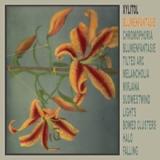
Xylitol, aka producer and DJ Catherine Backhouse, shifts up the refinement and musical breadth for her second album Blumenfantasie, the follow-up to her Planet Mu debut Anemones.
With Blumenfantasie, Xylitol wanted “to make space and for the music to float and propel at once”, finding routes through the pointillistic figures, cascading synths and the meditative stillness of kosmische musik and bolder breakbeat programming. She reaches this delicate balance through careful subtraction, hoping “to convey a sense of intimacy and sadness but without sentimentality” which she manages with a feel and sound that's raw and intuitive.
Blumenfantasie rolls through detailed jungle workouts that flutter and bleep, through beatless ambience, taking a rare dip below 160 bpm for the elegiac Mirjana, the album’s most explicit nod to Krautrock with a drum break chopped up from Amon Duul II’s anthemic ‘Archangel’s Thunderbird’, through to Halo, a bare bones grime rhythm that calls to mind the missing link between industrial pioneers Nurse With Wound and Wiley's Eskibeat.
Catherine cast her net to draw in experimental audiovisual duo Sculpture and Reading based post-rock band The Leaf Library as collaborators, pulling the former’s whirling eddies of musique concrète into a slice of sublime aquatic jungle, and the latter’s radiophonic folksong into a dark and disorientating breakbeat workout equally indebted to Source Direct as to Broadcast.
Blumenfantasie moves with a confident, self-effacing fluidity which has been informed by DJ Bunnyhausen’s more regular DJ gigs. She speculates ‘if this album feels more cohesive than its predecessor it's likely because I've been DJing a lot more, with Worthing Techno Militia, with central and eastern european electronica collective Slav to the Rhythm, as well as being part of Italo Disco crew Flex. Moving between these zones seemed to open up hidden pathways between the disparate musical trajectories they represent.'
While Anemones contrasted the rough and the delicate, its successor is an album built for the head, hips and heart, with painterly sounds and a sense of intimacy that encourages deep listening while keeping its eyes on the strobelight and its feet on the dancefloor.
Buscar:raw audio
Ąnis is a Lithuanian producer and DJ working in the space between broken rhythms and atmospheric weight. His tracks blur the line between club tools and introspective pieces - raw, textured, and unpolished in the best way.
Ąnis’ debut album “I Swear I’m Not Delusional” builds from late-night sketches into fully formed pressure systems. Ambient passages fall into break-driven grooves, each track shifting like a mood swing. It's rooted in tension, repetition, and space - think the grit and movement of early Skee Mask filtered through a more personal, less polished lens. Tracks like “Mountain People” carry warmth without needing to explain themselves, while others feel like they were made at 3am with no lights on. It’s not chasing a scene - just locked into its own pulse. This isn’t background music. It asks you to sit with it - or move to it. Either way, it sticks.
Credits
Original tracks written, produced, arranged and recorded by Jonas Zubavičius in Vilnius. Mastering by Pranas Gudaitis aka audiomastering.lt. Artwork and design by Povilas Baranauskis.
Like it or not, we switched it up — remixed Lisopylka Records into Lisosmuha. New release, new label.
A1? Every Ukrainian DJ will recognize the source instantly. Late to Emulate sparked the whole LIS001 story, and a ghost of that idea still lives in the first release. Hear it? Numero Cero was meant to be raw, but the atmosphere shaped it into something more deliberate. Hay Rumores? Svzz went fully loco while writing Papay — and you can tell.
Play it loud!
- A1: Give It To Me Baby
- A2: Ghetto Life
- B1: Make Love To Me
- B2: Mr. Policeman
- C1: Super Freak
- C2: Fire And Desire
- D1: Call Me Up
- D2: Below The Funk (Pass The J)
Rick James Blends Brazen Attitude, Fearless Sexuality, and Shrewd Charisma on Street Songs:
Punk-Funk Album Aims for the Hips and Head, Includes the Timeless Hit “Super Freak”
Sourced from the Original Master Tapes and Strictly Limited to 4,000 Numbered Copies:
Mobile Fidelity’s 180g 45RPM 2LP Set Presents 1981 Smash in Audiophile Sound for the First Time
1/4” / 30 IPS analogue master to DSD 256 to analogue console to lathe
“Punk funk” was a relatively unknown concept before 1981. But once Street Songs took the charts by storm that year, the world soon knew about what became Rick James’ signature style. And how. True to its name, Street Songs blends outspoken sexuality, brazen attitude, and edgy commentary amid contagious R&B-fueled arrangements that simultaneously aim for the hips, head, and various nether regions. And it’s never sounded better.
Sourced from the original master tapes, strictly limited to 4,000 numbered copies, pressed at Fidelity Record Pressing, and housed in a Stoughton gatefold jacket, Mobile Fidelity’s 180g 45RPM 2LP set presents James’ platinum-certified effort in audiophile quality for the first time. Playing with crisp dynamics, lively textures, airy headroom, and revealing clarity, this collectible edition of the record that stayed at the No. 1 spot on the R&B Album Charts for 20 weeks invites you to get closer to music that beckons you to turn your space into a private dance floor.
Then again, you’ll likely be so taken by how the taut bass lines, snappy rhythms, and four-on-the-floor beats — all rendered in stunning detail and with full-bodied architecture — come across with such accuracy and presence, you might stay pinned to your seat. On this pressing, the soundstaging, imaging, and lit-fuse energy of Street Songs reach new heights. Everything from the rubbery feel of the guitar lines to the depth of James’ temperature-raising vocals to the scale of the horn charts emerges as if James and his ace session crew set up in your room.
The Buffalo native and his ensemble waste no time getting their message across. On the album-opening “Give It to Me Baby,” James and company lay down a mix of sleek funk and pulsing disco that practically activates the bright lights of a discotheque and stimulates the libido of anyone within earshot. Having reached No. 1 on the Billboard Hot Soul charts, the song is pure sex — and just one of the carnal delights on a record that embraces the subject as fearlessly as James does his identity.
Of course, the most famous of James’ erotic excursions — the timeless “Super Freak” — hit No. 1 on Hot Dance Club Play charts, No. 16 on the Hot 100, and, later, No. 153 on Rolling Stone’s list of the Top 500 Songs of All Time. Bolstered by a quavering keyboard theme and electro riffs, the much-sampled track worms itself inside your muscles with smile-inducing subject matter, gliding vocals, nimble movements, a hot tenor-saxophone solo, and backing vocals by the Temptations.
The iconic Motown group isn’t the only celebrated guest artist on the Grammy-nominated Street Songs. James’ then-labelmate, Stevie Wonder, lends harmonica to the frank sociopolitical narrative on “Mr. Policeman,” a protest tune that also manages to stroll ’n’ strut via simmering organ, staggering brass accents, and James’ gritty vocal performance. In addition to contributing backing vocals on several cuts, Teena Marie turns in one of the album’s signature moments on “Fire and Desire,” a romantic old-school duet with James that impresses with smoothness, sensitivity, and smokiness.
High-profile colleagues aside, James remains the undisputed star, a figure whose leather-and-latex attire, braided hair, and natural swagger made him misunderstood by some in the mainstream and embraced by everyone in the know as a true original. As a testament to his magnetism and skills, his charisma and rawness seemingly seep through every note, whether on the balladic sweep of the risqué “Make Love to Me” or strident, poke-and-prod persuasion of the moonwalking “Call Me Up.”
On the closing “Below the Funk (Pass the J),” an uptempo autobiographical tale that addresses the visionary musician’s second-favorite love, the singer acknowledges his upbringing and inseparable connection with his roots — an homage to where he began and a toast to where he’s gone.
Rick James, keepin’ it real on Street Songs, still as real as it gets.
Malena Zavala is an Argentinian-born, London-based artist, producer, and filmmaker, known for crafting ethereal, genre-blending music that navigates the space between her Latin heritage and her British upbringing. With the forthcoming album If This Life Could Start Again set for release on 30 January 2026 on Paraná Records, Zavala presents her most intimate, cohesive, and accomplished work to date, marking a significant evolution in her artistic journey.
With her new album, Malena creates an atmospheric dream pop world, weaving singer-songwriter intimacy with synth pop, Argentine folk, indiepop, rock and experimental music, threaded together by her blissful vocals and dreamy guitar work. Gorgeously warm and vivid, If This Life Could Start Again charts the journey from pain to acceptance, mapping out the non-linear nature of healing through a sonic landscape. Each song embodies a distinct emotion within that journey, from grief and chaos to feeling lost, seeking refuge, finding confidence, and finally acceptance and letting go. Drawing on her Argentinian roots, Malena uses the Andes mountains as both a visual and thematic anchor – the difficult climb towards higher ground becomes a metaphor for healing, whilst being lost at rock bottom reflects the darkest moments of the journey.
Completely composed and performed by Malena herself, the album was recorded in Girona’s L’Empordà countryside in Spain with producer Luke Smith. As a professional producer and audio engineer, this was Malena’s first time relinquishing production control – an intimate creative shift that allowed their shared vision to shape the album’s rich, enveloping sound.
However, Zavala’s career to date has been a testament to self-sufficient artistry. Her critically acclaimed debut, Aliso (2018), was written, recorded, and produced alone in her parents’ garage, which honed her dreamy bedroom pop sound. The album, praised by The Guardian for its “gently warped and beguilingly melancholy guitar pop,” ****, immediately catapulted her from DIY beginnings to prestigious stages, supporting acts like Lord Huron at London’s Roundhouse and Men I Trust at Village Underground and subsequently continuing on their UK/EU tours. Later with standout performances at Latitude, Green Man, and All Points East. Her consistent radio support from key influencers including BBC Radio 6 Music, BBC Radio 1's Huw Stephens, and Steve Lamacq has solidified her presence on the airwaves.
Her second album, La Yarará (2020), saw Zavala delve deeper into her roots, exploring Latin traditions like Cumbia and Bolero. This exploration of identity continues powerfully on the new album, but with a newfound lyrical depth and sonic confidence. The new album, If This Life Could Start Again, is a raw and transformative eight-track journey that maps the emotional landscape of healing. Written after a period of personal upheaval, the album traverses themes of grief, hereditary trauma, and self-discovery. The record’s narrative is structured like a mountain ascent. A challenging climb through varied emotional terrain, posing the central question: “Will you join the journey?” Sonically, this journey mirrors the non-linear path to acceptance, evolving from acoustic folk and synth-pop to funk-infused rhythms and rock anthems.
As a formidable live performer, Zavala has built a robust touring profile across the UK and Europe. She will embark on an extensive tour in February and March 2026 to support the album, with dates spanning major cities from London and Glasgow to Berlin, Paris, and Barcelona.
With If This Life Could Start Again, Malena Zavala fully realizes her artistic vision as a self-taught producer to an autonomous artist commanding her career through Paraná Records whilst reflecting the vast landscapes of her heritage and affirming her place as a compelling and evolving voice in contemporary music.
A chance meeting in Mexico City set Points of Inaccessibility into motion. When Ibero-American composer Rafael Anton Irisarri crossed paths with Dutch media artist Jaco Schilp at MUTEK in 2024, a conversation about how technology shapes perception revealed an unexpected common ground. Schilp invited Irisarri to a spring 2025 residency at Uncloud, the Utrecht-based collective he co-founded, where Irisarri's sound began to take form amid an environment shaped by Schilp’s visual research.
The Uncloud studio was located inside the former Pieter Baan Centre, a forensic psychiatric prison where suspects of violent crimes were once confined. Its long history of silence and containment shaped the atmosphere in which the project developed. Within this setting, Irisarri coaxed long bowed-guitar tones through a network of pedals and looping systems. The raw gestures thickened into a vaporous and architectural field of sound. Schilp processed the material through a custom point-cloud software patch that produced images in continuous flux. The visuals flickered, dissolved and reformed like memories that resist coherence, functioning as a digital Rorschach that reflected the observer’s own perception.
Amid these spectral echoes, the project evolved into an examination of how the past persists within present signals. Memory endures as residue and interference, continually shaping perception even when its source has faded.
Schilp’s visual process required a continuous stream of sound in real time. Irisarri improvised throughout the residency, generating material that allowed the visuals to develop in parallel. Once back in his New York studio, he began shaping the recordings by carving pathways through the improvisations and mapping selected passages into MIDI. This process allowed him to build outward from the bowed-guitar material with minimal overdubs, adding Prophet 5 textures, Moog bass and strings that expanded the harmonic field while keeping the original performances at the center. To refine the structure, Abul Mogard provided editorial input, working with Irisarri’s stems to guide transitions and strengthen the overall pacing. The material, originally created under conditions of immediacy and constraint, evolved into a fully realized work through careful revision, patience and sustained reworking.
The title engages the geographic concept of the Poles of Inaccessibility, locations defined solely by their distance from all surrounding points. Irisarri adapts this idea to the conditions of digital life, where new forms of inaccessibility arise through the informational enclosures that structure perception. What appears to be a fully connected network often produces a deeper kind of separation, one shaped by the filtering logic of the systems that mediate experience. In this sense, the digital sphere mirrors its geographic counterpart. We inhabit spaces saturated with signals, yet the possibility of genuine contact becomes increasingly remote.
At its core, Points of Inaccessibility considers what can be understood as the new rituals of capitalist realism. Irisarri uses the term digital shamanism to describe the forms of simulated connection that organize contemporary life. These systems promise comfort through algorithms, influencers and AI interlocutors, yet they often reproduce the same conditions that generate loneliness in the first place. What appears as connection becomes the echo of connection, a sequence of gestures that imitate solidarity while withholding it. Like the geographic poles, these rituals are defined by distance. They pull us into environments where everything is illuminated, yet meaningful proximity becomes increasingly rare. In this sense, the work approaches a hauntology of the present, a reflection on futures that have stalled and intimacies that have been thinned by the algorithmic infrastructures that surround us.
This thematic tension unfolds across the album’s four movements. Faded Ghosts of Clouds introduces the work with textures that rise and dissipate in slow cycles, creating an atmosphere that resists clear definition. Breaking the Unison occupies a pivotal position in the sequence and focuses on the moment when the individual and the system fall out of alignment. Its shifting patterns trace the scattering of signals that once suggested connection, revealing the instability at the heart of contemporary perception. Signals from a Distant Afterglow forms the center of the album and features vocals by Karen Vogt, whose presence enters the sound field like a fragile transmission shaped by distance and delay. The closing piece, Memory Strands, follows motifs that appear, recede and briefly intersect before returning to quiet. Across these movements, the album outlines a landscape in which emergence and disappearance continually inform one another.
Listening to Points of Inaccessibility is an encounter with a sound field that is constantly in flux. Elements surface briefly, shift position and recede, creating a sense of motion that resists stable interpretation. The music moves between closeness and vastness, carrying traces of memory while withholding a clear point of resolution.
The album’s visual identity completes the project’s conceptual arc. In Mexico City, where Irisarri and Schilp first met, Daniel Castrejón transformed stills from Schilp’s point-cloud visuals into the cover image. The final artwork captures a single suspended frame of the digital material, a moment extracted from a field that is normally in constant motion. Its surface recalls the texture and abstraction found in the work of Catalan artist Antoni Tàpies, where material presence and erasure coexist within the same plane.
What emerges is a work that examines the tension between technological systems and human presence. Points of Inaccessibility asks whether connection is still possible within environments shaped by mediation and delay, or whether we have become isolated points within the very networks that promise proximity. What possibilities for relation persist within environments organized by algorithms and interruption? And how are we meant to understand presence when so much of it is constructed at a distance?
Points of Inaccessibility will be released on BioVinyl on February 6, 2026, with audiovisual performances planned throughout 2026.
Mastered by Stephan Mathieu
Artwork by Jaco Schilp
Design and layout by Daniel Castrejón
Artist photo by Iulia Alexandra Magheru.
- Swamp
- Sleep No More
- Amphetamine
- White
- Drown
- What Dreams May Come
- Rabies
- Strobe
- 12: Gauge
This release resurrects a long-lost cornerstone of Seattle's early grunge history, showcasing Bundle of Hiss, featuring future Mudhoney and TAD guys and singer Jamie lane, one of the genre's missing links. Between 1986 and 1988, when Seattle was still a circuit of small clubs, four-track tapes and bands sharing drummers and singers, Jack Endino went in to record one of the most solid - and most unfairly invisible - outfits of that scene: BUNDLE OF HISS. Two sessions (1986 at Reciprocal and 1987/88 at Audio Design) fell into limbo, stored in the basement of Mudhoney-Drummer Dan Peters and for years they were a kind of pre-grunge legend, everyone knew they existed, but there was no record, until Loveless Records from NYC released both on CD. The second one, Audio Design Sessions, now sees the light of vinyl for the first time, just as it should have come out in the late '80s: a basement document turned into a collectible artifact. For those who want real grunge, not the domesticated version. It gathers the core of those 1987-1988 recordings done by Endino: the moment when the band is tighter, darker and closer to what the press would later call the "Seattle sound": minor-key melodies, thick fuzz, vocals on the edge, and that mix of hard rock, punk and Sabbath-like heaviness we'd later hear in Mudhoney, TAD or early Soundgarden. And Jack Endino himself summed up these sessions: "Vintage Seattle grunge from one of the original practitioners_ I always felt sad that this hard-working band never managed to get a record out and was almost lost to history. It was a pleasure -and a technical pain!- to resurrect all this." Kinda key release of the early grunge days, first-generation material, recorded by the scene's producer, at the exact moment Seattle was shifting from noisy punk to that heavy, shadowy rock that later blew up. It sounds raw, young and dangerous: this is not a polished compilation, it's a snapshot of the scene.
Audio taken from a live performance by Anar Band (Jorge Lima Barreto and Rui Reininho) with E.M. de Melo e Castro in November of 1978 at Cooperativa Árvore, Porto. The performance was filmed. A segment was included in »Obrigatório Não Ver«, a weekly programme presented by Ana Hatherly on Public Television’s Second Channel. It was not possible to determine the exact date of the event, and no documentation seems to be available in the relevant archives.
»Encontro que Tenho« and »Profissões«: these titles are specific to this release. Having failed to locate the respective poems after a thorough search in E.M. de Melo e Castro’s body of work, it was deduced both texts were created for the occasion.
Even without a full contextualisation, the sound transmits the spirit of cultural agitation proper to these sessions. When this show happened, Anar Band were Jorge Lima Barreto (ARP Odyssey synthesizer) and Rui Reininho (Ibanez double-neck guitar), with the addition of E.M. de Melo e Castro, whom we shall call a poet but whose creative intervention was far reaching. Besides poetry, also continued his efforts in linking up diverse artistic areas (painting, drawing, collage, performance, video) and his official training in textile engineering. He was one of the artists featured in Henri Chopin's »OU Revue« in 1966, establishing his natural connection to the European concrete/visual/sound-poetry avant-garde. Melo e Castro was also proficient in the agitation of minds and political awareness. A good example in »Profissões«, where initially separate professionals (an intellectual, a fisherman, a soldier, a factory worker) are gradually mixed in a show of interdependency. Symbolically, through his words one listens to a transformation of society, although the same conclusion arises twice: surplus always finds its way to the hands of the capitalists.
That was the state of affairs many were looking to change, an economic and social malaise that the 1974 Revolution in Portugal fully uncovered, when dissident voices could finally be heard in public. Each in his own way, all three participants in this recording were non-believers in the structure of society such as it was presented. Through his books and press writings, mainly concerned with Jazz, Jorge Lima Barreto pushed his way into Portuguese artistic and critical circles since the late 1960s. Consciously and unwittingly, he collected enemies and pointed them by name, people he labelled as reactionary, people who delayed progress, social and cultural mixes, the avant-garde; they even delayed the chaos from which new forms and attitudes arise.
Rui Reininho, a non-conformist by heart, experienced incomprehension from an early age. His anarchic ways, a tendency to baffle others, were revealed through the choice of clothes and accessories, public behaviour, and »real life« performances. Just as Lima Barreto, and even together with him, he enjoyed provoking the extremes: Maoists on one side, right-wing conservatives on the other. He translated leftist books and joined Anar Band precisely on the day a duck or swan or goose (one of them) was thrown on stage in Porto, 1976.
This record documents a concrete action, a snapshot of the agitation, something we have no problem calling punk activism, something which allowed two people with little to no musical training to play and record music. By then, Anar Band had managed to release their only LP in 1977. It’s this performance, however, that reveals the naked rawness of the music: improvisation, mutual listening, and choice of intervention between both musicians and Melo e Castro, clearly sensing when the synth has to change tone, the voice has to make pauses, the guitar punctuates both and finds the space to… scream. The sound was captured by the film crew, adding to the rawness: the instruments are palpable, the voice often too close to the mic. Everything was preserved. First time on disc.
- Kollaps
- Grovt Skadeverk
- Riv Skorpen Av Såret
- Skreddersm
- Parasitt
- Traumemarsj
- Rottebitt
- Til Ettertids Plage
- Klarhet Og Dybde
- Rennestein
- Svikter Din Neste
- Naglet Til Livet
- Klangbunn Fra Helvete
NEW VERSION ON WHITE VINYL! After turning heads with the relentless 2024 EP Råtner på rot, Jordsjuk are back with their full-length debut: Naglet til livet (translates to 'Nailed to life'). Across twelve tracks and 36 minutes, the band delivers a visceral strike of raw, uncompromising metal - free of gloss, gimmicks and nonsense. Naglet til livet is a kaleidoscope of destruction, decay, and ugliness, the band states. From the thrash-fueled chaos of "Grovt skadeverk" and the suffocating aggression of "Parasitt", to the punk-driven decay of "Rennestein" and the gloomy introspectiveness of "Svikter den neste", this is the sound of filth, concrete, ruin, and rage. Twelve tracks of in-your-face, riff-driven and organic metal. Jordsjuk consists of Renton (drums), Mannevond (vocals), Sagstad (guitars), and Larsen (bass) - seasoned musicians from the Norwegian underground. Their sound sits somewhere between black, death, thrash, punk, and rock, forging a sonic identity as raw as it is deliberate. The lyrics, written in Norwegian, dive into personal collapse, trauma, and apocalyptic despair, delivered with uncompromising honesty. Drums were recorded at PhatCat Studios (Rygge, Norway), with the rest captured at various locations in Oslo. Mixing was handled by Kurt Ballou (Converge) at God City Studios (Salem, MA), while Brad Boatright took care of mastering at Audiosiege Studio (Portland, OR). The result is exactly what it needs to be: dirty, sharp, and heavy. Jordsjuk is necro music for necro times, says the band, and after hearing Naglet til livet, it's hard to disagree. The band were booked to by:Larm festival and Midgardsblot in 2025, and it's on stage that their sonic violence truly takes over. For those who've seen them live, expectations are high. For everyone else - prepare to be run over.
- A1: Intro
- A2: The Wonders At Your Feet
- A3: The Treason Wall
- A4: Hedon
- A5: White Noise
- A6: Black Silence
- A7: Haven
- B1: Punish My Heaven
- B2: Monochromatic Stains
- B3: Undo Control
- B4: Indifferent Suns
- B5: Format C For Cortex
- C1: Insanity's Crescendo
- C2: Hours Passed In Exile
- C3: The Sun Fired Blanks
- C4: Damage Done
- C5: Lethe
- D1: Not Built To Last
- D2: Therein
- D3: Zodijackyl Light
- D4: Final Resistance
- D5: Outro - Ex Nihilo
Gold Vinyl[35,08 €]
It's taken over two decades, but at last, the wait is over: Sevan Mater has unleashed the first- ever vinyl pressing of Live Damage , the iconic live performance by DARK TRANQUILLITY, captured during their "Damage Done" era. Pressed on Gold and Black swirl vinyl, limited to just 500 copies, and housed in a stunning gatefold cover, this reissue is nothing short of melodic death metal heaven. Originally released in 2003 as a DVD, Live Damage immortalized one of DT 's most intense and electric live shows - recorded in Krakow, Poland. Now, for the first time ever, that raw energy, that iconic Swedish aggression, and that perfectly balanced blend of melody and brutality has been etched into vinyl grooves for audiophiles and collectors alike. From the soaring leads of The Treason Wall to the punishing drive of Final Resistance, every track explodes with clarity and presence on wax.
The vinyl mastering brings new warmth and immediacy to the performance, giving fans the closest thing to being there, without the sweat and flying beer. And the packaging? Absolutely elite. Sevan Mater delivers a luxurious gatefold, featuring rare tour photos, liner notes, and an aesthetic drenched in cold, melancholic elegance. If you're a fan of At The Gates, In Flames, or if Damage Done was the soundtrack to your early 2000s fury, this release is a must-own. More than just a live album - it's a time capsule of melodic death metal at its peak.
NPVR is the avant garde duo made up of the late Peter Rehberg and Nik Void. Editions Mego is proud to present their second and final release. No this is not some kind of Beatles synthetic AI that raises the dead reconstructed recordings but rather a new album made by the humans and their machines.
The initial meeting of Rehberg and Void was in London in 2016 and despite or due to their mutual awkwardness found solace and compatibility in the fact that they both had a similar electronic modular set up, along with matching cases to transport all. The idea to collaborate was an obvious and organic process as a means to connect their individual gear together and observe the outcome. The fruits of these initial experiments, recorded in London, resulted in the playful experimentation of their acclaimed 2017 release 33 33 (eMego 251).
Now in 2024 Editions Mego presents the logically titled follow up, 33 34. These sessions were recorded six months after the initial recordings at Peter’s home in Vienna. This was planned out as a mirror city release to the original London recordings. With Peter having access to his full studio set up this time around we encounter a rich audio landscape which organically folds together a variety of musical genres blurring any distinction between these forms so the resulting music hovers as a new cloud of sound. Any musical form, be it industrial, electro-acoustic, ambient, drone and techno all coexist and melt into the other as the ensuing result unveils a hypnotic swarm of divergent sounds (music). When active there were no lines or contexts with NPVR, either between sound or genre within these recordings or live where NPVR were at home playing at a techno club one night and an avant garde venue the next.
The initial session of these recordings was edited by Rehberg and sent to Void to further develop. Over time the final versions were agreed on and then shelved as other outside projects took over. The awkwardness had been surmounted and the two had become close friends. NPVR performed at a range of venues such as Tresor, Sutton House, Corsica, Blitz, Paris GRM #Focus2, LEV Festival and Rigas Skanumezs Festival. Following Rehberg’s untimely passing Void had difficulty listening back to the sessions but eventually thought it fit to complete and release this album, of which even the artwork (like 33 33, an image from Zurich photographer, Georg Gatsas) had been decided upon prior to Rehberg parting ways.
There is an unmistakable joy to these recordings. One encounters an enthralling exploration of their chosen machines which conveys the excitement of what can be randomly conjured when people speak through such devices. There is no grand statement or argument here, just the sheer thrill of creation and the recorded results of random encounters. The art of collaboration was always a mainstay of Rehberg’s practice from the advent of the MEGO adventure. Rehberg & Bauer was an initial collaboration with former business partner Ramon Bauer. Even at this stage one can hear a relaxed sense of delight in the sheer discovery of sound.
A mix made for the Wire magazine following the release of 33 33 hints at the freedom that comes with endless urge for exploration and discovery. Abstract tracks from Z'EV. Jérôme Noetinger and Jung An Tagen are included alongside British stalwarts The Fall and New Order. There were no lines between pop / academic / underground or mainstream in Rehberg’s world. All of it sat at the same table. It is just matter in the atmosphere, like the diverse exploration found in these recordings that comprise 33 34.
Towards the end of his life Rehberg was obsessing over the immense output of the German ambient musician Pete Namlook. An artist renowned for not only his sprawling catalogue of ambient masterpieces but one who often said his main inspiration was nature. This is apt with regards to the work of NPVR which also aligns with such thought as the intertwining of the two individual artists and their machines results in a natural symbiotic flow, as it happens, just like in the world around us.
- 1: Stay Away
- 2: Call Me
- 3: A New Type Of Grey
- 4: Blood For Blood
- 5: Say That You Hate Me
- 6: Dark Clouds
- 7: Salt Lines
Calling All Captains have built a reputation for turning personal struggle into explosive, emotionally charged punk rock. Blending post-hardcore grit with the melodic urgency of pop-punk and alt-rock, the Edmonton-based band delivers music that’s as volatile as it is vulnerable. Their upcoming EP, The Things That I’ve Lost (out January 9, 2026 via New Damage Records), is their most personal and sonically refined work to date. Recorded at The Audio Department in Edmonton, Alberta with longtime collaborator and producer Quinn Cyrankiewicz, the seven-track release features a standout co-write on “Blood for Blood” with world-acclaimed songwriter Tom Denney (A Day to Remember, Pierce the Veil, Neck Deep, etc.) Mastered by Stuart McKillop at Rain City Recorders, the EP explores burnout, grief, and the quiet collapse of identity; capturing a band reckoning with itself in real time: honest, raw, and entirely unfiltered. “This is the most personal release we’ve ever put out,” says Gauthier. “These songs came from a place of reflecting on everything we’ve been through, personally and as a band. It’s raw, but it’s real. And I think people will feel that.”
- A1: Jomo
- A2: Genesis
- A3: Seen It All
- A4: Make It Out
- B1: Walking On Business
- B2: White Lines
- B3: Call On Me
- B4: Opp Thot
- C1: This Shit Still In Harlem
- C2: Dope Boy
- C3: Cinema
- C4: Ray Ray Skit
- C5: Back In My Bag
- D1: Whats Going On
- D2: Back In The Day
- D3: End Of Summer
- D4: At The Church Steps
This holiday season, Harlem’s Capo, Jim Jones, brings At the Church Steps to vinyl for the very first time — and it’s more than just a reissue. A founding member of The Diplomats, platinum-selling artist, and a pioneer of NYC street rap, Jones has long been a voice of the hustle, style, and raw authenticity that define East Coast hip-hop. With over 2 million records sold and a deep-rooted influence on music and culture, At the Church Steps is now set to become a collector’s essential — reimagined for vinyl in a way no fan has ever experienced.
This limited-edition, audiophile-grade 2LP set is crafted for true connoisseurs. Pressed on premium Neotech 100% virgin vinyl, the release uses exclusive mastering technology that employs predictive analysis to correct groove deformation — delivering unmatched clarity, fidelity, and warmth. Every detail, from the sonic depth to the physical finish, speaks to the cult following Jones commands. Tailored for both the streets and the crates, this vinyl is a tribute to legacy and craftsmanship. Store it upright, keep it out of direct sunlight — and know you’re holding a piece of hip-hop history made to last.
Key Marketing Highlights:
Available on vinyl for the first time as a limited numbered 2LP set on Audiophile-Grade, COllector's Quality Vinyl
Brand new studio album from Jim Jones now available on 2LP
Jim Jones is a member of legendary hiphop group The Diplomats
Bringing together two distinct yet complementary forces in electronic music, Zohar and Nymfo join for their first collaborative release on Dekmantel.
Zohar’s sound is defined by razor-sharp precision and pulsating percussive energy storm-like sonics that disorient and excite in equal measure. With a background shaped by years of commanding dancefloors, she has carved a diverse and eclectic path, where rattling low-end and rhythmic tension form the foundation. Known for her technical refinement and mixing wizardry, Zohar intuitively seeks unexpected connections, always pushing her listeners into new territory. Following several contributions to Dekmantel compilations, this marks her first full-length release on the label.
Nymfo has been an essential figure in drum & bass since the late ’90s. Starting out in Eindhoven’s rave and jungle scene, he quickly became known for his fierce DJ sets and later, his productions. His catalogue spans acclaimed labels such as Metalheadz, 1985 Music, Commercial Suicide, Hospital Records, Critical, Dispatch, Shogun Audio, and many more. With two albums and a steady output of singles and EPs, Nymfo has consistently balanced raw dancefloor energy with a deep, refined production ethos.
Their paths crossed countless times in the scene, yet it wasn’t until Dekmantel invited them for a special Dekmantel Connects performance an ambitious setup with eight CDJs and four mixers that they shared the decks for the first time. The synergy of that moment carried into the studio, where their collaboration took shape. This release now returns them to the Dekmantel family, presenting their joint vision: a dialogue between low-end weight, rhythmic intricacy, and forward-thinking club sonics.
- Dysphoria
- Tyrants And Kings
- Awakening
- Erase
- Tear It Down
- Machines And Men
- Redemption
- Never Coming Home
- Homesick
Progressive rock may rarely grace the mainstream spotlight, but its devoted global community continues to thrive, and few bands embody that spirit better than Airbag. Since their debut EP, Safetree (2007), and first full-length album, Identity (2009), the Norwegian quintet has steadily built a worldwide following with their cinematic soundscapes, soaring melodies, and timeless songwriting. From All Rights Removed to The Century of the Self, each release has cemented Airbag's reputation as one of the most vital acts in modern progressive rock, earning critical acclaim and packing venues across Europe and beyond. Now, 16 years and five studio albums later, Airbag returns with their first official live album, captured during a powerful performance at Poppodium Boerderij in Zoetermeer, The Netherlands in 2024. This double CD / double vinyl release showcases the band at their best, raw, immersive, and sonically stunning. The recordings have been meticulously mixed to preserve the atmosphere and authenticity of the live shows. For collectors, the vinyl edition is a must-have: A deluxe gatefold cover with an exclusive booklet and a limited first pressing on coloured splatter vinyl, a beautiful piece for fans and audiophiles alike. Whether you've followed Airbag from the beginning or discovered them along the way, this live album is a celebration of a band that continues to defy trends, connect deeply with fans, and delivers music that stands the test of time.
- 1: Intro
- 2: The Wonders At Your Feet
- 3: The Treason Wall
- 4: Hedon
- 5: White Noise
- 6: Black Silence
- 7: Haven
- 8: Punish My Heaven
- 9: Monochromatic Stains
- 10: Undo Control
- 11: Indifferent Suns
- 12: Format C: For Cortex
- 13: Insanity's Crescendo
- 14: Hours Passed In Exile
- 15: The Sun Fired Blanks
- 16: Damage Done
- 17: Lethe
- 18: Not Built To Last
- 19: Therein
- 20: Zodijackyl Light
- 21: Final Resistance
- 22: Outro - Ex Nihilo
Black Vinyl[35,08 €]
It's taken over two decades, but at last, the wait is over: Sevan Mater has unleashed the first- ever vinyl pressing of Live Damage , the iconic live performance by DARK TRANQUILLITY, captured during their "Damage Done" era. Pressed on Gold and Black swirl vinyl, limited to just 500 copies, and housed in a stunning gatefold cover, this reissue is nothing short of melodic death metal heaven. Originally released in 2003 as a DVD, Live Damage immortalized one of DT 's most intense and electric live shows - recorded in Krakow, Poland. Now, for the first time ever, that raw energy, that iconic Swedish aggression, and that perfectly balanced blend of melody and brutality has been etched into vinyl grooves for audiophiles and collectors alike. From the soaring leads of The Treason Wall to the punishing drive of Final Resistance, every track explodes with clarity and presence on wax.
The vinyl mastering brings new warmth and immediacy to the performance, giving fans the closest thing to being there, without the sweat and flying beer. And the packaging? Absolutely elite. Sevan Mater delivers a luxurious gatefold, featuring rare tour photos, liner notes, and an aesthetic drenched in cold, melancholic elegance. If you're a fan of At The Gates, In Flames, or if Damage Done was the soundtrack to your early 2000s fury, this release is a must-own. More than just a live album - it's a time capsule of melodic death metal at its peak.
Concrete Noir is the latest project from multimedia artist and sound designer Piero Fragola, known for genre-defying ventures like We Love (BPitch Control) and ANGLE (Tiptop Audio Records). With this project, he explores a hybrid space where electronics, voice and image merge into an introspective and shadowy form. The debut album, Romance Ruins, is the first release on the newly founded Frequens Records.
Composed entirely using Tiptop Audio’s ART modular system, it unfolds as a series of layered, emotionally charged compositions. These are structured songs with a physical low-end impact.
Musically, Romance Ruins moves beyond genre boundaries to inhabit a space shaped by contrast and collision. The result is a form of modern hybridization—melancholic yet forceful, intimate yet expansive. The sonic identity is carefully constructed but deliberately raw, emphasizing emotion over precision.
The title itself captures the core of this paradox. Romanticism, in its intensity, may ultimately destroy. And yet, from that destruction, something vital emerges. The album embraces the figure of a decadent hero—a child of broken ideals who reclaims beauty from collapse. It’s a romantic vindication of decadence, a belief that clarity can rise from ruin, and meaning from fragmentation.
Moving through a broad range of tempos, the tracks explore murky, melancholic, tactile and cinematic moods. Synths intertwine with guitars (Fender and Gretsch Dobro). All vocals are performed by Piero Fragola, except on Faraway Places, where his voice is joined by that of Viktoria Lishkee—the album’s only guest appearance.Nearly every track is paired with a video, expanding the work’s audiovisual dimension. As a designer for Tiptop Audio and instructor at IED and LABA in Florence, Fragola brings a multi-sensory vision to Concrete Noir—one where medium and message, form and feeling, are inseparable. With Romance Ruins, he delivers an artistic statement. A body of work that resists categorization and embraces the beauty of decay.
Romance Ruins marks the beginning of Frequens Records. Available in a 180-gram vinyl edition.
- A1: Day In The Life
- A2: George Bruno Money
- A3: Far Horizon
- A4: John Brown's Body
- B1: Red Beans And Rice
- B2: Bumpin' On Sunset
- B3: If You Live
- B4: Definitely What!
Recorded during that unique period in the late ‘60s when jazz, blues and rock musicians found common ground in London’s vibrant subterranean clubs, 1968s Definitely What! was the second of the run of the four ground-breaking Trinity albums. Showcasing Auger's open-minded approach and his masterful organ & piano skills, the album whips up a rich blend of jazz, R&B, psychedelic touches and soulful grooves, complemented by the tight, dynamic rhythm section of Dave Ambrose (bass) and Clive Thacker (drums).
After the previous year’s Open (1967) with its 'Summer of Love' feel and its melting pot of Mod R&B, cover versions of US soul hits led by Julie Driscoll’s inimitable vocals, Auger considered Definitely What! as his first solo album, and so he travelled deeper into jazz territory, balancing original pieces with audacious covers. Tracks include versions of Mose Allison's 'If You Live' and of Wes Montgomery’s ‘Bumpin’ On Sunset’. “I got a letter from Wes's wife,” recalls Auger, “saying that it was Wes' favourite version. Can you believe that, Wes's wife wrote to me!”
Elsewhere, we find a dramatic re-arrangement of The Beatles’ ‘A Day In The Life’ complete with orchestral strings and a punchy horn section, alongside a supercharged version of Booker T & The MGs’ ‘Red Beans & Rice’ . 'George Bruno Money' was dedicated to Auger's drinking pal of the era, Zoot Money, and 'John Browns Body' both combine prime Hammond jazz with the very British surrealist humour that was in vogue at the time. The title track goes further “out” in a sprawling instrumental piece rooted in experimentation. Brian himself specifically states in his sleeve notes that his concept “lies along a straight line drawn between pop and jazz and aims at the 'fusion' of both elements” - ‘fusion’ at that time was not even a recognised musical term, further reinforcing Auger’s credentials as an innovator.
That forward-thinking approach was developed in Open and Definitely What! would come to fruition a year later with the release of Streetnoise (1969) featuring the Trinity and Julie Driscoll. At the time, the move to bring together jazz, rhythm & blues, folk, gospel and pop into a progressive new sound may have annoyed the purists and confused the less open- minded, but these albums stand today as a testament to Auger’s unique position within British music, foreshadowing his future 1970s explorations with the Oblivion Express and beyond. Definitely What! remains a fascinating snapshot of 1960s musical experimentation - raw, eclectic, and unapologetically Auger!
This new Strut reissue is curated by Impressive Collective’s Greg Boraman in partnership with Brian and Karma Auger. The album is remastered by Cosmic Audio from the original tapes, and is packaged in Brian's favourite version of the 3 different sleeves the album was originally issued in.
Unearthed from a cache of home demos and reel-to-reel recordings, Boots No. 2: The Lost Songs is the second release of archival music from the vault of Gillian Welch and David Rawlings. Reissued on high quality audiophile vinyl for its fifth anniversary, this remarkable 48 song collection, spread over three volumes, was recorded between the making of Time (The Revelator) and Soul Journey. It is an intimate glimpse at the artist's sketchbook, containing some lifelong themes as well as some flights of fancy.
- Robespierre?
- Berio
- Kaldur Vindur
- Cipher
- Well, Actually
- Oslo
- Fount
- Ry
- Sneaking Around
Leading Danish contemporary jazz label April Records is proud to present Well, actually..., the third album from Polish acoustic jazz quartet O.N.E. Grounded in the spirit of democracy andcollective improvisation, the album offers a tightly woven set of original compositions that blur the lines between modal jazz lyricism and the raw energy of free improvisation.The band name O.N.E. is a clever double entendre: in Polish, "one" (pronounced oh-neh) means "they" in the feminine plural - an apt nod to the all-female lineup. In English, of course, it signifies unity. Both meanings reflect the band"s egalitarian, leaderless approach and cohesive group sound.Almost three years after the recording of their previous release Entoloma(Audio Cave), the group reunited in December 2024 at Studio S4 in Warsaw to record a fresh set of ten compositions. Spread over two sides, the album captures the continued evolution of a band that thrives on interaction, trust, and shared purpose - even in a society fractured by post-pandemic socio-economic uncertainty and political ambiguity. Featuring contributions from all four members - pianist Kateryna Ziabliuk, saxophonist Monia Muc, bassist Kamila Drabek, and drummer Patrycja Wybranczyk - the recordreflects their commitment to artistic democracy. Each voice is given space, yet the music always feels greater than the sum of its parts. Even on the miniature solo track solo form, the other three players remain present, supportive, and responsive. From Ziabliuk"s percussive piano textures and dreamlike voicings on tracks like Osloand Berio, to Muc"s expressive, woody tone on alto and baritone sax, each piece explores dynamic interplay and shifting emotional landscapes. Drabek"s resonant, grounded bass - by turns lyrical and propulsive - provides a central thread, while Wybranczyk"s drumming fizzes with precision and imagination, as heard on Cipherand the angular closer Sneaking Around.Together, these four distinctive creative forces have developed a shared language built on mutual respect, long-term collaboration, and deep listening. Their concerts across Europe (including Jazzahead, B-Jazz, Umea, and the Edinburgh Jazz & Blues Festival) haveaffirmed their standing as a boundary-pushing group with something new to say.
[f] [SOLO FORM]



