Juga-Naut, a multi-talented artist, emcee, producer and chef with an international following. He creates every aspect of his music himself from concept to final product. He has gained major recognition with a prolific plethora of solid self released projects.
'Marble & Granite' is a gargantuan collaboration between Jugz & Jazz T. The sound is two mountains colliding with the classic Hip-Hop ethos and a modern flyness. The core of the track is sculpting beautiful art from the hardest materials, starting from scratch with raw talent, never stopping, constantly honing your craft to create a solid lasting legacy. Available on 7" vinyl with full colour artwork by Jugz and digital!
Search:raw materials
JANA IRMERT – THE SOFT BIT
"The compositions for this album were shaped over the course of one year, at first without a concept or storyline as a starting point. Yet what I became increasingly interested in was a kind of sensory aspect of sounds. I felt I wanted to get closer so the sounds, feel their structure and surface and how they contrast each other."
stick your hands into the sand and feel the grains against your skin.
"Throughout the musical process, I used materials like metal, water, sand and air in a very direct and maybe more raw way to create and record sounds than I did in previous works, where I had often manipulated field recordings that had a more ambient character and thus strongly carried the location of origin in them.So in a sense, for the compositions of this album, I used sounds without a place, or just an expression of the sound of the particular material itself."
submerge yourself in water and listen to the sounds you hear.
"It turned out the processed sounds resulting from hard materials would often have soft and tonal qualities whereas those made from "soft" materials like water or air would ultimately be of percussive or harsh and noisy character. Finishing the compositions was like feeling along the surfaces of the single pieces with closed eyes, making out their shape and outline inch by inch. Maybe this is why to me, some of the compositions feel solidified like pieces of rock, while others seem to be ready to evaporate into air."
stand as still as you can and feel the air moving against your face.
“History repeats itself, first as tragedy, second as a farce” -Karl Marx
Uun returns for his fifth entry in the Ego Death series. This EP was created in solidarity with the global leftist movement that has risen to fight fascism around the world. Tonally the record stays intense throughout, which expresses the passion and immediacy of this coalition. For if we do not understand the past, we are doomed to
repeat it.
Exhausted Modern from Prague (Endless Illusion founder) and the techno veteran DimDJ from Thessaloniki are going together on this split EP, the fourth release on Lyon's imprint Blue Night Jungle. With their strong analog approach, they each explore the infinite possibilities of raw sound materials, going from wild acid aesthetics to classical Detroit's electro aesthetics. Two universes that are largely complementary, strengthening each other, and therefore creating a beautiful representation of what BNJ "Dance" sublabel aims to focus on. With this new release, Blue Night Jungle goes fully European by letting these two underground artist express themselves through a common way.
Aggelos Baltas is a veteran of the global electronic music scene, responsible for a handful of celebrated EBM 12”s as Dream Weapons, and a particularly heady and open-ended brand of krautrock as Fantastikoi Hxoi. His newest project, Anatolian Weapons, was conceived as a way to bring together these two seemingly mismatched concepts, with the polyrhythmic percussion and wailing tones of Greek folk music serving as their unlikely bonding agent. His output garners praise particularly around the Golden Pudel scene, such as Vladimir Ivkovic, and Phuong Dan. Lena Willikens, from the same circle, included Baltas’ track “Disillusioned” on her Dekmantel Selectors compilation in 2018.
But where much of what Baltas has released as Anatolian Weapons is instantly recognizable as dance music, To The Mother Of Gods—Baltas’ debut album for Beats In Space—is something else entirely. Created in tandem with Greek folk musician Seirios Savvaidis, it is a work of simultaneous collaboration and subtraction whose meticulous construction becomes more apparent with every listen. An album-length exploration of what happens when the principles of dance music are applied to pre-digital musical modalities. It is a record of psychedelic folk music that has more in common with Kikagaku Moyo, Minami Deutsch, and the Habibi Funk label than it does with anything else Baltas has produced under any alias. It’s difficult to imagine this music in any kind of club setting.
And yet, it’s very much the work of a DJ. Baltas initially heard Savvaidis’ music through a friend, and was absolutely amazed. “It was his very esoteric, pagan [music and] beautiful lyrics that grabbed me,” he writes. Seirios is a composer and performer of traditional Greek folk music with a growing discography of regional psych-rock gems. Baltas reached out to collaborate and the seeds of To The Mother Of Gods were sown.
Savvidis contributed stems of ten songs, which Baltas deconstructs and rearranges with appreciation of the ancestry of their lineage and of the deceptively ancient eerie, droning qualities inherent in the style. Occasionally augmenting Savvaidis’ recordings with his own, Baltas treats these elements as if raw materials for an architectural process.
To The Mother Of Gods showcases Baltas’ arrangement skills. He treats Savvaidis’ songs as landscapes, filling them with slanted, droning light and setting the singer’s vocals in dead center. His years behind the decks have given him an intuitive understanding of dynamics—drums crest and recede like tides, snippets of bassline repeat and swirl. He knows how to entrance, and when to push the music from the head to the body. Opener “Taratchi Katarratchi” (“Stormy Cataract”) is sung as a spell to ward off the fear of death, but Baltas’ orchestration demonstrates that dancing is an equally effective way of dispelling the darkness. The beat he assembles from Savvaidis’ playing recalls the late-night ecstasies of Primal Scream circa Screamadelica.
To The Mother Of Gods is a reminder that folk music and dance music are both powered by their audience as much as the musicians themselves. Savvaidis’ lyrics echo pagan Greek themes, touching on what Baltas calls “the magic of nature.” At times, as on “Kalesma” (“Invitation”), this can feel incantatory. Savvaidis chisels his vocal melodies into hard, clipped syllables, their cadence recalling Gregorian chant, and yet Baltas cloaks these details in washes of distortion. “Ston Stavraito” (“In Stavraithos”) is delivered with a lamentive tenderness that Baltas swells into a prideful stomp, immersing Savvaidis in marching drums and distant vocals that form a resilient protest-song. To The Mother Of Gods is a testament to the ongoing and innate truth that music can take us beyond ourselves. That repetition and drone can shepherd us to a liminal space beyond thought and rationality, where the wall between perception and reality does not exist. Call it spirit, if you want, and watch as it courses its way through modern-day dance music, mid-century psych, and the ancient sounds of the anatol.
Anatolian Weapons’ To The Mother Of Gods will be available from Beats In Space on June 14, 2019 in limited vinyl and unlimited digital forms.
Artist Highlights
• Aggelos Baltas is an Athenian music producer creating and Djing under the monikers of Anatolian Weapons, Fantastikoi Hxoi, and Dream Weapons.
• The Anatolian Weapons moniker is an outlet for Baltas to explore global music—from African to Anatolian and Middle Eastern, while also incorporating sounds from his home country of Greece.
Crammed Discs present the debut album by innovative, exciting French/ Chilean band Nova Materia. Avaialble as a CD and as a double LP version is housed in a gatefold jacket, plus colour innersleeves and includes a download card. Nova Materia's powerful, hypnotic music incorporates eerie sounds generated by raw and mineral materials (metal, rocks etc.) to create tracks that are in turn hyper-rhythmic and dreamy, poised between postpunk rock and electronic dance music. Nova Materia is a duet consisting of Caroline Chaspoul from France and Eduardo Henriquez from Chile. The band was born three years ago from the ashes of Panico, the Chilean alternative rock group with which Caroline and Eduardo toured around the globe and released several albums. After two Eps produced a.o. in collaboration with French producer Chloé and her Kill The
DJ label, Nova Materia now joins the likes of Acid Arab, Konono N°1, Juana Molina, Yasmine Hamdan and Matias Aguayo on the Crammed Discs roster.
When the past and the future collide, unexpected things can happen. And when we have music at the core and such talent providing the raw materials being the vector for this encounter is a privilege we like to gloat. Carioca avant-gardiste Guerrinha's Repetentes 2008 is a project that is close to our hearts and minds through its rare ability to convey deep nostalgia in a playful futuristic way, renovating a tradition that is the quintessence of their hometown's musical heritage with a zest for jest. Exactly what the offer here in two irresistible grooves that, while maintaining the clarity of references they lie upon, refresh them in a joyful way: 'Missão Misturebar' and 'Judas Preist'. The flipside 'Gelo Geronimo' takes us across a similar path, but intensifies the emotional element and desnifies the rhythmic components to deliver the kind of track that only a master of French alchemy such as Gilb'r could transmutate by subverting its principles in a somewhat darker take. How about that for science
New collaborative album from two of the world's most revered sound artists. 'At its best, William Basinski's music inspires the sort of rapturous testimony usually reserved for peak experiences, cult leaders and the dead.' Pitchfork // 'Awe-inspiring: strange, elemental, and profound.' AllMusic // For over half a decade, William Basinski and Lawrence English have been in regular contact with one another. During that time their paths have crossed repeatedly in various cities; Zagreb, Los Angeles, Hobart and more, in a variety situations. It was from these chance encounters - and the strange familiar of lives lived in transit - that their first collaboration, Selva Oscura, was seeded. The phrase Selva Oscura draws its root from Dante's Inferno. Literally translated as 'twilight forest,' it metaphorically speaks to both those who find themselves on the unfamiliar path and more explicitly the nature of losing one's way in place and time. Each of the extended pieces on this record maps an acoustic topography that draws on the concept of drifting into the strange familiar. The works each dwell in an ever shifting, yet fundamentally constant state of unfolding. As one sound fades away, another is revealed in its place, creating a sense of an eternal reveal. Selva Oscura was recorded in Brisbane and Los Angeles simultaneously. The compositions were each created through a process of iteration and rearrangement that inverted the micro and macro characteristics of the raw sonic materials. Dynamics and density were chiselled with restraint and at other times intensely reductionist approaches to create a limitlessly deep, but open sound field - as rich as the suggested place from which its title is drawn.
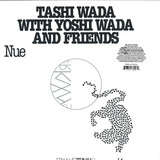
Composer Tashi Wada has performed for years with his father Yoshi Wada—artist, composer, and early member of the Fluxus movement. However, they have rarely appeared together in studio settings. Nue, the fourteenth entry in RVNG Intl.'s intergenerational FRKWYS series, finally brings Tashi and Yoshi, along with an eclectic group of close friends and extended family, together on tape.
Nue draws on aspects of Tashi's background for his widest vision to date—among them the minimalist bagpipe music of Yoshi, who co-composed three of the tracks, the psychoacoustic and perceptual explorations of his mentor, composer James Tenney, and reimagined forms of ancient and devotional music. The album, however, is not a tribute to the past or a recapitulation of familiar sounds. Instead, Nue is an intertwining of people and ideas as a means of growing, of looking inward to move outward, and of looking back to move forward.
To achieve this growth, Tashi assembled a core group of fellow travelers, including Yoshi, composer Julia Holter, producer Cole MGN, and percussionist Corey Fogel, to give life to this multifaceted suite. As an experience, Nue subtly navigates the interactions, intimacy and spaciousness of this group.
The album's title itself is a nod to Tashi's abiding interest in duality and the unknown: nue is a mythological Japanese chimera with the face of a monkey, the legs of a tiger, and a snake for a tail, a composite form, at once disturbing and otherworldly. But, as the composer points out, nue is also French for naked—stripped of complexity, bare and exposed, but also raw and essential.
From the doubling of tones—and the world of harmonic nuances such an action produces—to the rich interplay between individual musicians, all baring their own personalities and experiences through shared performance, Tashi's compositions allow space for these elements to join and grow. The multipartite creature that is an ensemble melds in the simplicity and purity of the music itself.
As explained by Tashi, each part was written with an individual in mind, not simply an instrument. And each individual performer makes their mark, from Holter's vocal performances on the cresting, oceanic 'Mutable Signs' and 'Ondine' with guest vocalists Simone Forti, Jessika Kenney and Laura Steenberge, to Fogel's resonant, precise percussion on 'Bottom of the Sky.' Producer Cole MGN, who has worked extensively with artists like Beck and Ariel Pink, helped to create a world of sound with minimal yet multi-dimensional materials. Like many of its influences, Nue uses deceivingly simple means to create complex, coherent worlds and narratives.
Tashi notes the influence of legendary Brazilian writer Clarice Lispector, whose work looked inward, investigating memory and emotion and dream, to understand the often overwhelming world outside the self. Like Lispector's classic novel Near to the Wild Heart, Nue cleaves these archetypal dualities—world/self, old/new, complex/simple—to create a work that allows them to coalesce into something singular.
As Tashi states in his liner notes: 'My desire was to create something both old and new sounding—ancient and futuristic—and ultimately something of its own world and other. Nue is a vision, an endless night of dreams, and a personal history of sorts, full of joys and demons.'
Guber releases his first EP on Paris based label Beat X Changers at the intersection of Ambiant and mental UK Bass music. The whole project is held by alternation of Slope / Release of sub-frequency and obsessional loop that dye each tracks. Anisotropic Expression is a first work that could be seen here as an draft representation of the behavior of surrounding matter. Non musical influences therefore are brought here by the the study of properties of materials expressed in a musical statement. Raw obsessional patterns, evolving and rolling out over the headroom could be seen as the emulation of many deformation models. Shaping of stereo and arrangement have been handled with the help of the sound engineer & producer X_1 leading to home or club-listening experience as well. Guber is been into music by listening & playing some music of the 70's and trash-metal that drove him straight to UK Bass music. Since there he is only focusing on spontaneous creation showing faithfull perception of thoughts, leading to a higher level of singularity.
Osaka, not being Japan's capital city, has a history of producing some unique underground movements and artists. Without the attention or the funds Tokyo artists may have access to, Osakan artists over the years have had to make their own way with raw innovation.Iku Sakan, an electronic musician and DJ from Osaka, has spent most of the last decade living in Berlin. Prior to that, he was active in the underground club scene of Kyoto & Osaka. A previous unit was Sakan & Senju (with Muneomi Senju of The Boredoms). Together, they produced a 15 copy handmade edition of their music on CDr. Iku personally handed a copy to Karlheinz Stockhausen, when he was visiting Tokyo for his last festival appearance in Japan.Sakan began playing steel drum at the Görlizer park in Berlin, Tori Kudo of Maher Shalal Hash Baz then invited him to accompany the band. Immersing himself in the international DIY / noise / improv scene back in Berlin, he became active as an improviser, DJ and promoter, and has since worked with Sun Araw, Anders Lauge Meldgaard, Pekka Airaksinen, Günter Schickert, and Damo Suzuki.Playing and improvising, touring and DJing, has led to his sound, a kind of metaphysical music, with circular rhythms and an emotive, melodic feel. He combines analogue and digital devices (Omnichord, Roland MC303, and a DIY electronic doll synth. made by his friend Stephane Shibatsuji-Perrin in Tokyo), and pre-recorded materials, mixing and merging all four signals into one mixer (no MIDI sync.), through an effect pedal. When recording, he usually lets these devices run until something clicks. Then he records and starts to improvise, like he's playing an imaginary instrument, entering a timeless region where track length loses its meaning.2017 has seen some of Sakan's Berlin recordings released, initially on two tapes: 'Human Wave Music', for Natural Sciences, and 'Cepheidian' for Planet Almanac. The two track long player 'Prism in Us All' on Japan Blues' imprint is his first LP. His on/off-world sound, part kalimba, part gamelan, part E2-E4 - and at the same time, none of them. A hypnotic, musical mantra, centring the spirit, and resonating with the harmonics of the spheres.Prism In Us All' is the second release on Japan Blues' eponymous imprint, after featuring the album on his NTS show in January.300 copies only, in silk-screened sleeve.
Spherical collections of stars form around black holes in situ; that is, locally to their cosmic neighbourhoods. It is said that future space colonization will rely on sourcing supplies in situ. Construction in situ uses raw materials at the site: colossal sculptures such as Naqsh-e Rustam, the Leshan Giant Buddha and Mount Rushmore were built in this fashion.
Wild, organic machine grooves, with a mind's eye on naked treetops and an early sunset. Melody breathes out from dubwise fx, percussion by turns sinewy and floating, sub blasts and stripped synth arrangements. Keys on air.
Spacious, witty, melancholic, deadly.
Prolific Seattle producer Jon McMillion returns to Nuearth Kitchen with another crucial chapter in his epic tale of haunted house-music subversions. This EP offers four variations on a bizarre and engrossing theme. Don't It Make You (edit 1)' is a work of extremes: By some miracle of aural physics, it's at once one of McMillion's strangest tracks and one of his most accessible. He sets into motion a staunch, relentless house rhythm bolstered with congas, massed claps, synth-bass raspberries, and a badass male singer intoning, Don't it make you feel good, if you wanna get down/Just say it, say it again,' over which a miasma of enigmatic tones bubbles and swirls. Like Bohannon's disco-funk classics from the '70s, Don't It Make You' seems like a tease, even at 10 minutes duration, you wish it would roll on for at least 30. On Don't It Make You (edit 2),' McMillion strips things down to dance-floor essentials and erases some of the free-floating background weirdness.
The two remixes are revelatory. New York house icon Fred P. (aka Black Jazz Consortium) slides the track into a tighter pair of pants, but that just makes it swivel harder and slyer. He emphasizes Don't It Make You''s mysterious drones and then loops a female vocalist singing He keeps me' while dropping in some echoed male chatter to gently disorient. What a dreamy, soulful trip Fred P. conjures here. And rising German wunderkind Orson Wells layers and pitches up the original's cascades of bleeps, which becomes the dominant motif, and then subtly modulates said bleeps over the tune's seven minutes, while keeping that irrepressible rhythm strutting. McMillion's raw materials prove to be fertile ground for these two maverick remixers to flaunt their own fascinating quirks while maintaining the original cut's club-darkening and ass-moving functionality.