
Cerca:real d

8
Alongside the legendary Mercyful Fate and more obscure acts such as Alien Force, Randy, and Crystal Knight, Copenhagen's Witch Cross are undoubtedly one of the best Danish metal bands of all time. Their 1984 album “Fit For Fight” is definitely among the top five metal records in the country. One of the two guitarists on this masterpiece was a certain ‘Cole Hamilton’. His real name is Ole Hamilton Poulsen. He joined the band after the recording of Witch Cross' debut single, “Are You There” (from 1983). His partner on guitar was Mike Wlad (his birth name is Michael Koch). Mike Wlad is not only a founding member of Witch Cross, but also their main songwriter. After the premature end of the original Witch Cross, Mike Wlad formed a band called Harlot, which released a hard-to-find album called “Room With A View” in 1988. He then moved to London. Witch Cross are now active again and are currently working on their third album.

9
Mit Sexistential meldet sich Robyn mit ihrem bislang poppigsten Album zurück. Nach dem atmosphärischen Honey (2018) rückt sie wieder klar strukturierte Popsongs ins Zentrum - neun prägnante Tracks, entstanden an einem persönlichen Nullpunkt. Nach dem Ende einer langen Beziehung ordnete Robyn ihr Leben neu, entschied sich bewusst für eine alleinerziehende Mutterschaft und setzte sich intensiv mit Sexualität, Nähe, Unabhängigkeit und Identität auseinander. Die Arbeit am Album begann 2020 und wurde von der Pandemie geprägt. Aufgrund geschlossener Grenzen arbeitete Robyn ausschließlich mit schwedischen Weggefährten, allen voran Produzent Klas Âhlund. Ergänzt wird das Album durch Co-Writes mit Max Martin - die erste Zusammenarbeit seit Body Talk - sowie eine neu bearbeitete Version von Blow My Mind, ihrem Sohn gewidmet. Klanglich verbindet Sexistential klassische Popstrukturen mit einer hypermodernen Produktion. Thematisch kreist das Album um Lust, Verletzlichkeit und Kontrollverlust - und um das Spannungsfeld zwischen Emotion und Biologie. Die Single Dopamine beschreibt Verlangen zugleich als Gefühl und chemischen Prozess, geprägt von Robyns Erfahrungen mit IVF. Humor und Selbstironie durchziehen den Titeltrack, während Songs wie Sucker for Love romantische Liebe verteidigen, ohne naive Rollenbilder zu reproduzieren. Sexistential steht für künstlerische Integrität, bewusste Offenheit und einen selbstbestimmten Neubeginn - riskant, ehrlich und voller Hoffnung.

- A1 1: It Really Never Did
- A2 2: Feeling Nothing Is Worse
- A3 3: Sorry From Now On
- A4 4: Moreoff More Off Than On
- A5 5: Falling Water (Before You)
- A6 6: I Should Have Been Listening
- A7 7: Number Girl
- A8 8: Show Me All Your Landscape Paintings
- A9 9: Dreaming About Everyone But You
- A10 10: What's One More Place?
- A11 11: Self-Reliance
11


Finland's GRAVETAKER are a duo of Lunatik and Atavistic Mouth. Taking inspiration from Soulside Journey-era Darkthrone and Katharsis among other things, the band drag death metal back to its ambitious and obscure roots with their first recording, Sheer Lunacy. With five tracks clocking over 35 minutes, each song has taken a form of its own, fully realized but effectively part of a greater (w)hole. From mesmerizing acoustic intros to divebombs casting their screams over blastbeats, crazed hysteria to somber fields and back again, all wrapped in a swirling-yet-mossy recording, Sheer Lunacy is hard to categorize in any specific subgenre popular to this age and day; GRAVETAKER would be violently antagonistic if they actually cared about the nowadays scene. A true testament to a schizophrenic approach to songwriting and wielding true Metal of Death, IRON BONEHEAD now makes this archaic tome available on vinyl for full analog possession.
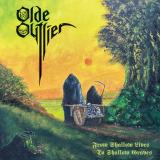
In many ways, OLDE OUTLIER rise from the legacy of Australia’s late Innsmouth — a cult band whose 2014 debut Consumed by Elder Sign endures as an underground classic. The connection is more than symbolic: guitarist Askew, vocalist Appleton, and bassist Greenbank all passed through Innsmouth’s ranks, while Beau Dyer now leads this new incarnation after years spent shaping the sound of Innsmouth and the earlier project Grenade.
From Shallow Lives to Shallow Graves marks OLDE OUTLIER’s recorded debut, a four-track, thirty-five-minute descent into their own cavernous realm. While faint echoes of Innsmouth’s inspirations — Armoured Angel and early Samael — linger, the band draw from a broader and far more obscure constellation. Shades of Amon Goeth, Martyrium, Head of the Demon, and Florida’s Equinox collide with the spectral drift of Ophthalamia and early Katatonia and Tiamat, all eroded and blackened into something untraceable.
Despite these depths, OLDE OUTLIER avoid any sense of technical indulgence. Their sound carries a rough, deliberate simplicity — a raw and smoky power that pushes each of the four long tracks forward with unhurried certainty. The songwriting unfolds through patient repetition and subtle shifts, allowing motifs to seep into place and gradually hypnotise. Appleton’s low gutturals bring a grim, expressive edge reminiscent of early Septic Flesh or Thou Art Lord, while the more open, lead-driven riffing imparts a distinctly archaic heavy metal aura that separates this band from their origins.
At many moments, that union of grit and atmosphere surpasses even Innsmouth’s achievements. Accented by well-placed clean and chorused guitar lines, From Shallow Lives to Shallow Graves becomes an immersive and strangely timeless work — a glimpse into an ancient, dimly lit world where OLDE OUTLIER feel less like a new formation and more like something unearthed from a forgotten past.

8
Analog Fingerprints Vol. 0 is a compilation bringing together the early 2000s works of Marco Passarani under his Analog Fingerprints alias, collecting key tracks originally released on Rome’s Plasmek and Pigna labels.
For Numbers, the story starts long before the label itself. In their formative years, digging in Glasgow’s Rubadub, Passarani’s records felt like dispatches from a future city. Releases on his own Nature Records and on labels such as Generator and Interr-Ference Communications were mind blowing: rooted in Detroit techno, Chicago house and electro, yet pushing somewhere new. Much like fellow travellers Autechre, who would remix him in 2001, Passarani’s music balanced machine funk with restless experimentation.
Information was scarce, and you would hear these records first on the dancefloor or at listening stations in shops like Rubadub. Print fanzines like Ear and early web outposts such as Forcefield offered only fragments. But there was a palpable axis forming between Detroit techno and a new European wave of record labels including Skam, Rephlex, Clone, Viewlexx and Nature itself. It was the sound that defined Saturday nights at Rubadub’s ‘69’ parties in Paisley, just outside of Glasgow.
Passarani’s records, in particular, were instrumental in bringing together the future Numbers co-founders. Richard had already booked him pre-Numbers; meanwhile Calum (Spencer) and Jack (Jackmaster), then 16/17 year olds working alternate Saturdays in Rubadub, were so enamoured with the Roman sound that they travelled to Rome for the Bitz Festival in 2003 to seek out Passarani and Lory D at their source.
The first Analog Fingerprints release landed as a 12” on Plasmek in 2001, following the fractured, IDM-leaning 6 Katun material. For Passarani, the project marked a recalibration. A DJ first and foremost, he had moved into production via early computer setups, from a Commodore Amiga through primitive PC audio, Cubase and Logic, later experimenting with Ableton. The IDM scene had offered a playground for trial and error, but there was always a tension between abstraction and the dancefloor. Analog Fingerprints became the bridge: still intelligent, but with more dance than distance. After years of broken beats and complex arrangements, he wanted directness without surrendering identity.
Working closely with Francesco de Bellis and Mario Pierro in the Pigneto district, the trio formed Pigna as a vehicle for reclaiming a more accessible dance sound, deliberately steering away from the minimal wave beginning to dominate Europe. Sessions were fast, instinctive, often stretching late into the night with friends dropping by. It was a studio as social space, production as collective energy.
“In that constant search for balance, Analog Fingerprints was my way of expressing something closer to the classic dance floor. The track 'Tribute' - a tribute to my favourite early Detroit techno track of all time, 'First Bass' by Separate Minds - came after I realised I had almost lost my connection with the dance floor. The simplest step was to take inspiration from early Chicago and Detroit and twist it in our Roman ‘Pigna’ way. My goal was to create more accessible dancefloor tracks by mixing my unconscious Italo roots with my teenage love for that early US sound, ensuring the result was as far as possible from the minimal sound that was starting to dominate everywhere.” - Marco Passarani
Technically, the Analog Fingerprints tracks span a transitional era: Roland TR-909, SH-101 and Alpha Juno hardware met early software experiments. A Novation Drumstation rack stood in for the unattainable TR-808, syncing with TB-303 and TR-606. Yet the true secret weapon was Jeskola Buzz, a tracker-style modular environment that allowed step-by-step parameter control and strange melodic constructions, later exported into the audio sequencer. Even the lead on ‘Tribute’ came from an early PPG Wave-style plugin. It was hybrid thinking at a moment when digital tools still felt unstable but full of possibility for technologists like Passarani.
Behind the music sat Finalfrontier, a loose Roman collective orbiting Nature and Plasmek. Distribution and production were intertwined; importing obscure records into Italy built connections with like-minded outsiders across Europe and the US. Expensive phone bills and fax machines forged an “electronix network” that linked Rome to Clone, Viewlexx, Skam, Rephlex, Rubadub and Detroit’s Underground Resistance. There was a shared sense of survival and resistance, of operating against commercial systems.
Passarani recalls “The first time I found a sheet of paper inside an Underground Resistance 12” with info about upcoming releases... and a huge picture of Spock on the back. Imagine that: you love the music, you love Star Trek, and there’s someone on the other side of the ocean sharing those same values and sounds. It was the perfect match. We even gave our original company the suffix ‘Finalfrontier’: that says it all.”
Feedback in that era arrived physically: distributor faxes, conversations with visiting DJs, the experience of playing abroad and meeting kids who had connected with the records. Glasgow became a key node in a scattered outlier network. Passarani personally brought the first two Nature releases to Fat Cat in London, playing them in-store. Shortly after, a fax arrived from Rubadub in Glasgow requesting copies.
“I still remember that phone buzz and the fax paper slowly sliding out, with someone I didn’t know saying they wanted 75 copies of Nature 001. Or like the time we got a fax from the Rephlex crew just saying, “Hello Nature Records, Keep up the good work.” That was how we knew the message was getting through. It was a fantastic feeling; just one piece of thermal fax paper as an analog notification - the mood for the entire week would change.” - Passarani
The connection to Glasgow has since stretched across generations. As Passarani reflects, links often fracture as scenes renew themselves, but in Glasgow something different happened. New and old mixed seamlessly. There was a visible trust in what came before, and a willingness to carry it forward rather than discard it. Observed from Rome, it was deeply encouraging.
Analog Fingerprints Vol. 0 captures that moment of exchange: Rome to Glasgow, Detroit to Europe, experiment to dancefloor. It documents an artist recalibrating his sound and a network of scenes discovering one another in real time, connected by vinyl, faxes and shared intent.

4
One of the most innovative and ambitious albums ever made, Genioh Yamashirogumi’s Ecophony Rinne is a sonic masterpiece featuring over 200 musicians that expanded the limits of what music and sound could do.
Before Akira there was Ecophony Rinne. Originally released in 1986, Ecophony Rinne is a four-part symphony of “ecological music” by Geinoh Yamashirogumi that married ancient tradition with technological innovation, and changed the way we listen to music in the process.
Half-speed mastered at Abbey Road by Miles Showell, Time Capsule’s high-tech analogue reissue is the first to reproduce composer Ōhashi’s ground-breaking “Hypersonic Effect” theory on vinyl, cutting frequencies beyond the realm of human hearing into wax to capture the full spectrum emotional impact of this extraordinary work.
Founded by genius polymath Tsutomu Ōhashi aka Shoji Yamashiro, Geinoh Yamashirogumi is a shapeshifting collective of over a hundred members from across disciplines. Rejecting professional musicianship, Ōhashi cultivated an ethos where neuroscientists, psychologists, doctors, journalists, engineers and students could critique society through artistic expression and pursue their research in ethnomusicological performances that spanned global traditions, Eastern spirituality and Western classical form.
Ecophony Rinne represents the pinnacle of this vision - an expansive orchestral suite made with over 200 musicians that channeled Ōhashi’s thinking about mankind’s relationship with nature, and fundamental questions of life, death and rebirth.
Here pipe organ synths made from sampled Tibetan horns sit alongside field recordings from Central African forests, Buddhist mantras circle dummy head microphones, Javanese Jegog percussion ensembles pulse like verdant ecosystems, and the acoustics of temples, caves and landscapes are conveyed in the mix. Weaving together culture, nature and technology, it is a record that vibrates with the polyphony of life on Earth.
But Ecophony Rinne was not only musically innovative. Noticing the difference between vinyl and CD versions of the album where digital reproduction limited the sound, Ōhashi developed a theory of “Hypersonic Effect”, determining that ultra-high frequencies above 20khz can impact human perception even if they are inaudible. At once a physical and a psychological experience, to listen to Ecophony Rinne is to feel music differently.
The rest is history. After its release, Ōhashi was approached by director Katsuhiro Ōtomo to produce the soundtrack for Akira, the work for which Geinoh Yamashirogumi is best known. Emerging from the shadows at last, Ecophony Rinne was its transcendental blueprint, reissued in its most complete hypersonic form on vinyl for the first time.
Rather than describe nature, Ecophony Rinne embodied it. Rather than reflect culture, Ecophony Rinne defined it. Rather than explore technology, Ecophony Rinne changed it. As a work of art, it is more relevant than ever. You won’t have heard anything like it.

8
It started in a Brooklyn studio back in 2011. A raw demo, a shared vision, and a deep reverence for the echoes of Basic Channel and King Tubby. After years of meticulous overdubbing and sonic layering, Marter (Bass) & Yony (Drums) have finally completed their masterpiece. Originally licensed to Bill Laswell’s label for digital release, this warm, lo-fi journey is finally available in its truest form. Recorded on 4-track and 8-track tape before meeting ProTools, every frequency breathes with analog soul.
This album sold out immediately upon its initial release in 2018. Due to overwhelming demand, a highly limited number of copies have been repressed with sticker on black jacket.
2nd album is on the way!

- A1: Dun
- A2: Sleep
- A3: Make My Feat Big Krit & Dice Raw
- A4: One Time Feat Phonte & Dice Raw
- A5: Kool On Feat Greg Porn & Truck North
- A6: The Otherside Feat Bilal Olivier & Greg Porn
- B1: Stomp Feat Greg Porn
- B2: Lighthouse Feat Dice Raw
- B3: I Remember
- B4: Tip The Scale Feat Dice Raw
- B5: Redford (For Yia-Yia & Pappou) (Redford Suite)
- B6: Possibility (2Nd Movement)
- B7: Will To Power (3Rd Movement)
- B8: Finality (4Th Movement)
Undun is the story of a man, Redford Stevens, dying in reverse, rewinding from the moment he became a statistic and hitting the points in his life where he's at his most self-aware. That he's a criminal who got caught up in the familiar street-hustle trappings that the modern media's documented countless times is a pivotal detail-- it's hit at an angle that seems to emphasize the futile inevitability of it all. His life could be any number of misdirected narratives that ends with a toe tag, and what details listeners learn about him are hazy, buried under archetypal turns of fate and decisive struggles. That this protagonist is a fictionalized composite of a handful of real people, filtered through a matter-of-fact narrative that splits character ambivalence with journalistic impartiality, only makes his lack of direction and the failure of any real closure stand out even more. "Lotta niggas go to prison," Dice Raw states on "Tip the Scale", "how many come out Malcolm X?"
So the Roots' latest album isn't a sprawling, rise-and-fall crime story, not a condemnation or a veneration of a man living outside the law, not a bullet-riddled grand guignol heavy on explicit details of soldiers getting cut down. It's a character study of a man whose existential crisis ends only with his death-- a death gone largely unspecified, the glamor and tragedy washed over with a doomed resignation. That's a hard thing to pull off, even for a band as given to deep-thinking concepts as the Roots are. And when your main lyrical catalyst is Black Thought-- a man more given to allusions than direct statements-- it's likely that it'll take a while for the full scope of Undun to really sink in.
If and when it does, it might strike listeners as a bit skeletal: omit the mood-setting instrumental bookends, including a brief, four-part orchestral suite that builds off Sufjan Stevens' "Redford (For Yia-Yia and Pappou)", and you've got maybe a half hour's worth of material. By ?uestlove's accounts, writing Redford's story introduced the headaches and challenges that come with scriptwriting into their songwriting, and what's left on Undun is the end result of frequent revisions and rewrites that attempt to reconcile character, theme, and continuity. If it comes at the expense of nuance, it's not always obvious: There's an easy-to-trace narrative line from Redford's acceptance of his fate ("Sleep") to his acknowledgement of how close it's approaching ("Make My"), back through declarations of aggravated toughness ("One Time"), and celebratory fatalism ("Kool On"), along ups and downs that juxtapose motivation ("Stomp") and helplessness ("Lighthouse"). When the vocal portion of the album ends with two of the bleakest sets of verses in the Roots discography, peaking with the estrangement of "I Remember" and the desperation of "Tip the Scale", Undun reveals itself as a story where a man's actual death isn't quite as tragic as the circumstances that pushed him to it.

- A1: On Your Mind
- A2: Nguzo Saba (The Struggle)
- B1: Unknown Track #3
- B2: Sexy Mama
- B3: Ultima Linda
- C1: Earthquake
- C2: Dizzy Profile (Alt Take)
- D1: Let Me Be The One
- D2: Alicia
- E1: Samba De Romance
- E2: Naima
- E3: Kimba
- F1: I’m Really Gonna Miss You
- F2: Reflections Of My Past (Feat Dennis Tini)
DJ Amir takes another deep dive into the back catalogue of Detroit's legendary Strata Records to curate a 2nd volume in his Strata Records – The Sound of Detroit compilations. Whereas volume one took in the soulful edge of the Strata canon this volume, as Amir says, 'leans into the label's groovier, funkier edges whilst still celebrating its bold, avant-garde spirit.' DJ Amir's relationship to the Strata label has resulted in the release of the long lost Charles Mingus live 'Jazz in Detroit' box set released on BBE Music along with re-issues from The Lyman Woodard Organisation and re-imaginings of Strata's genre defying music by Berlin based DJ and producer collective, Jazzanova as well as remixes from Kai Alce, Wajeed, Henrik Schwarz, re.decay and DJ Amir himself and, of course, volume one of The Sound of Detroit. Featuring music from The Soulmates, Fito Foster, Keith Boone & Janice Coombs and The Contemporary Jazz Quintet amongst others, The Sound of Detroit volume 2 absolutely exemplifies the importance of Strata Records in the history of innovative Black music as well as its place in the cultural landscape of Detroit as a powerhouse city for art and music. Released by BBE Music in collaboration with 180 Proof Records as a triple vinyl LP and high res. digital download DJ Amir presents Strata – The Sound of Detroit volume 2 really is a gem of a compilation to grace any serious music head's record collection.
The ‘Haris – Fourtrack EP’ marks the debut release from Shimmy, a new reissue label with a sharp ear for overlooked gems. Originally released 25 years ago and long coveted on Discogs, this sought-after EP finally returns to the shelves, breathing new life into a classic of the tech house underground.
Haris made his mark in the late ’90s and early 2000s with releases on iconic labels like Oblong and his own imprint, Laus Records, collaborating with scene heavyweight, Terry Francis. Renowned for his mastery of rolling, groove-led tech house, Haris crafted a sound that remains timeless and endlessly playable.
Each of the four tracks delivers a distinct flavour for different dancefloor moments, offering real depth and versatility across the EP. Expect snappy tribal percussion, eerie synths, haunting vocals and deep, driving basslines - all the essential ingredients for a late-night shimmy.
11
MTY-3.14 “π”, released on March 14, 2026, is the fifth and final chapter of a journey begun fifteen years ago.
This standard edition presents the final form of Polar Inertia across three 12" vinyl records, featuring 11 tracks. Nothing added, nothing removed—only the music, unfolding in full.
Images dissolve, words fall away. What remains are faint echoes, like footprints slowly erased in fresh snow.
This final opus does not close the path. It fades into it. π is not an ending, but a state: the moment where movement continues, even as the world turns silent.
A last step.
A final trace.
Still moving, beneath the cold.
POLAR INERTIA
We are no one because we want to be no one,
And to be no one we have to be everywhere and nowhere- Polar Inertia examines the enigmatic and blurry realms, embracing the art of obscured vision.
Encountering the collective Polar Inertia is much like being absorbed by fog and captivated by its ever-shifting forms and densities, with things being as indistinguishable as in a whiteout.
Formed in 2010 by a group of artists, Polar Inertia transcends visibility, delving into structures that lie beyond the public gaze. Layers upon layers intertwine within the fabric of Polar Inertia, extending beyond their profound electronic compositions and live performances. It manifests as a conceptual universe, where sound, monochrome aesthetics, and elusive narratives converge, much like trying to grasp the intangible fog. The entity that is Polar Inertia is involved in installations, print- and video work and texts created for different contexts and live in different spheres such as Palais de Tokyo in Paris or the Lyon Biennale of Contemporary Art. Still, clubs and festivals are perfect spaces to experience these nebulous soundworlds and immerse in them. Fittingly, some of Polar Inertia’s appearances include the colossal halls of Berghain and Bassiani and at experimental festivals like Mutek Montreal and Atonal Berlin, that like to break with the classic club conventions.
Polar Inertia's sonic landscape unfolds with wafting textures accompanied by resonating beats and drones, reverberating through empty spaces, merging with the vast expanse of nothingness. Their sound exists at the crossroads of ambient, experimental, and deep techno, interwoven with vocal narratives. Since their inaugural release “Indirect Light“ on Dement3d Records in 2011, they remain a stronghold of relevance and captivation in the electronic domain.
Mastered by sixbitdeep, with artistic direction by Diplomatie Studio.

8
Walter Thomas’s “Chicago Knights” LP features a retrospective of songs written and released between 1987 and 2009, primarily with the Roland 1824 and the Fostex 8 track reel to reel. Channeling the spirit of underground soul and dance music specifically rooted within the greater area of Chicago, Illinois–a city known for its deep and healthy soul and r&b roots–this compilation features 8 of its 9 tracks on vinyl for the very first time.
The intro track “I Wanna Get Witcha” dates back to 1987, holds a proven track record of kicking off many a dance floor, rocking clubs worldwide in a blur of boogie-funk, disco, and soul. “Immaturity” and both versions of “Fed Up” echo the emotional differences and tensions between lovers in a spat. “Magic City” served as the anthem and homage to its namesake roller skating rink in 90s-era Waukegan, IL. While “Chicago Knights” is a relentless mid-tempo groove inspired by the aggressive motorists that dominate Chicago roadways, “2nd Chance” drops the tempo to a slow r&b roll, preaching the ethos of love, peace, and forgiveness.
Last but certainly not least, “E&J’s” was a real commercial jingle used for a once legendary BBQ joint “E&J’s” in Illinois: a short bonus track to close out the LP. These 9 tracks are just a touch of Walter’s expansive body of work, and we’re stoked to bring them to you on wax.
Walter Thomas is a singer, songwriter, producer, arranger, and composer from North Chicago, IL known for his soulfully smooth arrangements and vocals. Walter has toured internationally with quintessential soul groups like the Temptations and Friends of Distinction, as well as opening for performers including the Floaters, Bette Wright, The Emotions, and The Drifters. His decades of touring with nightclub and concert performances have honed this gifted artist into a seasoned and refined live act.
11
As Nathan Fake rises from the nocturnal subterranea and rave catharsis of his previous records, on Evaporator, he resurfaces into the domain of daylight, bringing a tangible sense of air rushing against your face, of big skies, and endless landscapes. The idea of pop accessibility that trickled into 2023’s Crystal Vision is refracted here through the prism of sweeping ambient, deep electronica, and trance uplift. Evaporator is Fake’s idea of “airy daytime music”, with each track a different barometer reading across the album’s varying atmospheres, which range from vibrant sunbursts, bracing rainscapes, and fine mists of clement melodics. “It’s not overtly confrontational electronic club music,” states Fake. “It’s quite pleasant, it’s accessible. As I was progressing through making the tracklist, I called it a daytime album. It doesn’t feel like an afterparty album.” For the past decade Fake has been gingerly introducing collaborations with heroes and friends alike into his lone, idiosyncratic working process. Border Community alumni Dextro AKA Ewan Mackenzie transmutes his ferocious drumming for Pigs Pigs Pigs Pigs Pigs Pigs Pigs into the blurred choral thump of ‘Baltasound’. ‘Orbiting Meadows’, meanwhile, is his second collaboration with Clark, an eerily idyllic duet where microtonal 18EDO piano clangs slowly twirl around wailing pads. Evaporator marks the junction point of old technology and ever fresh creativity for Nathan. The trusty “dinosaur” age software, particularly Cubase VST5, that has powered two decades of music is rarely updated. “I used to sort of feel a bit ashamed of using such old software, and then I kind of had an epiphany – that’s just how I work”, comments Fake. “That’s just how I play. I’m very fond of these old tools, and I get the most joy out of them, but now I’ve incorporated new technology too.” When an artist accumulates so much synergy with their instrument, music making becomes instinctual. By Fake’s account, much of Evaporator just fell into place. The album title arrived randomly in his head (“it felt completely perfect. Airy.”), ideas looped and developed until things locked into place and just felt right. ‘The Ice House’ is a fleeting glimpse of the sonic world he taps into in this creative state, its glassy FM synths built around a counterpoint between rough-hewn crystalline arpeggios and sparse yet gravitas-bearing bass. “That riff I just wrote out on the keyboard, I just played it forever and ever and ever. The original track ended up being really short. Here you go, and it’s gone!” These unplanned channellings of sound call forth records from Fake’s past while he looks ahead, perhaps getting at the very essence of his musicianship. The opener ‘Aiwa’ (“the breeziest,” he muses) reminds of the introspection that characterised Providence, excited by the fire and grit of Steam Days’ textural experiments, its chunky slams and clatters surging into a flood of harmonic buzzing as they reach out for old wisdom. ‘Hypercube’ stampedes in a similar chronological confluence, infusing an incessant synth line reminiscent of the golden age of rave with the crackling, ecstatic energy of modern festival anthems. Like the vaporisation of liquid to particles, everything that Evaporator presents has a mutant desire to be amorphous. Sounds rarely settle; the irradiated garage beat of ‘Bialystok’ is pitched downwards to driving, rebounding effect, while ‘You’ll Find a Way’ warps static into shivering energy, cinematic synth strings building anticipation into a gradual gush of chords. This translates into a more expansive stereo field than Fake has explored before. ‘Slow Yamaha’ saves the wildest, most kinetic transformations for last with a cornucopia of crispy melodies and fried drums; a sibilance of cymbals on the left, a susurrus of shakers on the right, and kaleidoscopic lasers pulsing and fizzing all around. Evaporation culminating in pure excited atoms. In a world where music has increasingly become background content, making albums remains lifeblood for Fake: “It makes me realise how long; twenty years is ages! It’s weird to see how much the world has changed. Release day back then you did fuck all, now you spend all day on socials. When I grew up the people who made the electronic music I was into were quite mysterious, and the artwork was very abstract. There was a massive distance between you and that music, and that was a key part of it, really. Now it helps to be an extrovert, and I'm just not, but the album marks the first time my face has graced the cover art. I’ve never wanted to do this before, I'm very shy, and generally I don’t like being seen,” he professes. “But, twenty years in, I supposed I could try something new. I'm very lucky that I'm somehow surviving in this world, where the media world favours extroverts and interesting looking people. It’s not my world but somehow I’m still in it.” Evaporator continues to prove Nathan’s necessary presence, with some of his most engaging, varied, and magical music yet.

- A1: Mojo Pin
- A2: Dream Brother (Nag Champa Mix)
- B1: Kanga-Roo
- C1: So Real
- C2: So Real (Live)
- C3: Grace (Live)
- D1: Dream Brother (Live)
- E1: Dream Brother (Live)
- E2: The Way Young Lovers Do (Live)
- F1: Medley: Je N'en Connais La Fin/Hymne A L'amour (Live)
- F2: The Grace E.p
- G1: Grace
- G2: Grace (Live)
- G3: Mojo Pin (Live)
- H1: Hallelujah (Live)
- H2: Tongue (Rehearsal Demo)
- I1: Last Goodbye
- I2: Mojo Pin (Live Chocolate Version)
- J1: Kanga-Roo (Album Version)
- J2: Lost Highway (Live)
The Grace EPs by legendary singer-songwriter Jeff Buckley, is a 19-track, five x EP box set, comprising the following EPs: 'Peyote Radio Theatre' July 1994, 'Last Goodbye' January 1995, 'So Real' [June 1995], 'Live From The Bataclan' [October 1995] and 'The Grace EP' [February 1996],
This unique package contains all five twelve inch vinyl records each in their own full colour jacket, a double sided full colour insert with extensive liner notes, all carefully packed in a heavyweight leather laminate textured 15mm-spined outer sleeve.
The five discs that make up the Grace EPs box-set are a collection of live performances, B-sides and studio versions from songs that originally appeared on Buckley's "Grace" album.
Peyote Radio Theatre and So Real were promotional-only releases that weren't commercially available. The others are rare imports: Live from the Bataclan came out in France, The Grace EP in Australia, and Last Goodbye in Japan,
This EP set features "Last Goodbye", "Grace", "So Real" and two amazing live versions of his classic hits "Hallelujah" & "Mojo Pin".
The Grace EPs also features a whopping 12-minute version of Van Morrison's "The Way Young Lovers Do," a medley of "Je N'En Connais Pas la Fin/Hymne A l'Amour," Hank Williams's "Lost Highway," and a 14-minute take on Alex Chilton's "Kanga-Roo."
Finally there is a bonus track added to the The Grace EP; "Tongue," a spooky ambient 11-minute studio instrumental.

- A1: Window In The Sky
- A2: The Bachelor
- A3: Harry
- A4: Helnwein
- A5: Youth Packing
- A6: Syukatsu Process
- B1: Grandia Ad
- B2: Collapse Roppongihills
- B3: Driftwood
- B4: Memoria
- B5: Drakedreamdrain
- B6: Get Out
Following his critically acclaimed debut "Dentsu2060" released via Lorenzo Senni's Presto!?, Tasho Ishi's second full-length album "Tasho Ishi lI" is now available on his own label T's.
tI features the new-wave Parapara anthem "Collapse Roppongihills" which became a staple at Narita Airport raves. celebrity trap rave track "DreamDrakeDrain" reminiscent of jam session between Drake and David Chronenberg. the junk entertainment track "Hellnwein" depicting modern pop utopia and its violent underbelly.
The Japanese-style Eurodance meets Philip Glass "The Bachelor" inspired by reality TV. These anthems are contemporary, pop, and carry Tasho Ishi's unique critical edge.
The second album, 'Tasho Ishi Il', is both a musical translation of Japan's diverse techno-animism and a sequel to the previous work "Dentsu2060" Techno-animism: Para Para, anime voice actors, reality TV, epics, advertising, and raves. Each track stands alone yet forms part of a larger, chronologically unfolding narrative.
While all tracks are animated by Japan-specific sound imagery, this is a pop album rather than avant-garde or abstract. In essence, it's a series of songs generated by rave trans-layers, serving as both reportage and documentation tracing Tasho Ishi's visionary city and its phenomena.

- Leave (Again)
- Distance
- Ad Friend
- Crunch The Numbers
- Biters
- The Producer
- A Chorale
- Healing Attempt
- Sentence Structure In The Country
- Move
disponibile anche
OPAQUE RED VINYL[29,20 €]
more eaze is the moniker of Brooklyn-based composer, orchestrator, and multi-instrumentalist, mari maurice. A renowned collaborator both in performance and on recordings, maurice"s own work is a fantasia, a reflection of her curious and explorative musical mind, encompassing entire spectrums of sound from a wide sonic pallet of electro-acoustic textures, folk traditions, and pop forms that pirouette into fully realized ecosystems. sentence structure in the country is a definitive statement of the matchless quality of more eaze"s skill as player and musical thinker. The album relishes the ecstatic in performance and collaboration with an inviting wit and incisive compositions, imbuing tenderness, frustration, and joy into each passage. sentence structure in the country is a collection of compositions, each beautifully realized, self-contained worlds. maurice"s dexterous, tasteful arranging lays bare her influences and obsessive fascinations with remarkable congruency while foregoing any sense of indulgence. Her music holds a density not only in the lush compositions and embellishing flourishes, but also for those moments of spare, minimalist beauty. sentence structure in the country is a textural marvel, a mosaic of ethereal electronics and loamy acoustics sculpted around deeply moving, enduring songs.

more eaze is the moniker of Brooklyn-based composer, orchestrator, and multi-instrumentalist, mari maurice. A renowned collaborator both in performance and on recordings, maurice"s own work is a fantasia, a reflection of her curious and explorative musical mind, encompassing entire spectrums of sound from a wide sonic pallet of electro-acoustic textures, folk traditions, and pop forms that pirouette into fully realized ecosystems. sentence structure in the country is a definitive statement of the matchless quality of more eaze"s skill as player and musical thinker. The album relishes the ecstatic in performance and collaboration with an inviting wit and incisive compositions, imbuing tenderness, frustration, and joy into each passage. sentence structure in the country is a collection of compositions, each beautifully realized, self-contained worlds. maurice"s dexterous, tasteful arranging lays bare her influences and obsessive fascinations with remarkable congruency while foregoing any sense of indulgence. Her music holds a density not only in the lush compositions and embellishing flourishes, but also for those moments of spare, minimalist beauty. sentence structure in the country is a textural marvel, a mosaic of ethereal electronics and loamy acoustics sculpted around deeply moving, enduring songs.
