Reba's 858 Ass marks the first trip to Transarctica. Precise percussions, ethereal pads and voices, textures and breaks, 858 Ass is a 4tracker deconstructing influences like bass, breaks & jungle. The first EP sets the tone and direction for the new label, that will explore a broad musical aesthetic with the distinct “Transarctica” touch.
quête:reba
Wild Child is an American indie pop band from Austin, Texas formed in 2010. The band consists of Kelsey Wilson (lead vocals and violin), Alexander Beggins (lead vocals and baritone ukulele), Sadie Wolfe (cello), Tyler Osmond (bass), Matt Bradshaw (keyboard and trumpet), Cody Ackors (guitar and trombone), and Tom Myers (drums). Their second album, The Runaround, was released on October 8, 2013 via The Noise Company and produced by Ben Kweller. "The Runaround has the ability to instill energy into the listener, as the poppy-folk charm is irresistible. (...) Wild Child created a very well-executed LP, and accomplished their goal of staying out of a restrictive style of music. Even though each cut is different from the all the others in terms of style, instruments used or theme, together they form a cohesive album." Theaquarian
After more than a decade of non-stop touring, acclaimed Austin songwriting duo, Kelsey Wilson and Alexander Beggins, quietly stopped touring as Wild Child. Headed in different sonic directions, the pair didn't know if they would ever make another Wild Child record. Then, what felt like the "end of the world" brought them back together. Pandemic lockdowns closed stages and drained bank accounts. As artists from all backgrounds took their shows to the internet, Wild Child was no different. Wilson and Beggins got together to practice for a series of online performances for devout fans, and within 30 minutes they wrote the first single for what would accidentally become Wild Child's fifth album, End of the World. Mixed by Matt Pence (Jason Isbell, Elle King) and including contributions from guitarist Charlie Wiles (Paul Cauthen, John Moreland, Orville Peck), End of The World sees the pair find catharsis in art amid compound disasters. As Wilson describes it, "I just started signing about things that were freaking me out. Wearing a mask for a year. Global warming. There's no heat, no water. It was like a dirge to begin with. But by the end we were all screaming and laughing that, yes, this might be the end of the world, but we're all together right now, making music in my living room by candlelight. It's all OK."
Part 1[13,66 €]
Following on from 2024's "Distant Landscapes EP" alongside Tensal, Amorphic returns (solo this time) to James Ruskin's Blueprint Records with a new ten-track album released digitally and as two four-track vinyl EPs released simultaneously.
Amorphic is a pseudonym of Scottish artist Vince Watson to explore more raw and hypnotic signatures. Launched in 2022, Amorphic has featured on labels such as Token, Symbolism and Modularz as well as the two labels Vince runs himself: Amorphic and Morph.
With almost 30 years in the industry, Vince has released over 1000 tracks, which has allowed him to work and gig with some of the very best in that time including Laurent Garnier, Richie Hawtin, Carl Craig and in this year, Vince will release an LP with Carl Cox on his label Awesome Soundwave. As a touring musician has been able to play at some of the world's best clubs as both Amorphic and Vince Watson, including a residency at Tresor Berlin, DC10 Ibiza with Carl Cox, Berghain and Womb Tokyo as well as being a current resident of 909 Festival in Amsterdam.
earth had been watched by the keepers of the secrets for millennia.
the human experiment had evolved into chaos.
the subjects had destroyed themselves and the planet they were gifted.
a few were taken, leaving a dying planet behind.
the rest of human history was deleted.
the gods sought a new order.
the year zero...
- A1: World Is Dog
- A2: Cctv (Feat Creature)
- A3: Yottabyte
- A4: Bad Pollen (Feat Billy Woods)
- A5: Slum Of A Disregard
- A6: Rfid
- A7: Instant Transfer (Feat Billy Woods)
- A8: Ikebana
- B1: In The Shadow Of If
- B2: Skp
- B3: Hushpuppies
- B4: 14 4 (Feat. Skech185)
- B5: Voice 2 Skull
- B6: Xolo
- B7: Zigzagzig
Black Vinyl[35,08 €]
We’re teaming up with ELUCID and Fat Possum for a limited edition of 300 copies of a Rush Hour black ice coloured edition.
E L U C I D, one half of the illustrious duo Armand Hammer, is here with the full-length follow-up to 'I Told Bessie'. Further experiments in the sonic, expanding on the 'live' side of music paired with the embracing of chaos. Something you haven't heard, or not so for a very long time. E L U C I D is here to reveal the bleakness of reality.
---------------------------------------------------------------------------------
''There is never time in the future in which we will work out our salvation. The challenge is in the moment; the time is always now.''
James Baldwin
A raw, crackling urgency runs through rapper-producer ELUCID’s new album REVELATOR like an underground power line. There is no space here for sepia-toned reminiscences or indulgent self-mythologizing. Intellectual rabbit holes have been filled in with concrete and rebar ; there is nowhere to hide and no off ramp from the audio Autobahn that ELUCID has fashioned—a renegade Robert Moses with gold fronts, bulldozing the homes of the powerful and the complicit. REVELATOR brims with the energy of now, with a refusal to look away. Carpe diem in a murder one mask.
Born in Jamaica, Queens, ELUCID has been on the cutting edge of New York’s underground scene since the mid-2000s. From the beginning, he has defied both convention and expectation. He ran with Okayplayer darlings Tanya Morgan, but his own music eschewed their throwback charm for glitchy noise experiments and bass-swamped culture jamming. His 2016 debut studio project Save Yourself (re-released in a deluxe edition last year) announced him in earnest. But in recent years, his Armand Hammer releases with partner-in-crime billy woods have received significant attention and acclaim. Serving as a followup to his last solo album—2022’s comparatively balmy I Told Bessie—ELUCID hoped to “re-distinguish” himself with REVELATOR, setting himself apart amidst the increasing attention around the music he and his friends are making together.
For ELUCID, this meant setting bold new challenges for himself. One of these was diving further into live instrumentation than ever before—”getting my Quincy Jones on,” as he puts it. The testing ground for this approach was Armand Hammer’s most recent project, 2023’s We Buy Diabetic Test Strips’ Möbius strip soundscapes, warmed with instrumental flourishes and skin-shedding beat progressions. With REVELATOR, though, ELUCID strove to create an atmosphere of chaos, embracing experimental electronics and atonal sample bursts. He worked on much of the album with co-producer Jon Nellen, who comes from a background in avant-garde and Indian classical music. “I wanted to get as freaky as I could at this moment. I wanted people to hear things, maybe for the first time, or in a way they haven’t for a long while,” the rapper explains.
ELUCID arrived at the studio with a collection of noise sources: non-referential samples, glitches and noises. Together he, Nellen, and others created forms out of them and, as ELUCID recalls, “just started playing drums with it.” Their fried, distorted sound was directly inspired by Miles Davis at his most uncompromising—specifically, the tone-clustering funk track “Rated X” from his 1974 double LP Get Up With It. At times, the pairing of rap with avant-fusion sounds also brings Emergency! from The Tony Williams Lifetime to mind, perhaps in an alternate timeline where the late drummer was listening to Ice Cube’s AmeriKKKa’s Most Wanted.
“The World is Dog,” REVELATOR’s lead single, functions as the album’s aesthetic thesis statement. Like the Davis track, the textures are punishing, the tonality is in free-fall, and the driving breakbeat of a groove cuts in and out unceremoniously. Avant-jazz bassist Luke Stewart, who appears throughout the record, holds the whole thing together just long enough for ELUCID to tightwalk over the beat. This tension is exactly where REVELATOR sets itself apart; in a time of drumless loops, and safe soul samples, this is a high-wire act with no safety net. Similarly, the song announces the themes of the album within just a few phrases, evoking the way societies accept and adjust to new levels of debasement and brutality while suffocating under the weight of history: “Can’t clock the kill, all a mystery/Forced past will eating everyone eventually/The world is dog.”
Many of the songs on REVELATOR grapple obliquely with dissolution and disenfranchisement in America and across the world—the grim realities of our domestic sociopolitical climate and our involvement in foreign conflicts. “Much of my artistic and political sensibility comes from the Black arts movement here in New York,” ELUCID explains. “Recognizing the interconnected global struggles against oppression, artists and thinkers created works and actions in solidarity with freedom movements in South Africa and Palestine.” ELUCID cites intellectuals like Amiri Baraka, Kwame Nkrumah, Audre Lorde, Sonia Sanchez, and Nikki Giovanni among his heroes. (One track on the album is specifically inspired by Lorde’s work, “SKP,” citing the scholar’s paper “Uses of the Erotic: The Erotic As Power.”) Songs like REVELATOR’s insistent closer “ZIGZAGZIG,” find ELUCID applying up-to-the-minute messaging, making explicit reference to the conflict in Gaza: “Feed a war machine…from river to sea, in lieu of peace.”
Despite ELUCID’s preference for cacophonous system overload here, the rapper also provides moments of respite. Recorded at The Alchemist’s Los Angeles studio, the laid-back, wheezing “INSTANT TRANSFER” is a collaboration with billy woods, which crystallizes their shared sense of creative determination. “With much momentum behind us and even more on the horizon, I knew a purpose, and that every step was ordered to that purpose,” ELUCID said of the experience. Meanwhile, the jittery “HUSHPUPPIES” is a playful anomaly on the track list, providing a snapshot of ELUCID watching his grandparents in the kitchen while preparing for Friday night fish fry dinners.
“Love still rules over on this side,” ELUCID says. ”I’m raising a family. We are making meaning and finding joy in the midst of all the fucked up-ness of everything around us because the alternative is cowardice and slow death. We remain rooted. We celebrate our people and our wins. Struggle is necessary.”
“IKEBANA” is one of ELUCID’s strongest statements of purpose on the record, blending the record’s heaviest themes with its most hopeful sentiments. supported by a shoutalong refrain and an urgent prog-funk groove. Breaking away from images of dissolution and crumbling societal systems that populate REVELATOR, ELUCID notes that the only way to navigate life’s bleakest landscapes is to cling to love and believe in those around you—to look forward toward something better that may or may not be possible. For the rapper, one of the album’s most trenchant lines comes during a centerpiece of a beat drop: “Being alive/I must look up.”
“The lyric ‘being alive I must look up’ is important especially in the context of this album. Much of the album imagery is harsh and reflects the actual doom some of us experience. But still I/we exist,” ELUCID explains.
Every artist is, in one way or another, the product of their time, bound by life’s leaden gravity to operate within the space of that which is already known. But there are some who are able to shake free of these ties, to shape the culture as it unfolds, to make the present their own.
Revelation, as a concept, points to the scales falling from people’s eyes—something that has been hiding in plain sight becoming clear. “The revelator relates to things that have been talked about, things that have been forecasted,” ELUCID adds. “And now they’re really here, and everyone sees it. And there’s no escaping.” REVELATOR plays out with the unmitigated power of those storms, laying waste to any genre conventions in pursuit of a certain physicality. Here, ELUCID develops a wholly distinctive musical language to explore our fractured modernity.
REVELATOR's packaging was designed by longtime Armand Hammer / Backwoodz art director, Alexander Richter.
Long lost and much sought after Private Press from Western Massachusetts band Forest. A distinctive Acid-Jazz / crossover AOR / Soul sound, think Mother Earth jamming with Tim Buckley. This re-issue comes with 6 previously unreleased tracks. Forest was a rarity at the time in a band that consisted of two drummers, Gary Stevens and Bob "Rox" Girouard . The band was a well seasoned touring band who shared the bill with the likes of The Fabulous Rhinestones, The James Montgomery Band, Zonkaraz to name a few. The album covered various styles from blues to acid-jazz with the aim of securing a major record deal. Many of Forest’s alumni have gone on to highly successful careers in music: Jim Kimball relocated to Nashville to work alongside Faith Hill and Reba McIntyre, Bill Holloman with Danny Gatton, The Gatlin Brothers, Nile Rodgers and Chic, The Fab Faux and Bruce Springsteen, and Wes Talbot founded a music production library called The FRESH Music Library.
Swell Maps / Television Personalities affiliated C86-era indie pop rescued from sheer obscurity and thrust into semi-obscurity by FELT. The Catburgers were a short-lived Scottish group, this recording initially primed for release on Dan Treacy’s Dreamworld imprint yet placed on the perennial backburner as so many creative projects inevitably are.
Soundcloud uploads dating back over a decade ago and the odd blog/twitter post aside, the group seemingly lived on only in the memories of those who happened to catch them on the Edinburgh scene back in the day. Until now! With the help of the National Sound Archives, the original master tape containing these three tracks has been rebaked, cut and mastered for seven-inch.
‘Holiday House’ sounds immediately at home in the Postcard Records nexus, the influence of 1980 particularly tangible. Slower paced and with a touch more melancholy than its companions, the song sounds both in and out of time, as if some young teens raised on a hand-me-down diet of Pastels CDs might have laid it down yesterday.
Jowe Head of Swell Maps joins the group for ‘The Acid Tree’, whilst EP closer ‘Diving For The Brick’ sees the band ruminating on weak knees, sore lungs and stinging eyes down at the local swimming pool.
Accompanying the release is the original demo tape predating this record, recorded at The Rocking Horse Studios in Bathgate in Autumn 1986. The demo is restored from a tape copy owned by journalist Simon Reynolds and contains some of the tracks that made it onto the 7".
It’s time for the label founders to take control over our spaceship. Clusterhead offers four slices of proper abstract techno for those who know.
Release starts with Alteración del orden: a broken kick spiced with elastic synth washes and microdrones sets the pace while the rest of the percussive elements appear softly in the arrangement. The main sequence grows and mutates as minutes go by, reverb and stereo treatment goes heavier until repetition makes the desired effect on the virtual dancefloor.
Second cut Resiliencia Incesante again relies on broken kicks and processed synth lines. The BPM rate is higher here and the percussive elements are snapper and tighter. Sounds twist and change over time as the frequency range grows. An industrial ode to obscurity.
On the flip side, Automutilación creativa brings us again into oblivion, shuffled grooves obsessive sequences continuously moving and high pitched synthetic drums running through the stereo field.
Closing the release we have Notzing on board, still recovering from his amazing experimental work on our label, we give him again the commands of our spaceship to translate his mental obsessions in this superb rework of Automutilación creativa.
One more time we push the sound boundaries on behalf of timeless futuristic music in touchable format.
ESPAÑOL
Es hora de que los fundadores del sello tomen el control de nuestra nave
espacial. Clusterhead ofrece cuatro rebanadas de techno abstracto para aquellos que saben de lo que hablamos.
El disco comienza con Alteración del orden: ritmos rotos condimentados con sonidos elásticos de sintetizador y microdrones marcando el ritmo, mientras que el resto de los elementos percusivos aparecen suavemente en el arreglo. La secuencia principal crece y muta a medida que pasan los minutos, la reverberación y el tratamiento estéreo se vuelven más presentes hasta que la repetición produce el efecto deseado en la pista de baile virtual.
Como segundo corte Resiliencia Incesante nuevamente se basa en bombos rotos y líneas de sintetizador procesadas. La tasa de BPM es más alta aquí y los elementos de percusión son más rápidos y ajustados.
Los sonidos se retuercen y cambian con el tiempo a medida que aumenta el rango de frecuencia. Una oda industrial a la oscuridad.
En la cara B, Automutilación creativa nos trae de nuevo al lado oscuro, grooves mezclados, secuencias obsesivas en continuo movimiento y percusiones sintéticas de alto rango recorriendo el campo estéreo.
Cerrando el lanzamiento tenemos a Notzing a bordo, todavía recuperándonos de su asombroso trabajo experimental en nuestro sello, le damos de nuevo los comandos de nuestra nave espacial para plasmar sus obsesiones mentales en esta soberbia reelaboración de Automutilación creativa.
Una vez más empujamos los límites del sonido en nombre de la música futurista atemporal en formato táctil.
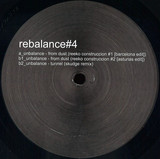
rebalance returns with a real banger . unbalance remixed by reeko & skudge! vinyl only
- A1: Cumbia Saramuya (Rebajada Dubmix)
- B1: Mosaico Y Descontrol
ON MANZANITA RED COLOUR VINYL A heavyweight slice of Caribbean DUB! Between 2021-2023 Ruido reworked original Discos Fuentes masters with vintage gear, transforming Colombian tropical classics from the 60's into raw, energy-dubbed, remixed, and reimagined for today. An essential 45RPM for dub heads and tropical groove lovers worldwide.
A chopped-and-screwed love letter to the sounds of rebajada – half-speed cumbia, pioneered by Sonido Dueñez in the 1990s, and born from an overheated turntable motor that didn’t make the crowd stop dancing. With Debit’s treatment, rebajada becomes an ethereal, at times intense ambient tapestry that’s also a history lesson.
Spend any amount of time pacing the streets of Monterrey, the bustling city in the north of Mexico where Delia Beatriz, aka Debit, grew up, and you’ll be sure to catch traces of cumbia echoing from Bluetooth speakers, DIY soundsystems, or car stereos. An Afro-Latin dance form and »practica cultural« originating in Colombia in the early 19th century, cumbia evolved rapidly in the early 1900s, as a localised sound played on drums and flutes quickly modernised to integrate European instrumentation like the accordion. When it reached Mexico in the 1940s, the sound shifted again, fusing with mariachi styles and integrating further vallenato folk elements. Eventually, cumbia spread across the entirety of Latin America, splintering into a spectrum of different musical styles such as chicha in Peru, and cumbia villera in Argentina. And over in Monterrey, cumbia inadvertently found its own idiosyncratic groove.
From the 1950s to the 1970s, waves of immigrants from across Mexico and Latin America headed to Monterrey to find work, making a home in Colonia Independencia. Colombian cumbia records, shipped in from Mexico City, Houston, and Miami, became the soundtrack of the neighbourhood, relaying familiar stories to a rural working class adjusting to their new industrial reality. The sound struck a chord with locals, and huge street parties hosted by ramshackle soundsystems known as sonideros unified the diverse community. So when cumbia rebajada materialised serendipitously in the 1990s, it emphasised and highlighted the memory distortions at the heart of the immigrant experience. Local record collector, selector, and sonidero Gabriel Dueñez had been playing cumbia for hours one night when disaster struck: his turntable’s motor overheated and slowed down, turning the music into a warped groan, with half-speed voices echoing over wobbly accordion drones and splashy drums. But the crowd kept dancing, and Sonido Dueñez realised he’d struck gold – cumbia rebajada was born.
Over the next few years, he dubbed a popular series of mixtapes, hawking them at the flea market on the dried-up Santa Catarina riverbed beneath El Puente del Papa, the bridge that links downtown Monterrey with Independencia. These woozy archives became the stuff of legend, poetically but subconsciously shadowing DJ Screw’s series of epochal cassettes that appeared over the border in Houston. Beatriz uses Sonido Dueñez’s first two tapes as the starting point for »Desaceleradas«, entering into a dialogue with time, culture, and geography as she recalls the sonic ecosystem that surrounded her decades ago, long before she emigrated to the USA. If 2022’s acclaimed »The Long Count« was an attempt to recover concealed pre-Columbian history in the face of colonisation, »Desaceleradas« jumps forward, figuring out how memory and shared celebration can resist a more contemporary form of cultural erasure. As AI systems scrape, blend, and decontextualise culture around us, leaving vapid slop, »Desaceleradas« proposes a slower, more careful, and ultimately more human kind of engagement. It’s an archive with a pulse.
- A1: Ashley Mcbryde - Your Cheatin’ Heart (Live On The Grand Ole Opry, September 7Th, 2024)
- A2: Marty Robbins & Marty Stuart - El Paso (Full Circle Mix)
- A3: Patsy Cline - Crazy (Live On The Grand Ole Opry, February 7Th, 1962)
- A4: Johnny Cash - Ring Of Fire (Live On The Grand Ole Opry, August 30Th, 1968)
- A5: Loretta Lynn - Coal Miner's Daughter (Live On The Grand Ole Opry, October 19Th, 1985)
- A6: Darius Rucker - Kiss An Angel Good Mornin' (Live On The Grand Ole Opry, February 14Th, 2021)
- B1: Dolly Parton Feat. Patty Loveless, Marty Stuart - I Will Always Love You (Live On The Grand Ole Opry, May 19Th, 2007)
- B2: Don Schlitz Feat. Vince Gill - The Gambler (Live On The Grand Ole Opry, March 29Th, 2025)
- B3: The Charlie Daniels Band - The Devil Went Down To Georgia (Live On The Grand Ole Opry, March 21St, 2014)
- B4: The Oak Ridge Boys - Elvira (Live On The Grand Ole Opry, February 20Th, 1981)
- B5: Luke Combs - Tennessee Whiskey (Live On The Grand Ole Opry, October 29Th, 2016)
- C1: George Jones & Alan Jackson - He Stopped Loving Her Today (Full Circle Mix)
- C2: Kelsea Ballerini - I Was Country When Country Wasn’t Cool (Live On The Grand Ole Opry, March 19Th, 2025)
- C3: Randy Travis - Forever And Ever, Amen (Live On The Grand Ole Opry, October 4Th, 2011)
- C4: Keith Whitley - Don't Close Your Eyes (Live On The Grand Ole Opry, March 19Th, 1988)
- C5: Reba Mcentire - Fancy (Live On The Grand Ole Opry, September 22Nd, 2017)
- D1: Alan Jackson - Chattahoochee (Live At The Grand Ole Opry's Carnegie Hall Performance, November 14Th, 2005)
- D2: Vince Gill & Patty Loveless - Go Rest High On That Mountain (Live On The Grand Ole Opry, March 14Th, 2015)
- D3: Carrie Underwood - Jesus, Take The Wheel (Live On The Grand Ole Opry, August 10Th, 2018)
- D4: Old Crow Medicine Show, Dom Flemons, Billy Strings, Molly Tuttle - Mama Don’t Allow It / Will The Circle Be Unbroken? (Live On The Grand Ole Opry, August 8Th, 2020)
- A1: Shania Twain– Whose Bed Have Your Boots Been Under?
- A2: Faith Hill– This Kiss
- A3: Brooks & Dunn– Boots Scootin’ Boogie
- A4: Travis Tritt– T-R-O-U-B-L-E
- B1: Tracy Byrd– Watermelon Crawl
- B2: Vince Gill– What The Cowgirls Do
- B3: George Strait– Check Yes Or No
- B4: Reba Mcentire– The Night The Lights Went Out In Georgia
- C1: Terri Clark– Better Things To Do
- C2: Patty Loveless– I Try To Think About Elvis
- C3: Martina Mcbride– Love's The Only House
- C4: Mary Chapin Carpenter– Shut Up And Kiss Me
- D1: Joe Diffie– Pick Up Man
- D2: Rhett Akins– That Ain't My Truck
- D3: Little Texas– God Blessed Texas
- D4: Rednex– Cotton Eyed Joe
The Flight & TEKE::TEKE & Thunderdrum feat. Tiggs
Assassin's Creed Shadows - Soundtrack Collection LP 4x12"
- A1: Assassin's Creed Shadows - Original Score Von The Flight - Shadows Main Theme
- A2: Welcome To Kyoto
- A3: The Long Shadow Of Oda Nobunaga
- A4: The Fujibayashi Legacy
- A5: Morning Training
- A6: Auntie Matsu
- A7: Becoming A Shadow
- A8: What's Been Hidden
- B1: Tomiko
- B2: Steel And Shadows
- B3: Into The Shadows
- B4: Naoe Attacks
- B5: Death Of A Legend
- B6: An Assembly Of Enemies
- B7: Rise Of Yasuke
- C1: An Oath Fulfilled
- C2: Master Sorin
- C3: Sacred Ground
- C4: A Song Of Remembrance
- C5: Bamboo Grove
- C6: Masked Enemies
- C7: The Incident
- D1: Busy Streets
- D2: Code Of The Sword
- D3: A Moment Of Sweetness
- D4: Chasing Demons
- D5: Akechi Mitsuhide
- D6: Matters Of The Heart
- D7: Yasuke's Past
- E1: Assassin's Creed Shadows - Kage No Iro Von Teke::teke - Ezio's Family Shadows Version
- E2: Kurutta Hono
- E3: Mienai Iro
- E4: Toku
- F1: Kage No Koe
- F2: Michi
- F3: Mizukagami
- G1: Assassin's Creed Shadows - Ukombozi Von Thunderdrum Ft. Tiggs Da Author - Nguvu Ni Umoja (Shadow's Theme)
- G2: Mwanajeshi
- G3: Ukombozi - Part I
- G4: Ukombozi - Part Ii
- H1: Hadithi
- H2: Chinja
- H3: Jenga Jenga
- H4: Ukombozi - Gameversion
- 44 Tracks aus dem Open-World-RPG-Actionspiel von 2025
- Enthält drei Alben, die auch separat erhältlich sind:
Original Score (2LP) von The Flight
Kage No Iro (1LP) von TEKE::TEKE
UKOMBOZI (1LP) von Thunderdrum ft. Tiggs Da Author
- Artwork von Ubisoft, Maya Kuroki und Nathan Sam Long
Ubisoft und Laced Records haben ihre Zusammenarbeit erneuert, um die Musik von Assassin's Creed Shadows auf Vinyl zu veröffentlichen.
In Assassin's Creed Shadows werden die Spieler:innen in die reiche Kulisse des feudalen Japans versetzt. Der Soundtrack verwendet sowohl traditionelle Instrumente als auch verspielte moderne Produktionstechniken, die auf die Zeitperiode und die Sci-Fi-Themen der auf Zeitreisen basierenden Serie verweisen.
Das Komponisten-Duo The Flight (Joe Henson und Alexis Smith) kehrt zur Assassin's-Creed-Reihe zurück, um die düstere Originalmusik für das Spiel zu liefern. Das Duo hat mit japanischen Meisterspielern zusammengearbeitet, um eine subtile und suggestive Musik zu schaffen, die von weitläufigen Aussichten bis hin zu nervenzerreißender Spannung und explosiver Action reicht.
Die Spieler erleben die Geschichte durch zwei Charaktere: die Shinobi-Assassine Naoe und den Samurai Yasuke. Um der Geschichte jedes Charakters eine eigene klangliche Handschrift zu verleihen, hat Ubisoft mit einigen außergewöhnlichen Künstlern zusammengearbeitet.
So verleiht die japanisch-kanadische Band TEKE::TEKE der verstohlenen Naoe ihre eindrucksvollen "Needle Drop"-Momente und liefert außerdem eine einzigartige Interpretation von Jesper Kyds kultigem Serienthema "Ezio's Family". Ihre Surf- und Psych-Rock-Einflüsse erinnern an kultige Tarantino-Soundtracks.
Das Produktionsteam Thunderdrum (Alex Cameron Ward, Félix Rebaud-Sauer und Hugo Brijs) arbeitete mit dem britisch-tansanischen Sänger Tiggs Da Author zusammen, um die Geschichte des Samurai Yasuke zum Leben zu erwecken. Dabei verschmelzen Morricone-Gitarren, ostafrikanische Rhythmen und japanische Flöten mit Texten in Suaheli.
- A1: Nguvu Ni Umoja (Shadow's Theme)
- A2: Mwanajeshi
- A3: Ukombozi - Part I
- A4: Ukombozi - Part Ii
- B1: Hadithi
- B2: Chinja
- B3: Jenga Jenga
- B4: Ukombozi - Gameversion
- 8 Tracks aus dem Open-World-RPG-Actionspiel von 2025
- Artwork von Ubisoft und Nathan Sam Long
Ubisoft und Laced Records haben ihre Zusammenarbeit erneuert, um die Musik von Assassin's Creed Shadows auf Vinyl zu veröffentlichen.
"Assassin's Creed Shadows" entführt die Spieler:innen in die reiche Kulisse des feudalen Japans und wird von einem Soundtrack untermalt, der traditionelle Instrumente mit verspielten, modernen Techniken verbindet. Das Produktionsteam Thunderdrum (Alex Cameron Ward, Félix Rebaud-Sauer und Hugo Brijs) wurde damit beauftragt, die erlösende Geschichte des legendären Samurai Yasuke zum Leben zu erwecken.
Thunderdrum fand in ihrem Kollaborateur und Sänger Tiggs Da Author einen verwandten Geist. Tiggs ist eine vitale Kraft in der schwarzen britischen Musik. Mit seinem unnachahmlichen Flow und seiner gefühlvollen Darbietung hat er bereits mit Ikonen wie J Hus und Stefflon Don zusammengearbeitet. Das verleiht dem Soundtrack eine völlig neue Dimension.
Durch die Verschmelzung von Morricone-Gitarren, ostafrikanischen Rhythmen und traditionellen japanischen Flöten mit Psych-Rock-Instrumenten zeigen Thunderdrum ihre Stärke in der Gitarrenmusik und der Vertonung. Tiggs Da Author betritt hingegen kühnes Neuland, da er zum ersten Mal in seiner Muttersprache Swahili singt.
Chicha Libre' first release in 10 years is an EP recorded in Mexico City and Bogotá with special guests Mexican sensation Son Rompe Pera and Colombian retro-futurist tropical band La Sonora Mazuren. The EP include covers of the classic Tequila! and Caminito de mi Tierra, first recorded by Ecuadorian cult composer Polibio Mayorga The B side consists of remixes of both those tunes in Rebajada and Rustico mode. The title of the release refers to Mexico’s Colombia’s national drinks. Both songs were remixed by Olivier Conan with Bryce Goggin.
- 1: Me Falta La Resistencia - Tangos De La Pirula De Málaga
- 2: Al Pilarico Por Agua - Bulerías Por Soleá
- 3: Romance De Juan Osuna - Seguiriyas Tientos
- 4: Aunque Pongan En Tu Puerta - Alegrías
- 5: Se Comerá Mi Dolor - Soleares
- 6: La Corales - Cuplé Por Bulerías
- 7: Que Viene El Coco - Rumba
- 8: Bulerías Niño Ricardo - Solo De Guitarra
- 9: De Alfombra De Rosas - Liviana
- 10: Con Su Rebaño - Serrana
- 11: Que El Viento Se La Llevó - Polo
- 12: Voy A Tener Que Dejarte - Fandangos Naturales
- 13: Escucha Lo Que Te Digo - Bulerías
- 14: Con Una Rosa El Pico - Fandango Santa Eulalia
- 15: Las Estrellitas Del Cielo - Villancico Por Bulerías
- 16: Zapateado Niño Ricardo - Solo De Guitarra
- 17: Entre Compás Y Desplantes - Soleares De Cádiz
- 18: Amante De Abril Y Mayo - Cuplé Por Bulerías
- 19: Lo Que Pasó En Veracruz - Soleares De Triana/Apolás
- 20: Caminito De Alcalá - Bulerías
- 21: Soleá Niño Ricardo - Solo De Guitarra
In 1959, a family friend went to the home of Paco de Lucía and Pepe de Lucía where he made several recordings with a Grundig TK46 tape recorder. This tape disappeared in 1967 and, after a long search process, was rediscovered in 2022, when a restoration process started using AI tools.
The historical value of this recording is incalculable and it gathers in 21 pieces an anthology of flamenco where most of its variants are represented (tangos, soleá, seguiriyas, bulerías...).
It is, in short, the definitive recording to illustrate the transition from classical flamenco to modern flamenco as we know it today.
Argentina artist Ignacio Sandoval - aka YOTO - presents his debut release on Kit Records. 'Levure' is a love letter to Sandoval's favourite childhood bakery.
Primarily a singer and drummer, YOTO takes cues from South American folk music legends Violeta Parra and Atahualpa Yupanqui. His music is built around crunchily harmonic choir-like vocals, perforated with tumbling guitar and percussion lines.
Like fellow Buenos Aires boundary-pushers Aylu and Vic Bang, YOTO's view zips with an ever shifting focus. These wry gear changes, fermented samples and knee-wiggling tempos evoke a microbiome of ecstatic activity.
Recommended if you like Elysia Crampton, The Residents, Panda Bear.
- A1: The Grand Jury - Music Is Fun To Me (Instrumental)
- A2: The Grand Jury - Music Is Fun To Me (Vocal)
- A3: South Side Coalition - (Don't You Wanna) Get Down Get Down (Don't You Wanna)
- A4: Chocolate Syrup - We've Got To Get Together (Brotherly Love) (Brotherly Love)
- A5: Three Ounces Of Love - Disco Man (Part 1 & 2)
- B1: Crystal Image - Gonna Have A Good Time (Instrumental)
- B2: Crystal Image - Gonna Have A Good Time (Vocal)
- B3: Lenny Welch - A Hundred Pounds Of Pain
- B4: Prophecy - What Ever's Your Sign (You Got To Be Mine) (You Got To Be Mine)
- B5: Prophecy - What Ever's Your Sign (You Got To Be Mine) (You Got To Be Mine)
- B6: The Dramatics - No Rebate On Love
- B7: The Electric Ladies - Nothing Between Us
In the mid-70s, Bob Shad’s cult New York Jazz label Mainstream Records turned to the burgeoning underground Disco scene and released a handful of great singles produced by the likes of Tommy Stewart, Jimmy Roach or Bert DeCoteaux. Featuring artists from the early Disco hotbed including South Side Coalition, Chocolate Syrup and Three Ounces of Love, these singles, proving Shad's great flair, accompanied the rise of the New York club and block party culture that was going to revolutionise the musical landscape a few years later. Most of the singles are officially reissued here on vinyl for the first time, with Three Ounces of Love's "Disco Man" full mix previously unissued on vinyl. Remastered by Colorsound Studio in Paris, with liner notes by Charles Waring and artwork by Thomas C. Bradley
Funk and Soul in the early 70s were mutating to a new sound spearheaded by such labels as Philadelphia International Records (PIR), Scepter and Salsoul: Early Disco was taking off and Its sound was earthier and more urban, mixing the nascent Disco beat with strong funk and soul elements. New York was at the epicentre of the phenomenon, thanks to its thriving club scene and also to a new wave of DJs from the Bronx who started playing the music at block parties along with James Brown and Mandrill. bubbling under was a cohort of small independent labels that released some great music on 7" singles to meet the growing demand. Industry veteran Bob Shad and his label Mainstream Records started investigating this new scene and asked his circle of independent producers to bring him their latest production for release. For the occasion, he set up two sub labels, IX Chains and Brown Dog.
Among the producers who'd heard Shad's call were Tommy Stewart who came up with The South Side Coalition's funky '(Don't You Wanna) Get Down Get Down' in 1975 and Prophecy's 'What Ever's Your Sign' a year later. Seasoned arranger/producer Bert DeCoteaux (Patti Austin, Maxine Brown, The Main Ingredient) brought Lenny Welch's soulful 'A Hundred Pounds of Pain' and the superb mid-tempo instrumental 'Nothing Between Us' by The Electric Ladies. Arranger Jimmy Roach came with his latest single with The Dramatics ('No Rebate on Love') whom he'd worked with at Volt and with Three Ounces of Love on their aptly titled single 'Disco Man,' whose unissued long version merging Side 1 and 2 is released here on vinyl for the first time. The sister group would go on to sign with Motown in 1978 and release their sole album self-titled 'Three Ounces of Love.'
Other highlights on 'Mainstream Disco Funk' include The Grand Jury's 'Music is Fun To Me' with its languid funky rhythm arranged by Ted Bodnar, a producer and studio engineer who'd work with Sir Joe Quarterman, Blair and Al Johnson. Also featured on the set is Crystal Image's superb 'Gonna Have a Good Time (part 1 & 2) which typifies the blend of urban funk, glitzy strings and metronomic beat that were signature elements of early Disco.
The style would keep getting more commercial over the years and reach overkill in the late 70s but the block party scene which more than embraced this breakbeat-filled genre would soon morph into hip hop in the second half of the 70s with the help of a few key industry figures such as Sylvia Robinson (Sugar Hill Records). By that time, Bob Shad had ceased releasing records and relocated in Los Angeles but he left behind a small treasure trove of superb obscure singles which are now making their LP debut on 'Mainstream Disco Funk' for the delight of all funk and disco lovers.
Following up his debut “Sycomore” EP signed in 2015 on Arboretum with a remix of Samuel Kerridge, the Italian born, Berlin based electronic music producer Mogano returns on Voidance Records with his new work “Terrarium!. By revisiting the initial approach of re-processing traditional eastern instruments such as the Egyptian Rebab into cinematic landscapes and sharp gritty textures, this work also consistently moves towards more Industrial, Techno, IDM and Drum&Bass territories. The Mediterranean cultural bridging got even more refined by the contribution of the Maltese producer Llimbs wich reveals a vibrant, ritualistic reinterpretation of the opening track “Terrarium”.
On their debut LP “Pome”, Liai has given us a stunning work of expertly crafted rhythmic ambience, inspired by the intimacy and solitude of the midwestern countryside. Having grown up in rural Missouri, Liai channels the mixed feelings that can accompany solo contemplation in nature - expansiveness, sentimentality, vulnerability and eeriness. This deeply personal set of tracks took 3 years to make, revealed in the precision of sound design and use of space. The work feels at once familiar and organic, yet technical and futuristic, almost alien - a product of digital melodies, granular processing and frequent sampling of their own previous works.
Bio:
By way of rural Missouri to Chicago to New York, Liai melds sonic elements of each city from pastoral, expansive drones to Chicago experimentalism and the rhythmic ambient that’s arriving on both coasts of the US. With two albums forthcoming, their work marks the meeting point of experimental sound design with emotional pop-like melodies.
- A1: Sampuesana - Los Dinners
- A2: La Borrachita - Junior Y Su Equipo
- A3: Paga La Cuenta Sinverguenza - Manzanita
- A4: Infinito - Hugo Blanco Y Su Arpa Viajera
- B1: El Jardinero - Manzanita Y Su Conjunto
- B2: Feito Parrandero - Los Feos
- B3: Bien Bailadido - Junior Y Su Equipo
- B4: Saturno 2000 - Los Santos
- C1: La Danza Del Mono - Lucho Gavilanes
- C2: Capricho Egipcio - Conjunto Tiupico Contreras
- C3: El Chacarero - Los Gatos Blancos
- C4: Pa Oriente Me Voy - Los Atomos De Paramonga
- D1: Alegrate - Junior Y Su Equipo
- D2: Todo Lo Tengo De Ti Menos Tu Amor - Grupo Celeste
- D3: La Fuga Del Bandido - Los Ecos
Analog Africa delves deep into the scene of the Mexican's sonideros (sound-system operators) to present the "Rebajada" movement they've created using locally made pitch controls, speakers and sound effects.
"In 2010, I had asked Eamon Ore-Giron - aka DJ Lengua - if he would be interested in compiling a Latin project for Analog Africa, and if so, if he had a theme in mind. He replied, “Have you ever heard of rebajada?“ The question mark above my head, together with the wall of China, must have been the only other object visible from out of space because Eamon, probably noticing I got paralysed, continued, “Rebajada in Spanish means “to reduce, to lower”. It’s basically Mexican sonideros (soundsystem operators) slowing down the beat of a Cumbia to create a much more tangible music to dance to. I’ll send you a mix I made last year and let me know what you think.“ And so he did.
That mix was called Rebajada Mota Mix and I began listening to it on a loop. Although I was not immediately hooked it was intriguing from the get-go, and so I kept listening until magic began unfolding. Slowed down music allows you enough time to hear right through it, revealing itself in ways I had rarely experienced before. Everything became more transparent and I was noticing sounds normally only perceptible by bats. A near psychedelic experience. That mysterious mix included a few Ecuadorian songs by Junior y su Equipo - aka Polibio Mayorga (a cult figure in the sonidero scene), a couple of Mexican tunes, one Colombian, and various Peruvian songs, undoubtedly the driving force behind this project.
The sonidero who brought Peruvian and Ecuadorian music to Mexico was the legendary Pablo Perea from Sonido Arco-Iris, and although his fingerprints are all over the compilation Saturno 2000, this selection of songs in rebajada is exclusive to DJ Lengua. With the exception of a few classics from Polibio Mayorga and La Sampuesana – the queen of all rebajadas – most of these songs were probably never performed as such before, let alone released.
So how did rebajada come to be? In a nutshell; Rebajada started with two families of brothers – the Pereas and the Ortegas – who travelled all over Latin America and returned to Mexico with heavy loads of records which they would sell to the various sonideros always on the lookout for new tunes. Colombian beats especially seemed to fit almost perfectly with the Mexican dance steps – but they were just a bit too fast. As a result some sonideros began experimenting with equipment, and Marco Antonio Cedillo of Sonido Imperial created a revolutionary pitching system that could slow records down to an extent other players could only dream about. And so rebajada was born . . . or so we thought.
At the same time in north of the country, in Monterrey, sonidero Gabriel Dueñez almost got electrocuted by a short circuit that nearly set his record player on fire. As a result the platter started spinning in slow motion for the rest of the party, turning Cumbia into a different affair altogether. The youngsters went crazy for it and started harassing the sonidero with requests to record cassettes for them. Reluctant at first, Dueñez finally began recording a series of pirated cassettes called “Rebajada” which included mainly Colombian cumbia and porro in slow-mo exclusively. Those tapes took the city by storm and turned rebajada into a celebrated and defiant movement of the youth.
Of course it would not be a Mexican urban legend if it didn’t include dramaturgical elements, and so for nearly 30 years, until this day and probably for ever, both cities have been arguing and claiming ownership the creation of rebajada for themselves. But sonidera Joyce Musicolor, who never has time for such trivial arguments, got straight to the point: “Rebajada, and the equipment to perform it, is from here Mexico City but it was Monterrey that popularised it.“
The Hill District were a group of working musicians assembled by bassist Walter “Sonny” Hughes who following one afternoon rehearsal session together the very same evening recorded their only ever 45 outing the somewhat elusive and now sort after amongst group harmony collectors “Your Scared Of Falling In Love”. The other group members were Sonny’s brother Richard Hughes (Lead Guitar), Anthony Law (Keyboards), William M. Standard Jr (Piano), Mark Smith (Drums) and Daniel S. Lee Jr (Lead Vocals). The groups name was taken from a grouping of African American neighbourhoods in the city of Pittsburgh P.A. locally referred to as ‘The Hill’. The recording session was held under the direction of record producer and song writer James Richard Calloway (A.K.A) Rich Calloway. Calloway would go on to release “Your Scared Of Falling In Love” on his own ‘C-Way Records’ label featuring a instrumental version on the flipside. Rich Calloway hailed from Uniontown P.A. with Uniontown being known affectionately by the local black community as ‘Oniontown’ the name which Calloway adopted for his publishing company. Unfortunately for the Hill District the final mastering of their song left something be desired (a scenario we’ve now rectified with our release) and as a result local Pittsburgh Disc jockeys refused to plug their song leaving their one and only 45 outing to fade into obscurity with the group members going their own separate ways to continue their careers as session musicians with other ensembles. Producer and lyricist Rich Calloway also continued with his own C-way Productions company later composing both sides of The Cleveland Ohio group ‘The Entertains’1975 outing for Steel Town records “Love Will Turn It Around/Why Couldn’t I Believe Them”. Calloway was no stranger to Cleveland having been earlier employed by Way Out Records owner Lester Johnson to compose the lyrics to Jesse Fisher’s “Your Not Loving A Beginner”, the songs arrangement’s being originally laid down by members of the Way Out group The Soul Notes, William Bell (A.K.A Bill Spoon), John Washington and Ricki Dannison under the working title of “I’ve Been Waiting For Your Love”. Prior to the Hill’s District release Rich Calloway had penned and released a 45 single on another local Pittsburgh artist Richie Merrett. The 1973 outing You’ll Always Have Yesterday Standing By” b/w “I Gave It Up” (C-Way 103). Merritt a professional singer who performed with several groups including The Electron’s on their 1968 outing “Turn On Your Lovelight (Shock 209) recorded his first solo outing on the Nashville Deltron label “Can I Get A Rebate/It’s Never Too Late” which he later released again on his own R.A.M label followed by two early 90’s outings, the modern soul favourite’s “Where Did I Go Wrong” and “You Got Problems”. Richie still performs today doing one off shows in between his solo performances aboard 7 Day Cruise ships travelling between Los Angeles and Sant Cabos, Mexico. “You’ll Always Have Yesterday Standing By” was later produced by Walt Maddox under the shortened title of “Yesterday’s Standing By” on his own group ‘These Gents’.
Therefore Soul Junction brings you two 70’s soul/Lowrider in demanders back to back for your delectation.
Auslandsländer neigen dazu, südamerikanische Länder als „exotisch“ zu betrachten. Aber wir können Ihnen versichern, dass es nichts Exotisches
ist, wenn 95 % der Bevölkerung um ihre Grundbedürfnisse kämpfen, hohe Kriminalitätsraten und Regierungen nacheinander nichts tun, um die
Situation zu ändern – tatsächlich folgen sie ihrer eigenen Agenda, um den Ball am Laufen zu halten.
Aus diesem Grund haben Bands wie die brasilianischen NERVOCHAOS eine solche Atmosphäre echter Brutalität und Authentizität. Sie machen
keinen „südamerikanischen Death Metal“. Sie nahmen einfach ihre harte Realität, nahmen den Einfluss von frühen Death Metal-Bands wie Morbid Angel, Vader und Sinister auf und spuckten sie so aggressiv wie möglich aus. Nervochaos, 25 Jahre alt und Teil der ältesten Generation der
brasilianischen Extremszene – zusammen mit Sepultura, Krisiun, Rebaelliun oder Abhorrence, um nur einige zu nennen – haben natürlich die
Erfahrung, die Abstammung und das technische Know-how, um tun Sie es in Pik.
Genau das ist „All Colours Of Darkness“, das zehnte (!) Studioalbum des São Paulo-Fünflings: Pechschwarzer Death Metal, so rauh gemacht, wie
es eine Band nur kann, mit der brutalen Atmosphäre, die wir von brasilianischen Extrem-Metal-Bands zu erwarten. Mit lyrischen Themen, die
sich um die dunkelsten Gefilde des Satanismus und der dunklen Magie drehen, beschwört Nervochaos den Metal über den Tod, wie es heute nur
noch wenige Bands können – mit einem brutalen Ansatz, einem technischen Rückgrat und einer effektiven Tiefe der Themen.
Nervochaos haben durch ihre harte Arbeit in den letzten 25 Jahren Kultstatus in der Musikszene erlangt und bieten auf ihre einzigartige Weise
eine klangliche Extravaganz. Die Gruppe hat neun Studioalben in voller Länge herausgebracht und tourt ständig weltweit, um ihre Veröffentlichungen zu unterstützen, und gibt rund 100 Konzerte pro Jahr – von Clubs bis hin zu Festivals.
Auslandsländer neigen dazu, südamerikanische Länder als „exotisch“ zu betrachten. Aber wir können Ihnen versichern, dass es nichts Exotisches
ist, wenn 95 % der Bevölkerung um ihre Grundbedürfnisse kämpfen, hohe Kriminalitätsraten und Regierungen nacheinander nichts tun, um die
Situation zu ändern – tatsächlich folgen sie ihrer eigenen Agenda, um den Ball am Laufen zu halten.
Aus diesem Grund haben Bands wie die brasilianischen NERVOCHAOS eine solche Atmosphäre echter Brutalität und Authentizität. Sie machen
keinen „südamerikanischen Death Metal“. Sie nahmen einfach ihre harte Realität, nahmen den Einfluss von frühen Death Metal-Bands wie Morbid Angel, Vader und Sinister auf und spuckten sie so aggressiv wie möglich aus. Nervochaos, 25 Jahre alt und Teil der ältesten Generation der
brasilianischen Extremszene – zusammen mit Sepultura, Krisiun, Rebaelliun oder Abhorrence, um nur einige zu nennen – haben natürlich die
Erfahrung, die Abstammung und das technische Know-how, um tun Sie es in Pik.
Genau das ist „All Colours Of Darkness“, das zehnte (!) Studioalbum des São Paulo-Fünflings: Pechschwarzer Death Metal, so rauh gemacht, wie
es eine Band nur kann, mit der brutalen Atmosphäre, die wir von brasilianischen Extrem-Metal-Bands zu erwarten. Mit lyrischen Themen, die
sich um die dunkelsten Gefilde des Satanismus und der dunklen Magie drehen, beschwört Nervochaos den Metal über den Tod, wie es heute nur
noch wenige Bands können – mit einem brutalen Ansatz, einem technischen Rückgrat und einer effektiven Tiefe der Themen.
Nervochaos haben durch ihre harte Arbeit in den letzten 25 Jahren Kultstatus in der Musikszene erlangt und bieten auf ihre einzigartige Weise
eine klangliche Extravaganz. Die Gruppe hat neun Studioalben in voller Länge herausgebracht und tourt ständig weltweit, um ihre Veröffentlichungen zu unterstützen, und gibt rund 100 Konzerte pro Jahr – von Clubs bis hin zu Festivals.
Director David Lynch once said "I long for a kind of quiet where I can just drift and dream. I always say getting inspiration is like fishing. If you're quiet and sitting there and you have the right bait, you're going to catch a fish eventually. Ideas are sort of like that. You never know when they're going to hit you." Inspired by this quote in both name and spirit, Hollie Kenniff's The Quiet Drift is an ambient gallery of cloudlike synths, seraphic strings, echoing guitars, and other celestial textures guided to cohesion by Hollie's own wordless singing. Though the album certainly creates (and originates from) the kind of space where Lynch's proverbial "fish" can be caught, The Quiet Drift is a fitting title for Hollie's own history, both recent and distant. During the course of the album's creation, Hollie and her family moved cross-country from an island in Washington state, to an island in Maine before ultimately relocating to Canada. "As a child I visited Ontario year-round," she explains in her own words. She continues "More than any other landscape, I think the lake, rivers, and woods there left the most enduring impression on me. The landscape and pace of life of these places will always stay with me." But the reverberant spaces Hollie crafts need no physical headquarters. Instead of conjuring views of nature at the ground level, her sound more readily evokes a top-down perspective, with the distinct features of the land shrinking underfoot as the listener becomes untethered from geography altogether. The Quiet Drift belongs more to the liminal spaces between life and afterlife, memory and fantasy, landscape and dreamscape, than any mappable locale. Describing her formative years, Hollie says "As a dual US/Canadian citizen who spent my childhood in a rural town-- one that I haven't returned to in many years - I have a sense of not entirely belonging anywhere. When I was a teenager my close friends were male musicians, so I was also an outsider to the degree that they were wild and anarchic in a way that I wasn't. I was a quiet book reader and avid music listener who enjoyed being around a creative group. I was also a radio DJ for alternative and punk music throughout high school." In this light, The Quiet Drift attests that creativity is placeless, and calls into question the stereotype of artists as scene-centric city dwellers. Having come of age in the absence of metropolitan sensory overload, Hollie learned to spot the muse in nature, and within herself, instead of the echo chamber of a frenzied peer group. On The Quiet Drift Hollie Kenniff wholly escapes from such pop-culture feedback loops into transcendent, shimmering realms, and she brings the listener along with her. In this age in which we have all been called to reevaluate our relationship to indoor spaces, and seek refuge in the great outdoors, The Quiet Drift provides an apt soundtrack for such rebalancing.
Adopted Berliner hailing originally from the US, Kyle Geiger is not just an experienced DJ and producer, having already released on staple techno imprints Soma, Perc Trax and Droid, but also a budding production teacher via his Twitch livestream started during the first lockdown of 2020. When he’s not sharing knowledge about DAWs and shedding light on diverse voices in the music scenes, he also runs his labels Cubero and Front Left.
Across three techno excursions, collectively dubbed 'Bellhouse' and numbered 1 to 3, Kyle uses recurrent themes and motifs to craft intricate techno rollers in different forms. 'Bellhouse 1' stands out as a peak time dancefloor track, complete with heavy-hitting percussion, a dramatic lead and scintillating hi hats. 'Bellhouse 2' on the other hand comes off as a more subtle, restrained groove, whose nervousness can keep the energy high, while the third track can be found more on the dubby side, with metallic synths and mechanical whirs atop a steadily evolving marching bass. Hosts Rebar take on 'Bellhouse 2' giving it their own spin - distilling its fidgety atmosphere into a more anchored, mind-bending slow burner.
American music icon releases her 50th solo studio album via Sony Legacy. The record premieres 13 new recordings of a career spanning selection of songs illuminating her vast repertoire. Collaborators include Reba McEntire, Carrie Underwood, Margo Price and Tanya Tucker. Lead single 'Still Woman Enough' is receiving specialist radio airplay. A superb 4* lead review in Mojo magazine and other strong reviews across country music specialist publications, plus broadsheets. Online/social media activity. Poster campaign and database mailout.
On their Night Dreamer debut, Sarathy Korwar and his allstar “UPAJ Collective” gain brand new ground in their mission to rebalance spiritual jazz with authentic Indian classical music. “UPAJ” means “to improvise” inHindi, and recording direct-to-disc at Artone Studios with almost no preconceived directions, they truly capture the “spirit of spontaneous improvisation”, as Sarathy puts it, like never before.
Sarathy Korwar 2020
"Recording in one take, direct-to-disc is a unique scenario to be in. I feel very blessed to be presented this opportunity. I decided very early on that in order to make the best use of this scenario, the music had to be completely improvised and spontaneous. That is the only true way to record within the limitations of one take. No regrets, no mistakes, no fear and no judgement. These were the ideals. In a way, this was about creating a utopian vision of a world I would like to live in. A microcosm of the ideals that I would like to live by, in the recording studio. The vision of going into the studio with this in mind, was more important than the resulting music we created. Process over product.
Before the session we did some collective breathing exercises that I have learnt from my mother (who is a pranayama practitioner/teacher) and Wim Hof. I believe this helps centre the focus of the group and balances the mind, making it most receptive to new sounds and inspiration.
The song So said Said is a tribute to Edward Said. Intimate Enemy, a tip of the hat to the book of the same name by Ashis Nandy (Intimate Enemy: Loss and recovery of self under colonialism). A cover of Flight IC408 by State Of Bengal is on Side B, as I am a massive fan of the band. Elephant Hangover is the imagery that the tune conjures for me personally on listening to it. A beautiful remix by the brilliant Osunlade of So said Said is on side D.
Thank you to the gifted musicians - Al, Tamar, Achuthan and Giuliano for trusting and letting go. I am lucky to spend time with you."
HIGHLIGHTS First ever reissue of "Kabwlú", a very hard-to-find album released by Discos Fuentes in 1965. The mysterious Los Picapiedra (which translates as The Flintstones, inspired by the 1960s American cartoon show), was a short-lived studio group with one albumto their name, "Kabwlú", mixing 'folkloric' and 'modern' elements with calculated 'caveman' humor. It is very musically diverse; not only are there the requisite genres that could be found on similar Colombian teenage-oriented groups' records of the time, such as cumbia, gaita, rock, twist and pachanga, but there is also a smattering of surf, doo-wop, Latin jazz, guajira, ska, and calypso. But what makes the whole thing so special is the odd, off-kilter arrangements, spooky tunings, rudimentary clanging percussion, invented 'cave' language, prominent twanging electric guitar and many zany sound effects. Several of Los Picapiedra's songs became very popular in Colombia as well as Venezuela and especially in the 'rebajada' (slowed down) version as played by the 'sonidero' sound system DJs in Mexico, such as "La Hossa". Presented in its original artwork and pressed on 180g vinyl. Part of Vampisoul's reissue series of classic Fuentes LPs. DESCRIPTION While Discos Fuentes was known for recording all sorts of interesting sounds from traditional folkloric Colombian music to the latest popular international styles, every once and a while they would put out a "novelty" record, perhaps to exploit a passing fad, and at times the label would green-light something strange or even outlandish. Many of those left-field releases have their merits and have subsequently become collectors' items over the years. One such case is the mysterious Los Picapiedra (which translates as The Flintstones, no doubt inspired by the 1960s American sitcom cartoon show), a short-lived studio group with one album to their name, "Kabwlú" (an unpronounceable, invented "caveman" term that is also untranslatable, but seems to have been the 'traditional rhythm' of Los Picapiedra's 'homeland'). What is interesting about the record is that it is very musically diverse; not only are there the requisite genres that could be found on similar Colombian teenage-oriented groups' records of the time, such as cumbia, gaita, rock, twist and pachanga, but there is also a smattering of surf, doo-wop, Latin jazz, guajira, ska, and calypso. But what makes the whole thing so special is the odd, off-kilter arrangements, spooky tunings, rudimentary clanging percussion, invented 'cave' language, prominent twanging electric guitar and many zany sound effects. Much like its namesake American cartoon The Flintstones, "Kabwlú" trades in creative anachronism, mixing 'folkloric' and 'modern' elements with calculated 'caveman' humor that works on many different levels. For instance the title tune seems to have been inspired by the pachanga craze and recalls the vibe of Ray Barretto's massive 1962 hit, 'El Watusi', but it has a certain joyful simplicity and rock-solid underpinning that elevates it beyond mere novelty or exploitation - and argues for its timely reissue for today's audience. The band was a studio invention that had no major significance in Medellin's live music activity. However, several of Los Picapiedra's songs were very popular in Colombia as well as Venezuela and especially in the 'rebajada' (slowed down) version as played by the 'sonidero' sound system DJs in Mexico, such as "La Hossa". Pablo E Yglesias (aka DJ Bongohead, Peace & Rhythm) Additional research by Luis Daniel Vega
After contributing with a remix in 2018, made of concrete invite Johannes Volk for a full-length artist release. A scene veteran, Volk is known for his releases on Jeff Mills’ Axis Records, Patrice Scott’s Sistrum or Steffi’s Dolly imprint or for his live appearances in staple clubs Berghain, Tresor, Panorama Bar, Golden Pudel, or Corsica Studios to name a few.
Opener 'Soldered Minds' introduces a dense, energy-filled dynamic that’s both impactful and intriguing. Label chiefs Rebar give the track a 'Hum' remix treatment, adding layers of sizzle and flow that transform it into an afterhours-ready alternative. Undulating basslines stand at 'Magma In Slo-mo’s base, a track that offers a solid anchor and great tool for the dancefloor. The haunting, glitch-laden 'Asphalt Flowers' brings unpredictability with its jittery, uneasy atmosphere that, if played at the right time, is the perfect trigger for a descent into dance delirium.
Hebi is tough, stomping, mesmerizing romany funk, riding Far East from the Baltic Sea on clopping hooves of uranium, with synths from spaceways further out still. Weakheart deejays will scatter, but Sotofett has road-tested this on dubplate for six months, tearing up parties and dancefloors.
Deeply meditative, desolately beautiful, Haru will stop you in your tracks. Osaruxo’s violin could be a rebab or a shamisen, a reed instrument or a voice.
Ravishing music.
Markus Suckut is a well known producer in the techno world, whose releases have found a home on such respected labels as Rekids, Odd Even, Hypercolour or Edit Select to name just a few. Suckut is also the founder of the SCKT imprint. The Düsseldorf producer has been a part of the 'made of CONCRETE' family for some time now and the pair up between the two on 'Voices In My Head' feels like an ideal match.
The title track 'Voices In My Head' may give off a tranquil feel but pay close attention and you’ll hear the psychosis bubbling below the surface. The synth scribbles that underpin the track would get the best of a sane mind in the right setting. '8' follows. It’s a smart, profound cut designed to raise the pressure on the dancefloor. On the flip, 'Drift' comes to life with fantastic mind-bending sweeps. Label bosses Rebar close the EP off on a quasi devotional touch with their rework of 'Voices In My Head'. The pair stays in the deep end with sublime synths and a stripped back rhythmic architecture. It’s a perfect counterpoint to Suckut’s original.
Melodize is a brand new label that kicks off with a mighty EP from Beartrax that includes a remix from US house legend John Tejada. Beartrax has already rebased on Motek Music, Lost Diaries and Deeper Love and makes a real impression here.
The US house legend and Kompakt regular that is John Tejada opens the EP with the moody and synth laden Clarity remix. It is a roller that takes you deep and has lush chords stretching to the heavens. Clarity in original form is a tender, piano laden tune with a vulnerable vibe and deep, resonating bass. Last up is Haunted Chalice, a track with a rasping lead synth that mesmerises as the warm drums roll on below.
This is a classy EP to kick off this exciting new label
feedback so far:
- Animal Trainer - "Haunted Chalice sounds awesome!"
- Huxley - "Like the remix."
- Nick Warren - "A fine mix from John and Haunted has great charm."
- Jamie Jones- "Sounds cool, will give proper feedback if played."
- Joyce Muniz- "John Tejada remix is sweet!“
Rudie will recognise Bobby Sarkie from The Tartans and The Immortals (not to mention his solo roots killer Better World). His singing here is expertly reined in by desolation, numbness and regret, over a hollowed-out, mesmeric rhythm, with some nasty synth-work and casually brilliant effects on the drums. The vocal cut is more than a minute longer than the version which opens the Jah Son Invasion album with such a flourish; and the mix is different, with more prominent keys, and toned-down bass. It's previously unreleased, like the dub.The B-side is booby-trapped with sensational instrumental excursions on Junior Delahaye's Working Hard For The Rent Man and Jackie Mittoo's almighty Drum Song, which conclude the same original tape-reel as Over And Over. Rent Rebate features masterful, boppish soprano saxophone-playing by Roland Alphonso, and restrained guitar interjections by Barry Vincent, with a Spanish tang. The superb hand-drumming on Mount Zion is by Ras Menelik; and it's Mittoo himself on organ (or just maybe Clive Hunt, Wackies can't quite remember).
- A1: Jesse Osborne-Lanthier - Flambe- Traffic Corridors Weep Corrosion Down Their Flaked And Crumbling Concrete Exteriors! Lattices Of Rusted Rebar Pop! Everywhere! Bridges Wrapped In Unreassuring Bandages Of Reinforced Material!
- A2: Death Qualia - Affordable Kill
- A3: Cvn - Bnc B0Ys
- B1: Gaul Plus - Pipesucker Clip Edit For Torey Thornton's Grace/Graze(D)/Grief
- B2: Greg Z - Soap Film
- B3: Via App - Communicating Through Opaque Glass
Rebar continue their geography-infused musical journey with the second EP, Lost in New York City. While the first release unveiled the majestic anthropophony of the Japanese capital, this release is centered around the city of New York. As in the previous offering, the three tracks all pertain to different styles, exploring different facets of techno, while carrying the common soundprint of the American metropolis. The first cut unveils a mesmerizing techno construction, while the second makes for a groovy interlude, rounded up by rolling techno in the third track. A mysterious and compelling affair, released on vinyl and digital at exactly one year from the inaugural opener.