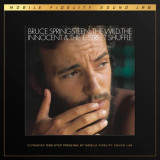
Released only eight months after his exhilarating debut, Bruce Springsteen's The Wild, the Innocent & the E Street Shuffle contains rousing dispatches from the boardwalk, the street, the beach, and the bedroom. It explodes with energy, dares to dream, teases with humour, crackles with tragedy, clings to hope, and overflows with discovery, youthfulness, and personality. It features an unforgettable cast of characters — corner boys, teenage hustlers, doomed lovers, jazz men, junk men, factory girls, fortune tellers, alley cats, pimps, escorts, and more — illuminated by vivid colour, breathtaking detail, and poetic action.
Musically, the heartfelt 1973 record is inhabited by sympathetic vignettes and cinematic arrangements steeped in rock 'n' roll, soul, jazz, and R&B. It finds the New Jersey native looking beyond the parameters of his preceding record and seeking to move on from environments he knows well (and chronicles here) by rushing headlong toward unknown territories, adventures, and people. Underpinned by the singer-guitarist's ambitious poetic enterprise and will to succeed, The Wild, the Innocent & the E Street Shuffle is the album on which Springsteen becomes the Boss.
Mastered on Mobile Fidelity's renowned mastering system, pressed at RTI on MoFi SuperVinyl, and strictly limited to 7,500 numbered copies, Mobile Fidelity's UltraDisc One-Step 180g 33RPM LP set is the definitive-sounding version of Springsteen's sophomore record. Benefitting from SuperVinyl’s nearly non-existent noise floor, superb groove definition, and dead-quiet surfaces, The Wild, the Innocent & the E Street Shuffle plays with a clarity, energy, presence, and openness that complement the expressiveness, dynamics, and scope of the seven restless songs that comprise a work Rolling Stone ranked the 345th Greatest Album of All Time.
Beyond the audiophile sonics that practically place you behind the console at 914 Sound Studios — listen to the separation between the instruments, natural decay of the notes, interplay within the widescreen soundstaging, and nothing-to-lose youthfulness of Springsteen’s voice — this reissue takes seriously this record’s influential merit by presenting it in packaging that underlines its status. Tucked in a beautiful slipcase, the LP is housed in a special foil-stamped jacket with faithful-to-the-original graphics. This reissue is made for listeners who prize sound quality and who want to engage themselves in everything involved with the invigorating set that busted Springsteen loose from the club circuit and landed him on the radio
Determined to liberate anyone within earshot and unafraid to come on strong, The Wild, the Innocent & the E Street Shuffle serves as the debut of the E Street Band — not only heard but seen for the first time by most of the public courtesy of the back-cover photograph. This is where saxophonist Clarence Clemons, organist-accordionist Danny Federici, and pianist David Sancious step out of the shadows — and drummer Vini Lopez and bassist Garry Tallent again stoke a fiery rhythmic engine that helps drive the untamed, reimagined big-band swing of “Kitty’s Back,” breathless R&B thrust of “Rosalita (Come Out Tonight),” and carefree dance steps of the funky “The E Street Shuffle.”
Of course, the main attraction remains a then-24-year-old visionary on the precipice of becoming a sensation and turning a then-bloated rock scene on its head. Recorded over three months while Springsteen and company were busy touring his debut LP, The Wild, the Innocent & the E Street Shuffle reflects the high-octane approach the vocalist embraced onstage and drifts away from the label-dictated acoustic-based frameworks of his debut. The set also witnesses Springsteen deepening his observational skills, with narratives such as the romantically tinged “4th of July, Asbury Park (Sandy)” and redemptive epic “Incident on 57th Street” mirroring changes taking place in the singer’s own life, small towns, and America at large.
A thrilling collision of memories, reflections, and composites — Sandy, Rosalita, and the latter’s parents are all based on actual people Springsteen knew, as is the community depicted in the opening track — the aptly titled The Wild, the Innocent & the E Street Shuffle resonates decades on due to its truths, authenticity, and spirit. Those characteristics — as well as the fact that many of its lengthy songs come on as the equivalent of sweaty, feverish soul revue that won’t stop until you’ve been exhausted — also explain how this now-iconic album triumphed over the reservations of industry “experts” that both demanded Springsteen re-record it and instructed deejays not to play it.
Yet there’d be no stopping a record that saw the past, present, and future, a band whose will would not be denied, and a phenomenon who was born to run. A never-ending invitation to act real cool and stay up all night, The Wild, the Innocent & the E Street Shuffle always feels alright.
Поиск:red jacket
Все
ush's eighth studio album, Moving Pictures, was released in 1981 and features the Top 10 hits "Limelight" and "Tom Sawyer." 40th Anniversary Edition LP cut at half-speed on 180-gram vinyl and wrapped in a premium tip-on gatefold jacket with one of six hand-drawn lyric sheets by Neil Peart.
Released in 1981 at the dawn of the age of sequencing and synthesizers, Moving Pictures has one musical foot firmly in the 70's and the other stepping into the future of recording technology. This global smash includes the ultimate prog-instrumental, YYZ; the band's ode to live performance, Limelight; Witch Hunt, which explores socio-politics; and Tom Sawyer, which captures the feelings behind teenage alienation more succinctly than any song that has since followed, save Nirvana's Smells Like Teen Spirit. This recording is considered by many to be the absolute best Rush. - Jodi Lutz
"Groovy was the third album to be released by acclaimed jazz drummer Red Garland. Originally released on Prestige Records in 1957 this energetic jazz album was performed by a trio made up of Garland alongside Paul Chambers (bass) and Art Taylor (drums). This new edition is released as part of the Original Jazz Classics Series and is pressed on 180-gram vinyl at RTI with all-analogue mastering from the original tapes by Kevin Gray at Cohearent Audio and presented in a Tip-On Jacket. "
- C Jam Blues
- Gone Again
- Will You Still Be Mine?
- It Could Happen To You
- Willow Weep For Me
- What Can I Say After I Say I'm Sorry
- Hey Now
- You Keep
- Coming Back Like A Song
Groovy was the third album to be released by acclaimed jazz drummer Red Garland. Originally released on Prestige Records in 1957 this energetic jazz album was performed by a trio made up of Garland alongside Paul Chambers (bass) and Art Taylor (drums). This new edition is released as part of the Original Jazz Classics Series and is pressed on 180-gram vinyl at RTI with all-analogue mastering from the original tapes by Kevin Gray at Cohearent Audio and presented in a Tip-On Jacket.
Don't judge a book by its cover. Judge a record by its cover.
And, perhaps, its title.
Cedar Walton's Mobius is as outrageously, disorientatingly brilliant as the stunning jacket design, featuring the legendary jazz pianist morphing into a mobius strip, set against a beautiful sky filled with cumulus clouds. A proper jazz-funk fusion slapfest, Mobius is a stellar electric set from - essentially - one *hell* of a SUPERBAND.
Yes, in addition to Walton's Fender Rhodes wizardry, Mobius is elevated by Ryo Kawasaki's stinging electric guitar, pristinely clear vocals by Adrienne Albert and Lani Groves, rootsy percussion by Ray Mantilla and Omar Clay, alto and baritone from Charles Davis, trumpet from Roy Burrowes, Gordon Edwards on bass and Frank Foster's tenor sax. Oh and did we mention STEVE GADD ON DRUMS?!?!
Gem after gem of looping, bliss-inducing gold, it's an incredibly revelatory album. It presents a thrilling synthesis of R&B, funk, blues and hard bop (with a hint of rock), all driven by an idiosyncratic electronic keyboard. Walton, a giant in the jazz world, got quite the workout every time he played, from piano to arp synthesizer to clarinet to electric piano to mini-moog and back again.
Mobius was Cedar Walton's debut for RCA in 1975. The versatile artist confirmed his abilities as a player, composer, interpreter and arranger with this stunning record, and his own bright compositions offered a springboard for the improvisations of the different soloists. Coltrane's "Blue Trane" is the first classic to be given the funkafied Mobius treatment, Ryo Kawasaki let loose all over neck-snapping Gadd-drum gold before the horns take a fiery turn and subsequently give way to Cedar's virtuosity. A sparkling b-boy break version of Thelonious Monk's "Off Minor" (featuring an absolutely *fire* solo from Walton) really sets proceedings alight. Of the three original pieces, the shuffling, percussive power of "Soho" is just absolutely mind bending Latin-influenced jazzy soul whilst the mellow vibes of "The Maestro" bring elegant, sumptuous soul. And then there's the effortlessly funky "Road Island Red". Just too, too good.
Cedar Walton was born in Dallas, Texas, on January 17, 1934 and began his professional career in 1959 when he began touring for several years with the J.J. Johnson Quintet. He later joined the Art Farmer-Benny Golson Jazztet and then Art Blakey's Jazz Messengers. Pretty solid credentials, right? While based in New York City, Cedar played with such luminaries as Donald Byrd, Eddie Harris, Blue Mitchell, Kenny Dorham, Lee Morgan, Freddie Hubbard, Jimmy Heath and Milt Jackson. Without question, he was one of the most complete and gifted musicians of his time and Mobius provides proof of that. The fresh, danceable tracks, all firmly rooted in the living tradition of blues and gospel, are skilfully presented by a master who enjoyed keeping abreast of contemporary tastes and was always keen to renew his language.
As the album notes state: “Mobius, which is the theoretical shape of the infinite universe, makes use of the most modern recording techniques and synthesizers. We mastered and mixed so that it’s hotter than the competition, which should help radio play and in-store demonstration.” Indeed. Mobius is really gorgeous mid-70s fusion, ranging from the funky to the ecstatic. It's an absolute MONSTER that will completely blow you away; and, yes, it's as wild and hypnotic as the cover. The audio for Mobius has been carefully remastered by Be With regular Simon Francis, ensuring it sounds better than ever. Cicely Balston's expert skills have made sure nothing is lost in the cut whilst the records have been pressed to the highest possible standard at Record Industry in Holland. The original, iconic sleeve has been restored here at Be With HQ as the finishing touch to this long overdue re-issue.
Foil Jacket- Black, Red and Gold Merge with Splatter.
Die Heavy Metal-Institution DEATH veröffentlichte ihr letztes Studioalbum „The Sound of Perseverance“ 1998 und erntete weltweit massiven Beifall der Kritiker. Der Abschied von den Metal-Legenden, endlich wieder in einer Gatefold-Doppel-LP erhältlich.
Foil Jacket - Pink, White and Red Merge with Splatter. DEATH, die von dem legendären Gitarristen Chuck Schuldiner gegründete Heavy-Metal-Institution, veröffentlichte 1993 das Album Individual Thought Patterns (den Nachfolger ihres bahnbrechenden Albums Human). Individual Thought Patterns verfeinerte die mit Human ingeschlagene progressive Richtung weiter und enthielt mit "The Philosopher" den wohl besten und bis heute bekanntesten
Song, der je aus der Welt des extremen Metals kam.
Foil Jacket - Violet, White and Red Merge with Splatter. DEATHs legendäres Debüt Scream Bloody Gore von 1987 ist mehr als nur ein unantastbares Album - bei seiner Veröffentlichung war es geradezu genrebildend. Heute wird das Album einhellig als einer der wichtigsten Eckpfeiler des Death Metal aller Zeiten angesehen. Als letztes Kapitel der umfassenden DEATH-Reissue-Serie von Relapse erscheint Scream Bloody Gore nun als Deluxe-Reissue, von Alan Douches (Death, Mastodon, Nile) sorgfältig von den Originalbändern neu gemastert.
Foil Jacket - Red, Cyan and Black Merge with Splatter. Das bahnbrechende Album Spiritual Healing von DEATH, ursprünglich 1990 veröffentlicht. Es markiert eine neue Wendung in der DEATH-Diskografie, die eine sauberere Produktion, ein neues Maß an grenzüberschreitendem musikalischem Können und Songwriting-Fähigkeiten einleitete, die zuvor von einer Metal-Band unvorstellbar waren. Spiritual Healing setzt den Standard für Riffs, verrückte Taktwechsel und natürlich die meisterhaften Gitarrensoli von Frontmann Chuck Schuldiner.
Drummer Tony Williams had joined Miles Davis’ band and played on landmark Blue Note albums by the time he recorded his 1964 debut album Life Time at age 18. These five adventurous original compositions featured Sam Rivers, Bobby Hutcherson, Herbie Hancock, Ron Carter, Gary Peacock and Richard Davis. This stereo Tone Poet Vinyl Edition was produced by Joe Harley, mastered by Kevin Gray from the original analog master tapes, pressed on 180g vinyl at RTI, and packaged in a deluxe gatefold tip-on jacket.
In conjunction with the publication, by Hachette Books, of Truckload of Art: The Life and Work of Terry Allen, an authorized biography by Brendan Greaves of Paradise of Bachelors, Gonna California imagines an alternate reality where Allen's long-lost first studio recordings, captured with a full band in LA in 1968, saw a proper release. (Instead nearly the entire pressing was destroyed by a fire set by the so-called "Hollywood Arsonist," and remaining copies were repurposed in artworks.) This first-ever (re)issue edition, limited to 500 copies, features recently rediscovered and remastered early (and superior) mixes of both songs; the original liner notes by Allen; an excerpt from the book; a lyrics insert; and Allen's contemporaneous visual art in an arresting gatefold jacket. No veteran country songwriter sounds more attuned to the national mood. His songs still feel like little guidebooks for staring down a harsh universe. - The Washington Post
Most audiophiles know Alan Parsons Project's I Robot by heart. Engineered by Parsons after he performed the same duties on Pink Floyd's Dark Side of the Moon, the 1977 record reigns as a disc whose taut bass, crisp highs, clean production, and seemingly limitless dynamic range are matched only by the sensational prog-rock fare helmed by the keyboardist and his creative partner, Eric Woolfson. Not surprisingly, it's been issued myriad times. Can it be improved? Relish Mobile Fidelity's stupendous UltraDisc One-Step 180g 33RPM box set and the question becomes moot.
Mastered from the original master tapes and pressed at RTI on MoFi SuperVinyl, I Robot comes to life with reference-setting realism on this numbered, limited-edition reissue. Boasting immaculate highs and lows, generous spaciousness, and see-through transparency that takes you into the studio with Parsons and Woolfson at Abbey Road, this definitive edition is designed to demonstrate the full-range capabilities of the world's best stereo systems while offering listeners the convenience of having all the music on one LP.
Featuring a nearly inaudible noise floor, this transcendent UD1S edition functions as a repeat invitation to savor reference-grade soundstages, immersive smoothness, sought-after instrumental separation, three-dimensional imaging, and consummate tonal balances. Able to be played back at high volumes without compromise or fatigue, it is a demonstration record for the ages – the likes of which are no longer being made. This is the very reason you own and invest in high-end audio gear.
The special characteristics of this UD1S version extend to the premium packaging. Housed in an elegant slipcase, the reissue features special foil-stamped jackets and faithful-to-the-original graphics. Aurally and visually, it is made for discerning listeners who prize sound quality and production, and who desire to fully immerse themselves in everything about this conceptual landmark. The Alan Parsons Project's most famous record deserves nothing less.
Inspired by and loosely based around the Isaac Asimov stories of the same name, I Robot delves into themes of artificial intelligence and technological dominance that make the record extremely relevant in the 21st century. Indeed, Parsons and Woolfson's pinnacle creation dovetailed with the ascendency of Star Wars, which itself is experiencing a rebirth in an age of self-driving cars, smart devices, and mindless automation. Lyrically, songs such as "The Voice" call into question human behavior – and their relationship to increasing robotic supremacy – in everyday life. Parsons and Woolfson reflect the associated paranoia, dichotomy, and transformation via shifting sci-fi arrangements steeped in drama and moodiness.
The absorbing tunes on I Robot also continue to fascinate due to their perfectionism and innovation. Borrowing from Pink Floyd's strategies, Parsons and Woolfson utilize a looped sequence on the title track to create new downbeats. "Some Other Time" employs two different lead vocalists and yet gives the illusion that only one is involved. Captivating strings, a piccolo trumpet, and bona fide pipe organ grace "Don't Let It Show." The origins of "Nucleus" stem from a unique analog keyboard concoction dubbed "the Projectron," devised by Parsons and electronic engineer Keith Johnson. Andrew Powell's orchestral and choral arrangements top it all off, with "Total Eclipse" arriving as a frightening track that presages the climactic "Genesis Ch. 1 V. 32."
Does man or machine win in the end? Decide as you get lost in Mobile Fidelity's UltraDisc 180g 33RPM LP pressing. Secure your numbered copy today!
More About Mobile Fidelity UltraDisc One-Step and Why It Is Superior
Mobile Fidelity Sound Lab's UltraDisc One-Step (UD1S) technique bypasses generational losses inherent to the traditional three-step plating process by removing two steps: the production of father and mother plates, which are created to yield numerous stampers from each lacquer that is cut. For UD1S plating, stampers (also called "converts") are made directly from the lacquers. Since each lacquer yields only one stamper, multiple lacquers need to be cut. Mobile Fidelity's UD1S process produces a final LP with the lowest-possible noise floor. The removal of two steps of the plating process also reveals musical details and dynamics that would otherwise be lost due to the standard multi-step process. With UD1S, every aspect of vinyl production is optimized to produce the best-sounding vinyl album available today.
MoFi SuperVinyl
Developed by NEOTECH and RTI, MoFi SuperVinyl is the most exacting-to-specification vinyl compound ever devised. Analogue lovers have never seen (or heard) anything like it. Extraordinarily expensive and extremely painstaking to produce, the special proprietary compound addresses two specific areas of improvement: noise floor reduction and enhanced groove definition. The vinyl composition features a new carbonless dye (hold the disc up to the light and see) and produces the world's quietest surfaces. This high-definition formula also allows for the creation of cleaner grooves that are indistinguishable from the original lacquer. MoFi SuperVinyl provides the closest approximation of what the label's engineers hear in the mastering lab.
- The Black Angels' classic sophomore album - Special color edition pressed on Metallic Silver Wax. - Triple LP housed in a Stoughton tri-fold gatefold jacket // "The Black Angels bring the aura of mid-1966 the drilling guitars of early Velvet Underground shows, the raga inflections of late-show Fillmore jams, the acid-prayer stomp of Austin avatars the 13th Floor Elevators everywhere they go, including the levitations on their second album, Directions to See a Ghost. Mid-Eighties echoes of Spacemen 3 and the Jesus and Mary Chain also roll through the scoured-guitar sustain and Alex Maas' rocker-monk incantations. But he knows what time it is. 'You say the Beatles stopped the war," Maas sings in `Never/Ever.' `They might've helped to find a cure/But it's still not over.' Even so, this medicine works wonders." - David Fricke, Rolling Stone Last time we met The Black Angels, they were staring into the desert sun somewhere outside of Austin, Texas. Two years later, night has fallen and the spirits have come out. It's time for The Black Angels to provide Directions On How To See A Ghost. If you're familiar with Passover, the band's 2006 debut, you'll know that The Black Angels's music alone is enough to invoke spirits. There's a name for the band's sound; they call it `hypno-drone 'n roll'. It's the sound of long nights on peyote, of dreams of a new world order, and of half-invented memories of the seamy side of '60s psychedelia. While the Iraq war is still a major influence on the band's lyrics, there are new forces at work here, including Eugene Zamyatin's dystopian novel We and in Christian Bland's words "psychic information from the past and future." See, The Black Angels really are in contact with ghosts. "Civil War battlefields are prime spots for seeing ghosts," says Bland. "One time at Kennesaw mountain in Georgia, I was climbing the mountain in the middle of June and it must have been close to 100 degrees, but in this one particular spot it was very cold. The hairs on my neck stood up and I knew something strange was happening. Then the wind whispered something like `retreat,' and I did. I later learned that the spot where I was on the battlefield was known as `the dead angle', the place where the fiercest fighting took place. The confederates ended up retreating from the mountain towards Peachtree Creek." The Black Angels formed in Austin, Texas, in 2004, comprising from six people (now five) from very different backgrounds. Singer/vocalist Christian Bland is the son of a Presbyterian Pastor and was raised in a devoutly religious household. Bassist / guitarist Nate Ryan was born on a cult compound and drummer Stephanie Bailey claims she's a descendent of Davy Crocket. She and Alex Maas (vocals/guitar) believe a little girl in a red linen dress haunts the group's home. The band released Passover in 2006 to critical acclaim for both the album and the song "The First Vietnamese War". Most of all, Passover established The Black Angels as a band with brains, balls and a strong message. And this time around, the message is there to read in a 16-page booklet that comes with the album. "Our central theme is that people need to open up their minds and let everything come through, and to learn from past mistakes," says Christian. "Only then will we understand the reality of this world and progress beyond where we are now as humans. We've built upon that theme with Directions to See a Ghost. We want people to study the booklet we are providing with the album in hopes that they will be able to relate each song to something in their life." _"War is Peace. Freedom is Slavery. Ignorance is Strength. Keep Music Evil."_
"Waxwork Records is thrilled to present BODY DOUBLE Original Motion Picture Soundtrack by Pino Donaggio. Body Double is a 1984 American neo-noir erotic thriller film directed, co-written, and produced by Brian De Palma (Carrie, Scarface, Phantom of the Paradise). It stars Craig Wasson, Gregg Henry, Melanie Griffith, and Deborah Shelton. The film is a direct homage to the 1950s films of Alfred Hitchcock taking on plot lines and themes such as voyeurism and obsession.
The film tells the story of a struggling actor, Jake Scully, who is offered a gig house-sitting in the Hollywood Hills. While peering through the beautiful home’s telescope one night, he spies on a gorgeous woman dancing in her window. But, when Scully witnesses the woman’s murder, it leads him through an underworld of the adult entertainment industry on a search for answers, with porn actress Holly Body as his guide.
After fighting censorship boards over the rating of his film Scarface - initially rated X and having to battle to make it R - Brian De Palma resolved to make Body Double as a pushback. At the time he said, “If this one doesn’t get an X, nothing I ever do is going to. This is going to be the most erotic and surprising and thrilling movie I know how to make… I’m going to give them everything they hate and more of it than they’ve ever seen. They think Scarface was violent? They think my other movies were erotic? Wait until they see Body Double.”
The film’s memorable soundtrack by legendary composer Pino Donaggio (Carrie, Tourist Trap, The Howling, Don’t Look Now) features memorable and influential cues including the standout track “Telescope”. The dynamic soundtrack music also features striking and exciting orchestral cues that are a throwback to classic Hollywood thrillers coupled with synth driven, electronic dance cues which complement the excessive 1980’s neon-washed porn industry in which the film is set.
Waxwork Records is excited to present the complete Body Double film music by Pino Donaggio for the first time on vinyl as a deluxe double LP featuring 150 gram Body Double red and blue colored vinyl, heavyweight gatefold jackets with film laminate gloss finish, an 11”x11” insert, and artwork by Robert Sammelin. The cover features the film’s classic 1984 original poster art restored."
Industrial/metal/glam outfit Orgy was the first act signed by Korn’s Jonathan Davis to his Elementree imprint, and the move paid off right away with their 1998 debut, which went Top 30 and scored a huge hit with its cover of New Order’s “Blue Monday.” Somehow, though, this enduring late-‘90s favorite has eluded a vinyl release...till now! With the full cooperation of the band, we’ve had it remastered for vinyl (by Mike Milchner of Sonic Vision) and placed this platter inside a beautiful gatefold jacket. Clear with red and yellow swirl pressing!
"Candyass" by Orgy includes the following tracks: "Dissention", "Fetish", "Blue Monday", "All the Same" and more.
This version of the album comes as in a Gatefold Sleeve packaging.
The LP is pressed on transparent, red & yellow vinyl!
You’d think a guy like Butch Walker (producer/ writer for such artists as Pink, Fall Out Boy, Avril Lavigne, Weezer, Green Day, Katy Perry, and Taylor Swift) wouldn’t be particularly unlucky in love, but on Readysexgo the torture never stops, as Butch recounts one failed affair after another in exquisitely painful detail. All set to Marvelous 3’s never less than hooky power pop/glam metal stylings, often placed in seamless segues from one song to another...Readysexgo is the catchy soundtrack to the love life of a hopeless but somewhat embittered romantic. We worked with the band to create a special Expanded Edition for the album’s first-ever vinyl release at music retail, adding the non-LP side “Fastboat” plus two covers from the album sessions, one of Naked Eyes’ “Always Something There to Remind Me,” and one of Steely Dan’s “Reelin’ in the Years,” which ended up in the Jim Carrey flick Me, Myself and Irene. And after looking at the red, white, and blue artwork (faithfully reproduced here on a gatefold album jacket with lyrics), we figured if you blend those all together, you get purple, so purple vinyl it is for this 2-LP set!
Analogue Productions (Atlantic 75 Series) Celebrating the 75th Anniversary of Atlantic Records! 180-gram 45 RPM double LP Mastered by Bernie Grundman from the original analog tape Contains Otis Redding's posthumous hit "Sittin' On the Dock Of the Bay" Appeared on Rolling Stone's 500 Greatest Albums of All Time, rated 161/500! Pressed at Quality Record Pressings Gatefold old-style "tip-on" jacket by Stoughton Printing Hybrid Mono SACD Mastered directly from the original master tape by Bernie Grundman The guts of the story are this: While on tour with the Bar-Kays in August 1967, Otis Redding's popularity was rising, and he was inundated with fans at his hotel in downtown San Francisco. Looking for a retreat, he accepted rock concert impresario Bill Graham's offer to stay at his houseboat at Waldo Point in Sausalito, California. Inspired, Redding started writing the lines, "Sittin' in the morning sun, I'll be sittin' when the evening comes" and the first verse of a song, under the abbreviated title "Dock of the Bay." He had completed his famed performance at the Monterey Pop Festival just weeks earlier. While touring in support of the albums King & Queen (a collaboration with female vocalist Carla Thomas) and Live in Europe, he continued to scribble lines of the song on napkins and hotel paper. In November of that year, he joined producer and esteemed soul guitarist Steve Cropper at the Stax recording studio in Memphis, Tennessee, to record the song. Cropper remembers: "Otis was one of those the kind of guy who had 100 ideas. ... He had been in San Francisco doing The Fillmore. And the story that I got he was renting boathouse or stayed at a boathouse or something and that's where he got the idea of the ships coming in the bay there. And that's about all he had: 'I watch the ships come in and I watch them roll away again.' I just took that... and I finished the lyrics. If you listen to the songs I collaborated with Otis, most of the lyrics are about him. ... Otis didn't really write about himself but I did. Songs like 'Mr. Pitiful,' 'Fa-Fa-Fa-Fa-Fa (Sad Song)'; they were about Otis and Otis' life. 'Dock of the Bay' was exactly that: 'I left my home in Georgia, headed for the Frisco Bay' was all about him going out to San Francisco to perform." Redding and Cropper completed the song in Memphis on Dec 7, 1967 with tragedy, unknowingly, looming. Just two days later Redding lost his life on a routine commute to a performance when the small plane he was in crashed. The other victims of the disaster were four members of the Bar-Kays — guitarist Jimmy King, tenor saxophonist Phalon Jones, organist Ronnie Caldwell, and drummer Carl Cunningham; their valet, Matthew Kelly and pilot Fraser. Cropper and bassist Donald "Duck" Dunn completed the music and melancholic lyrics of "(Sittin' On) The Dock of the Bay' which was taken from the sessions — Redding's final recorded work. Cropper added the distinct sound of seagulls and waves crashing to the background. This is what Redding had wanted to hear on the track according to Cropper who remembered Redding recalling the sounds he heard when he wrote the song on the houseboat. One of the most influential soul singers of the 1960s, Redding exemplified to many listeners the power of Southern "deep soul" — hoarse, gritty vocals, brassy arrangements, and an emotional way with both party tunes and aching ballads. At the time of his tragic death he was 26. ‘(Sittin’ On) The Dock of the Bay’ was released just a month following Redding’s death and became his only ever single to reach number one on the Billboard Hot 100 in January 1968. The album, which shared the song's title, became his largest-selling to date, peaking at No. 4 on the pop albums chart. "Dock of the Bay" was popular in countries across the world and became Redding's most successful record, selling more than 4 million copies worldwide. The song went on to win two Grammy Awards: Best R&B Song and Best Male R&B Vocal Performance. With the album, Redding confirmed himself as a talent lost far too soon. All the hallmarks of a top-notch Analogue Productions reissue are here for you to savor: Mastered directly from the original master tape by Bernie Grundman and cut at 45 RPM. Pressed on 180-gram vinyl at Quality Record Pressings, and housed in tip-on old style gatefold double pocket jackets with film lamination by Stoughton Printing.
- A1: Dat Boy Den
- A2: 4 The High
- A3: Only Fans
- A4: Work It Out
- A5: I'm Like That
- B1: Free Sanchie Free Shiesty (Feat. Big30)
- B2: Country Ass Nigga (Feat. Sauce Woodwinnin)
- B3: Rollin' In (Feat. Sauce Gohan)
- B4: 7 In A Cup
- C1: Steady Poppin It (Feat. 44 Mike Deezy)
- C2: Uh Uh (Feat. Peezy)
- C3: Ptsd (Puttin That Shit Dine) (Feat. Money Man)
- C4: Smashin' & Splashin
- C5: Free The Drippers
- D1: I Just Wanna
- D2: Loud Enuff (Feat. Peso Peso & Sauce Woodwinnin)
- D3: Switches & Ar's (Feat. Freeway)
- D4: Rip Pokey Freestyle (Screwed) (Feat. Sauce Woodwinnin)
Who exactly is Sauce Walka? He is DAT BOY DEN. Often considered one of rap’s biggest enigmas for his larger than life personality yet equally sharp and grandiose pen game, the Houston based rapper aims to put a stamp on his name with his newest studio album, DAT BOY DEN. The 18 track album features appearances from popular artists such as Peezy, BIG30 & Freeway, as well as fellow Houston-based artist Money Man & The Sauce Factory labelmates Peso Peso, Sauce WoodWinnin, Sauce Gohan & 44 Mike Deezy. Previous notable collaborations include artists such as A$AP Rocky, Bun B, Chief Keef, Lil' Keke, Maxo Kream, Migos, Slim Thug, Travis Scott, Trinidad James, and XXXTentacion. pPressed on Red & White Split Vinyl, housed in a widespine jacket.
Key Marketing/Selling:
Sauce Walka is an incredibly versatile rapper and while his image may be more street leaning, he is an incredibly gifted lyricist with an unmatched pen game and can outrap some of the more lyrical rappers
Founder of the popular Houston based label, The Sauce Factory
Popularized the term “Drip”
Made headlines in 2015 for releasing a diss track aimed at Drake called, “Wack 2 Wack,” over appropriating Houston culture
Sauce Walka has over 1.3M monthly listeners on Spotify
Supporting Conway the Machine on the WON’T HE DO IT tour from September-October 2023 and recently collaborated on the standout single, “Dangerous Daringer”
Sauce Walka is an extremely viral personality and very active on social media, and willing to put in the work to support his products
Previous notable collaborations include artists such as A$AP Rocky, Bun B, Chief Keef, Lil' Keke, Maxo Kream, Migos, Slim Thug, Travis Scott, Trinidad James, and XXXTentacion
Andy Sharrocks started writing songs in 1976. He found a vehicle for these songs with punk band Accident On The East Lancs. This started out as a covers band, but Andy soon became frustrated when the other members wanted to stay that way. The band disintegrated but Andy retained the name, forming a new cutting edge four piece playing his songs. He financed their first single in 1979 on his own label Roach Records. This was a double A side as one of the sides was a ditty called We Want It Legalised. The other side was a Bo Diddley kind of groove called Tell Me What Ya Mean, which Record Collector magazine recently said sounded like a song The Strokes should cover. This line up fell apart when immediate success failed to arrive, but Andy formed another band out of the ashes of local band Wilful Damage, and the guitarist out of the original covers band. They recorded and released on Roach Records another double A sided single in 1981 as well as an album released on cassette tape on Cargo Records. The singles now exchange hands on the collectors market for over seventy pounds, the album has been rereleased on vinyl twice, once on a German label, and once on UK’s OZIT/MORPHEUS Records which came with a bonus live album The singles have been released on many punk compilations and We Want It Legalised is about to be released on a new Manchester punk compilation on Cherry Red Records. They played many free festivals including Deeply Vale three times, and did many great supports including The Fall, Tractor, Here And Now and Crass. Andy left the band in 1982 for personal reasons, and had a one single deal with I Believe In Love on the Vibes and Vibes record label in 1985. Refusing to compromise and do covers, Andy found it impossible to make a living doing his own material which was now primarily Americana, after discovering alt.country through Steve Earle and Lyle Lovett in 1985. He went on the road as a tour manager, which is where he met Hilly Briggs, who went on to produce Andy’s first solo album in 2004 called Walking In Familiar Footsteps, which featured ex Rolling Stones Guitarist Mick Taylor, Bluesband and Manfreds frontman Paul Jones and Bobby Vee’s sons Jeff and Tommy on drums and bass respectively. Andy was now living in London and was gigging regularly on his own or with a revolving circle of musicians going under the collective title of Andy Sharrocks & The Smokin’ Jackets. He played over five hundred gigs all over London and the UK. He also did many supports for Mick Taylor, Buddy Whittington, Steve Gibbons, The Strawbs, Curved Air, and supported John Mayall on a UK nationwide tour, and played the Jazz Café in Camden twice with John. He also played The Hells Angels Bulldog Bash three times, The Skegness Rock n Blues Festival, The Herelbeke Blues festival in Belgium and The Colne Blues Festival. In 2009 he released another album called Dirt with The Smokin’ Jackets, which came out to great critical acclaim. Andy is now releasing a triple album of truly magnificent UK Americana, called Country Rock n Roll n Durty Blues. Press Quotes : "Country Rock ‘n’ Roll ‘n’ Durty Blues is a sprawling album of original rock and blues which takes you from Muddy Waters to modern Americana" – Nigel Carr, Louder Than War // "Good honest earthy rock ‘n’ roll done the old fashioned way with passion and aplomb" – Mark Radcliffe, BBC // "Country Rock ‘n’ Roll effortlessly lives up to its title … and more" – Pete Feenstra, Get Ready To Rock // "As a listener it really is bloody good fun - Briticana, Americana with a very English voice
Analogue Productions (Atlantic 75 Series)
Celebrating the 75th Anniversary of Atlantic Records!
Bad Company's eponymous 1974 debut featuring "Ready for Love"
180-gram 45 RPM double LP
Mastered directly from the original master tape by Ryan K. Smith at Sterling Sound
Pressed at Quality Record Pressings and RTI
Tip-on old style gatefold double pocket jackets with film lamination by Stoughton Printing
From the wreckage of Free came Bad Company, the English hard rock supergroup fronted by singer Paul Rodgers and featuring his drummer bandmate Simon Kirke, Mott the Hoople guitarist Mick Ralphs, and King Crimson bassist Boz Burrell. Peter Grant, who managed the rock band Led Zeppelin, also managed Bad Company until 1982.
The group's eponymous 1974 album debut decidedly proves the band is proudly not progressive — the details make a difference, as do the pastoral acoustics of the closing "Seagull" — reducing their rock 'n' roll to a strong, heavy crunch; compare "Ready for Love," a tune Ralphs brought over from Mott the Hoople, to the original to see how these quartet members keep their heads down as they do their business. Appropriately enough given their name, there's a sense of slow, churning menace to Bad Company, writes AllMusic reviewer Stephen Thomas Erlewine.
Their first three albums, Bad Company (1974), Straight Shooter (1975), and Run with the Pack (1976), reached the Top Five in the album charts in both the U.K. and the U.S.. Many of their singles and songs, such as "Bad Company," "Can't Get Enough," "Good Lovin' Gone Bad," "Feel Like Makin' Love," "Ready for Love," "Shooting Star," and "Rock 'n' Roll Fantasy," remain staples of classic rock radio. They have sold 20 million RIAA-certified albums in the U.S. and 40 millon worldwide.
The self-titled debut album was recorded at Headley Grange, Hampshire, in Ronnie Lane's Mobile Studio. The album reached No. 1 on the Billboard 200 in the U.S, and No. 3 on the U.K. Albums Chart, spending 25 weeks on the U.K. charts. The album has been certified five times platinum in the U.S., and became the 46th-best-selling album of the 1970s. The singles "Can't Get Enough" and "Movin' On" reached No. 5 and No. 19 on the Billboard Hot 10.
All the hallmarks of a top-notch Analogue Productions reissue are here for your pleasure: Mastered directly from the original master tape by Ryan K. Smith at Sterling Sound and cut at 45 RPM. Pressed on 180-gram vinyl at Quality Record Pressings and RTI, and housed in tip-on old style gatefold double pocket jackets with film lamination by Stoughton Printing.



