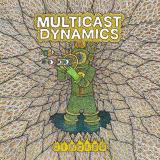
Several years after the release of ‘Metamorphosis’ (with Sid Hille), Multicast Dynamics (Samuel van Dijk) reemerges on Astral Industries with ‘Circles’ - an enchanting two-part work venturing into deep unconscious realms. Sonic landscapes unfold in a sequence of hidden spaces and intimate revelations, featuring detailed sound design and rich thematic content.
Circle One initiates the process, opening gently with glassy drones and the patter of distant voices. A faint light shimmers through swirling pools of liquid memories and melting forms. The atmosphere builds, and everything is engulfed in the act of transfiguration.
Passing through the threshold, Circle Two traverses further into cavernous territories. Boundless drifting soon becomes a gravitational pull toward something deeper. Submitted to the powerful undercurrent, incoming primordial pulsations signal a quest that reaches its fated culmination.
Perhaps the revelation of something long-lost, entering the Circle eludes to that which on the surface remains hidden, yet its rediscovery inevitable.
Buscar:reem
- 1: Die In Cleveland
- 2: High Resolution
- 3: Don?T Wear Me Out
- 4: Fear Of The Living
- 5: Sanctuary
- 6: Dead Alive
- 7: Public Meltdown
- 8: Depression Song
- 9: One And Only Girl
- 10: Pill
- 11: The World Doesn?T Need Your Jive
San Diego’s Mrs. Magician has always bent surf music and punk into something delightfully off-kilter — sun-soaked, hook-heavy power pop with a lyrical fixation on life’s darker undercurrents. Their 2012 debut, Strange Heaven, was a nihilistic pop statement that grew into a cult classic. The 2016 follow-up, Bermuda, sharpened the edges with punchy, nervy songwriting. Both records were produced by John Reis (Rocket From The Crypt, Hot Snakes, Drive Like Jehu), cementing the band’s place in Southern California’s underground lineage. Now, in 2026, Mrs. Magician reemerges with their long-awaited third LP, Spiritual Hangover. Recorded at Dave Grohl’s Studio 606 and Singing Serpent Studios with producer Christian Cummings, Spiritual Hangover finds songwriter Jacob Turnbloom trading youthful nihilism for something more reflective. Where earlier records wrestled with existential dread through anthemic defiance, this new collection embraces uncertainty — an admission of ignorance in the face of the human condition, paired with a genuine longing for connection and understanding. The humor remains. The hooks are sharper than ever. But the perspective has shifted.
These songs feel less like a declaration of dominance and more like a celebration of fragility — an acknowledgment that life is fleeting, confusing, and still worth enjoying. The album features Andrew Montoya (drums) and Mark Rivera (bass) of The Sess, Ian Fowles (guitar) of The Aquabats, and John Reis (guitar). Spiritual Hangover channels the bright urgency of late-’70s power pop through a distinctly Californian lens — warm, melodic, and irresistibly alive. “Super fun, well crafted, with great melodies. It gives me that late ’70s power pop energy I loved so much as a kid. Every track has something joyous to grab onto. In a world full of bleak news, Spiritual Hangover is a warming blast of California sunshine.” — Walter Schreifels (Gorilla Biscuits/Quicksand)
Be As One boss Shlomi Aber returns to Chris Liebing's CLR with the 'Schema' EP, arriving 24th April 2026 alongside a remix from James Ruskin. Active since 1994, Aber has been a cornerstone of underground techno for over three decades, with his focused, hypnotic approach in both the studio and DJ booth leading to releases on some of the scene's most respected labels, including Cocoon, Ovum, Nonplus, and Figure. With the 'Schema' EP, he follows his recent 'Retrospective' EP for Ben Klock's Klockworks, as well as previous CLR outings such as the 'Limelight' EP (2025), and the 'Remote 101' EP (2023), which both kept a spot in the Beatport Techno chart for over two years after release, while winning support from the likes of Carl Cox, Alienata, Dave Clarke, and many more.
Shlomi Aber's 'Schema' EP opens with the title track and heads straight into subterranean territory, pairing weighty low-end pressure with tightly controlled tension. Rattling bass foundations are o?set by sharp hi-hats and static-laced textures that flicker through the mix, keeping the groove locked and the atmosphere charged.
On remix duties, James Ruskin, founder of the seminal Blueprint, delivers a shadowy, atmospheric rework. Eerie pads hang in the background as swampy bass anchors the rhythm, with haunted melodic elements slowly unfolding to create a deep, immersive take built for late hours and dark rooms.
Closing track 'Gasolina' sees Aber shifting into broken-beat territory, where warm, glitchy rhythms loop with hypnotic precision. Ghostly synth motifs drift in and out of focus, giving the track a cinematic, heady quality that rounds out the release with understated intensity.
Founded by influential techno lynchpin Chris Liebing in 1999 and reemerging in 2021 after a five-year hiatus, Create Learn Repeat (CLR) has hosted a range of artists like Dubfire, Flug, Bjarki, DJ Dextro, and more while also focusing on developing newer acts in the scene, such as Risa Taniguchi, The Southern, and Klint.
The writer Max Sebald often pondered over the nature of human memory, specifically, how our thoughts and desires - and their results - overlap and mutate over time. In A Place in the Country, he writes of the significance of what see as “similarities, overlaps and coincidences”. Are they the “delusions” of the self and senses, or manifestations of “an order underlying the chaos of human relationships, ... which lies beyond our comprehension”?
Song of the Night Mists, the new album by post-classical composer Stefan Wesołowski, often feels it draws on Sebald’s premise.
On a simpler plane, the one where the market dictates the neatly ordered information we consume, Song of the Night Mists can be described thus: recorded in the main by Stefan Wesołowski in Gdańsk, both in his studio and in Saint Nicholas' Basilica, the album incorporates acoustic instruments - piano, violin, double bass - and classic synthesizers such as the Roland Jupiter-8, the Soviet Polivoks. A Roland Space Echo RE-150 tape delay was also pressed into service as an instrument. We also hear the basillica’s organ and field recordings from the Tatra Mountains. Other musicians were Maja Miro, who played the flute parts on ‘Glacial Troughs’ and brother Piotr Wesołowski, who played the organ on ‘Wilhelm Tombeau’. Sound engineer was Marcin Nenko, who was also on hand to record the basilica organ parts. The album was mixed in New York by Al Carlson (Oneohtrix Point Never, Jessica Pratt, Zola Jesus, Lady Gaga, and Liturgy) and Rafael Anton Irisarri handled the mastering.
Ostensibly, Song of the Night Mists is the last in a trilogy, following on from albums Liebestod (2013) and Rite of the End (2017). All three deal with existential matters such as love, death, decay and “an ultimate end”; apocalyptic and Promethean in spirit, and betraying very human conceits. The Sebaldian nature of the new record starts to make itself felt when Wesołowski talks of how he used sampling. One element is unexpected, that of sampling himself: “I go back to dozens of my own unused sketches and recordings, treating them as raw material to cut, slow down, reverse, and transform in every possible way.” Memory as sound, to be reemployed by the listener through their own imaginings.
Another set of samples made by Wesołowski plays another role. These are field recordings, originally created for an audio illustration of the formation of the Tatra Mountains, and used in a film by sound designer Michał Fojcik. Wesołowski: “You can hear cracking ice, streams, footsteps in the snow and the wind, and a real avalanche, recorded from the inside.” The “Tatra connection” on the album is also found in samples referencing composer Karol Szymanowski. The album’s title alludes to a poem about the mountains by Polish poet, Kazimierz Przerwa-Tetmajer.
Wesołowski’s Tatra recordings are “about a world without humans - about the fact that the world existed, was beautiful, and had meaning long before people arrived, and for the vast majority of its history, it was a place without us.” Wesołowski, using one iteration of the natural world, plays out in sound Sebald’s idea of another order, underlying the chaos of human relationships lying beyond human comprehension.
These feelings play themselves out on the five album tracks. Sonorous and rich, they illustrate tectonic shifts we have no control over. Wesołowski hints that the overall sound is a “meditation on the metaphysics of the non-human set against the spirituality that human presence has brought into it.” In that light, the opening number, ‘Core’, with its slow build, and crackling and straining sound effects, create an effect of the earth groaning into life in a creation myth. Once the piano part raps out a simple melody and modulated tonguing trumpet samples add to the overall atmosphere, the listener can certainly find a cue in the “spiritual”, or “human” side of the story. Human versus nature: from the strains and harmonic muscle stretches of the second number, ‘Glacial Troughs’, through to the powerful and filmic ‘Stalagmite’ and heart-on-sleeve romance expressed in closer, ‘Wilhelm Tombeau’, we listeners are cast as Friedrich’s wanderer, looking out over a landscape that will appear only if we engage with it.
Formations of melody appear incrementally, almost appearing by chance - like hidden footings in the rock shelves to give us something to grasp onto. Rhythms are used sparsely: the prolonged percussive taps on ‘Glacial Troughs’ are an anomaly and maybe there to give pace to the album to come; essentially to keep the listener strapped in. Elsewhere, percussion is used as an aid to mood, the two thudding, timpani-style passages on ‘Peak’ there to offset the short, beautiful, kosmische passage that splits them.
Elements of the borderline religious spirit that drove German electronic music in the late 1960s and 1970s also find a place on Song of the Night Mists. The swells and recessions of the organ find their emotional climax on ‘Wilhelm Tombeau’, a track which summons up echoes of the “mountain magic” vistas created by Popol Vuh or Tangerine Dream, especially with the slightly atonal wobble of the Mellotron that counters it.
This is a dramatic album, but it does feel a strangely short, or curtailed listen on ending, evoking the feeling one gets when waking from a dream, and, for all its incipient grandeur, a track like ‘Stalagmite’, for instance, ends on a minor note. Wesołowski admits that Song of the Night Mists is born of the all too human process of temptation, doubt and recalibration - Sebaldian overlaps and coincidences forming something that must live another life, away from its creator. In Wesołowski’s words, the album is “a newborn foal must stand up and walk right after birth.” Now it is yours to ponder.
We are excited to announce the first reissue of Tony Scott's iconic “Manteca” album originally released in 1973. This 180-gram vinyl audiophile edition captures the essence of a true master of contaminated jazz, allowing listeners to experience Tony Scott's vibrant artistry like never before.
Originally described in the album’s liner notes by Sam Charters, "Manteca" embodies the spirit of the jazz musician’s journey—a testament to durability, warmth, and exuberance. Charters notes, “You have to be durable these days to be a jazz man... a musician like Tony Scott has the kind of personality that it takes to be a jazz man today” — a sentiment that perfectly encapsulates the artist's incredible career.
From the bustling club scene of New York in the 1950s to captivating audiences in Japan, Scott's journey brought him to Sweden in the summer of 1973, where he collaborated with exceptional local musicians. The result was a collection of vibrant, uptempo jazz tracks combined with reflective ballads, showcasing the remarkable versatility and inventiveness of Scott's clarinet, baritone, and even his distinctive scat vocals.
The album opens with the titular track "Manteca," setting an exhilarating tone that endures until the final, almost sinister note of "One For Topsy." Complemented by an all-star lineup, including bassist Sture Nordin, drummer Ed Thigpen and legendary percussionist Sabu Martinez, this session embodies the international spirit of jazz—a genre that transcends boundaries and unites souls.
This audiophile edition has been meticulously remastered to provide an unparalleled listening experience, preserving the authenticity of the original while ensuring superior sound quality. With only a limited amount produced, this vinyl reissue is a must-have for collectors and jazz aficionados alike.
Join us in celebrating the reemergence of Tony Scott's "Manteca," a true landmark in jazz history, and immerse yourself in the dynamic sounds that have inspired generations.
First official vinyl reissue
180g virgin vinyl pressing from Pallas / Germany
350g. cover
Original artwork and liner notes
Recorded in Stockholm in 1973
The second instalment from London Odense Ensemble digs deeper into the group's vision of what modern psychedelic jazz should sound like. Cut from the same sessions as Jaiyede Sessions vol. 1, released last summer, vol. 2 presents a more nuanced approach to the material. On this set the ensemble focuses on shorter, layered pieces - travelling from deep spiritual jazz grooves to gorgeous free-flowing minimalism to full-on acid jazz. There's echo-drenched flutes being absorbed into layers of analog synth pads and guitars, bossa beats and double bass sequences merging with electronics. It’s an intoxicating mélange of sounds and styles, spanning wide temporal and geographical distances. London Odense Ensemble came together when two of the finest exponents of London's flourishing jazz scene, flautist and saxofonist Tamar Osborn and keyboard specialist Al MacSween, came over to Denmark to explore new sounds with Causa Sui's Jakob Skøtt and Jonas Munk, as well as local bass player Martin Rude. For two days the group laid down grooves and ideas and experimented in the studio, and later the best segments were edited and mixed by Jonas Munk, who took a somewhat liberal approach to the mixing process, often dyeing the material with external effects and synthesizers. Jaiyede Sessions are the kinds of records that defy genre-terms, yet have its own instantly recognizable fingerprint. It carries a unique shared vision between the players of what modern psychedelic jazz sounds like. bios: Tamar Osborn: Saxophonist, composer and multi-wind instrumentalist is the creative force behind modal jazz ensemble Collocutor (On The Corner Records). She is a member of the Dele Sosimi Afrobeat Orchestra, performs and collaborates regularly with Sarathy Korwar, Jessica Lauren, Emanative, Ill Considered and DJ Khalab. Al MacSween: Keyboard player & founding member of Kefaya. Collaborations include American jazz legend Gary Bartz, Syrian qanun master Maya Youseff, London Community Gospel Choir, Palestinian jazz singer Reem Kelani & kora player Kadialy Kouyate. Martin Rude: Multi-string instrumentalist & lead singer in Sun River & Edena Gardens with members of Papir & Causa Sui. Jakob Skøtt: Drummer in Causa Sui with a slew of side projects on El Paraiso, including Chicago Odense Ensemble, as well as being responsible for the label’s visuals. Jonas Munk: Guitarist in Causa Sui & studio wizard on most releases on El Paraiso. Also works with a wide palette of electronic music.
Spoiled Drama reemerges exhibiting their darker side on "This is Our Mission", their debut on the label embodiment of Berlin's Fleisch collective. The five track EP exhibits a unique range and dexterity, blurring lines between the realms of techno, EBM, acid and electro with a touch of maladjusted pop and post-punk. From the anxious beat and shimmering tones of "Another Death Experience" to the ritualistic war drums and heavily distorted vocals of "Kisses Are Out of Fashion", expect to feel dizzied, unnerved, yet beckoned to move. The eponymous track closes out the EP in an undeniably Drexciyan fashion, low-pitched vocals emerging from watery depths in lush sweeping pads and dissonant melodies. A mission accomplished with style.
- 1: Baby's Got The Blues
- 2: Trouble
- 3: Don't Look Down
- 4: On A Morning Like This
- 5: You Don't Know
- 6: Stay With Me Tonight
- 7: Get Together
- 8: Dreams
The Canadian folk singer renowned for her purity of voice and composer of the ever-fresh ’Morning Dew’; once at the heart of the Greenwich Village heyday when she sang at Gerdes Folk City alongside the likes of Paul Simon and Bob Dylan; and the UK’s premier purveyors of Cosmic Americana riding a wave of creativity and acclaim, following two successive classic albums Hollow Heart and On A Golden Shore. The spry octogenarian and the psychedelic cowboys proved a match ripe to be made. Since Bonnie’s reemergence, at Jarvis Cocker’s Meltdown in 2007, she’d been interacting with a host of London musicians, but when the Stars came onto her horizon she sensed she’d found the perfect accompanists for her new compositions. With no concrete plan they worked up a few songs, then went into Sean Read’s Famous Times studio to see what might happen. What might happen is now Dreams, comprising eight songs; six being recent compositions never before studio-recorded while a further two reach into and celebrate her back catalogue, along with the era that initially defined her, and as one of its now few active representatives – it’s her and Dylan and not many more – she stands for.
Mit 'Under a Familiar Sun' veröffentlicht The Vernon Spring alias Sam Beste ein faszinierendes Album zwischen Jazz, Ambient, experimentellem Pop und elektronischem Songwriting. Beste, einst Pianist in Amy Winehouse’ Band und Kollaborateur von u. a. MF DOOM, Joy Crookes und Beth Orton, entfaltet hier ein vielschichtiges Werk voller emotionaler Tiefe und klanglicher Finesse.
Entstanden in seinem Heimstudio in Brighton, verarbeitet das Album persönliche Themen wie Vaterschaft, Verantwortung und Selbstverortung in einer instabilen Welt - getragen von Beste’s charakteristischem, improvisationsnahem Klavierspiel und feinfühliger Produktion. Mitwirkende wie Autor Max Porter (Grief is the Thing with Feathers), Cellistin Kate Ellis und die in Brooklyn lebende Künstlerin aden verleihen dem Album zusätzliche Tiefe.
Ein durchkomponiertes, atmosphärisches Werk mit klarer Handschrift - für Fans von Bon Iver, James Blake, Nils Frahm oder Moses Sumney.
- A1: Basis Rahouma - بسيس رحومة,- Yana Alla Nafsa Masouda يانا اللي نفسي مسدوده (Blocked From What I Want)
- A2: Sheikh Amin Abde -L Qader الشيخ أمين عبد القادر, Mould Fi Madina Tanta مولد في مدينة طنطا (Born In The City Of Tanta)
- A3: Samah سماح, - Shawish Aldawriat شاويش الدورية, (Patrol Sargeant)
- A4: Mahmoud Al-Sandidi محمود الصنديدي, - Ana Mish Hafwatak (Part 2) انا مش حفوتك, (I Don’t Miss Your Love)
- B1: Abu Bakr Abdel Aziz (Aka Abu Abab) أبو بكر عبد العزيز,- Al Bint Al Libya أل بينت أل ليبيا (The Girl From Libya)
- B2: Sheikh Amin Abdel Qader الشيخ أمين عبد القادر, - Mawal Al Layl Kolo Makasib موال الليل كله مكاسب (Mawaal: The Spoils Of An All-Nighter)
- B3: Abu Saber أبو صابر, - Ya Allah Ank Zinat يا الله انك زينة (Oh, God, You Are Beautiful)
- B4: Reem Kamal ريم كمال, - Baed Al Yas Yjini بعد اليأس يجيني (After Hopelessness, He Comes To Me)
“Egypt’s “official” popular music throughout much of the 20th Century was a complex form of art song steeped in tradition, well-loved by the middle and upper classes, and even accommodating to certain non-Arabic influences. It was highly structured by professional musicians working an established industry centered in the capitol, Cairo. However, far from the bustling cosmopolitan center of Cairo, north and northwest, in towns like Tanta and Alexandria and extending across the Saharan Desert to the Libyan border, dozens of fully marginalized artists were developing a raw, hybrid shaabi/al-musiqa al-shabiya style of music, supported by smaller upstart, independent labels, including the short-lived but deeply resonant Bourini Records. Launched in the late 1960s in Benghazi, Libya, Astuanat al-Bourini اسطوانات البوريني (Bourini Records) published some 40 to 50 titles from 1968 to 1975. Bourini released 7-inch 45 RPM singles by 15 artists, all but one of them Egyptian, igniting brief careers for Alexandrian singer Sheikh Amin Abdel Qader and the blind Bedouin legend Abu Bakr Abdel Aziz (aka Abu Abab). The tracks compiled here comprise a full range of styles covered by the label, while highlighting some of its most gobsmacking moments, from Basis Rahouma’s beastly transformation into a growling and barking man-lion by the end of “Yana Alla Nafsa Masouda,” to Reem Kamal’s hopeful-if-bitter handclapping party pivot “Baed Al Yas Yjini,” which descends into an almost Velvet Underground outro-groove of nihilistic dissonance. All the tracks on this compilation were laid down in stark divergence from the mainstream Egyptian popular music topography of heightened emotions buoyed by lush arrangements. The contrast is most evident in Mahmoud al-Sandidi’s “Ana Mish Hafwatak,” wherein his voice weaves heavily but deftly through a constant accordion drone, and Abu Abab’s “Al Bint al Libya,” a sparse, slow-burning lament with minimal percussion, violin, and Abab’s nephew Hamed Abdel Muna'im Mursi on lyre. Whereas the Egyptian mainstream was aspirational, attempting to reflect Egyptian culture at its most refined, the performances captured by Bourini were manifestations of everyday life lived by the mostly otherwise ignored masses. More than half century old, this music has lost none of its urgency, presence, or relevance. We hear these artists as if they’d just joined us in our living room, and not on a stage decades ago surrounded by tens of thousands of long-forgotten acolytes.
- A1: Echoes Of A Billion Sun's
- A2: Messages From The Andromeda Galaxy
- A3: Stardust Memories (Among The Stars Dreams And Memories)
- A4: Trailblazer Of The Cosmos (Comet Rider A Leap Of Faith Into The Unknown)
- B1: Seeds Of Light (Hope For Growth And New Beginnings)
- B2: Fragile Eden (Threads Of Emerald Green)
- B3: The Cold Embrace Of Infinity
- B4: The Star Charts We Shared (A Maurizio Requiem)
After a 30-year interstellar silence, the enigmatic producer Alien Signal—pioneering alias of Italian electronic composer Alex Silvi—reemerges with Whispers from Distant Suns, a transcendent odyssey that bridges retro-futurism and modern electronica. Hailed as a magnum opus, this album transcends genre boundaries, captivating ambient purists, downtempo aficionados, and even experimental listeners with its hypnotic fusion of analog warmth and digital precision.
Cosmic Tapestry of Sound
Drawing comparisons to Vangelis’ Antarctica and Alpha—but reimagined through a 21stcentury lens—Whispers from Distant Suns marries nostalgic synth textures with cuttingedge production. Silvi’s mastery of melody shines through in tracks like “Stardust
Memories” and “Fragile Eden” where shimmering arpeggios and celestial pads drift over robotic, glitch-infused drum patterns and sparse, meditative percussion. The result is a paradox: a retro-futuristic soundscape that feels simultaneously ancient and alien, familiar yet unexplored.
Listener Testimonials
Fans and critics have flooded forums with praise:
“An auditory revelation! It’s like Vangelis met Jon Hopkins in a nebula—vintage soul with a futuristic heartbeat.”
“The textures are gorgeously cinematic. Closing your eyes, you’re adrift in a Tarkovsky film scored for the Andromeda galaxy.”
The Vinyl Experience
Pressed on heavyweight vinyl, the album’s physical release amplifies its immersive qualities. The gatefold sleeve, adorned with surrealist astrophotography and metallic
foiling, mirrors the music’s cosmic ethos. Side A leans into Balearic serenity, with sundappled grooves and aquatic synth ripples, while Side B delves into darker, more
experimental terrain—think Aphex Twin’s Selected Ambient Works colliding with the organic rhythms of Jon Hopkins.
Maturity in Motion
This album is a testament to Silvi’s evolution. Tracks like “Seeds Of Light” and “Message from Andromeda Galaxy” showcase his refined ear for dynamics, balancing silence and sound with surgical precision. Vintage drum machines spar with glitches, while field recordings of crashing waves and interstellar static blur the line between Earth and cosmos. The closing track, “The Star Charts We Shared” crescendos into a 6-minute ambient requiem, leaving listeners suspended in a state of weightless awe.
Final Transmission
Whispers from Distant Suns is more than an album—it’s a transcendent odyssey. Spanning time, space, and the artist’s own creative evolution, this immersive work invites listeners to lose themselves in its ebb and flow. Designed for moments both intimate and expansive, its balearic-tinged atmospheres resonate equally through dawnlit Mediterranean terraces or the solitary glow of headphones in darkness. These are compositions that pulse, morph, and haunt the air long after the final note fades. A living soundscape meant to accompany life’s quiet revelations and clandestine joys—a soundtrack to your most personal moments, crafted as what the artist calls ‘private dance music.’
Tailored for the Discerning Listener
Whispers from Distant Suns is designed with the true connoisseur in mind. This album is a must-have for:
Vinyl Collectors & Audiophiles: Those who value the warmth and tactile experience of heavyweight, limited edition pressings
Electronic Ambient and Downtempo Fans: Listeners who appreciate immersive soundscapes that merge retro analog charm with modern digital innovation.
Retro-Futurism Enthusiasts: Fans of pioneering artists like Vangelis, Boards of Canada, and early Warp Records who seek music that bridges nostalgic synth textures with futuristic experimentation.
Experimental Music Explorers: Individuals drawn to sonic narratives that invite deep, contemplative listening—perfect for both introspective moments and immersive listening sessions.
This release is not just an album; it’s a curated experience for those who desire music as a multidimensional art form, merging the vintage allure of analog sound with a contemporary, cosmic vision.
For fans of: Vangelis, Biosphere, Jon Hopkins, early Warp Records.
Rediscovered and compiled for release shortly before her death in November 2023, Further Selections from the Electric Harpsichord presents a never-before-heard recording of composer and artist Catherine Christer Hennix's early magnum opus. Originally debuted in 1976 at the festival Brouwer's Lattice at Stockholm's Moderna Museet, The Electric Harpsichord has steadily mystified fans and students of Western minimalist music for its implacable, transformative qualities, and the long-held, relative obscurity of its creator. Like the work of Hennix's close friend La Monte Young, the piece is set in just intonation and focuses on the transcendental potentials of precise tuning, inspired by their studies with Pandit Pran Nath. Composed of bursts of oscillating, synthetic tones using a carefully retuned synthesizer and a tape-based system for feedback delay, the sounds swirl, twinkle, and appear to bend time, space, and perception. Additional, sustained chords on the sheng, most likely played by her Deontic Miracle bandmate Hans Isgren, are present at the opening of the piece and reemerge towards the end of the recording. The release of Further Selections constitutes the most comprehensive original recording of this foundational work to date. Originally billed as The Well-Tuned Organ during its debut in Sweden, The Electric Harpsichord has developed a legendary reputation, predicated on a twenty-six minute fragment salvaged and circulated by Hennix's friend Henry Flynt. Promoting its importance on multiple occasions, Flynt aired the work on WBAI radio, organized a pair of tape concerts at New York alternative arts spaces in 1970s, and later penned a 1998 essay which served as the liner notes to its eventual CD release in 2010. For him, this work not only represented a sterling milestone in minimal sonic aesthetics, but also spawned a new genre that he dubbed "hallucinogenic/ecstatic sound environments (HESE)," which in turn inspired his own drone-like compositions. Gradually, interest in the recording led to a spate of archival projects, public performances, and new compositions by Hennix in the 2010s, in turn drawing into focus her multifarious practice, which includes serious contributions towards mathematics, poetry, sculpture, Noh drama, philosophy, and light art. Since 2018, Blank Forms has spearheaded a comprehensive publication effort in support of her work, including the writing collection Poësy Matters and Other Matters (2018); archival recordings like Selected Early Keyboard Works (2018) and The Deontic Miracle's Selections from 100 Models of Hegikan Roku (2019); and recent compositions such as Blues Alif Lam Mim (2021) and Solo for Tamburium (2023).
'Whiplash' is the first album recorded by bôa in over twenty years, following the incredible reemergence of 'Duvet'. The album is a collection of melody-driven narratives, leaning into the emotive and relatable lyricism which resonates so well with fans. “Whiplash” is very human and uniquely universal — reflecting on the tides of time and relationships, which can refer to past entanglements, deep-rooted friendships, or even the abruptness of social change around us today. Newer fans craving more of the timeless warmth that has made “Duvet” an enduring hit will find that in abundance here, while decades-long fans will feel as if they’re welcoming an old friend back into the fold.
Vortex Traks welcomes Analogous Doom to the label with her diverse and captivating „Collapsar“ EP. The US electro artist, real name Vanna Carr, reemerges with new music that reflects a deep reverence for the natural phenomena that surround us. Known for her melancholic, cinematic, and romantic melodies, Carr’s latest tracks are sure to resonate with listeners who appreciate the emotive aspects of electro. „Collapsar“ is a limited run of 200 copies.
Love Rudiments is a meditation by Ty Segall on his first love: the drums. Known popularly as a singing guitar player, he generally starts the recording of his songs by laying down a drum track. Love Rudiments kicks off with drums and percussion then adds a few other percussive and production aspects. It travels a great journey in this configuration. However, Love Rudiments wasn"t written or performed to present as some kind of solo drums album - it"s just another music album, with vibes (figurative as well as literal), feels, a theme and a through-line. Never one to shy away from a challenge, Ty"s made an instrumental album of percussive music that rides the wild surf of a waxing-then-waning love affair - from the first blinding look, to the eventual recognition, that look back at love"s rudiments, viewed from beyond and outside that seemingly infinite sensation And why not? Drums are a melody instrument too. Ty plays them with precision and sensitivity, delving deep into the textures of timpani, vibraphone, xylophone, percussion and e-drums, all of them occupying space within the luxe stereo spread of the drum kit. In the process, a psychological space is opened - a private emotional location where only two can meet. Love Rudiments reembodies the passion and compulsion that drives all of Ty Segall"s music in a suite of moments played on orchestral batterie to explore the most delicate passages of human interaction - playing on the bones of love.
Sweet soul and sentimental music has never really gone out of style, and in the particular cases of the innovative wave of 1950's filin era Cuban boleros, or 1960's Nuyorican street soul, they both remain a thriving beacon of timelessness and universality, capturing a particular style of breezy Caribbean romantic music that has stubbornly thrived in the tough concrete landscape of New York City.
Perhaps there is some love in the heart of the city, as the new ensemble La Triunfadora has managed to tap into something of significant substance on their debut recording, Clasicos Sentimentales Para Una Nueva Generación. Co-produced by band leader Benjamin R. Juliá and renowned talent William Holland aka Quantic (recorded and mixed at the latter's Selva Recording studio in Brooklyn), the group has managed to capture the essence of this reemerging style of classic music, while further injecting their own inspired vision of experimental and psychedelic arrangements.
On A-side display for this debut 7-inch release on Names You Can Trust are two canonized Cuban boleros from maestro composer and guitarist Cesar Portillo De La Luz, stacked together in an old school continuous medley, and transformed with lush orchestration that has the talented musicians sparkling behind the duet of lead vocalists Candace Camacho and bandleader Juliá.
The B-side jumps from 1950's filin into Ralfi Pagan's iconic 1969 latin soul masterpiece "Hijo De Mama." Once again La Triunfadora peppers in just enough exquisite arrangements and musicianship to transform the original into something fresh, yet still guided from an analog sensibility, and ultimately performed with a familiar romanticism that these classic lovers' songs have managed to express over the decades to different generations.
"Named for the band’s third lease on life, Third Wind finds Gulfer at a unique moment in their ten-plus year career. When they started in 2011, Gulfer played scrappy, complex math rock influenced by the emo revival. But in 2024 they’ve emerged almost unrecognizable, while still retaining the spirit of what made them all fall in love with Gulfer in the first place.
Third Wind’s stylistic turns are emphasized by deeper texture and simpler songwriting, influenced by the reemergence of 90s alternative and shoegaze. With a new emphasis on atmosphere and more straightforward composition, Gulfer give themselves space to explore audaciously.
Album opener “Clean” gets as close to pop as the band has ever been, where “No Brainer” dabbles deftly in downer rock that asks “what even is my fucking place in the world? "Bold juxtapositions feature elsewhere on Third Wind: pop-punk bruiser “Too Slow” stops on a dime before evolving into a slow burning drum n bass passage, all within two minutes. And then there’s “Heartshape”, a downright love song shrouded in virtuosic performance and electric-acoustic counterpoint. Although these contrasts could be construed as aimless fiddling, their seamlessness is the true essence of Third Wind, indicative of a sage band with a renewed love for what they do."
Tulsa, Oklahoma's Unwed Sailor have been on a tear over the past few years. Following a quiet phase through much of the 2010s, they reëmerged with the aptly titled Heavy Age (2019), and two more full-lengths, Truth Or Consequences (2021) and Mute The Charm (2023), that chart a remarkable evolution of their bass-led, pop-leaning post rock. On Underwater Over There - their ninth LP overall - a current of 80s goth and jangle-pop runs beneath a litany of memorable hooks and compositional left turns, creating a propulsive and intricate world of sound. The band worked collectively on all elements of mixing and production to craft a meticulously layered environment, while maintaining an air of spontaneity and experimentation across the set. Early standout, "Final Feather", drifts through varying landscapes of airiness and haze on a high-neck bass hook, while the hum of voices adds a contrast of angelic comfort. Bearing influence from New Order and The Cure in particular, its balance of gravitas and shimmer is the result of founding member Johnathon Ford's intuitive writing method: the lead bass line comes first, followed by supporting melodies, drums, guitars, keys, and final detailing. "Dusty" is a prime example of this process, as Ford's powerful, low-end groove anchors a full-spectrum array of guitars, bells, and arpeggiations along with Matt Putman's energetic drum section. Its fluid pacing provides a perfect establishing shot, with shifting moods that gather into a coda guided by David Swatzell's harmonized, glittering guitar riffs - a sunrise after a moonless night. In quick succession, "Blue Tangier" widens the aperture with a pounding percussive refrain, vibrant bass tone and an unforgettable, fuzzed-out melodic motif. Sprawling centerpiece, "Junko", is a loose callback to 2003's The Marionette and The Music Box, its deliberate stride and interwoven melodies evoking the hands of a mechanical clock, and the anticipation of something long-awaited but nebulous. It drifts effortlessly from innocence to intrigue, expands into a mesmerizing howl, and vanishes abruptly into mist. While honoring their forebears in winks and nods, Unwed Sailor remain totally inimitable in their approach and style, twenty-five years into an acclaimed career. The band's clear vision for Underwater Over There has yielded some of their most indelible work, and their inventive, passionate approach gives a strong sense of plenty more beyond the horizon.
After a year-long hiatus, 7CIRCLE reemerges on his label, Destroy To Rebuild, delivering two compelling originals, alongside groundbreaking remixes from none other than Perc (Perc Trax) and In Verruf (R Label Group). Through this release, 7CIRCLE solidifies his stance and dedication, forging new paths in the techno music realm.
The first track, "Twist Blade", wastes no time immersing listeners in a relentless barrage of drums and sharp percussion, creating a moment that ignites dancefloors. "Oblivion" takes on a darker and more hypnotic mood, setting the vibe for the deepest sets. Perc puts his spin on "Twist Blades", focusing on hard-hitting drums and distorted synths while maintaining the extended breakdown structure for maximum impact. Drawing on his expertise in emotive production, In Verruf transports "Oblivion" to otherworldly realms, infusing it with arpeggios, synth lines, and an emotional atmosphere to craft a remix that captivates audiences.
This release is sure to satisfy even the most discerning listeners.