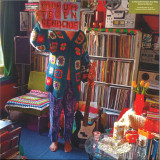
February 2014 saw the band release their 'Back To Bagarmossen' EP on London/Stockholm indie label PNKSLM Recordings. The 10' vinyl received huge praise both internationally and at home, even picking up mainstream TV coverage on Sweden's TV4. Following the EP, Les Big Byrd are now preparing to unleash their debut full length release, 'They Worshipped Cats', on Anton Newcombe's A Records ,Anton has co written & plays 2 tracks on the album . They are supporting the Brian Jonestown Massacre on their European tour . When Anton recently visited Stockholm with his band The Brian Jonestown Massacre, the guys accidentally ran into each other at a local record shop, and started talking about music. Anton invited the band down to his studio in Berlin to record and jam for a few days and it was there that a big part of "They Worshipped Cats" was conceived and recorded. Les Big Byrd was formed in Stockholm by Joakim Åhlund and Frans Johansson a couple of years ago. They each eventually joined different rock bands that brought them out of Sweden and into a different world. Frans' band Fireside, got signed by Rick Rubin to his label Def American and Jocke had a taste of international success with 60's-influenced garage-pop outfit Caesars, as well as his other, more electronically flavored project Teddybears. They decided that they still - in spite of everything - had their love for music intact, and the dream in common to get the perfect band together and give it one more shot. They recruited Jocke's former bandmate, drummer Nino Keller and keyboardist Konie and started jamming and rehearsing. Joakim had been running a recording studio in Stockholm, writing and producing for Swedish and international artists, including Robyn and Håkan Hellström, and had also directed music videos for prominent Swedish exports such as Bob Hund, Refused, Broder Daniel and The International Noise Conspiracy. Keyboardist Konie also runs a studio in Stockholm, where he's been recording a number of film scores as well as many of Swedens most interesting black metal acts.
Suche:refused
- 1: Pendelen Svinger
- 2: Octagon
- 3: Den Første Lysstråle
- 4: Clock Of The Long Now
- 5: Mycelium
- 6: Hvit Lotus
‘Dyp Tid’, the fifth album from Norwegian psych-rock group Electric Eye, is a contemplation of the unknown and the ineffable. Crafted in a landscape where time and space collapse, the record is Electric Eye's most ambitious and experimental project to date. Originally commissioned by Sildajazz – the Haugesund International Jazz Festival – and premiering there in 2022, ‘Dyp Tid’ (Norwegian for ‘Deep Time’) is both a meditative journey and an exploration of what it means to exist in a universe where time stretches far beyond humanity’s grasp. First performed live in Skåre Kirke, an octagonal wooden church in Haugesund, Norway that was built in 1858, these six atmospheric compositions centre church organs, synths and choral vocals over any traditional ‘rock’ instrumentation. Gradually winding through ambient minimalism, kosmische improvisations and experimental psych-jazz, ‘Dyp Tid’ isn’t just an album but a space; a mental landscape where sound and time intersect. Talking about the album, Electric Eye’s Øystein Braut says: “We have always been drawn to the cinematic, to the sense that something feels larger than life, and in Dyp Tid we wove these elements together into something both deeply personal and utterly elusive.” Setting up in Bergen´s Duper Studio, the recording space became a laboratory to further develop these new ideas and transform the ‘Dyp Tid’ piece into a fully-fledged studio album: “We delved into analogue technology, explored vintage machines, and experimented with what lay at the edge of our control. We sought the sound of time’s depths, something that felt infinite and uncontrollable. In an age where everything seems algorithmic and predictable, we aimed to create something that refused to be boxed in – something that lives and breathes by its own rules. The album intricately weaves together live recordings from the wooden church and studio sessions, often oscillating between the two in the course of a single track.”
SAFI ist laut und intensiv. Ein furioses Statement wie Punk auch definiert werden kann. Ambivalenz und Zerrissenheit sind Ausgangspunkt, die kombinierte Virtuosität aus viereinhalb Oktaven Stimmumfang und dem Kunstdiplom sind das Fundament. SAFI zeigt ihr Gesicht mit schnörkelloser Geradlinigkeit, pur, groß. Umarmt von einer gewaltigen Klangmauer. Krachsituation. SAFIs drittes Studioalbum wurde vom Berliner Soundkreateur Moses Schneider produziert (Tocotronic, Ätna, u. v. m.). Gäste sind u.a. Dennis Lyxzén (Refused), Sebastian Madsen (Madsen) und Rummelsnuff.
Was haben Motörhead, Refused, Rage against the Machine, AC/DC und Green Day gemeinsam? Es mag vielleicht verwundern, aber sie haben allesamt Songs mit Texten, die ziemlich gut im Kontext eines Widerstands gegen eine Epoche funktionieren, die immer mehr durch herzlosen Nationalismus, Rassismus, Faschismus und Egoismus gekennzeichnet ist. Das Leben im Europa des Jahres 2024 kann einem schon den Rest geben: In immer mehr Ländern wühlen Politiker*innen den Dreck auf, der schon längst hätte abgeschafft werden sollen - oder der zumindest kollektiv verachtet gehört. Doch eines muss man sich unbedingt ins Gedächtnis rufen: just because you got the power, heißt nicht, dass man recht hat. Tagtäglich wird einem heute eine neue dumme Idee um die Ohren gehauen. Meistens geht es darum, diejenigen nach unten zu treten, die eh schon am Boden liegen. Für Otto Normalverbraucher, der sich von der Gesellschaft betrogen fühlt, ist das reines TNT. Das Gefühl ist bisweilen nachvollziehbar, doch bitte wann sind die Verbreitung von Angst, das Bauen von Mauern und die Zerstörung von Bildungssystemen zur Lösung für Alles geworden? Seit wann ist ein menschliches Wesen aufgrund seiner Ethnie, seines Geschlechts, seiner sexuellen Orientierung oder seines Glaubens weniger wert? Unsere Antwort ist kurz und knapp: Wann immer irgendwer versucht, uns hier auf Linie zu bringen, entgegnen wir: fuck you, we won"t do what you tell us. Was also tun? Sind wir die einzigen, die sich in einer Welt, die sich spiralförmig in den Abgrund dreht, wie basket cases, also absolut verloren fühlen? Hoffentlich nicht. Und wenn wir eines gelernt haben, dann, dass im Produzieren, Spielen und Hören von Musik ein mächtiger Zauber liegen kann. Es gibt weniges, was so wirksam für sozialen Kit sorgt. Deshalb sind wir unglaublich stolz und freuen uns extrem, wieder ein neues Hellsongs-Album zu präsentieren. Für uns ist es ein Lichtstrahl in äußerst dunklen Zeiten. Zusätzlich zu den Cover-Versionen gibt es auch vier eigene neue Songs, die mehr oder weniger dasselbe Themenfeld abdecken. Mehr Vocals, mehr Drums, allgemein mehr Instrumente, gespielt von einer noch größeren Gang mit noch mehr Wut im Bauch als je zuvor. Hoffentlich gefällt"s euch. Wir lieben es! Lassen wir diese abgründigen Zeiten hinter uns und gehen wir gemeinsam in eine gleichberechtigte Zukunft! Eins wissen wir jedenfalls genau: We would rather be dead, als es gar nicht erst versucht zu haben. See you on the road!
Leya Touch & soFa elsewhere aka Dream Baby Dream combine their left-of-centre musical perspectives on an otherworldly new self-titled album that arrives on Hell Yeah this September and will get a Japanese domestic release on CD. The duo's beguiling mix of occult synths and treated vocals ride dubbed-out mid-tempo rhythms on a retro-futurist record that blends cold wave, cosmic disco, dub and trance.
Dream Baby Dream describes themselves as "two children who refused to grow up" and now they offer a glimpse into their very own fantastic land of dreams. This journey into diverse flavours spontaneously started after a cosy dinner and after just three sessions resulted in the album presented here. Playful yet sometimes gloomy, this music echoes life, both imaginary and real - the highs, the lows, the dark moments and the joy, trance-inducted love zones, daydreams and everything in between. It is a coherent hole but one filled with surprising turns, moments of deja vu and plenty of outsider dance floor delights.
Leya Touch is a rising voice and live act on the Brussels alternative scene. Together with soFa, a veteran DJ and producer who released on many forward-thinking labels worldwide, they provide signature vocals and synths that challenge typical genre categorisations.
Opener 'Love Zone' sets a strangely seductive basic channel vs dreamy pop vibe with wispy cosmic melodies and oodles of echoes as Touch's vocals draw you in. Lose limbed percussive jumbled and sci-fi motifs define 'Badalamenti On Fries', 'Curry Con Sax' has an avant-guard sense of soul and melodic curiousness and 'Diskoteka' is a jittery mix of retro synth sounds and whispered vocal coos that shimmer like stars in the night sky. Elsewhere there's the malfunctioning Kraftwerkian electronics of 'Körperkonsum', goa-filter madness of 'Banana Trance' and the eerie interplanetary dub of 'Carpenter On The Beach' while 'Whale Rider' and 'The Rude Red Lady' bring warped lines and enchanting vocalisations that sound like nothing you have heard before.
This is an exultant album of new musical rituals, tiny soundscapes, dehumanised words and combinations of the past, present and future that never fail to excite and intrigue.
Limited to 300 copies
What an unbelievable record. From the wild cover to the iconic breakbeats, Roots from Ian Carr’s Nucleus is one of the dopest albums we know. This is seriously thick, funky-prog jazz-rock heaven. Originally released on Vertigo in 1973, other than a couple of versions at the time for other territories, Roots was never re-pressed since so it’s gone on to become another one of those impossible to find records.
Maybe it was a little too out there for the time, but it’s aged very, very well indeed and this Be With re-issue, re-mastered from the original analogue tapes, shows off just why this deserves to be back in press.
Genius trumpeter and visionary composer Ian Carr was one of the most respected British musicians of his era. He was a true pioneer and saw the potential in fusing the worlds of jazz with rock, just as Miles Davis and The Tony Williams Lifetime did in the US. In late 1969, following the demise of the Rendell-Carr quintet, and tiring of British jazz, Carr assembled the legendary Nucleus. Regarding music as a continuous process, Nucleus refused to “recognise rigid boundaries” and worked on delivering what they saw as a “total musical experience”. We can get behind that.
Under bandleader Carr, Nucleus existed as a fluid line-up of inventive, skilled musicians. This constant evolution and revolution was all part of the continuous musical exploration and discovery that took jazz to new levels.
Working together with producer Fritz Fryer and engineer Roger Wake, the seven compositions by Carr, Brian Smith and Dave MacRae that make up Roots flirt with perfection, and Nucleus at that time made up of the cream of 1970s UK jazz with Brian Smith on tenor saxophones and flutes, Dave MacRae on piano and electric piano, Jocelyn Pitchen on guitar, Roger Sutton on bass, both Clive Thacker and Aureo De Souza on drums and percussion, Joy Yates delivering the vocals and of course Carr on trumpet.
The spellbinding title track immediately renders the album indispensable. Riding the illest of loping breakbeats, “Roots” is low-slung, doped-out heist-funk. An absolute monster. If it sounds familiar then that’s likely down to it being sampled by Madlib for Lootpack and Quasimoto’s “Loop Digga”, as well as by a whole host of beat manipulators. “Roots” conjures prime instrumental hip-hop / beat music, only 20 years ahead of its time. Truly, these are the roots. Through sinuous bass, twinkling keys and a hypnotic guitar riff, a smoky brass motif weaves its way into a gloriously deep haze around Carr’s solos. “Roots” is over 9 minutes long, but there’s not a single wasted second, not surprising given that this is a condensed version of an originally 40 minute long commissioned composition.
The soothing vocal fusion delight of “Images” follows. Meticulously constructed, with gorgeous flute work from Brian Smith, with Joy Yates’ silky vocals and Dave MacRae’s Rhodes never sounding better. The cool, driving “Caliban” closes out the first side. Originally the third movement in a four part commission to celebrate Shakespeare’s birthday it stands up on its own, all robust rhythms and blended brass. Keyboard colour and Carr’s trumpet are splashed across the funk drums and basslines (and there’s even some bamboo flute). This really is fusion: the elements of jazz and rock coming together in beautifully synthesis.
Side two opens in riotous fashion with the short, thrilling samba of “Wapatiti”. Next up, “Capricorn” forms a smoothed-out, jazzy constellation. Mellow and dreamy, its twinkling percussion and languid horns slowly build the vibe before head-nod drums and a killer bassline enter the fray. With a distinct heaviness that Black Sabbath would’ve envied, “Odokamona” is a venomous slice of riff-soaked jazz metal (yes, you read that right), elevated by Carr’s wah-wah horns.
The album closes with MacRae’s exceptionally cosmic “Southern Roots and Celebration”. Very much in conversation with Weather Report, it opens as a languorous, spiritual jazz of chiming keys and serene guitar that turns slowly, gorgeously into a mid-paced, brass-laced banger. It’s another sure-fire party starter and the sound of the band having a righteous blast, building an ecstatic chaos that ends with Yates screaming.
And of course we need to talk about Keith Davis’ cover for Roots. Perhaps the coolest record cover of all time? Certainly one of the most bonkers. Just your run-of-the-mill high-gloss, acid-tinged airbrush dystopian/utopian living-room party scene. Consider this your chemical flashback trigger warning.
Front-and-centre the hip-to-death green robot holds court with their giant ball of yellow barbwire wool, hooked up to… something(?) being teased out from under the stairs (probably best not to ask). A thoroughly zoned-out, long-legged Pop Art party-goer lounges half-plugged in to the painting behind her as a pair of legs flail into shot from the the top of the stairs opposite. We won’t even begin to guess what the chap’s up to in the middle, but the view out of the windows is rather nice, and someone’s already got the hoover out ready to tidy up. All of the Nucleus sleeves are something special, but this particular one? Crikey.
This Be With edition of Roots has been re-mastered from the original Vertigo master tapes, Simon Francis’ mastering working together with Pete Norman’s cut to weave their usual magic with these wonderful recordings. The crazy cover has been restored at Be With HQ as the finishing touch to this long overdue re-issue.
HOUSE OF COMMANDO, produziert von Oli Rüger & Tobi Wehner und gemastered von Howie Weinberg (bekannt für seine Arbeit mit Nirvana und U2), knüpft nahtlos an das erfolgreiche Debütalbum RED LIGHT HABITS von BIRD'S VIEW an.
Die deutschen Alternative-Rocker BIRD'S VIEW veröffentlichen ihr mit Spannung erwartetes zweites Studioalbum "House of Commando". Der Sound ist dabei eine einzigartige Kombination aus dem Punk von REFUSED, der Intensität von RED FANG und der Atmosphäre der FOO FIGHTERS.
Nachdem BIRD'S VIEW mit ihrem Debüt einen ersten kleinen Erfolg verbuchen konnten und mittlerweile von Wizzard Promotion vertreten werden, haben sie seit dem Release unter anderem mit SOULFLY, SKID ROW & GREEN LUNG getourt. Mit HOUSE OF COMMANDO machen sie nun einen weiteren Schritt in Richtung Rock-Olymp.
Die 11 neuen Tracks auf HOUSE OF COMMANDO hinterlassen bereits beim ersten Hören einen nachhaltigen Eindruck. Zu den Highlights des Albums gehören Stücke wie "Vienna", "Pin Drop“ und "Come Back Home"
Bomp Records of Burbank, California was likely the most significant American independent record label of the 1970s. In 1979 Voxx was founded as a subsidiary of Bomp as a specialty label for '60s-styled garage and psychedelic inspired music and was home to the debut album of the Pandoras. The Pandoras really got started back in 1982 when triple threat Paula Pierce (guitar, vocals AND songwriter) met singer and guitarist Debbie Mendoza at Chaffey College Rancho Cucamonga, one of those dozens of small communities that make up the greater Los Angeles area. According to stories told around the campfire, Paula had posted an advertisement on the bulletin board inside the college's cafeteria. The ad was both simple and direct: Wanted: female musician to jam with. As legend has it, the ad also stressed a keen interest in 60's garage punk music. Debbie answered Paula's ad, and soon the two girls were bringing guitars to school and holding impromptu jam sessions between classes. A little later that year, Paula brought in Gwynne Kahn on keyboards and second guitar, and Debbie convinced drummer Casey Gomez to join. People who were around at the time pinpoint December 1982 as the official beginning of the Pandoras as a band. The Pandoras didn't waste any time getting down to business. They started gigging regularly, and their repertoire of tasty garage nuggets expanded substantially, fueled both by Paula's talented songwriting and also no doubt by her relationship with Unclaimed frontman Shelley Ganz and his extensive knowledge of obscure 60's gems. The Pandoras unleashed their first recordings on the world in 1983 with the "I'm Here, I'm Gone" EP on Moxie records. It was a meaty slab of girls in the garage punk rock, and while maybe not as polished as subsequent efforts, it clearly showed off the talent of the band. Greg Shaw had been alerted to the band a few months earlier, and always one to know a good thing when he heard it, he quickly signed them. "It's About Time" saw the light of the day in 1984 on Voxx Records and became one of the first and best efforts of authentic 1960's-styled garage punk to emerge from the revival scene. It was pure garage gold! Today, 40 years after its original release date, we are thrilled to reissue this essential '80s garage punk gem as part of a series of releases celebrating Bomp! 50th anniversary. Our issue includes 3 bonus tracks and liner notes by Gravedigger V's John Hanrattie. "Paula Pierce refused to play it cute. On The Pandoras' debut album she out-snarled, out-screamed, out-fuzzed and out araged the male-dominated competition-like a well-aimed go-go boot to the jugular." - Mike Stax, Ugly Things Magazine "As good a '60s punk record as any contemporary combo is likely to make." - Trouser Press
- There Were Rebels
- Front-Load The Fun
- Yeah You, Person
- Don't Design Yourself This Way
- Furrowed Sugarloaf
- Rip The Atmosphere From The Wind
- Grow Like A Plant
- No One Displayed The Vigor Necessary To Avert Disaster's Approach
- Blame Yourself
- Instead Of Queen
- Not For Mating, Not For Pleasure, Not For Territory
- Playing Tunes Of Victory On The Instruments Of Our Defeat
It's already hard to describe what Deerhoof sounds like. So we'll skip that part and say this sounds a lot like Deerhoof with a different singer. And in keeping with 30-year Hoofian tradition, melodies soar, big hit earwigs abound, harmonies are complex, and keys change frequently and unexpectedly. Arrangements are in a constant state of impatient agitation. Emotions run high but delivery is usually a falsetto deadpan. We Sang, Therefore We Were is grief delivered in code. Greg plays everything save for a few birds who join in singing now and again. He keeps the instrumentarium severely limited, the sound shambling and anti-slick. It turns out Greg is a really good bass player and guitar player, if a bit more rudimentary and slicing compared to his Deerhoof bandmates. He does play more angry guitar solos. But don't expect another Chippendale/Saunier speed-drum freakout; the songwriting is gorgeous and sophisticated, and drums are almost an afterthought. Here, song is Queen. The singing is high and whispery, tending towards the three-part harmony. What we're saying is: We Sang, Therefore We Were sounds a bit like Deerhoof fronted by The Andrews Sisters. This is a peek inside the mind of one of indie rock's most celebrated drummers, many of whose fans may not even realize the relentlessness of his musicianship and compositional prolificacy. Mozartian chords and sounds insinuate themselves here and there on this record, finally taking over in a big climax at the end, when the drums break off unexpectedly into a laugh-or-cry orchestral outpouring that ironically may be the rawest part of a very raw album. "Satomi, Ed, John and I were chatting between shows in Austin in early December. They encouraged me to make a record on my own. With no one to please but myself, it came together way faster than usual. It was basically done by the holidays. I had been excited by the announcement that the new Rolling Stones record was going to sound 'angry.' I thought, 'Yes, I'm angry too.' But Hackney Diamonds turned out more like cotton candy than punk rock. So I went back to Nirvana. I always loved the catchy melody over massive distortion, the way their songs refused to conform to simple major or minor scales, the dark sarcasm which still resonates in this age of phony blue-check-washing of fascism." The album cover is all text, penned by Greg on the familiar topic of interspecies absurdist operatic anti-Cartesian revolution. The songs' lyrics are all drawn from this epic poem. White House spokespersons are recast as The Queen of the Night from The Magic Flute, The Queen of the Night is recast as a mockingbird singing all night in a battle for survival, and ultimately the mockingbird is recast as a campy drag artist taking pleasure in her own aggressive, tireless music-making.
"Sun Racket" is the brand new album from legendary Boston trio Throwing Muses, consisting of Kristin Hersh, David Narcizo and Bernard Georges. The follow up to 2013's 'Purgatory/Paradise' is an outpouring of modal guitars, reverbed shapes, echoey drums and driving bass set behind Kristen Hersh's well-thumbed notebook of storylines. A ten-song opus of suitably wrought tales set against a wall of sound that's at once calm and ethereal before building into glorious cacophonous crescendos.
When Throwing Muses wrote their last album, they were shattered. Pieces were coming and going, elements repeating and charging the whole. "It sounded beautiful jumping around like that". Two-minute songs reappearing as twisted instrumentals or another song's bridge.
They mimicked the effect live which kept them on their toes. Whatever was happening was already over in other words. 'Sun Racket' is the opposite. It refused to do anything but sit still. It says, "sit here and deal". "All it asked of us was to comingle two completely disparate sonic vocabularies: one heavy noise, the other delicate music box.
Turns out we didn't have to do much. Sun Racket knew what it was doing and pushed us aside, which is always best. After thirty years of playing together, we trust each other implicitly but we trust the music more" - Kristin Hersh And so, they continue. Business unusual.
"A ground-breaking band who changed the face of alternative music rather than follow the rule book." MXDWN "Pioneers of the 80'/early 90's college rock sound" Pitchfork "One of America's finest guitar bands" - The Quietus.
Color Vinyl[24,58 €]
Valley of Rain was Tucson’s Giant Sand’s debut album recorded in 1983, and eventually released by 1985. It included Howe Gelb on vocals, guitar and Winston Watson on drums for most of it, Tommy Larkins on drums for some of it and Scott Garber on fretless bass for all of it. At the time of the recording, Howe was unacquainted with the possibilities of tube (valve) amps and had recorded most of the album with a Roland JC120 at the miraculous 8 track facilities of The Control Center in Korea Town, Los Angeles by Ricky “Mix” Novak. This impromptu recording had occurred because the band refused to cancel their first Los Angeles live gig, at Madame Wong’s, when the band (Giant Sandworms) had broken up days before in Tucson. Instead, Howe headed out anyway with Scott, the newest member who’d only been in the band for about a year, after band mainstays Billy Sed and Dave Seger reasonably decided ‘enough was enough’ following a rough and tenuous year spent in the lower east side of NYC attempting to further the band circa 1981/82. Tucsonan Winston Watson, (who would go on to tour with Bob Dylan in the 90s, as well as Alice Cooper, Warren Zevon etc ) was already living in Los Angeles and was brave/kind enough to jump in for the live date with no rehearsal. The result was so sparked with adrenalin, that the trio set up an impromptu studio session the next day to attempt to capture the sonic thrust on tape. The total cost of the day and a half recording was $400 including one 1” reel of 30 minute tape. When Enigma Records offered to release the album they requested another 15 minutes of music to make it a full LP. Ron Goudie was then called in to oversee the extra recordings at a Venice, CA studio called Mad Dog with Eric Westfall engineering. Tommy Larkins, who had been on the previous country punk album of Howe’s “The Band of ... Blacky Ranchette” came in to drum for those last 3 songs. It was there when Howe borrowed an amp that had been stored at the studio did he discover the bolster of a tube amp and his world changed. The amp was a slightly modified Fender Twin Reverb owned by Robbie Krieger of The Doors. 30 some years later, now that the band had been put to sleep indefinitely, those very first songs had begun creeping into the last Giant Sand tours. It somehow seemed appropriate to give them another shot with the proper amp just to see what they could’ve been. What made the idea more approachable was the availability of both original drummers living back in Tucson. The first attempt came last summer with both Winston & Tommy and Thøger Lund on bass, as well as the 2 newest members, 29 year old Gabriel Sullivan and 23 year old Annie Dolan on double neck guitars. The sound was insane. The funny part was Gabriel, who engineered and mixed the session, gave it an intentional 80s production sound. Howe later explained to Gabe he had been at war with that production trend since those first original recordings. So they all tried it again at Christmas time, this time with a newly discovered Fender 30 amp that had only been in production from 1980 – 1983. This new re-recording of that first album now sounds like it should’ve sounded. It was re-done for $400 and the same day and a half session time as the original. Scott Garber even drove up from Austin TX with his fretless to play so that the album is literally the originally line up for at least half of the songs. And yes, no pedal boards were used too. The band intends to tour this summer playing only those Valley of Rain songs. Giant Sand Returns To Valley Of Rain.
(Clear with black, white & yellow splatter limited to 500 copies) SKA DREAM is a complete re-recording of Jeff Rosenstock's critically-acclaimed 2020 record NO DREAM however this time around all the songs are ska songs you're welcome. The very good idea to make this record came together when, like many other bands throughout this pandemic that refused to participate in super spreading events, we were trying to find a fun way to make some music together to share with people. Otherwise we were just spending our evenings texting the group chat in dread about the collapsing world around us. Not the most fun band activity. As with most things ska in my life, what started out as a fun goof with friends eventually morphed into "Hey, what if we tried to make it good though?" All of us have a pretty deep history playing and touring the country in punk/ska bands. We all understand the stigma that comes along with ska, we've all dealt with the pitfalls of it, and we've all kept on truckin' regardless. If you are one of those people who loves music as long as it isn't ska, that's cool, we see you. This record isn't for you and you don't have to listen to it. Byeeee. Okay, everyone else, we see you too, we love you and check it out, SKA DREAM is real. This record includes contributions from Jer Hunter (JER, Skatune Network, We Are The Union), Rick Johnson (Mustard Plug), Laura Stevenson, Ara Babajian (The Slackers, Leftover Crack), Boboso, Sean Bonnette (AJJ), George Clarke (Deafheaven), David Combs (Bad Moves), Chris Farren, Augusta Koch (Gladie, Cayetana), Angelo Moore (Fishbone), Franz Nicolay, nonregla, Elise Okusami (Oceanator), Mike Park (Bruce Lee Band, Skankin Pickle, Asian Man Records), PUP, Anika Pyle (Katie Ellen, Chumped) & Shannon Toombes.
Black Vinyl[22,65 €]
LTD. BLACK CLOUD COLOUR VINYL
THE GHOST INSIDE stands as an unstoppable force in the realm of hard rock music. Fueled by unwavering determination and unyielding passion, this band has forged a path marked by resilience and redemption. Their latest endeavor, the 6th studio album titled Search for Solace, delves into the profound theme of grappling with one"s own thoughts - the internal struggle between good, bad, and evil. It explores the journey of finding comfort and making peace amidst the chaos of life"s ebb and flow. The album reflects the band"s commitment to not succumb to negativity, anger, or darkness, aligning with their identity as an uplifting and comforting musical force for fans seeking solace. Established in 2004, THE GHOST INSIDE has solidified its position as a trailblazer in melodic hard rock. Their music seamlessly combines raw aggression with profound lyricism, creating a resonant experience for their dedicated fanbase. Despite facing challenges, notably a tragic bus accident in 2015 that left some members with life-altering injuries, the band refused to be broken. Through unwavering perseverance, they made a triumphant return to the stage, defying the odds. Their music embodies a spirit of resilience, unity, and the indomitable power of the human spirit. Each thunderous breakdown and soaring melody strikes a deep chord within the hearts of their fans, serving as a testament to the band"s enduring impact. THE GHOST INSIDE"s journey is a testament to their ability to inspire and uplift through music. As they embark on a global tour starting this Spring, venturing into new territories, including South America and beyond, the band continues to share their message of strength and perseverance with audiences around the world.
LTD. BLACK CLOUD COLOUR VINYL[23,49 €]
THE GHOST INSIDE stands as an unstoppable force in the realm of hard rock music. Fueled by unwavering determination and unyielding passion, this band has forged a path marked by resilience and redemption. Their latest endeavor, the 6th studio album titled Search for Solace, delves into the profound theme of grappling with one"s own thoughts - the internal struggle between good, bad, and evil. It explores the journey of finding comfort and making peace amidst the chaos of life"s ebb and flow. The album reflects the band"s commitment to not succumb to negativity, anger, or darkness, aligning with their identity as an uplifting and comforting musical force for fans seeking solace. Established in 2004, THE GHOST INSIDE has solidified its position as a trailblazer in melodic hard rock. Their music seamlessly combines raw aggression with profound lyricism, creating a resonant experience for their dedicated fanbase. Despite facing challenges, notably a tragic bus accident in 2015 that left some members with life-altering injuries, the band refused to be broken. Through unwavering perseverance, they made a triumphant return to the stage, defying the odds. Their music embodies a spirit of resilience, unity, and the indomitable power of the human spirit. Each thunderous breakdown and soaring melody strikes a deep chord within the hearts of their fans, serving as a testament to the band"s enduring impact. THE GHOST INSIDE"s journey is a testament to their ability to inspire and uplift through music. As they embark on a global tour starting this Spring, venturing into new territories, including South America and beyond, the band continues to share their message of strength and perseverance with audiences around the world.
The Morning Papers Have Given Us the Vapours was made with the black watch bandmates and producers/engineers Rob Campanella (Brian Jonestown Massacre, The Tyde, The Warlocks) and Andy Creighton (The World Record, Parson Red Heads). Ben Eshbach, formerly of The Sugarplastic, arranged the strings. Kesha Rose guests on lead vocals on the second single, Oh Do Shut Up. And the great Lindsay Murray once again lends her beautiful backing vox to a number of tracks.
the black watch songwriter/frontman John Andrew Fredrick wrote the ten songs on this, his Los Angeles-based band's latest album, entirely unselfconsciously, with no set goal in mind other than to revel in the joy of songwriting, and, eventually, the luxury of recording his music with his more-than-accomplished band. The Morning Papers Have Given Us the Vapours, produced separately and together by Rob Campanella and Andy Creighton evinces the black watch's often stunning ability to, as Andy Gill once observed in The Independent, "find chaos in the calm, melody in the miasma."
Fredrick, who has also published four comedic novels and a book on the early films of Wes Anderson, jovially describes himself as "a recovering Anglophile--one who'll never, one hopes, fully recover." From his home studio in the Angeleno Heights district of L.A., he waxes eloquent about how being branded, as it were, as a too-ardent lover of British music, film, and literature has left him as bemused as has the tag "prolific" that is often affixed to reviews of his work.
"I just don't think it's all that interesting to note that we've made so many records. Looked at one way, it's a sort of deflection from talking about the timbre if not the quality of the individual songs. Though I know it can be intimidating for fans who've just discovered us--a sort of 'My goodness, where do I start with this band that has put out LPs since 1988?' I get it. I do. I picture someone standing at our slot at a bin at a record store becoming overwhelmed at the prospect of picking the 'wrong' title. And then walking away and not picking up anything from us!" Fredrick laughs. "What can you do indeed?"
He started his career as a songwriter as a result of an American Football injury that left him bedridden in the home he grew up in in Santa Barbara, California. The year The Beatles immortal double-album came out at Christmastime he broke his leg so badly that he had to be home-schooled for an entire year. His parents, ex-teachers themselves, refused to let him watch telly for more than an hour a day. He propped a Silvertone acoustic on top of the massive cast that screamed all the way up to his thigh from his toes, and began to write little melodies and lyrics that, doubtless, did not in the least mask his love for the Fabs, The White Album in especial.
And he read and read and read--histories of the American Revolution and Civil War, mostly, and as many Dickens novels as his mum and dad could bring him. "That year," Fredrick observes, "surely made me who I am today. Proof that intensely unfortunate-seeming events can prove most fortunate. As a sport-mad kid, it made me absolutely mental that I was exiled from the activities I loved most and the school teams I played on. What a blessing undisguised that injury was! Not that I'd like to experience anything like it ever again, mind you."
Fredrick can even recall a few of the melodies he wrote as boy ("Utterly trite, of course, completely jejune"); and in a way, The Morning Papers Have Given Us the Vapours showcases a kind of get-back-to-where-you-once-belonged sensibility. "I didn't intend, this time, to make an album per se. I write both songs and fiction in order to find out what happens, to find out what I might want to say," he notes. "Rob often asks me what a particular song is about; and I often reply that I either don't know, or would prefer that others say. Same thing goes for when people ask me where they should start with our discography. I never know what to say. Our LP from 2011, Led Zeppelin Five (remastered in 2021 for its tenth anniversary), has been our best seller, I think--but that may be because some stoned Zepheads thought their gods had perhaps put out a record they'd missed!"
Despite being deadly serious about music-making, TBW's been known to either whimsically or perversely title their albums. Examples: Jiggery-Pokery (an allusion to John Lennon assessing George Martin's productions), After the Gold Room (a pun on the Neil Young classic plus a local eastside L.A. watering hole), Sugarplum Fairy, Sugarplum Fairy (echoing Lennon's famous count-off to A Day in the Life), Fromthing Somethat (a garbled spoonerism/lyric while doing a vocal), Brilliant Failures (the 2020 release that, along with Fromthing Somethat, was named Album of the Year by venerable indie rock magazine The Big Takeover), and the aforementioned LZ5.
For the new LP, the band recruited longtime friends and allies Ben Eshbach (the Emmy-Award-winning frontman of The Sugarplastic) and Lindsay Murray (Gretchens Wheel) to compose and arrange strings and sing heaps of lovely backing vocals, respectively.
And the result? A collection of songs that Fredrick, in his quite-but-not-quite self-deprecatory way, might call another set of brilliant failures. "Every song, every LP we do, is a failure of sorts--no matter how powerful or beautiful or pleasing-to-us it turns out," John concludes. "I have often said that my aim is to write songs as good as anything on The Beatles... and I will never achieve my goal. And thus I'll have to keep at it, keep trying. And chin-chin to that!"
And now your attention's been brought to a band (or you've heard of them or heard a track or two down the years) that has been pegged by The L.A. Weekly as "a national treasure" as well as "the most criminally-neglected indie pop group imaginable."
So here's to the prospect of that ostensible neglect becoming as much of a thing of the past as John Andrew Fredrick's year-long stint in bed.
- The Sage
- Deathwill
- 죽음이두려울때까지
- 풀이
- Confluence Loop
- 나락
- Noise And Cries
As part of Subtext's 20th anniversary, Subtext presents the debut album from bela as a co-release with Unsound.
bela was based in Seoul when they began to develop the framework for 'Noise and Cries (굉음과울음)'.Chewed up by a society that's slow to embrace those who exist on the margins, they and their close friends became fixated on the concept of death. "I wanted to cry, I Wanted to die," they recall. "The precariousness of living in South Korea hits different. I thought, let's share what is killing us." bela refused to lose hope, so they inventoried the sounds, experiences and emotions that had formulated their identity and wondered how this might form a different sort of South Korean musical expression. They considered the guttural death metal growls and industrial music they heard when they began to interface with Western culture as a teenager, the idiosyncratic folk rhythms that rattled away in the background of state events, the evocative, euphoric drones that had offered them solace, and the heady, cybernetic maximalism that's come to define contemporary queer club music.If this was going to be an album about death, bela knew wouldn't it be preoccupied with loss, but rooted in a deep desire to regain the will to live.
'Noise and Cries (굉음과울음)' is the first time bela has recorded their voice, and they metamorphose it from moment to moment, embracing a precarious vulnerability. Opener 'The Sage' references Jungtaryeong, two well-known arias from the Korean Pansori tradition - a folk form that is usually performed by a drummer and a singer. Screaming, whispering and rasping, bela twists borrowed words from the original arias, repurposing them to highlight the hypocrisy and brutality of patriarchal wisdom.
These bellowed phrases contrast with an abrasive rhythm that bela based on the eatmore jangdan, an irregular, traditional beat that's been remoulded into a jerky, electro-acoustic call to action. Even if the gargled Korean wordplay can't be fully understood, the mood translate flawlessly. On 'Death Will I', they reassemble the damaged relationship between a queer child and their
- Senseless
- Inner Qualities
- Needle
- Fallen
- Competition In Hatred
- Love Story?
- Drift Apart
- Dragon
- My Source
- Serenade
- Illumination
- Fascistproof Armour
- City Of Hope
- Still The 17Th Century
- Despertar
- All Of Us
- Nothing
- Emptiness
- Monster
- Le Sacre De Sang
- Let's March!
- Junior
- Highway Tonight
- The Rumble
- Easy Digestion
- Showdown
- No. 1
- Centipede
- The Preacher
- Take It Away
- Shuffle The Deck
- La Musica Continua
- Confront Yourself
- Thousand Years
- Rising Fire
- Lifestyle
- Darkness Of Ignorance
- Spiritual Game
- Revolution
- Remark Of Frustration
- Demo
- Not Free
- Dragon
- All Of Us
- Skulls
- Meat Is Murder
- Crashing
- Desasir
- Rebels Rule
- Top Of The World
- Still United!
Orange, yellow, cyan blue, aqua blue, baby blue vinyl. Limited to 400 copies
After being out of print for decades, End Hits Records has partnered with the Swedish hardcore punk legends ABHINANDA to re-release their complete discography on vinyl. Founded in 1992 in Umea, now recognized as a European punk hub, ABHINANDA played a significant role in shaping the history and development of the 90's hardcore scene. Alongside their contemporaries REFUSED (with whom they frequently shared and swapped members), they were instrumental in the international breakthrough and popularization of Scandinavian hardcore. Much credit for this goes to singer Jose Saxlund, who, along with Dennis Lyxzen (Refused, Int. Noise Conspiracy), operated the Straight Edge label "Desperate Fight" and played a vital role in consistently releasing recordings from the thriving Swedish scene. Finally, the entire ABHINANDA discography will be available once again, this time on strictly limited vinyl: The five-vinyl box set comes in an elegant cardboard slipcase, with each individual record housed in a gatefold cover and accompanied by a large-format poster. Additionally, there are numerous never-before-seen pictures, along with detailed liner notes/interviews featuring band members and contemporaries such as Dennis Lyxzen (Refused), Vique Simba (Revelation Records, Simba Zine+Records), Sara Almgren (Doughnuts, Int. Noise Conspiracy), and Kate Tucker-Reddy (108). The box set includes the three full-length albums "Senseless," "Self Titled," and "The Rumble," as well as a double LP featuring all demo recordings, EPs, and 7" tracks. The music has been completely remastered, and the artwork has been entirely updated.
In the beginning was a half-truth, the truth was of war and the half-truth was post-war. Fancying the pretensions of its cultural superiority, a continent chose to hide the truth behind ridiculous jargon and the soothing distance of offshored ?????????. Europe wished itself beyond war because it thought the privilege of peace a birthright, just as it refused to understand that post-war was a euphemism for interbellum. Then the truth has set us free.
The delusion was discarded and war was revealed as an inconceivable horror. Almost immediately it turned familiar and virtually comfortable. Novelty songs of drones gutting tanks became a laughing matter and the burning tanks, their crew inside, entertainment. Consequently, a plurality of people started to collectively dream of new stages of the righteous kind of carnage. This happened within weeks.
Our imagination has swollen to the point of loss of consciousness, compounded by the narrative form long in the sways of atrophy. All of this raises the question of to what degree were the years of peace culturally squandered. The art of the previous age prided itself on self-awareness, today we fail to even notice that we no longer recognize ourselves. But we have arrived where we started and our issues were not too complex for expression.
Since no art form generates action, the most appropriate art for a culture on the edge of extinction is one that simulates pain. In these times we shouldn't produce any other music, none but this, intended to prevent our silence from being misinterpreted.
Out of print for quite a few years now, this album is a stunning power-pop gem recorded at a time when this kind of girl group pairing with punk rock was unusual.b This is one of the most iconic albums released on Greg Shaw's Bomp! Records. It now includes bonus tracks on top! Definitely stood the test of time. Check out the titles, these young ladies were wearing their collective hearts on those sleeves of theirs. This kind of girl group pairing with punk rock was unusual at the time and it provided a much-needed antidote to the male dominated skinny tie brigade. Nikki looked like Pam Dawber (Mindy from Mork and Mindy) and sounded like Clare Grogan (of Altered Images) what was not to be instantly smitten by. Born and bred in Detroit, Miss Corvette reportedly ran away from home at age 16 because her mother refused to allow her to attend an MC5 show. Greg Shaw wrote the following in the liner notes to the 20th Anniversary label compilation, Destination Bomp! "Nikki was a tireless worker. Like some coalminer's daughter, she'd travel around the country with her band. Playing 200 shows a year. She knew everybody and was a lot of fun to hang out with so, I figured that if all her friends bought the record... so I signed her. The girl had style and attitude galore plus, she had master guitarist/songwriter and former Romantic Peter James. One of Detroit's most savvy cats." The lady herself kindly supplied the following summary. "We went to LA and signed with Bomp in maybe 1979 but Greg wasn't sure what to do with us. We did the Honey Bop single with Ronny Weiser at Rollin Rock and a couple songs with the Kessel Brothers. We started something with Kim Fowley that did not work out. They kept trying different producers until we finally decided to go back to Detroit and do the album on our own. We didn't have a lot of experience but we knew what we wanted and Detroit was part of that so we recorded the album and had a blast doing it. Peter wanted us to be poppier and I wanted to be more punk. We sort of met in the middle with what I've always called Bubblegum Punk. I can't believe it's been 43 years since this came out and there are still kids discovering it and people who grew up with it that still listen to it. I constantly hear from people all different ages, all over the world about how much they love it album and that really means so, so much to me!" Hear the phenomenon for yourself.
DEVO’s Hardcore documents the group’s beginning as pre-punk outcasts in the fertile Akron, Ohio, underground rock scene. Spawned at the nearby college of Kent State, site of the infamous May 4 Massacre, DEVO formed as a conceptual art project armed with the radical philosophy of de-evolution. Brothers Mothersbaugh (Mark, Bob and Jim) and Brothers Casale (Jerry and Bob) along with drummer Alan Myers soon whipped up an otherworldly brand of “devolved blues” that could hold its own alongside the beatnik groove of 15-60-75 (a.k.a. The Numbers Band) or the primal rock poetry of The Bizarros. Recorded on various four-track machines and in tiny studios, basements and garages between 1974-1977, Hardcore reveals their strikingly clear vision: rock ’n’ roll stripped bare of its collective cool and jerked back into propaganda fit for post-modern man. It’s no surprise that these transmissions would soon catch the eye and ear of Brian Eno, who later produced their landmark 1978 debut album. Noisy synth, strangled guitar chops and a primitive rhythmic thud power the early DEVO sound. Threaded beneath it all are lyrical themes of post-McCarthy paranoia, middle-class ephemera and DEVO’s long-running topic of choice: sex, or lack thereof. Few moments in pop music history can match the grinding, pent-up energy of “Mongoloid” and the spastic bounce and sputter of “Jocko Homo” (two anthems presented in their earlier and superior versions here). Cult favorites like “Mechanical Man” and “Auto-Modown” make Volume 1 essential listening. Superior Viaduct and Booji Boy Records are proud to present DEVO’s Hardcore to a new generation of spuds, lovingly packaged with Moshe Brakha’s stunning cover photography. As David Bowie said in 1977, DEVO is indeed “the band of the future.”
BACK IN THE RACKS..BOMBER VINYL REPRESS Petrol Girls are a radical feminist hardcore band making waves across the European and UK punk scenes The band are constantly on tour across the UK and Europe and are gaining great press and interest along the way . Recently picked up by major booking agency ITB after one London show. Their previous two 7" singles sold out in record time For Fans Of: War On Women , Bikini Kill, Fugazi, Refused, White Lung, Pettybone, Propagandhi
There was one irrepressible Chicago club act that refused to be replaced by any DJ's sound system. Maxx Traxx (and Third Rail before them) were a scene unto themselves in the early 80s, happening live on-stage five-plus nights a week somewhere in the 312. Their two LPs, both recorded in 1982, are a sheer energy ride almost too explosive to be captured by studio tape. And yet these two stone classics would remain unanswered by a city as it moved determinedly toward the motorik sound of house. Hop the turnstile and move with this complete document of Chicago's last great club band told in detailed text, newly revealed photos, and complete studio recordings painstakingly remastered. AVAILABLE IN LIMITED EDITION LAKE MICHIGAN TEAL VINYL!
Produced by legendary rock historian and Bomp! Label founder GREG SHAW, the Los Angeles all-female combo delivers a neo-60's garage punk classic.
"Paula Pierce refused to play it cute. On the Pandoras' debut album she outsnarled, out- screamed, out- fuzzed and out araged the male- dominated competition--like a well-aimed go-go boot to the jugular." - Mike Stax
That band released the digital-only album "The Southpaw Trail" in 2014. In 2018, the band had changed a few of its members and released "Mountain Street Songs" on vinyl on their own label Sublevels records.
The band played a few gigs around their hometown of Stockholm, most notably opening for Refused and Hot Snakes.
- A1: The Cult Of Venus Aversa
- A2: One Foul Step From The Abyss
- A3: The Nun With The Astral Habit
- B1: Retreat Of The Sacred Heart
- B2: The Persecution Song
- B3: Deceiving Eyes
- C1: Lilith Immaculate
- C2: The Spawn Of Love And War
- C3: Harlot On A Pedestal
- D1: Forgive Me Father (I Have Sinned)
- D2: Beyond Eleventh Hour
- D3: Beast Of Extermination
The 2010 studio opus featuring 11 sonic nightmares from the UK's supreme exponents of blistering Metal darkness. presented on double gatefold vinyl. 'Darkly, Darkly, Venus Aversa' was the band's ninth studio album; a gothic
horror themed slay-ride of fervour and perversion. Set amidst the orchestral melodrama and lush, cinematic production, there sits stalwart a ravening beast of furious riffing, flesh ripping vocals and monstrous, unstoppable percussion.
Described by Cradle's infamous frontman Dani Filth as 'without doubt the fastest and most brutal album we've created to date.' Unafraid of ruffling a few feathers, the band have continually refused to bow
to convention or to conform to prevalent trends and fads. Yet despite this uncompromising stance, the band are still the most successful British heavy metal band since Iron Maiden, with legions of fans around the globe.
On October 24th only Jimmy Bond was still with Chet : Peter littman had returned to America, and his seat was now accupied by Nils-Bertil ‘Bert’ Dahlander, a Swedish drummer who’d accompanied Lars Gullin. At the Keyboard was an almost-unknown pianist named Gérard Gustin who’d just been signed to a contract by Eddie Barclay. Given the context, they were obliged to fall back on standards. Chet knew how to play these better than anyone. He chose eight : ‘These Foolish Things’, wich stayed in his quartet’s répertoire for a while ; five others, wich the trumpeter performs here for the first time – ‘There’s a Small Hotel, Autumn In New York, Summertime, You Go To My Head, Tenderly – and two – I’ll Remember April and Lover Man – that he’d done less than tend ays earlier together with Lars Gullin and Dick Twardzik, whose disappearance was still something Chet refused to accept. Given this state of affairs, the whole session exudes a kind of sadness that’s impossible to put down, whatever the choice of tune or tempo.
Never before had Chet been as totally moving as he is throughout ‘You Go To My Head’.
- A1: 1916 (1:11)
- A2: Elastic Rock (4:05)
- A3: Striation (2:14)
- A4: Taranaki (1:38)
- A5: Twisted Track (5:19)
- A6: Crude Blues (Part 1) (0:54)
- A7: Crude Blues (Part 2) (2:38)
- A8: 1916 (The Battle Of Boogaloo) (2:58)
- B1: Torrid Zone (8:41)
- B2: Stonescape (2:39)
- B3: Earth Mother (5:15)
- B4: Speaking For Myself, Personally, In My Own Opinion, I Think… (1:31)
- B5: Persephone’s Jive (2:14)
Nucleus's Elastic Rock is undisputedly a milestone in Jazz-Rock. A beautiful and vital debut album, it was first released on Vertigo in 1970. Original copies are now very tricky to score and, like all the Nucleus records, it’s aged ridiculously well. This Be With re-issue, re-mastered from the original analogue tapes, shows off just why this deserves to be back in press.
Genius trumpeter and visionary composer Ian Carr was one of the most respected British musicians of his era. He was a true pioneer and saw the potential in fusing the worlds of jazz with rock, just as Miles Davis and The Tony Williams Lifetime did in the US. In late 1969, following the demise of the Rendell-Carr quintet, and tiring of British jazz, Carr assembled the legendary Nucleus. Regarding music as a continuous process, Nucleus refused to “recognise rigid boundaries” and worked on delivering what they saw as a “total musical experience”. We can get behind that.
Under bandleader Carr, Nucleus existed as a fluid line-up of inventive, skilled musicians. This constant evolution and revolution was all part of the continuous musical exploration and discovery that took jazz to new levels. And the music has kept relevant. To steal a line from a review of our re-issue of Roots, when it comes to anything Nucleus “it’s basically already hip-hop”.
The very title Elastic Rock could be regarded as the group's MO, describing a melting point between their rock and jazz impulses. Indeed, housed in a memorable gatefold jacket designed by Roger Dean, the die cut molten teardrop shape on the front sleeve opens to reveal a fiery volcanic crater. On the back, Dean's drawing has Carr with saxophonist Brian Smith, guitarist Chris Spedding, drummer John Marshall, bassist Jeff Clyne and sax, oboe and pianist Karl Jenkins in a circle, the central core of a movement and the basis for its activity.
Recorded over four days in January 1970, Elastic Rock didn't sound like any other British jazz album. Exploding out the gate, "1916" opens with Marshall's frantic pounding before melancholic horns enter. The smooth title track, "Elastic Rock" is just a gorgeous electric blues track. Light drums, gentle melodic horns, piano and a solid bassline serve as the perfect bed for Spedding's graceful bluesy guitar melodies. The serene "Striation", a Clyne and Spedding collaboration, is led by bowed bass and is the epitome of calm before the late night laid back vibe of "Taranaki" breezes along sweetly and smoothly with great trumpet and tenor.
The truly emotional "Twisted Track" is elegant with horns, while guitar is gently played with drums and bass. Initially deeply soothing, it gradually builds with various solos and duets. "Crude Blues (Part 1)" features an excellent oboe part by Jenkins with laconic guitar helping out. "Part 2" is livelier, with a heavy backbeat and great wind parts. "1916 (Battle Of Boogaloo)" features a steady bassline and great call and response parts from the horn section.
The highly-charged centrepiece of the record, the mesmeric epic "Torrid Zone" features an hypnotic bassline and hi-hat with some of the ensemble's best soloing. Brilliantly encapsulating the jazz fusion aesthetic so desired by the group, the rhythm section is rock-influenced but magically retains a laid-back jazz vibe. Just perfection. Spacey jazz in the style of In a Silent Way, the semi-ambient "Stonescape" features smooth, muted brass, warm, smokey keys and a barely-there rhythm section. Heavenly.
The bubbling, fragile restraint of "Earth Mother" partially utilises the "Torrid Zone" bassline but takes the energy in a different direction with Marshall's frenetic drumming and Spedding's unpredictable riffing. Next comes the very idiosyncratic drum solo track by Marshall in the appropriately-titled "Speaking for Myself, Personally, in My Own Opinion, I Think." The album closes with the raucous "Persephones Jive", a track that ends the album frantically, riotously, just as it began.
This Be With edition of Elastic Rock has been re-mastered from the original Vertigo master tapes, Simon Francis’ mastering working together with Cicely Balston's cut at AIR Studios to weave their usual magic with these wonderful recordings. The stunning die-cut gatefold sleeve has been restored in all its molten glory.
Their masterpiece? With breaks for dayyyyyys and an almost ambient, heavy jazz atmosphere throughout, *this* is the apex of British jazz-rock fusion. We'll Talk About It Later was first released on Vertigo in 1971 and original copies are now very tricky to score. Like all the Nucleus records, it’s aged ridiculously well and this Be With re-issue, re-mastered from the original analogue tapes, shows off just why this deserves to be back in press.
Genius trumpeter and visionary composer Ian Carr was one of the most respected British musicians of his era. He was a true pioneer and saw the potential in fusing the worlds of jazz with rock, just as Miles Davis and The Tony Williams Lifetime did in the US. In late 1969, following the demise of the Rendell-Carr quintet, and tiring of British jazz, Carr assembled the legendary Nucleus. Regarding music as a continuous process, Nucleus refused to “recognise rigid boundaries” and worked on delivering what they saw as a “total musical experience”. We can get behind that.
Under bandleader Carr, Nucleus existed as a fluid line-up of inventive, skilled musicians. This constant evolution and revolution was all part of the continuous musical exploration and discovery that took jazz to new levels. And the music has kept relevant. To steal a line from a review of our re-issue of Roots, when it comes to anything Nucleus “it’s basically already hip-hop”.
We'll Talk About It Later is arguably Nucleus's best album. Not only that, it's in the top 5 of all fusion albums. By the time Nucleus entered Trident Studios in September 1970 to record Elastic Rock's successor, they had already won a best group award at the Montreux Jazz Festival. Once again presented in a Roger Dean designed die-cut gatefold sleeve it continued to demonstrate the chemistry and interplay that worked so brilliantly on Elastic Rock; Carr's sumptuous trumpet and flügelhorn lines, Karl Jenkins's funk-filled electric keyboards, Chris Spedding's wah-wah guitar, Brian Smith's sax and the rhythmic foundation of drummer John Marshall and bassist Jeff Clyne.
The group work and insane musicianship Nucleus were famed for is in evidence from the off. The intensely funky "Song for the Bearded Lady" is absolute FIRE, blasting out the speakers to leave listeners floored. Counterpoint riffing segues into a spacious groove and a Carr trumpet solo demonstrating the influence of electric Miles from the period. The stop-start funk of "Sun Child" would appeal to Soft Machine devotees whilst the genuinely touching "Lullaby for a Lonely Child" is a lovely downtempo ballad. Featuring an understated, reflective horn line from Carr and Smith and atmospheric, shimmering bouzouki from Spedding, there's an exotic flavour which contributes to the bliss. The ominous, sleazy title track retains a swaggering menace and is not the only track to lend a sort of heavy stoner rock atmosphere. The guitars and bass are deep and low throughout, conjuring heavy psych moments to go with the actual jazz and even funk. To say this album was in conversation with Bitches Brew would not be overstating the sheer brain-frying brilliance.
The Weather Report-adjacent "Oasis" opens Side B, a colossal track featuring nearly 10 minutes of steadily building melodic horns, keys and choppy guitar riffs. So ace, it could easily go on for another 10. Mesmeric. Spedding adds unique vocals to the undeniable groove of "Ballad of Joe Pimp" whilst saxophonist Smith's duet with drummer Marshall at the conclusion of "Easter 1916" - inspired by the Yeats poem about the Irish nationalist uprising in Dublin - adopts the wildness of the most incendiary free jazz.
This Be With edition of We'll Talk About It Later has been re-mastered from the original Vertigo master tapes, Simon Francis’ mastering working together with Cicely Balston's cut at AIR Studios to weave their usual magic with these wonderful recordings. The stunning die-cut sleeve has been restored with the original gatefold window pane depicting the Irish uprising in 1916. Incredible, timeless, guaranteed spine-chills.
What a record! The outstanding Solar Plexus, the much-loved third album from Ian Carr and Nucleus, was first released on Vertigo in 1971. Inevitably, original copies are now very tricky to score and, like all the Nucleus records, it’s aged ridiculously well. This Be With re-issue, re-mastered from the original analogue tapes, shows off just why this deserves to be back in press.
Genius trumpeter and visionary composer Ian Carr was one of the most respected British musicians of his era. He was a true pioneer and saw the potential in fusing the worlds of jazz with rock, just as Miles Davis and The Tony Williams Lifetime did in the US. In late 1969, following the demise of the Rendell-Carr quintet, and tiring of British jazz, Carr assembled the legendary Nucleus. Regarding music as a continuous process, Nucleus refused to “recognise rigid boundaries” and worked on delivering what they saw as a “total musical experience”. We can get behind that.
Under bandleader Carr, Nucleus existed as a fluid line-up of inventive, skilled musicians. This constant evolution and revolution was all part of the continuous musical exploration and discovery that took jazz to new levels. And the music has kept relevant. To steal a line from a review of our re-issue of Roots, when it comes to anything Nucleus “it’s basically already hip-hop”.
We'll let Ian describe this one: "I wrote Solar Plexus' last year with the help of an Arts Council grant. It is based on two short themes which are stated at the beginning (Elements I & I1). The first theme is angular and has a slow, crab-like movement: the second theme is direct, simple and diatonic. CHANGING TIME and SPIRIT LEVEL explore the first theme and BEDROCK DEADLOCK and TORSO explore the second one. SNAKEHIPS DREAM tries to fuse both themes. (The title is a reference to the famous dancer 'Snakehips' Johnson)."
Solar Plexus features the same lineup as Elastic Rock and We'll Talk About It Later, but they're augmented by six guests, three of which play brass. Carr himself had almost full control of the writing and it does feel very different to the previous albums. It's more of a jazz record loosely based on a rock foundation rather than jazz fusion jamming.
The haunting synth-and-bass soundscape "Elements I and II" opens the album in dramatic, experimental fashion. It gives way to the bright, funky feel-good jazz of "Changing Times". An elegant onslaught of horns, courtesy of guests Kenny Wheeler and Harry Beckett, ride a solid groove for the duration. How the brass refrains have eluded samplers is beyond us. The melancholic "Bedrock Deadlock" features the brooding majesty of Jenkins' oboe and Clyne's mournful, skittering double bass. Wah wah guitar, drums and funky percussion then take over before the horns ride us out over frenetic beats. The dark, angular "Spirit Level" is a real highlight, by turns harmonic and beautiful then dissonant and wayward. Wonky jazz with no apparent structure or melodic bones. Regardless, it represents a great showcase for each virtuoso performer.
The breezy soul of "Torso" feels like a breath of fresh air, skipping along in the uptempo style with guitar, horns, drums and bass. A track which truly sounds scintillating, featuring sax solos, fantastic propulsive interplay from all the group around the halfway stage before Marshall gets his chance to really shine in closing out with a polyrhythmic drum solo. Final track "Snakehips' Dream" stretches cooly out over 15 minutes to round out a spellbinding album. An epic, suave groove, it's a relaxing piece with warm electric keys, laconic guitar and languorous horns. Truly sophisticated soulful jazz. An absolute masterclass. We could easily listen to this all day long.
This Be With edition of Solar Plexus has been re-mastered from the original Vertigo master tapes, Simon Francis’ mastering working together with Cicely Balston's cut at AIR Studios to weave their usual magic with these wonderful recordings. The stunning gatefold sleeve has been restored to complete this sensational package.
The distinctive rolling grooves, growling basslines and blasting horns of Snakehips Etcetera combined to present Nucleus's most energetic record. First released on Vertigo in 1975, original copies of Snakehips Etcetera are now very tricky to score. Like all the Nucleus records, it’s aged ridiculously well and this Be With re-issue, re-mastered from the original analogue tapes, shows off just why this deserves to be back in press.
Genius trumpeter and visionary composer Ian Carr was one of the most respected British musicians of his era. He was a true pioneer and saw the potential in fusing the worlds of jazz with rock, just as Miles Davis and The Tony Williams Lifetime did in the US. In late 1969, following the demise of the Rendell-Carr quintet, and tiring of British jazz, Carr assembled the legendary Nucleus. Regarding music as a continuous process, Nucleus refused to “recognise rigid boundaries” and worked on delivering what they saw as a “total musical experience”. We can get behind that.
Under bandleader Carr, Nucleus existed as a fluid line-up of inventive, skilled musicians. This constant evolution and revolution was all part of the continuous musical exploration and discovery that took jazz to new levels. And the music has kept relevant. To steal a line from a review of our re-issue of Roots, when it comes to anything Nucleus “it’s basically already hip-hop”
With all restraint out the window, 1975's pimped-up Snakehips Etcetera is the outrageous - in both cover art and sound - follow-up to the brooding Under The Sun. It's perhaps not one for the jazz purists! It finds Nucleus pared down to a core group of six, with Carr, Bob Bertles (sax), Ken Shaw (guitar), Geoff Castle (keys), Roger Sutton (bass) and Roger Sellers (drums) comprising the collective. Snakehips Etcetera reflects a period where the compositions start to become a little more direct and less-cerebral in comparison to some of Nucleus' previous releases. And why would we begrudge them some fun? This one rocks, swings and funks with no little soul. And more than a little jazzy sleaze. Clearly, they were having a good time.
The album has a real live, jamming feel to it, no surprise given the extent to which they were touring at the time. The band is tight and grooving throughout, none more so than on Bob Bertles's effervescent opener, "Rat’s Bag". So darn funky it stings, it's an infectious gem full of punchy clean lines over a killer bassline from Sutton. The thick, driving jazz-rock of "Alive And Kicking" is exactly that. It has a very improvisational feel, but an inspired one at that and features a wailing guitar solo from Ken Shaw that simply slays. The funky "Rachel’s Tune" is amazing, bringing you back to Canterbury days with its fuzzed-out organ solos to close out Side A.
Opening up Side B, the cool psychedelic title track unfolds slowly and sensually over its ten-plus minutes. A stoned soul stew of sorts, each member of the crew gets their chance to shine over Sellers's steady drums. The melodic funk fusion of "Pussyfoot" pairs Carr with Bertles on ace solo flute for a bright, springy melody. This one really gleams over shuffling drums. Changing the pace to close out this memorable set, the particularly cool "Heyday" is a reflective, sober tune which reinforces the sumptuous Nucleus palette, the acoustic guitar and bass high in the mix to make the neck snap, the horns elegantly blasting to help you swoon.
This Be With edition of Snakehips Etcetera has been re-mastered from the original Vertigo master tapes, Simon Francis’ mastering working together with Cicely Balston's cut at AIR Studios to weave their usual magic with these wonderful recordings. The striking, lascivious sleeve has been restored in all its seductive/ridiculous beauty.
Formed in the bygone barren period for British rock music that were the nascent
2010s, The St Pierre Snake Invasion have consistently shown themselves to be
an unapologetically creative force.
The long gap between debut album, A Hundred Years A Day (October 31st 2015)
and the release of underground sophomore smash Caprice Enchanté (June 21st
2019) was something the five- piece were reticent to repeat, but circumstance
beyond the Bristolians' control dictates that third LP, Galore, comes to us in a
markedly different world than the one in which St Pierre were building their
reputation and acclaim.
Sayell himself has been adamant that this latest offering would not be a COVID
album. He did not want it to address the ubiquitous isolation of global lockdown.
It immediately would date the record to a fixed point in time and not allow its
ideas to flourish and find a receptive audience for a continued period. Instead, the
changes represented in Galore are so fundamentally powerful and relatable to the
human condition. It is an album centered around universally resonant themes of
growth.
The summer of 2021 saw the birth of Sayell's first child. The concurrent writing of
the band's third LP has, naturally, been greatly informed by the experience of
impending fatherhood. Wondering about one's own impact on a life that you have
been a part in creating, the anxieties of what will be passed down to another
generation, and reflections on garnered wisdom with age; these are the key
themes that bring us to the band's magnum opus to date.
Alongside these introspective lyrics, the band's sound has taken on new life.
Where Carprice Enchanté was primarily informed by the musicality of Every Time
I Die, The Chariot, Refused and Mclusky, Galore builds on this framework by
incorporating influences as disparate as LCD Soundsystem, Soulwax and
Meshuggah into a coherent and daring whole. A song like That There's Fighting
Talk sees seething aggression taken to a mathcore nightclub, while the title track
and Apex Prey see the band exploring looser, quieter melodicism alongside Sang
Froid's Aisling Whiting, who brings a stake dynamic counterpart to Sayell in a
beautiful and captivating performance.
There are still tracks reminiscent of the band's previous work, such as
Submechano and Sleep Well - the latter featuring a sterling guest appearance
from Sugar Horse's Ashley Tubb - in which we hear the brash punk attitude St
Pierre's ever-growing fanbase adore. But ultimately, from the opening syncopated
notes of Pete Reisner's percussion and Sayell's distinctive vocals on Kracked
Velvet, it's impossible not to hear the palpable shift to another echelon of artis
Steven Wilson, four-time Grammy nominee, multi-instrumentalist,
producer & founder member of Porcupine Tree, released his critically
acclaimed third solo album 'The Raven Refused To Sing' in 2013, reaching
#28 in the UK charts & #3 in Germany
In 2017, he shot back into the charts with his fifth solo album 'To The Bone' at #3
in the UK & #2 in Germany, which built on the success of fourth solo album 'Hand.
Cannot. Erase.', which reached #13 in the UK & #3 in Germany.
Originally released in 2011, 'Grace For Drowning' is the second solo album from
Wilson. A more experimental & more eclectic record it built on the artistic inroads
he forged with 2009's exceptionally well- received Insurgentes. It is a modern
homage to the late 60's & early 70's spirit of using the album as an artist's primary
means of expression; combining jazz, classical & psychedelic music to create
"journeys in sound".
'For me the golden period for music was the late sixties & early seventies, when
the album became the primary means of artistic expression, when musicians
liberated themselves from the 3- minute pop song format & started to draw on
jazz & classical music especially, combining it with the spirit of psychedelia to
create "journeys in sound". So, without being retro, 'my album is a kind of homage
to that spirit. There's everything from Ennio Morricone- esque film themes to
choral music to piano ballads to a 23- minute progressive jazz- inspired piece' -
Steven Wilson
Pink Blue Marbled Vinyl
Angelo is an EP, named after a car, featuring nine songs Brijean have crafted and carried with them through a period of profound change, loss, and relocation. It finds percussionist and singer Brijean Murphy and multi-instrumentalist/producer Doug Stuart processing the impossible the only way they know how: through rhythm and movement. The months surrounding the acclaimed release of Feelings, their full-length Ghostly International debut in 2021 which celebrated tender self-reflection and new possibilities, rang bittersweet with the absence of touring and the sudden passing of Murphy's father and both of Stuart's parents. In a haze of heartache, the duo left the Bay Area to be near family, resetting in four cities in under two years. Their to-go rig became their traveling studio and these tracks, along with Angelo, became their few constants. Whereas Feelings formed over collaborative jams with friends, Angelo's sessions presented Murphy and Stuart a chance to record at their most intimate, "to get us out of our grief and into our bodies," says Murphy. They explored new moods and styles, reaching for effervescent dance tempos and technicolor backdrops, vibrant hues in contrast to their more somber human experiences. Angelo beams with positivity and creative renewal _ a resourceful, collective answer to "what happens now?". Angelo the car is a 1981 Toyota Celica they got off Craigslist during their first stint in Los Angeles, where Murphy and Stuart have since settled. "Such a bro-y, `80s dude car, it's been super fun to drive around in a new town," Murphy says. "He's older than us, he's a classic, he's got a story." It is a spiritual vehicle with a cinematic appeal, first dropping them off in an alleyway for the scene-setting intro, "Which Way To The Club." The question is quickly resolved by "Take A Trip" as a cruising bassline mingles with crowd sounds, hand-claps, cuíca hiccups, whip-cracks, even a horse neigh. Brijean have found some club on this cross-dimensional trip - the kind of imagined space or chamber within one's self capable of "shifting a fraction of who you are," says Murphy. They wrote the track with the simple intention to be "as free as we could be," adds Stuart, likening the flip on the B section to a realm unlocked: "What if the world changed completely? You open the door to a new room." Next is "Shy Guy," a motivational anthem for the wallflowers among us. Murphy sets up the daydream: "We are in junior high, we're on the dance floor, what's going down, who is dancing, who is not, how are we gonna make them dance?" The narrator, the MC, hypes up the room as conga-driven rhythms bounce between languid synth and guitar lines. "Show me how to move...I feel something...I know you feel it too," Murphy sings sweetly, calling back to the opening lines of Feelings, and this time the audience chants it back. It is easy to picture Brijean performing this one - something they only got to do a handful of times until more recently, opening shows for Khruangbin and Washed Out, an experience they found informative. Murphy explains, "It was inspiring to be out there and let loose more. To see how people can expand their expression on stage gave me more liberty with how I viewed my musicianship. My role for so long was to be a backup percussionist, so why would I ever leave the drums, you know? But then after playing all these runs, you see these artists and realize you can, you have permission." "Angelo" and "Ooo La La" deliver the danciest stretch in Brijean's catalog to date. The title track adopts a deep house pulse replete with strings, hi-hats, and kicks. The latter opts for a funkier groove that foregoes verses in favor of warbled hums and extended breakdowns. What follows is perhaps the duo's dreamiest run, a comedown initiated with the honey-hued interlude "Colors" drifting into "Where Do We Go?", a tropicália reverie where Murphy contemplates the passage of time and space. It all culminates in "Caldwell's Way," a fond farewell to their Bay Area community - "a part of my life that I knew couldn't come back," says Murphy. Above shimmering organ sounds, lush strings, and the birdcall of their former neighborhood, she wistfully articulates the uncertainty of moving on by remembering the characters dear to them. There's the wisdom of their neighbor, Santos, who refused payment when helping them move out: "I'd rather have 100 friends than 100 dollars." And the song's namesake, Benjamin Caldwell Brown, a friend and club night cohort for many years. "I'm only miles away, maybe I'm just feeling lonely," the line resigns to warm nostalgia, and "Nostalgia" runs the closing credits to this healing and transportive collection.
BLACK & WHITE VINYL[26,26 €]
If credibility were currency, FAKE NAMES" wealth would be off the charts. Composed of Brian Baker (Minor Threat, Bad Religion, Dag Nasty), Michael Hampton (S.O.A., Embrace), Dennis Lyxzén (Refused, INVSN, The International Noise Conspiracy), Johnny Temple (Girls Against Boys, Soulside) and the newest member Brendan Canty (Fugazi, Rites of Spring), the band is a veritable post-hardcore dream team. However instead of rehashing the past, Expendables is a reinvention that sees the band dialing back the distortion and leaning into the melodies. The result pairs their unparalleled pedigree with a pop sensibility that"s slightly unexpected and wholly satisfying. "For our last record 2019"s FAKE NAMESthe general influences were 70"s U.K. punk and power-pop; but it wound up with a little classic rock vibe as well, like the Vibrators meets Aerosmith. We never saw that coming!" , Baker explains. For Expendables the band enlisted producer Adam "Atom" Greenspan (IDLES, Yeah Yeah Yeahs). Baker explains, "The pop influences are a little more out front on this one and the production really helps it shine. It sounds more direct, more urgent." Expendables is the latest exchange in a musical conversation that spans four decades. Baker aptly refers to the lineup of FAKE NAMES as a "mutual admiration society" and says that once the five members got in the same room together, it felt as if they had already been in the band together for years.
Black Vinyl[21,81 €]
LIMITED BLACK & WHITE COLOURED VINYL EDIT
If credibility were currency, FAKE NAMES" wealth would be off the charts. Composed of Brian Baker (Minor Threat, Bad Religion, Dag Nasty), Michael Hampton (S.O.A., Embrace), Dennis Lyxzén (Refused, INVSN, The International Noise Conspiracy), Johnny Temple (Girls Against Boys, Soulside) and the newest member Brendan Canty (Fugazi, Rites of Spring), the band is a veritable post-hardcore dream team. However instead of rehashing the past, Expendables is a reinvention that sees the band dialing back the distortion and leaning into the melodies. The result pairs their unparalleled pedigree with a pop sensibility that"s slightly unexpected and wholly satisfying. "For our last record 2019"s FAKE NAMESthe general influences were 70"s U.K. punk and power-pop; but it wound up with a little classic rock vibe as well, like the Vibrators meets Aerosmith. We never saw that coming!" , Baker explains. For Expendables the band enlisted producer Adam "Atom" Greenspan (IDLES, Yeah Yeah Yeahs). Baker explains, "The pop influences are a little more out front on this one and the production really helps it shine. It sounds more direct, more urgent." Expendables is the latest exchange in a musical conversation that spans four decades. Baker aptly refers to the lineup of FAKE NAMES as a "mutual admiration society" and says that once the five members got in the same room together, it felt as if they had already been in the band together for years.
"You and Me" by Penny & the Quarters simply refused to stay lost. For 40 years, the song sat silent in a box of reels before heartthrob Ryan Gosling selected it to star in 2010's indie weeper Blue Valentine. The power of the track set off an international treasure hunt in pursuit of the mysterious artists behind it. Since then, "You and Me" has soundtracked thousands of weddings, spawned hundreds of YouTube covers, and tugged heartstrings for scores of advertisements and films. Fifteen years after "Eccentric Soul: The Prix Label" became Numero's worst selling compilation, we've reanalyzed the tapes and selected 11 equally-as-fascinating rehearsals caught by engineer Clem Price in Columbus, Ohio, in 1970.
- 1: Penny & The Quarters - You And Me
- 2: Joe King Glad I Found You
- 3: Jay Robinson - You Are Mine
- 4: Penny & The Quarters - You Are Giving Me Some Other Love
- 5: Eddie Ray - All In The Past
- 6: Brenda Walker - Since I Fell For You
- 7: Joe King - I’m A Stranger
- 8: Penny & The Quarters - I Cried A Tear
- 9: Eddie Ray - You Got Me
- 10: Jay Robinson Feat. Penny & The Quarters - Will I Ever
- 11: Eddie Ray & Joe King - Don’t Take Your Love From Me
- 12: Harmonic Sounds Band - Untitled Studio Moves (Inst.)
Smoked Coloured Vinyl[36,09 €]
Strawberries & Cream Coloured Vinyl[28,15 €]
Raspberry Ripple Coloured Vinyl[28,15 €]
Yellow Vinyl[26,01 €]
Pink Vinyl[26,01 €]
Black Vinyl[26,01 €]
Black Vinyl[23,11 €]
Red Vinyl[24,79 €]
“You and Me” by Penny & the Quarters simply refused to stay lost. For 40 years, the song sat silent in a box of reels before heartthrob Ryan Gosling selected it to star in 2010’s indie weeper Blue Valentine. The power of the track set off an international treasure hunt in pursuit of the mysterious artists behind it. Since then, “You and Me” has soundtracked thousands of weddings, spawned hundreds of YouTube covers, and tugged heartstrings for scores of advertisements and films. Fifteen years after Eccentric Soul: The Prix Label became Numero’s worst selling compilation, we’ve reanalyzed the tapes and selected 11 equally-as-fascinating rehearsals caught by engineer Clem Price in Columbus, Ohio, in 1970.