Fraufraulein, the San Francisco duo of Billy Gomberg and Andy Guthrie, are master world builders. Their work is immersive — it wraps around you like a warm coat, guiding you deep into a trance-like state. Time moves in slow circles, folds in on itself, and unspools like caught fishing line. It’s tempting to say Guthrie and Gomberg construct a new reality with their work, but I think they’re revealing the contours of familiar territory, gluing together a complicated mirror more than constructing a quotidian diorama. Their music reflects a truth that we all share in some way. It’s the pauses between thoughts, the little observations that color a day, the beauty of how others’ lives imbricate for brief moments before pulling apart completely. Fraufraulein’s music feels beamed from inner space, the soft parts of our consciousness that glow like a flashlight beneath fingertips.
It’s also tempting to call Greater Honeyguide, the duo’s new record — and first in four years — a tool for fostering presence. Each composition can serve as a meditative space, and observing the quietly unfurling layers of sound — a footfall and a quiet breath, scraps of overlapping melodies sung like notes to self, synthesizers droning lightly in the distance — can be a very calming, grounding experience. But I also love to let these pieces guide me through the sulci of my brain like a slot canyon, emerging at some long-forgotten memory or idea. Think of it as a passively-active experience, like looking out of a train window, watching the scenery blur together. At the end of the album’s 37 minutes, I feel transformed. Not necessarily different, just in tune with something else. Something beyond. Something within.
quête:reveal
The term Miao is a very ancient Chinese misleading pseudo-ethnic categorisation, what we call the Hmong in western languages, a term recognised by colonial French Indochina. Miao became a generic term which does not reveal the diversity of 38 subgroups or 9 million people, mostly in Southern China Guizhou Province.
China having moved towards the market economy, a large number of minority regions have marketed a commodity available only to them: their ethnicity itself. Ethnic tourism has developed in a big way in China since the 1990s for Chinese and foreign tourists, and is often promoted as the way to create income in those areas for development. I usually stay away from ethnotouristic shows and try to get music which is not a commodity! I was based in Dali, Yunnan, China between 2006 and 2013.
- A1: Do U Fm
- A2: Novelist Sad Face
- A3: Green Box
- A4: Dusty
- A5: The Linda Song
- A6: Dm Bf
- B1: I Tried
- B2: Melodies Like Mark
- B3: Wildcat
- B4: How U Remind Me
- B5: Pocky
- B6: Bon Tempiii
- B7: Pt Basement
- B8: Alberqurque Ii
- B9: Mary's
Yellow Coloured Vinyl[29,37 €]
Kneading dough is tricky – you should know how it’s supposed to feel. If you try too hard you could make it worse. It’s a beautiful practice – creation with a gentle touch, to work at something so it can be left alone. “If it’s too drawn out it’s awful. It’s easy to give too much.” Dance in the mirror. Contemplate your veiny hands. Who do they remind you of?
You begin by mixing flour and water. “What happens when your people die? Why’d they move the rock to the other side of Ulster Park?” Eliza Niemi asks two seemingly unrelated questions in a rising melody with guitar accompaniment, like fingers playing spider up to the nape of your neck. Gentle pressure. Strands of gluten form to bind the mix. A new question lingers in the binding. When she admits “but I don’t know how to tell if I’m feeling it or not,” that question surfaces through the text. It is reiterated throughout the album. When I’m working with dough I think the same thing to myself.
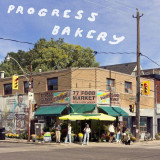
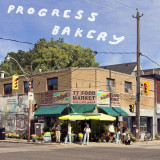
On Progress Bakery, her second album as a solo artist, Eliza knows to leave some questions alone – to let juxtaposition and tension be the proof. It doesn’t have to be hard. The feelings and revelations they provoke rise in the heat. The smell is sweet. Crispy on the outside and soft all the way through. She playfully slip-slides through words and sounds and images, delighting in surprise, skimming ideas like stones cast across clear water, touching down briefly with uncommon grace.
The question provoked between those opening lines resurfaces in the strands between songs – “Do U FM” is fully formed and beautifully layered, while “Novelist Sad Face” is a short, acapella rendering of gentle curiosity. What is holding these ideas together? Some songs demand more, seem to carry a whole load – eventually the skipping stone will halt to sink and resume its idle duty – while others drift in and out of focus, the way thoughts and dreams become interwoven before the mind is sunk into true sleep.
Music and words don’t always have to interact. Where she decides to keep them apart gives a new contour to where and how she puts them together. The kind of thing you’re supposed to take for granted with songs and their singers comes alive in Eliza’s hands – the little miracle of mixing, kneading, stretching, and stopping.
So often on Progress Bakery, Eliza teases out truth and meaning by asking questions. “Do I wanna be crying?” “Do you want me good or do you want me bad?” “Do I need an eye test?” “I’m writing songs in my head while you’re going over stuff with me — is that cruel??” In “Pocky” Eliza ends with a question that feels to me like the actual biography, succinct and revealing:
I don’t wanna be made to see
I just wanna ask “what’s that?”
Grace that ought to be rare, but in its care and precision is offered humbly, with great generosity, and without announcing itself. Eliza’s simple, miraculous music is given further form and shape by a group of collaborators – invaluable guest musicians Jeremy Ray, Evan Cartwright, Steven McPhail, Kenny Boothby, Ed Squires, Carolina Chauffe, Dorothea Paas, Louie Short, and Avalon Tassonyi. Together with Louie Short, who recorded, mixed, and produced the album along with Jeremy Ray and Lukas Cheung, Eliza has cultivated a richness in sound and texture that prods and provokes the ticklish ear. Barely audible guitar tinkering, a brief lo-fi field recording of trumpets, the harmonic clicking of a looped synthesizer, a flourish of reeds, a child’s conversation, each uncanny sound perfectly placed, rippling out under a soft breeze.
Lay in bed alone at night and ask aloud to the stillness,
“What were you doing at the Albuquerque Airport?
What were you doing there??”
And hear your question answered by a dream of swelling, undulating cellos. Try to grasp at the melody and structure. It’s not an answer (if there could be one), but it moves deeper, closer to the weird layer of fleeting moments and disconnected images, barely perceptible at its core. Wait for the dream reel to click into place.
Eliza took me for a ride in Nicole (her beloved Dodge Grand Caravan) and told me she’d been thinking of the album as an embodiment of transition – and I think every transition, known or unknown, carries the weight of new meaning, skittering off the surface tension of life as you know it, creating ripples, sometimes bouncing off and sometimes breaking through. There is a trick you can use to tell if a dough is glutinous enough. You’re supposed to stretch it out as thin as you can without breaking it and hold it up to the light. If you can see through, even if it renders the world murky and uncertain, you should leave it alone. I love this trick. It’s one that Eliza seems to know intuitively: work gently and ask questions and don’t always expect answers, and when you can, take a glimpse at something new, and then leave.
Kneading dough is tricky – you should know how it’s supposed to feel. If you try too hard you could make it worse. It’s a beautiful practice – creation with a gentle touch, to work at something so it can be left alone. “If it’s too drawn out it’s awful. It’s easy to give too much.” Dance in the mirror. Contemplate your veiny hands. Who do they remind you of?
You begin by mixing flour and water. “What happens when your people die? Why’d they move the rock to the other side of Ulster Park?” Eliza Niemi asks two seemingly unrelated questions in a rising melody with guitar accompaniment, like fingers playing spider up to the nape of your neck. Gentle pressure. Strands of gluten form to bind the mix. A new question lingers in the binding. When she admits “but I don’t know how to tell if I’m feeling it or not,” that question surfaces through the text. It is reiterated throughout the album. When I’m working with dough I think the same thing to myself.
On Progress Bakery, her second album as a solo artist, Eliza knows to leave some questions alone – to let juxtaposition and tension be the proof. It doesn’t have to be hard. The feelings and revelations they provoke rise in the heat. The smell is sweet. Crispy on the outside and soft all the way through. She playfully slip-slides through words and sounds and images, delighting in surprise, skimming ideas like stones cast across clear water, touching down briefly with uncommon grace.
The question provoked between those opening lines resurfaces in the strands between songs – “Do U FM” is fully formed and beautifully layered, while “Novelist Sad Face” is a short, acapella rendering of gentle curiosity. What is holding these ideas together? Some songs demand more, seem to carry a whole load – eventually the skipping stone will halt to sink and resume its idle duty – while others drift in and out of focus, the way thoughts and dreams become interwoven before the mind is sunk into true sleep.
Music and words don’t always have to interact. Where she decides to keep them apart gives a new contour to where and how she puts them together. The kind of thing you’re supposed to take for granted with songs and their singers comes alive in Eliza’s hands – the little miracle of mixing, kneading, stretching, and stopping.
So often on Progress Bakery, Eliza teases out truth and meaning by asking questions. “Do I wanna be crying?” “Do you want me good or do you want me bad?” “Do I need an eye test?” “I’m writing songs in my head while you’re going over stuff with me — is that cruel??” In “Pocky” Eliza ends with a question that feels to me like the actual biography, succinct and revealing:
I don’t wanna be made to see
I just wanna ask “what’s that?”
Grace that ought to be rare, but in its care and precision is offered humbly, with great generosity, and without announcing itself. Eliza’s simple, miraculous music is given further form and shape by a group of collaborators – invaluable guest musicians Jeremy Ray, Evan Cartwright, Steven McPhail, Kenny Boothby, Ed Squires, Carolina Chauffe, Dorothea Paas, Louie Short, and Avalon Tassonyi. Together with Louie Short, who recorded, mixed, and produced the album along with Jeremy Ray and Lukas Cheung, Eliza has cultivated a richness in sound and texture that prods and provokes the ticklish ear. Barely audible guitar tinkering, a brief lo-fi field recording of trumpets, the harmonic clicking of a looped synthesizer, a flourish of reeds, a child’s conversation, each uncanny sound perfectly placed, rippling out under a soft breeze.
Lay in bed alone at night and ask aloud to the stillness,
“What were you doing at the Albuquerque Airport?
What were you doing there??”
And hear your question answered by a dream of swelling, undulating cellos. Try to grasp at the melody and structure. It’s not an answer (if there could be one), but it moves deeper, closer to the weird layer of fleeting moments and disconnected images, barely perceptible at its core. Wait for the dream reel to click into place.
Eliza took me for a ride in Nicole (her beloved Dodge Grand Caravan) and told me she’d been thinking of the album as an embodiment of transition – and I think every transition, known or unknown, carries the weight of new meaning, skittering off the surface tension of life as you know it, creating ripples, sometimes bouncing off and sometimes breaking through. There is a trick you can use to tell if a dough is glutinous enough. You’re supposed to stretch it out as thin as you can without breaking it and hold it up to the light. If you can see through, even if it renders the world murky and uncertain, you should leave it alone. I love this trick. It’s one that Eliza seems to know intuitively: work gently and ask questions and don’t always expect answers, and when you can, take a glimpse at something new, and then leave.
Madronas’ debut LP Erogenous Biome is an amorphous, murky, cathartic offering. A duet of modular synthesizer and winds that’s equal parts doom and ecstasy, it’s the sound of a majestic butterfly emerging from it’s slimy chrysalis just in time to catch the sun setting on the end of days, a bewitching, heavy ceremony, a power-wash of both mind and spirit.
Tracked in one continuous take at Brooklyn’s Heavy Meadow studio, individual tracks were gleaned from the purge and eschew predictable structures, making for a dense, fluid suite of improvisation, like dancing smoke ribbons in the dark. The duo's chosen sound sources are seemingly opposite - Ry Fyan’s modular’s coming from electronic oscillators, Isaiah Barr’s saxophone and various flutes originating with the breath - but the visceral, imprecise, alive quality to the sound of both lends the record a thrilling combination of rapturous harmony and gritty, intense friction.
Opening the session in ritualistic, foreboding fashion, Voluntary lurches to life with rattles and wandering, bassy arpeggios before a suona’s cry signals the seance has officially begun. Ostraca Loam spits explosive modular rhythms and eerie shrieks for the flute to float above, while Detritus Harp smudges mechanical whirring, pensive horn and wind chimes for an untethered drift. Petrified Microdot swells with menacing sci-fi sequences and breathtaking sax runs until they both run out of breath, and Negative Lingam starts out in a panic of breathy riffing before exhaling into one of the most sublime passages on the record. Rhythmic pounding and undulating flutes punctuate Lenticular Shroud, before The Preparation Of The Novel sets the winds aside for a synthesized dual fit for electric dreams. The title track dominates the B-side, it's shimmering levity slowly unfurling to reveal itself as a kind of post-apocalyptic devotional music, deep space drifting grounded by earthly flutes, and Vale Of Cashmere offers an ascetic, contemplative closure, sparse flute and chiming rhythms organic or electronic - by this time it’s hard to know, it doesn’t matter either way.
Erogenous Biome is a world of it’s own, and one Impatience is honored to offer a window into.
RIYL - Senyawa, witchcraft, Colin Stetson , Civilistjavel, Mars (the planet), Finis Africae, raga, Stephen O’Malley, modular synthesizer, Anthony Braxton, Shabaka.
Madronas is Ry Fyan and Isaiah Barr. Fyan is a painter and tattoo artist, this is his first release. Barr is a prolific instigator of the downtown New York scene, producing and playing saxophone in jazz circles with his group Onyx Collective, as a player and/or producer on records by Nick Hakim, David Byrne and Wiki, performing live with William Parker and as part of his projects Universal Space Jam and Cafe Dewanee.
Erogenous Biome was recorded and mastered by Griffin Jennings at Heavy Meadow, Brooklyn.
Vinyl was cut by Beau Thomas at Ten Eight Seven Mastering, Berlin.
Artwork is by Ry Fyan, typography and layout by Nicolas Turek.
The Crystal Hum is the debut vinyl release by Taiwan-based artist Yuching Huang and her first release for Night School.
A beguiling dreamscape of crackles, spluttering, love-struck Casios presided over by the the spectral vocal and guitar work of Huang, Yuching sings love songs at the end of this world and the beginning of the next. Recorded during a hiatus from her group Aemong (a duo with artist Henrique Uba) in Berlin, these songs elevate Huang’s unique vocal style and grasp of atmospherics. The Crystal Hum deconstructs balladry, Garage, guitar music and reforms it into a
unified ghostly otherworld version of these languages.
The Crystal Hum thrums with buried desire, trails of nocturnal reverb seeping out of apartment windows, diaristic vocal performances and deeply emotive, evocative Western-style strings. Formulated by Yuching Huang after periods of frustration and experimentation, the album is an exercise in minimalism and paring back, with some tracks like JohnJohn featuring little else than an elastic bass, spring reverb trails, an interjecting vocal and swelling, dislocated synths. The effect is spellbinding, the soundtrack to getting lost in the labyrinthine, closed streets of Venice, Taipei, Hong Kong, or mirror versions of them in the imagination.
On opener Fly! Little Black Thing, a subterranean funk bassline roots Huang’s singing, a rudimentary, unreliable beat floundering in whimsy underneath. Demure, dream Dance music, Huang references classic lo fi experimenters Suicide and Arthur Russell as well as Night School label mates The Space Lady and Ela Orleans. In fact, after the release of Aemong’s third album Crimson, Huang credits the direction of The Crystal Hum to being enchanted by The Space Lady’s Greatest Hits,
the landmark lo-fi recording made by Susan Dietrich Schneider in 1990. The new, minimalist approach to her sound world reveals and shrouds in equal measure. On the heart-melter Love, a sultry mid-tempo Casio + bass backing drops into the ether with Huang’s vocal swimming in preternatural void before emerging anew, in awe at the world. Every chord change heralds new perspectives, every guitar flurry swells and drips emotion, nothing is wasted and space billows out from between the grooves.
Huang never reveals more than necessary, making this an in-between love album: the right amount of mystery and darkened mirror shines wanely on The Crystal Hum while remaining fragile and vulnerable in the sweet spots. Turning over in pillowing smoke and night in the dark corners, Huang sings in both Mandarin and English. The songs speak of earthly matters seemingly at the edge of dissipating into nothing. Distorted, beguiling Sambas warble like sweating dancehalls in an imagined Lynchian 60s, as on Thoughts. Closer You, An Illusion warps a classic 60s Girlgroup bassline beloved of the likes of Les Rallizes
Denudes into a slight ballad on the edge of the void, held back by the teary-eyed, wistful and enveloping vocal cooed by Huang. Each song feels like a love song dedicated to the bits between worlds, between beats, the negative space between people where desires, feelings and loss hangs in the air, resolute and unresolved.
- A1: Focused
- A2: Idntknwyt
- A3: Lover's Potion
- B1: G.r.e.a.t
- B2: Full Sentimental
- B3: Put Out The Fire
‘LIVE. SHIFT. DREAM.’ : three words for a first EP that invites you to embrace existence, shift gears when opportunities arise and keep your hopes and ambitions alive. That's what PAMELA is all about: electric energy, raw momentum, urgency. There's no time to get bogged down, it's all there in front of us, so let's make the most of it.
In this EP, each track is a facet of themselves, a distillation of their influences and raw energy. ‘Focused’ opens like an adrenalin rush, oscillating between desire and loss of control. ‘G.R.E.A.T.’ ? An explosive Britpop anthem, celebrating individuality with saturated synths and a heady riff. ‘IDNTKNWYT’ invites you to let go and dance without restraint. Then there's ‘Lover's Potion’, which reveals a softer, more intimate side, with a retro, hushed voice that's transporting.
And that's not all: ‘Full Sentimental’ is a powerful confession, where nostalgia becomes an outlet, while ‘Put out the Fire’ burns with urgency and sounds the alarm about the current climate situation.
Co-produced with Pierre Cheguillaume (who also produced Zaho de Sagazan), their tracks oscillate between LCD Soundsystem, The Cure, and Soulwax, blending into dance music tinged with indie rock and britpop. Showcasing their full power live, PAMELA will perform at La Maroquinerie (Paris) in March, after supporting Zaho de Sagazan on her Arena tour.
‘LIVE. SHIFT. DREAM.’ is more than just a start for PAMELA: it's an invitation to feel, to vibrate, and never stop.
OHYUNG aka Lia Ouyang Rusli describes their new album as “my trans self and my former self in conversation, from both perspectives.” The record represents their lengthy, complicated, but crucial journey between lives, strewn with both doubt and excitement. It is an ecstatic, pop-oriented shift in direction from an artist primarily known for noise, experimental hip-hop, and ambient music, but carried with sleek confidence, maturity, and a silvery, hallucinogenic shimmer that reveals Rusli’s experimental background. It is, writes Rusli, “sometimes written from a dark place and other times from a place of happiness.” Throughout, darkness and light rise and fall in layers of phased strings, trip-hop drum production, and earworming vocal lines.
Also a film score composer, Rusli’s songwriting craft is meticulous and nuanced. You Are Always On My Mind was, perhaps surprisingly, formed primarily from processed “generic string loops” found in online sample packs - a strange and wilfully jarring reminder that what seems to be is not always what is. Recontextualised, these string loops enshadow the simplicity of their origins and reveal a grace and purposefulness perhaps not even imagined by their authors, subtly drawing out euphoria and tension in equal balance.
Rusli also writes of the influence of rave culture central to their transition, and of the record’s production and theme. “It’s a declaration of love for raves and the dark hazy rooms that helped me to be free and true with myself— seeing other people who are so free and beautiful and thinking that one day that can be me— that’s me in the future.” But there is also a fear and unease present. Key moment “no good” explores “the worst version of myself as a trans person, feeding doubt to my pre-transition self” with its core lyric anyone can see / I’m no good for you, delivered over a relentless beat, swooning strings, and glistening synthesis.
Later, “i swear that i could die rn” renders a Spectreish Motown beat lamenting and lush with breathy synths and knife-edge melodies that eventually yield a hazy, gliding string section, created again from mutated, spliced, and transitioned royalty-free sample packs. The track is about “seeing my beautiful friends at raves and feeling at home appreciating the harsh noises of hardcore techno and acid. Feeling that I could die at this moment and be happy.”
Returning for another highly-anticipated album for Spatial, label stalwart Aural Imbalance breathes new life to a genre often starved of truly wide-ranging ambience blended with breakbeats that can move a dancefloor, elevating and surpassing expectations once again across a varied, cohesive selection of tracks.
A1 - Dream Assembly
Opening the LP we see Aural Imbalance showcase that inimitable world-building through swirling ambient soundscapes in full effect, a luscious intro welcoming sharp, snappy breakbeats, edited sublimely, collecting visceral cyberpunk debris on their long journey home. Subtle 808 basslines lie sleepily beneath as the composition forms a memorably soothing vibe that captures the mind.
A2 - Comet Cycle
Low filtered beats adorn an intro warning of energy to follow, forming a distinctive tone that is quickly elevated by surprisingly energetic and impeccably tuned breaks. Presently joined by inquisitive smatterings of ethereal effects, the track develops a curious and tuneful identity with harmonising melodies crafted across a varied mix, building and retaining a rousing, suspenseful vibe, leaving the listener in no doubt as to the ever-evolving skillset of Aural Imbalance.
B1 - Neptune
Setting the pace immediately with classy, imposing breakbeats, Neptune sees Aural Imbalance showcasing a wonderful ethos of dancefloor-friendly atmospherics with finely crafted edits toyed with at will for the listener with the breaks being the undoubted star of the show from an ambient legend. Subdued melodies and wide-ranging synthwork dances back and forth complementing the mix, all with a bouncy 808 bassline rumbling below.
B2 - Stasis
Changing the pace somewhat, next up we are treated to Stasis, a track which again opens with breaks, this time slightly more reserved with a thudding, analogue tone. Calming atmospherics crafted from delicious synthwork and reverberating melodies join forces with wisping pads that fly gently around the soundscape, with plinky rhapsodies delicately adding texture to a truly wonderful collage of sound.
C1 - Warpcore
Deceptively airy with incredibly light bongos and synths, the introduction to Warpcore entices the listener perfectly, smoothly introducing filtered breaks which suddenly reveal superbly programmed, distinctive amens that thrash around the mix with vigor. Clicky hats, striking cymbals and layers of tuneful effects deliver immense detail you can listen to over and over, hearing new elements each time.
C2 - Into The Void
Continuing the breaks-driven approach to the LP, Into the Void sees Aural Imbalance lay down a sublime selection of crisp, earthy old school breakbeats, edited to perfection with an immensely danceable beat pattern with delicate cowbell-style hi hats. Energising, vibrantly inspiring pads inject a warm sparkle to the mix, while a consistent, luscious classic 808 bassline playfully judders along below.
D1 - Thermal Isolation
Opening with an ever so slightly nervous tone, a plethora of layered ambient sounds create caution and intrigue, as Thermal Isolation's intro draws you in before a wonderful arrangement of messy breaks built with a delicious exuberance Aural Imbalance is clearly enjoying as his Spatial repertoire grows ever more impressive. Radiant effects are liberally flecked across the flourishing track in the latter half, adding grand texture and depth.
D2 - Forever
Closing the LP in style, Aural Imbalance delivers a mellow intro to Forever, consisting of filtered beats and a simple xylophone-style melody, before the true star of the show - some of the most finely crafted breaks you'll hear - thump their way into the mix and warmly seize our attention. Edited with a bold, effortless brilliance, the classic hats and kicks triumphantly jostle around long vocal samples and subtle ambient synths to round off this beautiful track - and album.
Words by Chris Hayes (Spatial / Red Mist)
- Throne
- Roam
- Axe
- Dawn
- Forest
An air of ancient ritualism cloaks Modern Love’s midnight meeting between UK producer MOBBS and French-Egyptian spellcaster Susu Laroche, carving out a channel between hexed trip hop and shoegaze that’s one part DJ Screw, one part MBV, operating within a long shadow of influence cast by Curve, Leila, Cocteau Twins, Nearly God.
Clasping chiral energies on their debut collab, MOBBS brings a history spanning shadowy production work for big name artists to the grimly stylised vein of performance art and musick explored by Susu Laroche, an Egyptian-French with strong binds to chthonic contemporary London.
Their maiden sacrifice heightens the senses to blends of monotonic, sandalwood scented incantations and carpet-burned downbeats swept in slurred dub. Songs are subtly variegated in tone to spell out shifting plays of light evoking bedsit antechambers and warehouse innards lit by iPhone candle or extractor hood and emergency light bulbs on their last lumens.
It's music that's as elaborately serrated and blemished as early MBV, but positioned in a vastly different cultural landscape, drawing from hip-hop, drone, psych and basement noise. The pair’s range of cultural obsessions maintains a precarious balance between shadowy histories and an asphyxiating present; all too often, when the past is projected it's thru a mollifying, nostalgic lens, so their critical, prudent hybrid sound is a vital, chilling corrective.
From the bell-ringing, chain-rattle jag of ‘Throne’ thru the sleepwalker drift of ‘Roam’, and concrete plangency of ‘Forest’, the marriage of MOBBS’ illusive textures with Laroche’s feel for analog image and film (as evinced in her art for the likes of Blackhaine and Mica Levi) imprints their sound in gauzy layers that leave fleeting impressions on the mind’s eye. At their heaviest, Laroche’s arcane declarations descend in impressive enactments, undressing the excesses of over-glossed trip hop to reveal and revel in the sound at its starkest, sexiest, for new waves of washed up souls.
QUEENDOM is an album that marks a new era for the project while staying true to the essence of Minuit Machine. Produced under the SYNTH RELIGION label, this opus immerses us in Amandine's introspective realm, oscillating between darkness and light, between doubt and self-conquest. While retaining the emotional DNA of previous productions, QUEENDOM stands out with a more pop-oriented touch, featuring tracks where Amandine sings in French for the first time.
The first single, "HOLD ME," is a powerful pop anthem addressed to the queer community, celebrating the freedom to be oneself and breaking free from societal and patriarchal norms. This track is a true empowerment statement, with striking electro beats supporting a strong message of emancipation and pride.
"Créatures," a collaboration between RAUMM and Minuit Machine, is a modern fairy tale—a timeless love story that could take place in any era. This salvific love, rarely seen today, embodies a poignant depth and beauty.
Continuing the journey, "Cent Fois"—a French-written track—takes us into a techno-pop universe with nostalgic yet hopeful undertones. This song perfectly reflects Minuit Machine's evolution toward a more radiant approach while staying faithful to its dark heritage.
"Party People," on the other hand, is a return to roots with dark wave/italo sounds. This hypnotic and haunting track questions identity in an increasingly robotic society, where individuals are forced to conform to imposed norms. This exploration of the individual versus the collective lies at the core of Minuit Machine's DNA.
"Mes Souvenirs," created in collaboration with Rebeka Warrior, dives intimately into the memories of Amandine and Rebeka. Together, they reveal fragments of their past—precious and vibrant memories that resonate through powerful and melancholic electro sounds.
Finally, the eponymous track "Queendom" invites us to plunge into the depths of Amandine's world—a universe that is both tormented and icy, yet resilient. Supported by a slow and captivating rhythm, this track is designed to grip and haunt the listener, like an incantation.
QUEENDOM is a bold and hybrid work where each track reflects a pursuit of sincerity and artistic reinvention while maintaining the ability to express emotions through rhythms that are both danceable and introspective. The album showcases Minuit Machine's artistic maturity, establishing itself as a must-listen in the darkwave and electronic pop scene.
Amandine entrusted the artistic direction of this album to Manon Dupeyrat, a brilliant young artist who crafted a bespoke universe perfectly aligned with the produced tracks. The album cover, both intimate and anachronistic, invites listeners into Amandine's private world through her bedroom, revealing what she wishes to share.
Limited White / Brown Vinyl[33,66 €]
Black Vinyl[33,66 €]
- A1: Do U Fm
- A2: Novelist Sad Face
- A3: Green Box
- A4: Dusty
- A5: The Linda Song
- A6: Dm Bf
- B1: I Tried
- B2: Melodies Like Mark
- B3: Wildcat
- B4: How U Remind Me
- B5: Pocky
- B6: Bon Tempiii
- B7: Pt Basement
- B8: Alberqurque Ii
- B9: Mary's
Kneading dough is tricky – you should know how it’s supposed to feel. If you try too hard you could make it worse. It’s a beautiful practice – creation with a gentle touch, to work at something so it can be left alone. “If it’s too drawn out it’s awful. It’s easy to give too much.” Dance in the mirror. Contemplate your veiny hands. Who do they remind you of?
You begin by mixing flour and water. “What happens when your people die? Why’d they move the rock to the other side of Ulster Park?” Eliza Niemi asks two seemingly unrelated questions in a rising melody with guitar accompaniment, like fingers playing spider up to the nape of your neck. Gentle pressure. Strands of gluten form to bind the mix. A new question lingers in the binding. When she admits “but I don’t know how to tell if I’m feeling it or not,” that question surfaces through the text. It is reiterated throughout the album. When I’m working with dough I think the same thing to myself.
On Progress Bakery, her second album as a solo artist, Eliza knows to leave some questions alone – to let juxtaposition and tension be the proof. It doesn’t have to be hard. The feelings and revelations they provoke rise in the heat. The smell is sweet. Crispy on the outside and soft all the way through. She playfully slip-slides through words and sounds and images, delighting in surprise, skimming ideas like stones cast across clear water, touching down briefly with uncommon grace.
The question provoked between those opening lines resurfaces in the strands between songs – “Do U FM” is fully formed and beautifully layered, while “Novelist Sad Face” is a short, acapella rendering of gentle curiosity. What is holding these ideas together? Some songs demand more, seem to carry a whole load – eventually the skipping stone will halt to sink and resume its idle duty – while others drift in and out of focus, the way thoughts and dreams become interwoven before the mind is sunk into true sleep.
Music and words don’t always have to interact. Where she decides to keep them apart gives a new contour to where and how she puts them together. The kind of thing you’re supposed to take for granted with songs and their singers comes alive in Eliza’s hands – the little miracle of mixing, kneading, stretching, and stopping.
So often on Progress Bakery, Eliza teases out truth and meaning by asking questions. “Do I wanna be crying?” “Do you want me good or do you want me bad?” “Do I need an eye test?” “I’m writing songs in my head while you’re going over stuff with me — is that cruel??” In “Pocky” Eliza ends with a question that feels to me like the actual biography, succinct and revealing:
I don’t wanna be made to see
I just wanna ask “what’s that?”
Grace that ought to be rare, but in its care and precision is offered humbly, with great generosity, and without announcing itself. Eliza’s simple, miraculous music is given further form and shape by a group of collaborators – invaluable guest musicians Jeremy Ray, Evan Cartwright, Steven McPhail, Kenny Boothby, Ed Squires, Carolina Chauffe, Dorothea Paas, Louie Short, and Avalon Tassonyi. Together with Louie Short, who recorded, mixed, and produced the album along with Jeremy Ray and Lukas Cheung, Eliza has cultivated a richness in sound and texture that prods and provokes the ticklish ear. Barely audible guitar tinkering, a brief lo-fi field recording of trumpets, the harmonic clicking of a looped synthesizer, a flourish of reeds, a child’s conversation, each uncanny sound perfectly placed, rippling out under a soft breeze.
Lay in bed alone at night and ask aloud to the stillness,
“What were you doing at the Albuquerque Airport?
What were you doing there??”
And hear your question answered by a dream of swelling, undulating cellos. Try to grasp at the melody and structure. It’s not an answer (if there could be one), but it moves deeper, closer to the weird layer of fleeting moments and disconnected images, barely perceptible at its core. Wait for the dream reel to click into place.
Eliza took me for a ride in Nicole (her beloved Dodge Grand Caravan) and told me she’d been thinking of the album as an embodiment of transition – and I think every transition, known or unknown, carries the weight of new meaning, skittering off the surface tension of life as you know it, creating ripples, sometimes bouncing off and sometimes breaking through. There is a trick you can use to tell if a dough is glutinous enough. You’re supposed to stretch it out as thin as you can without breaking it and hold it up to the light. If you can see through, even if it renders the world murky and uncertain, you should leave it alone. I love this trick. It’s one that Eliza seems to know intuitively: work gently and ask questions and don’t always expect answers, and when you can, take a glimpse at something new, and then leave.
- A1: My People Ft.. Ghetto Boy
- A2: Why Should I Smile Ft. Mélissa Laveaux
- A3: Solitude Ft. Isabel Sörling
- A4: Hey I Want You Ft. Olle Nyman
- A5: You Say (Inst.)
- A6: With Us Ft. Ben L’oncle Soul
- B1: California Intro (Inst.)
- B2: California Ft. Ala.ni
- B3: Loving You Is All I Want To Do Ft. Aloe Blacc
- B4: Mandolinho (Inst.)
- B5: Again Ft. Anna Majidson
"Float like a butterfly and sting like a bee" said the famous boxer Mohammed Ali, in reference to his legendary strike. This punchline also works wonderfully in music, listening to Roseaux's third album. A French success story, created with all modesty and honesty by the Parisian trio: Emile Omar, Alex Finkin and Clément Petit.
The three musketeers of sound cultivate their know-how, now acclaimed by critics and an ever-growing audience since their first project in 2012. It took them time to take a step back and gain perspective in order to offer us a return that is both joyful and resounding.
Roseaux takes root on the banks of soul, folk, jazz, and songs from all eras, a cascade of inexhaustible sounds, where the three composers draw their inspiration and merge their experiences.
The leaves of Roseaux soar to the breath of wonderful voices, chosen with precision by the three friends, like that of the American singer Aloe Blacc, present since the beginning of the adventure, essential enchanter of the three episodes.
Conceived as a dreamlike escapade full of emotions, on the fringes of the massive, instantaneous and often disembodied production, Roseaux is a totally artisanal group, a sort of UFO in the French musical landscape, which operates on instinct and above all on desire.
Thus, Roseaux has become an expert in bringing together, for the duration of a record, the artists who specifically form the DNA of their host: captivating voices, a plot on the piano and cello, but also encounters and reunions, in a poetic and deliberately nebulous universe.
A welcoming nebula, where the listener is invited to listen and immerse themselves without hindrance, in a luxuriant, wild, exciting sound forest. This third album is the work of 3 music lovers, capable of switching roles: writing, arrangements, production, from which emerge this time, eleven tracks with chiseled melodies including three colorful and unusual instrumentals.
A journey between melancholy and euphoria, which led Roseaux to the ends of the planet, from the Caribbean to Europe via Africa to unearth other vibrations and unique performers: the captivating Grenadian-British singer Ala.ni, the little English afropop prince from Ghana, Ghetto Boy, and the disturbing Swedish Isabel Sörling, sign here a first flamboyant collaboration with the group.
While the talented Haitian-Canadian Mélissa Laveaux, the hypnotic Scandinavian singer Olle Nyman, the sparkling French-Canadian Anna Majidson and our remarkable national Ben, already present on the second part, still manage to create a surprise by revealing new aspects of their range.
Roseaux's voices are decidedly impenetrable and its magic is renewed today by making the strength of all these scintillating elements dialogue, to be discovered in a setting of softness and voluptuousness.
Nature is full of reeds, this one is unique.
Kicking 2025 off with a NEW LIFE, Kito Jempere resumes operations retro-outfit shining, all machines blazing, pulling up with a boiling four-trackpackage bound to get dance floors quivering in excitement. A stick ofdynamite flung into the mouth of today's corporate dance music blandness, 'New Life' finds the Saint Petersburg producer spitting multi-strain madnesswith reckless fun and adventurous panache. Take New Order in theirTechnique days, sprinkle with early hip-hop breaks and finish it with a funk-savvy mix of acid, happy hardcore and ghetto tech jack, and you prettymuch have the opening track and lead-single 'New Life' capsulized to a tee.
A blissed-out, choppy ride spinning recklessly into dance-y abandon, 'LoveFilter' takes us on a heavy-lidded trip across dreamy electronic folds andonto vaporous apexes, where drum-heavy jolts and sliced vocals collidewith spacious pads from outer space. As hypnotic as it reveals hard-hitting, 'Killer Line De-Part' deploys a warped kaleidoscope of trancey shades,grunge-y grit and largely '80s informed analogue wizardry, convergingtowards the most hair-raising finale with your feet in the air and a dumbsmile across the face. Rounding off the record, 'Put Love Into Your Heart(Club Mix)' is a luminous slice of trippy, feelgood electronics engineered fordance floor communion and uplifting let-go. Fill your heart with love.
- A1: All Natural
- A2: Erryday 99
- A3: Falling
- A4: Fresh Rain
- A5: It Ain't Nothing
- A6: Lazy Sunday
- A7: Masterpiece
- A8: No Factor
- A9: That Won Joint
- A10: To Paris With Love
- A12: Treal (True Real)
- A13: Trump Tight
- B1: Watch Time Reveal
- B2: Work It Out
- B3: We Made It
- B4: That Movie Joint
- B5: Apartment J
- B6: Spitfire
- B7: Genres (Feat. Kris Brown)
- B8: We
- B9: Late Night
For the first time on vinyl, J Rawls 1999 beat series offers scenes 1-3 and 6 never before heard tracks. All these beats are from the archives of Rawls in his early years (1996-1999) as a young producer in Cincinnati, OHIO. These beats are the essence of that Rawls sound and embody his entire style. According to Rawls, “I did this album because I have had so requests for my music from that underground hip-hop era. This record took me back to a time when making music was just for fun.”
A new squad emerges from the depths of the underground: Soundboy Dead. No backstory, no revealed identity, just pure sound system pressure. The enigmatic project blasts off with Deflagration, a four-track EP that doesn’t just demand attention, it commands it. This is dub pressure weaponized, low-end warfare built to test any soundgirl or boy.
From the very moment you press play, there’s no doubt—this is a full-on sonic assault. 140 BPM riddims hit like a batterram. Dubwise basslines, twisted and distorted, strike like a torpedo hurled from the shadows beneath. Meanwhile, gnarly synths and vocal chops cut through the mix like an unholy horn sounding from the starless night. Each track is engineered to dominate the dance and obliterate any sound system into scattered atoms.
Soundboy Dead come with a clear statement: no gimmicks, no compromises. Sound clash in its deadliest form.
- A1: Killa P & Numa Crew - Boys In Blue (Feat Long Range)
- A2: Killa P & Numa Crew - Family
- A3: Killa P & Numa Crew, Fleck - Jungle Leng
- A4: Killa P & Numa Crew - Love Inna We Heart (Feat Long Range & Charlie P)
- A5: Killa P & Numa Crew - Champion Sound
- B1: Killa P & Numa Crew - Different Life (Feat Lady Lykez)
- B2: Killa P & Numa Crew - Badman City Pt 2 (Feat. Big Red)
- B3: Killa P & Numa Crew - No Laugh (Feat Big Chain & Buggsy)
- B4: Killa P & Numa Crew - Can’t Get Me Down (Feat Demolition Man)
- B5: Killa P & Numa Crew, Abstrakt Sonance - Dreaming
- B6: Killa P & Numa Crew, Gk - Heartless (Outro)
After many years of artistic collaboration, the long-awaited album, KILLING TIME, bringing together London-based MC Killa P and Italian Bass music collective Numa Crew, has finally arrived.
Killa P, a name synonymous with potent lyricism and raw energy in the Grime scene, delivers a vocal masterclass throughout his debut long-player, soundtracked by the stellar production of the Numa Crew. Together they expertly navigate genres including dubstep, grime, dub, and jungle, while maintaining a distinct and cohesive musical identity.
Not simply a collection of individual tracks, Killing Time is a meticulously crafted journey through sound system music. There are no stylistic boundaries, as the long-player encompasses the entire musical spectrum that unites the Italian crew with the London-based MC, with Killa P free to showcase his evolution as an artist. Alongside them, the album also brings together a diverse cast of friends and collaborators, vocalists, and producers, each adding their own unique flavor.
From the pulsating dubstep-infused Boys in Blue, a searing commentary on social inequality, to the reggae-tinged steppa tune Love Inna We Heart featuring Charlie P and Long Range, a plea for unity and love, Killa P's lyrical dexterity shines.
Tracks such as Champion Sound, Badman City Pt.2 featuring the French Ragga legend Big Red, and No Laugh featuring Big Chain and Bristol’s Buggsy are a nod to Killa P's roots, beautifully showcasing his mastery of grime's signature sound, while the sped-up tempos of the Fleck collaboration Jungle Leng, and Can't Get Me Down featuring Ras Demo, inject a jolt of Junglist attitude. Different Life is a vibrant ‘carnival’ jam, that infuses grime and dancehall moods and sees the great Lady Lykez on the second verse.
The album wraps on a contemplative note with Dreaming, a collaboration with Abstract Sonance, and Heartless, featuring Killa’s son GK on production, revealing an introspective note that adds yet more depth to Killa P's artistry.
As the album’s second track, Family, proclaims: ‘man a deal with family, not friends’ - a fitting line to define the album as a whole… An ode to the unity and strength of family.
Bárbara Salazar aka Barbarelle is an experimental multidisciplinary artist from Buenos Aires, known for her conceptual work as a DJ, creative director, and curator.
‘Celesta’ marks Barbarelle first foray into composing and producing her own music; a debut that reveals the intimate, heartfelt territories of her creative universe. The culmination of years of composing for herself - ‘behind closed doors’ - ‘Celesta’ is a deeply personal, self-guided masterstroke of beguiling, free-flowing ambient soundscapes and DIY electronics. With ‘Celesta’, Barbarelle artfully transitions from ardent music aficionado to fully-fledged artist, unveiling an enchanting sonic world that has quietly matured over time.
‘Celesta’ is an exquisite odyssey of sound, assembled from fifteen tracks recorded between 2022 and 2024 in Buenos Aires and Los Angeles. Conceived as spontaneous and intuitive explorations, many of these tracks were recorded in one take without technically-minded premeditation. The product of organic experimentation rather than concrete intention, ‘Celesta’ is an authentic, candid record of emotions, memories, and profound interiorities.
Over time, the pieces in this tapestry found a common thread: a conversation with the ethereal, defined by emotional intensities and softly spoken utterances. ‘Celesta’ is an invitation to immerse yourself in soundscapes that merge to the point of dissolution, evoking the transparency of water and the lightness of a dreamlike world that transcends matter. Like the song of a siren, the voice becomes just another instrument, beyond language yet full of significance. A collection of songs that feels like opening a secret diary; a direct pathway to the centre of the heart.
In addition to her work as an artist, Barbarelle is the founder of Atlas, a platform dedicated to active listening through radio, live performances, listening sessions and more. She is also known for her radio show of the same name on Dublab, where she shares her unique approach to sound with eclectic selections and interviews with the likes of Air, BADBADNOTGOOD, Lucrecia Dalt, Juana Molina & more.