The Body is a prolific musical force whose creativity is matched only by the astonishing weight of their sound. Duo Lee Buford and Chip King have established their own musical language that reimagines how rhythm, dynamics, and sonics can shape or dismantle song structure. Over the course of two decades, the duo has consistently challenged assumptions and defied categorization, redefining what it means to be a heavy band. On their new album, The Body are again pushing limits and testing the boundaries of the studio to explore the extremes and microtonality of distortion to find its maximal impact. I've Seen All I Need To See is The Body at their most incisively bleak, a towering monolith of noise.
Search:rhythm king
Sabaturin is Charles-Émile Beullac (Galerie Stratique, Canada) and Simon Crab (Bourbonese Qualk, United Kingdom). In the spirit of old school tape exchanges that resulted in musical collaborations developed over long periods of time but informed by the infinitely easier processes of the digital age, "Kenemglev" was assembled without the musicians ever meeting.
The title "Kenemglev" means "consensus" in Breton, something which quite naturally had to be achieved between both musicians. The other consensus was a sort of virtual middle ground symbolized by the Breton language, particular to a geographical area (Brittany) that both agreed would stand for a neutral meeting point between their respective native languages and, consequently, cultures. All titles are Breton words and the name Sabaturin ("standing on one feet", "to be off-balance") expresses mainly Charles' excitement: "Simon's bold approach has been some kind of a shock therapy for my music".
The sleeve was designed by Simon Crab, using a Chladni pattern simulation based on specific pitches. Looking like stained glass, it sort of reflects the way the music is presented: although including 9 titles, the album's tracklist flows uninterrupted on each side of the vinyl, semi-mixed, blended.
Detailed electronic ambience, glitches, loops and tiny details are augmented by a sort of signature rhythmic grid we recognize from "My Government Is My Soul"-era Bourbonese Qualk. It never settles into a formula and so the music remains loose, as much Mille Plateaux as classic 80s industrial shortwave-sampling or dub, rolled into one same entity, touching base with the gorgeous glitch dub "Morgouskus". This concludes a gentle and discreet album that doesn't require the validation of being associated with any of the current keywords in the electronic music scene.
- A1: Samba Negra - Eberebijara
- A2: King Somalie - Monkey 'S Dance
- A3: El Grupo Folclórico - Tamba
- A4: Los Viajeros Siderales - El Campanero
- A5: Rio Latino - Ayu
- B1: Aníbal Velásquez - La Mazamorra Del Diablo
- B2: La Francachela - Mosquita Muerta
- B3: El Grupo Folclórico - Juipiti
- B4: King Somalie - Le Mongui
- C1: El Grupo Folclórico - El Tornillito
- C2: Samba Negra - Long Life Africa
- C3: La Banda Africana - Te Clavo La... Mano
- C4: Myrian Makenwa - El Platano
- D1: El Grupo Folclórico - Tucutru
- D2: Grupo Bola Roja - Caracol
- D3: El Grupo D'abelard - Otro Perro Con Ese Hueso
- D4: Conjunto Barbacoa - Wabali
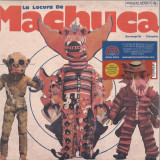
La Locura de Machuca is the story of one man’s bizarre odyssey into Colombia’s coastal music underground, and the wild, hypnotic sounds he helped bring up to the surface.
One night in 1975, a successful tax lawyer named Rafael Machuca had his mind blown in Barranquilla’s ‘Plaza de los Musicos’. Overnight he went from a high ranking position in the Columbian revenue authority to visionary production guru of the newly formed record label that bore his name, Discos Machuca, and for the next six years he devoted his life to releasing some of the strangest, most experimental Afro Psychedelia Cumbias ever produced. La Locura de Machuca is the story of one man’s bizarre odyssey into Colombia’s coastal music underground, and the wild, hypnotic sounds he helped bring up to the surface.
The Colombian music industry was thriving in the mid-seventies, but while homegrown bolero and vallenato tunes were doing well on the charts, it was imported African records that were setting crowds on fire at the picos – the sound-systems that fuelled neighbourhood parties – and wherever those records were played there were always a handful of groups who were inspired to plug traditional Cumbia directly into the electric currents coming from across the Atlantic.
It was these obscure bands, who fused Colombian and African rhythms with the swirling organs and psychedelic guitars of underground rock, that fired Machuca’s imagination. While the label made its money releasing popular hits by legends such as Alejandro Durán and Aníbal Velásquez, that money was poured back into a unique run of experimental releases by fringe artists such as La Banda Africana, King Somalie, Conjunto Barbacoa, and Abelardo Carbono, one of the godfathers of Champeta Criolla.
When Machuca couldn’t find groups to realise his particular vision, he simply created them himself. Drawing on a fearsome roster of musicians associated with the label, he assembled bands that lasted only as long as it took to record an album ,and unleashed the results – complete with arrestingly unusual album covers – under a series of different names such as Samba Negra or El Grupo Folclórico. This unorthodox approach led his longtime recording engineer, Eduardo Dávila, to describes Machuca’s productions as the “B-Movies of Colombian music.”
The story of Doctor Machuca and his eccentric exploits tells of one of Colombia’s most atypical and peculiar record companies; a defining pillar of Afro-Caribbean psychedelia. His productions have come to represent the roots of Champeta and set the pedigree standards for Afro and Costeño avant-garde. The seventeen tracks on La Locura de Machuca, harvested from the darkest, strangest corners of the Discos Machuca catalogue, sound like little else recorded before or since.
ACCEPT ARE BACK! The German kingpins of heavy metal will release their new, eagerly-awaited studio album via Nu- clear Blast on January 15th 2021. The ingenious title of the masterpiece is “Too Mean To Die”.
Speaking of heavy metal kingpins, when ACCEPT first launched at the end of the 70s, the metal genre didn’t even exist - at first the band could only be labelled with the (quality) seal “crazy loud and crazy wild”. Today we know that this was (and is) metal par excellence. And we also know that ACCEPT opened the door to thrash metal, inspiring giants such as Metallica. Guitarist Kirk Hammett recently stated in the German magazine “Gitarre & Bass”: “Wolf Hoffmann has a huge influence on me.“
ACCEPT, who once had their origins in the city of Solingen, a city of sound, have been a worldwide music phenomenon for more than 40 years. They still impress with razor-sharp guitar licks and a steel-hard sound. The band created all-time metal classics like “Balls To The Wall”, “Metal Heart” and many more.
Countless world tours and headline slots at the biggest, cutting-edge festivals cemented the band’s reputation as one of the best, hottest and loudest live acts ever. In addition, the band has sold millions of records, has achieved gold status in the USA, top 10 chart positions worldwide and a number 1 album (Germany, Finland) for “Blind Rage” (2014).
Now with “Too Mean To Die” their 16th studio album is in the starting blocks - it is the fifth album that US vocalist and front man Mark Tornillo has put his incomparable vocal stamp on.Recorded in the world music capital of Nashville (USA), ACCEPT’s music was once again produced by British master producer Andy Sneap, who is responsible for the mix. Sneap, who works for Judas Priest and Megadeth among others, has also been responsible for all ACCEPT productions since 2010.
Special circumstances often lead to very special albums. This is certainly true for “Too Mean To Die”, which of course alludes to the Corona period, although in a different way than one might assume. Hoffmann says: “Its to be expected that many musicians will address the Corona situation in their songs. There will certainly be slogans for cohesion, through which positive vibes should be spread, which is also good. But we have decided to not let ourselves be influenced by it. The fans will get a hard, direct and uncompromising metal album, but of course accompanied with a wink: We are too mean to die! Weeds do not go away! ACCEPT do not let themselves get down!”
Wolf isn’t wrong - the title track is a classic Accept cracker: dynamic and unwavering, turned up to eleven!
Zombie Apocalypse’, also relentless and hard, strikes the same note in the band’s signature style.
The first single - which will be released on October 2nd 2020 together with a remarkable video - is different. Titled ‘The Undertaker’, its a terrific midtempo number with great vocals and a built-in character that chugs along – certain to deliver some mermorable live moments! According to Wolf Hoffmann its one of the most catchy, pleasing pieces of the album.
New to the band, and thus to be heard for the first time on an ACCEPT album, is Philip Shouse (Gene Simmons Band, among others). The US guitarist fights hot duels with Hoffmann, while Uwe Lulis makes the guitar trio perfect and pro- vides the right rhythm. “Phil was part of our orchestra project and was also completely convincing live. We recognised his great talent immediately and simply didn’t let him go,” explains Hoffmann.
Just how varied the ACCEPT guitar trio performs on the new album is proven by one of the secret highlights: ‘The Best Is Yet To Come’ – a beguiling ballad in which Mark Tornillo is at his best. The metal world knows that Mark can scream like no other, but here it shows once again that the frontman can also sing magnificently. “Mark sang this, for us rather unusual song stunningly well. The fantastic thing about Mark is that he not only masters the typical metal screams, but can also sing melodically and beautifully. He proves this impressively in this song”, chief guitarist Hoffmann raves.
In addition, ACCEPT have strengthened their team even further with newcomers Martin Motnik (bass) and Philip Shouse (guitar), thus forming an unbeatable team together with “Drum God” Christopher Williams and “Rhythm Mas- ter” Uwe Lulis.
There’s no doubt that with “Too Mean To Die” Accept are once again playing at the top of the Champions League of the genre. Wolf Hoffmann & Co. present the (music) world eleven masterpieces at the beginning of 2021 - eleven songs for eternity!
Barang Bang Records Archive Series vol. 1
Previously unreleased recordings
Compiled by Gianmarco Liguori
Bernie McGann - alto sax
Kim Paterson - trumpet
Bobby Gebert - piano (side A)
Andy Brown – bass
George Neidorf – drums
Recorded by Trevor Graham in Sydney, Australia (copyright 1966)
There is no more engaging nor distinctive alto saxophone sound on the planet than McGann’s.
Sydney Morning Herald
McGann takes the language of Bebop then bends and stretches it to fit the contours of his own remarkable im-agination.
The Wire
Bernie McGann’s sound is exciting and physical, as heated as any post-coltrane modernist.
Downbeat
A lost treasure of Antipodean jazz
This compilation documents part of an exciting period in Australasian jazz. Recorded in Sydney, 1966, we can hear Bernie McGann was already one of the great Australian jazz stylists. At the time, the only publicly available recording he made was two tracks on the Jazz Australia compilation (1967) (CBS BP 233450).
Two years earlier, McGann was living in Auckland, New Zealand (1963-64). It was here that he worked regular-ly with Kim Paterson, Andy Brown and pianist Dave MacRae, and the basis of this band came into being.
‘Lazy Days’, ‘Chuggin’, and ‘Sky’ were salvaged from a cassette in Kim Paterson’s collection, one of the few remaining copies. Originally intended for a radio broadcast, the master tapes were reportedly destroyed after the session.
‘Rhythm-a-Ning’ and ‘When Will The Blues Leave?’ were taped by Trevor Graham at the Wayside Chapel in King’s Cross. Graham was a Sydney music journalist and ally of the avant garde, with the foresight to capture some of what was happening at the time.
This album is also notable for a rare appearance by the mysterious American drummer George Neidorf (mis-spelt as ‘Neidori’ in the liner notes on the first Soft Machine album), an early influence on drummer Robert Wyatt.
Field recordings of a major artist in strong company – a lost treasure of Antipodean modern jazz.
Dynamic Sounds Studio has its roots firmly set in Jamaica’s history. It was the first state of the art studio built in Kingston, Jamaica and a firm favourite with all the topflight homespun artists. Bob Marley chose to record the bulk of his seminal 'Catch A Fire' album there and many foreign musicians trying to catch some of that reggae magic and emulate that sound have beaten a path to its doors. As you will see the studio had a history already of its own, that was carved out before it became the aptly named Dynamic Sounds.
Originally named WIRL Studio's (West Indies Records Limited), it was set up initially to record Jamaica's versions of the American Rhythm and Blues tunes that were proving so popular on the island. It was started back in 1958 by Political leader Edward Seaga an astute businessman, who had many interests around the island including clubs and bars. As the R & B music evolved into its own styles from Mento into Ska, one of its main protagonists Byron Lee and his band the Dragonaires would be at the forefront and be seen as ambassadors to the cause. Edward Seaga would choose the band to head the 1964 World’s Fair and take them to New York to showcase the Jamaican Ska Music. His political ambitions leading the American friendly JLP (Jamaican Labour Party) against the Cuban inspired PNP (People's National Party), would see him cutting back his other interests and lead to the selling of WIRL, lock stock and barrel to Byron Lee. On taking over the business he renamed it Dynamic Sounds and extended it to include not only a top of the range recording studio but a pressing plant to distribute the new hot sounds of the day directly to the streets of Jamaica. The address would also change to 15 Bell Road, it's old address No 13, seemingly too unlucky for such a fine establishment.
The studio has become part of the Jamaican culture and each twist and turn in its musical story has been caught and recorded here. We get on board when the music had slowed down to the reggae skank that we now know and love. We have picked some fine cuts that we feel best represent the times. The rhythms are pushed to the fore and the great Sylvan Morris a much-underrated studio master, always came up with some interesting effects to enhance the version cuts. A fine time in reggae's history caught at one of Jamaica's finest studios. Dynamic Sounds from a Dynamic Studio.....
- A1: If I Could See Heaven Without Dying Feat Scott Burton
- A2: Ce-Les-Tial
- A3: Sunwalkers Part Two And Three Feat Bill Summers
- A4: Just A Little While Longer
- A5: African Bahia Sol Feat Dr Who Dat?
- B1: Viberian Waves 1 & 2 Feat Capitol Peoples
- B2: Broken Arted
- B3: Banana Peel (Cáscara De Plátano) Featuring Masauko Chipembere
- B4: Trop-Pics
- B5: Let The Cuica Play Feat Café And Micröclimate
In 2018 Far Out Recordings signed a record deal with Brooklyn born, nomadic producer Jneiro Jarel. Having just put the finishing touches to the recordings, Jarel suffered an ischemic stroke while living and working in Costa Rica and his wife Indigo was forced to set up a crowd fund to cover special medical transport back to the states to receive treatment. The release was put on hold, but thanks to the generosity of friends and fans around the world, Jarel was able to get the care he needed and is now on the long road to recovery. We’re overjoyed to finally announce that Jneiro Jarel’s After A Thousand Years is now set for an October 2020 release.
Throughout a career that has spanned over twenty years and seen collaborations with MF DOOM, Thom Yorke, Damon Albarn, BadBadNotGood, Portishead’s Beth Gibbons, Kimbra and Khujo Goodie (Dungeon Family), Jneiro Jarel’s consistently distinctive, forward thinking productions, as well as his love for the music of Brazil, made his partnership with Far Out a perfect fit.
Recorded between New York, New Orleans, Miami and Costa Rica, After A Thousand Years features legendary multi-instrumentalist Bill Summers, famed for his work with Herbie Hancock, Quincy Jones and Eddie Henderson. The album also features Malawian-American guitarist Masauko Chipembere who has worked with the likes of RZA from Wu-Tang Clan and Ladybug Mecca from Digable Planets.
For Jarel, After A Thousand Years is “a culmination of the longstanding musical contributions of the African diaspora.” Permeating the Brazilian music and Latin jazz Jarel has loved and drawn inspiration from, as well as the stateside jazz, soul and funk Jarel grew up around, the influence of Africa and its musical history, on both North and South America, is key to the album’s sound.
On lead single “Banana Peel”, Jarel’s outernational perspective makes for a track that is almost impossible to place geographically: you can hear the swing of Jarel’s native New Orleans jazz, the vibrance of Costa Rican rainforests as well as the influence of Jarel’s vast collection of Brazilian records. “Viberian Waves 1&2” is equally nonconformist, morphing from funky baroque-flavoured instrumental hip hop into a bossa inspired, percussive jam.
Taking its inspiration from the biblical prophecies found in the books of Isaiah, Daniel, and Revelation, foretelling the fully realized, physical and spiritual restoration of the earth and mankind after the thousand year reign of the Messianic Kingdom, After A Thousand Years contemplates and celebrates a world where everlasting love, peace, and harmony abound under a sovereign, divine rulership.
After A Thousand Years will be released on Vinyl LP and CD on the 30th October 2020 via Far Out Recordings.
FEEDBACK
“great release. Really like this!” Antal (Rush Hour)
“Banana Peel is exactly what we need now. Visionary Jneiro Jerel at his finest channelling healing sounds and rhythms from Mother Earth. A much-anticipated lens through Jneiro’s third eye. Thank you!” King Britt
“Sounding real good!” Errol Anderson (Touching Bass)
“I love it!!!!!!!” Raffaele Costantino (RAI RADIO 2)
“Sounds great. Congratulations. Will play it on my radio shows.” Batida
“Will pitch album to my editors” Dean Van Nguyen
“Please send me the full album once it's finished.” Francisco Noronha (Publico PT)
“Beautiful man. So happy that he's ok” King Hippo (WLPN-LP / Worldwide FM)
“cracking tune. already lined up to add to playlist. might go into radio show too.. love it” Oli Brunetti (Collectivo Futuro / Olindo Records)
“Amazing! Ive not heard anything from JJ for a long time but a welcome return, this is a cracking track. Looking forward to hearing more new material.” Mickey Jukes (1BTN FM)
“Very vibrant, fresh release! It gets better every time I am listening to it.” Shantisan (Superfly FM Vienna)
“This is a pretty special track , unique sound but very accessible , like it a lot and will play in my show Look forward to hearing the LP” Andy Wilson (Ibiza Sonica Radio)
“So good to hear Jneiro again, loving this cut. Thanks!” Chris Knight (Astrojazz)
“sublime !!!! will definitely play !!!” Mark Milz (Radio Corax)
“I-Robots approved!” Thanks for sharing...” I-Robots
The Mighty Jah Stitch was a legend in Jamaica, making the move as so many ghetto youth’s have tried from Bad Man to Music Man. Jah Stitch embraced the DJ Culture that he himself was an integral part of.
He put not one but two musical stamps on the format. His initial Big Youth sounding chants grew from working alongside the man on the mic. The second almost spoken vibe came about after a well documented incident that led to him being shot .He lived to tell the tale and cut some of the finest Roots DJ cuts, with his new vocal style that many copied but few have surpassed.
We have selected some of his best known tracks to show the knack of working a killer rhythm and dubbed vocal with an almost call and response story telling style.
The opening and title track to this set ‘Dread Inna Jamdown’ sees him working over John Holt’s ‘In The Springtime’.
The second cut ‘Dem Seek Natty Everywhere’ works another John Holt classic ‘Forgot to Say I Love You’.
After some hits in the 1970’s, the 1980’s would see a short name change to Major Stitch.
But we feel that his best loved monicker Jah Stitch serves the man well.
So sit back and enjoy some fine DJ Cuts
No Dread Can’t Dead…Jah Stitch R.I.P
- A1: New Amusements
- A2: Fighting Fit
- A3: Where Are They Now?
- B1: Speak To Me Someone
- B2: We Could Be Kings
- B3: Why I Was Born
- C1: Long Sleeves For The Summer
- C2: Save Me I’m Yours
- C3: Voice Of The Father
- D1: The Accidental
- D2: I Love You, What Are You?
- D3: Sub Rosa
• This is Gene’s second studio album released in 1997
• Singles include ‘Where Are They Now?’ (no.22 UK Charts), ‘Speak To Me Someone’ and ‘Fighting Fit’
• Double LP pressed on 180g Heavyweight vinyl, with original artwork,
presented in a gatefold sleeve with printed inner sleeves
• Inspired by the songs of The Smiths, The Jam and The Faces, Martin
Rossiter’s literate vocals and Steve Mason’s fluid guitar lines were perfectly complemented by the intuitive rhythm section of Kevin Miles and Matt James. They released four studio albums and a collection of B-sides and radio demos between 1995 and 2001, were named Best New Act at the inaugural NME awards in 1995, and went on to score 10 Top 40 hits.
Reissue of this mesmerizing record including an unreleased alternate mix of "Subterranean Zappa Blues". Hypnotic rhythms made of slow minimal beats, industrial textures, intoxicating drones and repetitive voices that seem to merge from dreams. Everything built by two of the most brilliant industrial music minds: Steven Stapleton and Colin Potter.
"This album arrived somewhere after a dream meeting of several individuals, Graham Bond, Joe Meek, Jacques Berrocal and myself. After a few beers and a heated disscussion of puncture repair we all lay down in a circle and point our penises at Venus, telepathic messages are sent out to Colin saying he can use the two golden microphones. He did, and here we are." Steven Stapleton, 17.1.94.
Rock 'n Roll Station began life with Steven Stapleton asking engineer Colin Potter to remix some of the more rhythmic elements of 'Colder Still' from 1992's Thunder Perfect Mind. As Potter gradually warped these sections into weirder and weirder pieces, a new album began to emerge. Potter himself explained it to David Keenan in England’s Hidden Reverse: “What I sometimes did in the studio was to ‘over-use’ effects and processors to totally mutate a piece into something completely different” while Stapleton observed how “it was almost as though telepathic messages were sent over to Colin. We’d started an album together at IC Studio that was never finished. He then sent me some vague mixes, which were just what I had in mind. So, from that basis, I started putting the album together.”
Potter would quickly become a key player in Nurse With Wound’s productions, a position he continues to fulfil to this day. He was first credited as a member on 1992’s Thunder Perfect Mind, a tour-de-force of cold, at times hostile, machined atmospheres, but considers Rock ‘N Roll Station from the following year to still be his favourite.
Building on percussion and drone elements, Stapleton and Potter throw in a huge range of bizarre and atmospheric elements: didgeridoos, chanting voices, and their usual selection of unidentifiable sounds.
Its strong focus on rhythm was erroneously surmised by some as an attempt to join the then rising electronic dance music scene. But it was Stapleton’s recent obsession with the music of ‘King of the Mambo’ Pérez Prado that was beating at the heart of Rock N’ Roll Station’s heady rhythms.
The album’s title alluded to two specifically rock-related stations of influence: the song of the same name by Jac Berrocal, of which a surprisingly straight cover opens the album in homage; and the tragic life of the Sixties British R&B organist Graham Bond who influenced bands such as Deep Purple and Cream. Beset by mental health problems (at one point believing he was the son of Aleister Crowley), Bond died under a train at a Tube station in 1989 and it is this tragic scene that Rock ‘n Roll Station’s closing track, ‘Finsbury Park, May 8th, 1:35 PM (I'll See You In Another World)’, sets in sound.
To close the 3 EP reissue series of Neville King and Lee Laing's King & City label, the all female group Charisma are presented with their summer infused Lovers cut, Everything Is Fine.
Three Lewisham friends, Angela Richardson on lead vocals, with Geselle and Janie backing, were active from 1982 to 1990, but are really remembered for the early recordings made with Neville King. Their debut, Everything Is Fine rides the Lovers sound at its peak. Written with One Blood's Lloyd Robinson, with the rest of band of Robinson brothers providing the rhythm section, this is pure South London sound system music.
Recorded again at TMC (Tooting Music Centre) Recording Studios - working alongside the likes of Dillinger, Tradition and New Musik - Everything Is Fine rides a beautiful soul reggae rhythm as Trevor (Drums) and Lloyd (Bass) Robinson set the foundations, while One Blood provide the Dub mix.
A true love's lament, a song of hope, serenity and pure vibes. Label head Chuggy slides behind the mixing desk for an extended Discomix that stretches, loops and dubs the vocal and dub back forth, to close a glimpse at this uniquely British phenomenon, taking reggae closer to it's heart and soul.
- A1: Das Goldene Zeitalter - Don't Give Up Your Smile Today
- A2: Nu Art Quartet - Black Bandit
- A3: John Tinsey - Freedom Excelsior (Part 2)
- A4: Obie Jessie Quartet - Black King
- A5: Walt Bolen - Peace Chant
- B1: Genghis Kyle - Bakit Ba
- B2: Luna Brothers Trio - Mozambique
- B3: Hozan Yamamoto - Spotlight On Sapporo
- B4: The Milestones - Funk
From 1963 to 2014: "Peace Chant - raw deep and spiritual jazz" exhibits 51 years of music. A well matched anthology with sounds to dive into, hard rhythms to dance to and vocals to meditate on.
The Tramp Records crew has compiled 9 tracks in nice order and dramaturgy. Some tunes you might have never heard before unless you own one of the rare original vintage vinyl records. Peace Chant is released on two separate LPs with own catalogue numbers and on one CD. Some songs I can't get out of my mind:
The previously unreleased "Don't Give Up Your Smile Today" is opening the compilation. It's from Das Goldene Zeitalter, a band that didn't survive - but whose members had a huge influence on German jazz, soul, afrobeat and funk within the last years merging into groups like The Poets of Rhythm, The Whitefiled Bros., and The Malcouns. Boris Geiger aka. Bo Baral sings a Pharoah Sanders like tune, his voice deeply resonating, the rhythm section heavily grooving.
After the first three woolly recorded tracks Walt Bolen's "Peace Chant" with its dry and funky sounds with flute, two guitars and percussion is quite a pleasure to listen to. Organ and voice are Bolen's who used to play the keys in San Fernando Valley church when he was a child. "Peace Chant" was recorded for his own Ar-Que label in 1972 and is one of the few cuts with him as a leader. He has played sessions and clubs for years and today he is sitting at the church organ again.
This publication's oldest recording dates back to 1963: "Mozambique" by Luna Brothers Trio, a Caribbean and hypnotic instrumental. For my jazz trained ears it is rather unusual that the güiro (the gherkin played with a stick) is being played throughout the entire song. Heavily laid back cowbell, concas and timbales and the slightly detuned piano are wonderful! "Mozambique" sounds like from another star but its origin is Los Angeles, where the brothers Fred and Ricardo Luna had their night club band. You could imagine a bast skirt strip and at the same time the great Raumpatrouille (Space Patrol) landing on German B&W TV screens in 1966.
Hozan Yamamoto recorded crime jazz with the Japanese bamboo flute shakuhachi. He belonged to Tony Scotts "Music for Zen Meditation" in 1964, played with Ravi Shankar, avant-garde jazz bassist Gary Peacock and appeared at Donaueschingen Festival for contemporary music. Tokio university's open minded lecturer recorded the funky and modal "Spotlight on Sapporo" in 1972.
ATA's newest release comes from The Yorkshire Film & Television Orchestra and features the vocal talents of Bugalu Foundation & Mind On Fire vocalist Martin Connor. This cover of the Georgie Fame classic "Somebody Stole My Thunder" features a powerhouse vocal performance from Martin Connor alongside the heavyweight big band brass sound of the Yorkshire Film & Television Orchestra's 10 piece horn section. This 7" single is backed with Rachel Modest's debut recording for the label, her intense vocal rendition of the Ben E King classic "I Who Have Nothing". Both tracks feature the trademark elements of the ATA sound: Big brass arrangements sit alongside the propulsive rhythm section, perfectly supporting both singers incredible performances.
Originally appearing as part of ATA Records free download series "Hard Work, No Pay" these 2 tracks have been sought after on vinyl for some time after garnering radio play and positive responses from BBC6 Music's Craig Charles Funk & Soul Show and the Huey Morgan show.
The Yorkshire Film And Television Orchestra is the brainchild of ATA founders Neil Innes & Pete Williams and multi-instrumentalist/arranger Steve Parry, who was approached by Neil & Pete in 2014 to provide the horn arrangements and brass performances for a then untitled British library style track intended for release as a 45. That track went on to become the track "Hawkshaw Philly" and features on the compilation "Early Works: Funk, Soul & Afro Rarities From The Archives" released earlier this year. Their shared love of huge big band arrangements and British library music ensured future collaborations, notably on this year's "ATA Records: The Library Archive Vol. 1".
Martin Connor is a well known face to anyone familiar with the Mancherster music scene and has spent 10 years as part of the Manchester collective "Mind On Fire" before providing vocals for the Latin-Funk band Bugalu Foundation (Legere Recordings).
Sheffield born,Rachel Modest developed her unique vocal ability within the churches and gospel choirs of her local community. Now based in Leeds she has developed a powerful and soulful vocal style that takes inspiration from artists such as Madeleine Bell, Dee Dee Warwick, and Dusty Springfield. Her debut for the label was this cover of the Ben E King classic "I, Who Have Nothing", which was later followed by an appearance on the debut 45 by The Magnificent Tape Band "Patterns in My Mind"and her own solo 45 "I Try/Forbidden Love", as well as collaborating with The Magnificent Tape Band on their debut LP "The Subtle Art Of Distraction" all of which received radio support from the likes of Gilles Peterson (BBC6 Music), Huey Morgan (BBC6 Music/Radio 2) and Lauren Laverne (BBC6 Music).
- A1: Christina Vantzou - At Dawn
- A2: Hot Chip - Nothing's Changed
- A3: Rhythm & Sound - King In My Empire (Feat Cornell Campbell)
- A4: Pale Blue - Have You Passed Through This Night
- B1: Suzanne Kraft - Femme Cosmic
- B2: Fever Ray - To The Moon & Back
- B3: Planningtorock - Much To Touch
- B4: Charlotte Adigery - 1,618
- C1: Mike Salta - Hey Moloko
- C2: Matthew Bourne - Somewhere I Have Never Travelled (For Coral Evans) (For Coral Evans)
- C3: Hot Chip - Candy Says (Exclusive Velvet Underground Cover Version)
- C4: Kaitlyn Aurelia Smith - Who I Am & Why Am I Where I Am
- C5: Beatrice Dillon - Workaround Two
- D1: Hot Chip - Worlds Within Worlds
- D2: Daniel Blumberg - The Bomb
- D3: Nils Frahm - Ode
- D4: Hot Chip - None Of These Things
- D5: Neil Taylor - Finnegan's Wake (Exclusive Spoken Word Piece - Excerpt)
"Minor Planets completes a trilogy of cosmically themed electro-acoustic albums by UK and Berlin based trio Twinkle3, 15 years in the making. This third installment is once again all about the unique synergies the group discover in combining free group improvisation with studio and musique-concrete techniques. The group's combined love of everything from Lee Perry to Noh Theatre via Karlheinz Stockhausen and King Sunny Ade lead them to respond musically to create a single universe where they all coexist and interact. Aleatoric analogue sequencing, chamber-like acoustic improvisation and dub treatments become distilled into a distinct and emotive narrative that takes us on an exhilarating hyperspace cruise to the outer reaches.
Clive Bell is a virtuoso of the Shakuhachi. His aesthetic takes us on a timbral journey between noise and pitch, expressed and phrased rhythmically by the contour of human breath. This creates a perfect context and focus for a music that moves seamlessly between rhythm, suspension, time modulated analogue states, dissonance and melody. Richard Scott and David Ross share a background in acoustic free improvisation and have pioneered new approaches to rhythm using self-designed analogue systems. On Minor Planets these seemingly paradoxical orthodoxies cross-pollinate in a spirit of wonder and optimism to produce original and experimental music that is both life affirming and uplifting.
Album artwork by Benjmain Kilchhofer captures the feeling of peering through the vacuum of space and catching a rare glimpse of the mysterious alien biomes, fossils, and silhouettes cast by dwarf planets, asteroids, Kuiper belt, and other trans-Neptunian objects."
From Mille Plateaux to Leaf, Staubgold and Raster-Noton, ~scape, or on his own label Ripatti, the Finnish artist Sasu Ripatti aka Vladislav Delay has been exploring various iterations of the dub culture vs. electronica, since 1997. His sonic crafts and unique signature sound has been sought after by an eclectic range of bands and artists, ranging from Massive Attack, Hauschka, Black Dice, Autopoieses, Animal Collective or AGF.
Somewhere between the old-school electronica culture, the soundscaping, the experimental paths of Lee Perry and Adrian Sherwood, ghostly clubbing anthems, minimalism, pop, jazz, without being, influenced, Vladislav Delay is building a drifting and coherent sound enigma.
Vladislav Delay met Sly Dunbar and Robbie Shakespeare (the most prolific Jamaican rhythm section and production duo) thanks to a series of jam sessions. Trumpet player Nils-Petter Molvaer had been asked by the Jamaicans to join them and he invited Delay alongside guitar player Eivind Aarset to tag along, which eventually turned into the Nordub project.
The result of these jam sessions turned into an album, mixed and mostly produced by Vladislav Delay, released on the label Okeh. It was also followed by an extensive series of live dates. This one-shot reunion was the beginning of another story: a trio composed by Delay, Dunbar and Shakespeare.
In January 2019, Vladislav Delay went to Kingston and spent some days at The Anchor studios, to record drums and bass with S&R, some voice takes and a series of atmospheric field recordings. Back to Finland, Delay started to experiment with this precious material, mixing and overdubbing, in the comfort and quiet of his studio, based on the island of Hailuoto, Baltic Sea, Northern Finland, giving another feeling to the Jamaican trip.
This became a tribute to the 'dub spirit', but in a very personal way, far beyond any influence or "the obvious". 500-PUSH-UP is two worlds collapsing, merging, also showing some intriguing approach of the Jamaican groove, used as a filigree, like the echo or the ghost of reggae, converging and conversing with a post-industrial and experimental approach. To file beside experiments - for instance - such as Lee Perry's 'Scientist Rids The World Of The Evil Curse Of The Vampires' or the On U-Sound productions.
- A1: For The Dead
- A2: Be My Light, Be My Guide
- A3: I Can't Help Myself
- A4: This Is Not My Crime
- A5: Sleep Well Tonight
- A6: Haunted By You
- B1: London Can You Wait?
- B2: Olympian
- B3: Fighting Fit
- B4: We Could Be Kings
- B5: Where Are They Now?
- B6: Long Sleeves For The Summer
- C1: Speak To Me Someone
- C2: As Good As It Gets
- C3: Fill Her Up
- C4: You'll Never Walk Again
- C5: Stop
- D1: Is It Over?
- D2: Yours For The Taking
- D3: O Lover
- D4: Somewhere In The World
- D5: Let Me Move On
Celebrating the 25th anniversary of their debut album 'Olympian', this is the definitive ‘Best Of’ Gene compilation, available exclusively on vinyl. Compiled by Matt James, Steve Mason and Kevin Miles and featuring 22 tracks, pressed on 2LP 180g heavyweight blue coloured vinyl Featuring fan favourites, plus all of the bands 10 top 40 UK singles including ‘Sleep Well Tonight’, ‘Haunted By You’, ‘Olympian’, ‘For The Dead’, ‘Fighting Fit’, ‘We Could Be Kings’, ‘Where Are They Now?’, ‘Speak To Me Someone’, ‘As Good As It Gets’ and ‘Fill Her Up’
Includes a selection of sleeve notes from the band and respected journalist Keith Cameron Inspired by the songs of The Smiths, The Jam and The Faces, Martin Rossiter’s literate vocals and Steve Mason’s fluid guitar lines were perfectly complemented by the intuitive rhythm section of Kevin Miles and Matt James. Gene released four studio albums and a collection of Bsides and radio demos between 1995 and 2001, and were named Best New Act at the inaugural NME awards in 1995, and went on to score 10 Top 40 hits.
- A1: Garou Densetsu Title (Neogeo)
- A2: Garou Densetsu Title (Mvs)
- A3: Fatal Fury Title (Neogeo)
- A4: Fatal Fury Title (Mvs) Ver.1
- A5: Three Heads Are Better Than One (Player Select)
- A6: Fight! (Battle Start)
- A7: The Hooligan Of Downtown (Duck King's Theme)
- A8: Haremar Faith Capoeira School - Song Of The Fight Believers Will Be Saved (Richard Meyer's Theme)
- A9: The Sea Knows (Michael Max's Theme)
- A10: Four Thousand Years Of Chinese History (Tung Fu Rue's Theme)
- A11: Results Are Everything (Battle Results)
- A12: Suspicious Guy (Interrim Demo)
- A13: The King Cobra Is Coming (Hwa Jai's Theme)
- A14: The Hero Raiden (Raiden's Theme)
- B1: Let's Start (Bonus Game Start)
- B2: Keep Going Until The Ends Of Hell (Bonus Game Main Bgm)
- B3: You Are Great! (Bonus Game Victory)
- B4: Failure Is The Key To Success (Bonus Game Defeat)
- B5: Hit By A Stick If You Walk Along The Bridge (Billy Kane's Theme)
- B6: Kidnapping (Geese's Subordinates Demo)
- B7: Desperate Awakening (Geese Appearance Demo)
- B8: A Kiss For Geese (Geese Howard's Theme)
- B9: Just A Little Smart Fighting Fellow (2P Battle Bgm)
- B12: I Won't Give Up! (Continue)
- B13: Beyond Despair (Game Over)
- B14: Enter Your Name (Battle Records Display)
- B15: Fatal Fury Title (Mvs) Ver. 2
- B16: The Hero Raiden -Rof Arrange Ver
- B10: In The Shadows Of Victory (Victory Demo)
- B11: If You Gaze At Reality (Ending)
SNK, Brave Wave Productions and Limited Run Games are proud to reveal their fifth collaboration, Generation Series 012: Fatal Fury for both CD and vinyl. Known as Garou Densetsu (餓狼伝説) in Japan and originally released for NEOGEO in 1991, Fatal Fury is one of SNK’s earliest, but also most popular 2D fighting games. The soundtrack, composed by TARKUN (Toshikazu Tanaka), features catchy and exciting tunes for each character in the iconic SNK fighters lineup.
This release marks the first time the soundtrack of Fatal Fury will be made available on vinyl. As with all Generation Series and other Brave Wave releases, this release will be remastered specially for vinyl, CD and digital (via a free download code included with the vinyl edition) and restored to the highest possible quality. The rest of the package will include our usual offerings, including high-resolution artwork and liner notes contained in a full-color booklet.
As a special bonus, Side B of the vinyl (the final track on the CD) will contain the track The Hero Raiden -ROF Arrange ver.-, which was originally featured in the 2015 mobile title The Rhythm of Fighters. The bonus track, an arrangement of the original song from Fatal Fury, was composed by TARKUN.
- A1: Walkin' My Baby Back Home (Nat King Cole With Orchestra)
- A2: What Does It Take
- A3: Walkin
- A4: I'm Hurtin
- A5: Where Were You
- A6: Angel Eyes
- A7: Nature Boy
- B1: I'd Rather Have The Blues (Nat King Cole In The Charts)
- B2: Unforgettable
- B3: Autumn Leaves
- B4: Pretend
- B5: Mona Lisa
- B6: Too Young
- B7: Smile
- C1: Hit That Jive Jack (The Nat King Cole Trio)
- C2: (Get Your Kicks On) Route 66 (Get Your Kicks On)
- C3: Sweet Georgia Brown
- C4: Straighten Up & Fly Right
- C5: Laura
- C6: Embraceable You
- C7: Dream A Little Dream Of Me
- D1: Besame Mucho (Nat King Cole Goes Latin)
- D2: Rex Rhumba
- D3: Rhumba Azul
- D4: Calypso Blues
- D5: Boulevard Of Broken Dreams
- D6: Rhumba Blues
- D7: Papa Loves Mambo
With the sole exception of Louis Armstrong, Nat "King" Cole was one of therare black artists to enjoy such celebrity in the Forties and Fifties. He began his career as a pianist, forming a trio in 1937 with guitarist Oscar Moore and bassist Wesley Prince, but he was so successful as a singer that he went on to make many recordings as a vocalist.
Capitol, his record label, was quick to capitalize on Nat Cole's velvet tones. The hits came one after another: Straighten Up and Fly Right (1943) sold a million copies, and Nature Boy (1948) and Mona Lisa (1950) sold over three 3 million each. Some of his other (numerous) popular hits can be found on Side B.
Nat Cole's popular songs, however — some were so sentimental they were even slushy — should never conceal his talents as a pianist and musician, which he displayed with the best jazz orchestras around (Side A), his own trio (Side C) or in outings with Latin rhythms (Side D).
His fame earned him his own NBC television show in 1956, while Presidents Truman andKennedy would consult Nat on complex racial issues. He also appeared in some fifty films, and continued to record profusely (at least a hundred of his titles entered the sales charts). Nat "King" Cole deserved his title: not only did he sell over fifty million albums, but he also belongs to those artists who wrote jazz history.
LTD. BLUE SEAFOAM WAVE VINYL
Holy Hive ist ein Folk-Soul-Trio aus Brooklyn, bestehend aus Folksänger/Gitarrist Paul Spring, dem begehrten Soul-Schlagzeuger Homer Steinweiss und dem Bassisten Joe Harrison. Die Band hat sich durch fast schon legendäre Konzerte und ihre EP "Harping" einen Namen gemacht. Als Holy Hive erforschen sie die Beziehung zwischen den lyrischen Traditionen des Folk mit dem Rhythmus und der Ästhetik des Soul. Das Debütalbum "Float Back To You", aufgenommen in Queens im Studio Diamond Mine (von dem Steinweiss Mitbesitzer ist), besteht aus 10 eigenen Songs, einem Cover von "Be Thou By My Side" (ursprünglich von der britischen Gruppe Honeybus aus den Sechzigern) und einer Adaption des irischen Folksongs "Red Is The Rose". Steinweiss hat das Album produziert, als Gäste treten die Harfenistin Mary Lattimore, Leon Michels (El Michels Affair) am Saxofon und Keyboard, Shannon Wise (The Shacks) als Backgroundsängerin, Dave Guy (The Roots) an der Trompete, Nick Movshon am Bass und Paul Springs Ehefrau Sophia Heymans am Klavier auf. Homer Steinweiss arbeitet seit zwanzig Jahren als professioneller Schlagzeuger und hat in dieser Zeit den Beat zu Hits von Amy Winehouse, Bruno Mars, den Jonas Brothers, St. Vincent und Charles Bradley beigesteuert - um nur einige zu nennen. Als Gründungsmitglied von Sharon Jones & The Dap-Kings ist er mit der legendären Gruppe durch die ganze Welt getourt, bis er sich für eine Karriere im Studio entschieden hat. Paul Spring hat als Solokünstler sieben Alben mit eigenen Songs veröffentlicht, darunter, "Home of Song", eine von Kritikern sehr gelobte Platte mit Kinderliedern. Der Multiinstrumentalist Joe Harrison hat unter anderem mit Frank Dukes und Charles Bradley gespielt. Die symbiotische Beziehung zwischen Steinweiss und Spring ist wie die eines Spechts, der auf dem Rücken eines Nashorns sitzt. Springs zarter Gesang und seine flatternde Gitarre schweben in perfekter Harmonie über Homers bulligem Schlagzeug. Holy Hive sind eine vielschichtige Band: Manches an ihnen erschließt sich sofort, anderes erst später. Wie der Titelsong des Albums, der sich zuerst wie ein wunderschöner klassischer Liebessong anhört und sich dann als die Gefühle einer Frau entpuppt, die sich auf ihre Katze freut. Dafür steht Holy Hive: Die Musik geht verführerisch einfach ins Ohr und entfaltet sich dann sehr langsam - bis sie ganz aufblüht.