The sophomore album from NYC musician and singer-songwriter Kyle Avallone, is a collection of nostalgic meditations that take you out of the smoky bar and into the gray daylight of a seaside town. It is a cinematic dreamscape steeped in warm vocals, lush synthesizers, and sweeping steel guitars. Throughout the ten songs, tender narratives play like home movies on a living room wall, revealing little worlds and distilled memories.
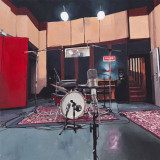
Recorded at Studio G in Brooklyn with Jeff Berner (Psychic TV), Avallone reaches beyond the lo-fi sleaze of his 2020 debut, Last Minute Man, for a higher fidelity and grander sound palette. “After making a record by myself on an old four-track tape machine, it felt like a natural progression to go into a proper studio and play music with my friends". The core band consists of Mark Perro (The Men) on keys and Russell Hymowitz on bass, who both sing backing vocals, along with David Christian on drums. On several tunes, pedal steel played by Jon “Catfish” DeLorme (The Nude Party) dances around Avallone’s baritone voice, delivering a twang that is distinctively more New York than Nashville.
Inspired by the conversational storytelling of artists like Terry Allen and Lou Reed, Avallone was moved to capture the drama and mystery of his own life experiences. The characters we meet here are flawed. Mistakes are made and lies are told. Love is either lost or on the line. Dreams manifold as both echoes of the past and hopes for the future – the faded glow of childhood impressions in “Down the Hill”; the single mothers’ kitchen table reverie in “Going to the Beach”; the lament for summer’s end in “Vacant Sea”.
Поиск:room 10
Все
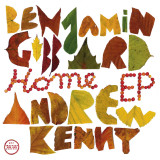
Originally released in 2003 on CD via Post-Parlo Records, and two years later on vinyl via Morr Music, the »Home EP« sees Benjamin Gibbard (Death Cab for Cutie, The Postal Service) and Andrew Kenny (The American Analog Set) each contributing three original tracks and playing one of the other's songs. This 2023 vinyl edition is released via Morr Music (EU+UK) and Barsuk Records (US). It features the artwork by Jan Kruse, that was originally made for the 2005 Morr Music version.
The EP was released as the fifth and final volume of the early-’00s series of split albums on Austin, TX indie Post-Parlo, the Gibbard/Kenny pairing followed short contributions in the series from such varied notable early-aughts indie artists as Kind of Like Spitting, Britt Daniel (Spoon), Bright Eyes, Pavo and Super XX Man.
Gibbard and Kenny’s installment came out during a prolific era for both writers: The American Analog Set had released the classic »Know By Heart« album in 2001 and followed it in 2003 with the acclaimed »Promise of Love«, while Gibbard’s profile was rising significantly via the critical and commercial success of The Postal Service’s »Give Up« and Death Cab’s »Transatlanticism«. Unlike the more lush arrangements of their main projects, both Kenny and Gibbard took a simple approach for their entry into the Home series, recording on cassette four-track machines in their respective living rooms in New York and Seattle and each performing four exclusive stripped-down tracks (including a cover of one of the other’s songs – Kenny choosing a rendition of Death Cab’s »Line of Best Fit« and Gibbard delivering his version of AmAnSet’s »Choir Vandals«).
»Home EP« showcases two brilliant songwriters whose legacies continue to shine twenty years later. The American Analog Set recently announced »For Forever«, their seventh album and first new music in 18 years, which was released last week and followed the band’s announcement earlier this year that The Numero Group will reissue their first three albums »The Fun of Watching Fireworks« (1996), »From Our Living Room to Yours «(1997), and »The Golden Band« (1999) as a vinyl boxset in early 2024.
Benjamin Gibbard has recently finished fronting both bands on the sold out Death Cab for Cutie / The Postal Service co-headline tour of arenas and amphitheaters in the United States celebrating the 20th anniversary of »Give Up« and »Transatlanticism«.
Teramo, Italy's Inutili, return with their fifth full-length album, "A Love Supreme." It's a departure from the band's last albums After a long lockdown, Inutili discovered the pure pleasure of playing music together. In their own words: The album was made simply and naturally through free and psychedelic jam sessions in the band's rehearsal room. A declaration of love for music, just a holy respect for music without schemes: A Love Supreme! Inutili is Alessandro Antinori (bass, guitar), Pietro Calvarese (guitar, vocals), Giancarlo Di Marco (guitar, bass) and Lorenzo Mazzaufo (drums, percussion, vocals). Special Guest: Francesco Gaspari (synthesizer, programming)
This brand new EP from the Cornish improv noise / post-rock / shoegaze trio is their first release since their acclaimed second album Sleepover, which came out at the end of 2021. It features two long tracks and vocals from their Sonic Cathedral bandmate Lorena Quintanilla from Lorelle Meets The Obsolete. “One of our recording sessions resulted in a couple of tracks that had a very different energy to what we’ve recorded to date because there was less of a motif-based approach to them, which made them kind of scenic,” explains Mildred Maude guitarist Matt Ashdown. “We felt like they were the best opportunity we’ve had for doing a collaboration. We’ve played a few shows with Lorelle Meets the Obsolete and really clicked – we love what she does in that band and also as J. Zunz – so we asked her to do both tracks. It feels completely right – a natural pairing.” “I love collaborations and this one was really special,” adds Lorena. “I feel honoured to be part of this EP. I always enjoy seeing Mildred Maude, I feel that one can grasp eternity during their sets. With ‘Half The Sky’, the vocal melody and lyrics came out immediately, I felt like I was in a room jamming with them and everything was slowly flowing and growing. As for ‘Shifting’, it was another story. It is such a beautiful song, and I didn't want to mess it up. They liked one of the takes I sent, so I kept on that track for the first part and for the end I looped vocals on my DL4.” “Vocals change everything and give it a different air of completeness, but Lorena understands our music, so she was able to maintain its looseness,” concludes Matt. “We’re stunned by what Lorena has done; she’s given both tracks a different life
Der australische Superstar Troye Sivan veröffentlicht sein drittes Studioalbum „Something To Give Each Other“.
Der mehrfach mit Platin ausgezeichnete Künstler zelebriert mit dem Album Sex, Tanz, Liebe, Freundschaft und Gemeinschaft. Das Album ist inspiriert von vielen Partys, Küssen mit Fremden und langen Dates. Mit seinen Hit Songs wie „Youth“ (2015) & „There For You“ (2017) feierte Troye mehrfache Goldauszeichnungen in Deutschland.
Neben mehr als 22 Milliarden Streams global ist der erfolgreiche Sänger auch nicht mehr aus der Filmindustrie wegzudenken. Neben „X-Men Origins: Wolverine“ ist der Künstler derzeit in der HBO Serie „The Idol“ des Künstlers The Weeknd zu sehen.
Sein Album „Something To Give Each Other” ist als CD und Vinyl erhältlich.
- A1: Wipe′Out″ Intro
- A2: Hakapik Murder
- A3: Messij
- A4: Canada
- A5: Tenation
- B1: Doh-T
- B2: Trancevaal
- B3: Surgeon
- B4: Cairodrome
- C1: Body In Motion
- C2: Cardinal Dancer
- C3: Cold Comfort
- C4: Kinkong
- D1: Operatique
- D2: Plasticity
- D3: Messij Extended
- D4: Argon
- D5: Phloem
- D6: Xenon
- D7: Xylem
- E1: Wipeout Intro (Μ-Ziq Remix)
- E2: Doh-T (Wordcolour Remix)
- E3: Xylem (Brainwaltzera Remix)
- E4: Canada (James Shinra Remix)
- E7: Cairodrome (Surgeons Girl Remix)
- E8: Messij (Datassette Remix)
- E5: Messij (Kode9 Remix)
- E6: Trancevaal (Simo Cell Remix)
Back in the 1990s video games were still largely seen as nerdy: fun, sure, but basically a guilty pleasure that you’d soon grow out of. The release in 1995 of wipE'out'', a lightning-fast, razor-sharp, futuristic racing game that helped to launch the PlayStation in Europe and North America, changed all that. This was a game that looked and sounded both adult and cool, the kind of game you would put on display in your living room, rather than hide away under your bed. Key to this was the fact that wipE'out'' borrowed unashamedly from the clubbing experience and electronic music, in a way that put it at the heart of progressive mid 90s culture. It soon became a phenomenon.
wipE'out'' looked sensational, with Sheffield agency The Designers Republic - known for their work with Warp - creating the visuals, packaging and manual for the game, drawing heavily on the bright colours and excitable geometric shapes of the rave and club flyers of the early 90s.
wipE'out'' also sounded like a new rave dream. The European version of the game included music from The Chemical Brothers, Leftfield and Orbital, the kind of fashionable game syncs that were almost unheard of at the time. Equally striking was the game’s original music, which came from Welsh musician Tim Wright, aka CoLD SToRAGE, by this point already a veteran in the video games world, having worked on the music for Amiga titles such as Lemmings and Shadow of the Beast 2. His music for wipE'out'' was, if anything, even more extreme than the big-name syncs, mixing the accelerated beats of drum & bass with the pure synth rush of trance to make music that sounded as breathlessly exciting as playing the game felt.
These tracks were burned into the brains of millions of gamers; the soundtrack to a generation of late-night anti-gravity racing, as the sun gingerly rose beyond the curtains. But they haven’t, perhaps, quite got the respect they deserve, something that this release will address. In 2023, video game music is finally getting its dues; here, remastered and repackaged –and also remixed by cutting edge producers such as Kode9, μ-Ziq, Brainwaltzera, Simo Cell, Wordcolour, James Shinra, Surgeons Girl and Dattassette– are some of the most important, thrilling, innovative and most fun songs ever committed to game release.
Buckle up and fasten the spaceship seatbelts! The Third Room, the multidisciplinary techno project from the industrial heart of Germany, is about to fire another satellite in the orbit. A stunning various artists series between fierce meteors, bright suns, dark moons and shining comets will continue to define the Essen-based collective's sound vision which is as diverse and timeless as space itself. Convince yourselves of a well-considered, galactical curation that contains quality tracks from talents, locals and longstays.
On the first of four releases, established producers named Beste Hira, Stranger, Alarico and OFF/GRID put out a stunning yet humble peak-time record. Four laser-beaming tunes speak for themselves and mark the beginning of the next chapter in the T3R adventure.
Don't miss to ascend to higher spheres - secure your copy and pre-order one of the limited records now!
©️ 2023 The Third Room
Mastering by Ahmet Sisman (The Third Room Studios)
Artwork by Daniel Bornmann & Elisa Jauch (Duat Agency)
Xavier Boyer, the lead singer of Tahiti 80 and one of the most distinctive voices in French indie pop, returns solo with a melodic and timeless new EP entitled "Soda Coda".
After "Tutu To Tango" (2007, under the name Axe Riverboy), "Some/Any/New" (2017), and not forgetting Tahiti 80's nine studio albums, Xavier Boyer has composed five songs navigating between soft rock, folk sounds and pop experimentation. "On previous albums, I'd done everything on my own, but this time I was looking for something more lively, more organic, more collective. I also wanted to exchange ideas with other musicians.
This mini-album (the vinyl version will include five alternative versions recorded on a 4-track cassette) was created with the help of three emblematic figures from the French music scene, Mehdi Zannad (Fugu, April March, A Girl Called Eddy) on keyboards, Laurent Blot (Le Superhomard) on drums and Stéphane Laporte (Domotic, Egyptology) on mix.
Recorded between tours and studio sessions with his main band, "Soda Coda" once again confirms his talent as a melodist and his appetite for sonic adventures. The power pop of "D Day" or the lyricism of "Children Of The Sun" would not be out of place on albums by Emitt Rhodes or Richard Swift (producer of Tahiti 80's "Ballroom" in 2014). "Oh Liza" is as smooth as an Elliott Smith novelty.
The singer assumes his influences: "My aim has always been to write timeless songs without pretending it's 1975, or 1998. I want my music to remain rooted in its time." "Read The Room" blends Jamaican music and avant-garde pop with its crystalline guitars and soaring synths, while "Soda Coda" brings a touch of Soul to the EP with its distorted piano and slap-back vocals.
More than a journey or a nostalgic trip, Soda Coda is a succession of luminous songs, and as Xavier Boyer sings on the eponymous track: "I'm singing something good, I can hear this tune lighting up my path".
I want to introduce this work ‘Halos of Perception’ to you in the way Lisa introduced me to it, through the sharing of experiences.
Lisa and I met for a walk near South Yarra station to talk about this work, when inclement weather made it too wet to visit the tunnels. Moving almost seamlessly from a world of leisurewear, infinite milk alternatives and blaring neons to stretches of green by the water that brimmed with sounds and life, we saw a few people climbing the Burnley bouldering wall, butterflies suspended in the hot wind and lots of plants I wish I knew the names of. Overhead the cars rumbled like a ceaseless animal as we talked about hidden ecosystems, imagined spaces and networks of care.
Stemming from a serendipitous encounter with an original Cave Clan member that led to many underground adventures, this work explores the worlds that exist outside of our perceptions. By the river, I leafed through a selection of tunnel photos Lisa had printed off at Officeworks, revealing alien textures, tunnels that stretch on into abysses of their own, underground flowing streams. Light is sparse and delicate, something reflected by the flickering and wavering in Lisa’s piano compositions.
As we walked, we noticed the ways in which infrastructure is often designed to keep people out—cut doors into fencing and clipped wires show an active and ongoing defiance of this. We spoke about how her Cave Clan friend used to go down to this painted room and read in solitude, using candles for light. The way sound exists underground, encased in these hollow cement tunnels, a painted room with its own deep hum. How people used to hold underground shows, how there were rules for safety (no exploring after rain, never alone) that was shared with each other. This warmth and absorption of other’s experiences is present in Lisa’s work—it’s immersive, like wading in water.
We paused on the walk to eat berries and talk about how The Caretaker creates transitory worlds with recorded sound, how this technology captures memory, and the exploratory pursuits of Pauline Oliveros’ Deep Listening Band. These citations of memory and deep listening inform Lisa’s use of analogue and classical instruments, playback artefacts and acoustic feedback in her own world-building. When speaking about ‘Halos of Perception’, she describes it as a fascination with timbre and acoustic artefacts.
Ideas of networks and enmeshment are felt deeply in Lisa’s compositions, motifs overlaid over each other evoking the image of many hands interlinking playfully, tenderly, softly. The way her compositions delve into refraction and echo makes me think about the tunnels and the way they splinter off into many possibilities. Manipulated textures reminiscent of the chalky, earthy, moss air that perfumes the tunnels’ subterranean air. Tactile details that gesture towards close attention, verging on obsession.
This work is also about imagining ecosystems of potential. Lisa shared with me that during this project, she has been reimagining subterranean networks in dreams, thinking about oral traditions, and the way water moves—from the sky to the earth, through the ground, connecting all these spheres. Realised in collaboration with hyperreal video artist Tristan Jalleh, Lisa’s dream landscape melds waterfalls, leaks, flower graffiti, and hidden messages lit up by imagined light sources with existing subterranean networks. There’s a real sense of wonder in this world she has built, how the city can reveal itself to you with some patience and care, how the city and its secrets can find its way into your dreams.
— Panda Wong
Highly Limited Edition re-issue of this mid 80s nugget from down under. HUGE TIP!
Poetical License was a brief project uniting Scottish born and Aotearean (New Zealand) musician Mark Airlie and keyboardist and vocalist Keri Ansley after the duo met in New Plymouth. The solitary 7” came together in 1986, recorded at the infamous Auckland studio, The Lab.
The A side’s fragile Footprints is as utterly charming as it is drenched in melancholia with a delicate glockenspiel lick and Ansley’s ethereal delivery of the vocals. On the B Side, Room 101 pivots to wonky rock and a more post-punk approach to composition. The two tracks shine brightly among an abundance of outsider gems made in Aotearoa during the 1980s.
Recital presents the first full-length vinyl LP by sound artist Asha Sheshadri. Whiplash combines elements of sound poetry, diary-like narrations, and delicate incidental music. Sheshadri has crafted a unique and marvelous album.
Asha Sheshadri is a visual artist and musician, who “meditates on meaning, context, and impermanence” (Joshua Kim). Moves freely between video, writing, sound, and photography. Her forms flow together to create unpredictable observations of the overlooked, while documenting personal and political networks within our collective, imperfect memory.
“This record is an alternate approach to the autobiographical ‘confessional’ – I wanted to stitch together some pivotal sketches in self-understanding and forgiveness. While their designs may seem affectively disparate, they are in fact quite interrelated. My intention (as with past recordings) is to task the listener with tracing the contours of the narrative (or lack thereof). Each track contains sound from video work, excerpts from writers I admire, ethnographic methods, recovered and recycled voice/text memos, photographs from personal and public archives, and research-driven fictions. These sources expand and collapse into each other, only to reveal the eponymous "whiplash". To me, the feeling of "whiplash" is the collision of: a refracted ambivalence towards what was once real, the endless cycle of reckoning with wherever "home" has taken place, the fraught process of anchoring one’s self in the wake of slow-release trauma, and how (if even possible) to translate all of this into artwork.” –Asha Sheshadri, 2023
“Place is security, space is freedom: we are attached to the one and long for the other. There is no place like home.” –Yi Fu Tuan, Space and Place: The Perspective of Experience.
All tracks arranged & recorded by Asha Sheshadri; in bedrooms, living rooms, libraries, bars, airplanes, backyards and parks across North America.
Mastered by Sean McCann.
Originally released as a hand-numbered CD on New Year's Eve of 2004, Last Light captures Tor Lundvall 's hushed songcraft at its most ghostly and grayscale, stripped bare like branches bracing for winter. Initially conceived of as "a piano album with sparse electronics" (with the working title November), Lundvall's palette steadily expanded, incorporating synthesizer, samples, bass, metronomes, and his signature spectral vocals. A journal entry from the spring of 2002 proved formative to his evolving vision: "I remember watching the blueish-grey light shimmering outside and hearing distant sounds echoing far away, eventually sinking into silence and stillness." The album's 12 tracks are steeped in this sense of autumnal transience, of bearing witness to what fades. The music moves in whispered swells, between dirge, drift, and devotional. Synths chime like slow-tolling bells; percussion shuffles and shivers, icy and isolated; bass traces a low-lidded plod - it's a mode both austere and seductive, lulling the listener into its landscapes of deepening dusk. Lyrically, Lundvall's language skews observational and depressive ("through lace curtains / grey light falls / dark clouds gather / in my soul" ), with each song like a gauzy glimpse into a different tableau framing winter's descent: rust - colored leaves, frozen ponds, cold crescent moons. Lundvall has long considered Last Light a "personal favorite" in his discography, and it's easy to hear why. In texture, finesse, and pacing, it vividly evokes the rare mood of fragile, frosty pastoral noir depicted in his iconic oil paintings. His is an art of the half-seen and half-remembered, of fleeting figures, shapes and shadows, and gathering darkness. Of all that disappears, and the ghosts that never leave: "So I wait / as the years / slowly drain the magic and the light / and the girl / I never loved / haunts me through the dark roads of my life."
Five groups, one mythical studio - documenting the emergence of a generation!
The initial postulate was simple: five groups, one emblematic studio and 24 hours for each to imagine and record two unreleased tracks with one objective - the will to document a French jazz scene in the midst of renewal.
In these last few years, several innovative currents have shaken up the world of jazz and attracted new fans. They have bubbled up from Los Angeles, impregnated with hip-hop culture (Kamasi Washington, Terrace Martin, Thundercat), or from London, tinged with African rhythms (Nubya Garcia, Kokoroko, Ezra Collective). Meanwhile, in France, a new scene is emerging, carrying with it more of a dancefloor-oriented sound influenced by electronic music - an obvious kinship with the French Touch explosion of the late 90s.
Historically, every movement has been assimilated to a certain neighbourhood, to specific clubs where late at night, young guns stayed up to imagine the jazz of tomorrow - the Cotton Club for the jazz of the 20s, Minton’s Playhouse in Harlem for Be-Bop, the Black Hawk in San Francisco for West Coast jazz, Birdland in New York for Hard-Bop or a lot more recently, the Total Refreshment Centre which has been the playing field for the new London scene.
In Paris too, this new sound is associated with actual venues, places which have allowed these groups to form, create a repertoire and forge an aesthetic - Le Baiser Salé for Monsieur Mâlâ, La Gare/Le Gore for Photon, La Pêche in Montreuil for Ishkero, La Petite Halle for Underground Canopy and also le Duc des Lombards and le 38 Riv’ for Alex Monfort; it’s in a live context that this music will always continue to evolve.
Keeping this “live” spirit, with all its spontaneity, was actually the guiding line for the elaboration of this Studio Pigalle compilation. Each take was recorded in the most organic way possible, bringing all the musicians together in the same room to limit post-production alterations before the final cut was assembled, in just one day, by studio in-house sound engineer, Felix Rémy.
A feeling of urgency permeates a record guided by an artistic production taking care to crystalise the essence of this artistically free-range generation whose childhoods were rocked just as much by Bill Evans and Roy Hargrove as by J Dilla and Jeff Mills. One of the two tracks recorded is geared towards the dancefloor, and the other, more cosmic/ambient gives freer rein to individual interpretation.
There were therefore many possible ways of interpreting these guidelines for the five formations which number among the most distinctive on the current French musical landscape, and the occasion, for some, to rummage through their archives! With Transe (Mbappé) and Da Verdere (Vella), Monsieur
Mâlâ present us with two unreleased tracks issued from the very first rehearsals of the quintet reworked especially for this compilation. “Seen the aesthetic range of this group, it all worked out very naturally in the studio”, recounts keyboardist Nicholas Vella “Recording like they did in the sixties with all the channels live and working with small imperfections was a very interesting task, even when it came to the mix, we had to make do with the takes we had... “
“Our group is very recent, and with this session, in just two tracks, we had the opportunity to present the entirety of our musical universe,” says Photons pianist Gauthier Toux. “All too often, we assimilate this fusion between jazz and dance music to computers and post-production modifications. For “Dessine”, we kept the first take, and we must have recorded just three or four for the other track with more of a techno bent. In one day, we understood that we could play our entire repertoire live, from A to Z”.
“When the Komos label offered me this project, it immediately spoke to me”, remembers Alex Monfort “Straight away, I thought of “Since I Met You”, a track with a nine/four time signature which really is reminiscent of a new- soul groove, but with this extra cosmic vibe! I wrote the words to the chorus and Nina Tonji placed her voice on the track, adding her own verses. For “Tonight”, the up-tempo track, I wanted to head off in more of a hybrid direction inspired by Kaytranada or the Black Radio series by Robert Glasper. A cross-over between jazz and hip-hop which really does represent my world, and I also tried to place vocals centre stage (Emcee Agora)”.
“We truly resonated with the way Antoine Rajon imagined this compilation and the recording session”, confide Warren Dongué and Jérémy Tallon from Underground Canopy. “When arriving in this studio we felt as if we had gone backtothe70s! Inkeepingwiththespiritofthisera,heknewhowtoletus keep our spontaneity, without recording in too many takes, and that’s how we like to work”.
“We managed to adhere to the themes of the compilation without changing our instrumentation, we wanted to remain faithful to the sound of Ishkero on these new compositions and take them somewhere else” – says drummer TaoEhrlich -“Withoutaddinganyelectronics.Thesessionwassupervisedin a truly subtle and benevolent manner. From a human perspective, it was also a wonderful experience”.
Whether turned towards hip-hop, ethnic or electronic music, the artists featured on this Studio Pigalle compilation represent the eclecticism of a new generation in the process of writing the first chapters of its history. Open to experimentation, these artists continue to hold high an immutable love for improvisation and creation in the moment... another definition of the word Jazz!
Vinyl[16,77 €]
StriIn 2013, Blue Smiley officially formed in Brian Nowell and John Slavin’s rodent-infested North
Philadelphia apartment. With Nowell primarily composing from the hammock he used as a bed, Blue
Smiley created three short recordings within a year, featuring drummers Gracie Clements, Tim
McMonigle, and Joe Veltri. Matt McGraw, drummer and childhood friend of Slavin’s, later joined the
group to galvanize a sound that helped define Philadelphia indie rock of the 2010’s. Blue Smiley’s first
professionally recorded album ok released in 2015, featuring dystopian noise-pop compositions with
fuzzy effects, unique for its focus on groove and precipitous tempo changes. Slavin then relocated to
Austin, TX while close friend and bassist Michael Corso joined Nowell for the next iteration of the
group. True to the Blue Smiley ethos, their next full-length return soon followed, replete with snappy,
short songs that waste no time getting to the point. On return, Nowell’s hushed vocals settle deeper
into the band’s tapestry, like an iridescent thread that catches your eye at just the right moment.
During their last tour, the band introduced a handful of new songs, but never made it to the studio.
While celebrating his upcoming 27th birthday with his parents, Nowell expressed his intentions to put
these tracks together for a third LP. Tragically, Nowell was found unresponsive in his room the
following morning on October 8, 2017, a victim of fentanyl poisoning. In spite of the band’s premature
ending, their legacy is now immortalized with this physical recording.
Vinyl[36,35 €]
StriIn 2013, Blue Smiley officially formed in Brian Nowell and John Slavin’s rodent-infested North
Philadelphia apartment. With Nowell primarily composing from the hammock he used as a bed, Blue
Smiley created three short recordings within a year, featuring drummers Gracie Clements, Tim
McMonigle, and Joe Veltri. Matt McGraw, drummer and childhood friend of Slavin’s, later joined the
group to galvanize a sound that helped define Philadelphia indie rock of the 2010’s. Blue Smiley’s first
professionally recorded album ok released in 2015, featuring dystopian noise-pop compositions with
fuzzy effects, unique for its focus on groove and precipitous tempo changes. Slavin then relocated to
Austin, TX while close friend and bassist Michael Corso joined Nowell for the next iteration of the
group. True to the Blue Smiley ethos, their next full-length return soon followed, replete with snappy,
short songs that waste no time getting to the point. On return, Nowell’s hushed vocals settle deeper
into the band’s tapestry, like an iridescent thread that catches your eye at just the right moment.
During their last tour, the band introduced a handful of new songs, but never made it to the studio.
While celebrating his upcoming 27th birthday with his parents, Nowell expressed his intentions to put
these tracks together for a third LP. Tragically, Nowell was found unresponsive in his room the
following morning on October 8, 2017, a victim of fentanyl poisoning. In spite of the band’s premature
ending, their legacy is now immortalized with this physical recording.
Cassette[16,77 €]
In 2013, Blue Smiley officially formed in Brian Nowell and John Slavin’s rodent-infested North Philadelphia apartment. With Nowell primarily composing from the hammock he used as a bed, Blue
Smiley created three short recordings within a year, featuring
rummers Gracie Clements, Tim McMonigle, and Joe Veltri. Matt McGraw, drummer and childhood friend of Slavin’s, later joined the
group to galvanize a sound that helped define Philadelphia indie rock of the 2010’s. Blue Smiley’s first professionally recorded album ok released in 2015, featuring dystopian noise-pop compositions with
fuzzy effects, unique for its focus on groove and precipitous tempo changes. Slavin then relocated to Austin, TX while close friend and bassist Michael Corso joined Nowell for the next iteration of the
group. True to the Blue Smiley ethos, their next full-length return soon followed, replete with snappy, short songs that waste no time getting to the point. On return, Nowell’s hushed vocals settle deeper
into the band’s tapestry, like an iridescent thread that catches your eye at just the right moment.
During their last tour, the band introduced a handful of new songs, but never made it to the studio. While celebrating his upcoming 27th birthday with his parents, Nowell expressed his intentions to put
these tracks together for a third LP. Tragically, Nowell was found unresponsive in his room the following morning on October 8, 2017, a victim of fentanyl poisoning. In spite of the band’s premature ending, their legacy is now immortalized with this physical recording.
180g Vinyl[36,35 €]
In 2013, Blue Smiley officially formed in Brian Nowell and John Slavin’s rodent-infested North Philadelphia apartment. With Nowell primarily composing from the hammock he used as a bed, Blue
Smiley created three short recordings within a year, featuring
rummers Gracie Clements, Tim McMonigle, and Joe Veltri. Matt McGraw, drummer and childhood friend of Slavin’s, later joined the
group to galvanize a sound that helped define Philadelphia indie rock of the 2010’s. Blue Smiley’s first professionally recorded album ok released in 2015, featuring dystopian noise-pop compositions with
fuzzy effects, unique for its focus on groove and precipitous tempo changes. Slavin then relocated to Austin, TX while close friend and bassist Michael Corso joined Nowell for the next iteration of the
group. True to the Blue Smiley ethos, their next full-length return soon followed, replete with snappy, short songs that waste no time getting to the point. On return, Nowell’s hushed vocals settle deeper
into the band’s tapestry, like an iridescent thread that catches your eye at just the right moment.
During their last tour, the band introduced a handful of new songs, but never made it to the studio. While celebrating his upcoming 27th birthday with his parents, Nowell expressed his intentions to put
these tracks together for a third LP. Tragically, Nowell was found unresponsive in his room the following morning on October 8, 2017, a victim of fentanyl poisoning. In spite of the band’s premature ending, their legacy is now immortalized with this physical recording.
Berlin-based Swedish bassist and producer Petter Eldh returns with a new Koma Saxo album Post Koma, out on We Jazz Records, 10 November. The title Post Koma aptly describes the vibe of this one: The Koma Saxo sound continues its evolution, morphing into a holistic vision of jazz now and soon, where live instrumentation and repurposed sampling lose their boundaries.
Over the course of its three iterations (self-titled debut in 2019, LIVE in 2020, Koma West in 2022) Koma Saxo has sounded at times "liquid" and postproduced, at times raw and direct, at times acoustic and at other times oddly electronic (even while still being made with acoustic instruments). Post Koma is a culmination of this sonic study by Eldh, resulting in a music vision that never second-guesses throwing tasty hooks and everlasting melodies out the window after a mere bite of them. But fear not: there are even more new ideas just around the corner.
Eldh's compositions and ideas merge together in a way that just flows. There are quality musicians in the mix, including Koma Saxo live band members Sofia Jernberg, Jonas Kullhammar, Otis Sandsjö, Mikko Innanen, Maciej Obara and Christian Lillinger, but that's like saying that a cake includes flour and sugar. This music is not about playing, it's essentially about how the music is and how it takes its shape, so you quickly lose track of who did what, and that's all in the benefit of encountering this music as an entity that is constantly challenging itself while moving forward. The musicians are valued contributors, and an integral part of what's here, but this is far from traditional jazz playing where a band sits in a room playing takes after takes of compositions on sheet.
That being said, this is jazz to the fullest. That is, music that understands its past but always moves forward, and is never afraid of taking risks. Petter Eldh uses jazz as a starting point, not the end goal. This gives his music edge and mobility beyond what can be contained on one album. In a way, an album, then, becomes a snapshot of a creative process in constant flux and evolution.
Opening track "Koma" is literally drum & bass. It only consists of those two elements, yet what comes out of it is an open invite, a way of clearing your palette. It would be useless to describe individual tracks beyond that, but there's a strong sense of deliverance to the set. It feels like an ending, and also like a new beginning.
Berlin-based Swedish bassist and producer Petter Eldh returns with a new Koma Saxo album Post Koma, out on We Jazz Records, 10 November. The title Post Koma aptly describes the vibe of this one: The Koma Saxo sound continues its evolution, morphing into a holistic vision of jazz now and soon, where live instrumentation and repurposed sampling lose their boundaries.
Over the course of its three iterations (self-titled debut in 2019, LIVE in 2020, Koma West in 2022) Koma Saxo has sounded at times "liquid" and postproduced, at times raw and direct, at times acoustic and at other times oddly electronic (even while still being made with acoustic instruments). Post Koma is a culmination of this sonic study by Eldh, resulting in a music vision that never second-guesses throwing tasty hooks and everlasting melodies out the window after a mere bite of them. But fear not: there are even more new ideas just around the corner.
Eldh's compositions and ideas merge together in a way that just flows. There are quality musicians in the mix, including Koma Saxo live band members Sofia Jernberg, Jonas Kullhammar, Otis Sandsjö, Mikko Innanen, Maciej Obara and Christian Lillinger, but that's like saying that a cake includes flour and sugar. This music is not about playing, it's essentially about how the music is and how it takes its shape, so you quickly lose track of who did what, and that's all in the benefit of encountering this music as an entity that is constantly challenging itself while moving forward. The musicians are valued contributors, and an integral part of what's here, but this is far from traditional jazz playing where a band sits in a room playing takes after takes of compositions on sheet.
That being said, this is jazz to the fullest. That is, music that understands its past but always moves forward, and is never afraid of taking risks. Petter Eldh uses jazz as a starting point, not the end goal. This gives his music edge and mobility beyond what can be contained on one album. In a way, an album, then, becomes a snapshot of a creative process in constant flux and evolution.
Opening track "Koma" is literally drum & bass. It only consists of those two elements, yet what comes out of it is an open invite, a way of clearing your palette. It would be useless to describe individual tracks beyond that, but there's a strong sense of deliverance to the set. It feels like an ending, and also like a new beginning.
Auf Album Nr. 4 wendet die britische Electronic Music Komponistin, Produzentin und Musikerin, die auch mit Ihren Filmscores für einiges Aufsehen sorgen konnte, ihren Blick nach innen, setzt sich mit Trauma und Trauer auseinander und konfrontiert ihre Ängste. Für Fans von u.a. Fever Ray.
Elizabeth Bernholz (geb. Walling), geboren 1981 in Canterbury, England, besser bekannt unter ihrem Künstlernamen Gazelle Twin, ist eine Electronic Music Komponistin, Produzentin und Musikerin, die derzeit in Leicestershire, England, lebt.
Auf ihren bisherigen drei Studioalben hat Gazelle Twin nach außen geblickt: auf Städte, auf einen gequälten Körper, auf die sich windenden Eingeweide des ländlichen Großbritanniens. Auf ihrem ersten Album für das neue Label Invada Records wendet sie ihren Blick jedoch nach innen. Black Dog ist ein Album über die Konfrontation mit der Angst und die Erwartung, dass die Dinge, die in der Dunkelheit lauerten, als man ein Kind war, verschwinden werden, wenn man erwachsen wird.
Black Dog erzählt eine Geschichte, die sich wie ein Film entrollt. Es geht darum, wie unsere Kindheit unser Erwachsensein geprägt hat: wie sich jedes Gefühl von Trauma und Trauer für immer in die Erinnerung eines Menschen einbrennt, egal wie sehr wir versuchen, ihm zu entkommen. Black Dog deutet an, wie diese Gefühle in besonderer Intensität zurückkehren, wenn man Eltern wird, wenn man sich selbst dabei beobachtet, wie man Dinge weitergibt, von denen man sich wünscht, sie nicht gehabt zu haben, nicht zu wollen.
In gewisser Weise läutert sich Bernholz auf diesem Album selbst. Im Gegensatz zu ihren maskierten Charakteren bei früheren Veröffentlichungen ist ihr Gesicht erkennbar, und sie erklärt, dass sie sich „dieses Mal nicht so weit entfernt hat" von ihrer Persona. Sie stellt sich als Medium für die Stimmen in ihrem Inneren vor, anstatt sie mit anderen Ideen zu verdrängen. Dabei wirkt sie groß und innig, ihre Stimme wechselt von feinfühliger Zärtlichkeit zu doomiger Kraft.
Dies ist ein Album, bei dem alte Geschichten geplündert, verdaut und wieder hochgewürgt werden müssen, um neue zu schreiben, bei dem wir uns selbst völlig in Frage stellen müssen. Black Dog blickt zurück und blickt hinein. Wir verschaffen uns Zugang, während wir zuhören. Unser Innerstes nach außen gekehrt.