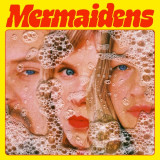
New Zealand indie trifecta Mermaidens, are set to make a resounding splash in the music scene yet again with the announcement of their fourth self-titled album and release of the project's first single ‘I like to be alone’. The trio, comprising of Gussie Larkin (guitar/vocals), Lily West (bass/vocals), and Abe Hollingsworth (drums), has been on an impressive journey of musical excellence, boasting three critically acclaimed albums, international tours, and a slew of accolades to their name. With a sound that is both bold and adventurous, Mermaidens' music is a testament to their unwavering creativity and relentless work ethic. Their upcoming self-titled album, a product of the band's tireless efforts between 2019 - 2022, promises to be a captivating sonic journey, delving into themes of self-awareness, introspection, long-term love, and even channelling political anger and frustration. Recorded mainly at Surgery Studios in Wellington, with the engineering prowess of Lee Prebble and produced by Samuel Flynn-Scott of The Phoenix Foundation fame, the album also saw the band stepping up their production game with Gussie and Lily working their magic with Protools in their DIY home studios, showcasing their growth and versatility as artists. “Working with Sam has really been a round-trip in our creativity,” as Lily explains, “we grew up listening to Sam’s early records and here we are getting the inside scoop on how to make that kind of magic. Listening to Pegasus today still transports me to a time when I listened to music on a Walkman. In the best possible way - sometimes it felt like we’d added an evil genius to the mix, we’d be working on a song and he’d come in like a mad scientist with fresh ideas to try.” To give fans a taste of the upcoming album's brilliance, Mermaidens have released new single 'I like to be alone.' The song has been part of the band's live repertoire for a while and explores the fulfilling contentment of being alone and the struggle to convey this sentiment to a partner. Its relatable lyrics capture the essence of cherishing solitude while navigating the complexities of human connections. Gussie's candid and honest approach to self-discovery is complemented by the song's, Michel Gondry inspired video, as Gussie explains: “The giant jean pocket and denim world were created by Hannah Webster, a textile designer and illustrator based in Wellington. Hannah took all the wild ideas for props and made them come true! I’m still in awe of how she managed to sew a 6x6 metre backdrop for the denim world out of whatever scraps she could find. The video captures our playfulness and sense of humour, and is a hint of what’s to come for the rest of the music videos. I love the way the story wraps up with the three of us together, literally playing “in the pocket”. Mermaidens' self-titled album will be released on Friday 3 November 2023 and is available for pre-order now. UK listeners will be able to pick up an exclusive Rough Trade vinyl pressing in transparent red, along with an A3 poster and jumbo bumper sticker. Having released their last two albums through iconic local label Flying Nun, Mermaidens will be released independently. Creative control is an important pillar for the band, who are hands on in every facet of their projects. Mermaidens gather their community close via their hugely popular multi-city boutique festival Mermgrown, hosting peers including Womb, Hans Pucket, Vera Ellen (Girl Friday) and Kōtiro from 2021 onwards. They've been invited to share the stage with Death Cab For Cutie, Sleater-Kinney, Gang of Four, Parquet Courts, Lorde and The Veils, and have toured extensively in Europe, the UK, and Australia.
Search:sam kin
Two unreleased tracks from Brazilian Thrash Punk Metal gods, Ratos de Porao, recorded in 2022 on the same sessions as their "Necropolitica" album. Accompanied by beautifully shocking full color artwork this mean 7" presents two unreleased tracks by the kings of venomous metallized Hardcore Punk. Recorded in the same sessions as their "Necropolitica" album, these two bangers show a band at the top of their game after 40 years of career, as aggressive, rebellious and powerful as ever. Long live Ratos de Porao!
- A1: String Quartet No. 5 I
- A2: String Quartet No. 5 Ii
- A3: String Quartet No. 5 Iii
- A4: String Quartet No. 5 Iv
- A5: String Quartet No. 5 V
- B1: String Quartet No. 4 (Buczak) I
- B2: String Quartet No. 4 (Buczak) Ii
- B3: String Quartet No. 4 (Buczak) Iii
- C1: String Quartet No. 2 (Company) I
- C2: String Quartet No. 2 (Company) Ii
- C3: String Quartet No. 2 (Company) Iii
- C4: String Quartet No. 2 (Company) Iv
- D1: String Quartet No. 3 (Mishima) 1957 – Award Montage
- D2: String Quartet No. 3 (Mishima) November 25 – Ichigaya
- D3: String Quartet No. 3 (Mishima) 1934 – Grandmother And Kimitake
- D4: String Quartet No. 3 (Mishima) 1962 – Body Building
- D5: String Quartet No. 3 (Mishima) Blood Oath
- D6: String Quartet No. 3 (Mishima) Mishima/Closing
When Kronos plays a piece, they become fellow composers, true collaborators. Without them, we wouldn’t have the kind of string quartet playing that we find around us today. There are two kinds of string quartet playing: the ‘Before Kronos’ and the ‘After Kronos’.” – Philip Glass
‘Kronos Quartet has broken the boundaries of what string quartets can do.’ – New York Times
Nonesuch releases Kronos Quartet’s acclaimed album Kronos Quartet Performs Philip Glass on vinyl for the first time to coincide with Kronos Quartet: Five Decades, a year-long celebration marking the quartet’s 50th anniversary. Originally released in 1995, the album features David Harrington (violin), John Sherba, (violin), Hank Dutt (viola) and Joan Jeanrenaud (cello) performing Quartet No. 2 (Company) (1983), No. 3 (Mishima) (1985), No. 4 (Buczak) (1990), and No. 5 (1991), the first piece Glass wrote especially for Kronos. Recorded at Skywalker Sound in California, the album was produced by Judith Sherman, Kurt Munkacsi and Philip Glass. The cover art features Francesco Clemente’s painting The Four Corners (1985). At the time of the album’s release, the New York Times said, ‘It contains some of Glass's best music since Koyaanisqatsi. His ear for sumptuous string sonorities is undeniable,’ while the Washington Post called it ‘An ideal combination of composer and performers.’ It was a top 10 hit on Billboard’s Top Classical Albums, and spent 12 weeks on Billboard’s Classical chart.
In his original liner note, critic Mark Swed wrote, ‘Glass’ string quartets may contain his most intimate music. They are works through which a very public composer, perhaps the most important opera reformer of our age and a longstanding collaborator in large-scale music theater, holds up a mirror to himself and his way of composing. “In an odd way,” Glass explains, “string quartets have always functioned like that for composers. I don’t really know why, but it’s almost impossible to get away from it. It’s the way composers of the past have thought and that’s no less true for me. It’s almost as if we say we’re going to write a string quartet, we take a deep breath, and we wade in to try to write the most serious, significant piece that we can.” Glass says that as he sat down to write String Quartet No. 5, he had discovered that perhaps not taking a serious tone might be the most serious way to deal with it. “I was thinking that I had really gone beyond the need to write a serious string quartet and that I could write a quartet that is about musicality, which in a certain way is the most serious subject.”’
Glass’ first numbered quartet was written in 1966; however, he did not return to the string quartet medium until 1983, when he provided incidental music for a dramatization of Samuel Beckett’s prose poem, Company. During those 17 years, Glass had formed an ensemble and developed his style in a series of increasingly elaborate pieces for it. String Quartet No. 3 is also adapted to dramatic music, this time from his score to the 1985 Paul Schrader film, Mishima. It was with the music of Mishima that Kronos became associated with Glass, recording the string quartet sections of the soundtrack and subsequently working extensively with the composer on all five of his numbered quartets. Kronos also gave the first concert performances of Company and Mishima. String Quartet No. 4 was composed in remembrance of the artist Brian Buczak, who died of AIDS in 1988.
As Kronos’ anniversary season continues with further concerts around the world, Nonesuch will reissue Black Angels on vinyl on February 16. First released in 1990, the award-winning album includes George Crumb’s title piece, which inspired David Harrington to found the quartet. Called ‘an unusually elevated and searing Vietnam War protest’ by the New York Times, it sets a dark, powerful tone for this collection, which addresses the political/physical/spiritual consequences of war. Also featured are works by Charles Ives, István Márta, Thomas Tallis, and Dmitri Shostakovich. ‘Stylishly packaged, intelligently programmed, superbly recorded and brilliantly performed,’ proclaimed Gramophone. ‘In short, very much the sort of disc we’ve come to expect from the talented and imaginative Kronos Quartet.’ The Evening Standard included it among its ‘100 Definitive Classical Albums of the 20th Century’.
Born in Baltimore, Maryland, in 1937, Philip Glass is a graduate of the University of Chicago and the Juilliard School. By 1974, he had created a large collection of music for The Philip Glass Ensemble. The period culminated in the landmark opera, Einstein on the Beach. Since Einstein, Glass’s repertoire has grown to include music for opera, dance, theatre, orchestra, and film. His scores have received Academy Award nominations (including Kundun and The Hours, as well as Notes on a Scandal) and a Golden Globe (The Truman Show). Recent works include his memoir, Words Without Music, his first Piano Sonata, opera Circus Days and Nights, and Symphony No. 14. Glass received the Praemium Imperiale in 2012, the US National Medal of the Arts from President Barack Obama in 2016, and 41st Kennedy Center Honors in 2018.
Nonesuch’s relationship with Glass began in 1985, with the release of the score for Paul Schrader’s Mishima featuring Kronos Quartet. Over the years other Glass works on Nonesuch have included Einstein on the Beach (1993), Kronos Quartet Performs Philip Glass (1995), Music in Twelve Parts (1996), Glass Box (2008), as well as the soundtracks for Powaqqatsi (1988), Kundun (1997), Koyaanisqatsi (1998), and The Hours (2002), amongst others.
For 50 years, San Francisco’s Kronos Quartet – David Harrington (violin), John Sherba (violin), Hank Dutt (viola), and Paul Wiancko (cello) – has challenged and reimagined what a string quartet can be. Founded at a time when the form was largely centred on long-established, Western European traditions, Kronos has been at the forefront of revolutionizing the string quartet into a living art form that responds to the people and issues of our time. In the process, Kronos has become one of the most celebrated and influential groups of our era, performing thousands of concerts worldwide, releasing more than 70 recordings of extraordinary breadth and creativity, and collaborating with many of the world’s most accomplished composers and performers. Through its nonprofit organization, Kronos Performing Arts Association, Kronos has commissioned more than 1,000 works and arrangements for string quartet – including the Kronos Fifty for the Future library of free, educational repertoire. Kronos has received more than 40 awards, including three Grammy Awards and the Polar Music, Avery Fisher, and Edison Klassiek Oeuvre Prizes.
Kronos is prolific and wide-ranging on recordings. The ensemble’s expansive discography on Nonesuch includes three Grammy-winning albums: Terry Riley’s Sun Rings (2019), Landfall with Laurie Anderson (2018), and Alban Berg’s Lyric Suite featuring soprano Dawn Upshaw (2003); the 40th-anniversary boxed set Kronos Explorer Series; Nuevo (2002), a Grammy- and Latin Grammy–nominated celebration of Mexican culture; Pieces of Africa (1992), a showcase of African-born composers that simultaneously topped Billboard’s Classical and World Music charts; and Folk Songs (2017), Nonesuch’s 50th album with Kronos, which featured Sam Amidon, Olivia Chaney, Rhiannon Giddens, and Natalie Merchant singing traditional folk songs.
Zero Years Kid is the alter ego of Joachim Badenhorst, one of the most fascinating and adventurous Belgian jazz musicians from the last 2 decades. He plays with the international band Carate Urio Orchestra but also as musician with Naima Joris or Chantal Acda.
Zero Years Kid started of as a solo project, but has grown into a full and organic live band.
Badenhorst sees Zero Years Kid as a kindergarten to explore other ideas and interests besides of jazz. Together with Jan de Vroede, Lennart Heyndels and Erik Heestermans he brings a colorful amalgam of hip-hop, pop, dance and r&b with playful and poetic lyrics in his native language: Dutch. Next to his clarinet and sax he adds samples and electronica which results in a surprising fantasy world where it is wonderful to wander.
In 2019 debut album Ongerijmde Rijmen was released. Successor Geen Grenzen is ready and will be released on November 10th of this year on Klein. Geen Grenzen is an ode to breaking boundaries, to color outside the lines and to don’t get hung up on expectations.
The title track is a rework of No Limits by 2Unlimited. The song got translated, slowed-down and distorted to the universe of Zero Years Kid. The album is a poetic and humorous trip with a melancholic twist, and themes like the covid pandemic, intense arguments that are forgiven, writers-block, desire and love.
Five groups, one mythical studio - documenting the emergence of a generation!
The initial postulate was simple: five groups, one emblematic studio and 24 hours for each to imagine and record two unreleased tracks with one objective - the will to document a French jazz scene in the midst of renewal.
In these last few years, several innovative currents have shaken up the world of jazz and attracted new fans. They have bubbled up from Los Angeles, impregnated with hip-hop culture (Kamasi Washington, Terrace Martin, Thundercat), or from London, tinged with African rhythms (Nubya Garcia, Kokoroko, Ezra Collective). Meanwhile, in France, a new scene is emerging, carrying with it more of a dancefloor-oriented sound influenced by electronic music - an obvious kinship with the French Touch explosion of the late 90s.
Historically, every movement has been assimilated to a certain neighbourhood, to specific clubs where late at night, young guns stayed up to imagine the jazz of tomorrow - the Cotton Club for the jazz of the 20s, Minton’s Playhouse in Harlem for Be-Bop, the Black Hawk in San Francisco for West Coast jazz, Birdland in New York for Hard-Bop or a lot more recently, the Total Refreshment Centre which has been the playing field for the new London scene.
In Paris too, this new sound is associated with actual venues, places which have allowed these groups to form, create a repertoire and forge an aesthetic - Le Baiser Salé for Monsieur Mâlâ, La Gare/Le Gore for Photon, La Pêche in Montreuil for Ishkero, La Petite Halle for Underground Canopy and also le Duc des Lombards and le 38 Riv’ for Alex Monfort; it’s in a live context that this music will always continue to evolve.
Keeping this “live” spirit, with all its spontaneity, was actually the guiding line for the elaboration of this Studio Pigalle compilation. Each take was recorded in the most organic way possible, bringing all the musicians together in the same room to limit post-production alterations before the final cut was assembled, in just one day, by studio in-house sound engineer, Felix Rémy.
A feeling of urgency permeates a record guided by an artistic production taking care to crystalise the essence of this artistically free-range generation whose childhoods were rocked just as much by Bill Evans and Roy Hargrove as by J Dilla and Jeff Mills. One of the two tracks recorded is geared towards the dancefloor, and the other, more cosmic/ambient gives freer rein to individual interpretation.
There were therefore many possible ways of interpreting these guidelines for the five formations which number among the most distinctive on the current French musical landscape, and the occasion, for some, to rummage through their archives! With Transe (Mbappé) and Da Verdere (Vella), Monsieur
Mâlâ present us with two unreleased tracks issued from the very first rehearsals of the quintet reworked especially for this compilation. “Seen the aesthetic range of this group, it all worked out very naturally in the studio”, recounts keyboardist Nicholas Vella “Recording like they did in the sixties with all the channels live and working with small imperfections was a very interesting task, even when it came to the mix, we had to make do with the takes we had... “
“Our group is very recent, and with this session, in just two tracks, we had the opportunity to present the entirety of our musical universe,” says Photons pianist Gauthier Toux. “All too often, we assimilate this fusion between jazz and dance music to computers and post-production modifications. For “Dessine”, we kept the first take, and we must have recorded just three or four for the other track with more of a techno bent. In one day, we understood that we could play our entire repertoire live, from A to Z”.
“When the Komos label offered me this project, it immediately spoke to me”, remembers Alex Monfort “Straight away, I thought of “Since I Met You”, a track with a nine/four time signature which really is reminiscent of a new- soul groove, but with this extra cosmic vibe! I wrote the words to the chorus and Nina Tonji placed her voice on the track, adding her own verses. For “Tonight”, the up-tempo track, I wanted to head off in more of a hybrid direction inspired by Kaytranada or the Black Radio series by Robert Glasper. A cross-over between jazz and hip-hop which really does represent my world, and I also tried to place vocals centre stage (Emcee Agora)”.
“We truly resonated with the way Antoine Rajon imagined this compilation and the recording session”, confide Warren Dongué and Jérémy Tallon from Underground Canopy. “When arriving in this studio we felt as if we had gone backtothe70s! Inkeepingwiththespiritofthisera,heknewhowtoletus keep our spontaneity, without recording in too many takes, and that’s how we like to work”.
“We managed to adhere to the themes of the compilation without changing our instrumentation, we wanted to remain faithful to the sound of Ishkero on these new compositions and take them somewhere else” – says drummer TaoEhrlich -“Withoutaddinganyelectronics.Thesessionwassupervisedin a truly subtle and benevolent manner. From a human perspective, it was also a wonderful experience”.
Whether turned towards hip-hop, ethnic or electronic music, the artists featured on this Studio Pigalle compilation represent the eclecticism of a new generation in the process of writing the first chapters of its history. Open to experimentation, these artists continue to hold high an immutable love for improvisation and creation in the moment... another definition of the word Jazz!
Isabelle Adjani ist das, was man eine Ikone des französischen Kinos nennen kann. Mit ihren fünf César-Auszeichnungen (ein beeindruckender Rekord) in der Kategorie "Beste Schauspielerin" für "Possession", "Ein tödlicher Sommer", "Camille Claudel", "La Reine Margot" und "Skirt Day" hat sie keinen Zweifel an ihrem Starstatus gelassen - sowohl in Frankreich als auch international. Die Wartezeit auf ein Album von Isabelle Adjani schien nicht enden zu wollen.
Nach ihrer legendären Reise mit Serge Gainsbourg, die sie vom Grund des Swimmingpools (Adjanis eigene Worte in ihrer ersten musikalischen Veröffentlichung mit der französischen Musiklegende Gainsbourg, Pull marine) zu den Höhen des Ruhms führte, begann sie mit der unglaublichsten Besetzung zu arbeiten, die diese Ära zu bieten hatte - Benjamin Biolay, Etienne Daho, Gaëtan Roussel, Seal, Simon Le Bon, Christophe, Akhenaton, Daniel Darc, Philippe Pascal, David Sylvian, Youssou N'Dour und Peter Murphy. Diese Veröffentlichung ist das Ergebnis von 15 Jahren Sessions und Treffen, bei denen die Zeit einfach keine Rolle mehr spielte.
Das neue Album, das vollständig von Pascal Obispo produziert wurde und bei dem Pascal Obispo und Cécile de Laurentis gemeinsam Regie geführt haben, ist endlich aus seiner Puppe geschlüpft. Isabelle Adjani meldet sich mit ihrem einzigartigen Album "Bande originale" (dt.: "Soundtrack") zurück, das in Form von 12 Duetten ein musikalisches Großereignis für die Festtage sein wird.
Take the 101 north out of Los Angeles, and you'll pass by Agoura Hills, where the core duo of the band Dub Thompson grew up. Whatever you see in that town won't readily prepare you for the music they wrote while there, but you're free to look."Most everyone who's in a group who's our age lives on the Internet," says guitarist Matt Pulos. "The kinds of things that have shaped our band aren't anchored to any one time or place."Pulos and his bandmate, drummer Evan Laffer, are currently both 19 years old, and are putting that line of thought to the test; their musical influences travel from the Midwestern malaise of Big Black and Pere Ubu, to Kraut pioneers Can and Kraftwerk, while bowing to the British belligerence of The Fall and This Heat.Recording the album while living with Foxygen's Jonathan Rado at his rented house in Bloomington, the band had its first taste of a heavy Indiana summer, and all the humidity and insect life that buzzes along with it. "We woke up every day, ate hard-boiled eggs and stood on a porch," says Pulos of the experience.Their first collection of songs slyly unties the shoes of genre and convention, shapeshifts mischievously, and tramples on the promises delivered on the name itself.There are only eight songs on this rangy debut.Intense blasts of hook-filled noise rock ("Hayward!"), rocksteady marionette stomp ("No Time"), hypnotic bouts of doomy poetics ("Epicondyles"), outlandishly sexy groove rock ("Dograces"), and a number of other bite-sized forays into parts unknown are made manifest across 9 Songs. The vibes are strong here. Pulos sings and plays like he's working out long-standing grudges, pulling the most sinewy tones from an acoustic guitar and ripping huge chunks of demon flesh out of his electric. Laffer matches him step for step on the drums, an exacting presence behind the kit who pushes even the band's more placid moments into bouts of tension. Together they succeed in animating their musical ideas to startling, almost unnatural life. Reverb units, keyboards, samples and processing gluing everything together, saturated in the August heat and worn in until they sound second nature, it's like somehow you've been listening to these songs forever.
Weighing in with more of the deadly payloads that make systems weep, Alan Johnson return to Sneaker Social Club to finish what they started on 2022’s The Stillness EP.
Gareth and Tom’s sharp instinct for the fundamentals of crushing half-step pressure remain undiminished on this latest EP. Their sound palette reaches across contrasting strands of music culture, and every bar is teeming with micro details of sound design which give the tracks a living, breathing quality.
Ten Year Tonnage splits the EP open in whipcrack snares, DMZ flutes and a thick bed of sub, constantly shifting and teasing roots drops before opening up the mids and letting the low end snarl.
The chord hook on ‘Shapeshifter’ nudges towards some bold rave shapes, but there’s restraint and poise in the way the sounds get deployed. The Johnson way is one of suffocating space and uneasy tension, which obviously creates the best kind of dancefloor drama. As ‘Muay Size’ ably demonstrates, the likely lads are happy to pare a tune back to a skeletal framework and keep dancers waiting. When the pay-off comes, it’s not what you might expect, and that’s precisely why their sound is fresher than yours.
‘People Of The World’ goes even further out as it staggers and stumbles through skewed jazz samples and snatches of drums being thrown across the room. For all the splaying angles, there’s still a rock solid weight to the tune which proves Alan Johnson are more than comfortable taking things out to a weird fringe without losing their swagger.
- A1: Aretha Franklin - Try A Little Tenderness
- A2: Otis Redding - These Arms Of Mind
- A3: Peggy Lee - Fever
- A4: Aaron Neville - How Could I Help But Love You?
- A5: Stevie Wonder - Contract On Love
- A6: Gene Chandler - Duke Of Earl
- A7: Booker T. & The Mg's - Green Onions
- A8: Ben E. King - Stand By Me
- B1: James Brown & The Famous Flames - Think
- B2: Etta James - I Just Want To Make Love To You
- B3: Ray Charles - Unchain My Heart
- B4: Marvin Gaye & The Vandellas - Stubborn Kind Of Fellow
- B5: Dionne Warwick - Don't Make Me Over
- B6: The Supremes With Diana Ross - Your Heart Belongs To Me
- B7: Dinah Washington - Mad About The Boy
- B8: Sam Cooke - (What A) Wonderful World
It's been a little over ten years since Hailu Mergia reemerged on the international music scene. Following the first in a series of his classic recordings reissued in collaboration with Awesome Tapes From Africa, Mergia assembled a band and began performing live again after many years driving a cab in Washington, DC. His first show back appeared on the front page of the New York Times along with a stellar review and he took off from there performing his flavor of Ethiopian jazz all over the world in the years since, including Radio City Music Hall and Montreal Jazz Festival. Finally, we have a recorded document of the keyboard player's powerful DC-based trio _ which practices each weekend in his basement _ featuring Kenneth Joseph on drums and Alemseged Kebede on bass. Beautifully captured at one of their fiery live shows at the venerable Brooklyn non-profit cultural center Pioneer Works on July 1, 2016, the concert was recorded by PW staff and mixed by Ted Young with mastering by ATFA's expert audio extraction collaborator Jessica Thompson. The performance clarifies what many people across the globe already know: in his fifth decade of music-making Hailu Mergia continues to push the boundaries of his remarkable abilities. Mergia and his veteran band energetically and playfully unpeel layer after layer of harmonic and rhythmic interest out of a spectrum of Ethiopian repertoire. Modern jazz demands constant reinvention and improvisation, night after night creating new works out of known modes and classic standards. This band is unstoppable when it comes to turning age-old melodies (like "Tizita" or "Anchihoye Lene") upside down and inside out until they emerge as molten new works, often spontaneously. Mergia's original compositions (like "Yegle Nesh") shine brighter than ever here as well. Moving from keyboard to organ to accordion to melodica, he deftly switches instruments _ often during the same song. Mergia at 77 years old seems to be working harder than musicians half his age. "Pioneer Works Swing (Live)" brings into focus the kind of onstage group improvisation and deadly solo passages that reach for places Mergia and the band have never gone, on festival and club stages across four continents. Now that Mergia has released two new recordings along with four classic reissues, he is eager to let everyone hear what he's been doing on the road since he re-took the global stage for his victory laps. So much more than an old act from yesteryear, Mergia balances his legendary Ethiopian recordings with good old fashioned sweat-soaked live concert triumphs such as the one we have here.
The last twelve months have been a whirlwind for Henry Counsell and Louis Curran, the men who make up Joy (Anonymous). Having established themselves during the Covid-19 era by playing impromptu meet-ups on London’s South Bank, they have graduated to bigger venues, travelled to far-flung locales and recorded their second album, Cult Classics, while maintaining the spontaneous energy and irrepressible joy that made their name. Their music revels in the euphoria of being alive and all the feelings, good or bad, that come with it. It invites us into a community, draws us close and promises the night of our lives.
Recorded over the course of a year, the blueprint for Cult Classics was laid down over a two-week span at Imogen Heap’s Round House in east London. Joy (Anonymous) invited friends old and new to visit - they’d record live instruments in jam sessions upstairs and then retreat to a second room to flip and loop and generally mess with the sounds, moulding them into sizzling dance tracks. “Loads of people were coming up to me like ‘I thought this was going to be a dance record?’” Louis says, remembering the quietly beautiful music they’d be recording. “I’d be like, don’t worry about that, just keep playing.” He’d send it back to people later and they’d be floored - “That was my bit and you’ve made it... jungle!”
It was an organic and creatively fulfilling approach, one that didn’t allow any of the music to get stale or stagnate. As they built the tracks from the sounds they’d collected, Joy (Anonymous) would weave the new songs into their famously improvised live sets, testing them, refining them, taking note of the audiences’ reactions. In a year punctuated by a lot of travel, they’d also incorporate the voices of people they met along the way - “Beazley’s Poem”, which opens the record, features the words of a man who was working security at a Fred Again show at New York’s Terminal Five. “He was basically doing the opposite of his job and being a hype man, climbing on the fence and ramping up the crowd - we ended up hanging out with him - like, who’s this legend?” Louis explains. “He just speaks really amazingly about his life, all these amazing thoughts and opinions - he started jumping on the mic when we were playing, preaching these amazing messages to the crowd, like that we all need to be nicer to each other. The first time we played the record in its entirety, he introduced us and that’s the recording we’ve used.”
Joy (Anonymous) remain dedicated to the spirit of spontaneity. They shut a street down with a surprise waterside party in New York. On a trip to Copenhagen they played an impromptu set in a cafe, which turned into a house party and a night-long good time. In Lithuania, they ended up playing in a decommissioned prison. It’s harder, perhaps, to keep that spirit alive now that they are operating more within the confines of the music industry but they will keep lugging their kit to wherever the party calls for as long as they can. “I think if we lose that, we’ve kind of lost what makes us us,” Henry says.
Bursting with multi-genre reference points and disparate influences, Cult Classics is very much a dance album. The samples we made ourselves or we took from music that is quite different to dance music, but we definitely wanted to shout out a lot of the dance influences that we love,” Henry says. They listened to a lot of Daft Punk and Basement Jaxx as well as The Prodigy (“more rage stuff”), taking songwriting tips from their dance forebears, but also recording bits that felt more like jazz and motown (see: A Place I Belong and the lovely album closer, You’re In Or You’re Out). Emir Taha’s gentle classical guitar runs like a thread throughout Cult Classics, washing into the undertones of the record, tying it all together.
The album follows the beat of a night out, from frenetic, sweaty movement to the gentler winding down as the dawn breaks. At times it is euphoric, celebratory and pure, whirling fun, at others it seeks the joy in the darker emotions that life throws our way. 404 is designed to encapsulate everything about the Joy (Anonymous) journey so far. Skittering beats and ghostly vocals give way to vibrating house chords: sirens blare as we approach a dubstep drop. It’s dramatic and wild, ratcheting up, seeming to settle then hitting you with an intense and frantic breakdown before the ghostly vocal returns to lull us back into the world. It has the feel of a hungry cat playing with a mouse, toying with it before letting it get away.
What sounds like someone playing the spoons on playful, housey How We End Up Here is actually Louis’ restless habit of clicking his rings on everything, one of a myriad of calling cards and easter eggs that day one fans will recognise. They rework Miley Cyrus and Swae Lee’s Party Up The Street into a French-electro-inspired future classic, adding a note of melancholy to a tune that you can imagine hearing blaring from every car on a summer drive. The lyrics on Cult Classic are generally reassuring, inspirational, originally drawn from Henry in stream-of-consciousness freestyles. You’re fine the way you are, they seem to say - the repeated “No need to try” of A Place I Belong, the assurance that “It’s in me all the time” on In Me All The Time. Even the summery but regretful Did You Wrong hints at the growth that is possible from less than ideal behaviour. For Joy (Anonymous), joy isn’t about just being “happy” all the time - it’s about relishing every element of your being.
The name ‘Joy (Anonymous)’ is taken from the work Henry did with Alcoholics Anonymous groups: it is a way to build a community around sharing joy. Their impromptu live sets are known as ‘meetings’; they encourage fans to share moments of joy to their website. They care deeply about the scene they’ve come up in and are determined not to leave it behind. Every show is another chance to reach out and connect with people who love to come together and revel in music as loud as it can go.
Support slots for Fred Again and The Streets, wild B2Bs with Fred and Skrillex, and a set at Four Tet’s Finsbury Park all-dayer this summer have given the duo the opportunity to live out childhood dreams and introduced their infectious live shows to new audiences at huge venues.
With an album as assured and joyful as Cult Classics on the horizon (and a killer collab with The Blessed Madonna coming up), they’re only going to reach higher heights. But the essence of Joy (Anonymous) remains on the South Bank. Between shows at Ally Pally in September, they dragged their camping chairs and gear back down to the banks of the Thames: and it just felt right.
- 1: Gehe Zähle
- 1: 2 Einer Packt
- 1: 3 Louie, Louie
- 1: 4 Party
- 1: 5 Wohnung
- 1: 6 Dünne Finger
- 1: 7 Jahahihi
- 1: 8 Bessere Zeiten
- 1: 9 Mein Ernst
- 1: 0 Vater Kruses Fahrt Ins Glück
- 1: Bastard
- 1: 2 Heaven
- 2: 1 Kinderlied
- 2: Maul
- 2: 3 Alle Feind
- 2: 4 Osten War Rot
- 2: 5 Grüße Und Lügen
- 2: 6 Auf Dass Die Anderen
- 2: 7 Fertig, Raus
- 2: 8 Hund
- 2: 9 In Der Nähe
- 2: 10 Bitterwald
- 2: 11 Von Hier Zur Wand
- 2: 1 Lage Wie Laune
- 2: 13 Andersen
- 3: 1 Zurück In Den Usa
- 3: 2 Bang Bang
- 3: Kein Schulterklopfen
- 3: 4 Grüße Und Lügen
- 3: 5 Klump
- 3: 6 Stück Für Stück
- 3: 7 Bessere Zeiten
- 3: 8 Bang Bang
- 3: 9 Gehe Zähle
- 3: 10 Einer Packt
- 3: 11 Zurück In Den Usa
- 3: 12 Bastard
1988 in Hamburg gegründet (und 1991 wieder aufgelöst), war die Kolossale Jugend neben OZSWMK und Cpt. Kirk eine der ersten maßgeblichen Bands, die der so genannten "Hamburger Schule" zugeordnet wurden. 1989 erschien beim Label L'age d'or die erste LP "Heile Heile Boches" und 1990 folgte das zweite Album "Leopard II". Die dritte LP des Boxsets enthält Raritäten (Sampler-Beiträge, Single-Versionen) und Aufnahmen eines bislang unveröffentlichten Live-Konzerts aus dem Forum Enger (22.9.1989). "Heile Heile Boches" erschien 1989, im Jahr des Mauerfalls. International gab es zwar Hip Hop, Crossover, Hardcore und Alternative-Punk; in Deutschland lediglich deren Simulation oder Imitation, und außer einem inzwischen längst redundanten, wenn auch unverwüstlichen Deutsch-Punk nur wenig, das in der Musik als Bollwerk gegen den neu aufkeimenden Nationalstolz hätte dienen können. Aber es gab die Kolossale Jugend. Seit jeher am reingrätschen, nerven, ständig sich austauschend, vorantreibend und völlig immun gegen Versuche der Politik, Wirtschaft und Volksgemeinschaft sie für die heraufbeschworene Pop Nation Deutschland zu vereinnahmen. Schicksalsjahre einer Kaiserin: die Wendezeit. Das zweite Album, 1990, wurde folgerichtig "Leopard II" betitelt. Mithin sind Musik und Text auch denkbar schlecht für eine groß angelegte Verwertung geeignet; sie passieren in einem irrwitzigen Tempo. Die Texte sind maßlos, schwer zu fassen und immer einen Schritt voraus. Scheinbar ohne Anfang und Ende prasseln und hämmern sie so gewaltig drauflos, wie die Band auf ihre Instrumente drischt. Wir hören, wie jemand denkt und seine Kollegen verschaffen ihm den musikalischen Nach- und Ausdruck, den das Denken in so intellektfeindlichen Zeiten damals wie heute verdient. Aber das hat mehr mit Rockmusik zu tun, als das eingangs erwähnte, auch wenn man damit glaubte, nah am Original zu sein, denn die Reduktion und die Leerstellen sind kolossal. Und doch stand die Kolossale Jugend - die Band, die vom Himmel fiel, weil sie aus keiner klar definierbaren Tradition kam - am Anfang von etwas Neuem. Als sie sich 1992 auflöste, konnten sich weitere Akteure in und außerhalb Hamburgs an neuen Referenzrahmen mit Überschriften wie "Halt's Maul Deutschland"* oder "What's so funny about L'Age Poly d'Or" ** orientieren. Pascal Fuhlbrügge gründete und verließ L'Age d'Or, machte danach Musik mit Erneuerbare Energien, Sand 11 oder 8, sowie für Theaterproduktionen. Heute entwickelt er neben der Musik eigene Theaterstücke und spielt sie auch. Christoph Leich war dann lange Schlagzeuger bei Die Sterne und ist heute in der Musikbranche im Bereich Logistik tätig. Klaus Meinhardt zeichnete das L'Age d'Or Logo, gestaltete die Jugend-Cover, war Gitarrist beim Heinz Krämer-Werner Hornig Sextett und arbeitet als Illustrator. Kristof Schreuf starb völlig überraschend am 9. November 2022, er war Bourgeois with Guitar, Autor, Sänger und Texter der Band Brüllen. Seine Texte u.a. für taz, Jungle World und die Süddeutsche Zeitung waren Ereignisse. Die vorliegende Wieder- und teilweise Neuveröffentlichung ist ihm gewidmet.
It’s been a little over ten years since Hailu Mergia re- emerged on the international music scene. Following the first in a series of his classic recordings reissued in collaboration with Awesome Tapes From Africa, Mergia assembled a band and began performing live again after many years driving a cab in Washington, DC. His first show back appeared on the front page of the
New York Times along with a stellar review and he took off from there performing his flavor of Ethiopian jazz all over the world in the years since, including Radio City Music Hall and Montreal Jazz Festival.
Finally, we have a recorded document of the keyboard player’s powerful DC-based trio—which practices each weekend in his basement—featuring Kenneth Joseph on drums and Alemseged Kebede on bass. Beautifully captured at one of their fiery live shows at the venerable Brooklyn non-profit cultural center Pioneer Works on July 1, 2016, the concert was recorded by PW staff and mixed by Ted Young with mastering by ATFA’s expert audio extraction collaborator Jessica Thompson. The performance clarifies what many people across the globe already know: in his fifth decade of music-making Hailu Mergia continues to push the boundaries of his remarkable abilities.
Mergia and his veteran band energetically and playfully unpeel layer after layer of harmonic and rhythmic interest out of a spectrum of Ethiopian repertoire. Modern jazz demands constant reinvention and improvisation, night after night creating new works out of known modes and classic standards. This band is unstoppable when it comes to turning age-old melodies (like “Tizita” or “Anchihoye Lene”) upside down and inside out until they emerge as molten new works, often spontaneously. Mergia’s original compositions (like “Yegle Nesh”) shine brighter than ever here as well. Moving from keyboard to organ to accordion to melodica, he deftly switches instruments—often during the same song. Mergia at 77 years old seems to be working harder than musicians half his age.
Pioneer Works Swing (Live) brings into focus the kind of onstage group improvisation and deadly solo passages that reach for places Mergia and the band have never gone, on festival and club stages across four continents.
Now that Mergia has released two new recordings along with four classic reissues, he is eager to let everyone hear what he’s been doing on the road since he re-took the global stage for his victory laps. So much more than an old act from yesteryear, Mergia balances his legendary Ethiopian recordings with good old fashioned sweat-soaked live concert triumphs such as the one we have here.
- A1: I Still Can't Believe You're Gone – Willie Nelson
- A2: Love Sick - Bob Dylan
- A3: We Had It All - Donnie Fritts
- A4: Magnolia - J.j. Cale
- A5: In The Rain - The Dramatics *
- B1: By The Time I Get To Phoenix – Nick Cave & The Bad Seeds
- B2: I Don't Want To Talk About It - Crazy Horse
- B3: Dark End Of The Street - Ry Cooder
- B4: Kind Woman - Percy Sledge
- B5: Wait And See - Lee Hazlewood
- C1: Strong As Death (Sweet As Love) - Al Green
- C2: Shades Of A Blue Orphanage - Thin Lizzy
- C3: Heart Like A Wheel - Kate & Anna Mcgarrigle
- C4: When My Mind's Gone - Mott The Hoople
- D1: I'll Be Long Gone - Boz Scaggs
- D2: The Coldest Days Of My Life Pt 1 – The Chi-Lites
- D3: Roll Um Easy - Little Feat
- D4: Brokedown Palace - Grateful Dead
- D5: I Feel Like Going Home - Charlie Rich
Following on from the Primal Scream frontman’s brilliantly-received previous release for Ace, ‘Sunday Mornin’ Comin’ Down’ (accolades included being short-listed for Rough Trade’s compilation of the year), Bobby Gillespie brings us another slice of the music that soundtracks his life. And in this case, it’s his touring life. Drawing on the experience of ‘the way that the noise and clamour of the road can tire you out, wear you down and frazzle your nerves to shattered fragments of jangled exhaustion’, these are the records Bobby turns to for solace, for comfort, for empathy and for resourcefulness.
The compilation features an introduction from the man himself, talking us through his personal choices as though he’s sitting cross-legged on the carpet going through records with you in his lounge. Also long-time cohort of the band, Kris Needs has written extensive liner-notes, serving up an intensive track by track insight and analysis.
Titled after and kicking off with the Willie Nelson track of the same name, ‘I Still Can’t Believe You’re Gone’ leads us through a darker and deeper exploration than its predecessor, featuring Nick Cave’s funereal version of ‘By The Time I Get To Phoenix’ and Ry Cooder’s sparse and beautiful reworking of ‘Dark End Of The Street’. And we get there via such greats as Bob Dylan, JJ Cale, Donnie Fritts, Crazy Horse, Lee Hazlewood, Al Green, Thin Lizzy and so many more.
In Bobby’s own words: ‘These songs are soul savers to soothe frayed and battered nerves and to ease and settle the heart. They work on me like medicine every time. I would like to share this wonderful music that has given me strength, joy and inspiration over the years with you the listener, so that you too might get the same feelings of protection and inspiration that I do whenever I listen to these songs. We're all travellers on some kind of road through this life, and we all need respite from time-to-time - the music on this compilation is soul food of the highest order - I hope you enjoy it.’.
Vladislav Delay presents the fourth EP in his "Hide Behind The Silence" series with five 10" releases coming throughout 2023. Intuitive and raw music, momentary and reflective, released on Ripatti's own label "Rajaton".
Stillness is a myth. Consider concepts such as ”still water”, or ”still air” for that matter. Go to a restaurant, ask them for a glass of still water, hold it against the light and see where we’re at. Even though the water itself has been captured and imprisoned in the glass, it never stops breathing. It’s filled with tiny particles, dancing. Everything can be explained on a molecular level, but since we’re not scientists – and even if you happen to be – it’s the natural world of perception that moves me.
Still air is very similar. A hot summer’s day with zero wind feels completely still. It’s the closest I have felt to complete stillness. Or for a more urban adaptation, imagine the same vibe inside a normal apartment. In those moments, revelations and mind- blowing experiences can be had with experiments in stillness.
Try this: Just sit down for a minute on a sunny day, making sure there’s enough natural light. Do absolutely nothing. Try not to breathe for a bit. (If you need a mental anchor, you can play Cage’s 4’33” in your head but nothing else.) Watch the tiny dots of dust dancing :..’ ̈.:; ́ ́*°.,’:,. ̈ ̈ ̈ ̈:,.’
The movement is crazy, but the feeling of stillness comes from witnessing how subtle it is. In (perceived) complete stillness, every act of microscopic mobility seems to speak volumes. Yet, it feels both reassuring and oddly threatening that the stillness is never complete. What if we would need absolute stillness? Or is it just enough that we can perceive something as such? Extremes attract, so for both water and air, extraordinary movement is equally fascinating. That is also a luxury item of sorts. For us to enjoy a very ”loud” body of water or air, we need to be safe, in enough control of the situation. So when you are, it’s worthwhile to pay attention and take it all in.
A rapid flowing free with extreme strength and just barely in control. Look at that water go! No still water on this one, only ”sparkling”. A windy day when birds seem surprised how hard it is to fly, but in the end they make it. Trees bend but don’t break. The wind shows you its movement but doesn’t hurt you. It feels friendly, like a big clumsy dog that doesn’t quite understand its size.
It’s beautiful to be a guest of the elements, but not at the mercy of them. A new kind of dialogue forms.
Q&A with Sasu Ripatti:
1) Tell us something about the EP series ”Hide Behind the Silence”, what’s the idea and what can we expect?
Exploration of inaction. Of many kinds. In arts and in personal life, or at bigger and more serious levels. Questioning myself as a human being as well as an artist. Acknowledging the growing activism all around, and the very clear need for it, and how it reflects my own inaction.
Musically speaking, after Rakka, Isoviha and Speed Demon, I finally found some relief, but more importantly lost the need to go musically ever more outward and intensive. I felt quite strongly certain periods/moods from the past and they made me revisit some musical ideas or states of mind I was exploring early on.
It’s about live moments being captured, not much premeditation or editing. More intuitive and raw, even though the end result (to me) feels and sounds quite introspective and calm. It’s not very ambitious. Momentary and reflective.
2) Your music doesn’t sound very silent. Does it come from somewhere behind the silence?
Oh, this time to me it sounds quite quiet and playing with space if not silence. I don’t know what’s actually behind silence, but I think silence is the source of everything. We just don’t understand it yet.
3) What kind of thoughts or experiences gave inspiration to this series?
Writing this in Nov ’22, it’s not a stretch to say the world has been really unwell. Sometimes, like Mika Vainio put it, the world eats you up. I feel a bit like that. And I try to hide in my studio and stay away from it all, but it’s getting harder by the day. I’ve been questioning myself and thinking if what us artists are doing is worth anything, and whether it’s just a selfish thing I’ve been doing for the past 25 years, running away from everything. I haven’t come to a conclusion yet.
4) Is it easy for you to be in silence, or around silence?
Absolutely. I not only hide behind silence but I also love silence. It’s only since I started going back to nature as a grown-up person that I sensed and was enveloped by silence, true silence. I have begun to appreciate it a lot. I think all the people should spend more time in silence.
All tracks composed and produced by Sasu Ripatti.
Artwork by Marc Hohmann, photography by Shinnosuke Yoshimori.
Mastering by Stephan Mathieu for Schwebung Mastering.
Vinyl cut by SST Brueggemann.
Publishing by WARP Music Ltd.
For fans of Brian May, Slash, Zack Wylde, Classic Rock and Guitar Heroes! The Guitar Zeus 25th Anniversary 4LP/3CD set is a massive collection featuring the greatest guitar players ever including Slash, Brian May, Ted Nugent, Yngwie Malmsteem, Neal Schon, Richie Sambora, Zakk Wylde and many, many more. With 2 never released tracks featuring Tommy Thayer of KISS and Derek Sherinian (ex Dream Theater). This is the ultimate collection for any guitar enthusiast, there is nowhere else you can find this many guitar greats on one release! Curated by drum legend Carmine Appice who set the grooves for the groundbreaking psychedelic debut by Vanilla Fudge in 1967. Post-Fudge, Bogert and Appice formed Cactus (seen as an influence on King‘s X and Van Halen). Post-Cactus, the rhythm section found Grammy winning Guitar Hero Jeff Beck to form the first supergroup: Beck, Bogert & Appice (BBA). One of the premier showmen in rock, Appice became known worldwide for his astonishing live performances, in addition to becoming a highly sought-after session drummer, recording with countless artists throughout his career. In ‘76, he joined the Rod Stewart Band, touring, recording and writing two of Stewart‘s biggest hits, “Do Ya Think I‘m Sexy” and “Young Turks”. He would go on to form King Kobra, tour with Ozzy Osbourne and Blue Murder with John Sykes (Whitesnake) and Tony Franklin (The Firm)
- A1: Mack The Knife
- A2: Ain't Misbehavin
- A3: Cheek To Cheek
- A4: C'est Si Bon
- A5: When The Saints Go Marching In
- A6: Blueberry Hill
- A7: You Rascal You
- B1: Dream A Little Dream Of Me (With Ella Fitzgerald)
- B2: I Can't Give You Anything But Love
- B3: When It's Sleepy Time Down South
- B4: A Kiss To Build A Dream On
- B5: Georgia On My Mind
- B6: La Vie En Rose
- B7: When You're Smiling (The Whole World Smiles With You)
In the year 1900 a musical genius was born in New Orleans. This man
who has been aptly described as 'The man who revolutionised Jazz' is of course the King of the trumpet Louis Armstrong. Perhaps another Jazz great Duke Ellington sums it all up best when he said “Louis Armstrong is, of course, the man who, when heard playing trumpet, inspired thousands to play like him. Hundreds of thousands more were simply inspired to play the same instrument he played and who knows how many millions just loved to listen to him? Louis Armstrong is what I call an American standard, an American Original.”
There is no stopping the mighty SORCERER and in the autumn of 2023 the band will release their highly anticipated fourth album entitled ‘Reign Of The Reaper’. Again not content with repeating themselves the album features some of the darkest, heaviest and most aggressive material the band has ever recorded, and at the same time some of the most lyrical and beautiful. The band holed up in their home studios and wrote music all through 2022 and then once again headed to SolnaSound Recording in Stockholm, the studio owned, run and operated by Simon Johansson (Wolf, Soilwork) with Mike Wead (King Diamond). SORCERER are also known for their long title tracks with catchy and highly memorable choruses, and the second single ‘Reign Of The Reaper’ is no exception. Taking the listener through the realms of death and dread, this doom-laden epic with it’s many twists and turns will crush souls, leaving metal fans begging for more darkness and despair.
- King Of The Hill
- Resting Place
- Preacher 1
- Preacher 2
- Song C
- Sad Moon
- Pete & Manny
- Fortunate Sun
- Sneaking Up On Boo Radley
- Great Divide
- Line In The Dust
- See The Same Way
- Shadow Hand
- Sunlight Moon
- Listen To The Silence
- Funhouse
- Sunflower Cat
- Song D
- Swan Song
- Variations On Swan Song
- Living In The Sunshine
- Groove Infatuation
- Evening Sun
- Clown’s Tamborine
- Preacher In The Ring (Part 1)
- Fortunate Son
- Sneaking Up On Boo Radley
- See The Same Way
- Shadow Hand
- Funhouse
- Sunflower Cat
- Swan Song
- King Of The Hill
- Resting Place
Das bahnbrechende Album Spirit Trail von Bruce Hornsby aus dem Jahr 1998 wird dieses Jahr 25 Jahre alt. Im September werden BruceHornsby & The Noisemakers eine Herbsttournee, um diesen Anlass mit einer Spirit Trail:25th Anniversary Edition Box-Set.Spirit Trail 25th Anniversary ist ein 3-Album-Boxset, das das remasterte Album, vier unveröffentlichte Tracks und zehn Live-Songs enthält unveröffentlichte Tracks und zehn Live-Songs.