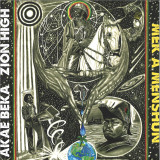
Akae Beka's inimitable style of rich, deep, multi-layered songwriting, uncompromising devotion to RasTafari and soulful healing melodies developed over decades performing with St. Croix based band Midnite and countless recordings. At the point of his untimely passing in 2019, he had released over 70LP's. He is without a doubt one of the most prolific reggae artists ever known.
The stellar production trinity that is Zion I Kings have been involved collectively and individually in creating some of the most highly regarded contributions to the vast Akae Beka catalogue. The timeless songs of 'Mek A Menshun' amply reward the listener who can penetrate into the mystical musical realms of Rastafari. Longtime fans of Midnite and Akae Beka will note that Vaughn Benjamin's singing on 'Mek a Menshun' reached new heights of melodic delivery and emotional intensity. Coupled with his always poetic and insightful lyrics, these 10 original songs rank among his best recordings to date. The title track 'Mek A Menshun' includes vocals by Protoje Grammy (R)-nominated artist.
Mek A Menshun features the stellar musicianship of the ZIK distinguished in typical fashion by the rock-solid drumming of Lloyd "Junior" Richards. On this album, his playing is complemented by Aston Barrett Jr. ("By Day", "Only Now") and Kirk Bennett ( "Kagm Mystory", "Mek A Menshun"). The signature stylings of the other core ZIK musicians are augmented by horns (Andrew "Drew Keys" Stoch -trombone, Donald "Jahbless" Toney -saxophone), flute- Sheldon "Attiba" Bernard, kette- Andrew "Bassie" Campbell, and the guitar of Chet Samuel. ZIK guitarist Andrew "Moon" Bain contributes a string arrangement on "Only Now". Throughout the album, Laurent "Tippy I" Alfred's spot-on organ shuffle bubbles the rhythm forward. Many of the 'Mek A Menshun' tracks were among the last recordings done by the veteran engineer Gary Woung.
Originally released digitally and on CD, this LP is now being released for the first time on as a 12" vinyl LP courtesy of Before Zero Records.
Buscar:sam kin
For most of us, life is a series of human interactions; some good, some bad, some happy, some sad. But what would life be without those peripheral characters who plant themselves into our worlds through the sheer force of their presence? Whether we speak to them or not, those vibrant contrasts to the everyday tide of ordinary people are a magical part of the human experience. Oddballs and misfits, flamboyant instigators or low-key game changers, we all clock them on our own hectic journeys, and they make the day a little brighter. Everyone has their favourite people.
Following the runaway success of their first one-shot single in 2020, Favourite People reconvene for a full-length of blues-tinged cuts stemming from sessions at Selva Studios in Brooklyn. The project’s roots predate the studio, from scattered jams and sweaty nights in New York nightspots to impromptu recordings on cruise ships, but the flashpoint of inspiration that truly set the album in motion was the arrival of a blonde 1960s Fender Telecaster. From there, the motley crew of sharp-shooting string slingers and sticks men set about crafting paeans to those striking souls who make the world a more colourful place.
The emphasis here is on the kind of forward-facing, electrically charged mix you felt (whether you realised it or not) hearing early Sabbath or Priest for the first time. With their undeniable bias towards vintage soul, Favourite People are far from heavy metal, but the same lineage of blues and by extension jazz informs the music, while the tonal crunch of that 70s era guides the sound. Feasting on tasteful overdrive and leaning on the unmistakable flavour of tape for much of the recording, the deal was sealed on this purposeful exercise in vibe thanks to the near-mythical texture of Guy Davie’s EMI Nigeria console at Electric Mastering.
Across the album there are mellow shades and bursts of good-time get-down exuberance, but the lead singles capture the essence of the band in no uncertain terms.
‘Promise Of Nibbles’ brings the Favourite People MO into sharp relief with a low-slung, hard swinging blues confection full of overheating organ and duelling guitars in pursuit of Southern-stewed boogie (im)perfection.
‘We’ll Be Late To The Party’ turns up the tempo and dials in the fuzz, striking an anthemic note which lands somewhere between urgent highway escapism and euphoric communal revelation.
‘Mass and Mustiness’ leans in on the funk dimension of the group’s sound with the sweetest licks and chops on that fabled telecaster backed up by an acutely angled beat and the slinkiest of b-lines.
These are but three of the vibrant vignettes laid down by this quietly unassuming collective of heads down jammers, loose groovers and vintage sound freaks –heavy grooving instrumentals pulled from their own moments of pure musical magic and captured on disc for your listening, dancing, living, loving pleasure.
2022 limited edition of this Japanese no wave gem from 1982. With extended liner notes and interviews with band members about the recordings of the album, as well as unpublished photographs from 1981 by Jibiki Yuichi.
The Japanese punk rock movement known as Tokyo Rockers began in the summer of 1978. It incubated an independent music culture as well as a host of fascinating, individualistic musicians. One of the more striking units was the male-female duo Maria 023. NON played bass for them, and it was here that she first attracted attention. However, Maria 023 was short-lived, and NON would not reappear until the following year, August 1979, on stage at the legendary concert event "Drive to 80s". Her unbilled performance at the event consisted of several songs for solo bass and vocals, and her combination of intensity and a distinctly female emotionality made a striking impression. In the months that followed, NON continued to play solo and she became a pivotal presence among the female rockers on the scene at the time.
Finally she shifted from solo to group performance, and formed NON BAND. After several member changes, the line-up stabilized into a unique trio with Kinosuke Yamagishi on violin and clarinet, and Mitsuru Tamagaki on drums. It was with this line-up that the group reached a musical peak. At the same time, the Japanese punk and new wave rock scene was moving in a new direction, as a second generation of artists appeared and mushrooming independent labels began to play an increasingly important role. I myself started a label called Telegraph Records in 1981 and worked hard on record releases and building a distribution network.
Since starting the label, I had wanted to release a record by NON BAND. There were many vicissitudes before it could happen, but in February 1982 NON BAND's first album was released as a 10-inch LP on Telegraph Records, the label's fifth release. In the early Japanese indies scene, if a release sold 1000 copies it was counted as a significant success. The NON BAND album went through several repressing and sold 2000 copies. The album was a hit and the band's critical reception and popularity suddenly took off.
The shows that followed the release of the album were given a boost by the addition of two female rockers, the guitarist Kummy and keyboard player Mitsuwa. The group was reaching a real musical peak and everyone expected more great developments, but just six months after the release of the album the group would grind to a halt. Members quit the band one after another, and with no possible replacements to be found, NON herself faded away from the scene.
NON BAND's career in the early Japanese indies scene was thus short-lived. But their sole album was reissued twice on CD, and remained popular with listeners. However, the group's history was to have a second chapter.
NON ended up returning to her hometown, snowy Hirosaki in the far northern prefecture Aomori. There she raised two children and took over the running of the family business, an arts supplies store. Her thoughts turned once again towards music, and in 1999 she took up her bass again and began to sing. She invited two fabulous musicians, Keiji Haino and Tatsuya Yoshida, to Hirosaki, and performed together with them as well as solo. This marked the beginning of a new phase for her, and she played live in Tokyo and released a solo album, "ie". She got back in touch with Yamagishi and Tamagaki and reformed NON BAND. They added Emi Sasaki on accordion and began to play a handful of gigs each year, bringing a mature depth to their undiminished power and dazzling a new generation of fans. In 2012 the group released an album of recent live performances entitled " NON BAND Liven' 2009-2012". I released the album on the newly reanimated Telegraph Records.
NON still lives in the north, in Hirosaki. The city is famous for its summer Neputa festival. The first track on this album, "Duncan Dancin'" is almost a theme song for NON BAND, but its rhythm is taken from the ohayashi music that is performed in this festival, as large floats and troupes of dancers wind their way through the streets. The title refers to the legendary dancer, Isadora Duncan. The image perfectly represents NON herself: Isadora Duncan dancing to the earthy rhythms bubbling up out of the north land.
Nov 9, 2016 Jibiky Yuichi (Telegraph Factory)
In order to achieve a meticulous sound quality the reissue version is cut on 12" vinyl instead of the original 10" format. The original cover artwork has been reproduced and there are liner notes by Jibiky Yuichi with unpublished photos of NON BAND.
- A1: Los Avilenos - Cumbia Con Guitarra
- A2: Tito Chicoma Y Su Orquesta - Ritmo Veregua
- A3: Freddy Roland Y Su Orquesta - Arroz Con Coco
- A4: Silvestre Montez Y Sus Guantanameros - El Diablo
- A5: Mita Y Su Monte Adentro - El Yoyo
- A6: Los Kintos - Tin Marin
- A7: Orquesta Reve - Mi Son Combinado
- B1: Poppy Y Sus Piranas - Guayaba
- B2: Al Valdez Y Su Conjunto - Aprieta
- B3: Sonora Casino - El Negro Javier
- B4: German Neciosup Y Su Orquesta - Casamiento No
- B5: La Sonora Mag - El Negro Bembon
- B6: Nico Estrada - La Malanga
- B7: Melcochita Y Karamanduka - Machu Picchu
This sampler compiles 14 killer tropical tracks for the dance floor, all taken from the vaults of Peru's MAG records, including cumbias to descargas, boogaloo to salsa. Classic songs such as 'Arroz Con Coco' or 'Aprieta (Oye Como Va),' and also obscure recordings like the stunning 'Ritmo Veregua' by Tito Chicoma or the totally under-the-radar -recorded in Lima- 'Mi Son Combinado' by Cuba's legendary Orquesta Revé. MAG will turn 70 in 2023 and is a pivotal label in Peruvian music, mainly focused on tropical rhythms although its extensive catalogue also includes rock, pop and jazz recordings. This compilation celebrates the recent addition of Discos MAG to the Vampisoul family, where the best and most elusive titles from the MAG archive will become available again. MAG has been, since its foundation in 1953, an essential label in the music scene of Peru, allowing the development of the careers of both tropical artists and musicians of other genres. At the head was Don Manuel Antonio Guerrero, its founder, whose name comes from the acronym of the label itself (M.A.G.). In 2021 MAG was acquired by the Spanish company Distrolux SL, owner of the Munster and Vampisoul record labels, after years of previous collaborations in which some of the most emblematic titles in the catalog were already reissued for the international market: Nils Jazz Ensemble, Sonora Casino, Traffic Sound, Al Valdez, Pax_ "14 MAGníficos" is a 14-track compilation that celebrates a new era in the history of the label, now under the Vampisoul umbrella, with a selection of astonishing dance floor-oriented gems. This is also a perfect introduction to MAG, showcasing the amazing musical variety sported by the Peruvian label throughout the years. The comp includes juicy Cuban songs like 'Mi Son Combinado', an outstanding original taken from the extremely scarce LP recorded by Cuba's finest Orquesta Revé for MAG in Lima, and the explosive guaracha 'Tin Marin' by Los Kintos, a group lead by guitarist Pancho Acosta. Also classic songs such as 'Arroz Con Coco' or 'Aprieta (Oye Como Va),' and obscure recordings like the stunning 'Ritmo Veregua' by Tito Chicoma.
Gianluca Petrella is one of the most internationally renowned Italian musician, composer and producer, winner of the Down Beat Critics Poll in the "Rising Stars" category for two years in a row. Cosmic Renaissance is a music collective led by Ganluca with Mirco Rubegni (trumpet), Riccardo Di Vinci (electric bass, double bass), Simone Padovani (percussion) and Federico Scettri (drums, samplers), with Soweto Kinch (vocals and tenor sax) as special guest among others. Cosmic Renaissance's aim is to write and play music that actually starts from jazz and reaches new heights and music genres, in the name of unity, discovery, connection, understanding and other beautiful things that make us human. Try to imagine all this into music, and you'll have an idea of how "Universal Language" really sounds!
repress
Levon Vincent returns with his fourth full-length studio album Silent Cities a striking departure from his previous records. This, his first release experimenting with the cassette format, Silent Cities is a kind of mixtape through more private moods and personal pitches (literally given Levon’s non-standard tunings).
While Levon has always pro
duced dance floor jams with the intention of raising people’s heart rates, Silent Cities began with 72 bpm: his average resting heart rate, and the concept of tuning the music he was making to his own body rather than increasing anything. This brought the tempos down to 72 bpm or even half of that, at 36bpm. Programming the record during the empty cityscape of Berlin lockdowns, this is the first time Levon’s created an album for the home stereo or for headphone listening whilst navigating through a city. A mixtape specialist in his youth; he was always wanted to play with the cassette format. The results are sure to delight any listener, with the ever-present ambient, krautrock, shoegaze, hip-hop and electro influences coming to the foreground on this work.
“I was expanding further along the lines of a surprise favourite from my previous LP, a song called She Likes To Wave To Passing Boats which was not a 4 on-the-floor piece to play in clubs but a more impressionistic piece of music that I wrote to expound some emotions one day” says Levon. “It was a song written using just intonation. I really love how warm the pure 4ths sound, so when working on the new LP Silent Cities I decided to use my own tunings”.
Historically, the use of just intonation has meant that such instruments could sound "in tune" in one key but at the expense of more dissonance in the other keys. None of the songs on Silent Cities use standard Western equal temperament, Levon created his own scale designs coupled with the ancient ratios found in just intonation.
Born in Houston in 1975, Levon’s life changed dramatically when his parents moved their family to New York in 1981, uprooted from what he knew, the shock, the change from Houston to New York at 6 years old, is referred to constantly in Levon’s Musical output over the years. Levon's family moved houses in and around NYC from 1981 -2010, never more than a mile or two from the WTC. He lived on the Lower East Side during his teenage years and early 20s. This time period and this locale are also a big theme recurrent in his music as he tries to convey how the "downtown" lifestyle and culture-melding affected him so much at a tender age. He cut his teeth working in record shops around lower Manhattan, and while working at the Halcyon Record shop in Brooklyn he (alongside DJ Jus-Ed) was instrumental in creating the wave that came to be known as the "NYC House Renaissance" circa 2010. During the Y2K years he studied 20th C post-minimalism at Purchase college of New York under James McElwaine (who tangentially produced Man Parrish’s Self-Titled proto-hip-hop debt LP). Levon was fortunate to study theory with avant-garde composer Dary John Mizelle and orchestration under conductor Joel Thome. He undertook masterclasses with Philip Glass and also served as intern for John Kilgore, engineer for Steve Reich, where he was present for notable mix sessions such as “Violin Phase.”
Post-minimalism clearly remains an influence not to mention the early sampler stars of 80s freestyle and synth pop. Mixing such far-reaching influences is something Levon executes tremendously well. The first track Everlasting Joy moves at a head nodding 96 BPM tempo, reflecting formative influences like Paul Hardcastle’s Rainforest or Art Of Noise’s Moments in Love. “Those types of songs were a big eye opener for me as a youth, because it was where I realised songs in popular culture didn’t have to be kept to just 3 minutes, and they didn’t require vocals either. So, Everlasting Joy is a song with that intention, one that might be radio-friendly, despite the long arrangement and without vocals. You could say it was inspired by 107.5 in NY because that was a station I listened to a lot in the 1980’s.”
The majority of demos on Silent Cities were recorded before Covid-19 hit the world - when Levon had found a studio space outside of home in his adopted city of Berlin. It was a career first - working on music outside the bedroom. This riding the train or bicycling ‘going to work’ in Berlin opened up a new mood in his music, using the time back and forth to be inspired - commuting as an NYC transplant who still feels as a tourist in Berlin, with a pair of headphones, looking out the window on the train, or stopping on bridges and parking his bike to enjoy Berlin's skyline and horizon. Then, the pandemic struck and “work” came to a halt. Levon had recorded so much material during that year in the studio out of house it seemed like an inflection point for him to lighten the burden of the possessions he was carrying.
“People close to me have watched me give away synths and hardware regularly and I have given away my record collection every few years for my whole life. As a struggling artist in my 20s who had worked in record stores that whole time, I learned that moving constantly with 12k records just wasn't the way to live. So, in light of the pandemic, I set up a shop online, and sold all my music equipment. I also created a separate shop for all my sneakers and clothes. Easy come, Easy go. This provided me with a slow drip type of income that carried me quite well through the pandemic and it allowed me to focus on my own art and music. Getting rid of all my possessions felt like a weight being lifted from my shoulders and I was able to stay the course and remain committed to the music. I needed a further 2 years to mix and arrange the LP. If it weren’t for the pandemic, I would not been able to make this type of LP, so in light of everything, I was able to turn a depressing time in to something lasting and musically very positive.”
You can hear how his approach to a cassette release retains the "Medium is the Message." ethos. Silent Cities is a spooling, warm piece about life memories and embodiment.
- A1: Good Life
- A2: Mecca & The Soul Brother
- A3: Go With The Flow Side
- B1: The Creator
- B2: All Souled Out
- B3: Good Life (Group Home Mix)
Pressed On Clear Vinyl! 1991 was the year that it all broke loose for producer Pete Rock and his rhyme partner, CL Smooth. But the duo was far from an overnight sensation. The two friends had been on the grind since high school in Mt. Vernon, NY in the mid-'80s, and Pete had been building up to his big moment since he first manned the decks on WBLS's hugely influential 'In Control With Marley Marl' radio show, starting in 1987. In '91, Pete's talent finally forced him from the studio shadows into the spotlight, and after remixes and co-productions for Heavy D (1989's Big Tyme album); Johnny Gill ('Rub You The Right Way,' 1990); and Elektra label-mates Brand Nubian ('Slow Down,' 1990); it was time for top billing. As Pete's rep skyrocketed with a revolutionary remix to Public Enemy's 'Shut 'Em Down' in 1991, the stage was set. The duo's debut EP, 'All Souled Out', was the perfect set-up - and bridge to - their flawless LP, Mecca & The Soul Brother, which appeared only one year later. Fans new (thanks to a recent revival, resulting from the song's use in a Google / Android commercial) and old are sure to know the EP's only single, 'The Creator.' The cut is a perfect slice of early '90s hip-hop - jumpy, funky and rolling along at a sprinter's pace, with killer horns that sew up the chorus. Interestingly, it's the only song on the EP where Pete Rock rhymes (and solo at that, with lines written by Brand Nubian's Grand Puba). The remaining five of the EP's songs, with CL Smooth in full charge of the mic, are no less impressive. The sleeper is perhaps 'Go With The Flow,' a kinetic groover with an egregiously thick, muted bassline, surgical cuts and never-endingly captivating lines by the liquid-tongued CL. 'All Souled Out' boasts all of the Pete Rock trademarks - a jumpy, filtered bassline; beautifully stitched horn samples on the hook; and this time with a faster tempo. CL has no issues with Pete's BPM challenge, proving he can drop knowledge at any speed. And of two different versions of 'Good Life' on the platter, the EP's final cut, the 'Group Home Mix,' is perhaps the winner, with an abundance of musical action to back up CL's lyrical musings on ways to achieve success and comfort in life. 25 years after its initial impact, 'All Souled Out' sounds as heavy and essential as ever, and will remind fans how important this duo was to the artform.
Some of the greatest jazz musicians of all time have passed through Art Blakey's Jazz Messengers: Horace Silver, Hank Mobley, Kenny Dorham, Wayne Shorter and Donald Byrd, among many others. However brief their stay, working with the demanding and full-throttle drummer not only increased their visibility, but also their chops and interpretive capacity. Blakey's ability to drum up the best players in the game may have even eclipsed his superhuman ability to play drums.
Altoist Jackie McLean, trumpeter Bill Hardman, bassist Spanky deBrest, and pianist Sam Dockery deliver whole-bop goodness on five propulsive, fiery tracks. True to its title, this LP bops hard, with a ferocious swing, boundless energy and telepathic communication between players - especially Blakey and Hardman. Considering the rhythmic demands of Blakey's locomotive playing style, this was an incredible achievement.
Impex Records has cut this gorgeous 180-gram LP with the original analogue mono master tapes and without computer processing of any kind. You hear all the vivacious interplay that occurred on that weekend in 1957 when Blakey and crew forged a bold new vision of muscular, funky jazz. This is music that still resonates over 50 years later. Not to be missed!
Hitting play on SEAMOSS2, the latest missive from Portland noisetinkerers Sea Moss, is like punching the big red button on a cartoon
bomb before it explodes into a multicolored mushroom cloud
From the second Nap Time revs up, vocalist Noa Ver and drummer Zach
D'Agostino absolutely clobber the listener with a distorted hodgepodge of sounds
as raw and violent as they are winkingly playful, as if Black Dice and Melt-Banana
were caught in the middle of some kind of psychotic square dance together.The
duo's setup "which involves a primitive assemblage of hacked feedback
oscillators, colorful Rococo tin boxes, and a contact mic plugged directly onto
Ver's neck to capture her barking intonations " harkens back to an era of DIY
where live performance meant everything. Blurring the line between reckless
improvisation and tightly- knit compositions, the band achieves a disorientingly
complex interplay. Though Sea Moss's music may initially seem to be an act of
pure blunt force, the duo's true prowess lies in the intricacy of their rhythmic
interplay. As freeform as it all might seem, SEAMOSS2 contains the band's most
potent, precise compositions yet, refining the distinct style they forged on
disorienting releases like Bread Bored and Bidet Dreaming into a thrilling act of
controlled chaos.
In an era where the communal spirit of DIY feels more difficult to achieve than
ever, Sea Moss embody the classic ethos of weirdo punk music in all its absurdity
and wonder. It's this same sense of scrappiness that's earned them attention
from legends like Lightning Bolt and Machine Girl, and SEAMOSS2 illustrates why
they're every bit as deserving of their own trophy in the noise-rock hall of fame
one adorned in broken contact mics and scuffed-up scratches from one too many
bloody basement shows.
experiment in markmarking and sound, as a kind of writing by ear - metallic, brushed, wooden - lines imprinted and pressed circular. The record takes its name from the discarded title of the several-hundred-page draft of Clarice Lispector’s eventual 96-page novel Água Viva. Devoid of characters or plot, Água Viva appears always in suspension between the interior and exterior and impression and expression. Weird and formless (like the jellyfish ‘agua viva’ translates to in Portuguese) Lispector’s text deals less in the cerebral or the knowable realms of words and more in the unknowable moment of experience. Its joy is found in its looseness, its meaning found in its lack of definition. Loud Object began as six sides of violin improvisations, four of them abandoned and the last of them added to or processed using samplers in moments Steiger calls ‘wells’ - gaps or dips in the recording which could be filled or poured into. The process of filling up and taking away, of repeating and multiplying, of building tension between the finite and the lost - all wrestle with actualisation. Which line will be drawn? In the liner notes for the LP, Evie Scarlett Ward writes, “The record holds loss.” Though the lines are fixed, its contents are fluid - forty minutes filled in and manipulated, before time moves on. Steiger’s relentless rearranging of convention means no two of his live shows are the same, and his decade-plus involvement in London’s free improvisation scene constantly surprises. Loud Object is no exception. Recorded on the 12th, 13th and 14th February 2021 by Daniel Blumberg. Produced by Billy Steiger. Mixed by Billy Steiger and Shaun Crook. Mastered by Giuseppe Ielasi. Artwork by Billy Steiger. Layout by Oli Barrett. Liner notes by Evie Scarlett Ward.
First time in - stockfind from great 2020 release! 300 copies pressed
After a fifteen year hiatus from music making, Pedro Tenreiro, Porto’s veteran and legendary DJ, former A&R, producer and re-edit pioneer behind projects such as Mr. Spock, Illmatic+Phaser and Dancin’ Days, joins Hugo Passos, a key player of the city’s early Hip Hop scene, to form Bonfim.
In the last couple of years they met once a week to have some fun exploring Pedro’s record collection through Hugo’s MPC.
The result is a six track EP of sample based music that draws its inspiration from soulful and, so called, classic golden age Hip Hop, 90s House and leftfield jazzy sounds that reflects the duo’s eclectic tastes.
Winter’s glittery, holographic image takes on a darker shade in the grooves of their 4th album, What Kind of Blue Are You? The record sees Samira Winter return to the kind of hooky shoegaze of her early recordings. A darker, more world-weary perspective informs the honest and emotionally unguarded lyrics. Sonically, What Kind of Blue... is Winter’s greatest achievement yet. Texturally,, bellowing fuzz and wirey guitars evoke a new sonic territory. Tracks like “Atonement” (ft. Hatchie), “Good” (ft. Sasami) and “Fool” claw, scrape and wriggle their way into your ear. Produced by Joo Joo Ashworth (Sasami, Automatic, Dummy). Recently completed a US and Europe tour as part of Hatchie’s band. 4 pre-release singles and a video for “Atonement”. Featured guest peformances from Sasami Ashworth and Hatchie. Recent collaborations with Pachyman, Mile High Club, and Jorge Elbrecht. “Utterly charming kaleidoscopic dreampop... her perfect palette of sounds draws you in but she’s got the tunes to keep you around” Brooklyn Vegan // Tour Dates Europe & Australia (Supporting Hatchie). Sept 25th Bristol @ Louisiana, Sept 26th Manchester @ YES, Sept 27th London @ Village Underground. // Track Listing: Side A 01. Wish I Knew 02. Atonement 03. Good 04. Sunday 05. Crimson Enclosure Side B 06. Write It Out 07. Lose You 08. Fool 09. Mr. On-My-Mind 10. Kind Of Blue
12 track vinyl LP and 18 track CD including bonus single and demo recordings. The Daggermen all went to Rede Secondary School in Medway, Kent. It was a school for those that failed their 11 plus, or who passed it but decided to go there anyway (as Jon pretends). Being in some of the same classes we became friends and found we liked the same music; The Who, The Small Faces, The Kinks, The Beatles and The Jimi Hendrix Experience. We started going to Carnaby Street, wearing Beatle boots and generally being a bit Moddy. Dave’s older brother, James Taylor, played organ in The Prisoners and we’d listen to cassette tapes of them along with other local band, The Milkshakes as we bounced on the trampoline during P.E. After watching both bands play live in local venues such as the M.I.C. club in Chatham we formed The Daggermen, working out who was going to play which instrument as we stood next to the now demolished school sports hall. No one can quite remember who thought of the name, The Daggermen (it was me) or how comes Jon was playing bass on a guitar in the band at the very start and then Terry took over when we started gigging (it was because he had a real bass guitar and a car). But the next thing was that we were supporting The Prisoners both in Medway and places such as the 100 Club in Oxford Street. Then, one sunny day at around the age of 17, I bumped into Billy Childish walking across a field. I formally introduced myself and told him that he should definitely come and see our band that night because we were “fucking brilliant”. He did turn up and bought us a tray of whiskies whilst we were on stage, a sure sign that he had liked it. This led to him and Russ Wilkins, bass player in The Milkshakes alongside Billy, asking us if we wanted to record an E.P. for Russ’s label, Empire Records. This was our first ever recording called Introducing The Daggermen which was made in a brick arch under Rochester bridge that we rented for £2 a week to rehearse in and lovingly referred to as ‘The Hole’. We got ourselves a “manager” (our mate, Vic Templar) and started playing up and down England, drinking as much as possible in the van on the way to each gig, often paralytic by the time we went on stage. Our musical style was a sort of mixture of punk and mod and we played covers such as ‘Heatwave’ (The Who’s version) and ‘Get Ready’ by the Temptations, along with Dave and Terry’s originals. Then came a change of line up when Jon resumed his position as bass player and Terry left for America. We started wearing military jackets thanks to Jimi Hendrix and made our first long player, Dagger In My Mind (I got the title off an episode of Star Trek, although I remembered it wrong and it should have been ‘Dagger Of The Mind’). The album was produced by James Taylor and Allan Crockford of The Prisoners at Woolly Studios on the Isle of Sheppey in 1986. This line-up played together for a couple of years up and down the country (also with a few gigs in France) before we called it a day and sailed off into the future in bands such as The James Taylor Quartet, The Kravin’ “A”s, The Solarflares and Billy Childish and The Buff Medways. As energetic youths we had a lot of fun and I am very proud to have been part of The Daggermen. We hope you enjoy these recordings, now all gathered together for the first time. Sincerely yours, Wolf Howard, Cafe Mozart, Chatham CD TRACKLISTING 1 – It’s You I See 2 – What Do I Do For You 3 – There’s No Escaping 4 – I’ve Been Hurt 5 – I Have Lost Heart 6 – You Were Meant To Be 7 – Every Moment 8 – Dagger In My Mind 9 – That Girl 10 – D’you Think Of Me 11 – I Feel The Regret 12 – I’ve Been Searching 13 – Now It’s You I Need 14 – Ivor 15 – One More Letter 16 – I Wish You Were Mine 17 – Bundle 18 – No Reason LP TRACKLISTING 1 – It’s You I See 2 – What Do I Do For You 3 – There’s No Escaping 4 – I’ve Been Hurt 5 – I Have Lost Heart 6 – You Were Meant To Be 7 – Every Moment 8 – Dagger In My Mind 9 – That Girl 10 – D’you Think Of Me 11 – I Feel The Regret 12 – I’ve Been Searching
How many hardcore, let alone metal, bands exceed all previous efforts on their third LP? Some might argue that ‘Feel The Darkness’ was Poison Idea’s prime. You could present ‘Master Of Puppets’ and ‘Reign In Blood’, if you’re so inclined. Let’s face it, these are a dying breed of exceptions to the rule. And yet, like an icepick in the eye socket of logic, here stands Foreseen with ‘Untamed Force’. In the landmine ridden field that is crossover, where bands can all too easily get it so wrong, Foreseen not only survive the death sentence of their sophomore record “Grave Danger” (2017), but head out on a blunt force killing spree. ‘Untamed Force’ indeed. Rarely has a record title been more fitting. Vocalist Mirko Nummelin sounds more pissed off than ever, 12 years on. Drummer Mårten Gustafsson’s arms and feet generate enough power to make Finland energy self-sufficient. And finally, pushing the band over the edge, separating Foreseen from us feeble bastards, we have new member Ville Valavuo joining Jaakko Hietakangas to form what is arguably the scene’s deadliest six string tag-team. Foreseen’s power is untamed but at the same time borne from hard work, a love for the craft and their musical community, and absolutely no excuses. Dig in, endure, stomp out, shoot to kill. Foreseen are for headbangers who haven’t been brainwashed by click tracks and digital recordings. Foreseen are for punks who can deal with a synth intro and harmonised solos. In 2022, ‘Untamed Force’ is the guiding principle that can inspire, but not be replicated, by the Kings of Hardcore Thrash.
1. Soldier's Grave 2. Birthright 3. Tolerance of Abuse 4. Suffocating Routine 5. Oppression Fetish 6. Cold Comfort 7. Serve Your Purpose 8. Desensitized 9. Untamed Force
LP colour is Transparent Blue. Stu Spasm (Lubricated Goat) + Russell Simins (Jon Spencer Blues Explosion) + Kate Bjelland (Babes In Toyland). One off garage-sleaze rock masterpiece. Remastered. Crunt began in 1993 as a kind of indie rock supergroup and had their 1994 debut album touted by Pearl Jam's Eddie Vedder. Crunt's members included guitarist/vocalist Stuart Gray (aka Stu Spasm) and bassist/vocalist Kat Bjelland. Gray was well-known in Australia by the start of Crunt for his past involvement in the bands Salamander Jim and the horn/guitar punk rock of Lubricated Goat, which included drummer Martin Bland who went on to play in the Monkeywrench. As for Bjelland, she was the frontwoman/guitarist for the Minnesota-based Babes in Toyland. Crunt was rounded out by drummer Russell Simins, who was the full-time sticksman for New York City's Jon Spencer Blues Explosion. Each of Crunt's members were temporarily residing in Seattle when Gray conjured up the idea of starting a new group. After writing almost a dozen songs, the trio entered Seattle's Ranch studio in February of 1993 with Simins and Gray acting as the producers, and their friend John Dunleavy -- known for his work with the Supersuckers -- filling the role of engineer. A year passed before the group's self-titled album was released on February 15, 1994, on Austin, TX label Trance Syndicate, owned by Butthole Surfers' drummer King Coffey. The record was the imprint's first release from a non-Texas group. The debut of the full-length album coincided with the "Swine"/"Sexy" single on Australia's Insipid label, which was known for releasing singles by other bands such as the Cows, Urge Overkill, and the Jesus Lizard. Prior to the releases, there had been talk that the band was not going to just be a side project, but a full-time band in the same tradition as Babes in Toyland and the Blues Explosion. The trio had even planned a full-scale tour. By January of 1995, however, Crunt came to an end.
At any given time, you’re likely to find Jim Lauderdale making music, whether he’s laying down a new track in the studio or working through a spontaneous melody at his home in Nashville. And if he’s not actively crafting new music, he’s certainly thinking about it. “It's a constant challenge to try to keep making better and better records, write better and better songs. I still always feel like I'm a developing artist,” he says. This may be a surprising sentiment from a man who’s won two Grammys, released 34 full-length albums, and taken home the Americana Music Association’s coveted Wagonmaster Award. But forthcoming album Game Changer is convincing evidence that the North Carolina native is only continuing to hone his craft. Operating under his own label, Sky Crunch Records, for the first time since 2016, Lauderdale recorded Game Changer at the renowned Blackbird Studios in Nashville, co-producing the release with Jay Weaver and pulling from songs he’d written over the last several years. “There's a mixture on this record of uplifting songs and, at the same time, songs of heartbreak and despair—because that's part of life as well,” he says. “In the country song world especially, that's always been part of it. That’s real life.” Lauderdale would know: He’s been a vital part of the country music ecosystem since 1991, when he released his debut album and began penning songs for an impressively long roster of country music greats. “When I was a teenager wanting to be a bluegrass banjo player, I never would have imagined that I would get to work with people like Ralph Stanley and Robert Hunter and George Jones and Elvis Costello and John Oates,” he muses. “Getting to work with them inspires me greatly to this day, and I know it always will.” From rollicking guitar riffs on “That Kind of Life (That Kind of Day)” to the slow, sweet harmonies of “I’ll Keep My Heart Open For You,” Game Changer shows off Lauderdale’s ingenuity as a singer, songwriter, and producer—while reestablishing him as one of Americana’s most steadfast champions..”
As three souls plunge down from the heavens, death and destruction can be felt hanging in the air like a foul stench. Red clouds swirl around a black sun that never sets and an erratic clock ticks off-tempo, moving faster and slower before rewinding and starting anew.
“Let me paint you a picture…” vocalist Mikey Arthur sings, welcoming listeners with a dramatic opening scene. It takes a skillful guide to navigate the darkest depths of hell. And, as The Gloom In The Corner depict in their second full-length album Trinity, death is merely the beginning of the series of chilling adventures
Purposefully aligning their song count with unlucky number thirteen – a reoccurring symbol in the ever-unfolding Gloom Cinematic Universe or GCU – it comes as little surprise to longtime fans that each of the Australian quartet’s enticing tracks intertwine to form an interlocking tale; this time centered around the appropriately labeled unholy trinity.
Comprised of previously deceased characters Rachel Barker, Ethan Hardy, and Clara Carne, the group’s bloody battle is woven throughout the album as the anti-heroes determinedly claw their way back to Earth from the Rabbit Hole dimension, slashing, shooting, and extinguishing anyone who dares to oppose their quest. Yet, for the Girl of Glass, Ronin, and Queen of Misanthropy, there is clearly more to the story than what can be contained within a single package.
Projecting a wide and complex web of lore, plot twists, and tongue and cheek humor, frontman Mikey Arthur, guitarist Matt Stevens, bassist Paul Musolino, and drummer Nic Haberle, have been producing highly detailed concept releases since their formation. And, consistently filling in more missing pieces of the puzzle with every body of work, the band equate each new record to a fresh season of The Umbrella Academy dropping on the streaming service of your choice. Because, just as a great TV series captivates viewers with its music and storytelling, the quartet’s work provides a complete experience designed to allow fans to check in with their favorite characters, all the while enjoying a cinematic new soundtrack.
For those just joining the GCU, as well as those looking for a quick refresh, 2016 debut album Fear Me introduced listeners to main protagonists Julian “Jay” Hardy, a Section 13 agent consumed by anger over his girlfriend Rachel’s death, and Jay’s gloom (later known as Sherlock Adaliah Bones), a demonic entity who at times takes over Jay’s body as a host vessel. 2017 EP Homecoming tells the tale of Jay’s brother Ethan, a war veteran suffering from PTSD, who upon discovering his brother’s struggle, kills himself as part of a Dante-style rescue mission to bring Rachel back to life. In 2019 EP Flesh and Bones, we’re introduced to Clara Carne, a past witness to one of Jay and Sherlock’s crimes, who instead of taking revenge, began a twisted love story with Sherlock, only to be murdered by his forced hand. And 2020’s Ultima Pluvia EP where we finally learn of Sherlock’s past as an ancient warlord under the tyrannical King Baphicho, and see Sherlock and Jay’s deaths ushered in by Section 13 opponent and New Order leader Elias DeGraver and his gloom Atticus Encey.
After 2016’s Fear Me, the band admit that their original intention was to jump straight into the events of Trinity before pivoting to create Homecoming, Flesh and Bones, and Ultima Pluvia. However, upon reflection, primary storywriter Mikey Arthur believes that pushing the timeline back actually provided greater opportunity for the group to properly flesh out the songs and plotlines for their sophomore studio record.
Indeed, while Trinity re-introduces the three central “heroes” of this new arc, it’s important to understand that while familiar, the characters are not carbon copies of who they were earlier in the story. And neither is the band who brought them to life.
Fully embracing the weird and whacky has never been a struggle for The Gloom In The Corner. Rather, it’s together with this attitude that the group come away with special moments such as the fascinating old and new dynamic between neighboring tracks “Red Clouds” – a song whose initial version predates the formation of The Gloom In The Corner as an official band – and “Gravity” in which a demo intended for future material was adjusted to fit the sonic drop.
Mirroring this evolution in the band’s musical approach, a sense of growth can also be seen projected in the characters and story that the quartet chronicle across the thirteen tracks.
Classifying their individual sound as an intricate form of “cinema or theater-core” due to the depth and breadth of their musical approach, features, samples, symphonic elements, and conceptual nature, The Gloom In The Corner continue to prove that they’re more than just a simple concept band.
In fact, similar to character theme music in movies and video games, the group seamlessly play off their diverse sonic story in a variety of ways. Continuing to breathe new life into older staples from their catalog, the quartet reworked their infamous “Oxymøron” breakdown from Fear Me into an impactful moment in Trinity’s “Nor Hell A Fury” and sprinkled audio easter eggs of this sort all throughout their new music for fans to discover.
Listeners are also brought further into the world of the GCU with the help of what The Gloom In The Corner call their “casting process.” Like picking actors for a musical, the band meticulously selected eleven different vocal features and several additional voice actors to bring the album and characters to life. Described as a 50/50 split between notable talents such as Ryo Kinoshita (Crystal Lake), Joe Badolato (Fit For An Autopsy), and Lauren Babic (Red Handed Denial), as well as talented friends and family like Elijah Witt (Cane Hill) and Mikey’s sister Amelia Duffield, each featured artist brought their own touch and realistic spark to the characters they portrayed.
For in the end, as much as Trinity and it’s cast live within the confines of their own supernatural worlds, themes such as falling out of love (Gatekeeper), battling depression (Obliteration Imminent), and standing behind women’s empowerment (Nor Hell A Fury), are ones that many can relate to or understand. And, while most individuals may avoid drowning their woes by way of transforming into full-on egotistical murderers like the Queen and King of Misanthropy and the gang, The Gloom In The Corner have illustrated that time and time again, life’s a little more fun when you can crack a smile. Taking a page from the trinity’s playbook: try to avoid the end of the world. But if you can’t…at least spend it with a killer soundtrack.
From their new millennium rise to MTV superstardom through pop-punk’s modern resurgence that has introduced their iconic, multi-platinum sound to new audiences around the world, SIMPLE PLAN have been an indelible part of pop culture for more than two decades because they’ve never lost sight of what got them there in the first place: their fans.It’s this same sense of mutual respect that’s fully on display on “The Antidote,” the first single from their sixth studio album, HARDER THAN IT LOOKS., their first new music since 2016’s Taking One For The Team, and the most authentically Simple Plan album since 2004’s Still Not Getting Any. Free agents for the first time in their storied career, the band kept their circle tight during the recording process, enlisting longtime songwriting partners like We The Kings’ Travis Clark and producers Brian Howes and Jason Van Poederooyen (who worked on the band’s 2011’s album Get Your Heart On!) and Zakk Cervini (blink-182, Good Charlotte). From the skyscraping choruses of “Congratulations” and “Ruin My Life” (ft. Sum 41’s Deryck Whibley) to the unflinching poignancy of the album-closing “Two,” which instantly ranks alongside “Perfect” and “Untitled (How Could This Happen To Me?)” as one of the band’s best closers ever, HARDER THAN IT LOOKS certainly respects Simple Plan’s storied career – and the same spirit that helped the band sell 10 million albums worldwide – without being overtly reverent. The album-opening “Wake Me Up (When This Nightmare’s Over)” is a cathartic rush of familiarity and freshness – not to mention a bit lyrically prescient, as the COVID-19 pandemic hit shortly after the band wrapped the album. (“We certainly didn’t set out to write a pandemic album,” Bouvier says with a laugh. “It’s funny how some of the songs might seem like that, though.”) There are even spiritual successors to early material, like the glass-half-full skate-punk-leaning “Best Day Of My Life,” quite a 180 for a band who put a song called “The Worst Day Ever” on their genre-defining, Platinum-selling 2002 debut No Pads, No Helmets...Just Balls. But you won’t find an ounce of fat on the 10-song album, no obvious plays to recapture the radio waves they claimed in the early aughts with smash hits like “I’d Do Anything,” “I’m Just A Kid” and “Addicted.”
- A1: Here If You Want Me 03 01 Min
- A2: Overtime 02 44 Min
- A3: Up To You 03 13 Min
- A4: Second Thought 03 30 Min
- A5: Anytime You Want 04 16 Min
- A6: Heavy Like Air 02 53 Min
- A7: For A Minute 02 49 Min
- A8: Mercury’s Ladder 01 34 Min
- B1: Empty Eyes 02 56 Min
- B2: Bottleneck Boys 03 30 Min
- B3: Balloon 01 43 Min
- B4: Riversong 03 45 Min
- B5: The World Can Wait 03 05 Min
- B6: Not A Blue Sky 02 50 Min
- B7: Coffee Girl 03 11 Min
- B8: ) | Death 01 36 Min
Public Possession proudly presents Aiden Ayers debut album „Venus Copper Rose“. A few words by the artist himself: „ Venus Copper Rose came to me in a dream. The three words are all the same thing, symbols of beauty and material formations of love. Together they are a VCR (videocassette recorder) - a memory machine, a portal into fantasy and myth + a transcriber of dreams. The songs on the album represent the past five years of my life. The oldest of them were written and first recorded in 2017 and the youngest barely made it to the mastering session on time. I am always writing and recording, travelling to and fro, on little islands off the coast of BC, down to the California desert, or in makeshift basement studios throughout Vancouver. Every song has grown up and been captured in a different way - the album is a wild garden of misfits, flowers and weeds. I hope that people feel nourished by this album - I believe that is the ultimate role of music, like another kind of food, light, or love. I hope these songs and this album can help people see the beauty and poetry that flows through their own lives.“
Since 2014, Wand have made five albums (and an EP) in the studio and a living playing on the road. Business/pleasure: the two sides of their (multiverticed, decagon) coin, flipping in the strobe light of ongoing self actualization. And yet, by doing both at the same time-making a record of them playing live-they"ve now made their best one yet. How do you get Spiders In the Rain? Start by going all the way back to January 2020. Do you remember? Wand do. They"d been touring Laughing Matter for ten months. They"d done the coast, spanned the country, crossed the water twice, came back home and kept on going...driving, flying, occasionally floating (or maybe just thinking they were?), always on to the next town. They did all kinds of shows-clubs, ballrooms, festival gigs with no roof overhead-the songs expanding and contracting according to the dimensions of each day. Seventy-nine shows, and everything that was involved-the miles that ran beneath them, the different places and people everywhere, the music as it reathed, making everyone change every night-alchemized the band, and they drove deeper into their far horizon than they"d ever previously gone. The essential truth of the live vibe-that it"s always better when everybody"s here-was clear, so they booked a few shows more in Cali, from L.A. up to Marin. They brought along light and projections from The Mad Alchemist Liquid Light Show and Mike Kreibel and Zac Hernandez too, to tape everything-to get the big-deck energy out of performances in S.F. and L.A., but also to draw it out of the margins in Sacramento, Novato and Big Sur. It all happened, too. Everyone brought their experience. Packaged sumptuously with artwork from Sam Klickner, Spiders In the Rain is an arc of natural beauty and man-made abstraction inside and out, on an epic scale. Wand are orchestra and machine on Spiders In the Rain, one with the audience, able to get inside any dimension of their sound, whether its songs from their second album or their last one.




