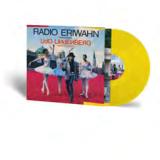
Ein fiktiver Radiosender als Titel, der mit den politischen Verhältnissen im Osten abrechnet und ein Cover,
das Lindenberg auf dem roten Platz mit drei Balletttänzerinnen zeigt. Schwer vorzustellen, ein Album
mit noch höherer zeitgeschichtlicher Relevanz zu veröffentlichen. Dieses Jahr feiert Lindenbergs „Radio
Eriwahn“ 40. Jubiläum. Schon im Titel des 19. Studioalbums des Panikrockers: eine Anspielung auf den
frei erfundenen Sender Eriwan. In einer Kategorie politischer, teils unmoralischer Witze wird mit diesem
„Sender“ des Sowjetregimes hinter vorgehaltener Hand die Politik und der Alltag in der DDR verarbeitet.
Ein treffender Titel für ein Album, welches vom humorvollen Umgang mit der Ost-West-Teilung lebt. Die
A-Seite des Albums besteht aus Studiotiteln, die B-Seite sind Live-Aufnahmen aus Moskau, wo er anlässlich
der Weltfestspiele der Jugend und Studenten 1985 mehrfach auftrat. Ein heimlicher Triumpf für Lindenberg,
dem nach seinem ersten Konzert in der DDR seine DDR-Tour abgesagt wurde. Das Cover zeigt Udo auf
dem roten Platz, der für das Cover rot eingefärbt wurde, nachdem Lindenberg bei seinem ersten Besuch
enttäuscht war, dass der Platz nicht tatsächlich rot ist. Am 17.10.2025 erscheint die Jubiläumsversion von
„Radio Eriwahn“ in gelb-transparentem Vinyl in einer streng limitierten, handnummerierten Auflage von
nur 1.500 Exemplaren. Um das 40. Jubiläum gebührend zu feiern, wird das Album zudem auch als CD
neu aufgelegt.
Buscar:send
Mark Fell inaugurates his new label – The National Centre for Mark Fell Studies – with his first solo electronic material in years; a slinky, ravishing volley of unique dance drills that have been in the works for over a decade, feeling somehow like Derek Bailey dissecting Singeli, or Autechre and Hermeto Pascoal dancing in hyperspace. There’s nothing else quite like it.
Back on the floor for the first time since dealing a pair of deep house 12”s with DJ Sprinkles, sending a contemporary classic in »Protogravity« with Errorsmith, plus a lauded collab with Gábor Lázár – all in 2015 – Fell taps back into core club concerns last explored to this uncompromising extent on his string of »Sensate Focus« EPs released between 2012–2013. He’s hardly been slacking since then, with a slew of far-reaching avant collabs with everyone from Rian Treanor to Limpe Fuchs, Okkyung Lee to Pat Thomas, Explore Ensemble to Will Guthrie – each one blurring distinctions between producer, composer, and conductor.
The »Nite Closures« EP is worth the wait – and then some. As ever, Fell manages to retain a highly distinctive, instantly identifiable sound while also tracing and mapping new bends in the continuum. His exploration of contemporary styles and patterns is here distilled and articulated with a rare, daring playfulness and sinuous intricacy – for over half an hour he flows from frantic to almost emotional at the drop of a snare. Trust it’s not your everyday / everynight club music, with an asymmetric angularity bound to wrong-foot fresher feet, but also the type of absolutely future-facing, skewed machine funk that clubs are crying out for, even if they don’t quite realise it.
As someone who’s witnessed the dominance of colouring-book Jive Bunny DJs recycle tested ideas ad infinitum, the message is a firm do-one to myopic ravers in »Nite Closures«. From the displaced anticipations tested in its extended dub and ravishing, tweaked polymetrics on its version, through a »Large Modulos #3« teeming with organismic details, to the hair-kissing swang of »auchterhouse (inversion)« and its clipped, cascading 2.1-step reprise, Fell offers thrilling new options for the loosey-gooseyest dancers at each turn. For us, it’s perhaps his greatest record this century.
- A1: Lovin' Me
- B1: Lovin' You
"Feeling the Sea" 7-inch single from singer-songwriter HANAH SPRING, with a background in jazz and soul!
HANAH SPRING, who calls Shonan and Kamakura her home base and continues her musical career, is already known for her talent.
She also collaborates with a variety of artists, and her new song is the endlessly soothing lovers' reggae "Lovin' Me"
It's a positive tune that sends the message, "I'm me, let's sing love for myself"
The B-side includes a lovers' cover of Minnie Riperton's "Lovin' You" This release is an exquisite pairing of the answer song "Lovin' Me," which pays
homage to the original, and the cover version of "Lovin' You"
This single is from "SALT... meets ISLAND CAFE -Sea of Love 3-," a surf music compilation curated by "SALT...," a magazine that proposes new values
for beach lifestyles and surf culture.
- The Seer Gives Lagertha A Prophecy
- The Vikings Sail For Wessex
- Kwenthrith's Story
- Vikings Battle Brihtwulf's Army
- Torstein Loses An Arm
- A Cloaked Figure Arrives In Kattegat
- Battle For The Hill Of The Ash
- Judith
- Sacrifice For The Crops
- Siggy Sacrifices Herself To Save Ragnar's Sons
- Rollo Learns Of Siggy's Sacrifice
- Bjorn Fights To Save Rollo
- Helga Tells Floki Of Harbard
- The Seer Laughs At Rollo's Misery
- Aethelwulf Attacks
- Ragnar Kills The Messenger
- Athelstan Is Reborn
- Floki Appears To Kill Athelstan
- Ragnar Honors Athelstan's Death
- Ecbert Sends Athelwulf On A Journey
- Aethelwulf Meets With Kwenthrith
- Floki's Siege Towers Revealed
- Vikings Reach Paris
- The Attack Begins
- Vikings Attempt To Rip Open Gates
- Floki Melt Down
- Floki Curses The Gods
- Kalf And Lagertha Make A Pact
- Lagertha's Stealth Assault On The Bridge
- The French Counter - Attack
- Ragnar Hallucinates, Sees Gods
- The Vikings Are Told Of Ragnar's Death
- Vikings Attack Paris
- Ragnar Sets Sail For Home
- The Walls Are Breached; The French Lose Hope
- Ragnar Knows Floki Killed Athelstan
The saga continues with the powerful soundtrack to Vikings Season 3. Composed by Emmy Award-winner Trevor Morris, the score evolves with the growing scale and emotional weight of the series. Season 3 takes viewers deeper into Ragnar's journey, from political ambitions to personal sacrifice, and the music reflects this with rich orchestration, ambient electronics, and haunting Nordic textures. This edition also features musical contributions from Einar Selvik (Wardruna) and Steve Tavaglione, whose unique elements lend an ancient layer to the score. Vikings (Music From Season Three) is available as a limited edition of 750 numbered copies on white coloured vinyl. This 2LP package includes a 4-page booklet with pictures and liner notes by Trevor Morris.
- If I Had A Heart
- Battle Field
- The Eye Of Odin
- Of Fathers And Sons
- Journey To Kattegat
- Northern Lights / Entry To Kattegat
- The Sunstone
- You Shall Not Enter Valhalla
- Meeting Floki
- Ragnar's Sail
- Ragnar Recruits
- Seduction
- Vikings Set Sail
- North Sea Storm
- Madness Takes Hold
- Vikings Reach Land
- Vikings Attack Village
- Floki's Fire
- Vikings Sail Home
- Vikings In Hexham
- Mano E Mano
- Battle On The Beach
- Athelstan Asks For Freedom
- Ragnar Challenges The Earl
- Ragnar Fights The Earl
- Sending The Earl To Valhalla
- Ragnar Takes The Throne
- The Angel Of Death
- Lagertha Oversees
- Vikings Attack
- Rollo Is Baptised
- Rollo Left Behind
- Ragnar Meets The Naked Woman
- The Ash Tree
- Aslaug Is With Child
- An Uncertain World
- Making A Deal
- Earl Accepts The Challenge
The official soundtrack to the first season of the acclaimed historical drama Vikings is now, for the first time, available on vinyl, offering fans and collectors a rich and immersive listening experience. Composed by Emmy Award-winning composer Trevor Morris (The Tudors, The Borgias, Dragon Age: Inquisition), the score captures the raw intensity, emotional depth, and mythic atmosphere that helped define the tone of the series. From sweeping orchestral moments to brooding ambient textures, the music reflects the harsh beauty of the Viking world and its complex characters. One of the standout tracks is the opening theme, “If I Had A Heart” by Swedish artist Fever Ray, whose haunting vocals and minimalist electronics set the tone for the series. The track became iconic, earning recognition for its unique contribution to the show’s identity. The series itself has received widespread acclaim and multiple awards, both for its storytelling and technical execution, with the music playing a vital role in its success. Vikings (Music From The TV Series) is available for the first time on vinyl as a limited edition of 750 numbered copies on blue coloured vinyl. This 2LP package includes a 4-page booklet with pictures and liner notes by Trevor Morris.
- Harte Zeiten
- Stopp/Weitergehen
- Fragen
- Teilchenbeschleuniger
- Angst
- Westradio
- Wohngebietspark
- Durchknall
- Tanzen
- Orden An Die Wand
- Manchmal
- Schlussendlich
Am 26.09.2025 erscheint beim feinen Wiener Indie-Label Voller Sound endlich das heiß erwartete Debüt-Album der New-New-Wave-Band Parc de Triomphe - als Vinyl mit grell-pinken Farbtupfern. Eine Reminiszenz an die 1980er- und 1990er-Jahre. Auf dem selbstbetitelten Album setzen sich Jörn Brien und Florian Knabenschuh in gewohnt düsterer Elektro-Pop-Manier mit der eigenen Vergangenheit auseinander. Themen wie Einsamkeit, Verletzlichkeit und die Angst vor Umbrüchen werden aufgehellt von Farb- und Hoffnungsschimmern. Druckvoll, treibend, wütend Musikalisch geht es bass- und beat-lastig zur Sache. In den oft tanzbaren Stücken werden der druckvolle Basslauf und die treibenden Beats von der markanten Stimme und einem ebenso einprägsamen Gitarrensound begleitet. Manchmal schrille, oft wütende, dann wieder ruhige, kühle Synthie-Klänge unterstreichen die Anleihen beim New Wave der 1980er. Passend zu den Texten, die sich nicht zuletzt mit DDR, Wende und den nachfolgenden Baseballschlägerjahren in Ostdeutschland auseinandersetzen. Aber keine Sorge vor zu viel Vergangenheit und Nostalgie. Im Gegenteil: Frei nach dem Bandmotto "Krawall! Elektro! Pop!" schlagen die Musiker mit ihrer melancholisch-düsteren Musik und den aufwühlenden, lyrischen Texten eine Brücke ins Hier und Jetzt. Die erzeugten Emotionen bewegen Jung und Alt. Radio-Airplay, Charts und TV Mit der EP "Harte Zeiten" haben Parc de Triomphe Ende 2023 ein erstes Ausrufezeichen gesetzt. Mit Airplay auf FM4, zahlreichen Konzerten und einem TV-Auftritt sowie Platzierungen in den Austrian Indie-Charts konnte sich die Band in der Wiener Indie-Szene schon einen Namen machen. Der Song "Westradio" lief beim beliebten Berliner Sender radioeins. Auf Spotify kommen die bisher vorab veröffentlichten Singles jeweils auf Tausende Streams. Auf dem Album "Parc de Triomphe" finden sich insgesamt 12 fein produzierte (Alf Peherstorfer) Songs, die eingängig, aber nie langweilig sind, straight, aber auf ihre Art trotzdem schräg. "Geschmackvoll, eingängig und wundervoll" FM4-Moderator Andreas Gstettner-Brugger schrieb zur Single "Harte Zeiten": "Die beiden deutschen Musiker, die sich in einem Wiener Park kennengelernt haben, produzieren hier einen geschmackvollen, eingängigen und wundervollen Song, der mich an Tocotronic, frühe Blumfeld und diverse Krautrockbands erinnert." Fazit: Fans deutschsprachiger Musik, die den New-Wave-Sound der 1980er-Jahre im modernen Gewand feiern und dem Indie-Sound der frühen 1990er-Jahre nicht abgeneigt sind, sollten "Parc de Triomphe" auf ihre Plattenteller legen.
- A1: In My Life
- A2: Playing Around
- A3: Do You Wanna
- A4: Turn On Your Funk-A-Phizor
- A5: The Beat Won't Leave You Hangin
- A6: On The Way To The World
- B1: Happiness Is
- B2: Send My Love
- B3: Oh I Love You So
- B4: Down At The Disco
- B5: Let Me Put It In Your Ear
- B6: Errol Flynn
A photo in Rodney Stepp’s scrapbook sums this period in his life in music. It’s 1974, The Spinners were headliners at the “Zaire 74” music festival, a sideshow to Muhammad Ali’s fabled “Rumble in the Jungle” fight with George Foreman. Among the faded snapshots, there’s a picture of Stepp backstage posing arm in arm with Ali; another image shows The Greatest seated at Stepp’s Fender Rhodes alongside vocalist Etta James. It was all a dream for this Naptown wunderkind, who had previously recorded for Herb Miller’s LAMP Records as the Diplomatics and had issued the sweet soul killer “Young Girl” as Jazzie Cazzie and the Eight Sounds on a rare Knaptown 45. (These recordings have been documented on the Now-Again LAMP anthology and our Loving On The Flipside compilation.) But as exciting as his rise out of those local status was, as exciting as it was to headline festivals and arenas and appear on late night talk shows, Stepp grew restless with the mechanical routine of being a sideman. He grew tired of playing the same charts night after night. He was hungry for a creative outlet that mimicked his earliest days in recorded music. So, in 1978, Stepp left The Spinners and returned to Indianapolis, where he established an all-stargroup of musicians–including members of Jazzie Cazzie and the fabled Amnesty–and he named the band Rapture. They inspired countless others. They recorded an album’s worth of material. Now-Again’s Egon first got tapes from Stepp in 2002 and dutifully transferred them, but the time was not right for a foray into this wealth of material. Come 2025, and this is the first time it Rapture’s music is seeing the light of day, a triumphant, late career moment for Stepp and a cause for celebration of those intrigued by deep, sweet soul and disco funk
- A1: You Can't Bring Me Down
- A2: Lost Again
- A3: Alone
- A4: Lovely
- A5: Give It Revolution
- B1: Get Whacked
- B2: Send Me Your Money
- B3: Emotion No. 13
- B4: Disco's Out, Murder's In
- B5: Go'n Breakdown
Lights… Camera… Revolution is the fourth studio album from Venice Beach, L.A. heavyweights Suicidal Tendencies. Suicidal’s flirtation with the mainstream (complete with obligatory criticism of ‘selling-out’) went Gold in the US with over half a million copies sold, and to this day remains an essential record in any Metal or Punk collection. It is an excellent record for fans of Anthrax, Metallica, Biohazard and Black Flag. Lights… Camera… Revolution is available as a 35th anniversary edition of 2000 individually numbered copies on red coloured vinyl
Don your bandanas, leather jackets and distressed jeans, because heavy metal is about to shine brighter than ever as Swedish newcomers BOMBER bring back the hottest era in hard rock history. Asserting their own trademark blend of 70s and 80s inspired classic and hard rock with catchy hooks, top-notch guitar solos and a vibrant aesthetic, BOMBER brings you their debut album, Nocturnal Creatures, via Napalm Records! After explosive live shows in Sweden and a subsequent tour of Germany, the hard rockers prove that the glorious era of rock isn’t over and that they’re already setting the highest standards on Nocturnal Creatures. On ten powerful tracks, BOMBER turns the night into an intoxicating adventure that convinces both old and new fans of the prominent classic and hard rock genre. Album opener and title track “Nocturnal Creatures” opens the gates with epic storytelling and interludes the following passionate ride through “Zarathustra”. With fiery vocals, melodic guitars and untamable drum-play, the track gets the listener’s pulse pumping, while “Fever Eyes” ensnares with wistful weeping choirs and guarantees a quickly increasing temperature. “Black Pants Magic” emerges into an unforgettable high-class rock experience through its industrious and catchy hook, while songs like “A Walk Of Titans (Hearts Will Break)” and “You’ve Got Demons” surprise with dynamic melodies and Anton Sköld’s powerful voice. On “The Tiger”, BOMBER send their listeners right into the eye of a raging thunderstorm of riffs driven by brilliant grooves, while “Kassiopeia” sets the strings on fire with its marvelous solos. Bursting album closer “Aurora” presents Nocturnal Creatures’ crowning achievement, bringing the 40-minute escapade to the edge of the world. With their new studio album, Nocturnal Creatures, the rising stars of Sweden establish a milestone in the legacy of hard rock that leads the once so majestic genre to new glory – marked by their very own special vision!
- In My House
- Dear Buddy
- After Midnight
- If I Called You
- Back With Me
- Flat Tire
- Bill
- Don't Wanna Be Happy
- Go Nowhere
- Something In Common
BLUE & YELLOW GALAXY SWIRL VINYL[26,01 €]
Mit ihrem vierten Album voller Eigenkompositionen lädt die eigenwillige Singer-Songwriterin Kendra Morris dazu ein, in die DIY-Kaleidoskopwelt von Next einzutauchen. Morris' neuestes Album für Karma Chief verzichtet auf vielschichtige Produktionen und glatte Sounds und präsentiert Kendra von ihrer authentischsten Seite, mit einem kreativen Prozess, der lebendig, schön und chaotisch ist und von Herzblut und der unvollkommenen Perfektion des Augenblicks getragen wird. Als Konzeptalbum in umgekehrter Reihenfolge verbindet ,Next" Kendras Figuren mit einem Vintage-Brettspiel im Stil von Milton Bradleys besten Retro-Würfelspielen. Begeben Sie sich auf die Reise von Block zu Block durch Next, und dieses Universum offenbart sich Ihnen. Sie können hören, wie die Klangpalette mit Morris' Einflüssen und Inspirationen mitschwingt. Jahrzehntelange New Yorker Klänge und Stimmen verschmelzen an den Nahtstellen dieser Tracks - eine Welt, in der das Brill Building und Warhols Factory im selben Block florieren, während Blondie und die Frightnrs rockige Sounds erkunden. Doo-Wop und Boom-Bap untermalen den Cut-and-Paste-Stil eines UHF-Senders, während Morris, eine Künstlerin, die sich hinter der Kamera genauso wohlfühlt wie vor dem Mikrofon, das Tempo vorgibt. Kendra Morris und Karma Chief Records laden Sie ein, mit Next mitzuspielen, einer akustischen Reise, auf der Würfeln für Spannung und Abenteuer steht. Es ist Next, komplett mit 10 Tracks und stundenlangem Spaß für die ganze Familie. Einige Teile müssen zusammengebaut werden. Plattenspieler, CD-/Kassettenplayer oder Streaming-Dienst sind separat erhältlich.
Bryan Ferrys gefeiertes Album „Avonmore“ aus dem Jahr 2014 ist eine meisterhafte Mischung aus anspruchsvollem
Songwriting, eleganter Produktion und atmosphärischem Charme – von Kritikern als sein bestes Werk seit
„Avalon“ gefeiert. Mit Kollaborationen mit langjährigen Bandkollegen von Roxy Music und Gastauftritten
von Johnny Marr, Nile Rodgers und Marcus Miller liefert das Album einen modernen und doch klassischen
Ferry-Sound. Herausragende Tracks wie „Loop De Li“ und „Driving Me Wild“ zeigen seine charakteristische Mischung aus Eleganz und Melancholie, während Coverversionen von Stephen Sondheims „Send in
the Clowns“ und Robert Palmers „Johnny and Mary“ für zusätzliche Tiefe sorgen. Ein Muss für Fans von
Bryan Ferry und raffnierter Pop-Kunst und eine fesselnde Ergänzung für jede Sammlung.
Das Album erscheint zum ersten Mal seit 2014 wieder auf limitierter roter Vinyl-LP und CD. Bryan Ferry
hat auch das aktualisierte Artwork für beide Formate gestaltet.
- 1: Radio Free Europe 2025 (Jacknife Lee Remix)*
- 2: Radio Free Dub 1981 (Mitch Easter Remix)
- 3: Radio Free Europe (Original Hib-Tone Single)
- 4: Sitting Still (Original Hib-Tone B-Side)
- 5: Wh. Tornado (From Cassette Set)
Vier Jahrzehnte, nachdem der Song das College-Radio erhellte und die bemerkenswerte Karriere von R.E.M. begründete, sendet „Radio Free Europe“ ein brandneues Signal aus. Angeführt wird diese 5-Track-EP vom ursprünglichen Produzenten der Band, Mitch Easter, der auch die letzten beiden Studioalben von R.E.M., Accelerate und Collapse Into Now, produziert hat. Angeführt wird die EP von einem bisher unveröffentlichten 2025er-Remix des GRAMMY-Gewinners Jacknife Lee (Taylor Swift, U2, The Killers, Weezer). Abgerundet wird das Set durch vier seltene Kassetten-Demos von 1981, darunter „Wh. Tornado“ und ‚Radio Free Dub‘, die beide ihr digitales Debüt feiern. Die Radio Free Europe 2025 EP wird digital und als limitierte 10-Zoll-Pressung auf Vinyl erhältlich sein.
Vom "Klassik-Star der Gen Z" zum Pianisten der Stunde: Louis Philippson "My Way"Nur sieben Monate nach seinem Debüt "Exposition" beleuchtet "My Way" die rasante Entwicklung des jungen Pianisten, Social-Media-Stars und Moderators Louis Philippson vom "Klassik-Star der Gen Z" (Süddeutsche Zeitung) zu einem der Pianisten der Stunde. Vom britischen Sender Classic FM wurde Louis als einziger deutscher Künstler in die "Top 30 artists under 30 in 2025" aufgenommen, während BR-Klassik erklärte: "mit Louis Philippson hat die klassische Musik einen neuen Rockstar gefunden." Auch auf den 12 restlos ausverkauften Konzerten seiner Debüt-Tour im Mai 2025 und bei den Arena Shows der "Night of the Proms" im Winter 2024 begeisterte er tausende Menschen für die Klassik auf seine eigene Weise. Daran knüpft Louis Philippson mit seinem Album "My Way" an. Aufgenommen mit dem MDR Sinfonieorchester unter der Leitung von Dirigent Ben Palmer, verbindet es neue Originalkompositionen mit neuen Bearbeitungen bekannter Themen aus der Klassik oder Filmmusik für Solo Piano sowie Piano und Orchester. Zu den neuen Werken zählen unter anderem der virale Hit "Beethoven Virus" für Klavier und Orchester, "Show Waltz" für Klavier und Orchester, "Supernova" für Klavier, Sopran und Orchester, sowie mehrere Solostücke für Klavier. Unter den neu interpretierten Klassikern finden sich das mitreißende Medley "Dancing Bee" für Klavier und Orchester, "Cornfield Chase" für Klavier und kleines Ensemble, sowie eine Bearbeitung von Themen aus den Vierjahreszeiten mit dem Titel "Vivaldi Storm". Key Dates: • 6th June: German public broadcaster MDR broadcasting a studio concert featuring the MDR Radio Symphony Orchestra (reach 1 Mio)Pre-oder start and 1. Single "Für Elise"• 23rd July: German public broadcaster ARD "3nach9" talk show (reach 1 Mio)• 11th Sept: German public broadcaster TV gala ARD Deutscher Radiopreis - 2 performances live (reach 1 Mio +)• 12th Sept: German public broadcaster TV gala MDR Goldene Henne - Performance (reach 2 Mio)Album Release • September: pitch for ClassicFM Gala London • 26th Sept. German public broadcaster MDR Riverboat Talkshow (reach 2 Mio)• October - November: Concerts in GSA in venues up to 3,000 cap (e.g. Hamburg CCH / München Prinzregententheater / Düsseldorf Tonhalle etc.)• 6th Dec: German public broadcaster ARD charity show Ein Herz für Kinder (reach 3 Mio)• Dec: concert at Royal Albert Hall London • Spring 2026: Europa-Tour mit Konzerten in Paris, Benelux, Polen, Spanien usw.In the making: documentary about his life similar to Anastasia Kobekina
- A1: Malavoi - Te Traigo Guajira
- A2: Los Caraibes - Donde
- A3: Tropicana - Amor En Chachacha
- A4: Ryco Jazz - Wachi Wara
- A5: Eugene Balthazar - Dap Pignan
- A6: Roger Jaffort - Oye Mi Consejo
- A7: Les Kings - Oriza
- B1: Les Supers Jaguars - Tatalibaba
- B2: Super Combo De Pointe A Pitre - Serrana
- B3: L'ensemble Abricot - Se Quedo Boogaloo
- B4: Henri Guedon - Bilonga
- B5: Les Aiglons - Pensando En Ti
- B6: Los Martiniquenos - Caterate
In Guadeloupe, many people think that jazz and ka music are like a ring and a finger. To some extent, the same could be said about so called Latin music and the music played in the French West Indies.
Both aesthetics were born in the Caribbean and bear so many connections that they can easily be considered cousins. In constant dialogue, there are lots of examples of their fruitful alliance and have been for a while. The English country dance that used to be practiced in European lounges came to be called kadrille in Martinique and contradanza in Cuba. They both featured additional percussion instruments inherited from the transatlantic deportation. Drawing from shared feelings about the same traumatized identity – later to be creolized – it would be hard not to assume that they were meant to inspire each other. The golden age of the orchestras that graced the Pigalle nights during the interwar period further proves the point. As soon as the 1930s, Havana-born Don Barreto naturally mixed danzón and biguine music in a combo based at Melody's Bar. In the following decade, Félix Valvert, a conductor who was born and raised in Basse-Terre in Guadelupe, also worked wonders in Montparnasse with La Coupole, which was an orchestra made up of eclectic musicians. Afro- Caribbean performers of various origins were often hired on rhythm and brass sections in jazz bands, which used to enliven the typical French balls of the capital. In the 1930s and onwards, Rico’s Creole Band was one of them.
Martinican violinist-clarinettist Ernest Léardée, who would become the king of biguine music as well as the main figure of French Uncle Ben's TV commercials (a dark stigma of post-colonial stereotypes), had musicians from the whole Caribbean sphere play at his Bal Blomet – and they all enchanted "ces Zazous-là" (according the words of Léardée's biguine-calypso piece). In les Antilles (French for French West Indies), music history started to speed up in the 1950s, when trade expanded and radio stations grew bigger. The Guadelupean and Martiniquais youth tuned in their old galena radio sets to South American and Caribbean music. As for the women traders, les pacotilleuses, they bought and sold goods across different islands (the "passing of items through various hands" was thought to be most pleasurable) and brought back countless sounds in their luggage. Such was the case of Madame Balthazar, who once returned from Puerto Rico with the first 45rpm and 33rpm to ever enter Martinique.
Out of this adventure was created the famous Martinican label La Maison des Merengues, a music business she opened and undertook with her husband and which proved to be a major landmark. At the end of the 1950s, in Puerto Rico, Marius Cultier competed in the Piano International Contest playing a version of Monk's Round 'Midnight. He won the first prize and this distinction foreshadowed everything that was to come. Cultier, the heretic Monk of jazz, was quickly praised for writing superb melodies, always tinged with a twist that conferred a unique sound to his music. It didn't take long for the gifted self-taught musician to get to play with Los Cubanos, making a name for himself thanks to his impressive maestria on merengues.
The rest is history. Besides, in the late 1950s, Frantz Charles-Denis, born into the upper middle class in Saint-Pierre and better known by his first name Francisco, went back home after working at La Cabane Cubaine – a club located rue Fontaine where he had caught the Latin fever. Francisco's music was therefore heavily marked by his Cuban cousins' influence, which gave the combos he led a specific style and also led to renewal. Things were swinging hard in La Savane, located in the main square in Fort-de-France. He set up the Shango club close by and tested out the biguine lélé there, a new music formula spiced up with Latin rhythms. Soon afterwards, fate had him fly to Puerto Rico and Venezuela.
As for percussionist Henri Guédon (percussions were only a part of his many talents), he was born in Fort-de-France in May 22nd 1944, the day marking the celebration of the abolition of slavery. As an old man, he could remember that in " his father's Teppaz, a lot of hectic 6/8 music was constantly playing...". In the opening lines of his Lettre à Dizzy, a small illustrated collection of writings published by Del Arco, he highlighted the huge impact that cubop had on him as a teenage boy, around 1960. He eventually turned out to be the lider maximo in La Contesta, a big band steeped in Latin jazz. He was also the one who originated the word zouk to describe music which brought the sound of the New York barrio to Paris. It was the culmination of a journey that started in Sainte-Marie: "a mythical place for bélé, the equivalent of Cuban guaguancó". In the early 1960s, the tertiary economy developed to the detriment of agriculture. Yet rural life was where roots music emerged in Martinique and in Guadeloupe.
Record companies played a major part in the process of Latin versions sweeping across the islands – before reaching everywhere else. Producer Célini, boss of the great Aux Ondes label, and Marcel Mavounzy, both the head of Émeraude records - a firm which was founded in 1953 - as well as the brother of famous saxophonist Robert Mavounzy, were big names to bear in mind. Although there were many of them - all of whom are featured on this record - Henri Debs was definitely the major figure in the recording adventure. He proved to be so influential that he even got compared to Berry Gordy. In the mid 1950s, when he acquired his first Teppaz, he worked on his first compositions: a bolero and a chachacha. Then, he became the one man who made people discover Caribbean music, from calypso to merengue. He was among the first ones to rush out to San Juan, Puerto Rico, to buy records and distribute them through a store run by one of his brothers in Fort-de-France. He had members of the Fania All Star come and perform there, which he was madly proud about. He was also the first one to pay attention to Haitian music, such as compas direct and various other rhythms which would soon flood the market. As a result, many of the combos hitting his legendary studio would end up boosted by widespread "Afro-Latin" rhythms. However, he never denied his identity: gwo ka drums were given a major role, although they were instruments which had long been banned from the "official" music spheres. The present selection bears witness to such a creative swarming. Here are fourteen tracks of untimely yet unprecedented cross-fertilization: all types of music rooted in the Creole archipelago have found their way, whatsoever, to the tracklisting. Whether originating from the city or being more rural, they all go back to what Edouard Glissant, in an interview about the place of West Indian music in the Afro-American scope, called "the trace of singing, the one which got erased by slavery." "It is so in jazz, but also in reggae, calypso, biguine, salsa... This trace also manifests through the drums, whether Guadelupean, Dominican, Jamaican or Cuban... None of them being quite the same. They all point to the idea of a trace, seeking it out and connecting to each other through it. This is the hallmark of the African diaspora: its ability to create something new, in relation to itself, out of a trace. It may be the memory of a rhythm, the crafting of a drum, a means of expression which doesn't resort to an old language but to the modalities of it." The opening track features one of the emblematic orchestras of this aesthetic identity, criscrossing many music types from the archipelago. The 1974 Ray Barretto guajira – Ray Barretto was a major New York drummer influenced by Charlie Parker and Chano Pozzo – is magnificently performed by Malavoi, a legendary Fayolais group (i.e from Fort-de-France). Additionally, the compilation ends on a piece by Los Martiniqueños de Francisco. It symbolically closes the circle as it is a genuine potomitan of Martinique culture which also functions as a tireless campaigner for Afro-Caribbean music. Practicing the danmyé rounds (a kind of capoeiria) to the rhythm of the bèlè drum, it delivers a terrific Caterete, a kind of champeta of Afro- Colombian obedience which was originally composed by Colombian Fabián Ramón Veloz Fernández for the group Wgenda Kenya. The icing on the cake is Brazilian Marku Ribas, who found refuge in Martinique in the early 1970s, bringing his singing to the last trance-inducing track. These two "versions" convey the whole tone of a selection composed of rarities and classics of the tropicalized genre, swarming with tonic accents and convoluted rhythms. It is the sort of cocktail that the West Indians never failed to spice up with their own ingredients. For instance, the Los Caraïbes cover of Dónde, a famous Cuban theme composed by producer Ernesto Duarte Brito, has a typical violin and features renowned Martinique singer Joby Valente and his piquant voice.
The track used to be – or so we think – their only existing 45rpm. The meaningful Amor en chachachá by L'Ensemble Tropicana, a band which included Haitian musicians among whom was composer and leader Michel Desgrotte, also recalls how Latin music was pervasive in the tropics in the mid-1960s. They were the ones keeping people dancing at Le Cocoteraie in Guadelupe and La Bananeraie in Martinique. Around the same time, another "foreign" band, Congolese Freddy Mars N'Kounkou's Ryco Jazz, achieved some success on both islands by covering Latin jazz classics – such as their adaptation of Wachi Wara, a "soul sauce" by Dizzy Gillespie and Chano Pozo whose interweaving of strings and percussions can have anyone hit the dancefloor. How can you resist Dap Pinian indeed, a powerful guaguancó by Eugene Balthazar, performed by the Tropicana Orchestra and published by the Martinique-founded La Maison des Merengues? It also acts as a symbol of the maelstrom at work. Going by the name Paco et L'orchestre Cachunga, Roger Jaffory used to play guaguancó too: his Fania-inspired Oye mi consejo is one example of his style. Baila!!!!! Dancing was also one of the Kings' focus points. Oriza is a Puerto Rican bomba and a "classic" originally composed by Nuevayorquino trumpeter Ernie Agosto, which reserves major space for brasses, giving it a special sheen.
Emerging from the New York barrios crucible was also La Perfecta, a Martinique group originating from Trinidad, whose name directly references the totemic Eddie Palmieri figure as well as his own band, also called La Perfecta. Here they borrow Toumbadora from Colombian producer and composer Efraín Lancheros and interpret it by emphasizing percussions, which set fire to the track even more than the wind instruments. The same goes for Martinique's Super Jaguars, who use Tatalibaba – a composition by Cuban guitarist Florencio "Picolo" Santana which was made famous by Celia Cruz & La Sonora Matencera – as a pretext for sending their cadences into a frenzy. In a more typically salsa vein, the Super Combo, a famous Guadelupean orchestra from Pointe-Noire that was formed around the Desplan family and had Roger Plonquitte and Elie Bianay on board, adapt Serana, a theme by Roberto Angleró Pepín, a Puerto Rican composer, singer and musician also known for his song Soy Boricua. Here again, their vision comes close to surpassing the original. In the 1970s, L'Ensemble Abricot provided a handful of tracks of different syles, hence reaching the pinnacle of the art of achieving variety and giving pleasure. They played boleros, biguines, compas direct, guaguancó and even a good old boogaloo - the type they wanted to keep close to their hearts for ever, "pour toujours", as they sang along together in one of their songs. Léon Bertide's Martinican ensemble excelled at the boogaloo which had been composed by Puerto Rican saxophonist Hector Santos for the legendary El Gran Combo.
Three years later, in 1972, Henri Guédon, with the help of Paul Rosine on the vibraphone, tackled the Bilongo made famous by Eddie Palmieri. Such a classic!!!!! And so were the Aiglons, the band from Guadelupe: choosing to execute Pensando en tí, a composition by Dominican Aniceto Batista, on a cooler tempo than the original, they noticeably used a wonderfully (un)tuned keyboard in place of the accordion. On the high-value collectible single – the first one released by Les Aiglons under the Duli Disc label – there is a sticker classifying the track under the generic name "Afro". Now that is what we call a symbol. Jacques Denis
- 1: No Faith
- 2: Shadow Boxing
- 3: Sugarcoated
- 4: Deadwire
Nu-hardcore quintet, Bodyweb, are the sound of someone’s nervous system on the verge of breakdown—hyperactive, tormented and unflinchingly vulnerable. Born out of the Leeds hardcore scene, they’re a shape-shifting alloy of jagged emotion and precision chaos. What began as late-night jams between Louis Hardy (Higher Power, Big Cheese, Fate) and Ben Jones (Pest Control) eventually mutated into train_wreck_simulation, a debut EP filled with frantic breakdowns and nu-metal swag that felt like the soundtrack to a digital exorcism. The final piece of the puzzle came from Hardy’s estranged childhood friend, pq. His twisted samples and synthetic textures are haunted and disturbed, injecting cyberpunk soul into hardcore flesh. Contorting through several iterations in the following years, the band absorbed Luke Thompson (Stiff Meds) on drums, filmmaker Tom Hobson on guitar and Naomi Macleod (Empire State Bastard) on bass, and laid down their first collective offering. deadwired is due out on Flatspot Records later this year. Bodyweb's second EP is a violent thesis on connection and pain that sends Hardy’s unfiltered vocals through heaven and hell. Four overstimulating tracks run a gamut of styles and influences from Slipknot to Björk, constantly lane-switching between dizzying heaviness, ambient soundscapes and brain-burrowing hooks. Entirely self-produced, deadwired upgrades the sonic formula laid down on the last record and raises the question: what else could exist in Bodyweb’s twisted roadmap? Nothing seems impossible. What seems important, however, is retaining the rawness in a style that can often turn sterile. “We still wanted it to sound very human. It had to be well produced but not cold and lifeless.” shares Hardy. “We didn’t use a click track. All guitars were real amps with microphones. We tried to make everything as real and raw as possible, we recorded using all the same gear we use when playing live too to really capture the energy of how it feels when we jam together." ‘Deadwired’ is a snapshot of violent implosion. Four ADHD-fuelled transmissions from the edge of spiritual collapse. It drags metallic hardcore through glitched-out ambience to confront ego death, generational trauma, and the violence of being alive. On stage, Bodyweb don’t just perform, they purge. Raucous live electronics meld with digitally contorted guitars. Breakbeats meet breakdowns—no backing track in sight. Bodyweb enable a collective catharsis. Mosh, dance, dive, scream, heal. A physical therapy session screamed into the void.
- A1: Intro
- A2: Blah Blah Blah
- A3: Medina’s In Da House
- A4: Danger - Pt. 2
- B1: Don’t Let This Rap Shit Fool You
- B2: Pain I Feel
- B3: Posse Jumpa
- C1: Maniac Cop
- C2: Good Cop / Bad Cop
- C3: Sendin’ Dem Back
- D1: Long Winded
- D2: Jackpot
- D3: Danger
Blah Blah Blah is the 1996 debut album by Brooklyn-based hip hop duo Blahzay Blahzay, composed of DJ P.F. Cuttin' and rapper Outloud. Their big breakthrough was the single "Danger", which was issued as the lead single of their 1996 album Blah Blah Blah. The single contains many samples, including Beastie Boys and Q-Tip "Get It Together", Gwen McCrae "Rockin' Chair", and Jeru The Damaja "Come Clean". It reached #4 on the Billboard Hip Hop Chart and #46 on the Billboard Hot 100. The tracks "Pain I Feel", "Good Cop/Bad Cop" and "Danger, Pt. 2" also gained traction. The album featured guest performances by Dark Man, Smoothe Da Hustler and Trigga Tha Gambla.
Nick Bike hops aboard his groove machine once again here for another superb run out, this time with his Italian mate Stan Brega on Chosen Spokes. 'Big Bizniss' gets going with a super cool and laid back downtempo, disco and funky fusion. Lavish horns, cowbells, sultry chords and effortlessly vibey vocals all make it an instantly lovable and hip-swinging summer classic. Flip it over and you'll find 'Forever & Ever', which is an epic, cosmic, Balearic, ambient and blissed out cover of a David Bowie mega-hit. Proggy guitars draw out the me option and make it a perfect end of the night tune to send people home teary-eyed but euphoric.
Saxophonist, flautist and producer Chip Wickham casts a formidable shadow across the worldwide jazz landscape. Originally from Brighton, but now dividing his time between the UK, Spain and the Middle-East, he has made a name for himself with a series of beautifully crafted solo albums that draw equally on the hard swinging spiritual jazz of Roland Kirk, Yusef Lateef and Sahih Shihab, alongside the music of British jazz legends such as Tubby Hayes and Harold McNair and the more contemporary sounds of Jazzanova, Kyoto Jazz Massive and Robert Glasper. His close working relationship with Matthew Halsall’s Gondwana Records has spanned close to two decades (since he played on Halsall’s 2008 debut ‘Sending My Love’) and has since released three standout releases on the label (the ‘Cloud 10’ LP, and the ‘Astral Travelling’ and ‘Love & Life’ EP’s). Once again returning to the heralded label, he now prepares to release his elegant fifth studio album ‘The Eternal Now’. Further exploring his penchant for hard-hitting soulful, spiritual jazz and modal hard-bop, it denotes an exciting new chapter in his much- revered discography, once which sees his unbridled artist flourish into new and fruitful pastures.
A beautifully crafted record, ‘The Eternal Now’ is a heartfelt ode to submitting oneself to the practice of creating art, and the freedom that’s derived from letting go. Speaking on his journey to bringing it into the world, Chip explains “The Eternal Now is a creative place where time has no purpose. A place where the past and the future don’t exist. A place where an artist can create something that is timeless and relevant. Writing this album has been a deliberate journey of exploration and drive into the furthest reaches of creativity. An attempt to push myself artistically into new spaces using new colours and new energy”. On how he approached this record in comparison to his previous offerings, he divulges ‘I had to be playful and take risks. It has taken longer than any other album to make and it has been so worth it. I have been drifting and taking the road less travelled as well as not looking back. I’ve enjoyed being on the outside and the freedom it has brought me to create something new and fresh and relevant and timeless.’
I have been playing Eternal a lot in my DJ sets & it all started with Dev/Null posting a video clip of a tune he was working on, in a Skype group chat we're both a part of. It was probably the best thing I'd ever heard from him and I hassled him relentlessly to finish this track so I could start playing it and then potentially signing it for Future Retro London. That tune he was working on ended up being Eternal & I had no hesitation towards taking the tune for the label. I asked him who he would like to remix Eternal for the release and he picked DJ B (who's had tunes out on Demolition Squad & Brazen) and he did a nice 4x4 version, taking the track down a stompier path (I don't know if stompier is a word but can't think of a better word to use).
Watch The Spin is a tune I first heard when I was in Helsinki, playing at a night called 20hz, organised by DJ Sofa & ODJ Pirkka. Pirkka played after me and during his set, I heard him play this track which had a wicked 90s Bristol jump-up flavour, but with new twists & style to it. I went into the booth and asked him who it was by, and he told me it was by him & another guy called Onni and that they'd recently started making music together under the alias of Unlimited Vibes. When I got back to London the next day, I asked him to send the tune and he did and I really liked the track, so decided to sign it for Future Retro London, to fit alongside Eternal on this release. And to complete the release, Ricky Force has done an exceptional remix of Watch The Spin, bringing his modern jungle sound to the table.