A chance meeting in Mexico City set Points of Inaccessibility into motion. When Ibero-American composer Rafael Anton Irisarri crossed paths with Dutch media artist Jaco Schilp at MUTEK in 2024, a conversation about how technology shapes perception revealed an unexpected common ground. Schilp invited Irisarri to a spring 2025 residency at Uncloud, the Utrecht-based collective he co-founded, where Irisarri's sound began to take form amid an environment shaped by Schilp’s visual research.
The Uncloud studio was located inside the former Pieter Baan Centre, a forensic psychiatric prison where suspects of violent crimes were once confined. Its long history of silence and containment shaped the atmosphere in which the project developed. Within this setting, Irisarri coaxed long bowed-guitar tones through a network of pedals and looping systems. The raw gestures thickened into a vaporous and architectural field of sound. Schilp processed the material through a custom point-cloud software patch that produced images in continuous flux. The visuals flickered, dissolved and reformed like memories that resist coherence, functioning as a digital Rorschach that reflected the observer’s own perception.
Amid these spectral echoes, the project evolved into an examination of how the past persists within present signals. Memory endures as residue and interference, continually shaping perception even when its source has faded.
Schilp’s visual process required a continuous stream of sound in real time. Irisarri improvised throughout the residency, generating material that allowed the visuals to develop in parallel. Once back in his New York studio, he began shaping the recordings by carving pathways through the improvisations and mapping selected passages into MIDI. This process allowed him to build outward from the bowed-guitar material with minimal overdubs, adding Prophet 5 textures, Moog bass and strings that expanded the harmonic field while keeping the original performances at the center. To refine the structure, Abul Mogard provided editorial input, working with Irisarri’s stems to guide transitions and strengthen the overall pacing. The material, originally created under conditions of immediacy and constraint, evolved into a fully realized work through careful revision, patience and sustained reworking.
The title engages the geographic concept of the Poles of Inaccessibility, locations defined solely by their distance from all surrounding points. Irisarri adapts this idea to the conditions of digital life, where new forms of inaccessibility arise through the informational enclosures that structure perception. What appears to be a fully connected network often produces a deeper kind of separation, one shaped by the filtering logic of the systems that mediate experience. In this sense, the digital sphere mirrors its geographic counterpart. We inhabit spaces saturated with signals, yet the possibility of genuine contact becomes increasingly remote.
At its core, Points of Inaccessibility considers what can be understood as the new rituals of capitalist realism. Irisarri uses the term digital shamanism to describe the forms of simulated connection that organize contemporary life. These systems promise comfort through algorithms, influencers and AI interlocutors, yet they often reproduce the same conditions that generate loneliness in the first place. What appears as connection becomes the echo of connection, a sequence of gestures that imitate solidarity while withholding it. Like the geographic poles, these rituals are defined by distance. They pull us into environments where everything is illuminated, yet meaningful proximity becomes increasingly rare. In this sense, the work approaches a hauntology of the present, a reflection on futures that have stalled and intimacies that have been thinned by the algorithmic infrastructures that surround us.
This thematic tension unfolds across the album’s four movements. Faded Ghosts of Clouds introduces the work with textures that rise and dissipate in slow cycles, creating an atmosphere that resists clear definition. Breaking the Unison occupies a pivotal position in the sequence and focuses on the moment when the individual and the system fall out of alignment. Its shifting patterns trace the scattering of signals that once suggested connection, revealing the instability at the heart of contemporary perception. Signals from a Distant Afterglow forms the center of the album and features vocals by Karen Vogt, whose presence enters the sound field like a fragile transmission shaped by distance and delay. The closing piece, Memory Strands, follows motifs that appear, recede and briefly intersect before returning to quiet. Across these movements, the album outlines a landscape in which emergence and disappearance continually inform one another.
Listening to Points of Inaccessibility is an encounter with a sound field that is constantly in flux. Elements surface briefly, shift position and recede, creating a sense of motion that resists stable interpretation. The music moves between closeness and vastness, carrying traces of memory while withholding a clear point of resolution.
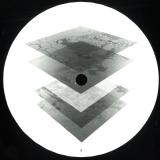
The album’s visual identity completes the project’s conceptual arc. In Mexico City, where Irisarri and Schilp first met, Daniel Castrejón transformed stills from Schilp’s point-cloud visuals into the cover image. The final artwork captures a single suspended frame of the digital material, a moment extracted from a field that is normally in constant motion. Its surface recalls the texture and abstraction found in the work of Catalan artist Antoni Tàpies, where material presence and erasure coexist within the same plane.
What emerges is a work that examines the tension between technological systems and human presence. Points of Inaccessibility asks whether connection is still possible within environments shaped by mediation and delay, or whether we have become isolated points within the very networks that promise proximity. What possibilities for relation persist within environments organized by algorithms and interruption? And how are we meant to understand presence when so much of it is constructed at a distance?
Points of Inaccessibility will be released on BioVinyl on February 6, 2026, with audiovisual performances planned throughout 2026.
Mastered by Stephan Mathieu
Artwork by Jaco Schilp
Design and layout by Daniel Castrejón
Artist photo by Iulia Alexandra Magheru.
Поиск:signal
Все
CYRK Relaunches Time Zero with a High-Voltage Return to Electro Berlin-based duo CYRK proudly announce the relaunch of their Time Zero imprint, marking the occasion with a striking new release that dives head-first back into their electro roots. The EP showcases three tracks of pure electronic funk, delivered with the razor-sharp production and futuristic flair that has come to define the project. Adding a further layer of intrigue, the record includes a remix from the enigmatic producer Client_03, whose identity remains one of electronic music's most compelling mysteries. Their reinterpretation pushes the release into even deeper machine-funk territory, rounding out a package that reaffirms CYRK's command of the genre. With the rebirth of Time Zero, CYRK signal a new chapter--one that celebrates their unmistakable sound while looking boldly toward the future.
- A1: No Es Por Acá
- A2: Pedazo De Tonto (Feat. Luis Mexia)
- A3: Indispensable
- A4: Deja De Chingarme
- A5: Te Pedí
- B1: Con Honores
- B2: De Piedra A Papel (Feat. Pablo Alborán)
- B3: Si Es Cierto Que Te Vas
- B4: Primera Cita
- C1: Mil Maneras De Morir (Feat. Kakalo)
- C2: Necesito Encontrarte
- C3: Mi Alma Embrujada
- C4: Corazón De Oro (Feat. Los Hijos De Frank)
- D1: Vete Yendo (Feat. Angela Aguilar)
- D2: Ni Me Debes Ni Te Debo (Feat. Con Camilo)
- D3: Hundido En Un Pozo
- D4: Música De Fondo
- D5: Outro
- Ähnliche Artikel Finden
Colmillo de Leche marks a defining moment in Carín León’s artistic evolution, reimagining his sound and signaling the true beginning of a career rooted in authenticity and fearless creativity. Awarded the 2023 Latin GRAMMY for "Mejor Álbum Norteño", the album cemented his status as one of the leading voices in the new wave of regional Mexican music.
140g Black 2LP in widespine jacket with printed inner sleeves
Liverpool-born, Glasgow-based electronic artist KAVARI announces PLAGUE MUSIC, her debut EP for XL Recordings. Having earned early and enduring support from Aphex Twin, Ethel Cain, Ninajirachi, Flume, and Yeule, the EP marks KAVARI’s most focused and uncompromising body of work to date; a release that sharpens her sonic signature, deepens her world building, and signals her arrival on XL with clarity and intent.
Building on the foundations of her 2022 EP Suture, PLAGUE MUSIC pushes further into darker, more uncompromising territory. Drawing from drum & bass, dubstep, and noise, the EP imagines a world in decay, reflecting a sense of global instability and emotional unease. KAVARI deliberately sidesteps EDM conventions, emphasising the genre’s intensity and impact while stripping away any sense of escapist lightness. Across the four tracks, sound design becomes a narrative tool: traces of human presence - breath, movement, and spatial textures - collide with abrasive electronic elements that blur the line between rhythm and experimental.
With PLAGUE MUSIC, KAVARI announces herself as a bold, visionary force in electronic music, pushing the boundaries of genre while creating work that is as emotionally gripping as it is physically powerful
Whispering Signals unveils Schweres Wasser, a new sub-label guided by Thorsten Hoffmann and Markus Offermann, rooted in Aachen’s influential techno scene. Their devotion to dub-techno’s stripped, elemental aesthetics shapes the first release: three dub-drenched, slow, and deeply absorbing tracks recorded more than a decade ago yet still sounding remarkably current. Reworks by long-time friends .VRIL & Danieli underscore the material’s enduring precision and timeless sound.
- A1: The Whip Hand
- A2: Aegis
- A3: Dyslexicon
- B1: Empty Vessels Make The Loudest Sound
- B2: The Malkin Jewel
- B3: Lapochka
- C1: In Absentia
- C2: Imago
- C3: Molochwalker
- C4: Trinkets Pale Of Moon
- D1: Vedamalady
- D2: Noctourniquet
- D3: Zed And Two Naughts
Noctourniquet And then everything went black, at least for a while, at least for The Mars Volta. In the months and years following their fifth full-length, Octahedron, Omar kept on at his usual fearsome creative pace. In fact, he ramped up his output considerably, starting up his own Rodriguez Lopez Productions label and releasing a slew of solo albums. It was a practice he’d begun shortly after De-Loused’s release, with his solo debut A Manual Dexterity: Soundtrack Volume One, but as the decade reached its close, Omar grew to rely upon his solo recordings as an outlet for his prolific creativity, these albums often exploring musical pastures far beyond even The Mars Volta’s wide-ranging parameters. Before choosing to release music under his own name, Omar would always play it to Cedric first, to see if the frontman thought it had potential to become Mars Volta music. Shortly after Octahedron’s completion, Cedric flagged one batch of tracks Omar had cut with Deantoni Parks, a brilliant drummer and composer who’d briefly occupied the Mars Volta drumstool in-between Jon Theodore and Thomas Pridgen’s tenures, and whose volcanic creativity and unique, unpredictable approach to rhythm and composition had quickly made him one of Omar’s favourite artistic foils.
As with the music that made up Octahedron, the new tracks Cedric had optioned for The Mars Volta often veered far from the riotous, Grand Guignol visions of their earlier releases. It possessed the punchy, song-based focus of Octahedron, though this was a considerably darker, more menacing strain of pop, with synthesisers figuring heavily in the productions. Cedric took the tracks in 2009 and set about writing songs to the music. But no more new Mars Volta music would be heard until 2012. The years that passed in-between were nonetheless momentous, and busy, witnessing an unexpected reunion of the members of At The Drive-In, and Cedric joining his own side-project, Anywhere. But there wasn’t any sign of life within the Mars Volta until Omar, Cedric and their bandmates took to the road for a series of live shows in the spring of 2011, billed as The Omar Rodriguez-Lopez Group, debuting the songs that would become Noctourniquet. The album followed the next year, and it remains one of The Mars Volta’s finest, its electronic textures staking out unfamiliar but fertile new ground.
An unsettling, subtly turbulent listen, Noctourniquet found Cedric sketching out a story about “some sort of device that stops the darkness from bleeding”, drawing influence variously from the nursery rhyme Solomon Grundy, the Greek myth of Hyacinthus and the song Birth, School, Work, Death by British underground rockers The Godfathers. It was an album of dystopian futurism, signalled by the paranoid cyber-rock of opener The Whip Hand and its unnerving chorus, “That’s when I disconnect from you”. But it was also an album of inspired, unexpected moves and uncanny invention, like how Dyslexicon seemed to eerily evoke Blondie’s Rapture, before rushing headlong into its bruising chorus, tempos shifting restlessly throughout like quaking earth beneath the listener’s feet, or how Aegis put a brave new spin on The Mars Volta’s trademark rewiring of salsa’s overdriven passions, or how Cedric had never sounded as scary as he did on The Malkin Jewel’s mutant burlesque shuffle. Tracks like Molochwalker were sleek and concise in a way The Mars Volta had never really attempted before – which was all part of Omar’s plan.
“It had all been guitar, guitar, guitar, overdubs, everything fighting for space in the same frequency,” he explains. “So for Noctourniquet, it was all about subtracting elements, of sticking to how I made demos.” Deantoni’s presence helped revivify the group, playing against cliché and expectation, and taking each song in unexpected directions. “I’d beatbox a rhythm for him to play, to go with my guitar part, and he’d come back with three or four alternate options. It was so great.” Similarly, Cedric had never sung better than on Noctourniquet, staking out a fearsome spectrum from the chilling Tom Waitsian growl of The Malkin Jewel to the keening, beautiful vocalisation on Vedamalady, rising to match some of Omar’s most deft, most immediately effective and melodic songs yet. Indeed, Noctourniquet is the sound of a band discovering new ways to do familiar things, renewing their commitment to their mission, finding fresh inspiration a decade in, and shaking off any complacency that might have come with ten years of acclaim and success.
Grupo um celebrate 50 years with release of lost dictatorship-era album nineteen seventy seven!
First time release - vinyl comes with printed innersleeves
Brazilian avant-jazz vanguardists Grupo Um celebrate their 50th anniversary, sharing a second previously lost 1970s album from the vaults. Nineteen Seventy Seven (titled after the year it was recorded) is another rip-roaring instrumental fusion treasure from the band which spawned from within Hermeto Pascoal’s famed mid-1970s São Paulo collective.
Like their debut album Starting Point, Grupo Um’s Nineteen Seventy Seven was recorded when Brazil's military dictatorship was at its most repressive. “There were no open doors to those who dreamt to be protagonists in creative instrumental music”, remembers drummer Zé Eduardo Nazario, “even popular composers and singers had to submit their songs to censors and many records were banned and confiscated from the stores.”
Just like Hermeto Pascoal's Viajando Com O Som (1977) and Grupo Um's previous album Starting Point (1975), both of which remained unreleased until the 21st century, Zé Eduardo asserts that the 1977 album was flatly 'without any chance to be released at that time."
Recorded at Rogério Duprat’s Vice-Versa Studios in São Paulo, the group were under both time and space restraints, “we chose the small Studio B,” Lelo Nazario recalls, “which had a Tascam (TE AC) 12x8 console and a 4-channel AMPEX AG 440 machine. Therefore, we had to record without overdubs, everything straight to tape.”
Expanding from a trio to a quintet, original Grupo Um members Lelo Nazario (keys), Zé Eduardo Nazario (drums), and Zeca Assumpção (bass) were joined by saxophonist Roberto Sion and percussionist Carlinhos Gonçalves. Carlinhos, Zé and Zeca had already played together in the group Mandala, while brothers Lelo and Zé had just finished a stint backing Hermeto Pascoal during his years in São Paulo.
Lelo was deeply immersed in modular synthesizer experimentation during this period, working extensively with the ARP2600 and EMS Synthi AKS. These electroacoustic explorations formed the sonic foundation for "Mobile/Stabile," one of his first compositions to merge modular synthesis with Brazilian music, a fusion that would ripple throughout the Brazilian jazz scene. The piece premiered at the first São Paulo International Jazz Festival in 1978, performed by Grupo Um with guest trumpeter Márcio Montarroyos. In a shocking moment, festival organizers interrupted the show mid-performance, sparking fierce backlash from both audience members and journalists who denounced the incident as artistic censorship during Brazil's era of political and cultural repression. The version on Nineteen Seventy Seven is the first recording of the composition.
Nineteen Seventy Seven combines Afro-Brazilian rhythm, modular synthesis and a plethora of whistles, percussion and effects pedals. Album opener “Absurdo Mudo” - so titled for the absurd difficulty it poses to the musicians performing it - starts out in a cloud of mysterious dissonance, before the haze breaks for a glorious keyboard and saxophone interplay atop an uptempo samba groove. “Cortejo dos Reis Negros (Version 2)” (Procession of the Black Kings), based on the maracatu rhythm, inverts the traditional jazz song structure by beginning with improvisations, which are followed by the theme and a final coda. “The studio also had two Parasound electronic reverb units,” Lelo notes, “and the timbre is very audible on the soprano sax and percussion.”
Grupo Um’s daring music represents a manifesto of resistance during the dictatorship years, but it’s one which remains just as relevant today. As Lelo puts it: “For me, the aesthetic issue has always been about combining contemporary avant-garde languages with Brazilian music, independent of categories and commercial interests. The result of this fusion takes music to a new level.”
Recording credits (1977)
Recorded at Vice-Versa B Studio, São Paulo, November 9, 1977
Produced by Lelo Nazario and Zé Eduardo Nazario
Engineered by Ricardo “Franja” Carvalheira
Lelo Nazario – Wurlitzer electric piano, acoustic piano, signal generator, percussion
Zé Eduardo Nazario – drums, percussion
Zeca Assumpção – electric bass
Carlinhos Gonçalves – percussion
Roberto Sion – soprano sax, clarinet
Release credits (2025)
Produced by UTOPIA Studio, São Paulo
Project Coordination in Brazil by Irati Antonio (Utopia Studio)
Tape Restoration and Digital Mastering by Lelo Nazario at Utopia Studio, July 2025
Liner Notes by Lelo Nazario and Zé Eduardo Nazario
Photography by Jorge Las Heras, Lelo Nazario, and artists' personal archives
Photo Restoration by Lelo Nazario
Artwork and Design by Alessandro Renaldin
Groggy, engrossing new work from Ulla under their newly minted U.e. tag, riffing to the sublime on a set of (mostly) acoustic reveries that tap into the kind of smokey vapours favoured by the likes of Vincent Gallo, Voice Actor, Jonnine.
A new year, label, album and handle for Ulla, a multifaceted artist who has draped our pages with wonder, under numerous aliases and collabs, for almost a decade. On ‘Hometown Girl’ they distill transience and flux into a quiet set of chamber works subtly resembling the room recorded nuance of their ‘Jazz Plates’ side with Perila - here taken a step further into more elusive, low-lit dimensions.
In a mode that’s wistful and melancholic, listening to the album’s dozen discrete pieces feels like leafing thru a journal of hand-written notes, reflecting on the feelings that come with separation from loved ones and displacement from familiarity. Ulla performed and recorded all of the instruments themselves, lending a tangible tactility to layered arrangements of woodwind, keys, strings, drums and voice, lightly speckled with electronics and perfused with open window field recordings.
They locate a crackling frisson of personality in the voice notes and day-dreaminess of their mottled inscapes, gauzily demarcating lines between past and present selves. In that aesthetic and approach we can also hear similarities to Jonnine’s blue-skied ‘Southside Girl’ or crys cole’s poetic sensuality, often leaning into the domestic surreal.
A frayed, opening salutation ‘Good Morning’ signals a delirious half hour in Ulla’s company, variously swaying to the downstroked jazz swing of a ‘Lavender (NF)’ spritzed with clarinet, whilst ‘Froggy Explorer’ stirs the air like Jan Jelinek on a barely-there tip. The Basinski-esque fritz of degraded loops really snags the imagination along with a twinkling nightlight ‘Ball’, as the album opens out into its most fully resolved songs with a closing couplet of disarming wonders ‘Drawing of Me’, and a blurry ‘Mute’ that feels like Ulla 〜almost〜 reveals too much before retreating back into the shadows.
Mit ,A Constant Charade" nimmt der Künstler und Produzent Elujay aus Oakland die Maske von seinem facettenreichen, genreübergreifenden Schaffen ab. ,Einer der talentiertesten Singer-Songwriter der Bay Area" (Hypebeast) gibt sein Solo-Debüt beim kunstorientierten Indie-Label drink sum wtr mit einer risikofreudigen LP, die auf fast ein Jahrzehnt einzigartiger Arbeit in der zeitgenössischen Pop-Landschaft folgt. Er sieht seinen Stil als eine Fusion unerwarteter Einflüsse: R&B gemischt mit Rhythmen aus Yacht Rock, Sophisti-Pop, Dancehall, Al Jeel, Lovers Rock und den Klängen seiner trinidadischen Wurzeln. ,A Constant Charade" ist eine dynamische Sammlung, die von Verletzlichkeit und Ehrgeiz geprägt ist. Die Themen berühren soziale Signale, Verhaltensmuster und die Art und Weise, wie wir uns anderen gegenüber verhalten, ,einfach beobachten, wie ich mich fühle, wenn ich unter Menschen bin", sagt er. "Ob ich nun den Code wechsle oder mich anders verhalte ... wir alle tun das, es ist eine Farce." Mit seinem charakteristischen Gesang und den bisher stärksten Arrangements, zusammen mit einer Reihe von Mitwirkenden und Co-Produzenten, durchbricht Elujay die Spielchen, um echt zu sein. Aufgenommen an verschiedenen Orten über einen Zeitraum von drei Jahren, krönt "A Constant Charade" ein bahnbrechendes Jahr 2025, das mit der zweiten Folge von GEMS IN THE CORNERSTORE von JEMS! begann, seinem von dsw unter Vertrag genommenen Projekt mit J. Robb. Wie GEMS lehnt sich das neue Album stärker an den Einflüssen karibischer Musik und Leftfield-Elektronik an, von Dance bis Ambient und einem Dutzend Stilrichtungen dazwischen. ,Ich denke, es ist wichtig, einfach zu erkennen, dass diese Leute, mit denen man zusammenarbeitet, den neuen Sounds, die man entdeckt, eine gewisse Glaubwürdigkeit verleihen", sagt Elujay. Er schreibt einen Großteil der nostalgischen Qualität von "A Constant Charade" Nicholas Creus zu: ,Er ist Jazzgitarrist und ein großer Fan von The Police und Yacht Rock, er ist einfach überall auf diesem Album zu finden." Ebenso wie den langjährigen Mitstreitern Martin Rodrigues, Jaden Wiggins und Ben Yasemsky, die Elujay seit seiner Kindheit kennt. ,Benji ist einfach ein stiller Killer, ein großartiger Gitarrist, Produzent und Finisher, der immer in letzter Minute alles aufräumt." Wenn es um die Zusammenarbeit mit anderen geht, ,habe ich kein Ego, es geht nur darum, dass die beste Idee gewinnt. Letztendlich geht es um die Menschen, wir wollen einfach nur die bestmögliche Musik machen."
'The World in Air Quotes' is a genre-shifting style-melting kaleidoscope of art-rock, jazz, techno, folk & industrial. The God In Hackney sound like very little else from the early 2020's and whilst 'The World In Air Quotes' innovative progenitors are manifold - Eno, Coil, The Durutti Column, 1980s ECM jazz to name a few - it sounds beholden to none of them.
The God In Hackney's first album 'Cave Moderne' was Andrew Weatherall's album of the year for NTS Radio.
The God In Hackney's second LP, 'Small Country Eclipse', was album of 2020 for critic Sukhdev Sandhu of The Colloquium for Unpopular Culture: "Mordant music: stuttering, dread, black humour. A record that felt truly independent, beholden to no genre, out of step with all centres and signposted nodes."
'The World In Air Quotes' is The God In Hackney's 3rd album and their most musically emotive and lyrically inventive to date. It's an album that resonates with feelings about climate change, isolation, extinction, the social impact of technology, the flattening of history—and illuminates the darkness with imaginative rhythm, melody, noise & poetry. Songs range from widescreen, anthemic rock, to strange intricately arranged jazz-influenced songs, to abstract, textural electronic pieces. There's a strain of dark and surreal comedy too that runs through the lyrics and some of the choices the band makes in their sounds and arrangements.
The core God in Hackney quartet of Andy Cooke, Dan Fox, Ashley Marlowe and Nathaniel Mellors has expanded to include American multi-instrumentalists and composers Eve Essex (Eve Essex & The Fabulous Truth, Das Audit, Peter Gordon & Love of Life Orchestra, Peter Zummo, Liturgy) and Kelly Pratt (Father John Misty, David Byrne/St Vincent, Beirut, and Lonnie Holley among many others), signalling a new and ambitious direction for the band.
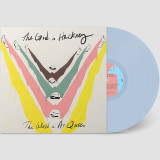
The album cover features original artwork by Iranian-American artist Tala Madani, recently the subject of a career survey exhibition at the Museum of Contemporary Art, Los Angeles.
Advertising:
The Wire, Maggot Brain
Reviews & features:
Maggot Brain - forthcoming feature
Hi-Fi+ Magazine - album review in April 2023 issue
Dereck Higgins (You Tube review)
Sonosphere - interview / feature
Weirdo Shrine - interview
It's Psychedelic Baby - interview
Spettacolo (Italy) - feature.
Ghettoblaster Magtazine (USA) - feature
Airplay:
Gilles Peterson - BBC Radio 6 Music
Steve Lamacq - BBC Radio 6 Music
Dublab - playlisted & featured in Dublab Recommends (Los Angeles)
Cian Ó Cíobháin - RTE Raidió na Gaeltachta (Ireland)
WFMU - playlisted
Resonance FM - The Wire presents Adventures In Sound & Music
Human Pleasure Radio (New Zealand)
Pete Wiggs & James Papademetie - The Seance (Repeater Radio, Sine FM & others)
Peter Hollo's Utility Fog - FBI Radio (Australia)
Jonathan Lethem & Sam Sousa on Radio Free Aftermath (KSP Claremont 88.7)
Life Elsewhere
WRPB Princeton
In Memory of John Peel
Mike Watt's Watt from Pedro Show
- Somewhere, Nowhere
- Angles Mortz
- False Prophet
- Fluoride Stare
- The Void
- Ascension
- Just A Kid
- Host
- Landslide
- Renaissance
- 7: Am
- Blue In Grey
2026 Repress
Flickering in ultraviolet, there is an elusive place where blue pill meets red, ups become downs, and day merges with night. Those liminal spaces where anything is possible is where you’ll find Nightbus and their hypnotic debut album Passenger. Doom, uncertainty, and opportunity lurk in the shadowy corners of their murky existence with stops at disassociation, co-dependency, and addiction before reaching its final destination - a glimmer of hope.
The in-between of Nightbus’ own Gotham lies where Manchester’s city pulse meets Stockport’s outer realm. An audio-visual entity formed among a musical family of friends, freaks, and foes in messy mills and after hours on dancefloors alike, their sound bleeds from tension where collective creative forces are bound together and collide with the fallout of being torn apart. Before even playing a show, their So Young released single ‘Mirrors’ – a knowing nod of respect to some well-known gloomy Northerners - may have made old school indie heads shimmy at shows in Salford’s The White Hotel but also signalled the duo’s knack for offering listeners a Bandersnatch approach to hitchhiking their own personal Nightbus in whatever direction they choose to take. “Everyone can have their moment with our songs; the music is our response to who we are as young people, living in the city full of this energy right now,” they say.
Whilst reverb hefty melodies and dread-filled loops embody isolation from writing at each of their home studio set-ups, magic happens in the ether across 90s trip-hop, indie sleaze and electronica; Jake’s production layers Olive’s pop sentimentality with drums and samples whilst tales of a cast of faceless characters place Olive as puppet master; her severed self’s perspective manipulating their stringed limbs at arm’s length to see how their stories play out when scenes reflecting her own lie close to the bone. “It’s a bit fucked; like having this out of body experience with a made-up movie running through my head,” she says. “As I write I can see they’re all from a similar world, but they allow me to explore different feelings without giving away part of myself.”
Recorded at The Nave in Leeds with producer-engineer Alex Greaves (Heavy Lungs, Working Men’s Club), surprise and danger lies in every crevice. Brooding whispers turn to chants on 6-minute opus ‘Host.’ Improvised when performed live, its immersive shift in tempo leads to hefty dub courtesy of Jake’s pedals. Even then, you won’t know shit’s hit the fan until its mid-point reveal when ominous bass blasts a thunderous soundtrack as its protagonist defiantly walks away after committing the perfect crime. “It makes you wait, and more songs should have sirens,” Olive grins.
Leaning deeper into alter-egos via the video game-psychological horror of a Silent Hill dystopia, the band’s Fight Club moment ‘Angles Mortz’ turns its literal translation of death angles on its head as it reflects upon kink and internalised shame reincarnated as pride. Elsewhere the ice cool ‘Landslide’ is a Requiem for a Dream about the addiction of being in a band; ‘The Void’ explores co-dependency and estranged relationships; and carefully selected samples revive house track ‘Just A Kid’ from the band’s early incarnation. Passenger’s every direction is to face challenges head on. “That is what’s so great about horror; you can see through predictable patterns so when the unexpected occurs it's more realistic and uncomfortable… I want to own the dark stuff!”
As for Passenger’s first single, the pulsating ‘Ascension’ is a spiralling deep dive into death, suicide, and legacy around who or what we leave behind. A noughties club banger by way of NYC beats - ergonomically designed for those who like to stay out a little too often and too late - it throbs like a house party’s partition wall as the literal levelling up undergoes a neon transformation; blue glitching to pink, diffusing the white construct of the Nightbus Matrix. “It really does feel like the end of something and was purposely written that way,” they say, “the ascension is like a firework going off!”
With wheels in motion, Nightbus has become a movement surpassing sonic realms. Between shows from Porto to Brighton taking in The Great Escape, Rotterdam’s Left Of The Dial and Paris’ Supersonic; DJing; remixing; guesting (BDRMM’s Microtonic album); and even enlisting talented like-minds to craft a 3-part queer coming-of-age music video series which ties in with a new ‘hyperpop’ phase in the evolution of their popular Nightbus Soundsystem club night, heads are now being turned from sports brands to high-end fashion designers. “There are things we can’t reveal just yet,” tells Olive, “but we’re excited about the direction this beast we’ve created is heading.” As the album philosophises and asks one ultimate question; what does it truly mean to be ‘Passenger’? Nightbus may not claim to offer a definitive answer, but it might make you feel a bit better about those demons.
- 1: Senja
- 2: Butterfly
- 3: Fat Cats, Starving Dogs (Feat. Maxo Kream)
- 4: Body High (Feat. Toro Y Moi)
- 5: Little Ray Of Light
- 6: Jumpy (Feat. Ski Mask The Slump God)
- 7: Took A Breath
- 1: Ma
- 2: Is It? (Feat. Charlotte Day Wilson & Daisy World)
- 3: She (Feat. Kurtis Wells)
- 4: Serpents!
- 5: Oh Well
- 6: Bumpy Road (Feat. Redveil)
- 7: Timezones
- 8: Jelly Air Island
With WHERE IS MY HEAD?, his first full-length album since 2019, Indonesian-born artist Rich Brian redefines success on his own terms. No longer chasing hits, he turns inward — creating the most vulnerable and honest music of his career. The result is a cohesive, deeply personal body of work that strengthens his bond with an ever-growing fanbase. Brian handled most of the production himself, shaping an analog-forward sound rooted in his self-taught mastery of synthesizers and keyboards. He sings more than ever before, with a newfound confidence and maturity that signals real artistic growth. WHERE IS MY HEAD? isn’t just a return — it’s a revelation. Each track answers one central question: how can I make art that truly makes me happy? To visually explore this feeling of self-reflection, the album introduces two versions of Brian — a MAESTRO who scores music for the dreams of MOVIE BRIAN, who exists unaware inside the world the Maestro has created. This surreal, introspective concept is brought to life through a series of cinematic music videos and visualizers, all directed by Jared Hogan, expanding the depth of the album into a fully realized narrative world.
Als Sir Georg Solti im Herbst 1969 sein Amt als Musikdirektor antrat, verglich er die Stadt Chicago und
ihr berühmtes Orchester einmal mit dem „Dornröschen“-Schlaf. Doch fünf Jahre später war es ein anderes
Ballett – Strawinskys „Le Sacre du Printemps“ –, das zeigte, wie explosiv diese neue Beziehung geworden
war, in einer Aufnahme, die auch ein halbes Jahrhundert nach ihrer Entstehung noch immer aus den Lautsprechern dröhnt. „Glamourös und kraftvoll.“ – Gramophone
Deccas vollständig analoge Vinyl-Serie DECCA PURE ANALOGUE punktet mit einigen der legendärsten
Aufnahmen aus den Archiven von Decca und Philips. Die Serie wurde von Rainer Maillard gemastert und
von Sidney C. Meyer in den renommierten Emil Berliner Studios geschnitten, bei Pallas auf 180-gr.-Vinyl
gepresst und in luxuriösen Gatefolds in handnummerierten, limitierten Auflagen präsentiert.
Es werden ausschließlich originale analoge Quellen verwendet – in diesem Fall 2-Track Stereo-Bänder–
und es kommen keine zusätzlichen Geräte im Signalweg zum Einsatz, d. h. es findet keinerlei digitale
Klangbearbeitung statt.
Die LP wurde für 45RPM gemastert, um einen besseren Hochtonbereich zu erzielen und die ganze „Wucht
und Klarheit“ der Originalaufnahme wiederzugeben.
Jedes Album enthält das Original-Artwork und Original-Liner Notes, Archivfotos und Faksimiles der OriginalAufnahmeprotokolle sowie neu verfasste Anmerkungen, die die Geschichte der Aufnahme, den technischen
Hintergrund und den Mastering-Prozess beschreiben.
Wiener Philharmoniker, Willi Boskovsky
Decca Pure Analogue: New Year’s Day Concert in Vienna 1979 LP...
Das Neujahrskonzert 1979 in Wien war sowohl musikalisch als auch technisch ein Höhepunkt. Es war sowohl
das Ende einer goldenen Ära für Willi Boskovsky, längjähriger Konzertmeister der Wiener Philharmoniker
und Dirigent sensationeller Neujahrskonzerte, als auch der Beginn eines neuen Zeitalters in der Aufnahmetechnik. Lange Zeit als erste digital aufgenommene Veröffentlichung von Decca gefeiert, hat die jüngste
Recherche eine Reihe von analogen Sicherheitsmastern zutage gefördert, die fast ein halbes Jahrhundert
lang unberührt in den Archiven der Decca schlummerten – bis heute. „Dies ist eine sensationelle Veröffentlichung.“ – Gramophone Magazin
Deccas vollständig analoge Vinyl-Serie DECCA PURE ANALOGUE punktet mit legendären Aufnahmen
aus den Archiven von Decca und Philips. Die Serie wurde von Rainer Maillard gemastert und von Sidney
C. Meyer in den renommierten Emil Berliner Studios geschnitten, bei Pallas auf 180-Gramm-Vinyl gepresst
und in luxuriösen Gatefolds in handnummerierten, limitierten Auflagen präsentiert.
Es werden ausschließlich originale analoge Quellen verwendet – in diesem Fall erstmals analoge Master
früher digitaler Aufnahmen – und es kommen keine zusätzlichen Geräte im Signalweg zum Einsatz.
Jedes Album enthält das Original-Artwork und die Original-Liner Notes, Archivfotos und Faksimiles der
Original-Aufnahmeprotokolle sowie neue Anmerkungen, die die Geschichte der Aufnahme, den technischen
Hintergrund und den Mastering-Prozess detailliert beschreiben
- A1: Hypnosis - Astrodance (Computer Remix)
- A2: Wish Key - Easy Way (Instrumental)
- A3: Laserdance - Technoid (Space Version)
- A4: Panish Symphonic Orchestra - Computer Game
- B1: Koto - Dragon‘s Legend (Maxi Version)
- B2: Cyber People - Digital Signal Processor
- B3: Lexx - Flexxy Ball Theme (Instrumental Version)
- B4: Plash Band - Unheimliche Schattenlichter
Mit “ZYX Italo Disco Spacesynth Part 4” setzen wir die Vinyl – Compilation-Serie mit den größten Spacesynth Klassikern der 80er Jahre fort.
Alle Spacesynth- und Schallplatten Fans können sich auf die legendären und unvergessenen Hits von Koto, Laserdance, Hypnosis, Wish Key uva. freuen.
- Mean Street
- Dirty Movies
- Sinners Swing!
- Hear About It Later
- Unchained
- Push Comes To Shove
- So This Is Love?
- Sunday Afternoon In The Park
- One Foot Out The Door
The song titles on Van Halen's aptly titled Fair Warning don't lie. The likes of "Unchained," "Mean Street," "Push Comes to Shove," "One Foot Out the Door," and more indicate the mood the band channels on its double-platinum 1981 record — the nastiest, darkest, and fiercest album of the group's storied career. For the fourth time in four years, Van Halen throws down the gauntlet to all challengers and emerges victorious.
Sourced from the original analog tapes, pressed on MoFi SuperVinyl at Fidelity Record Pressing, and strictly limited to 5,000 numbered copies, Mobile Fidelity's UltraDisc One-Step 180g 45RPM 2LP set plays with unfettered clarity, dynamics, and immediacy. Benefitting from superb groove definition, an ultra-low noise floor, and dead-quiet surfaces, this vinyl edition captures what went down in the studio with tremendous realism and involving presence.
Taking a more controlled approach in the studio and still completing everything in less than two weeks, Van Halen and producer Ted Templeman relied on studio amplifiers to direct the sound. Further diverging from the live-on-the-floor approach of its earlier albums, the ensemble also employed overdubs to great effect. The result: Dense, stacked architecture that underlines the hard-hitting tenor of the songs — and which comes alive like never before on this reference edition that looks as good as it sounds.
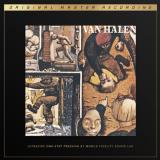
The premium packaging and gorgeous presentation befit the reissue's select status. Housed in a deluxe slipcase, it features special foil-stamped jackets and faithful-to-the-original graphics that illuminate the splendor of the recording. Aurally and visually, it is made for listeners who want to immerse themselves in everything involved with the album, including the iconic cover art adopted from William Kurelek's haunting painting, "The Maze."
Isolated frames from Kurelek's childhood-inspired work — including a man bashing his head into a brick wall, a guy pinning down an adversary as he delivers bare-fist blows to his face and others watch with apparent glee, a boy tied down on a conveyer belt and being sent through the equivalent of a meat saw — adorn the front and back covers. The sunnier visual disposition of Van Halen's prior efforts gives way to something sinister and tortured, traits reflective of the music within. The band members, too, are visually depicted not in glamorous shots but in a serious black-and-white portrait in which the quartet is clad in black leather jackets.
Tough, aggressive, stark: Fair Warning comes on like a series of bare-knuckled punches to the solar plexus and boasts lyrical narratives to match. Though not a concept record, the concise album revolves around themes of roughing it on the streets and struggling to survive amid dim prospects. Singer David Lee Roth reportedly penned many of the initial lyrics after traveling to Haiti and observing extreme poverty. The characters and situations populating Fair Warning reflect hardscrabble existence, last-chance desperation, and underlying danger.
Witness the crazies, poor folks, and hunters of “Mean Street”; the former prom queen turned pornographic actress on “Dirty Movies”; the menace and vice of “Sinners Swing!”; the streetwise hustle of “Unchained”; the isolation and alienation of “Push Comes to Shove”; the desire for escape on “One Foot Out the Door”: A carefree California beach party Fair Warning is not.
Having said he felt angry and frustrated during the sessions, guitarist Eddie Van Halen uses the forceful arrangements as a playground for his seemingly unlimited arsenal. Supported by a crack rhythm section and a hyped-up Roth, he performs with an almost impossible combination of punk-like intensity, technical finesse, lyrical fluidity, and unbridled emotion. The virtuoso was increasingly butting heads with Templeton and seeking a freedom in the studio he believed denied him.
No wonder he plays like a bat out of hell. Listen to the rapid-fire manner in which he slaps the high and low E strings on the 12th fret of his instrument on “Mean Street,” instilling the tune with funk flair and metal-spiked sharpness. For the pouty strut of “Dirty Movies,” Eddie Van Halen contributes slide guitar magic made possible after he sawed off the lower portion of a Gibson SG so he could reach further down the fretboard.
Related intensity, urgency, and daredevil momentum punctuate the surging “Sinner’s Swing!” A heavily flanged, delicately melodic introduction frames the attitudinal “Hear About It Later,” among the most creative arrangements of Van Halen’s career. And do riffs come any bigger or magnetic than those on the high-wire kick of “Unchained”? As for the out-of-left-field “Sunday in the Park,” an instrumental composed on an Electro-Harmonix micro-synthesizer: Who but Eddie Van Halen to supply creep factor in such an ingenious way?
Despite selling fewer quantities than Van Halen’s prior efforts, Fair Warning remains for many diehards the record that epitomizes all of the band’s immense strengths —Roth’s manic energy and tongue-wagging humor, Alex Van Halen’s rhythmic heartbeat-in-your-chest bombast, and Michael Anthony’s lucid bass lines included. Arriving when the New Wave of British Heavy Metal and new-wave movements were taking flight, it signaled a shot across the bow from a band determined to stay a step ahead and provide proof nobody could touch what it delivered.
More than four decades later, Fair Warning still sounds that alarm.
Coming straight from the Cozmo comes RudyLane with a debut EP The Return Of The Synth. Landing the ship on new imprint Drag Vader comes a four tracker from the heavenly isles. Leading the arrival we have ' The Goat' a low hung brooding affair which then builds into haunting territories twisting into funk infused techno awakenings. ' 2 yrs L8' slips us onto at first a desolate plaine, trying to find a signal, with stripped vocal stabs swung groove, smokey juno bass into a hook that the Dark Synth would be proud of. ' Thirsty Pool' on the flip is a more minimal workout weaved within hypno vocals driving us forward into hopeful waters. 'Protests Digital' closes out the party blending worlds of emotive melodies and gnarly walking basslines through arpeggiated mid riffs dusted with dub kissed filterness. Landing firmly on the ground RudyLane is off to a strong start.
Excited to hear what's next on this journey.
Ten years after her first release, electronic musician Mor Elian presents her debut album Solid Space. Showing her full artistic range, the LP drifts between dream-like listening states and experimental club spaces. Written in a transitional time, these compositions arrived in emotional, unfiltered bursts. Solid Space brings together ambient textures, early IDM structures, and experimental electronics, with distant, hazy vocals converging into a single, subconscious flow. It is released by adventurous electronic music label topo2 on November 28, 2025. The record is pressed on 180 grams of ICCS-certified bio-vinyl, housed in a heavy full-colour sleeve, and comes with a download-code to the full release. Mastering is done by Ike Zwanikken, mixing by Gramrcy, artwork courtesy of Kees de Klein, and poetry written by Eelco Couvreur. Additional production and mixing on track 7 by Carrier.
—
in the half-sleep: a voice
not anyone’s, just sound.
what it touches, it mirrors
learning to name itself.
a throat opens —
to hum through bone
to say nothing correctly.
we coexist as opposites
in our mother tongue, dreaming
the things we were never meant to touch.
there is a channel
between pulse and sentence —
a being moving through
the being that once answered to me.
to feel and not own the feeling,
each of us made visible
by the other.
- 1: What Took You So Long
- 2: Sorrow
- 3: Surrender No Resistance
- 4: Eins Zwei Drei Vier
- 5: Never Seen
- 6: Stardust Fever
- 7: Any Second Now
- 8: Shattered Illusion
- 9: Into The Light
- 10: Talking To The Man
- 11: What Took You So Long (The Juggernauts)
- 12: Sorrow (Rue Oberkampf)
- 13: Surrender No Resistance (Potochkine)
- 14: Eins Zwei Drei Vier (Section 25)
- 15: Never Seen (Silicon Avatar)
- 16: Stardust Fever (Portion Control)
- 17: Any Second Now (Twice A Man)
- 18: Shattered Illusion (Mark Lane)
- 19: Into The Light (Emmon)
- 20: Talkin To The Man (Silent Signals)
“Detraex Corp arrives on Sagome to deliver a heady journey through experimental rhythm and dub-informed weight and release with their new album Live at Pompeii. The album, much like its Carlo Gabriele Tribbioli created artwork, represents a journey, a collection of sounds and emotions, sequenced to share with us, the listener, a variety of experience, and of memory, which are at once familiar and other.
"Live at Pompeii sets things off with the tone-setting Tykes of, where frazzled, shuffling drums meet sub bass weight and ketamine oud, sounding something like Wordsound’s Scarab leaving the 90s and entering the future. Tombaroli invites the head nods, clearly communicating the album’s intentions and inviting us to that party under that out-of-town bridge with its insistent percussion and pulsing weight.
"Other tracks, such as Bullet Holes, carry us further into a psychedelic alternative, with its lysergic fever-dream soundtrack to an unnamed mediterranean plaza, and No Minus’s sounding like a nascent, primitive distant cousin to Jeru’s Premier-produced Come Clean.
"Channel 83 firmly returns us to the club, weaving mystical soundsystem magic with its stunted horns and swirl of voice, driven forward with the most chest-rattling of stomps, before the album enters its finale, where the grimey judder of Expect Excerpt slides to a bleary-eyed half-speed, evoking the club which won’t let you leave.
"Mount Point eventually provides that release, an early morning sunrise of a track, with rich, slow trudge and post-club shimmer, before Landings Dub signals the end of the journey, a metallic elegy to what has preceded, and a contemplation of your upcoming repeat listen, and re-entry, to the world of Detraex Corp.”
Words by Daniel Magee
Music by Detraex Corp
Mastered by Giuseppe Ielasi
Artwork and Layout by Carlo Gabriele Tribbioli