Debut solo project Marek 'Latarnik' Pędziwiatr - musician, composer, pianist & synth wizard. Best known from his bands EABS & Błoto and Jaubi's "Nafs At Peace" album
Influenced by the sound of solo recordings by Thelonious Monk, Ahmad Jamal, McCoy Tyner and Emahoy Tsegué-Maryam Guèbrou, Latarnik gave up electronics in order to record an intimate debut album, commemorating his great-grandmother, using a hundred-year-old Steinway & Sons grand piano and analogue tape. Deeply spiritual and emotional solo piano works from one of the leading lights of the new Polish jazz scene!
Suche:sol monk
Playing in Dixieland jazz bands during his teens and then passing through some Kansas City jazz acts, New York-born alto saxophonist Steve Lacy became associated with the avant-garde jazz movement from the mid-1950s, playing on free jazz pianist Cecil Taylor’s influential debut LP and early work by the Canadian pianist Gil Evans, before serving a long tenure with the idiosyncratic improv pianist Theolonius Monk, whose work he would continue to reference throughout his career. Visiting Europe from the md-1960s, starting with a trip to Copenhagen with pianist Kenny Drew (who made the Danish city his home thereafter), Lacy later travelled to Italy to form a quartet with Italian trumpeter Enrico Rava (who had earlier played in Argentinian sax player, Gato Barbieri’s group), plus South African exiles and former Blue Notes members Johnny Dyani on double bass and Louis Moholo on drums. Lacy subsequently moved to Paris, which became his permanent base from 1970, leading a sextet there whilst also exploring the limits of the alto saxophone as a solo instrument. The disparate and often discordant album Threads was recorded in Rome at Mama Dog studio in 1977 for filmmaker-turned-record producer Aldo Sinesio’s Horo Records label; comprised of six of Lacy’s own compositions, the album saw Lacy supported by Alvin Curran on piano and Frederic Rzewski on flugelhorn, synthesizer and percussion, the pair both longstanding members of the experimental group, Musica Elettronica Viva.GO
Debut full length album on the Valley of Search label by Mexican born, New York-based vibraphonist, marimbist, improviser and composer Patricia Brennan. The twelve original instrumentals that make up the album were composed and performed solo by Brennan on vibraphone and marimba. Employing unusual performance techniques and occasional electronics, many of the compositions were borne from improvisations created live in the studio at the time of recording. At times exploring silence and space, stillness and patience the album investigates new sonic territories with an endless sense of curiosity. "This album is a personal statement not only as a vibraphonist but also as an improviser and composer," says Brennan. "From bowing and bending pitch, to the use of extended effects via guitar pedals, this album reflects my vision for the vibraphone and the potential of all the possible ways it can be played. I wanted to not only incorporate all those techniques in the compositions but also wanted them to become part of my general improvisatory language." Patricia has performed with many renown musicians including singer and composer Meredith Monk and Theo Bleckmann, saxophonists Jon Irabagon and Scott Robinson, trumpeter Ambrose Akinmusire, drummer Marcus Gilmore, guitarist Mary Halvorson and many others. She has performed in venues such as Newport Jazz Festival, SF JAZZ, and Carnegie Hall, as well as international venues such as Wiener Konzerthaus in Vienna, Austria, Alte Oper in Frankfurt, Germany, Palacio de Bellas Artes in Mexico City and Teatro Colón in Buenos Aires, Argentina.
Limited Edition 180g Vinyl LP! All-Analogue Mastering by Kevin Gray!
Pressed at RTI!
This mid-period masterwork from jazz piano's most uncommon voice finds Monk and his quartet (Charlie Rouse on tenor, Ben Riley on drums and Larry Gales on bass) exploring every texture, tone and melodic turn of seven expansive tracks. This group was subtle, mature and confident, easily supporting Monk's more idiosyncratic side-tracks (check out the solo on "Locomotive" or the restless exposition on "Japanese Folk Song") while allowing listeners freedom to move through or contemplate all the sublime subtexts Monk conjures from the endless well of his inspiration.
This emphasis on laid back and mature presentation aided the recording as well. These master tapes sound amazing and getting them to disc was a pure pleasure. Subtle changes in atmosphere, tone and melody fill the space between the speakers, a wide soundstage and expansive dynamics the gift of music indelibly played. This is one sonic powerhouse for the ages.
Available for the first time on 180-gram 2-LP with the full performances of the original tracks and including two bonus tracks, this new Impex release gets you closer to Monk's genius than ever before. Kevin Gray and Robert Pincus used analogue master tapes and minimal processing to great effect, while original session and jacket images were culled to create the deluxe gatefold jacket. Add in the sound-of-silence pressings from RTI and you have a can't miss jazz disc ready to delight and inspire every time it spins on your turntable. Impex has pulled out all the stops on this mesmerizing Monk classic. All you have to do is get one and enjoy before they're all gone.
- A1: Sudden Reverb - Sound Tlakotli (Deadbeat Remix)
- A2: Pitch Black - Transient Transmission (Adrian Sherwood's Delta B(0)=B Remix)
- A3: The Orb - Say Cheese (Gaudi's Dubble Mozzarella Mix)
- A4: David Harrow - In My Head (Inside My Head Mix)
- B1: Subset - The Astrogator (Sub Signals Mix)
- B2: 3Head - Afnaz (Dennis Bovell Dub Mix)
- B3: Groove Armada - Oh Tweak To Me (Gaudi Remix)
- B4: Shpongle - How The Jellyfish Jumped Up The Mountain (Cosmic Trigger Remix)
- C1: Aux25 - Passing Through
- C2: Simm Feat Phelimuncasi - Cracks
- C3: Alpha Steppa - Colour
- C4: Radikal Guru - Badman Skank
- C5: Paolo Baldini Dubfiles - Ethiolò Dub
- D1: African Head Charge - Disciplined And Dignified
- D2: Gaudi Feat Steel Pulse - Cry Dubber
- D3: 100Th Monkey - Fly Higher Dub
- D4: Dub Fx - Dub Everyday (Gaudi's Sub Signals Remix)
- D5: Phonolab Feat Bill Laswell - Where Do Comets Come From
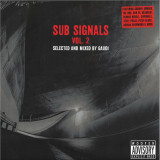
Sub Signals Vol.2 is a deep dive into underground bass, guided by artist and producer Gaudi. Featuring predominantly unreleased originals and versions by some of the biggest names in the worldwide dub collective, it intricately combines analogue elements with digital grooves to stunning effect.
Much more than just a compilation, the Sub Signals series is a celebration of the evolution of the sound of dub, from its original roots in reggae to its fusion with a much wider spectrum of sounds and influences. Gaudi curated the first volume back in 2006 for the cult Canadian label Interchill, sourcing tracks and dubs from High Tone, Zion Train, Manasseh, Almamegretta, Noiseshaper, Creation Rebel, Greg Hunter, Dubadelic and more.
15 years on, Gaudi has created the second volume, blending contributions by established reggae names Steel Pulse, Dennis Bovell and African Head Charge with next generation dub producers Alpha Steppa, Radikal Guru and Paolo Baldini Dubfiles, headline acts Groove Armada, Dub FX and The Orb with underground artists Deadbeat, Pitch Black and SUBSET, to create a seamless 75 minute mix.
“With Volume 2, I wanted to create a deep vibrational experience by shaping an aural trajectory that encompassed the many aspects of dub and its related sub-frequencies. To achieve my goal, I reached out to the artists I regularly work with to ask for contributions, in some cases digging in their archives to find what I was looking for.”
As a solo artist, Gaudi has recorded over 20 albums, while as a producer he has hundreds of productions under his belt. He has worked with legends of the reggae and electronic music worlds including Lee "Scratch" Perry, Horace Andy, Dub Pistols, Hollie Cook, Youth, Mad Professor, Prince Fatty, Lamb, Trentemøller and Nusrat Fateh Ali Khan.
Dedicated to the sound of dub in its many forms, Gaudi’s latest excursion of his Sub Signals series is pure bass therapy, designed to excite your eardrums and worry your woofers.
- A1: The Perfect Crime
- A2: Smilers Strange Politely
- A3: Material Condition
- A4: Butchering The Punchline
- A5: Up To My Elbows
- B1: I'm In The Water
- B2: Tricks On Everything
- B3: Caveats
- B4: Figure Eights
- B5: The Bell
LTD Clear Vinyl[24,79 €]
RIYL: Guided by Voices, Pavement, The Clean, XTC, Flying Nun. The title of The Stroppies' newest LP, Levity, serves as a creative statement of intent and an acknowledgment of the dichotomy between the music they have made and the conditions in which they were produced. For a group that started over an initial idea to "create open ended music, quickly and haphazardly”, the logistical challenges of creating their second album in the midst of a pandemic, in a city that endured the longest lockdown in the world, created a need to redefine process. Levity, The Stroppies strongest creative statement to date, is the result of this new approach to creative process. Playful yet focused, but broader in scope and experimentation than previous efforts, the ten songs that comprise Levity continue the band's exploration of the pop song as both foil for experimentation and conduit for personal reflection. Whereas the group's debut LP Whoosh! demonstrated their ability to craft clean, concise jangle pop, Levity takes a different route by utilizing a darker pallet of sounds to create its impressionistic whole. Fuzz and distortion are employed to add weight to songs built on tape loops and Motorik drum patterns. Warbling synthesisers and modulated keys add new moods and dimensions to The Stroppies unique brand of pop classicism. Thematically, the band continues their exploration of the personal refracted through the lens of the absurd, though this time around the music feels a few shades darker, a somewhat inevitable consequence of the collective trauma of the past 24 months. While the narrative around the 'lockdown record' is increasingly commonplace, there are unavoidable realities involved in making creative decisions under such circumstances that can't be overlooked, especially for a band that thrives on collaboration. "The restrictions around COVID really informed the way we made the record', says Angus Lord, the band's co-founder and guitarist. "It meant that there was a lot less opportunity to meet and build ideas collaboratively, which is how we’ve worked in the past. Instead, ideas were developed in isolation, then shared digitally, developing slowly over correspondence and only bearing fruit when we were able to be in a room together. I think this had a big effect on the songwriting and execution.” This process even extended to the studio, where The Stroppies found a kindred spirit in John Lee of Phaedra Studios, who mixed the record in isolation, somehow managing to synthesise the band's pop sensibilities with their penchant for studio experimentation. Furthermore, the addition of new member Zoe Monk, known for playing in a diverse array of Melbourne acts (Eggy, Thibault, The Opals) contributed both synthesiser experimentation and rock solid rhythm guitar, a huge addition to the band's developing sound, an infectious combination of the off-kilter 90s US underground, British artpunk ala Wire and a more than generous love of classic Pop songwriting. The Stroppies have managed to craft a record of weight and substance. Through Levity the Stroppies have, at least temporarily, found their feet amongst the chaos
RIYL: Guided by Voices, Pavement, The Clean, XTC, Flying Nun. The title of The Stroppies' newest LP, Levity, serves as a creative statement of intent and an acknowledgment of the dichotomy between the music they have made and the conditions in which they were produced. Levity, The Stroppies strongest creative statement to date, is the result of this new approach to creative process. Playful yet focused, but broader in scope and experimentation than previous efforts, the ten songs that comprise Levity continue the band's exploration of the pop song as both foil for experimentation and conduit for personal reflection. Whereas the group's debut LP Whoosh! demonstrated their ability to craft clean, concise jangle pop, Levity takes a different route by utilizing a darker pallet of sounds to create its impressionistic whole. Fuzz and distortion are employed to add weight to songs built on tape loops and Motorik drum patterns. Warbling synthesisers and modulated keys add new moods and dimensions to The Stroppies unique brand of pop classicism. Thematically, the band continues their exploration of the personal refracted through the lens of the absurd, though this time around the music feels a few shades darker, a somewhat inevitable consequence of the collective trauma of the past 24 months. While the narrative around the 'lockdown record' is increasingly commonplace, there are unavoidable realities involved in making creative decisions under such circumstances that can't be overlooked, especially for a band that thrives on collaboration. "The restrictions around COVID really informed the way we made the record', says Angus Lord, the band's co-founder and guitarist. "It meant that there was a lot less opportunity to meet and build ideas collaboratively, which is how we've worked in the past. Instead, ideas were developed in isolation, then shared digitally, developing slowly over correspondence and only bearing fruit when we were able to be in a room together. I think this had a big effect on the songwriting and execution." This process even extended to the studio, where The Stroppies found a kindred spirit in John Lee of Phaedra Studios, who mixed the record in isolation, somehow managing to synthesise the band's pop sensibilities with their penchant for studio experimentation. Furthermore, the addition of new member Zoe Monk, known for playing in a diverse array of Melbourne acts (Eggy, Thibault, The Opals) contributed both synthesiser experimentation and rock solid rhythm guitar, a huge addition to the band's developing sound, an infectious combination of the off-kilter 90s US underground, British artpunk ala Wire and a more than generous love of classic Pop songwriting. The Stroppies have managed to craft a record of weight and substance. Through Levity the Stroppies have, at least temporarily, found their feet amongst the chaos.
Muddy Monk was revealed alongside Parisian artists Myth Syzer, Ichon and Bonnie Banane on 'Le Code'. From his native Switzerland, he imposes a fine, synthetic universe that plays a major role in the renewal of French-language song. The journey began in 2018 with 'Longue Ride', a cathartic first album that he describes as 'a kind of therapy' and that was unanimously acclaimed by the critics. In 2020, he returns with 'Ultra Tape', a mixtape which, with the benefit of hindsight, is the first step towards his second album. We discover a more raw universe. Darker too. A superb launching pad for his second album.
With Ultra Dramatic Kid, Muddy Monk delivers a radical new piece, a bubble of just over thirty minutes in which he manages to work his magic and make us dance on the edge of his emotions. As if everything could change in an instant towards happiness or chaos. An electric album and a sublime dive into his universe, which draws equally from Daft Punk, Rage Against The Machine and Travis Scott. A project that takes the form of a global experience, both auditory and visual, since almost all the tracks on the tracklisting have been put into images by Felix de Givry, the whole forming a short film to be discovered with the release of the project. In the end, Ultra Dramatic Kid is an uncompromising album in which it is a pleasure to get lost. An album that further establishes the Swiss artist as one of the artists capable of redefining the contours of French-speaking music for many years to come.
Mr Emotinium goes rogue on a new breaks-heavy bop for Acid Waxa, riding a wave of mid tempo squelchers and industrial strength gurner-churners, pressed on vinyl for the very thirst time!
The tough breakbeats, slippery machine funk and fizzier end of the acid spectrum have always been a predominant driving force throughout most of Roy’s impressive output to date but on his new Fenix Break slab for Acid Waxa, Nottingham’s finest lays the mid-tempo gurner-churners on thick with a trowel and goes in deep on a wild, cement mixer bop.
Employing the use of an old Akai sampler avec floppy discs and the mega rare Cwejman S2 & Synton Fenix 19 synths alongside his usual acidic apparatus - Roy delivers six heavily-processed 303 sizzlers, recorded straight to tape for added rawness and pressed on to vinyl for the very thirst time, following a sold out, limited edition cassette version of Fenix Break, released in 2019.
The latest entry in An’archives’ ‘Free Wind Mood’ series, Ki is a trio that pits long-time collaborators Tamio Shiraishi (saxophone, voice) and Takahashi Michiko aka Mico (drums, voice, vocoder, melodica, piano, percussion) against drummer, percussionist and vocalist Fritz Welch. They each bring a wealth of experience, from Shiraishi’s early moves in the Japanese underground of the late ‘70s and early ‘80s – he was a founding member of Fushitsusha, and played with Taco and Machinegun Tango – to his legendary, late-night solo New York subway performances; he and Mico also spent some time playing with No Neck Blues Band, while Welch, currently based in Glasgow, has a long history taking in stints with Peeesseye, Lambs Gamble and FvRTvR.
Tearful Face Of My Cute Love (Is Begging To Me), named after a yakuza song, is Ki’s first LP, after CD-Rs on Chocolate Monk (Ki No Sei, 2009) and Unverified (Stops Dropping, 2010). Documenting two live performances from 2008, it’s a startling, wild freedom chase, each piece stretching languorously across one side of the vinyl, giving the trio maximum space to thunder their way through space and time. Their West Nile 2008 show, on side one, opens with a battery of drums, fierce and livid, before Shiraishi’s unmistakable and remarkable whinnying, high-zone tone slithers into earshot. The stage is set, the battle moves forward, yet there’s remarkable simpatico between the three players, with Mico and Welch volleying guttural vocal exhortations at each other. When it does offer respite – see the sudden swoop into near- silence at around 12:30– everything’s still tense; who knows what’s around the corner?
For all its fury, though, Tearful Face Of My Cute Love... is full of oddly lyrical moments, too – see the sweet melody that winds out, with gentle melancholy, near the very end of the West Nile performance. This lyricism also haunts the second side of the album, a performance from Glassland, Brooklyn, which seems more focused on the intersection of incidents, from clattering cymbals to ghostly swarms of sax scream, to dive-bombing spirals of vocoder. There’s an appealing sense of audio verité here, as though you’re in the room with the performers, shaken and stirred by every movement, lost in the interlocking maze they’re weaving in real time. It’s a bracing, thrilling document of very immediate, human music – of three bodies moving through the world, sounding their environment.
[a] a1 Tearful face of my cute love [is begging to me] (Side A)
[b] b1 Tearful face of my cute love [is begging to me] (Side B)
Debut full length album on the Valley of Search label by Mexican born, New York-based vibraphonist, marimbist, improviser and composer Patricia Brennan. The twelve original instrumentals that make up the album were composed and performed solo by Brennan on vibraphone and marimba. Employing unusual performance techniques and occasional electronics, many of the compositions were borne from improvisations created live in the studio at the time of recording. At times exploring silence and space, stillness and patience the album investigates new sonic territories with an endless sense of curiosity. "This album is a personal statement not only as a vibraphonist but also as an improviser and composer," says Brennan. "From bowing and bending pitch, to the use of extended effects via guitar pedals, this album reflects my vision for the vibraphone and the potential of all the possible ways it can be played. I wanted to not only incorporate all those techniques in the compositions but also wanted them to become part of my general improvisatory language." Patricia has performed with many renown musicians including singer and composer Meredith Monk and Theo Bleckmann, saxophonists Jon Irabagon and Scott Robinson, trumpeter Ambrose Akinmusire, drummer Marcus Gilmore, guitarist Mary Halvorson and many others. She has performed in venues such as Newport Jazz Festival, SF JAZZ, and Carnegie Hall, as well as international venues such as Wiener Konzerthaus in Vienna, Austria, Alte Oper in Frankfurt, Germany, Palacio de Bellas Artes in Mexico City and Teatro Colón in Buenos Aires, Argentina.
Danish singer-songwriter Soren Munk releases his debut solo album Purr Show on 15 April 2022 via Navarino Records.Soren also travels the world as a cameraman for Channel 4 News, and the album was written and recorded in between trips to cover some of the major global events of recent times, from the war in Mali to the Taliban resurgence in Afghanistan
Soren also co- wrote the much- loved theme tune to the hit animated TV series Charlie and Lola – which is currently trending on TikTok with millions of views.Despite the nature of his news work, the songwriting on Purr Show has a more private focus, dealing in intimate but ambiguous moments of love and loss.
Melodic and intense, the album has elements of Dream Pop, Slowcore and classic songwriting, while the blend of electric guitars, analogue synths and vocals draws on the work of artists that combine restraint and power, such as Neil Young, Low, Big Star and Elliot Smith. Soren worked with Andy Ramsay from Stereolab to record the album, and Jimmie Robertson (Depeche Mode, Arctic Monkeys) during the mixing Soren explains, “I wanted to create slow pop songs. Romantic and melodic but with an edge of strangeness that makes them harder to pin down. That's the music I respond to – things that are assertive but fragile at the same time. Where every element counts.”Soren drew together a strong lineup of musicians and collaborators, including guitarists Garo Nahoulakian (Emiliana Torrini, Gaz Coombes, Piney Gir) and Nick 'Growler' Fowler (Gaz Coombes, Luke Haines); a Danish rhythm section of drummer Nikolaj Bjerre (Lamb) and bassist Andreas Jensen (Dub Pistols); and
pianist Tom Dyson (co-writer of the Charlie and Lola theme). Soren's vocals are often combined on the songs with the soft alto of backing singer Emma Faulkner, creating a sense of something confidential, like snatches of pillow talk.
- A1: Hidden Portal
- A2: Early Waves
- A3: Sensitive (Feat Jerome Thomas)
- A4: Nacre
- A5: Skybox (Feat Blue Lab Beats)
- A6: Monkeyflower (Interlude)
- A7: One4Dumile
- A8: Dust On A Curb (Feat Summers Sons & C Tappin)
- B1: Levada (Feat Dal)
- B2: Orbit Sundog
- B3: Mount Rakko
- B4: Seaside Dreams (Feat Hunter Rose)
- B5: Uteki (Feat Alfa Mist)
- B6: Warplude
- B7: Half Nine (Feat Keepvibesnear)
- B8: Ajar
New album by pioneering German beatmaker FloFilz. On Close Distance, the lofiturned-hifi producer blends hip-hop inspired beats with contemporary jazz, alt r&b and a little rap. Featuring Alfa Mist, Blue Lab Beats, Jerome Thomas,
KeepVibesNear, Summers Sons & C.Tappin, Dal & Hunter Rose. Close Distance is his fourth album for Melting Pot Music. Since 2013, the self-taught bedroom producer and classically trained violinist has sold more than 10k LPs and gained 200 million streams.
Close Distance literally means “near in space or time” (or “nah dran”, as we say in German). The 16 songs on Close Distance came to life over the past two years. Many sketches were birthed at FloFilz's old home studio in Aachen. Some songs were made from scratch in London, where Flo did sessions with UK jazz supremos Alfa Mist and Blue Lab Beats at their studios. One was recorded in a kitchen in Streatham, where rap duo Summers Sons and pianist C.Tappin reside.
More sessions were already in planning when lockdown kicked in and travelling was no longer an option. Around the same time, Flo was about to move from Aachen to Berlin which he eventually did in November 2020. Once installed, he started sharing beats and files out of his makeshift studio in Moabit. Beat folders were sent to
London where two of our favourite new alt R&B vocalists – Jerome Thomas and KeepVibesNear – live. Another one went to Dartmoor where the jazz/hip-hop trio Dal added their magic touch while Hunter Rose processed her sultry vocals in Cape Town - 12 flying hours away from Berlin.
The album artwork has been created by Indonesian illustrator Fatchurofi, who caught FloFilz's attention through his work for everybody’s favourite band Khruangbin. Taking influences from Japanese Ukiyo-e art, Fatchurofi is adding a zen-like clarity (and tranquility) that resonates very well with the album.
It is no exaggeration to say that FloFilz has not only created another inspiring album with Close Distance but one that demonstrates how music can close the distance which we all have experienced (and still do) in a beautiful way.
Lia Ices was pregnant with her first child when she started writing her forthcoming record, Family Album, a stunning collection of psychedelic-tinged Americana. She was living with her husband, a wine-maker, on Moon Mountain in Sonoma, CA, where she walked from house to studio through a rose garden with an orchard at its center every day to sit at her piano and see what fell out. It was a “total Eden,” Ices describes. “I got pregnant in January, and Una was born in September, so I was on the same ripening mode as all the fruit.” “This album is terroir,” she says, using a wine-making term used for the complete natural environmental factors that make something taste the way it does. Fully, spiritually connected to the soil on which it was made, to the air Ices breathed. Ices hasn’t released music for six years, since her last album, Ices, in 2014. It’s been a long personal journey to get to Family Album, which she’s putting out on her own label, Natural Music. The first song Ices wrote for Family Album was “Young on the Mountain,” a breezy folk-rock track about life and death and freedom that’s the album’s highest energy. “The more real life gets, the more mystical it feels,” she explains. This idea reaches throughout the album, like on “Anywhere At All,” which is essentially an ode to “how psychedelic it is to be a first time mother,” Creating a life and creating this record at the same time is only part of the story. Those two acts also brought Ices closer to who she really is, and to the music she’s supposed to make. There’s a holistic energy around Family Album, epitomized by the opening track, “Earthy,” a gorgeous, dynamic song that begins with Ices solo on the piano, and midway through becomes a total psych-Americana jam. Though it starts the album off, even by the end it’s clear this is the record’s centerpiece, both its introduction and its heart; she sings about the Muse, about life and death, about both being here and giving herself away in order to find herself. She worked with producer JR White (Girls) all over California: three studios in LA, one in Stinson Beach, and one in San Francisco. Ices describes White as a “Brian Wilson type” with a singular mastery over gear; she says even just the way he rigged the mic while she was singing allowed her to get some of her best-ever vocal performances. And for the album’s accompanying visuals, she entrusted good friend and filmmaker Conor Hagen to follow her and her band around the west coast of California on tour over the course of 9 months for the album’s first single ‘Hymn’, as well as director Aaron Brown (Cass McCombs, Arctic Monkeys) to help her make the aura-themed video for the record’s title track. Ices says of Family Album. There’s a “universal timing” to this record that it’s had since its beginning, with Ices’ ripening. “It keeps being a teacher to me, it has its own energy field around it.”
She Drew The Gun are today announcing their return with new album Behave Myself. The follow-up to the critically acclaimed Revolution Of Mind, which was named among BBC 6 Music’s Albums Of The Year, is produced by Ross Orton (Arctic Monkeys, The Fall, The Kills, Working Men’s Club). The first music from the record is confirmed to arrive next month.
Under the moniker She Drew The Gun, songwriter Louisa Roach began by playing solo gigs around Liverpool, she quickly caught the attention of The Coral’s James Skelly who she began working with at Skeleton Key Records, recruiting band members along the way. At first glance Roach’s fuzzy psych-pop may suggest that the Wirral born songwriter is another ‘Cosmic Scouser’ but then you’re drawn into the spirit of rebellion, songs that rally against injustice and food banks and celebrate outsiderdom.
She Drew The Gun are today announcing their return with new album Behave Myself. The follow-up to the critically acclaimed Revolution Of Mind, which was named among BBC 6 Music’s Albums Of The Year, is produced by Ross Orton (Arctic Monkeys, The Fall, The Kills, Working Men’s Club). The first music from the record is confirmed to arrive next month.
Under the moniker She Drew The Gun, songwriter Louisa Roach began by playing solo gigs around Liverpool, she quickly caught the attention of The Coral’s James Skelly who she began working with at Skeleton Key Records, recruiting band members along the way. At first glance Roach’s fuzzy psych-pop may suggest that the Wirral born songwriter is another ‘Cosmic Scouser’ but then you’re drawn into the spirit of rebellion, songs that rally against injustice and food banks and celebrate outsiderdom.
The Franklin Street Arterial were from Portland, Maine and are the type of band to appreciate since the beginning of A Side.
Late 70s and early 80s light fusion sound (but not smooth jazz!). Definitely more on the jazz side rather than rock, but with well crafted melodies and solid professional playing from all.
Sublime synthesizer, fine guitar, and fantastic sax gives an honest and touchable value to this record.
LIMITED EDITION COLOURED VINYL
Outernational Sounds very proudly Presents The Mallory-Hall Band "Song of Soweto" & "The Last Special".
Limited, fully licensed digital and vinyl reissues of two crucial South African sessions led by Charles Mallory and Al Hall, Jnr., featuring Kirk Lightsey, Marshall Royal, Rudolph Johnson, Billy Brooks and more! Essential companion pieces to Kirk Lightsey’s legendary ‘Habiba’.
Featuring tracks:
Song Of Soweto: Side A – ‘Song of Soweto’, ‘Hamba Samba’; Side B – ‘Cape Town Blues’, ‘Moroka Rock’, ‘The African Night’
The Last Special: Side A - ‘The Last Special’, ‘Princess of Joh’Burg’; Side B - ‘Amafu (Clouds)’, ‘Blue Mabone’
Never released outside South Africa, and out of print since 1974, Outernational Sounds presents two long-lost Johannesburg sessions from the Mallory-Hall Band – an all-star review of West Coast jazz stars who toured apartheid South Africa in the mid-1970s.
Sanifu Al Hall, Jnr. is a musician’s musician. During a storied career stretching across six decades, Hall has recorded with the greats of the music including Freddie Hubbard, Doug Carn, and Johnny Hammond, and leads his own Cosmos Dwellerz Arkestra. But until recent years, the only records on which he had appeared as leader were a brace of rich, funky LPs, Song Of Soweto and The Last Special, issued only in South Africa under the moniker of The Mallory-Hall Band (named for Hall and his co-leader, guitarist Charles Mallory – musical director for Martha Reeves and the Vandellas, Mallory was conductor for Dusty Springfield touring bands, and had worked with John Lee Hooker, Stevie Wonder, and many others). Neither LP had any wider release, and both have remained out of print since 1974. How did a young stalwart of the Los Angeles jazz scene end up in a recording studio in apartheid South Africa?
Al Hall, Jnr. and Charles Mallory had arrived in South Africa as part of the touring band for the singer Lovelace Watkins. Sometimes billed as ‘the Black Sinatra’, the Detroit-born Watkins sang standards and ballroom classics on the Las Vegas circuit. He never made it big in the US, but in his 1970s heyday he was a huge star in southern Africa, and 1974 he hired a jazz big band to accompany him on a tour of South Africa – Hall and Mallory were part of the line-up, alongside Mastersounds bassist Monk Montgomery, pianist Kirk Lightsey, tenorist Rudolph Johnson, drummer Billy Brooks, and Marshall Royal, musical director of the Count Basie band. The tour was a huge success, and during downtime from performing, members of the group managed to independently record no fewer than three albums. Lightsey and Johnson’s stunning Habiba was the first (reissued as Outernational Sounds OTR.013), and it was followed by two crucial sessions led by Hall and Mallory – Song of Soweto and The Last Special, issued on the local IRC imprint.
Visiting apartheid South Africa in 1974 was a controversial choice for any artist. Numerous artistic and cultural bodies around the world had already announced that their members would boycott the country in solidarity with the struggle against apartheid, and working in South Africa was severely frowned on by anti-apartheid activists everywhere. For a Black band, touring the country to play to mostly white audiences could have been seen by many both inside and outside South Africa as a questionable decision. ‘It was a batch of mixed reactions when I choose to visit South Africa whilst apartheid policies were in place,’ Hall recalls. ‘To me the choice was a simple one – “I wanna see for myself!” I also wanted to be a part of breaking down racial barriers, having been down some of the same roads in my own country.’
The albums were recorded by a twelve-piece band at Johannesburg’s Video Sounds Studios in December 1974, and feature the legendary pianist Kirk Lightsey, Black Jazz recording artist Rudolph Johnson, and the rest of the touring band. Both records are superbly arranged slabs of peak 1970s funky big band soul jazz, with tasteful Latin inflections and more than a nod to South Africa’s upful township jazz sound. They are the sonic traces left by a seasoned African American band who were touring South Africa in the depths of the apartheid era, and who immediately moved beyond the segregated hotels and ballrooms to build links with local South African players and audiences.
Never previously available outside South Africa, Outernational Sounds’ new editions of Song of Soweto and The Last Special (alongside our edition of Kirk Lightsey’s Habiba) represents the first time these albums have been in print for nearly fifty years. Fully licensed from Gallo Records and pressed at Pallas in Germany from Gallo’s original masters, they feature new sleeve notes from Francis Gooding (The Wire) based on interviews with Al Hall, Jnr., and a reminiscence from pianist Kirk Lightsey.
“Sunlight to blue … Blue to blackness” - This was one of the more upbeat title suggestions for the very bare, back to basics, reflective album from The Durutti Column. Originally released in June 2008, Sunlight to Blue… was a conscious response to the previous two polished and ‘studio-based’ releases. Here he created some sparse, simply beautiful 'sketches' as he once called them, more reminiscent of his work from the early eighties. Many of the pieces are instrumentals played on his Juan Montero flamenco guitar, and he returns to 'Without Mercy' for the last track 'Grief' whilst reinventing 'Never Known' from LC. Now, for the first time, the LP is available remastered and re-packaged as a gatefold double 12” 180gram vinyl release.
This album also saw the debut of the then talented young pianist and singer, Poppy Morgan, who co-wrote the melancholy Ananda as a duet with what Reilly dryly called 'intrusive guitar'. For the uninitiated, Vini was the first artist signed to Manchester’s influential Factory Records, co-wrote and played on Morrissey’s first solo album ‘Viva Hate’, and was heavily featured in the Manchester music culture film, ’24 Hour Party People’. Vini Reilly has recorded under the name The Durutti Column since 1978 and has a rich portfolio of work, releasing over twenty albums in this time. Ever critical of Vini’s voice, but ever a fierce champion of his talent, the late Tony Wilson would surely appreciate this return of The Durutti Column.