Buscar:sol queen

Estilos
Todo
Tar Blanche - How to Dance Freely without Social Anxiety

London-based producer Tar Blanche, also known as a member of the dreampop band Yumi Zouma, unveils How to Dance Freely Without Social Anxiety, a 7-track journey through jazz-house, deep house, and chill-out lounge.
With a sound that resonates alongside artists like dublon, Table, and Berlioz, the English producer blends ambient textures, refined guitar riffs, and emotive productions, crafting an intimate yet hypnotic atmosphere. Signed to Délicieuse Records, Tar Blanche continues to push boundaries, cementing his place as one of the most exciting producers in modern electronic music.

No en stock

Haga su pedido ahora y le encargaremos el artículo en nuestro proveedor.

24,79

Ültimo hace: 66 Días
Sam Quealy - Jawbreaker

Sam Quealy

Jawbreaker

12inchMCSQ005LP
Music & Craft
05.02.2026

With her sophomore album JAWBREAKER, Sam Quealy cements her status as one of pop’s most daring new voices. Like the cult candy it’s named after, JAWBREAKER is bold, addictive, and dangerously fun — a sugar-coated explosion of chaos, glamour, and emotion.

Produced alongside longtime collaborator Marlon Magnée (La Femme) between their Paris home studio and the legendary Studio Ferber, the album marks a striking evolution from Blonde Venus (2023). Here, Quealy trades the sharp edges of techno-pop for a lush, disco-infused sound, blending live instrumentation and cinematic sheen with her trademark anarchic energy. The result is a record that feels liberating, hedonistic, and deeply human — a vibrant antidote to modern gloom.

From the euphoric escape of “LONDONTOWN” to the dark romance of “LOVE LASSO”, and the shimmering pop fantasy of “GIRLS NIGHT”, Quealy channels a thousand versions of herself — club queen, rock diva, dreamer, and provocateur. The ethereal duet “BY MY SIDE” with Magnée closes the album in a haze of tenderness and light.

A multidisciplinary artist — singer, dancer, performer, and visual visionary — Quealy extends her universe through spectacular music videos and high-energy live shows that merge fashion, choreography, and raw emotion. On stage, she’s magnetic: a whirlwind of hyper-femininity and power, commanding every room with unfiltered authenticity.

With JAWBREAKER, Sam Quealy delivers a fearless pop statement — an exhilarating fusion of sensitivity, chaos, and self-expression that confirms her as a genre-defying visionary ready to take over the world.

No en stock

Haga su pedido ahora y le encargaremos el artículo en nuestro proveedor.

22,48

Ültimo hace: 56 Días
Various - Wizzz! French Psychorama Volume 5 (67-75)

The journey through French-speaking pop archives continues with this fifth volume, packed with fuzz, gimmicks, and dissent. Far from the charts, the selected tracks display a great creative freedom, often backed by corrosive humor. Welcome to the surprising, kaleidoscopic, and colorful world of the late sixties and early seventies, Wizzz!
Born in Montauban, Robert Pico stumbled into music by chance when he met René Vaneste, then artistic director at Pathé-Marconi. René brought him to Paris to record his first 45 RPM EP in 1964. A year later, Pierre Perret introduced him to Vogue, where he recorded his second album with Claude Nougaro’s orchestra. Sylvie Vartan then introduced him to RCA, where he recorded four singles, including the astonishing "Chien Fidèle," a track backed by a hair-rising fuzz guitar. Alongside his solo career, he also composed for other artists like Alain Delon (the song was recorded but remains unreleased), Magali Noël, Bourvil, and Georges Guétary. In the Paris of the sixties, he mingled with Mireille Darc, Elsa Martinelli, Marie Laforêt, France Gall, Françoise Hardy, Petula Clark, Régine, Dani, Serge Gainsbourg, Joe Dassin, Franck Fernandel, Charles Level, and Roland Vincent. Despite his efforts and winning a Grand Prix Sacem for his final record, Robert Pico didn’t achieve the expected success in show business and decided to leave Paris and return to the Southwest, where he devoted himself to writing. He is the author of 23 books (including Delon et Compagnie, Jean-Marc Savary Editions 2025, a memoir about his youth and his many encounters). Today, he is relieved to never have become a celebrity and devotes himself to his work with passion.
In 1969, the Franco-Italian movie Erotissimo was released, directed by Gérard Pirès (who later directed Taxi in 1998, written and produced by Luc Besson). This pop comedy features Annie Girardot, Jean Yanne, Francis Blanche, Serge Gainsbourg, Nicole Croisille, Jacques Martin, and Patrick Topaloff. The soundtrack was written by Michel Polnareff and William Sheller, with lyrics by Jean-Lou Dabadie. "La Femme Faux-cils," performed by Annie Girardot. It recounts the feelings of a rich CEO's wife who seeks to develop her sex appeal under the influence of advertisement and magazines. Groovy, sparkling and light, this track, with ITS lush arrangements humorously critiques consumer society and feminine beauty standards.
“Je suis l’Etat” (1967) is the flagship track of the first EP by singer-songwriter Spauv Georges, aka Georges Larriaga, better known as Jim Larriaga (1941-2022). Born into a family of bakers, the young man was initially planning to become a hairdresser when he discovered English-speaking music through Elvis Presley and the Beatles. After this revelation, he decided he would become a songwriter and gave himself five years to succeed. He recorded his first two EP’s independently for RCA under the pseudonym Spauv Georges; meaning “that poor George”, a nickname given to him by the mother of her friend Jean-Pierre Prévotat (future drummer of the Players, Triangle, or Johnny Hallyday). Portraying a depressed and eccentric young man, Spauv Georges created corrosive and amusing songs that didn’t reach a wide audience, despite a TV appearance with Jean-Christophe Averty.
Supported by his loyal friend and fellow songwriter Jean-Max Rivière, Georges Larriaga met the future singer Carlos in the early '70s, then Sylvie Vartan’s assistant. He wrote songs for Carlos, including the popular "La vie est belle," "Y’a des indiens partout," and "La cantine", which went onto become a huge hit in 1972. He also composed for Claude François (“Anne-Marie”, 1971), Charlotte Julian (“Fleur de province”, 1972), helped launch child singer Roméo (who sold 4 million records), and later wrote the hit "Pas besoin d’éducation sexuelle" (1975) for the young Julie Bataille. In 1971, Jim recorded an album for Disc'Az: “L’univers étrange et fou de Jim Larriaga”, which featured pop gems like “La maison de mon père”.
The story of the song "Zoé" began when Pierre Dorsay, artistic director at Vogue Records, asked Swiss singer and musician Pierre Alain to write a song for a new female singer. The inspiration came when he realized that Zoé (the artist's name) was also the name of France's first atomic battery, created in 1948, which consisted of uranium oxide immersed in heavy water! The lyrics reflect a bubbling energy that must be handled with caution, while the instrumentation echoes this atomic theme, notably with the use of a theremin.
Zoé’s career lasted only as long as a single 45 RPM, but it seems Christine Fontane was the vocalist behind this pseudonym, who is known for several EPs, a good "popcorn" album in 1964, and a handful of children’s singles in the '70s. Regardless, the photograph on the cover is of a different girl entirely.
Later, Pierre Alain continued his career, writing songs for himself, Marie Laforêt, Danièle Licari, Alice Dona, Arlette Zola (3rd place in Eurovision 1982), and achieving multiple gold and platinum records in Canada. Also an inventor with several patents, president of the Romande Academy, and head of the French Alliance in Geneva, he now composes atonal music, books, and poetry. Moreover, he is also the host of "Les Mardis de Pierre Alain" at "Le P'tit Music'Hohl" in Geneva.
Filled with oriental choruses and fuzz guitar, "Fou" is from Jacques Da Sylva's only EP released by Vogue in 1967. Despite the quality of this recording, all traces of this singer disappear after this first effort.
Valentin is a baroque pop singer born in Belgium. He is the songwriter and composer of most of the tracks on his three singles released in the late 60s in Canada. A legend says that he reincarnated himself as Jacky Valentin during the 1970s for a rock'n'roll revival career in Belgium, but his older brother sadly debunked this story. Valentin's first two singles were arranged by Claude Rogen, a Parisian session pianist who had come to Canada to promote the song “Mister A Gogo”, a cover of David Bowie’s “Laughing Gnome”, adapted by singer Delphine, his wife at the time. Far from his usual network, Claude Rogen arranged music for Polydor, including the arrangements for “Je suis un vagabond” in 1969, a jerk tune with string arrangements and a furious optimism.
Jacques Malia wrote, composed, and recorded his only 45 EP for Festival in 1966. “Histoire de gitan” is an incredible beat track with bohemian scat that tells the story of a gypsy musician who came to Paris to make it in the Music-Hall, to no avail. The hero of the song and its author probably shared a similar fate, as Jacques Malia faded into anonymity after this remarkable attempt.
Bernard Jamet recorded two EPs for Barclay in the late sixties and co-wrote several songs with Christine Pilzer, Pascal Danel, and prolific songwriters Michel Delancray and Mya Simile. The track “Raison Légale” (1968), his masterpiece, immerses the listener in a courtroom right when a murderer is being judged, with jerk rhythm and free arrangements. A unique, paranoid, judicial, and psychedelic oddity.
Jean-Pierre Lebrot-Millers started his career in show business in 1967 as a singer and songwriter for the Philips label. After three singles, he wrote several songs of a new kind with his friend Pierre Halioche, in the midst of the sexual liberation movement and the democratization of drugs. With provocative lyrics, “Les filles du hasard” and “Barbara au Chapeau Rose” were released on a Philips singles in 1968. The character of Barbara was inspired by a queen of Parisian nightlife during the psychedelic years: model Charlotte Martin, who dated Eric Clapton from 1965 to 1968, then Jimmy Page from 1970 to 1983. Jean-Claude Petit’s arrangements, with a table-filled intro, soul brass, and Hendrixian guitar, emphasize the flamboyance of a hedonistic and sexy character, whose dog is named Junkie because “Junkie est un nom exquis”! The track was recorded live in three takes with a full orchestra.
Upon its release, the record was censored by Europe 1 and RTL due to its references to drug use. Jean-Pierre Lebrot was then banned from the airwaves and later dismissed by his record label. He changed his artist name to Jean-Pierre Millers, while his companion Pierre Halioche became D. Dolby for a new dreamy composition, “Chilla”, which Jean-Pierre produced himself with arrangements by Jean Musy. Once again, the song was immediately censored everywhere. After this setback, he decided to stop singing and started taking on odd jobs to support his Swedish wife and their son until the day he met Jean-Pierre Martin, then production manager at Decca, who had worked with Manu Dibango. Martin offered Jean-Pierre Lebrot-Millers, then employed at Rank Xerox, the position of artistic director at Decca. He accepted and became, a year later, promotion director (radio, press, TV). He worked on Julio Iglesias’s first album for Decca, which became a massive hit and allowed him to meet Claude Carrère. The latter asked him to write new songs and find their performers, much like a “talent scout.” It’s through him that Jean-Pierre discovered Julie Pietri and Corinne Hermès. He composed “Ma Pompadour” for Ringo, Sheila’s husband, and took the microphone again for the syncope hit “Rendez-Vous” in 1982.
That same year, Jean-Pierre Lebrot-Millers tried to release a track for which he had heavily gone into debt: “Si la vie est un cadeau”. Having recorded it in London, he presented it to numerous professionals, all of whom refused to get involved. The same thing happened with Antenne 2 and the Sacem when he proposed the song as France’s entry for Eurovision. He then met Haïm Saban, who was producing cartoon soundtracks and had just launched the Goldorak theme song. Saban, having listened to the song, declared it had the potential to become a hit. He sent Jean-Pierre and Corinne Hermès to meet the CEO of the Luxembourg radio and television network. The latter received them, asked to hear a verse and chorus a cappella in his office, and immediately hired them to represent Luxembourg at Eurovision 1983. They reworked the arrangements and recorded a new version with Haïm Saban as co-producer. The song ended up winning Eurovision 1983, a great comeback for our hero. He continued producing and hung out with the band Nacash in Belgium when a couple came to introduce their daughter for an impromptu audition in a hotel room. The girl sang “Les démons de minuit” while dancing to a radio cassette. Impressed, he had her take singing lessons for a year and composed a song for her (for which he had the melody and title, but no lyrics). This required him to go on the hunt for a lyricist, who ended up being Guy Carlier. They recorded the song, which was initially a ballad, at Bernard Estardy’s CBE studio, and gave the singer a new name: Melody. They showed the song around their industry network without success. Later, Estardy called Jean-Pierre to suggest changing the rhythm and making it pop-rock. Orlando, Dalida’s brother, liked the result and decided to co-produce the track. “Y’a pas que les grands qui rêvent » became a classic hit. The song has since been covered by Juliette Armanet (as a ballad, like the original) and Valentina.

Born into an aristocratic Breton family, Hervé Mettais-Cartier worked as a DJ at Queen Kiss, a nightclub in Poitiers, where he formed the band Les Concentrés with Michel (an actor) and Christian (a radio technician). Together, they created a repertoire of whimsical songs (“Ma bique est morte”, “J’suis un salaud”, “Fils de dégénéré”...) that they performed on stage dressed in white (in homage to “concentrated milk”). They performed at Bliboquet and Olympia in 1968 for the 10th edition of the “Relais de la chanson Française” organized by L’Humanité-Dimanche and Nous les Garçons et les Filles, sponsored by Pepsi Cola. Winners in the author-composer category, alongside Danish singer Dorte, their visibility allowed them to record a 45, and appear on television in Jean-Christophe Averty’s show. The A-side of the disc features Bruno le ravageur, a casatchok dedicated to Bruno Caquatrix, the director of Olympia, nicknamed in the song “Coq Atroce” or “croque-actrices”. The B-side is dedicated to “Fils de dégénéré”, a quirky tribute to Hervé's aristocratic roots, mixing absurdity with sophisticated vocal harmonies.
After Les Concentrés, Hervé Mettais-Cartier formed the duo La Paire et sa Bêtise with his friend Olivier Robert. They performed in Parisian cabarets and toured with Pierre Vassiliu. In the late 1970s, Hervé began a solo career. He recorded two albums for the Motors label in 1978 and 1979, which did not achieve their anticipated success due to lack of promotion. In 1980, he met Bernadette, with whom he started a family and created a “Chansons à voir” (songs to see) show that he performed until his death at the end of 2024.

Publicité comes from the final EP by the Missiles (Ducretet Thomson, 1966), a disc that also includes “La (nouvelle) guerre de cent ans”, featured on Volume 4 of our Wizzz! series. Please refer to the booklet for the story of the band.

“He’s 1.82 meters tall, 28 years old, weighs 135 kg, is black and Belgian”: this is the description of singer Hegesippe on the back of his sole single (Decca, 1967). He appears on the album cover wearing a Greek toga, like a hippie gag – we are at the end of the year 1967. In “Le crédo d’Hegesippe”, this former bodyguard of Antoine and the Charlots plays the delightful card of the thick brute converted to Flower-Power and non-violence, with arrangements by Jean-Daniel Mercier, aka Paul Mille.
“Ethéro-disco” was released on a promotional record for clients of the Maréchal company (Liège, Belgium) for the New Year 1979. Over a funky rhythm, celebrity impersonations (Brigitte Bardot, Jacques Dutronc, Fernandel…) deliver an enigmatic text about pharmaceutical products like ether, bismuth, and aspartate. The track was composed by Dan Sarravah (responsible for Joanna's “Hold-up inusité” featured on Wizzz! Volume 3) and Tony Talado, who was also a singer (one 45 in 1967), songwriter (with over a dozen credits between 1964 and 1985 in various styles from surf music to disco), author (Devenez Végétarien, Dricot Editions, 1985), ad designer, and psychologist.

Décollez-les is on the A-side of Mamlouk's only single, a pseudonym for Marsel Hurten, who is known for his work on several EPs in the late sixties, as well as composing music for Hervé Vilard’s “Capri, c’est fini”, Claude Channes' “La Haine”, Annie Philippe’s “On m’a toujours dit”, and Nancy Holloway’s “Panne de Cœur”.
This strange song, with Afrobeat horns and absurd dialogues between a chef and his kitchen staff, is the result of a collaboration between Marsel Hurten and one of his neighbors, a photographer from Pavillon-sous-Bois (93), where the musician settled after returning from the Algerian War. A music video was shot to promote the record.
Marsel Hurten was born in Tourcoing (59) into a musical family. At a young age, he joined the brass band founded by his grandfather, playing the piston before studying trumpet at the conservatory, as well as teaching himself how to play the guitar. As an orchestra musician, he toured in France, Belgium, Germany, and England. He released a series of solo 45’s between 1965 and 1968 for the DMF and Az labels before stopping recording to focus on working for other artists (Gilles Olivier, Noëlle Cordier…).
“L’amour nu” (Vogue, 1971) is the work of the short-lived Belgian band Mozaïque. The track, written by singer Jacques Albin, closely resembles another of his compositions, “Carré Blanc”, which he recorded in 1969 for Disc’AZ.
Represented by the Lumi Son micro-label based in Marignane (Côte d'Azur), Jean-Marc Garrigues released two 45 RPMs in the late sixties, defending the French jerk sound. The song “Je dis Non” is a short, joyful ode to youth, pop music, and rebellion.
Songwriter and performer Jacques Penuel released three singles. The first one, “Astronef 328” (Fontana, 1969), features a dizzying series of chords punctuated by sound effects, a sci-fi story, and arrangements by Jean-Claude Vannier.

We would like to sincerely thank Pierre Alain, Moon Blaha, Marsel Hurten, Bastien Larriaga, Jean-Pierre Lebrot-Millers, Bernadette Mettais-Cartier, Robert Pico, Olivier Robert, Claude Rogen, Micky Segura.

No en stock

Haga su pedido ahora y le encargaremos el artículo en nuestro proveedor.

23,11

Ültimo hace: 76 Días
Kid Kapichi - Fearless Nature LP
  • A1: Leader Of The Free World
  • A2: Intervention
  • A3: Shoe Size
  • A4: Stainless Steel
  • A5: Worst Kept Secret
  • A6: Dark Days Are Coming
  • B1: Patience
  • B2: If You've Got Legs
  • B3: Head Right
  • B4: Saviour
  • B5: Rabbit Hole
También disponible

White Vinyl[24,79 €]


Jeder, der mit dem zähneknirschenden, blutigen Punk-Knurren von Kid Kapichi vertraut ist, kennt ihre „Fearless Nature“, daher sollte es auf den ersten Blick keine Überraschung sein, dass das vierte Album der Band aus Hastings diesen Titel trägt. Der erste veröffentlichte Track, „Stainless Steel“, wird von Frontmann Jack Wilson als Brücke zwischen dem alten und dem neuen Kid Kapichi beschrieben. Mit seiner tödlichen, straffen und kraftvollen Effizienz trägt er zwar eindeutig die Handschrift des klassischen Sounds der Band, aber die Reife seiner Sichtweise und der Mut in seiner Verletzlichkeit sind etwas Neues. Das hört man auf dem gesamten Album „Fearless Nature“, das von Momenten der Selbstzweifel durchzogen ist und von einer Band stammt, die nach Jahren an vorderster Front mutig genug geworden ist, die Einschusslöcher in ihrer Rüstung zu zeigen. „Fearless Nature“ ist auch im wahrsten Sinne des Wortes eine Brücke zu einem neuen Kid Kapichi.

Im Mai 2025 gaben Gitarrist Ben Beetham und Schlagzeuger George Macdonald bekannt, dass sie die Band verlassen würden – eine Entscheidung, die sie bereits etwa sechs Monate zuvor intern getroffen hatten. Die Entscheidung fiel einvernehmlich, und „Fearless Nature“ steht an der Schnittstelle zwischen zwei Generationen: Die Songs wurden mit der alten Besetzung geschrieben, aufgenommen und produziert (Co-Produktion: Beetham und Mike Horner), werden nun aber mit der neuen Besetzung auf Tournee gehen. Gitarrist Lee Martin und Schlagzeuger Miles Gill sind beide langjährige Freunde von Wilson und Bassist Eddie Lewis und Veteranen unzähliger hart spielender Bands auf der Live-Szene im Süden Englands.

Die politische Botschaft der Band mag unverändert geblieben sein, aber mit „Fearless Nature”, das ihr Repertoire erweitert, hat sie nun Gesellschaft bekommen. Ihre Entscheidung, emotionale Komplexität in ihre lyrische Perspektive einfließen zu lassen, ist ein großer Schritt nach vorne, und die Vorteile liegen auf der Hand, aus denen alle Kraft schöpfen können.

Für Fans von: Fontaines DC / Gorillaz / Blur / Yard Act / Soft Play / Demob Happy / Queens of The Stone Age

Reservar16.01.2026

debe ser publicado en 16.01.2026

24,79
Kid Kapichi - Fearless Nature LP
  • A1: Leader Of The Free World
  • A2: Intervention
  • A3: Shoe Size
  • A4: Stainless Steel
  • A5: Worst Kept Secret
  • A6: Dark Days Are Coming
  • B1: Patience
  • B2: If You've Got Legs
  • B3: Head Right
  • B4: Saviour
  • B5: Rabbit Hole
También disponible

Black Vinyl[24,79 €]


Jeder, der mit dem zähneknirschenden, blutigen Punk-Knurren von Kid Kapichi vertraut ist, kennt ihre „Fearless Nature“, daher sollte es auf den ersten Blick keine Überraschung sein, dass das vierte Album der Band aus Hastings diesen Titel trägt. Der erste veröffentlichte Track, „Stainless Steel“, wird von Frontmann Jack Wilson als Brücke zwischen dem alten und dem neuen Kid Kapichi beschrieben. Mit seiner tödlichen, straffen und kraftvollen Effizienz trägt er zwar eindeutig die Handschrift des klassischen Sounds der Band, aber die Reife seiner Sichtweise und der Mut in seiner Verletzlichkeit sind etwas Neues. Das hört man auf dem gesamten Album „Fearless Nature“, das von Momenten der Selbstzweifel durchzogen ist und von einer Band stammt, die nach Jahren an vorderster Front mutig genug geworden ist, die Einschusslöcher in ihrer Rüstung zu zeigen. „Fearless Nature“ ist auch im wahrsten Sinne des Wortes eine Brücke zu einem neuen Kid Kapichi.

Im Mai 2025 gaben Gitarrist Ben Beetham und Schlagzeuger George Macdonald bekannt, dass sie die Band verlassen würden – eine Entscheidung, die sie bereits etwa sechs Monate zuvor intern getroffen hatten. Die Entscheidung fiel einvernehmlich, und „Fearless Nature“ steht an der Schnittstelle zwischen zwei Generationen: Die Songs wurden mit der alten Besetzung geschrieben, aufgenommen und produziert (Co-Produktion: Beetham und Mike Horner), werden nun aber mit der neuen Besetzung auf Tournee gehen. Gitarrist Lee Martin und Schlagzeuger Miles Gill sind beide langjährige Freunde von Wilson und Bassist Eddie Lewis und Veteranen unzähliger hart spielender Bands auf der Live-Szene im Süden Englands.

Die politische Botschaft der Band mag unverändert geblieben sein, aber mit „Fearless Nature”, das ihr Repertoire erweitert, hat sie nun Gesellschaft bekommen. Ihre Entscheidung, emotionale Komplexität in ihre lyrische Perspektive einfließen zu lassen, ist ein großer Schritt nach vorne, und die Vorteile liegen auf der Hand, aus denen alle Kraft schöpfen können.

Für Fans von: Fontaines DC / Gorillaz / Blur / Yard Act / Soft Play / Demob Happy / Queens of The Stone Age

Reservar16.01.2026

debe ser publicado en 16.01.2026

24,79
LYDIA LUNCH & THE ART GRAY NOIZE QUINTET - PERMAFROST / MASS PRODUCTION (10")
  • A1: Permafrost
  • B1: Mass Production

THE ART GRAY NOIZZ QUINTET is spearheaded by twisted Australian guitar legend STU-ART GRAY, most notoriously known as STU SPASM of LUBRICATED GOAT, CRUNT, SALAMANDER JIM, and THE BEASTS OF BOURBON. Adding another crazed chapter to an already solidly sordid musical history, THE ART GRAY NOIZZ QUINTET stars some of the finest scoundrels of the New York City underground scene - SKELETON BOY of WOMAN on two-string bass, NIKKI D'AGOSTINO on sax, and veteran drummer RICH HUTCHINS of LIVE SKULL providing the savage, swinging beat. A rotating roulette of characters swagger into the second guitar slot as needed, each showcasing their particular specialty - twang, treble, or atmosphere. Stuart Gray's wayward path through the flashpoints of noise, grunge, and swamp-rock history is well-represented in the Quintet's sound - chaos with a cinematic edge. Sharing stages with kindred spirits such as THE SCIENTISTS and MUDHONEY got the attention of audiences early on. Their recordings and incendiary gigs throughout the New York scene and beyond soon caught the eye of the infamous LYDIA LUNCH, and it was only a matter of time before a new collaboration was born . . . Now, THE ART GRAY NOIZZ QUINTET collide with the queen of no wave LYDIA LUNCH on a new two-fisted ten-inch single . . . Melting the MAGAZINE classic "PERMAFROST", and grinding out an apocalyptic version of IGGY POP's "MASS PRODUCTION". Only on IN THE RED RECORDS! "Speaking of noise, that’s kind of Stu Spasm’s thing — from LUBRICATED GOAT in the late 1980s, to his current project, THE ART GRAY NOIZZ QUINTET. This elder statesman of clamor hasn’t lost his touch." - THE NEW YORK TIMES

Reservar16.01.2026

debe ser publicado en 16.01.2026

26,92
MULUKEN MELLESSE - MULUKEN MELLESSE WITH THE DAHLAK BAND (ETHIOPIQUES)

Swan Song

The vinyl LP at the heart of this éthiopiques 31 tracks 2 to 11 was one of the very last vinyl records ever released in Ethiopia. But above all it represents, we felt, the absolute masterpiece of the Ethiopian Groove – the Swan Song of Swinging Addis. The album leaves a clear idea for posterity of the level of sophistication and mastery that modern Ethiopian music had achieved, before being crushed under the Stalino-military heel of the Derg – as the bloody revolution that was unfolding came to be called.

Ethiopia1976.

The Revolution that broke out in February 1974 rolled on in a ruthless march. The whole of Ethiopian society was utterly stunned. The bouquets of flowers handed joyfully to the first tanks of the coup d'état were to wilt very rapidly. From September 1976 to February 1978, 18 months of Red Terror (the name given by the junta itself) spilled blood throughout the country. This fratricidal conflict took its heaviest toll among students and youth. The shift from feudalism to a cruel and primitive Stalinism left the country's citizens deeply traumatised, and snuffed out any pretence of activism, whatever the sector of society. This ice age was to last for seventeen long years.

ሙሉቀን፡መለሰ Mulukèn Mellèssè Muluqän Mälläsä

It was three tracks by Muluken that served as the opener for éthiopiques-1 more than 25 years ago. Seven more tracks appeared on éthiopiques-3 and 13, all accompanied by The Equators, which was soon to become the Dahlak Band.

The first track, Hédètch alu, also the very first piece that Muluken ever recorded, left audiences both unsettled and amazed. Reflecting the singer's extremely young age (he was just 17 at the time), this angelic voice mystified many, who thought they were in fact listening to a feminine voice. He was not yet 22 when he released his last vinyl record in 1976 with Kaifa Records (KF 39LP), one of the very last to be issued in Ethiopia, before the cassette tape became the dominant medium for music distribution – and before the new revolutionary regime put a stop to all independent musical life, via an unspeakable barrage of prohibitions and other persecutions.

Mulu qèn, literally, “A well filled day”. This tender maternal intention wasn't enough to ward off the cruelty of fate. His mother's premature death drove Muluken to leave his native Godjam, in northeast Ethiopia, to live with an uncle in Addis Ababa. Born Muluken Tamer, he took his uncle's last name – Mèllèssè.

The spelling Muluken appeared in his administrative records. Transcription of Amharic to the Latin alphabet, both in Ethiopia and for scholars, gives rise to controversies and quibbles that can never be neatly settled. French allows for a closer approximation of the original pronunciation, thanks to its battery of accent marks, confusing as they may be to anglophones.

Between rather accommodating administrative record-keepers and the various versions that pop up in interviews given by the artist, Muluken's year of birth oscillates between 1953 and 1955…

1954? One thing is certain: the artist's talent made itself known very early indeed, because he got his start in 1966-67, at the age of 13 or 14. Photos from the period attest to his extreme youth. It's a strange sort of initiation for a very young teenager to become a sensation in the heart of Addis's nightlife at the time, Woubé Bèrèha – the Wilds of Woubé. And what's more, in the club of the Queen of the Night, the Godjamé Assègèdètch Alamrèw herself, the very same that was portrayed by Sebhat Guèbrè-Egziabhér in his novel-memoir Les Nuits d’Addis Abeba2… The legendary female club owner who is remembered to this day by the capital's ageing boomers.

Muluken first tried his hand at the drums, before he grabbed the microphone. He emigrated briefly to the Zula Club, across the street from the old Addis Post Office, one of the ground-breaking bars of the burgeoning musical scene, before joining the Second Police Band in 1968, for around three years. He spent a few months with the short-lived Blue Nile Band founded by saxophonist Besrat Tammènè. As the musical scene grew increasingly successful, and pulled slowly but decisively away from its institutional ties, Muluken released his first 45rpm single in February 1972 (Amha Records AE 440). It was included in two LP Ethiopian Hit Parade compilation albums in September of the same year. All in all, Muluken released eight two-track 45s and the same number of original cassette tapes between February 1972 and 1984, the year that he departed for permanent exile in the USA. After converting to Pentecostalism in 1980, Muluken gradually abandoned all secular musical activity. In 1985, at the end of a concert in Philadelphia, he decided to quit concerts and recording for good. Mèlakè Gèbré, the historic bass player from the Walias band who was playing with him that night, recalls that everything appeared so irredeemably diabolical in Muluken's eyes, that it was to be the end of his contribution to Ethiopian Groove.

The end of the story, the beginning of a legend.

Dahlak Band, forgotten by History

Aside from his personal history and vocal talents, it must be remembered that Muluken Mèllèssè was one of the biggest names in the musical innovations that marked the end of the imperial period. These éthiopiques aim to convince those who are just discovering this hidden gem... As for Ethiopians themselves, they are to this day captivated by this singular and atypical figure in the Abyssinian pop landscape – even though he withdrew from public life some 40 years ago. Incorrigible devotees of poetic twists, of more or less hidden meanings, Ethiopians appreciate above all the care Muluken took in choosing his lyrics and the writers who penned them, such as Feqerte Haylou, Alemtsehay Wodajo and, here, Shewalul Mengistu (1944-1977). Love songs, written by women, a far cry from the conventional drivel that pleases sappy sentimentalists.

Muluken is equally acclaimed for his perfectionism when it came to music, the opposite of the overly casual approach that is all too common. He remained a faithful partner of musicians who came from a lineage that borrowed from several inventive and pioneering bands (Venus, Equators, Dahlak). Amongst them were certain artists who began their musical lives with Nersès Nalbandian at the Haile Sellassie Theatre and who come of age in around 1973 – at just the wrong time, you might say. Among them were the pillars Shimèlis Bèyènè (trumpet), Dawit Yifru (keyboards) and Tilayé Gèbrè (sax & flute). Most notably Tilayé Gèbrè, certainly one of the most important musicians, composers and arrangers of his generation, of the end of the imperial era, and of the early years of the Derg.

It was only in 1981 that a miraculous opportunity arose for Tilayé to escape the Stalinist paradise of the dictator Menguistou Haylè-Maryam. Once again it was Amha Eshèté (1946-2021) who provided a solution. The spirited and courageous producer, who had been in exile in Washington since 1975, succeeded, thanks to his incredible perseverence, in bringing the Walias Band to the USA. It was, in fact an extended Walias Band comprising ten musicians3, six of whom chose to slip away after a few concerts and the recording of an LP (The Best of Walias, WRS 100). Tilayé Gèbrè was one of these. He has been living in the USA ever since. There he joined the then-nascent Ethiopian diaspora, which lived largely unto itself, and was making only very modest headway in the American musical market. It seems unfair that Tilayé Gèbrè and the Dahlak Band were not able to benefit earlier from the public recognition that they do deserve.

A similar draining away of the top-rate talents would lead to the reorganization of the major groups of the “Derg Time”. The remaining artists spread themselves around between Ibex Band (renamed Roha Band), Ethio Star Band and a remodeled Walias Band. That spelled the end of the Dahlak Band.

With this record, produced by the essential Ali Abdella Kaifa a.k.a. Ali Tango, we can appreciate everything that the Derg not only destroyed, but also prevented from flourishing. This gem of Ethiopian-style afrobeat came out in 1976 (and, by way of a parenthesis, before the FESTAC 1977 in Lagos, which was attended by an impressive delegation of Ethiopian musicians — although Fela was already personna non grata in his own country). Despite everything that might distinguish this ethio-groove from Fela’s music – no colonial axe to grind, no question of political confrontation with the authorities, no claims to negritude or Africanism for the Ethiopian musicians, and less extrovertion! –, this LP fits beautifully into the saga of intense and electrified soul of the new “African” groove that Fela and Manu Dibango embodied so well from that point onwards.

In restoring this record to its place in the afrobeat epic, it can be seen that, if nothing else, the timeline bestows a legitimate pedigree and a historical primacy to works that had no international impact when they were originally released.

Warning! Masterpiece!

No en stock

Haga su pedido ahora y le encargaremos el artículo en nuestro proveedor.

20,59

Ültimo hace: 3 Meses
Van Halen - Fair Warning 2x12"
  • Mean Street
  • Dirty Movies
  • Sinners Swing!
  • Hear About It Later
  • Unchained
  • Push Comes To Shove
  • So This Is Love?
  • Sunday Afternoon In The Park
  • One Foot Out The Door

The song titles on Van Halen's aptly titled Fair Warning don't lie. The likes of "Unchained," "Mean Street," "Push Comes to Shove," "One Foot Out the Door," and more indicate the mood the band channels on its double-platinum 1981 record — the nastiest, darkest, and fiercest album of the group's storied career. For the fourth time in four years, Van Halen throws down the gauntlet to all challengers and emerges victorious.


Sourced from the original analog tapes, pressed on MoFi SuperVinyl at Fidelity Record Pressing, and strictly limited to 5,000 numbered copies, Mobile Fidelity's UltraDisc One-Step 180g 45RPM 2LP set plays with unfettered clarity, dynamics, and immediacy. Benefitting from superb groove definition, an ultra-low noise floor, and dead-quiet surfaces, this vinyl edition captures what went down in the studio with tremendous realism and involving presence.

Taking a more controlled approach in the studio and still completing everything in less than two weeks, Van Halen and producer Ted Templeman relied on studio amplifiers to direct the sound. Further diverging from the live-on-the-floor approach of its earlier albums, the ensemble also employed overdubs to great effect. The result: Dense, stacked architecture that underlines the hard-hitting tenor of the songs — and which comes alive like never before on this reference edition that looks as good as it sounds.

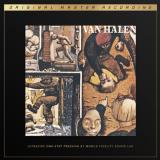
The premium packaging and gorgeous presentation befit the reissue's select status. Housed in a deluxe slipcase, it features special foil-stamped jackets and faithful-to-the-original graphics that illuminate the splendor of the recording. Aurally and visually, it is made for listeners who want to immerse themselves in everything involved with the album, including the iconic cover art adopted from William Kurelek's haunting painting, "The Maze."

Isolated frames from Kurelek's childhood-inspired work — including a man bashing his head into a brick wall, a guy pinning down an adversary as he delivers bare-fist blows to his face and others watch with apparent glee, a boy tied down on a conveyer belt and being sent through the equivalent of a meat saw — adorn the front and back covers. The sunnier visual disposition of Van Halen's prior efforts gives way to something sinister and tortured, traits reflective of the music within. The band members, too, are visually depicted not in glamorous shots but in a serious black-and-white portrait in which the quartet is clad in black leather jackets.

Tough, aggressive, stark: Fair Warning comes on like a series of bare-knuckled punches to the solar plexus and boasts lyrical narratives to match. Though not a concept record, the concise album revolves around themes of roughing it on the streets and struggling to survive amid dim prospects. Singer David Lee Roth reportedly penned many of the initial lyrics after traveling to Haiti and observing extreme poverty. The characters and situations populating Fair Warning reflect hardscrabble existence, last-chance desperation, and underlying danger.

Witness the crazies, poor folks, and hunters of “Mean Street”; the former prom queen turned pornographic actress on “Dirty Movies”; the menace and vice of “Sinners Swing!”; the streetwise hustle of “Unchained”; the isolation and alienation of “Push Comes to Shove”; the desire for escape on “One Foot Out the Door”: A carefree California beach party Fair Warning is not.

Having said he felt angry and frustrated during the sessions, guitarist Eddie Van Halen uses the forceful arrangements as a playground for his seemingly unlimited arsenal. Supported by a crack rhythm section and a hyped-up Roth, he performs with an almost impossible combination of punk-like intensity, technical finesse, lyrical fluidity, and unbridled emotion. The virtuoso was increasingly butting heads with Templeton and seeking a freedom in the studio he believed denied him.

No wonder he plays like a bat out of hell. Listen to the rapid-fire manner in which he slaps the high and low E strings on the 12th fret of his instrument on “Mean Street,” instilling the tune with funk flair and metal-spiked sharpness. For the pouty strut of “Dirty Movies,” Eddie Van Halen contributes slide guitar magic made possible after he sawed off the lower portion of a Gibson SG so he could reach further down the fretboard.

Related intensity, urgency, and daredevil momentum punctuate the surging “Sinner’s Swing!” A heavily flanged, delicately melodic introduction frames the attitudinal “Hear About It Later,” among the most creative arrangements of Van Halen’s career. And do riffs come any bigger or magnetic than those on the high-wire kick of “Unchained”? As for the out-of-left-field “Sunday in the Park,” an instrumental composed on an Electro-Harmonix micro-synthesizer: Who but Eddie Van Halen to supply creep factor in such an ingenious way?

Despite selling fewer quantities than Van Halen’s prior efforts, Fair Warning remains for many diehards the record that epitomizes all of the band’s immense strengths —Roth’s manic energy and tongue-wagging humor, Alex Van Halen’s rhythmic heartbeat-in-your-chest bombast, and Michael Anthony’s lucid bass lines included. Arriving when the New Wave of British Heavy Metal and new-wave movements were taking flight, it signaled a shot across the bow from a band determined to stay a step ahead and provide proof nobody could touch what it delivered.

More than four decades later, Fair Warning still sounds that alarm.

Reservar

El artículo no se ha publicado. Tú puedes reservar ahora el artículo y después de ser pagado se te será enviado.

186,13
London Music Works & Nick Squires - Music From The Crown LP 2x12"
  • A1: The Crown Main Title
  • A2: Duck Shoot
  • A3: The Letter
  • A4: Where Does That Leave Me?
  • A5: Mary Is Dead
  • B1: Your Majesty
  • B2: Future King
  • B3: Princess Margaret
  • B4: New Queen
  • B5: Charles
  • C1: Simple Harp
  • C2: Fairytalec
  • C3: Simple Harp Variation No.1
  • C4: Voices
  • C5: Actually Her
  • D1: Al Fayed
  • D2: Gunpowder
  • D3: William
  • D4: Holding Hands
  • D5: Leave You To It

Silva Screen Records präsentiert „Music from The Crown“, ein mitreißendes neues Album, dass die Emmy-prämierte Netflix-Serie mit frischen orchestralen Interpretationen ihrer einprägsamsten Melodien feiert. Aufgenommen vom renommierten Ensemble London Music Works und mit ausdrucksstarken Cello-Soli von Nick Squires, umfasst die Sammlung die Hauptthemen und wichtigsten musikalischen Momente aller sechs Staffeln und zeichnet die Reise der Krone von der jungen Elizabeth II. bis zum Ende ihrer Regierungszeit nach.

Diese neuen, für ein volles Orchester arrangierten und mit modernem cineastischem Glanz versehenen Versionen würdigen den musikalischen Ton von „The Crown“ und verleihen den prägnanten Themen von Hans Zimmer, Rupert Gregson-Williams und Lorne Balfe die Unmittelbarkeit eines Konzertsaals. Hans Zimmer ging das Projekt mit dem Gewicht eines Spielfilms an und erkannte die weitreichende Vision des Schöpfers Peter Morgan. Rupert Gregson-Williams erinnert sich an lange Gespräche, in denen der majestätische und doch zurückhaltende Ton des ersten Themas festgelegt wurde, während Lorne Balfe betont, wie die Filmmusik mit Königin Elizabeths Entwicklung von der Unschuldigen zur Monarchin mit gereift ist. Als Martin Phipps in Staffel 3 das Ruder übernahm, schuf er ein Gleichgewicht aus Respekt vor dem Bestehenden und einer frischen musikalischen Identität, die die neue Ära der Serie widerspiegelte.

Reservar12.12.2025

debe ser publicado en 12.12.2025

31,05
FREDERIK CROENE - SANS RETOUR

FREDERIK CROENE

SANS RETOUR

12inchCORTIZONA034
CORTIZONA
05.12.2025

The piano recital/album sans retour forms the concluding part of Croene's 'Trilogy of Hopelessness' (Cortizona). The overarching theme is the sense of doom inherent in our responses to climate change. After the doomed indulgence in nostalgia ('cul de sac', 2019) and the doomed yearning for landscapes lost through climate change and human mismanagement ('solastalgia', 2022), he now presents 'sans retour': the doom of the inevitably failed fantasy of escape.

Six piano pieces serve as an in memoriam for six fearless aviation pioneers who ultimately lost their lives in plane crashes. The album opens with a sound recording of the communication between Yuri Gagarin and mission control one minute before the launch of the first manned space flight. At the end of Side A and the beginning of Side B, excerpts from the conversation between Richard Russell and air traffic control can be heard.

Conceived as a single, Beethovenian composition, Croene once again demonstrates the wide range of sound palettes a piano can produce. The common thread is a melody based on the 'Dies Irae', which takes six different forms to embody the in memoriam concept.

Reservar05.12.2025

debe ser publicado en 05.12.2025

20,13
Freddie Mercury - Freddie Mercury - Mr Bad Guy 40th Anniversary

Freddie Mercurys Debüt-Soloalbum „Mr Bad Guy“ war der erste Schritt des legendären Frontmanns von
Queen in Richtung Solokarriere. Es enthielt vier Singles und erreichte Platz 6 der britischen Albumcharts.
Auf diesem Album griff Freddie auf Einflüsse aus Disco, Dance und Pop zurück. Daraus entstanden
Songs wie „I Was Born To Love You“ und „Living On My Own“.
Mit „Made In Heaven“ und „Love Me Like There’s No Tomorrow“ lieferte Freddie außerdem zwei grandiose
Rock Balladen.
Anlässlich seines 40-jährigen Jubiläums wird „Mr Bad Guy“ auf 180 g schwerem, durchschimmernden
grünem Vinyl aufgelegt.

Reservar05.12.2025

debe ser publicado en 05.12.2025

25,63
CRYME - London Boy: The Remixes

CRYME

London Boy: The Remixes

12inchSEVEN7000LTD
Seven
28.11.2025

For SEVEN's first anniversary, we've brought together a roster of talented artists, each with a distinct style, to reimagine CRYME's hit "London Boy" originally released on The Backroom EP in 2024. This 5-track remix EP features a remastered version of the original alongside fresh interpretations by none other than Ghettotech heavyweight MCR-T, Prog House queen Roza Terenzi, modular wizard JakoJako, and Amsterdam's legendary Stef de Haan as a digital bonus. The vinyl will be limited to 500 copies.
With full marketing and PR support around the anniversary SEVEN7000LTD is set to be SEVEN's biggest release of the year.
A1 - CRYME - London Boy (MCR-T Remix)
CRYME's 808-driven electro, ghetto house hybrid "London Boy" gets the MCR-T treatment, spiced up with a dose of Garage. The Berlin-based artist reshaped the bassline into a gritty reese bass and put in the iconic UK hardcore vocal "your name is not down, you not coming in," perfectly amplifying the track's original UK flair.
A2 - CRYME - London Boy (Roza Terenzi Remix)
Roza Terenzi joins the "London Boy" Remix EP with a sleek, modern tech house cut. Flipping the distinct 808 cowbells into heavily processed percussive elements that bounce through the mix while carrying a melodic line. Her remix is packed with her quirky yet precise sound design and kinetic frequencies. The original vocal phrases are creatively chopped up into fragments and reassembled so they become part of the rhythmic backbone.

B1 - CRYME - London Boy (JakoJako Remix)
JakoJako shows off her genre diversity with a steezy Tech House flip of "London Boy." The talented Berlin-based live act lays down a solid drum foundation and a bouncing bassline - no frills, just a steady groove built for the dancefloor. The composition stays laidback, leaving space for a raw synth melody and her reworked, chopped-up vocal layers that add just the right touch of playful silliness to the track.

B2 - CRYME - London Boy (Original Mix)
On the B-side you will find CRYME's remastered original "London Boy", first released in 2024 and featuring ANTICALM, a British rapper, vocalist, and songwriter whose "You Don't Want This" vocal sample takes center stage. Merging 808-driven Electro and Grime with a touch of Ghetto House, the track reimagines a genre-bending battery of block-party energy in the club setting. With its driving rhythm and unmistakable vocal hook, it remains a powerful tool for DJs and a highlight on any dancefloor.

No en stock

Haga su pedido ahora y le encargaremos el artículo en nuestro proveedor.

13,40

Ültimo hace: 4 Meses
False Lefty - Time Will Tell LP
  • A1: Throwing Words
  • A2: Admit Defeat
  • A3: Daddy
  • A4: Heaven Sold
  • A5: 4/7, Hello?!
  • A6: You Don't Know Your Name
  • B1: They Stay
  • B2: The Cake
  • B3: Queens Of Lefty
  • B4: Blanks
  • B5: Boat Song

Mit ihrem Debütalbum »time will tell« setzen FALSE LEFTY den nächsten Meilenstein. Das Duo – Veva (AT) Stehend am minimalistischen Drumset und Tom (GB) an der drei-saitigen Gitarre – bleibt seinem Credo treu: Reduktion bis aufs Maximum. Bittersüße Melodien treffen auf rohe Energie und schaffen ein Soundgewitter zwischen Alternative Rock, Indie und Post-Punk. Kein Füllmaterial, keine Kompromisse, sondern ein eigener Sound, der nach internationalem Erfolg schreit. Man hört Einflüsse von Bands wie The Cure, Radiohead gewürzt mit einer Prise Sex Pistols, doch FALSE LEFTY verwandeln sie in ihr eigenes Gebräu – roh, direkt und voller Haltung. Mit stampfenden Rhythmen, gekonntem Songwriting und dieser besonderen Mischung aus Urgewalt und fragiler Melancholie. Immer kraftvoll, immer unverwechselbar.

Reservar28.11.2025

debe ser publicado en 28.11.2025

23,95
ON THE HUH - SECOND TIME AROUND
  • On Our Own Way
  • Elfnsafety
  • Class Of 65
  • Generation Apart
  • Sussed You Out
  • Cant Be Arsed
  • Dont Wanna Be Like You
  • Queen Of Sleeze
  • Stand
  • Fry Up
  • Your Old Man
  • Spirit Unbroken
También disponible

Red Vinyl[21,43 €]

SPLATTER CAMOUFLAGE VINYL[22,06 €]


"On the Huh" is taken from the deepest UK slang term 'on the huh' meaning: Not level, crooked or wonky. Comprised of singer Sloss (Braindance), guitarist Chris (Infa Riot), bassist Dave (Special Duties) and drummer Tom (Infa Riot), "ON THE HUH" from Norwich have taken the scene by storm with their first album "Bit on the side", which was sold out in a few weeks. Now it's time for their new album "Second Time Around"! The 12 new songs are a perfect match of glam, brickwall, and streetpunk with strong Oi! and rock and roll influences. "On the Huh" are "on our own way" and what really sets this record miles apart, however, is the sense for catchy songwriting and the fun and authenticity they convey with every chord. "Class of 65" is a melodic homage to the original Mods from the 1960s and the youth cult that like rock and roll, influenced rebels and subcultures from Punk, Oi to Brit-Pop and beyond. Society is changing, but good old British punk rock will never go out of style. Songs like "Generation apart" or "Spirit unbroken" hit the bullseye. When you sit at the bar in an English pub after work, watching the guys at the dartboard, 'On the Huh' could be sitting at the next table. From the jukebox, 'Sussed Out' and 'Don't Wanna Be Like You' are blasting. You take a big sip of your pint, smile quietly to yourself, and nod. Outside, the world keeps spinning rapidly and has forgotten what really matters. "'Second time around' is like an old friend to you_ `Is there a more beautiful compliment for a band and their music?

Reservar21.11.2025

debe ser publicado en 21.11.2025

19,96
ON THE HUH - SECOND TIME AROUND

ON THE HUH

SECOND TIME AROUND

12inchSBLPR273
Sunny Bastards
21.11.2025

"On the Huh" is taken from the deepest UK slang term 'on the huh' meaning: Not level, crooked or wonky. Comprised of singer Sloss (Braindance), guitarist Chris (Infa Riot), bassist Dave (Special Duties) and drummer Tom (Infa Riot), "ON THE HUH" from Norwich have taken the scene by storm with their first album "Bit on the side", which was sold out in a few weeks. Now it's time for their new album "Second Time Around"! The 12 new songs are a perfect match of glam, brickwall, and streetpunk with strong Oi! and rock and roll influences. "On the Huh" are "on our own way" and what really sets this record miles apart, however, is the sense for catchy songwriting and the fun and authenticity they convey with every chord. "Class of 65" is a melodic homage to the original Mods from the 1960s and the youth cult that like rock and roll, influenced rebels and subcultures from Punk, Oi to Brit-Pop and beyond. Society is changing, but good old British punk rock will never go out of style. Songs like "Generation apart" or "Spirit unbroken" hit the bullseye. When you sit at the bar in an English pub after work, watching the guys at the dartboard, 'On the Huh' could be sitting at the next table. From the jukebox, 'Sussed Out' and 'Don't Wanna Be Like You' are blasting. You take a big sip of your pint, smile quietly to yourself, and nod. Outside, the world keeps spinning rapidly and has forgotten what really matters. "'Second time around' is like an old friend to you_ `Is there a more beautiful compliment for a band and their music?

Reservar21.11.2025

debe ser publicado en 21.11.2025

21,43
ON THE HUH - SECOND TIME AROUND

ON THE HUH

SECOND TIME AROUND

12inchSBLPS273
Sunny Bastards
21.11.2025

"On the Huh" is taken from the deepest UK slang term 'on the huh' meaning: Not level, crooked or wonky. Comprised of singer Sloss (Braindance), guitarist Chris (Infa Riot), bassist Dave (Special Duties) and drummer Tom (Infa Riot), "ON THE HUH" from Norwich have taken the scene by storm with their first album "Bit on the side", which was sold out in a few weeks. Now it's time for their new album "Second Time Around"! The 12 new songs are a perfect match of glam, brickwall, and streetpunk with strong Oi! and rock and roll influences. "On the Huh" are "on our own way" and what really sets this record miles apart, however, is the sense for catchy songwriting and the fun and authenticity they convey with every chord. "Class of 65" is a melodic homage to the original Mods from the 1960s and the youth cult that like rock and roll, influenced rebels and subcultures from Punk, Oi to Brit-Pop and beyond. Society is changing, but good old British punk rock will never go out of style. Songs like "Generation apart" or "Spirit unbroken" hit the bullseye. When you sit at the bar in an English pub after work, watching the guys at the dartboard, 'On the Huh' could be sitting at the next table. From the jukebox, 'Sussed Out' and 'Don't Wanna Be Like You' are blasting. You take a big sip of your pint, smile quietly to yourself, and nod. Outside, the world keeps spinning rapidly and has forgotten what really matters. "'Second time around' is like an old friend to you_ `Is there a more beautiful compliment for a band and their music?

Reservar21.11.2025

debe ser publicado en 21.11.2025

22,06
JOSEPH	DECOSIMO - FIERY GIZZARD

JOSEPH DECOSIMO

FIERY GIZZARD

12inchDLRLPC163
Dear Life Records
14.11.2025

Old-time and traditional music stay exciting for their contrasts. Exacting instrumentation honed through mentorships and late-night jams at fiddler's conventions tangles with a community-sourced inventiveness that influences variants and new sounds. Joseph Decosimo is a master of this genre for this very reason, blending deep technique with an openness and curiosity that keep his music crackling with life. A "marvelous fiddler" (No Depression) and banjo player who braids "exultation and veneration" (INDY Week) into his music, on his third solo album Fiery Gizzard Decosimo gathers a close-knit ensemble of friends from his musical career to infuse his interpretations of fiddle and banjo pieces with a contagious communal joy. As an artist working with traditional music from the South and Appalachia, Decosimo chooses songs based not only on historical significance and lineage but also his own sensory approach. For Fiery Gizzard, his ear was tuned to otherworldly tones and mystery, sourcing from field recordings such as Virginia fiddler Luther Davis' hypnotic version of "Shady Grove" while amping up the music's psychedelic potential. On the middle Tennessee banjo composition "Flowery Girls," a VHS of bluesman Abner Jay inspired Decosimo to rig up a pickup inside a fretless banjo and play it thr ough a tube amp to capture some of Jay's edge and funkiness. But to round out the sound and keep it kinetic meant galvanizing a genre-eschewing crew to jam out - and not in a "spaced-out drooly" kind of way, he laughs, but as a sort of "responsive conversation." Decosimo has always been a community-minded artist. He began playing as a seventh graderin Tennessee, fostering relationships with older players at jams and in homes, a learning mode natural to his inquisitive nature and desire for musical connection. A folklorist by intuition, he later became one by profession, studying with old-time legend Clyde Davenport, teaching in East Tennessee State University's renowned bluegrass program, and receiving his PhD at the University of North Carolina with a dissertation titled "Catching the `Wild Note': Listening, Learning, and Connoisseurship in Old-Time Music." In North Carolina, Decosimo kicked about in the verdant environment of Durham and Chapel Hill's folk and indie scenes, collaborating with artists including Alice Gerrard, Hiss Golden Messenger, and Jake Xerxes Fussell. This community has influenced his own music, including his "sublime and strangely heartening" (Bandcamp Daily) 2022 release While You Were Slumbering and Beehive Cathedral, Decosimo's 2024 "Appalachian mountain music treasury" (New Commute) trio album with Luke Richardson and Cleek Schrey for Dear Life Records. Continuing on this path, Fiery Gizzard is home base for a loose outfit of mostly Tarheel-based musicians from within and beyond traditional music. Inspired by a tour with fiddler Stephanie Coleman (Nora Brown), guitarist Jay Hammond, and synth builder and multi-instrumentalist Matthew O'Connell, Decosimo assembled studiomates based on close friendships and comfort. Coleman, O'Connell, and Hammond contribute to Fiery Gizzard, along with bassist and producer Andy Stack (Helado Negro, Wye Oak), horn player Kelly Pratt (Beirut, David Byrne), Mipso and Fust's Libby Rodenbough, Joseph O'Connell (Elephant Micah), and trad/experimental artist Cleek Schrey. Decosimo's fiddle and banjo work is virtuosic, intricate and simple simultaneously, a testament to his many years of study. On some tracks, his playing or lovely, plain-hearted singing is the centerpiece, such as on his interpretations of Texan street preacher Washington Phillips' 1929 recording "I Had a Good Father and Mother" or the Eastern Kentucky fiddle barn-burner "Glory in the Meetinghouse," famously played by Luther Strong for Alan Lomax. But there's also a trusting open-door policy, like where Southern Appalachian tune "Ida Red" relaxes into Coleman's sweet, confident fiddling and Hammond's loping guitar. As a bandleader, Decosimo's confidence and enthusiasm for the music reveal the heart of traditional music and how it can come to life through community. Fiery Gizzard is Joseph Decosimo as a powerful champion of traditional music - a sponge who soaks up as much as he squeezes out, a responsive artist who makes his genre accessible, and a magnet who can bring musicians of all sorts into his orbit with his same passion.

Reservar14.11.2025

debe ser publicado en 14.11.2025

22,27
Fu Manchu - Godzilla’s/Eatin’ Dust +4 LP 2x12"
  • 1: Eatin’ Dust
  • 2: Shift Kicker
  • 3: Orbiter
  • 4: Mongoose
  • 5: Pigeon Toe
  • 6: Module Overload
  • 7: Living Legend
  • 8: Godzilla
  • 9: Grendel, Snowman
  • 10: Strolling Astronomer
  • 11: Urethane
  • 12: Jailbreak

Godzilla’s/Eatin’ Dust is the most popular release in Fu Manchu’s 30 year recorded history. It is the combination of what were originally 2 distinct 10” releases: Godzilla (1997) and Eatin’ Dust (1999).In 2018, Scott Hill (vocals/guitar) found the original tapes from the Godzilla recording sessions produced by Josh Homme (Queens Of The Stone Age/Kyuss) and unearthed a secret that had been in his garage since 1996...The band had recorded 4 songs that had never been released. These extra songs are early versions of "Grendel, Snowman," "Strolling Astronomer" and "Urethane” (whose final versions appeared on 1997’s The Action Is Go) and a cover of Thin Lizzy's "Jailbreak" (which is a different version than the one which was released on 7” in 1998). The songs line up perfectly with the original tracklist, which includes the band’s crowd pleasing cover of Blue Oyster Cult’s “Godzilla” and fan favourites “Eatin’ Dust” and “Mongoose” (which was featured in a Super Bowl commercial for Toyota and included in the TV series “Sons Of Anarchy” and the films “Boondock Saints II” and “The Hot Chick”).In 2019, the band released a 2,000 unit limited edition of this new version in a triple 10" package. Due to the continuing demand after this version sold out, in 2020 the band issued a new limited edition version of 1,500 units neon green and white splatter double 12" gatefold package with 2 sided insert including the previously unreleased tracks at 45 RPM for the heaviest audio possible. Five years later, they are finally doing a repress of this 45RPM double 12” version on white with brown splatter vinyl in a limited edition run of 2000 units.

Reservar07.11.2025

debe ser publicado en 07.11.2025

27,94
Cindy Lee - Act Of Tenderness

Cindy Lee

Act Of Tenderness

12inchW25-04LP
W.25TH
31.10.2025
  • 1: Act Of Tenderness
  • 2: Power And Posession
  • 3: What I Need
  • 4: New Romance
  • 5: Last Train's Come And Gone
  • 6: Operation
  • 7: Quit Doing Me Wrong
  • 8: Fallen Angel
  • 9: Bonsai Garden
  • 10: Miracle Of The Rose
  • 11: Wandering And Solitude
  • 12: A New Love Is Believing

Cindy Lee is the diva alter-ego of singer / guitarist / drag queen Patrick Flegel, the one-time captain of heralded Canadian experimental guitar pop act, Women. In Flegel's working on / as Cindy Lee exclusively over recent years, their songwriting makes a move toward high atmospherics, often achieving a mysterious sweetness rooted equally in beauty and ache.

As Cindy Lee's first long-form statement, Act Of Tenderness makes use of antipodal themes to create a living sound: static with grace, distortion and sugar, all masterfully arranged with crooked nods toward pop classicism. The layered vocal on "Power And Possession" creates a palpable haunt, bringing historical girl-group lament to choir-esque heights. The feedback shriek and industrial grind of "Bonsai Garden" provides near-operatic damage, yet never stumbles into the irrevocably grave. These snowy pieces give the album a decidedly cinematic feel, albeit one bent more towards Eraserhead.

Originally released in a scant private edition in 2015, Superior Viaduct's imprint W.25TH is pleased to give Act Of Tenderness its deserving wide release.

Reservar31.10.2025

debe ser publicado en 31.10.2025

23,32
NAKED RAYGUN - JETTISON (REMASTERED)

NAKED RAYGUN

JETTISON (REMASTERED)

12inchQSLPC186
Quarterstick Records
24.10.2025

Limited edition GRAPE CRUSH vinyl 1000 copies worldwide. Remastered by Bob Weston at Chicago Mastering Service. Originally released in 1988 vinyl reissue includes 4 bonus tracks. "Plenty of bands can claim Naked Raygun as an influence, from post-punkers to hardcore acts. All of them could learn a thing or two or three by studying the whoas. With Jettison... Naked Raygun achieved creative bliss. Here is an album that successfully combines dissonant instrumentation with supremely catchy vocals." - Punknews.org - // Naked Raygun were an extraordinary staple in the Chicago music scene - beginning in the early 80's and continuing until their quiet demise in the early 90's. Their music showed the world that punk rockers could play and be really good at it. Founded in Chicago in 1980, by Marco Pezzati, Jeff Pezzati and Santiago Durango, Naked Raygun released six albums during their eleven year career that would change the sound of punk rock indefinitely. The band is widely recognized as being one of the most influential punk bands of the 80's. Their anthemic style incorporated politics in a uniquely accessible way, melding pop and hardcore into one cohesive sound, that would later be dubbed, "The Chicago Sound". Shortly after their first release, Basement Screams, Durango left to join Big Black permanently, and was replaced by John Haggerty, whose unique style of buzzsaw guitar would define Raygun's sound for their next four albums. Additionally, Pierre Kezdy replaced Camilo Gonzalez and Eric Spicer took over drums for Jim Colao. In 1990, Haggerty left the band to start Pegboy. Bill Stephens joined the band for their final studio release entitled, Raygun...Naked Raygun.

Reservar24.10.2025

debe ser publicado en 24.10.2025

26,01
Artículos por página
N/ABPM
Vinyl