After their recent LP Mirages (Kraak Records, 2025) with French turntablist Guilhem’All, the group continues to explore collaborations with artists and instruments from diverse musical traditions. Building on decades of uncompromising acoustic exploration, Razen delves deeper into their practice with five improvisational pieces that unfold slowly in time and space. The duo’s radical core - Brecht Ameel and Kim Delcour - finds in Van der Harst a longtime kindred spirit, united by the impact of sound, intonation, and the sheer joy of playing.
To be released on April 24 via VIERNULVIER Records, the artwork for Stained Glass Starling was created by American visual artist Robert Beatty (Oneohtrix Point Never, Christina Vantzou, The Weeknd, Tame Impala). The physical release comes with a 16-page booklet including artwork and an interview.
A long-standing artistic kinship lies at the heart of this project, with first encounters dating back to the early 2000s in Belgian musical improv theatre. Van der Harst’s lifelong experience in improvised music and music theatre, spanning back to the 1980s, combined with a vast arsenal of rare and historical instruments, opens new tonal territories within the Razen universe.
These explorations are not incidental: his family roots in the former Dutch East Indies — through his great-grandfather — provide a quiet backdrop to his enduring affinity for Asian musical traditions. Instruments such as erhu, Javanese kacapi, and others introduce timbres
that bring the music its most pronounced Asian inflections to date.
Yet despite this shift in colour, the underlying ethos remains unmistakably Razen. Working from sound rather than form, the ensemble approaches music as painters approach a canvas: adding layers, contrasts and shades with care. There is no soloist’s ego here; all voices are equal, echoing principles found in gamelan traditions.
Over the decades, Razen and Dick Van der Harst have crossed paths repeatedly, notably through cult theatre productions by Belgian theatre maker Eric De Volder, including Zwarte vogels in de bomen (2002) and Huis der Verborgen Muziekjes I–II (2000–2006). Recording an albumtogether had long been a shared aspiration — a wish that crystallised after a 2024 concert at Concertzaal Miry in Ghent, part of the Ruiskamer series by VIERNULVIER Art Centre.
Cerca:soloist
DJ Support: Antal, I Cube, Noel Watson, Colleen Cosmo Murphy, Sean Johnston, San Soda, Takaya Nagase, Tina Edwards, Pete Herbert, Kenneth Bager, Severino, Aaron Paar, Felix Joy, Harri Harrigan, Laroye, Telford, Darker Than Wax, Rocky (X Press 2), Shane Johnson, Dan Tyler, Felix Dickinson and many more
Having previously released selected retrospectives focused on the musical output of Ryo Kawasaki and Joan Bibiloni, NuNorthern Soul has now turned its attention to the vast back catalogue of Jasper Van’t Hof’s pioneering electro-acoustic, Afro-fusion collective, Pili Pili.
The band was established in 1984 by Van’t Hof, a Dutch pianist who began his career in Europe’s jazz scene of the late 1960s, as a way of combining his love of jazz-fusion and the music of North-West Africa. Van’t Hof already had a reputation for combining roles in traditional jazz combos with more experimental and abstract projects. These included a spell in violinist Jean-Luc Ponty’s first band, years spent masterminding jazz-rock outfit Jasper Van’t Hof’s Porkpie, the recording of an all- electronic album (1982’s Visitors), and a celebrated collaborative live album with the great Archie Shepp, Mama Rose.
Pili Pili, though, was another step forward for Van’t Hof. Working with percussionists and vocalists from Benin and Mali (including the now legendary Angelique Kidou) and a string of adventurous jazz soloists (saxophonist Tony Lakoto and trumpeter Annie Whitehead included), Van’t Hof’s collective frequently combined live and programmed percussion, electronic and acoustic instrumentation, and the talented improvisor’s own memorable melodies and impactful solos.
NuNorthern Soul’s retrospective focuses on the most productive and celebrated period of Pili Pili’s near three-decade history, showcasing tracks originally recorded and released on studio albums released between 1984 and 2002. The six tracks on show offer an essential glimpse into the musical gold to be found across the Pili Pili catalogue.
In keeping with NuNorthern Soul’s previous retrospectives, the vinyl version of Selected Works 1984-95 comes with extended liner notes telling the remarkable story of this most unusual of cross-cultural collaborations. These feature extensive quotes, reflections and memories from Jasper Van’t Hof and were written by music historian Matt Anniss.
- A2: Little Red Corvette
- A3: Delirious
- B1: Let's Pretend We're Married
- B2: D M.s.r
- C1: Automatic
- C2: Something In The Water (Does Not Compute)
- C3: Free
- D1: Lady Cab Driver
- D2: All The Critics Love U In New York
- A1: 1999
- D3: International Lover
a A1 1999; Lead Vocals Co-Lead Vocal – Dez*, J.J.*;Music By All Music, Voice [All Voices] – Prince
[b] A2 Little Red Corvette; Guitar [Guitar Solos], Soloist [Guitar Solos] – Dez*; Lead Vocals [Co-Lead Vocal] – Dez*, Lisa*; Music By [All Music], Voice [All Voices] – Prince
[c] A3 Delirious; Backing Vocals [Background Vocal] – Lisa*; Music By [All Music], Voice [All Voices] – Prince
[d] B1 Let's Pretend We're Married; Music By [All Music], Voice [All Voices] – Prince
[e] B2 D.M.S.R.; Backing Vocals [Backgroundsinging], Handclaps – Brown Mark*, Carol*, Jamie*, Lisa*, Peggy*, Poochie, The Count (7); Music By [All Music], Voice [All Voices] – Prince
[f] C1 Automatic; Backing Vocals [Background Vocals] – J.J.*, Lisa*; Music By [All Music], Voice [All Voices] – Prince
[g] C2 Something In The Water (Does Not Compute); Music By [All Music], Voice [All Voices] – Prince
[h] C3 Free; Music By [All Music], Voice [All Voices] – Prince; Voice [Background Voices] – J.J.*, Lisa*, Vanity, Wendy*
[i] D1 Lady Cab Driver; Music By [All Music], Voice [All Voices] – Prince; Voice Actor [Lady Cab Driver] – J.J.*
[j] D2 All The Critics Love U In New YorkMusic By [All Music], Voice [All Voices] – Prince
[a] A1 1999; Lead Vocals [Co-Lead Vocal] – Dez*, J.J.*;Music By [All Music], Voice [All Voices] – Prince
[b] A2 Little Red Corvette; Guitar [Guitar Solos], Soloist [Guitar Solos] – Dez*; Lead Vocals [Co-Lead Vocal] – Dez*, Lisa*; Music By [All Music], Voice [All Voices] – Prince
[c] A3 Delirious; Backing Vocals [Background Vocal] – Lisa*; Music By [All Music], Voice [All Voices] – Prince
[d] B1 Let's Pretend We're Married; Music By [All Music], Voice [All Voices] – Prince
[e] B2 D.M.S.R.; Backing Vocals [Backgroundsinging], Handclaps – Brown Mark*, Carol*, Jamie*, Lisa*, Peggy*, Poochie, The Count (7); Music By [All Music], Voice [All Voices] – Prince
[f] C1 Automatic; Backing Vocals [Background Vocals] – J.J.*, Lisa*; Music By [All Music], Voice [All Voices] – Prince
[g] C2 Something In The Water (Does Not Compute); Music By [All Music], Voice [All Voices] – Prince
[h] C3 Free; Music By [All Music], Voice [All Voices] – Prince; Voice [Background Voices] – J.J.*, Lisa*, Vanity, Wendy*
[i] D1 Lady Cab Driver; Music By [All Music], Voice [All Voices] – Prince; Voice Actor [Lady Cab Driver] – J.J.*
[j] D2 All The Critics Love U In New YorkMusic By [All Music], Voice [All Voices] – Prince
- A6: Anthony Hamilton & Elayna Boynton– Freedom, Acoustic Guitar – Elayna Boynton, Co-Producer – Daniel Beard, Mixed By, Mastered By – Daniel Beard, Duane Allen (2), Piano, Electric Piano
- B7: Don Johnson And Christoph Waltz– Five-Thousand-Dollar Nigga's And Gummy-Mouth Bitches, Written-By
- B9: Don Straud– Sneaky Schultz And The Demise Of Sharp, Written-By
- B12: Rick Ross With Walton Goggins And Jamie Foxx– 100 Black Coffins, Engineer
- Recorded | By
- C14: Samuel L Jackson, Leonardo Dicaprio And Christoph Waltz– Hildi's Hot Box, Written-By
- C17: James Brown And 2Pac With James Russo (2), Christoph Waltz And Jamie Foxx– Unchained (The Payback / Untouchable), Mixed By
- D19: Brother Dege– Too Old To Die Young, Lyrics By, Music By – Dege Legg, Mastered By – Bruce Barielle, Mixed By – Dege Legg, Primo (9), Tony Daigle, Producer – Dege Legg, Primo (9), Tony Daigle, Recorded By – Dege Legg, Vocals, Resonator Guitar
- D20: Samuel L Jackson And Jamie Foxx– Stephen The Poker Player, Written-By
- D22: Samuel L Jackson And Jamie Foxx– Six Shots Two Guns, Written-By
- D23: Annibale E I Cantori Moderni*– Trinity Titoli, Composed By – Franco Micalizzi, L Stott*, Conductor
- A1: James Russo (2)– Winged, Written-By
- A4: Jamie Foxx And Christoph Waltz– "In That Case Django, After You ..", Written-By
- A2: Luis Bacalov, Rocky Roberts– Django Theme Song (English Version), Written-By – Luis Bacalov
- A3: Ennio Morricone– The Braying Mule, Written-By – Ennio Morricone
- A5: Luis Bacalov, Edda Dell'orso– Main Titles Theme Song (Lo Chiamavano King), Written-By – Luis Bacalov
- B8: Luis Bacalov– La Corsa (2Nd Version), Written-By – Luis Bacalov
- B10: Jim Croce– I Got A Name, Written-By – Charles Fox, Norman Gimbel
- B11: Riz Ortolani– I Giorni Dell'ira, Conductor – Riz Ortolani, Written-By – Riziero Ortolani*
- C13: Jerry Goldsmith Featuring Pat Metheny– Nicaragua, Soloist – Pat Metheny, Written-By – Jerry Goldsmith
- C15: Ennio Morricone– Sister Sara's Theme, Written-By – Ennio Morricone
- C16: Elisa– Ancora Qui, Written-By – Elisa Toffoli, Ennio Morricone
- D21: Ennio Morricone– Un Monumento, Written-By – Ennio Morricone
a A1 James Russo (2)– Winged, Written-By Dialogue – Quentin Tarantino
d A4 Jamie Foxx And Christoph Waltz– "In That Case Django, After You...", Written-By [Dialogue] – Quentin Tarantino
[f] A6 Anthony Hamilton & Elayna Boynton– Freedom, Acoustic Guitar – Elayna Boynton, Co-producer – Daniel Beard, Mixed By, Mastered By – Daniel Beard, Duane Allen (2), Piano, Electric Piano [Wurlitzer], Bass, Electric Guitar, Acoustic Guitar, Programmed By, Percussion – Kelvin Wootenm, Producer – Kelvin Wooten, Recorded By – Daniel Beard, Kelvin Wooten, Vocals, Backing Vocals – Anthony Hamilton, Elayna Boynton, Written-By – Anthony Hamilton, Elayna Boynton, Kelvin Wooten
[g] B7 Don Johnson And Christoph Waltz– Five-Thousand-Dollar Nigga's And Gummy-Mouth Bitches, Written-By [Dialogue] – Quentin Tarantino
[i] B9 Don Straud– Sneaky Schultz And The Demise Of Sharp, Written-By [Dialogue] – Quentin Tarantino
[l] B12 Rick Ross With Walton Goggins And Jamie Foxx– 100 Black Coffins, Engineer [Recording Engineer] – Isaiah Pryor, Phillip "Logann" Scott III*, Guitar – Charlie Burrel*, Lyrics By – Jamie Foxx, Rick Ross, Mixed By – Jaycen Joshua, Mixed By [Assisted] – Trehy Harris, Music By – Jamie Foxx, Producer – Ainz "Brainz" Dimilo*, Jamie Foxx
[m] Recorded By [Rick Ross's Vocals] – John Rivers*, Written-By [Dialogue] – Quentin Tarantino
[o] C14 Samuel L. Jackson, Leonardo DiCaprio And Christoph Waltz– Hildi's Hot Box, Written-By [Dialogue] – Quentin Tarantino
[r] C17 James Brown And 2Pac With James Russo (2), Christoph Waltz And Jamie Foxx– Unchained (The Payback / Untouchable), Mixed By [The Payback], Edited By [The Payback] – Claudio Cueni, Voice [As Ace Speck] – James Remar, Written-By [Dialogue] – Quentin Tarantino, Written-By [The Payback] – Fred Wesley, James Brown, John Starks*, Written-By [Untouchable (Swizz Beatz Remix)] – Anthony Henderson, Bruce Washington, Kasseem Dean*, Tupac Amaru Shakur*, Yafeu Fula, D18 John Legend– Who Did That To You?, Performer [Sample] – The Mighty Hannibal, Producer – Paul Epworth, Written-By – James T. Shaw (The Mighty Hannibal)*, John Stephens (3), Paul Epworth
[s] D19 Brother Dege– Too Old To Die Young, Lyrics By, Music By – Dege Legg, Mastered By – Bruce Barielle, Mixed By – Dege Legg, Primo (9), Tony Daigle, Producer – Dege Legg, Primo (9), Tony Daigle, Recorded By – Dege Legg, Vocals, Resonator Guitar [Slide/Dobro], Body Percussion [Stomps], Handclaps [Claps] – Dege Legg
[t] D20 Samuel L. Jackson And Jamie Foxx– Stephen The Poker Player, Written-By [Dialogue] – Quentin Tarantino
[v] D22 Samuel L. Jackson And Jamie Foxx– Six Shots Two Guns, Written-By [Dialogue] – Quentin Tarantino
[w] D23 Annibale E I Cantori Moderni*– Trinity: Titoli, Composed By – Franco Micalizzi, L. Stott*, Conductor [Orchestra Directed By] – M° Gianfranco Plenizio*
[a] A1 James Russo (2)– Winged, Written-By [Dialogue] – Quentin Tarantino
[d] A4 Jamie Foxx And Christoph Waltz– "In That Case Django, After You...", Written-By [Dialogue] – Quentin Tarantino
[f] A6 Anthony Hamilton & Elayna Boynton– Freedom, Acoustic Guitar – Elayna Boynton, Co-producer – Daniel Beard, Mixed By, Mastered By – Daniel Beard, Duane Allen (2), Piano, Electric Piano [Wurlitzer], Bass, Electric Guitar, Acoustic Guitar, Programmed By, Percussion – Kelvin Wootenm, Producer – Kelvin Wooten, Recorded By – Daniel Beard, Kelvin Wooten, Vocals, Backing Vocals – Anthony Hamilton, Elayna Boynton, Written-By – Anthony Hamilton, Elayna Boynton, Kelvin Wooten
[g] B7 Don Johnson And Christoph Waltz– Five-Thousand-Dollar Nigga's And Gummy-Mouth Bitches, Written-By [Dialogue] – Quentin Tarantino
[i] B9 Don Straud– Sneaky Schultz And The Demise Of Sharp, Written-By [Dialogue] – Quentin Tarantino
[l] B12 Rick Ross With Walton Goggins And Jamie Foxx– 100 Black Coffins, Engineer [Recording Engineer] – Isaiah Pryor, Phillip "Logann" Scott III*, Guitar – Charlie Burrel*, Lyrics By – Jamie Foxx, Rick Ross, Mixed By – Jaycen Joshua, Mixed By [Assisted] – Trehy Harris, Music By – Jamie Foxx, Producer – Ainz "Brainz" Dimilo*, Jamie Foxx
[m] Recorded By [Rick Ross's Vocals] – John Rivers*, Written-By [Dialogue] – Quentin Tarantino
[o] C14 Samuel L. Jackson, Leonardo DiCaprio And Christoph Waltz– Hildi's Hot Box, Written-By [Dialogue] – Quentin Tarantino
[r] C17 James Brown And 2Pac With James Russo (2), Christoph Waltz And Jamie Foxx– Unchained (The Payback / Untouchable), Mixed By [The Payback], Edited By [The Payback] – Claudio Cueni, Voice [As Ace Speck] – James Remar, Written-By [Dialogue] – Quentin Tarantino, Written-By [The Payback] – Fred Wesley, James Brown, John Starks*, Written-By [Untouchable (Swizz Beatz Remix)] – Anthony Henderson, Bruce Washington, Kasseem Dean*, Tupac Amaru Shakur*, Yafeu Fula, D18 John Legend– Who Did That To You?, Performer [Sample] – The Mighty Hannibal, Producer – Paul Epworth, Written-By – James T. Shaw (The Mighty Hannibal)*, John Stephens (3), Paul Epworth
[s] D19 Brother Dege– Too Old To Die Young, Lyrics By, Music By – Dege Legg, Mastered By – Bruce Barielle, Mixed By – Dege Legg, Primo (9), Tony Daigle, Producer – Dege Legg, Primo (9), Tony Daigle, Recorded By – Dege Legg, Vocals, Resonator Guitar [Slide/Dobro], Body Percussion [Stomps], Handclaps [Claps] – Dege Legg
[t] D20 Samuel L. Jackson And Jamie Foxx– Stephen The Poker Player, Written-By [Dialogue] – Quentin Tarantino
[v] D22 Samuel L. Jackson And Jamie Foxx– Six Shots Two Guns, Written-By [Dialogue] – Quentin Tarantino
[w] D23 Annibale E I Cantori Moderni*– Trinity: Titoli, Composed By – Franco Micalizzi, L. Stott*, Conductor [Orchestra Directed By] – M° Gianfranco Plenizio*
[a] A1 | James Russo (2)– Winged, Written-By [Dialogue] – Quentin Tarantino
[d] A4 | Jamie Foxx And Christoph Waltz– "In That Case Django, After You ..", Written-By [Dialogue] – Quentin Tarantino
[f] A6 | Anthony Hamilton & Elayna Boynton– Freedom, Acoustic Guitar – Elayna Boynton, Co-producer – Daniel Beard, Mixed By, Mastered By – Daniel Beard, Duane Allen (2), Piano, Electric Piano [Wurlitzer], Bass, Electric Guitar, Acoustic Guitar, Programmed By, Percussion – Kelvin Wootenm, Producer – Kelvin Wooten, Recorded By – Daniel Beard, Kelvin Wooten, Vocals, Backing Vocals – Anthony Hamilton, Elayna Boynton, Written-By – Anthony Hamilton, Elayna Boynton, Kelvin Wooten
[g] B7 | Don Johnson And Christoph Waltz– Five-Thousand-Dollar Nigga's And Gummy-Mouth Bitches, Written-By [Dialogue] – Quentin Tarantino
[i] B9 | Don Straud– Sneaky Schultz And The Demise Of Sharp, Written-By [Dialogue] – Quentin Tarantino
[l] B12 | Rick Ross With Walton Goggins And Jamie Foxx– 100 Black Coffins, Engineer [Recording Engineer] – Isaiah Pryor, Phillip "Logann" Scott III*, Guitar – Charlie Burrel*, Lyrics By – Jamie Foxx, Rick Ross, Mixed By – Jaycen Joshua, Mixed By [Assisted] – Trehy Harris, Music By – Jamie Foxx, Producer – Ainz "Brainz" Dimilo*, Jamie Foxx
[m] Recorded | By [Rick Ross's Vocals] – John Rivers*, Written-By [Dialogue] – Quentin Tarantino
[o] C14 | Samuel L Jackson, Leonardo DiCaprio And Christoph Waltz– Hildi's Hot Box, Written-By [Dialogue] – Quentin Tarantino
[r] C17 | James Brown And 2Pac With James Russo (2), Christoph Waltz And Jamie Foxx– Unchained (The Payback / Untouchable), Mixed By [The Payback], Edited By [The Payback] – Claudio Cueni, Voice [As Ace Speck] – James Remar, Written-By [Dialogue] – Quentin Tarantino, Written-By [The Payback] – Fred Wesley, James Brown, John Starks*, Written-By [Untouchable (Swizz Beatz Remix)] – Anthony Henderson, Bruce Washington, Kasseem Dean*, Tupac Amaru Shakur*, Yafeu Fula, D18 John Legend– Who Did That To You?, Performer [Sample] – The Mighty Hannibal, Producer – Paul Epworth, Written-By – James T Shaw (The Mighty Hannibal)*, John Stephens (3), Paul Epworth
[s] D19 | Brother Dege– Too Old To Die Young, Lyrics By, Music By – Dege Legg, Mastered By – Bruce Barielle, Mixed By – Dege Legg, Primo (9), Tony Daigle, Producer – Dege Legg, Primo (9), Tony Daigle, Recorded By – Dege Legg, Vocals, Resonator Guitar [Slide/Dobro], Body Percussion [Stomps], Handclaps [Claps] – Dege Legg
[t] D20 | Samuel L Jackson And Jamie Foxx– Stephen The Poker Player, Written-By [Dialogue] – Quentin Tarantino
[v] D22 | Samuel L Jackson And Jamie Foxx– Six Shots Two Guns, Written-By [Dialogue] – Quentin Tarantino
[w] D23 | Annibale E I Cantori Moderni*– Trinity Titoli, Composed By – Franco Micalizzi, L Stott*, Conductor [Orchestra Directed By] – M° Gianfranco Plenizio*
[a] A1 | James Russo (2)– Winged, Written-By [Dialogue] – Quentin Tarantino
[d] A4 | Jamie Foxx And Christoph Waltz– "In That Case Django, After You ..", Written-By [Dialogue] – Quentin Tarantino
[f] A6 | Anthony Hamilton & Elayna Boynton– Freedom, Acoustic Guitar – Elayna Boynton, Co-producer – Daniel Beard, Mixed By, Mastered By – Daniel Beard, Duane Allen (2), Piano, Electric Piano [Wurlitzer], Bass, Electric Guitar, Acoustic Guitar, Programmed By, Percussion – Kelvin Wootenm, Producer – Kelvin Wooten, Recorded By – Daniel Beard, Kelvin Wooten, Vocals, Backing Vocals – Anthony Hamilton, Elayna Boynton, Written-By – Anthony Hamilton, Elayna Boynton, Kelvin Wooten
[g] B7 | Don Johnson And Christoph Waltz– Five-Thousand-Dollar Nigga's And Gummy-Mouth Bitches, Written-By [Dialogue] – Quentin Tarantino
[i] B9 | Don Straud– Sneaky Schultz And The Demise Of Sharp, Written-By [Dialogue] – Quentin Tarantino
[l] B12 | Rick Ross With Walton Goggins And Jamie Foxx– 100 Black Coffins, Engineer [Recording Engineer] – Isaiah Pryor, Phillip "Logann" Scott III*, Guitar – Charlie Burrel*, Lyrics By – Jamie Foxx, Rick Ross, Mixed By – Jaycen Joshua, Mixed By [Assisted] – Trehy Harris, Music By – Jamie Foxx, Producer – Ainz "Brainz" Dimilo*, Jamie Foxx
[m] Recorded | By [Rick Ross's Vocals] – John Rivers*, Written-By [Dialogue] – Quentin Tarantino
[o] C14 | Samuel L Jackson, Leonardo DiCaprio And Christoph Waltz– Hildi's Hot Box, Written-By [Dialogue] – Quentin Tarantino
[r] C17 | James Brown And 2Pac With James Russo (2), Christoph Waltz And Jamie Foxx– Unchained (The Payback / Untouchable), Mixed By [The Payback], Edited By [The Payback] – Claudio Cueni, Voice [As Ace Speck] – James Remar, Written-By [Dialogue] – Quentin Tarantino, Written-By [The Payback] – Fred Wesley, James Brown, John Starks*, Written-By [Untouchable (Swizz Beatz Remix)] – Anthony Henderson, Bruce Washington, Kasseem Dean*, Tupac Amaru Shakur*, Yafeu Fula, D18 John Legend– Who Did That To You?, Performer [Sample] – The Mighty Hannibal, Producer – Paul Epworth, Written-By – James T Shaw (The Mighty Hannibal)*, John Stephens (3), Paul Epworth
[s] D19 | Brother Dege– Too Old To Die Young, Lyrics By, Music By – Dege Legg, Mastered By – Bruce Barielle, Mixed By – Dege Legg, Primo (9), Tony Daigle, Producer – Dege Legg, Primo (9), Tony Daigle, Recorded By – Dege Legg, Vocals, Resonator Guitar [Slide/Dobro], Body Percussion [Stomps], Handclaps [Claps] – Dege Legg
[t] D20 | Samuel L Jackson And Jamie Foxx– Stephen The Poker Player, Written-By [Dialogue] – Quentin Tarantino
[v] D22 | Samuel L Jackson And Jamie Foxx– Six Shots Two Guns, Written-By [Dialogue] – Quentin Tarantino
[w] D23 | Annibale E I Cantori Moderni*– Trinity Titoli, Composed By – Franco Micalizzi, L Stott*, Conductor [Orchestra Directed By] – M° Gianfranco Plenizio*
Original Gravity Records Ignites the Summer with Latin Fever Vol. 4
Available on Limited Edition Vinyl & Digital Platforms
Original Gravity Records turns up the heat once again with the explosive release of Latin Fever Vol. 4 — the highly anticipated fourth instalment in the label’s signature Latin groove series. Packed with sizzling salsa, fiery guajira, and vintage Latin soul, this EP is a globe-spanning collaboration anchored in the UK and powered by musicians from Peru, Cuba, the USA, and Italy.
From the opening tumbao of El Tumbao Del Solar by Abramo & Néstor, to the irresistible charisma of Chévere Girl by Luchito & Néstor, this record is a celebration of rhythm, culture, and cross-continental energy. Flip the wax, and you’ll find La Vieja Escuela serving up Vacilar Mi Guajira — a classic throwback dancefloor gem — before Néstor Álvarez brings the party home with the brass-heavy burner La Fiesta Se Va.
With drums, bass, and production led by OG’s own Neil Anderson and a tight brass section along with standout soloists from both sides of the Atlantic, Latin Fever Vol. 4 is pure analog fire — recorded with heart, soul, and serious groove.
Whether you're a crate digger, DJ, or just a lover of Latin rhythms, this is one for the shelf and the stereo.
Get it while it's hot. This is Latin Fever — and it's contagious.
'Epiphany' is an album by composer and arranger Vince Mendoza, released in 1999, it is appearing here on vinyl for the first time and features the London Symphony Orchestra and seven jazz soloists, including John Abercrombie, Michael Brecker, Peter Erskine, and Kenny Wheeler. The album consists of eight original compositions by Mendoza, ranging from the lyrical "Impromptu" to the rhythmic "Barcelona". The music is a blend of classical and post-bop, with influences from show tunes and Spanish folk music. Mendoza's orchestrations are subtle and evocative, creating a rich and varied sonic palette. The soloists interact with the orchestra in different ways, by blending in, contrasting, and often improvising over the written parts. This prefund musical journey is a testament to Mendoza's creativity and versatility as a composer and a conductor.
180 G. BLACK VINYL WITH LINER NOTES IN CREOLE, FRENCH, ENGLISH
Originally released in 1979, "Spiritual Sound" lives up to its name, a soaring, triumphant album, six tracks of spirit magic from Guadeloupe.
Telluric, intense, terribly alive, the gwoka drums of Guadeloupe carry the identity of a painful and fervent island. Marked forever by the crime of slavery, Guadeloupe's créolité cherishes the ka drums and their natural environment: the low-pitched boula drum with male goatskin, the high-pitched soloist makè drum with female goatskin, the chacha, ti bwa, triangle, calabash and other percussion instruments that surround them, and the voices - the fiery, proud, timbred, urgent voices of the gwoka.
This album is also a legend for its voices: in his then dazzling youth, singer Lukuber Séjor was one of the first gwoka artists to largely feminize the chorus of répondè, who converse with his text delivered in a straight and powerful voice.
And everything here sets new standards. In 1979, Mizik Filamonik - Spiritual Sound proclaimed a spiritual patriotism of ferocious intensity. The album by Lukuber Séjor - whose spelling alone is a battle - sets out to give Guadeloupe the intangible weapons of self-respect and self-knowledge, through a singular practice of traditional music.
The genesis of gwoka music is less straightforward than one might imagine... The drums performed the servile task of accompanying the work of slaves in the fields and during the “corvées” imposed by the administration, before being freely practiced by the common people after the abolition of 1848. At the heart of the conviviality of the Guadeloupeans furthest from the cities - geographically and socially - the gwoka drums come out for carnival, funeral wakes and neighborhood celebrations, but also during strikes, fits of anger and armed vigils of the riots and revolts that have punctuated the island's history. For generations, governors of the colony and then the prefects of the overseas department of Guadeloupe have been viewing the gwoka as a potential for turbulence and a threat to public order.
But as the Beatlesmania, “chanson engagée” and rock revolutions unfolded in Europe, young people turned to the drums of mizik a vié nèg (“bad negro music”, in Creole), which Guadeloupeans had learned to despise by following the “assimilation” process advocated by the school system and most of the political class. At the end of the sixties, in a Guadeloupe mourning the deadly repression of the May 1967 social movement, they played traditional music, refusing to wrap it up in tourist prettiness and madras folk costumes. Instinctively, they played a rough and contemporary gwoka, led by the incendiary Guy Konkèt. This was the era of decisive 45 rpm records such as Robert Loyson's Kann a la richès, which brought to light the fieriest words of union rallies.
At his home in Sainte-Anne, Lukuber Séjor played with flautist Olivier Vamur and his brother Claude Vamur, who cobbled together a drum kit from tin crockery and became, a few years later, the most influential drummer in Kassav'.
These were the years of the Bumidom program, when young Guadeloupeans were encouraged to emigrate to mainland France. At the age of twenty, Lukuber Séjor embarked on the liner Irpinia, disembarking at Le Havre and taking the train to the Gare Saint-Lazare - the route taken by thousands of young West Indians who went on to study or looked for work, all the while trying to maintain a link with their homeland. In this case, it's at the Antony university residence, where Lukuber played the drum and participated in a thousand gwoka updates and aggiornamentos, while exile reinforced the need for a spiritual link with the native land.
In 1978, Guy Konkèt played at the Salle Wagram, a historic event for West Indian music. After serving as répondè - i.e. backing vocalist - on one of his home-recorded albums, Lukuber joined his live band. Little by little, he became one of the key artists on a circuit parallel to French show business. At a student party in Caen, he met a young woman from Martinique who, at the time, was more motivated by her ambitions as a visual artist than by her vocation as a musician. Her name was Jocelyne Béroard and, a few years before she plunged into the Kassav' adventure and became the greatest West Indian singer of her generation, she designed the cover of Lukuber Séjor's LP.
This ambition was obvious and imposed its will. A more or less regular band was formed, with Roger Raspail, Rudy Mompière and Éric Danquin on ka drums, Claude Vamur on ti bwa, Olivier Vamur and Françoise Lancréot on flutes and Annick Noël on keyboards. Lukuber Séjor is set on wanting to extend the gwoka palette to other instruments, as the jazz-rock revolution opens a thousand new doors. Annick Noël will play a wide range of timbres and textures on electric piano and synthesizer. Another novelty: the répondè are two men and two women, Roger Raspail, Olivier Vamur, Françoise Lancréot and Maryann Mathéus ...
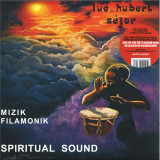
Mizik Filamonik - Spiritual Sound is a self-production in which the singer and leader sank all his savings, allowing him no more than a single day in the studio. The first side is more of a musical manifesto, with the first two tracks, Éritage and Penn é plézi, being instrumentals. The third, Son, forcefully celebrates the need for Guadeloupeans to connect with the gwoka. In fact, Jocelyne Béroard's cover shows a tambouyé in the shadow of a cloudy sky, against which a radiant sun is rising and whose light will soon flood the entire landscape. The silhouette and face of this man strongly evoke the immense Vélo, master of the ka, rejected at the time on the fringes of society.
The second side of the LP is surprising. Formally, three tracks are explicitly linked like the three parts of a triptych. Primyé voyaj evokes the appalling tribulation of Africans deported as slaves to Guadeloupe; dézyèm voyaj speaks of the Bumidom program and the economic, political and social forces driving young Guadeloupeans towards the mirage of prosperity in France; twazyèm voyaj closes the cycle with the emigrants' return from Europe after years away from their island...
This gwoka, obsessed with the need to save Guadeloupe spiritually, appeals far beyond the politicized audience. Mizik Filamonik - Spiritual Sound instantly became a classic, although Lukuber Séjor never really made a career for himself as a musician.
After all, the album was released in 1980, with no promotional resources in France or Guadeloupe - and therefore no concerts. The thirty-two-year-old author, composer and performer made his own third trip back to Guadeloupe. He set up a small woodworking business, which he lost in Hurricane Hugo in 1989. His other activity, teaching in a medical-educational institute, became the core of his professional life. He continued to be an active campaigner - a campaigner for the Creole language, a campaigner for the reawakening of identity, a campaigner for special education, a campaigner for a thousand causes that he ignited with his generous and perceptive enthusiasm, such as the defense of breadfruit fries...
The echoes of his 1979 album have not died down. Of course, the use of Penn é plézi as the theme tune for Radio Guadeloupe's funeral notices from 1980 to 1992 kept him in the collective memory, but he continues to sing and compose sporadically, as with his all-female
vocal group Vwapoulouéka... Still convinced that music is a means of liberating the spirit, he continues the journey of a young man eager to deploy the power of Creole music and language.
Bertrand Dicale
Bingo Club demands no rules for entry. Everyone knows your name. The hours are endless and the dress code remains
unspoken.
Martin Rousselot opened the doors to the Bingo Club at the dawn of the 2020's. Joined by Neysa Barnett, Vassili
Yatchinovsky, Marie-Paule Bargès and Emile Larroche, Bingo Club puts down its signature sound-stamp and juggles with
styles of different kinds; if five songs throb to the clank-clank of New York trains, five more drift lazily like Marseille's sailspotted waves.
Group signifiers and visual tropes are reduced to a molten wash of melodies and images that, whether heard or seen, unite
kindred spirits.
Whether as a duo or as a soloist, in English or in French, a warm mix of soothing voices is blanketed by soft rock
instrumentation. The videos are filmed with an analogue camera across the four corners of the globe.
A first EP, "Separated," released in 2020, sees a collaboration with Al Carson (Weyes Blood, Ariel Pink, Jessica Pratt...). In
2021 the single "Someday," featuring Annie Lime & Jonas San, comes out. In 2022, Bingo Club presents its debut album «
Better Lucky Than Beautiful », produced and mixed in Paris at Studio CBE by David Mestre (Sebastien Tellier, Chassol, ...).
The album is a collection of ten songs, written in different times and places, like a musical travel diary or sound-postcards.
Stunning big band music from Finnish composer Kerkko Koskinen with saxophonist Linda Fredriksson and UMO Helsinki Jazz Orchestra. "Agatha 2" is an album that continues the saga from "Agatha", released in 2007. Koskinen composes highly dynamic, emotive and expressive music for Finland's premiere jazz orchestra UMO. Linda Fredriksson (lately present due to their very successful album "Juniper" on We Jazz Records) shines as the soloist, who understands Koskinen's vision in its entire potential. This is cinematic, moody music for of the large canvas. The album also marks the first new release for Helsinki's Ricky-Tick Records (in collaboration with We Jazz Records and Grotto Editions) for over a decade.
- When Your Lover Has Gone
- A Cottage For Sale
- Who's Sorry Now
- Once In A While
- These Foolish Things
- Just For The Fun Of It Can't
- I Lover Come Back To Me
- Don't Get Around Much Anymore
- I Understand
- Just One Of Those Things
- The Song Is Ended
- I Should Care
- The Party's Over
- Angel Eyes
- Teach Me Tonight
By the time Just One of Those Things was recorded, Nat "King" Cole was already considered by the general public as more of a singer and entertainer than a jazz pianist. Cole did his first sessions with the more jazz-oriented Billy May in 1951, but it wasn't until 1957 when they collaborated on this first LP - Just One of Those Things, a memorable album in which all 12 songs fit seamlessly together perfectly. It wasn't just May's arrangements that created such swinging music behind Cole's vocals though, it was also the band, which included many illustrious soloists: Harry "Sweets" Edison, Willie Smith, Pete Candoli, Jimmy Rowles and Lee Young, along with John Collins and Jack Costanzo, members of the celebrated Nat "King" Cole Trio.
- A1: From A Drop, A Flame
- A2: Korunim
- A3: One Drop Remained
- A4: The Veiled Sea
- A5: Unpredictable And Joyous
- B1: Swimming In The Sky
- B2: The Lost Grotto
- B3: Ghost Warriors
- C1: Shadow Tundra
- C2: Dreaming Of Vengeance
- C3: A City Where None Live
- D1: Sacred River
- D2: The Perfect Wave
- D3: Sword Of The Sea
Austin Wintory's third collaboration with Giant Squid and creative director Matt Nava, Sword of the Sea, sees it's soundtrack surfing onto vinyl.
The music has been specially mastered for vinyl and is pressed to heavyweight discs, all housed in a deluxe gatefold sleeve. Illustrator Elaine Lee has created original artwork that flows from the front cover to the back.
Nominated for Best Score Soundtrack for Video Games and Other Interactive Media at the 68th GRAMMY Awards, Sword of the Sea is an aesthetic successor to thatgamecompany's Journey and Giant Squid's ABZÛ and The Pathless. The album is a mellifluous musical adventure, resonating immaculately with the game's sense of flow and beauty. Piano, synthesisers, strings, wind, and choral elements collaborate with, and cascade over one another, always with a purposeful momentum. Harmonically, pieces carry the listener along a gently undulating path, punctuated by unexpected chord changes - jagged little musical surprises that hint at the game's deeper mysteries.
Soloists Kristin 'Field of Reeds' Naigus, Tina Guo, Malukah, Paul Cartwright and Tom Strahle elevate the score with soaring performances, while ensembles including London Voices and the Phoenix Boys Choir enrich the texture of the enveloping compositions.
- Le Mieux Et Le Bien
- Yellow Moon
- Papillon
- Come Home
- My Little Sweet New Zealand Bunker
- Stop This World
- Indien De Paname
- Les Maximiseurs De Pi
- Notre Ile
- My Little Sweet New Zealand Bunker
- C'est Comme Ca C'est La Vie
Rather than yielding to despair in these troubled times and offering listeners a rope to hang themselves, Zimmermann (trombonist for Claude Nougaro, Manu Dibango, and Tony Allen) playfully grants them another option - a humorous sarcasm! He mocks the vain shelters of the powerful with the tune "My Little Sweet NZ Bunker", denounces the manufacture of one- track minds with "Les maximiseurs de PI", and escapism with the classic satirical Mose Allison's song "Stop This World (let me off" (translated and sung in French) In more tender moments, he reflects on the intimate consequences of this global unraveling.
Daniel Zimmerman's style, both as a composer and soloist, is that of a melodist above all else; disregarding concepts, he sings and seeks to go straight to the heart. He was voted 'Trombonist of the Year' by Jazz Magazine (Frances most influential jazz publication) in 2021, 2022, 2023 and 2024.
We Jazz Records kicks off their new series of archival 7" releases with Esa Pethman "In Belgium 1967" released 23 September 2022. The two-tracker is licensed from the Belgian VRT radio archives and both of the pieces are previously unreleased. Finnish jazz legend Pethman, heard here on alto flute and tenor sax, joins forces with European jazz greats such as Heinz Bigler, Uffe Karskov and Jean Fanis. This is a small but valuable piece of unheard European jazz history from the early heyday of modern jazz. The physical release is a quality "inside-out"-styled EP with 3mm spine and small center hole on the 45rpm vinyl.
An excerpt from the liner notes by Mikko Mattlar:
"Esa Pethman (b. 1938) was one of the key figures of modern Finnish jazz in the 1960s. His album The Modern Sound Of Finland was the first Finnish modern jazz album and his composition "The Flame" a true modern Fenno-jazz evergreen.
Pethman was born in Kuusankoski, 135 kilometres from Helsinki in the Kymenlaakso area. The jazz scene was active even though it was an area of rural landscapes and paper mills. Pethman discovered jazz when he heard a Charlie Parker record being played at a local music shop in the late 1940s. Following Parker, bebop became his favourite style of jazz.
Young Pethman played flute and saxophone in local bands who accompanied schlager singers. They played tangos and waltzes for dancers, but usually started a typical dance event with an hour of jazz. In 1959 Pethman moved to Helsinki to study music at the Sibelius Academy. Back then it was a strictly classical music academy, but Pethman later described the studies as crucial for his development and career. He quickly made his way to studio sessions and into the best orchestras in Helsinki.
As a student of composition, Pethman also began writing his own music. "The Flame" was a melody he just got on his mind one night, and he decided to write it down. The catchy composition was released as a 7" single in 1964, a year before Pethman's debut album. Both records stand as benchmarks for modern Finnish jazz. The album consisted entirely of Pethman's compositions, not versions of jazz standards like a lot of the Finnish jazz released until then.
In the mid 1960s, Finnish jazz was also taking its first international steps. Pethman's quintet took part in the first Montreux Jazz Festival in Switzerland in June 1967. At the Montreux jazz band competition, the quintet came in fourth of the twelve contestants. Despite not winning the competition, the band got an honourable mention, and Pethman was now recognized outside Finland.
In December 1967 Pethman travelled to Brussels. His visit was organised by the national Finnish broadcasting company Yleisradio and their jazz program producer Matti Konttinen. Konttinen was supposed to go to Brussels with Pethman, but the musician ended up traveling alone.
In the Decca recording studios Pethman played two songs. He recorded a version of his most famous composition "The Flame", where he played the alto flute and was accompanied by Belgian musicians. On Swiss saxophonist Heinz Bigler's composition "Like Steel", Pethman played the tenor saxophone. The band was now more international, consisting of Bigler, the Italian Francesco Santucci, the Dane Uffe Karskov, a Belgian rhythm section and Pethman. After 55 years, Pethman still remembers Bigler's remarkable skills as a saxophonist.
The two-day visit included the recording session, a dinner and a concert. Pethman and the other non-Belgian musicians came to Brussels mainly to play at a jazz concert organised by the European Broadcasting Union EBU. They played at the studio first, and the concert was held the following day. Pethman and all the other soloists played as members of an international big band. The studio and live session were produced by the Belgian Radio and Television jazz section leader Elias Gistelinck."
Announcing Perseverance Flow, the latest album from acclaimed Chicago-based ensemble Natural Information Society (NIS), release date 2024-10-24. After a trilogy of double LPs by expanded manifestations of the band that began in 2018 with Mandatory Reality & continued through Since Time Is Gravity (a Pitchfork Best Jazz & Experimental Album of the Year selection & Mojo’s #1 Underground Album of 2023), NIS returns to its core formation of Lisa Alvarado on harmonium, Mikel Patrick Avery on drums, Jason Stein on bass clarinet, & composer/multi-instrumentalist Joshua Abrams on guimbri for one continuous 37 minute composition across a single LP. As the rocket boosters on spaceship earth sputter closer to burnout, lower your stylus into a soundfield that grows stronger the deeper you travel into it; a dose of the medicine many of us look to music to deliver awaits you inside.
One of the deep contemplations of this natural information (thanks Bill Callahan) is the wide range of source materials Abrams draws from over the band’s more than 15 year history: Ideas from minimalism, modal jazz & traditional musics are regularly reimagined in these compositions. The 2021 double LP descension (Out of Our Constrictions), with guest soloist Evan Parker, reflected aspects of Abrams’ love of party music, Chicago house, & John Coltrane. *But even veteran travelers with the NIS best brace themselves for the Perseverance Flow.
Speaking to the history & the inspirations behind the album, Abrams offers: “We played the piece for a year in concert before the recording. At Electrical (Audio Studios, Chicago) we went in at 11 & were done in time to pick our kids up from school.” Abrams continues: "In a reference world, I imagine Perseverance Flow like a live extended realization of a Jaylib lost instrumental as remixed by Kevin Shields. Or vice versa. I also think it has sympathies to some of the more rhythmically intricate dance musics out of Chicago & Lisbon.”
The core NIS ensemble heard on Perseverance Flow always address Abrams’ writing with the discipline of orchestra musicians & the creativity of improvisers. But this time around, instead of inviting living legend status musicians Evan or William Parker or Ari Brown as honored guests to solo freely over the composed materials, Abrams’ invited guest collaborator was the medium of the recording studio itself. Situated at the board with engineer Greg Norman, Abrams pushed post production techniques found only sporadically on earlier NIS records deep into the heart of the music, distorting & reshaping instruments to subtly &, at times, aggressively mutate timbre & texture, color & time.
Refracting the band’s signature mesmerizing chains of overlapping rhythmic patterns through the sonic funhouse of dub makes Perseverance Flow the most formally experimental NIS album to date. Now a soundworld fully unique to itself is listening to itself, consoling & humoring itself, & consoling & humoring you. A destruction myth & a creation myth of a soundworld together at once —”energetically nutritious” (October 2025 Issue 500 The Wire) supernatural information society.
“Perseverance Flow is skipping rope in slo-mo. A dance of co-operation to rally guts & humors & keep marching through pouring tears” (Abrams).
Futura Resistenza is pleased to present the latest release from the prolific, restlessly creative composer-performer Anthony Pateras, two side-long pieces - one performed by Callum G'Froerer on double-bell trumpet, the other sung by Clara La Licata - in which soloists are accompanied by numerous pre-recorded tracks of their own instrument or voice, creating acoustic halls of mirrors where the distinction between live performer and recorded accompaniment becomes difficult to perceive. Palimpsest Geometry (2020) for double-bell trumpet & tape works with rapidly pulsed single trumpet notes, at brisk tempos that hover at the perceptual threshold between rhythm and tremolo. The interaction between different rates of pulse produces skittering echoes, as if G'Froerer's layers of trumpets were really a single sound bouncing around the sonic space. There Is A Danger Only Our Mistakes Are New (2021) for voice & tape goes to work on a see-sawing two-note melodic cell, insistently transposed and transposed again, hummed or sung with open vowels, contracting to a semitone and expanding to a minor third. More than anything in the canon of Western art music, the piece calls up the criss-crossing repeated figures of Inuit vocal games or the interlocking repetitions of Banda-Linda music, where rhythmic and harmonic displacements of repeated motifs fuse together individual parts into the illusion of an impossibly rich and multi-faceted unitary sonic organism. Essentially homogeneous in texture yet built up from constantly changing details, broadly static yet always moving and shifting, these pieces exemplify Pateras' recent work while also pushing it into a new, strikingly immediate direction. Here, form grows organically out of the material itself; the results are sparkling, immersive, and quietly uncompromising. (Francis Plagne)
Don Cherry, armed with a voracious musical appetite and boundless imagination, first made a name for himself - though not always fully understood - alongside Ornette Coleman, playing trumpet or cornet. In Los Angeles and then New York, he stood at the heart of a revolutionary approach to improvisation based on melody rather than harmony, later baptized "Free Jazz," the final structural development of American jazz. Over time, he became a champion of improbable fusions - gradually integrating into his style a whole array of "exotic" instruments, and more importantly, the cultures from which they originated. Among them: India, Brazil, Africa, Indonesia, and even China. The time had come for the emergence of "world music": in hindsight, a patchwork rich in imagination and seduction, but once the novelty wore off, often lacking in substance.
In Don Cherry's case, however, the commitment ran deep - tied to his personal engagement with a global vision of art and the human condition. Ustad Ahmed Latif Khan, from the Delhi gharana (a musical lineage), was part of a new generation of accompanists - percussionists, sarangi players, flutists, etc. - who had extended both the technical and conceptual possibilities of their predecessors to gain recognition as soloists and soon to venture onto the international scene. Among them, Latif stood out for his taste for irregular, highly syncopated rhythmic patterns - rich in variety and originality. Don and Latif had never met before the recording session, but the two quickly recognised one another as kindred spirits - calm, focused... and full of laughter. Don clearly knew what he wanted to create, and nothing seemed to pose a challenge for Latif, who grasped the American's intentions immediately, warmed up his fingers at astonishing speed, and with his perfect pitch, naturally took on the role of tuning Don's diverse instrument collection to match whatever was found in the studio - from concert piano and Hammond B3 organ to chromatic orchestral timpani.
- A1: Improvisation In Abu-Ata (Golha-Ye Rangarang #204)
- A2: Improvisation In Sigah (Golha-Ye Javidan #140)
- A3: Improvisation In Shur (Golha-Ye Rangarang #182)
- A4: Improvisation In Homayun (Barg-E Sabz #150)
- A5: Improvisation In Bayat-E Zand (Yek Shakheh Gol #169)
- A6: Improvisation In Dashti (Barg-E Sabz #174)
- A7: Improvisation In Abu-Ata (Golha-Ye Rangarang #201)
- B1: Improvisation In Bayat-E Turk (Barg-E Sabz #177)
- B2: Improvisation In Afshari (Barg-E Sabz #94)
- B3: Improvisation In Dashti (Golha-Ye Rangarang #200B)
- B4: Improvisation In Abu-Ata (Barg-E Sabz #35)
- B5: Improvisation In Sigah (Golha-Ye Rangarang #193)
- B6: Improvisation In Bayat-E Turk (Golha-Ye Javidan #136)
- B7: Improvisation In Dashti (Golha-Ye Rangarang #162B)
Cassette[9,66 €]
A collection of stunning Persian-tuned piano pieces cut from Iranian national radio broadcasts made for the Golha programmes between 1956 & 1965...
Morteza Mahjubi (1900-1965) was a Iranian pianist & composer who developed a unique tuning system for the piano which enabled the instrument to be played in all the different modes and dastgahs of traditional Persian art music. Known as Piano-ye Sonnati, this technique allowed Mahjubi to express the unique ornamental and monophonic nature of Persian classical music on this western instrument - mimicking the tar, setar & santur and extracting sounds from the piano which are still unprecedented to this day.
An active performer and composer from a young age, Mahjubi made his most notable mark as key contributor and soloist for the Golha (Flowers of Persian Song and Poetry) radio programmes. These seminal broadcasts platformed an encyclopaedic wealth of traditional Persian classical music and poetry on Iranian national radio between 1956 until the revolution in 1979.
Presented here is a collection of Morteza Mahjoubi's stunningly virtuosic improvised pieces broadcast on Golha between the programme's inception until Mahjoubi's death in 1965 - mostly solo, though at times peppered with tombak, violin & some segments of poetry.
The vast collection of Golha radio programmes was put together thanks to the incredible work of Jane Lewisohn & the Golha Project as part of the British Library's Endangered Archives programme, comprising 1,578 radio programs consisting of approximately 847 hours of broadcasts.
- A1: Improvisation In Abu-Ata (Golha-Ye Rangarang #204)
- A2: Improvisation In Sigah (Golha-Ye Javidan #140)
- A3: Improvisation In Shur (Golha-Ye Rangarang #182)
- A4: Improvisation In Homayun (Barg-E Sabz #150)
- A5: Improvisation In Bayat-E Zand (Yek Shakheh Gol #169)
- A6: Improvisation In Dashti (Barg-E Sabz #174)
- A7: Improvisation In Abu-Ata (Golha-Ye Rangarang #201)
- B1: Improvisation In Bayat-E Turk (Barg-E Sabz #177)
- B2: Improvisation In Afshari (Barg-E Sabz #94)
- B3: Improvisation In Dashti (Golha-Ye Rangarang #200B)
- B4: Improvisation In Abu-Ata (Barg-E Sabz #35)
- B5: Improvisation In Sigah (Golha-Ye Rangarang #193)
- B6: Improvisation In Bayat-E Turk (Golha-Ye Javidan #136)
- B7: Improvisation In Dashti (Golha-Ye Rangarang #162B)
Vinyl LP[22,27 €]
A collection of stunning Persian-tuned piano pieces cut from Iranian national radio broadcasts made for the Golha programmes between 1956 & 1965...
Morteza Mahjubi (1900-1965) was a Iranian pianist & composer who developed a unique tuning system for the piano which enabled the instrument to be played in all the different modes and dastgahs of traditional Persian art music. Known as Piano-ye Sonnati, this technique allowed Mahjubi to express the unique ornamental and monophonic nature of Persian classical music on this western instrument - mimicking the tar, setar & santur and extracting sounds from the piano which are still unprecedented to this day.
An active performer and composer from a young age, Mahjubi made his most notable mark as key contributor and soloist for the Golha (Flowers of Persian Song and Poetry) radio programmes. These seminal broadcasts platformed an encyclopaedic wealth of traditional Persian classical music and poetry on Iranian national radio between 1956 until the revolution in 1979.
Presented here is a collection of Morteza Mahjoubi's stunningly virtuosic improvised pieces broadcast on Golha between the programme's inception until Mahjoubi's death in 1965 - mostly solo, though at times peppered with tombak, violin & some segments of poetry.
The vast collection of Golha radio programmes was put together thanks to the incredible work of Jane Lewisohn & the Golha Project as part of the British Library's Endangered Archives programme, comprising 1,578 radio programs consisting of approximately 847 hours of broadcasts.
Sonetos del Amor Oscuro is an ode performed by four enchanted souls who have intertwined their hearts and conjured harmonies and rhythms that wander endlessly among the spellbinding words of a poet from Granada... Federico García Lorca;
He wrung, pushed and vibrated words like tectonic plates, transforming plains into poetic mountain landscapes. He then covered them with a Moorish carpet of snow crystals and had them reflected by the dark locks of hair of a gypsy girl from Albaicín who, with a voice forged in gold and silver, sings her little sister to sleep with a soothing lullaby.
Helena Casella – vocals
Myrddin De Cauter – flamenco guitar
Stijn Kuppens – cello
Stefan Bracaval – flute, bass flute
Helena Casella, the Belgian-Brazilian vocalist with a deep, soft and warm voice, translates her multicultural background and personal thoughts into music in a passionate, soulful and refined way. With her roots in an exceptionally musical family, her music exudes this unique heritage. She effortlessly interweaves genres such as R&B, soul, hip hop and modern jazz, while remaining true to the vibrant sounds of Brazil, an essential part of her roots.
Her debut album was released earlier this year on W.E.R.F. records.
Myrddin De Cauter's music is deeply moving, complex, passionately rhythmic and deeply emotional. He has mastered the compás of flamenco, which gives him the freedom to converse with elements from jazz or classical music. His speed sometimes seems otherworldly, but those who take the time to listen closely to his music will quickly discover an immense world of pure emotion, beauty and tranquillity. After six albums and countless concerts, Myrddin proves that great virtuosos do not necessarily have to come from Spain. At the tender age of eleven, his father taught him to play the clarinet in jazz and gypsy swing style; he became part of the family orchestra and gained his first experiences on stage. A classical melody composed on the guitar prompted him to ask his father to teach him the basics of flamenco guitar. Soon after, Myrddin seemed ready for the real thing and went to Andalusia to learn from Manolo Sanlucar and Gerardo Núñez. This inspired him to compose in his own unique language, deeply rooted in the pure flamenco tradition but enriched by boundless creativity.
Stijn Kuppens is a cellist, composer and producer. In his own genre, which he describes as non-classical cello, he uses the cello in his own unique way. His profound knowledge of the complex history and techniques of the style is clearly audible: Kuppens' mastery of classical music is evident in every note he plays, whether he is performing solo or collaborating with other musicians. His skill as a musician and ambition to explore the boundaries of conventional classical music is evident in his ability to seamlessly blend different genres.
Stefan Bracaval is a classically trained flutist who graduated from the Royal Conservatory of Antwerp. His fascination with the expressive potential of improvisation led him to jazz, where he became a self-taught jazz flutist. Bracaval has collaborated on projects with prominent jazz figures such as Charles Loos, Bert Joris and the Brussels Jazz Orchestra. In addition, he worked as a soloist and arranger with the VRT Radio Choir in 2016. Bracaval leads the Stefan Bracaval QU4RTET, which emphasises the flute as a central jazz instrument and brings new repertoire rooted in jazz traditions.
Live
31/10/2025 – Café Silverio, Gent (BE)
15/01/2026 – Kloosterkapel Diepenbeek (BE)
16/01/2026 – ‘t Ey, Belsele (BE)
17/01/2026 – Sint-Luciakerk (kerkconcerten Merode), Engsbergen (BE)
23/01/2026 – Muziekcentrum Dranouter (BE)
- Ah, Nyhetspamp
- Kuldeskrik
- Landsbysladder Petty Four
- Landsby Intermezzo
- Landsbysladder Pas De Deux
- Landsbyminiatyr
- På Jolla, Til Nordafjell
Green Vinyl. Twenty-five years after their first recording, Panzerpappa - perhaps Norway's most cordial avant-prog ensemble - felt the time had finally come to release their first-ever concept album. In 2025 the band will launch Landsbysladder, their eighth studio release. Landsbysladder is Norwegian for "village gossip" and the album comprises seven instrumental pieces centred on the themes of rumours, tales, and gossip in a small village - a musical chronicle of minor and major dramas unfolding in a tight-knit community where everyone knows everyone - or at least thinks they do. Landsbysladder tells a vivid story without uttering a single word. The music shifts between open, melodic passages and sudden bursts of intensity, drive, and complexity. Tempo changes, rhythmic twists, and harmonic detours mirror the unpredictable way gossip can spread, grow, and shift the mood in an instant. The album features several distinguished guest musicians: renowned folk artist Rannveig Djonne on diatonic accordion, seasoned performer Silje Hveem Lofthus on flute, internationally acclaimed soloist and professor Håkon Stene on tuned percussion, Håkon Borve on the rarely heard contra-alto clarinet, and last but not least, jazz luminary Ståle Storlokken - known from Elephant9, Terje Rypdal, Motorpsycho, and Supersilent - on synthesizer.