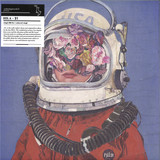
Volume one of a four part solo album set. (Monstruos Y Duendes).
The music of Myrddin goes through marrow and bone and is both complex, passionately rhythmic and profoundly emotional. He fully masters the compás of flamenco, which gives him the freedom to converse with elements of jazz or classical music. His swiftness sometimes seems extraterrestrial, but whoever takes the time to listen intensively to his music will soon find an immense world of pure emotions, beauty and peace. After four CDs and numerous concerts Myrddin proves that great virtuosos of flamenco don’t necessarily have to come from Spain.
Suche:soon
Unter Evolution versteht man gemeinhin die allmähliche Veränderung der vererbbaren
Merkmale einer Population von organischen Strukturen von Generation zu Generation.
Überträgt man diesen Gedanken aus der biologischen Welt in die musikalische von Northern
Lite, so trägt jedes neue Album die signifikanten Merkmale seiner Vorgänger in sich, aber erfindet
dennoch den typischen Northern Lite Sound auf spielerische Art neu.
Evolution, das 13. Studioalbum von Northern Lite, gibt ihrem unstillbaren Drang nach Härte und
Geschwindigkeit Raum, ohne jedoch die existenzielle Notwendigkeit von Liebe zu verleugnen.
Sich ihrer eigenen Vergänglichkeit bewusst geworden, gehen Kubat, Bohn und Rödel, nun jenseits
der vierzig, schonungslos mit sich ins Gericht. Weder textlich noch musikalisch werden
Gefangene gemacht. Von zärtlich quecksilbrigen Pop Balladen, bis hin zu neuen Hymnen, die die
Kraft haben, ganze Generationen im Herzen zu verbinden, nimmt jeder Song des neuen Albums
seine Hörer mit auf eine Reise zu sich selbst.
Im Ergebnis bilden hier Inhalt und Form eine rauschhafte Koexistenz, die nur durch die
meisterhafte Präzision der musikalischen Ausführung noch Steigerung erfährt.
"21" is the well-crafted, sharp and original first album by the duo HILA, composed by American cellist Artyom Manukyan (who already worked with Kamasi Washington, Daedalus, Flying Lotus, Run DMC, Gretchen Parlato, Raphael Saadiq, Clive Lowe Mark...) and french producer Dawatile.
The combination of jazz, Los Angeles beat-scene and the vibrations of 80s and 90s Soviet Armenia make it a striking and unprecedented fusion. These kind of nostalgic and unconventional references forcefully shake the codes of mainstream culture to create a sincere, raw and intimate expression.
"HILA" was born from a spontaneous and intense creative impulse between Artyom Manukyan, a Los Angeles-based Armenian celloist and his partner in crime, David Kiledjian aka Dawatile, a French multi-instrumentist of Armenian descent. This project is proving to be a true master stroke given that it only took 21 days for the duo to make it a reality.
"HILA" was made in less a moon cycle but captivates and electrifies audiences upon its first outings. "H.I.L.A" colors the warmth of the Californian "High" with Armenian vibes. The artists chose this name for their creation since both have a close and valuable connection to these locales. This journey began in 2007, on the day Dawatile went to Yerevan, the capital of this small country in the Caucasus mountain to realize a first fusion project centered around local folkloric music genres.
There he was introduced to local musicians including the Armenian Navy Band, one of the country's foremost groups in which Artyom played the bass and cello. In this context, he also met many musicians such as Tigran Hamasyan and Norayr Kartashyan. This will be the beginning of connections between Lyon, Yerevan and Los Angeles. The following year, the two artists will be be seen performing next to Taylor Mc Ferrin at the Jazz à Vienne festival. More recently, they partnered up again when the cellist, who had freshly relocated in California, invited Dawatile to produce his album. As soon as the studio’s threshold was crossed, they decided to postpone this record and create a joint project: Hay (as the Armenians call themselves) / High In Los Angeles. HILA was born at the end of these 21 days of intense creation. The association of Artyom Manukyan and Dawatile is the combination of two visions, two versions of Armenia, two personalities, the reunion of the Eastern and Western blocs.
One grew up nurtured by the sounds of hip-hop and jazz in Europe and the other by art music and Russian-influenced 1980s Armenian folkloric music before moving to L. A., Ca. The cornerstone of it all, the glue that unites everything : Armenia and music. They generate a new identity synthesizing two perceptions, their complicity transcending these cultural discrepencies. To achieve this, they will scour through images of Artyom’s childhood, within the popular culture of Soviet Armenia. Together, they revisit this decidedly retro vibe, based on the work of Caucasian groups inspired by African American music. This background is rehashed and fused with ancestral Armenian sounds. The DNA of the album "21" is molded by these dear influences.
We can also hear the ancestral sounds of Armenia, a country at the edges of both Europe and Asia. The presence on two tracks of Armenian music Master Norayr Kartashyan, infuses the languor of past melodies and traditions. These purposeful anachronistic sounds offer a fantastic depth to this powerful opus. Listening to the album, one can appreciate the successful fusion of styles and influences. Those combinations, however, manage to preserve individual identities only to enhance the art through an adamant musical dialogue.
Being driven by the urge to transpose Armenian musical traditions into a unique universe, the daring artists, offer an innovative combination by blending, for the first time, these ancestral sounds with the world of Los Angeles beat-scene and jazz. An invention largely fueled by the magic strings of Artyom and maestro Miguel Atwood-Ferguson, a pillar of the genre in Los Angeles combined. These associations resonate with a triumphant equilibrium. HILA is musical uncharted territory in which Artyom's cello strings intertwine to ignite the harmonies of keyboards, the machines, the vocals and electronic layers Dawatile pieced together. HILA plays the soundtrack of an adventure set between Armenia around the end of the Soviet era and a mysterious near future.
Artyom Manukyan grew up in Armenia in the 90s. At the time, he studied Russian classical music while learning jazz with assistance by his father, a music journalist. Being an unconditional music lover, he went on to sharpen his skills at the prestigious Berkelee College of Music. Subsequently, he’s been lucky enough to travel the world touring with numerous acts and mainly with the Armenian Navy Band. The group has fostered alacritous success honored by a BBC Award as a crowning achievement. He moved on 10 years ago and made his way to L.A. with his cello on his back. In the City of Angels, he quickly became a popular figure of the jazz and hip-hop scenes thanks to his first album "Citizen". He’s accompanied prestigious musicians such as Kamasi Washington, Melody Gardot, Daedalus, Flying Lotus, Run DMC, Gretchen Parlato, Raphael Saadiq, Clive Lowe Mark, or Vulfpeck. He released his solo album on the cello, "Alone" in October 2019.
Dawatile is a bold producer and multi-instrumentist as well as a passionate and resolute musician molded by jazz. As a versatile artist, he handles and juggles the saxophone, the keys, the bass and composition. Simultaneously, Dawatile produces cross-over projects and soundtracks for the movie industry. He, as well, has had the opportunity to be a part of many tours, including with his electro hip-hop band, Fowatile and more recently with the "Future Kreyol" trio, Dowdelin. Being the ever workaholic, he has under his belt a string of prestigious collaborations with the likes of Talib Kweli, Foreign Beggars, Roy Ayers, Tigran Hamasyan, Mathieu Boogaerts, Voodoo Game and Piers Faccini. His taste for developing new musical recipes and his know-how in production make him a much sought-after album producer. In concert, the HILA duo offers a sober, precise and rhythmic performance. "21" is an aerial and lively album taking the audience on an at times joyous and sometimes melancholic dreamlike journey. The magic of "HILA" operates at the speed of light and positions it already as an avoidable group.
Wah Wah 45's are proud to present "Cages", the third album from southern soul boys The Milk. Having released "Favourite Worry", their critically acclaimed sophomore album and first for independent label Wah Wah 45's, in 2015, the band are able to trace the seeds of the latest LP back to their recording sessions with producer Paul Butler (Andrew Bird, Michael Kiwanuka, Nick Waterhouse) almost five years ago, blending elements of soul, funk and rock together to create their own unique sound, inspired by some of their favourite artists such as Bill Withers, Traffic and the Isley Brothers.
"I can't wait to hear you write songs that look outward" - these words from Paul subconsciously had a lasting impression on the band. To atone for more inward-looking sentiments on "Favourite Worry", there had to be a shift in perspective. During the formative stages of the new album The Milk started pursuing a Nichiren Buddhist practice. The values and principles they discovered during this have informed every aspect of the record.
"We wanted to write an album that looked outside of the walls, to people, society and the environment - embracing real freedom in musical expression by utilising more complex rhythmic structures, extended harmony and dissonance to paint an original and authentic-sounding record" explains If their debut, "Tales from the Thames Delta", was inspired by hedonism and "Favourite Worry" by introspection, "Cages" is an impassioned conversation with the world. Racism and division are all on the rise. British society is being pulled apart by forces that seek to divide us and rip the compassion and empathy from our minds and hearts. We have become distracted from the more urgent challenges of boundless consumerism, climate change, and the mental health emergency reeking havoc on our streets.
We are the birds in the cage, tied by cheap thrills and fake news to a limited world vision that is no longer fit for purpose. The good news? We can all choose to challenge this view. "Cages" is equal parts the dark black shadow of how far we've fallen and the blazing sunlight whose rays of hope can still change the world. Four life-long friends, Ricky Nunn (vocals), Mitch Ayling (drums) Luke Ayling (bass) and Dan Le Gresley (guitar) formed their first band when they were still at school in Essex, playing countless working men's clubs, and finally became The Milk.
The band have built up a following of dedicated fans around the UK, which has resulted in them selling out venues such as Scala, Koko and Shepherds Bush Empire. Keen to get back on the road where they feel most at home and where the guys really shine, the band offer up a compelling set of diverse styles, matched with an ability to effortlessly intertwine songs together, gives their music a continuous feel to it. Since signing to Wah Wah 45's, the band released their second album "Favourite Worry", which became one of BBC 6 Music's albums of the year, sold out London's Union Chapel, toured with the Fun Lovin' Criminals and completed a sell-out UK tour climaxing at London's KOKO in Camden town. ... More live dates coming very soon!
Ever since dropping her critically-acclaimed debut LP Online Dating through Central Processing Unit back in 2017, Tryphème (Tiphaine Belin) has marked herself out as one of the more unique voices in contemporary electronica. We mean that literally - Belin's productions are characterised by frequent use of vocals, either processed to provide atmosphere or deployed high in the mix as passages of singing/spoken word. When these are wedded to her typically deft electronic productions the results are lush, atmospheric and moving.
Two years on from Online Dating and Tryphème has returned to CPU with the six-track Aluminia EP. While Online Dating leaned into a range of rave styles, Aluminia is more painterly, with Belin putting greater emphasis on timbre and texture. 'Lava', 'Fey' and 'Cry Silent Cry' are some of the most innovative tracks Belin has produced to date.
While another producer would allow listeners to luxuriate in such warm synth tones, Belin doesn't let you get comfortable, constantly surprising you with innovative structural choices or unexpected sounds. The way in which 'Lava' is agitated by chattering voices and processed singing recalls both the uncanniness of Holly Herndon and the maximalism of A. G. Cook, while the synth line that snakes through 'Cry Silent Cry' nods to Lorenzo Senni's recent trance deconstructions. Beats and bass take precedence in Aluminia's midsection.
This is the portion of the record which most closely recalls Online Dating - 'Eedyu' and 'X-Ray Mantra' are more settled than the other cuts on Aluminia, and it's here that the 90s electronica influences that so often inform CPU's output are most keenly felt. Those who enjoyed Bochum Welt's recent Seafire full-length - itself another CPU drop - will be able to get behind these tunes.
The two sides of Aluminia are combined in penultimate number 'In A Cyber Spiral'. The track's eerie beginning, with its ghostly vocals and nagging drums, is reminiscent of Hype Williams. Soon things morph into a leftfield digi-dub replete with speaker-crushing sub. Halfway through Belin wrong-foots us again, cleverly flipping the drums from half-time to a kind of fluttering breakbeat. It's the most diverse and unique production in a record full of them, drawing on everything from IDM to Eskibeat, and a track which furthers Tryphème's status as an exciting new artist on the European electronics scene.
French duo Double Mixte bring their digital thunderstorm of neon lit noire to the Italians Do It Better family on their debut EP. Mixed and produced by label head Johnny Jewel, Romance Noire opens the door to a new wave of Italians Do It Better artists coming in 2019.
Fresh Blood. New Tears. The title track arpeggiates and boils as waves of bass flow beneath. Rhythms are carried to the ceiling by a searing cascade of disintegrating color. A heavy backbeat anchors Clara Apolit’s poetry, ready to wear for a night in the face of oblivion.
The cinematic “Arlette” is a call for discovery through a darkness lit only by the glare of headlights in digital rain. Through all of this, Thomas Maan’s incantations search for the lonely, lost in the void of electronic fog. “November” finds in Clara an Anglophonic chanteuse, meditating on the cycles of time.
A blend of suspended sound and an uncertain melody contracts and expands before dissolving. Romance Noire is art that both contemplates and tanscends time’s firm grip. It’s a filmic journey inducing a vague sense of future nostalgia. Happy Valentine’s Day. Double Mixte is Clara Apolit and Thomas Maan.
The duo met in Paris and there was an immediate pull to create music together. They pooled their combined interest in powerful narrative & dark 70’s French film music to write lyrically vivid songs. In 2017, Thomas reached out to Johnny Jewel for what soon became a collaboration that expanded their vision into a haunting debut EP, out today on Italians Do It Better.
THE NEW ALBUM LAUNCH! Available on LP & CD – Artwork & Sound Attached. 'IZIPHO SOUL RECORDS' cannot contain their excitement any longer. The eagerly anticipated follow up to ‘ONE LOVE’, which was last year’s number one independent soul album of the year, is soon upon us. ABSOULUTELY is an album described by Cornell as ‘Songs that came through my Soul and out of my Heart!’
No sales pitch required - suffice to say it’s all killer - no filler.
Eight original songs and two classic covers from our heroes Curtis Mayfield and Marvin Gaye (Mr Gaye’s heavenly spirit filled the room when CC & Co laid this one down!) Songs: Say Yes, I See Love, Earn It, Come Live With Me Angel, I Could Never, Ever Since, Love Thang, Morning Touch, Ghosted & We’re A Winner.
In 2019, The Mighty Mocambos returned in fine form with their new album "2066", played a storming European tour and celebrated a colourful year delivering their own true style of funk, Afro, hip hop with cinematic compositions and storytelling.
The mean streets groove and furious drums versus car chase workout of "Golden Shadow" and the joyous instrumental stomper "Preaching To The Choir" were soon identified as DJ favourites. ... So here they are on glorious golden 7inch vinyl to jumpstart in 2020 with.
“Please Wait“ (Ta-ku & matt mcwaters) releasing their EP „Black & White“ featuring soon to be mega star Masego and others via 823 & Jakarta Records. After releasing last year’s very successful tribute-record “25 Nights for Nujabes” (almost 13 mio. plays on Spotify to this day), Perth-based artist Ta-ku finally returns with brand new music!
... Please Wait is the culmination of numerous online exchanges and years of sharing voice memos, stems, musical ideas & TikTok links between Ta-ku and Canadian producer matt mcwaters. Their cathartic approach to this body of work has been more about self-expression than anything else and has culminated in an EP that covers a range of issues and experiences from different times in their lives.
While the 1st single features Jamaican-American multi-talent Masego and will also have a video, the 2nd single features up & coming singer/songwriter Alayna. Ta-ku’s 823 label represents the appreciation for the people/ideas/places that inspire and push us forward.
The artwork is shot by the artists themselves and each release has an accompanying photo zine that acts as a visual story to compliment the music being showcased.
The hyper talneted Stellar Om Source (NOT NOT FUN, RVNG, NO 'LABEL) blowing up new styles on this one!
"If there is one thing that leaps out from Stellar OM Source’s music, it is the sense of a highly active mind at work. There is an indivisible feeling that a real person is behind this dynamic flurry of tones, waves, vibrations and modulations. On I See Through You, the first full Stellar OM Source release in over four years, the spark that first LP piqued the interest of so many listeners is glowing stronger than ever.
In the 2010's, Christelle Gualdi carved a name as one of the most essential live electronic musicians around, dazzling dancers and home listeners in kind with her bombastic, acidic hardware jams. Circumstances outside her control forced a stop for the Stellar OM Source project. It was touring, including two shows in the summer of 2019 at Dekmantel Festival and Listen! that Gualdi credits as year highlights, which proved to be the integral jump-start to the engine.
Inspiration came rushing back thanks to the human connection of performing. Seeing a younger generation connect with her put fresh charge into the circuitry of her gear. All this accrued into new material on the road, and thus I See Through You was born.
The spirit of 2013’s cult favourite Joy One Mile is alive and well on I See Through You. There is once again immediacy, urgency and lust. But Stellar OM Source stepping into a comparatively more poppy and playful mode on these four tracks could also throw some. Fundamentally she says, it comes from a similar place, and ends with an enmeshed and positive outcome. Gualdi credits both “1995 rave” and “the clarity, bass and breath” of hi-def hip-hop productions as being twin northern stars for her to follow.
The artwork comes from friend and highly respected photographer & director Pierre Debusschere, whose work similarly flits between arresting close-ups and, well, the widescreen luxe of Beyoncé videos. “I’m definitely not a purist anymore,” Gualdi laughs – and with club-ready impact meeting human warmth, this shows in abundance.
“Night Alone” wastes no time in getting the listener up to speed. Is that an LFO sample running through “Night Alone”? Is this a lost Metro Area classic? Is that Stellar OM Source taking a diversion into searching Ibiza-rousing vocal for a moment, or did we imagine that in a heat haze? Where are the kicks? Oh there they are. How many elements are buried and revived within just over five minutes?
It’s hard to tell. Before we know it, “Lost Codes” is up and away, keeping pulses racing. A pitter-patter of baby kicks feel like a pre-tremor before a welting electro-Italo lead crashes into play. With fizzing energy, rasping synths and a frisson of danger, fans of Unit Moebius and The Hacker will be doing somersaults of joy.
“White Echoes” wastes kicks off the flip side with low gurgles descending briefly like a UFO reverse parking into the spot SOS had vacated. Soon, 303s are twisting like Chinese burns while warm chords offer a salve. The mood maintains on “Wild Palms”, the only song on this record not to feature additional mixing work from Peaking Lights’ dub-wise sensei Aaron Coyes.
True to form, the B2 is all Stellar: elements switching up and out, with all the fun and frenzy of capital-L Live action. Kick drums and bassline darting back and forth like a synchronised swimming routine, all elements in concert. The momentum of a runaway mine cart that you can’t help but strap yourself to. I See Through You is one for the dancers who have given Stellar OM Source the motive to move forward once again."
Sauce Combo is a powerful and dynamic jazz trio lead by Marcjean, saxophonist from Bestown (Besançon), sided by the mercenary drummer Tom Moretti and the melodious
Victor Pierrel on bass. The trio's music takes place in the modern jazz renewing coming especially from England and the USA. France has now a champion. Inspirated by vintage african and west indies jazz, 70's jazz funk and fusion but also 90's drum & bass, broken beat and hip hop, the repertoire is a rich jazz bomb exploding to the
ears. Each second brings its his new colorful burst to admire. The band's brilliant game makes it a living listening experience. The music is rich and versatile but cohesive and united. Why?
Crash Test came to light in one day during a single 7 hours recording session at the Honey For Bear laboratories. Arnaud Bataillard, the sound's engineer, wanted to try several new
tubes and audio gears added in his studio set up. The trio went to test it in a crash test session. All the recordings could have been compromise somewhere but... What was before planned as a try ended into a fantastic album. The mental disposition, while playing
when you know that all can be lost in a minute, gave the musicians the proper dimension to express their feelings in a total freedom. They were playing for pleasure and without any pressure. It was for all, but it could have been also for nothing. And we can literally feel that. This unique record had to be release as soon as possible to transmit the freshness of this beautiful impact to the listeners. Above all, Clément Laurentin's "Equilibre Précaire VI" achieves this album, offering a painting with four figures at the edge of the fall, in a constant imbalance, playing with time and gravity. It's the perfect allegory for the three band's members plus the engineer while making this record.
- A1: Miss Love (First Version)
- A2: Here Come I, Here Is Me (First Version)
- A3: Hospitals
- A4: One Moment It Will Last
- A5: North South East The West
- B1: The Rose (First Version)
- B2: Mister Nothing
- B3: Looking For
- B4: Roots Of Life
- B5: What's There Left
- C1: Twinkling Stars
- C2: Blinded By The Lies
- C3: Bullshit
- C4: Foolin
- C5: How's About The Aims In Life
- D1: Intro (Live In Queekhoven 1982)
- D2: Miss Love (Live In Queekhoven 1982)
- D3: Here Come I, Here Is Me (Live In Queekhoven 1982)
- D4: The Rose (Live In Queekhoven 1982)
- D5: Something Between You & Me (Live In Queekhoven 1982)
Early Days maps out Nine Circles interpretation of Cold Wave and Minimal Synth. Unbelievably the tracks are mostly from a brief time period, ’80—’82. Alienation and uncertainty course through the 2LP with heavy Yamaha chords, metallic machine beats and brittle vocals.
Nine circles was formed in the early 80s by Peter Van Garderen and Lidia Fiala. In 1980 there was a band called Genetic Factor. This band split up when their three members got girlfriends and they started to make music together with their girls. So at that time there were 3 bands living together in one house.
One of the couples were Peter van Garderen and Lidia Fiala. Lidia had been writing lyrics since she was 15 years old. Nine Circles was born. Within 2 years they wrote about 60 songs.
Also living in the house was Richard Zeilstra, who had a job at the VPRO radio, hosting a show called „Spleen“ where he gave New Wave bands a chance to play. He asked bands to send tapes to him and the best bands had the opportunity to play live at the radio and also got the chance to be on the „Radio Nome“ compilation. Peter and Lidia sent their tape to him and were the only ones from this house to be on the show. Richard knew their music was special. Nine Circles never played a live show on stage, only one concert live at the radio which is also featured on this LP.
Two years later Peter and Lidia split up and Nine Circles disappeared. In 2009 Lidia’s son googled her name just for fun and found a lot about the band Nine Circles. Lidia was surprised, she never knew how popular Nine Circles have been over the years. She got herself on Facebook and since then she got in touch with many people and decided Nine Circles should come back! Peter was not able to join the band these days, he had a different life but he was supporting Lidia and liked that she enjoyed doing music again. Peter still had all the old recordings and sent Lidia a lot of the music they made together back in the days. The best tracks are collected on this 2LP.
Together with Per-Anders Kurenbach Lidia revived Nine Circles. They recorded new material (released on the album „Alice“) and played live until Lidia had to stop playing live for health reasons in 2016. Nevertheless they‘re working on a follow-up album called „Emerge“ which is planned to be released in 2020 and hopefully Lidia will be able to go on stage again soon.
Following a string of releases via his own bbbbbb recors, along with bodies of work on трип Recordings, February 2019 saw Bjarki debut on !K7 Records with the ‘Happy Earthday’ album.
With the album considered to be the Icelandic producers first full debut LP, ‘Happy Earthday’ offered a conceptual collection of music which Bjarki thought he would never release. Influenced by his home country of Iceland as well as the planet’s environmental issues, the album received support across the board from the likes of The Quietus, DJ Mag, Pitchfork, XLR8R, FACT and CLASH Music, along with being crowned Mixmag’s ‘Album of The Month’.
As part of the limited edition 200 copy box set version of ‘Happy Earthday’, a secret album of original music was available to hear unbeknown to listeners. Now receiving a full release this December on double vinyl and digital platforms, Bjarki will release his second full album of the year via !K7 Records. ‘Psychotic_Window’ is a further extension of the experimental artists creative vision whilst continuing to address environmental themes and nature.
Combining influences from techno, breakbeat, IDM, electronica and more across all of his studio output, ‘Psychotic_Window’ is Bjarki’s final signoff for 2019. The new 14-track album follows in line with one of his most significant years to date, highlighted by performances at major events including Dekmantel and DGTL Festival, along with pioneering eclectic new sounds via his bbbbbb recors label.
“After ‘Happy Earthday’, people have been asking me about the secret tracks and it made me feel that they deserve a proper release. Each track means a lot to me as I made them during a depressing phase in my life; I was pretty broke, working many shit jobs and also just being super lazy, uninterested in leaving my apartment.
Before I started touring, I had these periods where I could write so much music without thinking, pouring my heart out to comfort my thoughts and feelings without trying. I doubt that this kind of window will come back to me anytime soon, my way of music making has changed a lot after going on tour. At that time, I was listening to a lot of Coil, Chris Carter and Cosey Fanni Tutti. I think every struggling artist goes through these phases of being sleep deprived, staying up and making music all night. This was my psychotic window.” -
Bjarki
When acclaimed South African musician Guy Buttery first sought out Dr. Kanada Narahari in late 2016, it was as his patient.
“It was a dark time.” Buttery recalls, “I had been bedridden for months and had been suffering from debilitating bouts of fatigue which no diagnosis or medication could help me get to the bottom of. When I first met Kanada, I was at the stage where even picking up my guitar to make music had become a joyless and taxing exercise.”
As Buttery’s searched for a cure, a family member recommended he see Kanada an Ayurvedic doctor who had relocated to South Africa from India and set up a practice in Durban. It was during this consultation, that the musician first experienced how Narahari infused the healing properties of Indian Classical music into his practice. Rather than treating him with a smorgasbord of pharmaceuticals, Narahari played his sitar and set Buttery on a strict daily diet of Raga’s to fast track his recovery.
Buttery was not only struck by his doctor’s musical talents but by the powerful healing properties inherent in his sitar compositions. When he left Narahari’s doctors room that afternoon, he asserts he was feeling decidedly clearer, lighter and stronger.
“Diving into Kanada’s music was definitely one of the reasons I'm still here today.” he admits. “The consistent tonal centre at the heart of Indian Classical Music, literally became my support pillar over this period. A central core of sorts in which to fall back on, strengthen and discover.”
Narahari as it turned out, was not only a prominent music therapist (and one of the only Ayurvedic doctors practicing in South Africa) but like Buttery, a highly accomplished musician with a devoted following back in his homeland.
Born in a small village along the Western Ghats in Karnataka, India, Narahari, at the age of nine, had enrolled to study Carnatic classical vocal and developed an interest in Hindustani Classical music with a particular passion for the sitar. While Buttery had secured his reputation as one of South Africa’s musical treasures, a multi-instrumentalist who commands sold-out performances both locally and internationally and more recently had been awarded the prestigious 2018 Standard Bank Young Artist for Music.
From this consultation, a friendship developed between the two musicians with Buttery soon inviting Narahari to join him in his studio. But it wasn’t all plain sailing in the beginning. While Buttery and Narahari’s sensibilities were very much aligned, there were a range of cultural and musical influences, nuances and inflections that first needed to be navigated and understood.
“I suppose we had to find a common ground.” Buttery says, before adding, “Which in the end turned out to be pretty "uncommon ground" for the both of us.”
It was after a few intensive sessions together that something exhilarating began to emerge. What began as a few idle improvisations soon evolved into feverish and lengthier jams. Whenever time permitted, the musicians would meet, descending deeper into the emerging sounds, while reimagining the realms that existed between their African and Indian heritages.
Over the next few months, the duo would rack up over fifteen hours of recordings in studio, and it was up to Buttery to shape the material into an album which they collectively titled Nāḍī, which Narahari translates from the Sanskrit as "The Channel" or "An Internal River".
During this period, Narahari bestowed upon Buttery, the moniker Guruji while Guy would refer to him, in affectionate return, as Panditji. Each time the musicians would meet, the studio space would be cleared by an impromptu ritual, with Guruji burning African Imphepho while Panditji would chant a Sanskrit mantra dusting Indian Agarbatti clouds over their instruments.
Once the room had been made hazy with this aromatic alchemy (with the ancestors welcomed in) the musicians would pick up their instruments and plunge into shimmering tides of sound. Reflecting on these sessions, Narahari recalls the immense creative freedom he felt throughout: “Guy and I tried to wander as much as possible, without any speculative, preoccupied ideologies or limitations. Love remained at the forefront of our journey together.”
“Those evenings we spent together in the studio” adds Buttery, “felt incredibly rich with purpose and a profound sense of freedom. While improvising, anything could happen and mostly did.”
On a first listen, the tracks on Nāḍī emerge as salty, humid invocations to the inscrutable depths and misty myths of the Indian ocean-- that vast body of water that stretches between, and laps the shorelines, of the artists’ respective homelands.
When asked to describe the sound him and Narahari refined, Buttery prefers to relay a series of evocative images.
“For me” he explains, “Nāḍī is a lighthouse, a beacon that resides at the bottom of the ocean.” As Buttery envisions it, “what once offered light to guide ships to safety, has been submerged and re-purposed by marine life as a coral-reef temple. Similarly, this sunken lighthouse exists as a concealed cenotaph, memorializing the ancient sea-routes and passages that once connected the two distant lands.”
On paper this may sound obscure but listening to the songs, it serves as an apt metaphor.
Across each meditative movement, listeners are able to relive the journey, immersing themselves in a series of incantations, replete with high dynamics, delicate African-Indian inflections and virtuoso string playing of an entirely new order. Further complimenting the fusion of musical dialects are a range of guest artists including Shane Cooper on bass, Thandi Ntuli on vocals, Chris Letcher on organ, Ronan Skillen on tabla and percussion and Julian Redpath on guitar, synth and backing vocals.
Now like the submerged lighthouse, the recordings stand as a monument, a marker and snapshot of this fortuitous meeting, a tribute to the healing gifts of Guruji and Panditji in performance. It’s a process that already, both musicians look back on with reverence and nostalgia.
Buttery ruminates in closing, that when he first met Kanada his illness correlated with the biggest drought South Africa had experienced in many years “…for whatever reason, whenever we would connect and make music together, the sky would tend to open. Even if it was just a few drops. This went on for months, until finally the drought dissipated and my health had been restored.”
By the time the heavens did open across the East Coast, a deep friendship had been forged and with it abundant musical offerings poured down. A treasured sample of which we able to share in every time we press play and immerse ourselves in the sacrosanct musical universe that is Nāḍī.
The band C.R.A.C. was formed in 1974 by bassist/vocalist Rick Cua, drummer Tommy Rozzano, keyboardist Larry Arlotta, and lead singer/percussionist Ricky Chisholm. Their name is an acronym for the founding members' last names. Playing mostly popular covers, the band's main gig was four nights a week at a Syracuse, NY club called Big Daddy's. It didn't take long before Big Daddy's was packed whenever C.R.A.C. was there.
As they gained popularity, a variety of opportunities presented themselves. Soon, they had enough new gigs to leave Big Daddy's and focus on their budding career.
Drawing inspiration from other bands in their genre, their passion for music, and the success of their first radio single, "Of The Lites," they continued to add to their repertoire of songs written by members of the band. Fresh off the high of their radio debut, they added two new members: guitarist Ronnie DeRollo and singer/percussionist Duane "Spoon" Walker. C.R.A.C., or as they became known at this time, CRAC, continued on their upward trajectory as one of New York's premier funk and R&B bands. The band continued to expand throughout the late 70's as their territory moved throughout New York and New England.
The busier the band got, the more their talent grew, and this afforded some members the honour of playing with such well-known artists as Maynard Ferguson, Melba Moore, Sea Level, Duke Jupiter, and The Outlaws.
I remember the first time I read W.E.B. DuBois eclectic masterpiece The Souls of Black Folk. The way in which this Weberian scholar flowed from personal account to prose to sociological analysis to music and even political intervention has had a lasting impact on my own work as a cultural anthropologist. It made me understand that as scholars we must use different means in order to give expression to the totality of the lived experience: There is only so much in an academic text.
The experience of alienation has always been at the heart of my scholarly and artistic practice. I have used academic writing, lecturing, theatre performance and electronic improvisation to understand and represent it as a theoretical concept, postcolonial condition and lived experience. I believe, some issues need to be told like a story, some analyzed in most abstract terms and others need to be sung like a gospel. The medium changes the message.
In this sense, I guess, I’m a singing cultural anthropologist.
For some time now I have been engaged in the use of dystopian themes and sounds to paint a sonic picture of structural racism and whiteness of our present. But recently I have grown weary of this Ballardian idea of Future Now and the resulting phantasmagorian aesthetics myself and others have been invested in. The widespread availability of Digital Audio Workstations, sequencers, loopers and delay pedals has lead us into a futuristic cul de sac best described by Mark Fisher as the very absence of future.
Likewise, I am most skeptical of the “naturalist” countermovement, the return of folk. Especially in Germany, I am convinced there is no such thing as an innocent or progressive folk musical expression as it is always connected to the idea of the homeland (“Heimat”) which in turn produces the colony. It seems to me, the current zeitgeist is stuck between a “museum of a dystopian future” and a “museum of an idealized past”, but I wanted to sing about the present.
So, I involuntarily returned to pop music in its two-folded meaning of something popular and addressing not an essentialist notion of “Volk” or its woke cousin “communities”, but society as a whole.
I entered the studio just with a few lo-fi sounding melodies and rhythms from my circuit bent CASIO synthesizer. I had no clue what the finished product would sound like. But as soon as Markus started drumming, in a way strangely reminding me of CAN’s Ethnographic Forgery Series, my uptight sounds were suddenly embedded within a warmer global sound spectrum. The alien at home and abroad and the strange overlapped: We were seeing one and the same sound differently but were gently held together by Tobias’ producing.
Making music is about building coalitions. It’s about suggesting an articulation of styles, sounds and people, that hasn’t materialized, yet, but may help us in the current crisis: I wanted Amon Düül II to send their drug induced archangel thunderbird to rescue the refugees, that had tried to escape the police by climbing up a tree in Munich in 2016. I wanted Sun Ra to taunt far-right protesters in Chemnitz in 2018. And I wanted to mourn the loss of a former kebab shop cum discotheque that served as proof that there is such a thing as a minoritarian universalism.
SCHLAND IS THE PLACE FOR ME is a pop album featuring songs of alienation, not only as a tragic experience, but as a pop-cultural promise. Maybe Bill Callahan sung it best, “I am Star Wars today, I am no longer English grey”. I want those who suffer from alienation to stand in alliance with those who seek alienation, and vice-versa. A coalition, that tolerates the possibility that we are moved by the same groove for contrary reasons.
Fehler Kuti
Munich, Autumn 2019
Music by Julian Warner, Markus Acher & Tobias Siegert
Saxophone on RINDERMARKT by Franz Brunner
Trombone on RINDERMARKT and IL by Matthias Götz
Recorded and mixed by Tobias Siegert in Munich.
SONTAGSFAVORIT mixed by Dario Albiez in Dusseldorf.
Mastered by Duphonic in Augsburg.
Artwork by Atelier Grande, Munich.
Emotional Rescue is delighted to present a collection of works by the founding father of the modern drum movement, Glen Velez. Collated from his first 3 solo albums from 1985 to 1989, Sweet Season is a snapshot in to the pioneering composing and performance of this four-time Grammy winner. Born in 1949, of Mexican American ancestry, Velez grew up in Texas before moving to New York in 1967. Playing jazz on the drums he soon gravitated to hand drums from around the world (frame drums in particular), seeking out teachers from many different musical traditions.
Among the many instruments Velez favours are the Irish bodhran, the Brazilian pandeiro, the Arabic riq, the North African bendir and the Azerbaijani ghaval. Although these instruments are similar in construction they have their own playing techniques that open new possibilities.
Sweet Season highlights this vocabulary, mixing and adapting techniques from various cultures to develop new ones. The music, often composed as cross-cultural ensembles, has a particular fondness for polyrhythms - superimposing different meters simultaneously - while incorporating Stepping Split-tone and Central Asian Overtone singing to complete the global horizons.
This new genre of contemporary drumming has been hugely influential and seen Velez work with the likes of John Cage and Steve Reich, as well as teaching his virtuosic combinations of hand movements and finger techniques to many emerging players.
To co-incide with 4 new albums on the label, Morphine gives a surprise RE-DOSE with label friends and heroes on re-flip duty.
More info soon
Having returned from a 4-year break in August with its latest release from GW & Henry, A&R Edits follows up with a debut for Moplen.
With a recent remix of Frankie Knuckles ft. Jamie Principle and a Salsoul Reworks EP, Luca Moplen has been gaining new traction of late, so it felt fitting to release two of his evergreen edits on vinyl for the first time. Moplen’s edit of Tavares’ classic disco stomper ‘It Only Takes A Minute’ coupled with Greg Wilson’s edit of Moplen’s edit of Larry Levan’s mix of David Joseph’s ‘You Can’t Hide (Your Love From Me)’, if you can follow all that!
An all brother group hailing from Providence, Rhode Island, Tavares were a band that evolved with the disco sound, hitting their peak in 1976 when both ‘Heaven Must Be Missing An Angel’ and ‘Don’t Take Away The Music’ became huge club favourites. They scored their first R&B #1 in ‘1974 with a cover of Hall & Oates ‘She’s Gone’ and in 1975 they returned to the top of the R&B chart whilst going top 10 pop and scoring a #2 Disco hit with ‘It Only Takes A Minute’.
In 1992 a cover by boy band Take That would gift them their first top 10 entry, many people unaware that this track had first been recorded 17 years earlier. Rising to prominence in Brit-funk band Hi-Tension, David Joseph soon found his footing as a solo artist after they’d split, with his first release being ‘You Can’t Hide (Your Love From Me)’ in February 1983.
That same month, Greg Wilson appeared on The Tube, mixing between two copies of this very record – the first time mixing had been demonstrated on British TV. It would subsequently enter the UK chart, climbing into the top 20. The track would then be remixed by legendary Paradise Garage DJ Larry Levan, resulting in a #2 placing on the Billboard Dance chart.
Upon hearing Moplen’s extended dub edit, Greg worked further into it reintroducing the song – given his history with the track it was unthinkable that he’d play it without the vocal. The result is a unique version where Moplen’s dub sets the vibe during the first half of the edit before the song is finally introduced.
- 1: Something So Strong
- 2: Weather With You
- 3: It's Only Natural
- 4: Chocolate Cake
- 5: Fall At Your Feet
- 6: Distant Sun
- 7: Better Be Home Soon
- 8: Four Seasons In One Day
- 9: Don't Dream It's Over
- 10: Mean To Me
- 11: Locked Out
- 12: Don't Stop Now
- 13: Pineapple Head
- 14: Instinct
- 15: Fingers Of Love
- 16: Private Universe
- 17: Not The Girl You Think You Are
- 18: Nails In My Feet
- 19: Pour Le Monde
UMC are proud to present the first ever vinyl release of ‘The Very Very Best Of Crowded House‘! An institution in their homeland, a two-album wonder in the U.S., and, during the last half of their ten-year career, bona fide stars in the U.K. and most of Europe, Crowded House recorded some of the best pop music of the late ’80s and early ’90s. Leader Neil Finn’s carefully crafted songs, meticulous eye for lyrical detail, and gift for melody are matched by few other songwriters. The songs of Crowded House & Neil’s songwriting acclaim have been championed by the likes of Ariana Grande & Miley Cyrus, Chris Martin & Eddie Vedder & most recently Fleetwood Mac, for which Neil is currently the touring guitarist/vocalist. The 2010 chart-topping compilation features all the band’s major hits including ‘Fall At Your Feet’, ‘Weather With You‘ & ‘Don’t Dream It’s Over’ plus many (many) more. The 19-track collection is cut across 2 x 180-gram black vinyl LPs featuring printed inners & essay. DL codes included.