The deep and swinging groove is what makes Buddy Guy’s Slippin’ In so wonderful. The album earned Guy the Grammy Award for Best Contemporary Blues Album. Slippin’ In was produced and engineered by the great Eddie Kramer, who manned the board for Jimi Hendrix and many others. Guy finds his way back to the blues, with some incredible electric guitar sounds. He was backed by a stellar cast of musicians that included Stevie Ray Vaughan band mates Tommy Shannon, Reese Wynans, and Chris Layton. Some absolute blues classics and up-tempo rockers found their way to Buddy’s tracklist. He uses the blues in such a fantastic way that everything turns out to be positive. Just listen and you’ll hear what the master of blues is doing.
Cerca:sound man
Roberto Agosta, or just Agosta as he likes to be called, is a Sicilian DJ and producer from Catania active all along the eastern coast of Sicily, a place that proved to be a soulful place and a training ground for a long career, making him an excellent music selector and a reference point in the spread of alternative music.
A soundtrack music enthusiast since he was a child, now a vinyl "serial gathere", Agosta has always put his vast knowledge at the service of a very personal sound that sums many different music styles and contaminations, simple and profound but straightforward and direct at the same time.
Agosta’s eponymous album, released on LP, CD and digital formats, was conceived during the Covid-19 lockdown, thanks to the precious collaboration of friend DJ and producer Massimo Napoli aka Galathea, with whom Roberto has already started another project called AN-AN that will produce a new record for Space Echo at the end of 2022.
This record highlights a typical chill-out aesthetic, thanks to its trip-hop and ambient rhythms and atmospheres, while a deeper exploration reveals the psychedelic essence of the entire work, a daring and exciting journey in the most primitive Sicily, and the energy that sustains all of its ten tracks.
Much of their author and his lifestyle - mainly based on meditation, the search for spiritual elevation, the relationship with nature and the regaining of contact with those particular places and with the people who live there - is revealed by those tracks that constitute a soundtrack for this spiritual but also extremely physical journey.
The song titles are, in fact, intrinsically linked to Roberto’s real life: the Gorna and Ilice mountains at the foot of Etna, the Carricante vineyard and its excellent wine, Unna, Three Chestnuts, Varanni, Don Alfio, Lady G. Each of them represents a pleasant and dreamlike narration and the escape from the complex dynamics of a city like Catania, among echoes of the most dreamy Pink Floyd, the softer side of ’70s krautrock, but also the Massive Attack and Tricky’s Bristol scene.
There’s also an excellent choice of synthesizers and overdubbed guitars, thanks to the talent of the multifaceted musician and producer Salvo Bruno Dub, and of Manuela Amalfitano, Loredana Poidomani and Deran Obika’s voices.
Agosta is an introspective, deep work with a cinematic vocation, perfectly rooted in the territory where it took shape, among sunny landscapes, lush with vegetation but also deserted and arid lands. From Sicily to the cosmos... enjoy!
Fast rising UK soul-pop star Olivia Dean today announces her long-awaited debut album ‘Messy’, due for release on Friday 30th June 2023 via EMI Records. Featuring the singles ‘Danger’ and ‘UFO’, Messy cements Dean as one of the most original and versatile voices in UK pop. Crafting classic yet conversational hooks with genre-fluid tinges, she’s honed a way of exploring universal themes of love, loss and everything in between with razor-sharp but open-hearted storytelling. “The self-love ballad is tricky, but the Londoner balances defiance with genuine romance, the psychedelic soul evoking tweeting birds and dappled sun rays.” - The Guardian “With a talent and musicality that sound both natural and effortless, she’s got to be a hot tip” - Sunday Times Culture "A gorgeous collection of soul-laced songs... that are anchored by Dean’s remarkable voice." - NME
A counterculture movement united by an expansive, experimental and deeply soulful sensibility, Japan’s rebel protest music challenged the status quo and changed the country’s music industry in the process.
The birth of Japan’s nascent acid folk scene was rooted in the messy and invigorating political climate of the late 1960s. It is a story of Dadaists, communists, pharmacists and cult leaders, led by a young generation of upstart students, artists and dreamers hellbent on turning their world upside down.
Born on the campuses of Tokyo, Kyoto and Osaka, and centred around newly formed independent label and left-wing stronghold URC, this uniquely Japanese form of folk expression provided an outlet for musicians who were tired of aping Western sounds and instead found ways to sing in Japanese and integrate traditional forms in new ways.
At the forefront of this movement was Yellow Magic Orchestra’s Haroumi Hosono, a polymath innovator whose band Happy End released the first Japanese language rock album, and whose influence would go on to be felt across Japanese music for decades. Alongside, and informed by the Kansai scene’s Takashi Nishioka and Happy End collaborator Ken Narita, they experimented with cadences and accents of the Japanese language to open the door for others to experiment with their own forms of psychedelic folk too.
Some, like Nishioka, were more inspired by Dadaism than drugs, while others, like Kazuhisa Okubo, would ultimately find work as a chemist, having founded two further folk groups that flirted with varying levels of success. Obstinately uncommercial, relentlessly creative, the music featured on Time Capsule’s Nippon Acid Folk represents a broad church of influences.
Perhaps the wildest addition to this congregation however was Hiroki Tamaki, a classically-trained violinist and committed iconoclast, whose synth-prog odysseys hinted at his obsession with the divine. Subsumed by the teachings of Bhagwan Shree Rajneesh, he penned an album in praise of the infamous religious leader of which two superbly mind-bending tracks are featured on this compilation.
Charting the decade from 1970 to 1980 as the dreams of political and spiritual liberation seeded in the ‘60s turned to dust, Nippon Acid Folk surveys a little explored corner of Japanese music history, but one which ultimately laid the foundations for an independent music industry, launching the careers of Hosono and others in the process.
Nippon Acid Folk 1970-1980 is pressed on 12” vinyl and represents the start of Time Capsule’s deep dive into Japan’s rich history of folk and psychedelic soul music.
What Do We Do Now is the fifth solo studio LP recorded by J Mascis since 1996. This is obviously not a very aggressive release schedule, but when you figure in the live albums, guest spots, and records done with his various other bands (Dinosaur Jr., The Fog, Heavy Blanket, Witch, Sweet Apple, and so on), well, to paraphrase Lou Reed, "J's week beats your year." What Do We Do Now began to come together during the waning days of the Pandemic. Utilizing his own Bisquiteen Studio, J started working on writing a series of tunes on acoustic with a different dynamic than the stuff he creates for Dino. "When I'm writing for the band," he says, "I'm always trying to think of doing things Lou and Murph would fit into. For myself, I'm thinking more about what I can do with just an acoustic guitar, even for the leads. Of course, this time, I added full drums and electric leads, although the rhythm parts are still all acoustic. Usually, I try to do the solo stuff more simply so I can play it by myself, but I really wanted to add the drums. Once that started, everything else just fell into place. So it ended up sounding a lot more like a band record. I dunno why I did that exactly, but it's just what happened." Two guest musicians are playing this time out; Western Mass local Ken Mauri (of the B52s) plays piano on several tracks. Since J himself has some experience with keys, when asked why he needed a hired gun, he says, "Ken is great, and he plays all the keys. I tried playing some keyboards on the first Fog album, but I'm really only comfortable playing the white notes, so it's kind of limiting. laughs Nowadays, I could just turn the pitch on a mini Mellotron to play different sounds, but black keys just seem hard. For whatever reason, I just like banging on the white ones. Seems like it's harder to figure out how to stretch your fingers around the other ones." Mauri has no such qualms and plays all the keys very damn well. He sounds especially great on "I Can't Find You," where he is Jack Nitzsche to J's Neil Young, creating one of the album's loveliest tunes. The other guest musician, Matthew "Doc" Dunn, is also prominent on this track. Dunn's steel guitar manages to both widen and soften the musical edges of the music, giving it a full classicist profile. Dunn is an Ontario-based polymath who J met through Matt Valentine. After J played on Doc's great 2022 Sub Pop single, "Your Feel," he figured it was time for payback. Both Dunn and Mauri add beautifully to the songs here, helping to transform them from acoustic sketches into full-blown post-core power ballads. What Do We Do Now is the finest set of solo tunes J has yet penned, and the way they're presented is just about perfect. Asked if he would be touring to support the album, J says he'll be doing some weekend dates, but he probably won't be putting a band together. And I'm sure these songs will sound great solo and acoustic, but the arrangements on this album are truly great and put a cool, different spin on Mascis' instantly Recognizable approach to making music. So, what do we do now? Not sure. But apparently, what J does is to make one of his most killer records ever. Hats off to him. - Byron Coley
Waxwork Records is proud to release THE EXORCIST: BELIEVER Original Motion Picture Sound- track by David Wingo & Amman Abbasi.
THE EXORCIST: BELIEVER is a 2023 supernatural horror movie directed by David Gordon Green. The film is the sixth installment in The Exorcist franchise
and serves as a sequel to The Exorcist (1973).The film features a number of original tracks. Most notably, the film contains Japanese language covers of
"Stayin' Alive" by Bee Gees and "Holding Out for a Hero" by Bonnie Tyler. Composer Dominic Lewis noted that the film's soundtrack represents "all vibe and no technique".
Waxwork Records is proud to release THE EXOR- CIST: BELIEVER as a deluxe double LP featuring 180 gram Black & White swirl colored vinyl, heavyweight gatefold packaging,
a four-page booklet featuring an exclusive interview with director David Gordon Green and composers David Wingo and Am- man Abbasi, layout and design by Matt Needle, and more.
For the second instalment in our Cuban Classics series, we proudly present this sought-after slice of sublime Afro-Cuban jazz from 1976. It comes courtesy of one of Cuba’s most influential acts, Grupo Irakere. Founded in 1973 by Chucho Valdés (son of the Cuban pianist and bandleader Bebo Valdés) the group was home to many of Cuba’s finest musicians over the years. With an electrifying style and sound, they mixed traditional Cuban music with jazz, funk, and rock.
This self-titled album includes the much-loved, dancefloor heavy-hitter 'Chequeré-Son’, a Latin-jazz funk masterpiece with Cubanized bebop-flavoured horn lines, lush keys, and ‘70s hip swagger. Though 'Chequeré-Son’ is the keystone of the record, the album is laced with brilliance at every turn, from the Carlos Santana-esque channelling ‘Iya’ with its percussive Latin power, to the sultry, slick and passionate '38 1/2’. Elsewhere, the absorbing, ever-building energy of 'Juana 1600’ and steamy vocal dancer ‘Xiomara’ are also highlights of this incredible album.
Pressed on Cuba’s state led Areito Records, the album was well received internationally, garnering distribution in Finland on Love Records, in Italy on Phase 6 Super Stereo, and also in the Dominican Republic, Mexico and Venezuela.
A cherished Afro-Cuban triumph, this album has been crying out for a reissue and we’re delighted to make that happen.
"Along with Black Flag and the Circle Jerks, Fear helped define the sound and style of L.A. hardcore. Even though they formed during the first wave of punk in 1977, they didn’t put out an album until five years later, titled The Record. They used their music to piss off everyone around them, and they achieved that goal with flying colors on this debut album. It remains a punk classic to this day and Record Collector’s Mark Rigby called it “probably the most exciting and impressive, one-dimensional, ill-mannered, distasteful, odious ‘hate’ record ever made.” The album only spawned one single, “I Love Livin in the City”, but includes many more gems, including “We Destroy the Family”, “Let’s Have a War”, and “Beef Boloney”. The Record is available as a limited edition of 1500 individually numbered copies on translucent magenta coloured vinyl."
First volume of the Extreme Years serie (1990-1994) of the prolific artist - all released for the first time on vinyl. The three other titles will be released every 2 months starting March.
Intifaxa is the first part in a series of 4 outstanding double vinyl albums with bonus songs, previously released on CD between 1990 and 1994 on the Australian cult label Extreme Music.
Intifaxa is full of heavy percussion fire with deep tribal grooves, embedded in modulated field recordings. The album is a transcendental journey into Eastern soundscapes and a secret weapon for DJs who enjoy to tear down the borders of tribal underground house and psychedelic trance music.
The original tracks were perfectly remastered for this first time ever vinyl release and the new masters received high praise from the Extreme Music owner Roger Richards.
New sleeve designs were created by Oleg Galay, who is famous for his artworks for many Muslimgauze reissues.
All 4 album covers are made from extra heavy cardboard with deluxe spot UV finish and inside print.
In a union of drum and bass talent at its most authentic, MAKO and SEBA have joined forces to deliver a long-awaited and highly anticipated collaborative single titled "Brotherhood" and "Stockholm Syndrome." These tracks were initially started when SEBA visited MAKO in 2019 and showcase the synergy and creative prowess of both artists.
"Brotherhood" sets the tone for this momentous release as MAKO and SEBA combine their unique styles and sonic signatures to create a track that embodies the essence of Drum & Bass in its purest form. Crushing amen breaks over dystopian themes and chilling Rhodes hooks, this track is constantly moving with its fusion of commanding rhythms, complex arrangement quirks, and grudge-bearing bass work, resulting in a captivating sonic journey that is sure to shatter any jungle sound-system. Topped off with the inspiring mantra of “What is love? One name for it is knowledge."
On the flip side, "Stockholm Syndrome" pays homage to SEBA's cherished hometown. The track captures a minimal yet visceral spirit, a catchy hook that's rare for a track with such a haunting theme is backed with stepping beats and macabre break edits, topped with intricate percussion. This track clearly identifies both MAKO and SEBA's signatures and instantly lets the listener know they're hearing both in fusion, and the heart and soul of both producers' heritage.
MAKO and SEBA's collaborative single is a testament to their individual artistry and the magic that unfolds when they unite. Their ability to seamlessly blend their distinct styles and push the boundaries of the drum and bass genre, while remaining true to its core values, is evident in every note and beat.
This is a brotherhood we're delighted to witness taking shape.
- A1: Griselda
- A2: West Coast
- A3: War
- A4: Dario
- A5: Amilcar
- A6: Matriarch's Plan
- A7: Fernando
- A8: Centac
- A9: La Madrina
- A10: El Sicario
- A11: Martha Ochoa
- A12: June
- A13: Miss Blanco
- A14: Carmen
- B1: One Kilo
- B2: Mala Madre Madhouse
- B3: Extraordinary Amounts Of Cocaine
- B4: Alberto
- B5: Gente Rica
- B6: Rivi
- B7: Emeralds
- B8: Viuda
- B9: Medellin
- B10: Que Juntos Hagamos Oro
- B13: Nada Nunca Se Acaba
- B14: The Last Cigarette
- B11: Michael Corleone
- B12: Farewell
Der Soundtrack von Carlos Rafael Rivera zur neuen Netflix-Miniserie GRISELDA, die am 25. Januar 2024 startet. Die Kolumbianerin Griselda Blanco ('The Godmother') gründet ein eigenes Kartell und hebt die männlich dominierte Welt des Drogenbusiness aus den Angeln. Mit Sofia Vergara in der Hauptrolle.
Skydaddy, the moniker of London based musician and bandleader Rachid Fakhre, has announced his debut EP, Pilot, releasing on the 2 February 2024. Alongside this announcement, Skydaddy has shared a new single ‘His Masterpiece’
Having spent the last few years writing and producing as one half of the acclaimed musical duo Spang Sisters, Skydaddy’s debut EP Pilot promises to be a ray of light bursting out from an increasingly busy London indie scene. Combining cello, violin, flute, piano and intricate vocal harmonies, Skydaddy cuts an utterly compelling figure, leading a fluid and interchangeable band, at its largest 7 people strong, they delicately glide through intricate passages of chamber-folk-rock, into swelling orchestral crescendos.
Released today is new single ‘His Masterpiece’ a piano driven track bristling with both a sense of hope and of melancholy. Skydaddy’s vocals sit alongside ear worm hooks from violins and flute. Following on from debut single ‘That Morning’ (also on upcoming EP Pilot) Skydaddy manages to capture a sound of yearning and nostalgia, whilst still sounding completely fresh and incredibly exciting. Offering insight on the inspiration on the track, he offers:
“Inspired by the story of Claude Lantier from Emilie Zola’s L'Œuvre (Commonly translated to ‘His Masterpiece’), the song charts the plight of an early impressionist painter in Paris whose works are unappreciated and gawked at by the Parisian artistic elite who are still tethered to the Romantic trend in painting. Lantier (whose character is based on Paul Cézanne) becomes madly obsessed in a painting which he believes to be his masterpiece and the ultimate demonstration of his talent and genius; an obsession which leads to his eventual, self-inflicted demise. The song is ultimately about alienation, bitterness and the struggle of creativity.”
Bob Balch hier. Diese Aufnahmen gehen in das Jahr 2021 zurück. BIG SCENIC NOWHERE spielten eine Show in Joshua Tree, und da wir alle am selben Ort waren (Tony, der Sänger, wohnt etwa 20 Stunden entfernt), dachten wir, wir sollten zwei Tage lang im Studio jammen. Normalerweise produzieren wir unsere Aufnahmen, indem wir frei jammen und diese Jams dann in Songs umwandeln. Der Song "The Way Down" war der letzte Jam dieser Session. Wir wollten gerade einpacken, als Tony Reed anfing, das Hauptriff zu spielen. Manchmal ist das alles, was es braucht, um in einen 25-minütige Jam einzutauchen.
Black Vinyl[19,96 €]
Bob Balch hier. Diese Aufnahmen gehen in das Jahr 2021 zurück. BIG SCENIC NOWHERE spielten eine Show in Joshua Tree, und da wir alle am selben Ort waren (Tony, der Sänger, wohnt etwa 20 Stunden entfernt), dachten wir, wir sollten zwei Tage lang im Studio jammen. Normalerweise produzieren wir unsere Aufnahmen, indem wir frei jammen und diese Jams dann in Songs umwandeln. Der Song "The Way Down" war der letzte Jam dieser Session. Wir wollten gerade einpacken, als Tony Reed anfing, das Hauptriff zu spielen. Manchmal ist das alles, was es braucht, um in einen 25-minütige Jam einzutauchen.
- A1: The Look Of Destiny - Crêpesuzette (1982)
- A2: The Speechless Man - Physique Du Rôle (1983)
- A3: The Doll - Polarphoto (1982)
- A4: Make Up - Démodé (1980)
- A5: All The Fancies - Weltanschauung (1984)
- A6: My Only Fight - Ici On Va Faire (1985)
- B1: La Porta - Rosadelleceneri (1985)
- B2: Darkest Before Dawn - Vapore 36 (1987)
- B3: Domani - Anonimia (1989)
- B4: Io Trasformo - Agorà (1989)
- B5: Raving Mad - Autosuggestion (1988)
- B6: Sogni - Quartz (1987)
- B7: Attonito - Maniumane (1989)
“The Missing Boys” is a film born from the need to tell the story of the emergence and affirmation of a forgotten music scene, like much of the youth movement that spread in metropolitan areas as well as in the provinces more than forty years ago, dealing with the same critical issues of everywhere. It’s a story of mostly unknown bands, who from Sardinia, especially from Cagliari and Sassari, interrupt the blissful isolation of an island, only apparently distant from that revolution that ignited wherever there was a stage and a power socket. The birth of a path that began with punk and quickly transformed into a magmatic picture where research, experimentation, sound subversions and slivers of darkness, shape a multifaceted and unique scene in balance between affinities and divergences with its whole surroundings. The examined period between 1979 and 1989 marks a seminal decade, a ten years time-frame linked to an indelible generational transition, like an imaginary journey “from the ants to the clouds”, an invisible thread suspended between those kids and their great dream. This album contains music from a vibrant and uncompromising season, just like all that cannot be recognized as industrial product and maintains an independent spirit. (Davide Catinari)
The man of many bands seems perpetually on the lookout for theunbalancedorthesurprising.Likealoveroffirstdates,Nick Wheeldon never tires of adding new formations with an ease that borders on the supernatural. After a highly acclaimed debut solo album in 2021, Communication Problems, followed by Gift in 2022, Nick Wheeldon, the Parisian Englishman from Sheffield, returns with a third opus, Waiting For The Piano To Fall. Nick Wheeldon has recorded nearly 20 albums with countless bands, including Nick Wheeldon's Demon Hosts, Os Noctàmbulos, 39th & the Nortons and Sex Sux, each of them offering him a new opportunity to refine a sound inspired by Gene Clark and Alex Chilton, at once majestic and fragile, delicate and flayed. Waiting For The Piano To Fall is the third LP in a triptych for which Nick Wheeldon has tried to capture a moment, an acoustic photograph. The band, The Living Paintings, had never playedtogether before this album and had no rehearsals before arrivingat the studio. It lends an amazing color, shape, confidence andexperiencetoNick'shypersensitiveanti-folksongs.Moreelaborate arrangements take shape around subtle country soulgroovesinwhicheventhe softestballadsswing.
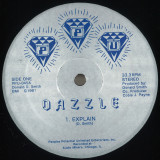
Dazzle rolled deep. Very deep. In the 1980s, it wasn't unusual for the Milwaukee-based group to show up at various Midwest night clubs in a caravan of 30-40 cars and vans. Their live following was hard won over a career that spanned 20+ years, many line up changes, and a handful of project names. Friends, family, and fans made the journey with them weekend after weekend, a testimony to both the musical prowess of the group and the tight-knit community that they emerged from.
Donald Smith, band leader, was there the whole time - joined by many of his siblings and friends - first as founder of the Ghetto Players, a early 70's nine-piece which also included siblings Michael, Ronald, and Charles. They played hard funk in the style of early Kool and the Gang, and although they sadly left no recordings, the strength of their live act managed to catch the eye of local Milwaukee R&B music entrepreneur Cobie Joe Payne. Cobie had made a couple of records locally in the early/mid 70s as a singer, including the impossibly weird and amazing rare afro-blues-funk 45 "Sweet Thing", but had never enjoyed national success. When the Ghetto Players disbanded in the early-mid 70s, Donald soon put together a new group, C on the Funk (the 'C' referring to lead vocalist and sibling Charles), under Payne's tutelage. Sister Lorrie Smith came in as the drummer, the line-up being fleshed out by brothers David and Melvin Johnson, and friend Robert Mitchell. After a few years as a strictly live attraction, they drove to Chicago and produced a single, "In the Disco" / "A Place" for Payne's small record label Sweet Thang Records in 1980. Lacking the financial backing needed to supply the local R&B disk jockey's "promotional fees" , this single sadly languished in obscurity, gathering dust inside the local tavern jukeboxes and manilla promo envelopes that comprised Payne's DIY distribution network.
C on the Funk were traveling the Mid West extensively at this point, and making some important friends on the road. Ike Wiley Jr. of the Dazz Band/Kinsman Dazz took particular interest and the band was re-christened Dazzle, partially as a tie-in with Dazz, partially to embrace the new sounds that would distinguish the 70s disco scene from what record collectors and DJs would now refer to as the "Boogie" era. There no doubt was a stigma attached to the word "Disco" as the eighties began, and as we see in this collection C On the Funk's "In the Disco" is remixed and transformed into the psychedelic synth instrumental of Dazzle's "Disco's Out", a title which embodies both the next-step approach Smith and company were pushing for, and humorously comments on the state of black dance music in the early 1980s. The Dazzle recording, done in Chicago in 1982, updated the sound and featured an expanded line up, most notably a second synth player (Charles Washington), and a percussionist/second lead vocalist (Greg McDonald). The added synth textures and deep percussive grooves give the Dazzle recordings an elegant late night vibe that resonate just as well in a good pair of headphones as they do on the dance floor. The trance inducing cough syrup-warble of "Explain" may best exemplify this here. Sadly, a pressing flaw in the 12" halted production and promotion, and the EP and the songs within were lost to the ages. The group, having done a much better line in the live music business, followed that path instead all the way to the early 90s. --bio provided by andy noble
NonRev's debut release on ETERNALSOUL, Sonder Ep, is a journey into the deep and atmospheric vibes of the 90's while still keeping his sound raw, fresh and current.
This incredibly talented up and coming UK producer, has been writing and dj-ing since the mid 2000's, with many releases showcasing his diverse influences and production styles across the spectrum of DnB.
ETERNALSOUL proudly presents his debut release on the label, which highlights his love and influences of DnB's golden era, while still keeping true to his own unique production qualities.
Soul Jazz Records’ long out of print classic ‘Studio One Dub’ collection is being re-released in three new one-off limited-edition coloured pressing 18th anniversary format editions!
Firstly a heavyweight special limited edition one-pressing only orange 2xLP vinyl + download.
Secondly, there is also a new special limited-edition one-off pressing edition orange-pressed CD enclosed in jewel case and slipcase.
And thirdly there is a very limited unique new one-off pressing orange-cased cassette format (200 copies only)!
18 years on from its original release Studio One Dub remains super-hard hitting featuring classic + rare Dub tracks from Studio One, many available on vinyl for the first time in over thirty years.
Studio One Dub includes the dubs of many classic tracks such as Horace Andy’s “Skylarkin”, Johnny Osbourne’s “Truth and Rights”, John Holt’s “Hooligan”, Freddie McGregor’s “Bobby Bobylon” plus many more rare tracks.
The album also comes with two rare interviews - one with Clement 'Sir Coxsone' Dodd about dub and dubplates and one with the sound engineer Sylvan Morris, talking about his groundbreaking period at Studio One and his many innovations that he evolved there.
In short, this is a 100% essential album!
"Almighty slab of dub featuring loads of rare and classic dub versions of Studio One's foundation tracks." Rough Trade
“Quite a treat awaiting here for the unsuspecting reggae faithful – as always with Soul jazz chock full of a bunch of big tunes – but here in version form lies some of the freshest rhythms and most radical revisions of some of the greatest Studio One music. The darkest and the absolute deepest in the series – naturally essential.” Boomkat
"Continuing the Studio 1 Series this album features classic and rare Dub tracks from Studio One, many available for the first time in over thirty years. Studio One Dub includes the dubs of many classic tracks such as Horace Andy’s “Skylarkin”, Johnny Osbourne’s “Truth and Rights”,
John Holt’s “Hooligan”, Freddie McGregor’s “Bobby
Bobylon” plus many more rare tracks. In short, this is an essential album!" Wax Museum