On the latest instalment of his VALA series, Finnish techno explorer Kaspiann tunnels into heads-down, mind-warping rhythm tracks of the highest order. Alongside his appearance on respected platforms such as Delsin Mantis and Optic Portal (alongside Spekki Webu), VALA affords Kaspiann the space to explore the depth and breadth of his sound with steely focus. The four tracks on VALA 4 are teeming with tactile textures and intricate detail that feel familiar and abstract all at once, perhaps best described by the titles that indulge in a little Finnish word play. ‘Sammalkämmen’, literally translated as ‘moss palm’, feels like a fitting reflection of the spongy mid-range matter on the opening track, while the humid, dense atmosphere of B1 cut ‘Suohunaja’ could indeed conjure a sense of ‘swamp honey’. From ‘Sienikieli’s tunnelling rhythmic intrigue to the intricately arranged, expressive percussion of ‘Niin Vain’, Kaspiann continues to broaden his vocabulary within the language of deep techno, triggering ineffable sensations from carefully sculpted sonic forms and strapping them to incisive rhythms.
quête:stee down
"Wind, Again" is Sary Moussa’s fourth studio album and second album on Other People. Based between France and Lebanon, Moussa returns with a riveting electro-acoustic album informed by his ever-changing relationships to space, listening, and resonance as well as his growing interest in the study of harmonics in electronic and electro-acoustic music.
Years in the making, “Wind, Again” approaches distinct musical worlds and languages by bringing together improvisations by musicians performing on Western and West Asian instruments such as the Hammond organ, clarinet, saz, and buzuk with electronic arrangements and textures. Rather than force a rapprochement of these musical worlds through the instruments, and keenly aware of the weighty sonic histories they carry, Moussa proposes another way through which they can exist together in contemporary electronic composition.
Composed of six tracks, each of which demonstrate an array of recording and processing techniques, the album generates moments of tension produced by the synthesis of textural, tonal, and harmonic encounters that Moussa calls “shadows”, which outline an impressionistic musical language, existing at the edge of familiarity. Such moments permeate tracks like “Everywhere at once” and “Violence” that open with the Hammond organ and the saz respectively and slowly reveal an expansive field of sounds that showcases each of the musicians’ characteristic performances and Moussa’s densely layered textures. It is a latent yet unrelenting tension through which the composer invokes rather than represents a collective experiential state, especially familiar to those who know his environment. In “Wind, Again” these shadows are articulations of sounds steeped in traditions they are never quite tethered to. Such articulations are implied and alluded to, they play within a musical reference without the latter explicitly existing in the recording, always teetering, never completely here nor there.
Sonically and musically, the album is fueled by the cultural, social, and personal realities that Moussa was brought up and lives in.
Both personal and musical ties with the musicians who feature on the album is central to Moussa’s practice. In the title track “I will never write a song about you”, musician Julia Sabra opens with rolled piano chords, followed by Paed Conca on clarinet and Abed Kobeissy on buzuk, before Moussa’s electronic processing pieces together, lifts, and sustains the melodic direction of the track that emerged from the musicians’ separate improvisations. For Moussa: “The initial connection between the three performances was made on a track that no longer existed, the original recording was both an obstacle and necessary step for the track we hear on the record. It’s as if we were all telling different stories and I pulled on the thread that held them together”. The track, and more generally the record, is tinged with a melancholy of things lost, though it never fully succumbs to it.
“Everything inside a circle”, Moussa’s most personal track and for which he provides the only vocals on the record, harkens back to a childhood memory of listening to music with his mother in a car: “There was a sound I was looking for — a memory of a sound and how I first heard it. This track is a hybrid of that memory and what I wanted to make of it”. The track relies heavily on generativesystems and perhaps embodies most the ambiguous quality of the record’s music in its refusal to be pinned down by one musical tradition or another.
“Wind, Again” is both familiar and alien, cold and warm; it pays homage to the mechanics, materials, and tactility of the instruments and converges acoustic and synthetic spaces. What anchors the sound of the album are the elements of a whole that cannot find its own idiosyncrasy and that is precisely why Moussa’s album is a tour de force.
- A1: Blue
- A2: Trouble Man – Kyle Eastwood Feat. Joni Mitchell
- A3: Moon At The Window - Demo
- A4: Be Cool – Demo
- A5: Harlem In Havana
- B1: Cherokee Louise
- B2: Come In From The Cold
- B3: In France They Kiss On Main Street
- B4: Nothing Can Be Done
- C1: Sex Kills
- C2: Edith And The Kingpin
- C3: Cold Blue Steel And Sweet Fire
- C4: The Jungle Line
- D1: Shades Of Scarlett Conquering
- D2: Yvette In English
- D3: Marcie
- D4: A Bird That Whistles
- E1: Love
- E2: Comes Love
- E3: The Man I Love – Herbie Hancock Feat. Joni Mitchell
- F1: At Last
- F2: You’re My Thrill
- F3: Sometimes I’m Happy
- F4: Stay In Touch
- G3: Sweet Sucker Dance – Early Alternate Version
- H1: You Dream Flat Tires
- H2: Answer Me, My Love
- H3: Love Puts On A New Face
- H4: Both Sides Now
- I1: Harry’s House/Centerpiece
- I2: Sunny Sunday
- I3: Hana
- I4: Last Chance Lost
- I5: Smokin’ (Empty, Try Another)
- J1: Paprika Plains
- K1: Hejira - Live At The Santa Barbara County Bowl, September 9, 1979
- K2: Refuge Of The Roads
- K3: Blue Motel Room
- L1: Black Crow
- L2: Off Night Backstreet
- L3: Just Like This Train
- L4: No Apologies
- L5: Not To Blame
- L6: The Magdalene Laundries
- M1: The Sire Of Sorrow (Job’s Sad Song)
- M2: God Must Be A Boogie Man
- M3: A Chair In The Sky
- N1: Goodbye Pork Pie Hat – Live At The Santa Barbara County Bowl, September 9, 1979
- N2: The Tea Leaf Prophecy (Lay Down Your Arms) – Herbie Hancock Feat. Joni Mitchell
- N3: Shine
- G1: The Crazy Cries Of Love
- O1: If I Had A Heart
- O2: Impossible Dreamer
- O3: One Week Last Summer
- O4: Summertime – Live At Newport Folk Festival, July 22, 2023
- P1: Stormy Weather
- P2: Two Grey Rooms – Demo
- P3: The Dry Cleaner From Des Moines
- P4: Twisted
- P5: If
- G2: Face Lift
- Easter Parade
- Heatwave
- Family Life
- Body And Soul
- Mid Air
- Because Of Toledo
- The Downtown Lights
- Let's Go Out Tonight
Ladies & gentlemen - get ready for something truly special: Scotland"s best jazz musicians meet one of the best and most influential bands from Scotland! The Colin Steele Quartet play the music of The Blue Nile, undisputed masters of Sophisti-Pop. Especially their second album "Hats" (1989) is regarded as an all-time classic masterpiece. The beautiful and atmospheric, often synth-driven songs of The Blue Nile get the deluxe jazz treatment in exciting new arrangements. All-time classics like "Easter Parade", "Heatwave" and "Let"s Go Out Tonight" shine in bright new shades and colours, and get transformed into something unique by Colin Steele"s very own trumpet style. The album perfectly captures and even enhances the late-night moods and aural landscapes of The Blue Nile"s music, while also adding some unexpected, and, yes, even slightly funky turns to songs like "Body & Soul" and "Headlights On The Parade". Colin Steele"s smooth and emotive trumpet caresses and lifts these beautiful songs to new heights.
- Never Again
- Next To You
- I Wonder If I'll Ever Forget This
- Never My Mind
- Carry My Home
- Tropical Storm
- From Way Down Here
- Feeling The Fall
- Enough
- Over It
Jess Kerber aus Nashville nahm im Alter von 12 Jahren erstmals eine Gitarre in die Hand, um mit ihren frühreifen Stimmungen und Zupfstilen zu experimentieren - beeinflusst von Gleichgesinnten wie Joni Mitchell und Susan Tedeschi. Dies führte zur Entwicklung einer einzigartigen Klangpalette und zu einem authentischen, persönlichen Zugang zum Songwriting. Inspiriert wurde sie gleichermaßen von ihrer Erziehung in Louisiana und dem Studium am Bostoner Berklee College of Music. Ihr Debütalbum "From Way Down Here" zeigt die Dynamik und Tiefe ihrer großartigen Stimme und ihrer nachdenklichen, humanistischen Texte, sowie die raffinierte Komplexität ihres Gitarrenspiels. Während der Entwicklung vieler dieser Kompositionen, bei frühen Live Auftritten in und um Boston und Cambridge, lernte Kerber den Songwriter Will Orchard kennen, der schnell zu einem Partner und Kollaborateur in der Entstehungsphase ihrer Aufnahmen wurde. Orchards Fähigkeiten als Produzent und Multiinstrumentalist heben Kerbers Arrangements auf eine neue Ebene, mit einer entwaffnenden Reinheit und Emotion in einer Dynamik, die derjenigen von Gillian Welch und David Rawlings angelehnt ist. Mit den Traditionen der Americana erschaffen Kerber und Orchard zusammen mit Mischtechniker Charlie Dahlke von The Brazen Youth ihr eigenes Subgenre, das gleichzeitig intim und und universell, tröstlich und rau ist. Über das gesamte Album hinweg erhält Kerbers reicher, samtener Tenor eine tiefe Zärtlichkeit und Wärme, während unterschiedliche Elemente wie Pedal Steel, Wurlitzer, Schlagzeug und Ambient-Gitarre für den schimmernden Background sorgen. Der Einfluss ihrer Erziehung - und und das, was sie liebevoll als ,Abgehobenheit vom Rest der Welt Gefühl" des tiefen Südens nennt - zeigt sich in den ehrlichen, geradlinigen und zeitlosen Qualität ihrer Kompositionen. "From Way Down Here" ist das seltene Debüt, das alle Merkmale einer erfahrenen Songwriterin aufweist. Sie konstruiert eine fesselnde Welt von rauer Schönheit und Wahrheit, deren Bann lange nach dem Verklingen der letzten Töne anhält.
José James just can’t leave the ’70s alone. Or maybe it’s the other way around. The singer, songwriter, bandleader, and producer was born in 1978, after all, but over his past 17 years of fundamentally forward-looking, blessedly mercurial music, he keeps getting pulled back in. His 2013 Blue Note breakthrough No Beginning No End revisited the hooky, funky, jazz-streaked songcraft of the time through a modern crate-digger’s ears. On 2020’s No Beginning No End 2 — James’ debut on his own Rainbow Blonde Records — he went back through the portal with a small army of fellow celebrated eclecticists. Just last year, there was the album 1978, a richly layered love letter to said year that felt deep, luxe, and cool. It’s as if — vested with the restless fluidity of jazz, the tuned-in sensitivity of soul, and the revisionist grit of hip-hop — he is trying to play his way into the exact moment when, culturally speaking, everything was about to change.
“I'm still so fascinated by the tension in that era of all these seemingly clashing things happening at once,” says James. “The loft scene, the jazz scene, Elton and Billy, Bob Marley, the Isleys, Funkadelic, disco being this behemoth in a way I don't think we even understand today… And then there’s where everybody went from there — into hip-hop, into punk rock, exploding jazz. It's like a summation of the ’70s, and it's about to transform. It's the peak of the rollercoaster.”
Literally breaking into history is impossible, of course, but James’ new LP, 1978: Revenge of the Dragon, does feel like breaking through or bursting out. In loving contrast to its predecessor, the fresh set plays hot, like a Friday night out at the Mudd Club in its prime. Though he’s dreamt up albums with collaborator counts approaching the dozens, James gathered a tight crew for this one. Himself and Taali on vocals. BIGYUKI on keys and analog synth. Jharis Yokley on drums. Bass split between David Ginyard (Blood Orange, Terence Blanchard) and Kyle Miles (Michelle Ndgeocello, Nick Hakim). And an all-star brass lineup: Takuya Kuroda on trumpet, young lion Ebban Dorsey on alto sax, and genre-spanning ronin Ben Wendel on tenor sax. They set up in Dreamland Studios near Woodstock, a restored 19th century church, and recorded live to tape, two tracks, drums pushed to the max — “a small homage to the rise of punk,” says James.
In that place out of time, the band laid down a handful of choice covers and some wild originals, like the single “They Sleep, We Grind (for Badu),” a decades-collapsing cut powered by an ugly groove. Steeped in dub, funk, and sampledelia, James chants an artists’ mantra (“They sleep, we grind / Man, f--- your nine to five”), makes lyrical callouts to Marley and Nas, and channels everything from George Clinton to J Dilla, not to mention the earthy mysticism of Erykah Badu. In 2023, James released and toured his Badu covers LP, On & On. “Living in her musical house for a year was transformative,” he says. “This is my summary of everything I learned through her, tying it to this idea that artists move differently. We are in society but we are outside, too, looking out and in at the same time. Our hours are different, our schedules are different.”
To that point, James and co. actually began each day in the woods, filming the album’s visual companion piece, Revenge of the Dragon, an honest-to-God kung-fu short complete with bad overdubs, training montages, camera tricks, and plot twists. The film pays tribute not only to the genre’s greatest year (1978, of course), but also its cinematic exchange with Blaxploitation, plus James’ own recent Shaolin training and admiration for Bruce Lee as a culture-bridging force (the LP’s cover recreates an iconic shot of Lee). On top of that, says James, “We had this immediacy in the studio. Live, one take, no overdubbing. I feel like that's where the martial arts piece comes in, where it's about being relaxed but also aware, and there's immediacy in your movements.”
Across the project, tribute takes that refracted, multifaceted form. From his personal late-’70s playlist, James chose four covers reflecting the era’s disco-fied churn: the MJ-meets-Quincy dancefloor masterpiece “Rock With You”; Herbie Hancock’s prescient vocoder fever dream, “I Thought It Was You”; and a pair of Black-radio hits from two bands whose fans typically wouldn’t have been caught dead in the same stadium: “Miss You” by the Rolling Stones and the Bee Gees’ “Inside and Out.” All of it gets filtered through a contemporary Black (and beyond) lens, coming out loud, free, funky, and buzzing — dynamic, yes, but also of a joyous piece.
1978: Revenge of the Dragon transports you to a crowded room where all this is playing out in real time. That feeling is helped out by opener “Tokyo Daydream,” a bass-driven swan dive into a neverending night of boutique bar-hopping and neon revelry. Later, “Rise of the Tiger” finds James bringing rare braggadocio to a propulsive track with growling synth lines and a hunger for whatever comes next. And then there’s the closer, “Last Call at the Mudd Club,” which with its upbeat energy and string of Stevie-inspired pickup lines, evokes the sort of unabashedly elated track the DJ throws on at 3:56 a.m. before everyone is kicked out. “I wanted to leave the album on that note,” says James. “If this was a night out in New York, this would be the last thing you hear before you get in that taxi and go back to your apartment.” Or, perhaps, back to 2025.
- 1: Cheryl!
- 2: Brutalised Robotics
- 3: Talk, Clown
- 4: Notopia
- 5: Your Love Shines Down Like A Supernova’s Death
- 6: Rights Down 50
- 7: What Ya Gonna Do With Yr Days
- 8: Light Touch Of The Man Spreader
- 9: Golden Cerebellum
- 10: I Only Cry From A Distance X Time = Frustration
- 11: Blistered Eyeballs
Dez Dare launches into 2025 with his 5th album, ‘CHERYL! Your Love Shines Down Like A Supernova's Death'. Blending his unique mix of existential wordplay and experimental riffage to create an album that is at arms with itself while cohesive; cheeky and upbeat, simultaneously breaking our hearts. How often do we think about what we miss when we are distracted by shiny things? While fencing with social media, long winded stories, dreams of other lives, unnecessary toys, and irrelevant social experiments with happiness, we miss the things that make up our world. This album looks at those morsels of time and the bits that fill them, soaking existence… as well as manspreaders. Those people should be added to the 7th circle of hell… or suburbia. Either is probably a similar commute!
Dez Dare (AKA Darren Smallman of labels God Unknown, BATTLE WORLDWIDE, Low Transit Industries, and bands Thee Vinyl Creatures, The Sound Platform, Warped) grew up in Geelong, Australia, where he became involved in the local punk and rock scene in 1990. Sharing stages with the likes of 5678s, Cosmic Psychos, Fugazi, The Dirty Three and the Hard-ons, before shifting his focus to running record labels. In the 2020s we see Dez Dare take form in a spare room in Brighton, UK, where Dez starts building his own studio and producing music and videos that have been described as "sounds like MONSTER MAGNET and DEVO caught in a drug bust… highly unique and highly recommended" by MAXIMUM ROCKNROLL Nick Odorizzi to The Wire’s Edwin Pouncey "dynamically armed with a ten-pronged set of lyrical barbs and musical hooks that, once heard, sink deep and hold fast" to Crossfire Metal "minimalistic, electronic psychedelic hippie poop that is only bearable with a hell of a lot of acid, angel dust and LSD". On this album Dez was joined by Laura Loriga on backing vocals and Jonny Halifax on backing vocals and lap steel, expanding on the sound of previous records and adding a new dimension to his trademark weird-n-roll.
[a] 1.Cheryl! [Loading...
- Apartment Life
- The Machinist
- The Men Are Fighting
- Lakeland
- Seven And Seven
- Over & Over, Pt. 1
- Bells And Bells
Fit for Consequences: Original Recordings, 1984–1987 is the first ever archival release from Repetition Repetition, the “two-man electric minimalist band” consisting of Ruben Garcia and Steve Caton hailing from Los Angeles in the mid 1980’s. Repetition Repetition’s unique blend of cosmic art-rock minimalism / maximalism was self-released across a series of cassettes produced in micro editions, and while garnering the attention and participation of luminaries such as Harold Budd, remained under the radar during the band’s existence. Fit for Consequences: Original Recordings, 1984–1987 collects select material from across the duo’s catalog.
It was over a plate of Mexican breakfast food when Ruben Garcia and Steve Caton first told Harold Budd of Repetition Repetition and the worlds they intended to explore by respective way of synthesizers and guitars --- a rendezvous instigated by the former’s fan mail to the legendary composer. If the upstarts entered this restaurant from a one-way street of admiration, they would leave with not only Budd’s interest but, sometime later, a blessing in the wake of many hours shared by the three in Garcia’s Los Angeles home recording studio: “This is going to be difficult, but God help them, I think they’re great,” noted Budd in a USC lecture in 1985. Now several degrees removed from prior rock music aspirations, the real game was afoot.
Between 1984 and 1988, Repetition Repetition operated within something akin to the underground of the experimental underground, although even that designation perhaps overstates the case. The duo’s sparse output consisted of three cassettes self-released on Garcia’s Third Stone Music label: Repetition Repetition (1985), Lakeland (1987), and The Machinist (1987). Their songs would also be included during this period on Trance Port Tapes’ vital scene-scanning compilations assembled by A Produce. Live performances occurred with similar infrequency, but Garcia and Caton counted converts in quality over quantity, numbering among them the aforementioned Budd, a Chambers Brother, and, judging by a memorably drop-jawed reaction following a rare Repetition Repetition gig, Jackson Browne.
Likewise, critical support materialized in the form of KCRW deejays Brent Wilcox and Dean Suzuki, whose steady airplay positioned Repetition Repetition’s music amidst fearless company like Jon Hassell, Hiroshi Yoshimura, and Richard Horowitz. Yet, to hear fellow Trance Port featured players like Tom Recchion and Bruce Licher of Savage Republic tell it, Garcia and Caton moved as ghosts --- a notion more vexingly endorsed by the silence of record companies that failed to come knocking --- and therein lies an overarching truth to the work itself.
Journey to the heart of Repetition Repetition and one discovers a collective ear impossibly attuned to the hypnotic possibilities of stylistic convergence, the resulting music possessed of seamless multimodalities which beckon to a glimmering plane of the disembodied. Where Caton sought his artistic fixes at an intersection of popular genres, Garcia zoned in on the sonically spare, drawing from the same wellspring as the Enos and Rileys of his personal avant-garde pantheon, and in their coming together the two tapped into a deeper cosmic source. Synthetic walls of keyboard sound in forever states of reprise met waves of shimmering --- and at times even punishing --- guitar in reply, their soundscapes hovering convincingly between, as suggested in fittingly dualistic fashion in a press kit assembled by Garcia, such disparate sensations as bird flight in one song and oil drilling in the next.
But don’t call it a push-pull dynamic, as this was a creative partnership founded upon fluidity and organicism by way of, naturally, repetition. In contrast to, say, the Bressonian ideal of repetitive motion as a great stripping away, the concept in the hands of Garcia and Caton equated to ascendancy via continuous unfolding, a maximal route to minimalism. To be sure, their recording philosophy morphed over the course of the act’s short history, and what started as a process defined by consistent in-person interplay developed into a more isolated method formulated by Garcia, who eventually took to his own one-man bedroom-studio sessions in order to fully chart any and all potential ostinato-loaded paths which he could travel down, the Tascam-captured resonances subsequently provided to Caton as blueprints from which to take flight himself, adding layer upon layer of steel to the proceedings.
If the practice and execution changed, however, the evidence certainly didn’t rest in the results: The seamlessness remained, and, despite the brevity of their time together, so has Repetition Repetition. With this finely calibrated collection of songs in Fit for Consequences: Original Recordings, 1984–1987, Freedom To Spend sees to it that the private worlds of Garcia and Caton can now be visited by all rather than just the count-‘em-on-both-hands lucky few whose musical endeavors or collector vocations carried them into this once-distant dimension.
Repetition Repetition’s Fit for Consequences: Original Recordings, 1984–1987 will be released on Freedom To Spend in vinyl and digital editions on May 30, 2025. The collection includes extensive liner notes from Bill Perrine, and wil be offered alongside Over & Over, a supplemental collection of music available exclusively as a mail order cassette from Freedom To Spend and RVNG Intl.
- 1: Salvage Title
- 2: Tree Of Heaven
- 3: Betty Ford
- 4: Free Association
- 5: Hollow Skulls
- 6: Artex
- 7: Love Vape
- 8: Wildwood In January
- 9: Resident Evil
- 10: All Over The World
- 11: Fantasia
An album for sleeping and waking, walking and driving, hunting and fishing, for loitering outside a roadhouse on the haunted tundra. Okay in elevators, not great for dinner. On Caveman Wakes Up, Friendship’s new album and second for Merge Records, the band’s historically capacious definition of country music grows wider still. Shambolic guitars are offset by flute pads, bleary poetry is set against a Motown rhythm section, a song about Jerry Garcia and First Lady Betty Ford fades out with a drum solo, like if Talk Talk came from a dingy Philadelphia basement and was fronted by James Tate. Songwriter Dan Wriggins’ ragged baritone cuts through eleven murky, swirling country-rock songs with profound lyrical substance and sincerity. Like an alarm clock incorporated into the edge of a dream, Caveman Wakes Up belongs equally to the conscious and subconscious mind, fraught with background, steeped in reference and experimentation, delivered casually and as a dire warning, dedicated, above all, to music’s creative soul. Over the years, dedication has paid off. Friendship has become a kind of reverse supergroup,
wherein the band itself and each individual member are located centrally in an increasingly prominent scene of young folk and country musicians and songwriters. Drummer Michael Cormier O’Leary leads the instrumental collective Hour and, along with bassist Jon Samuels, runs Dear Life Records, home to friends and peers who count Friendship as a major influence including MJ Lenderman, Florry, and Fust. (Samuels also plays lead guitar in MJ Lenderman and the Wind). Guitarist Peter Gill’s band 2nd Grade records prolifically. Wriggins began writing the songs of Caveman Wakes Up on a downtuned classical guitar of Lenderman’s and finished on a barely tuned piano in an apartment he shared with Sadurn’s G DeGroot.
In the summer of 2023, Wriggins had just left the Iowa Writers’ Workshop, where his love for poetry and mistrust for the academic poetry world grew in tandem. A relationship fell apart, and Wriggins crashed for several weeks at Lenderman and Wednesday’s Karly Hartzman’s home in North Carolina, where he recorded the first demos of “Resident Evil,” “All Over the World,” and “Love Vape.” Wriggins returned to Philadelphia, and the band got to work on new ideas, finally tracking the album in five days with engineer Jeff Ziegler (Mary Lattimore, War on Drugs). Wriggins recorded vocals with Love the Stranger engineer Bradford Kreiger, and organ, violin (Jason Calhoun), and flute (Adelyn Strei) were recorded by Lucas Knapp in a West Philadelphia church.
- A1: La Baule - Evndl X Tulki
- A2: Blessed - Fnonose
- A3: Areia Quente - Dosi X Aisake X Bastien Brison
- A4: Panama - Xander. X Lazlow
- A5: Caswell - Loafy Building X Yestalgia
- A6: Postcards - Fugee
- A7: Sand Dollars - Goosetaf X Timothy Infinite
- B1: Palm Beach - Klemsis X Aboueb
- B2: Chasing The Sun - Tah. X Gatz2Gatz
- B3: Brazilian Skies - Epektase X Stratega
- B4: Ribeira Grande - Dlj X Florent Garcia
- B5: Navajo Bay - Showyou X Noflik
- B6: Palermo - Viktor Minsky X Living Room
- B7: Sunny Afternoon - Comodo X Coogan X Maelk
- C1: Island - Kyu
- C2: Brighter Days - Two Scents X Lotus Beats
- C3: Roadtrip - J_San X Klemsis
- C4: Perks - Hya X Lazlow
- C5: L Aperitivo In Piazza - So.lo X Towerz
- C6: Sunny Stroll - Vihta X Vhskid
- C7: Warmer Weather - Enluv X Spaniel Mac X Azula
- D1: Radiance - Bashful X Deja Blue
- D2: Soda Pop - Sling Dilly X Sleepermane
- D3: Rooftop Café - Hokø X Hoogway
- D5: Afternoon Hammock - Corey J. Beats
- D6: Chipping Away - Steezy Prime X Luv Pug
- D4: Summertime - Snazzy X Morningtime
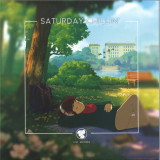
Surrender to the calming essence of summer with Saturday Chillin’! Allow yourself to unwind and cherish the weekend with the soft rhythms and soulful harmonies of our latest compilation. Transport yourself to a place where time seems to slow down, enveloped by warm sunlight and fragrant flowers, escaping the bustle of city life. Let these soothing melodies set the perfect tone for your ideal summer days.
DMV-by-way-of-the-U.K. punk duo Teen Mortgage have announced their debut album, Devil Ultrasonic Dream, out May 9th on vinyl via Roadrunner Records.
Produced by the band alongside longtime collaborator Kenny Eaton, the album’s first single, “BOX,” is a two-minute sprint of seething defiance, packed with hooks and unrelenting energy.
The album’s title, Devil Ultrasonic Dream, leans into the 1980s-era satanic panic in rock and roll. “The Devil Ultrasonic Dream,” explains frontman James Guile, “is about realizing a fantasy that Christian fascists don’t understand or want you to have. The devil—Satan—has always been a symbol of counterculture.”
Originally from England, Guile had been toying with the Teen Mortgage project under various monikers for years, crafting a sound steeped in sociopolitical commentary and built for the mosh pit, heavily influenced by classic ’80s punk. After relocating to Maryland five years ago, he connected with drummer (and former nurse) Edward Barakauskas via a Craigslist ad. Since then, the duo have spent years building Teen Mortgage’s presence in the DMV scene. In between a global pandemic and Barakauskas serving as an ER frontline worker, they managed to drop an EP and a string of singles before signing to Roadrunner Records in 2024.
Teen Mortgage has earned support slots with a stacked list of artists, from Weezer, Smashing Pumpkins, OFF!, and Alkaline Trio and return to the UK in June to play Download Festival and support Weezer at their Halifax Piece Hall show.
- I Got Heaven
- Loud Bark
- Nothing Like
- I Don't Know You
- Sometimes
- Ok? Ok! Ok? Ok!
- Softly
- Of Her
- Aching
- Split Me Open
Mannequin Pussy"s music feels like a resilient and galvanizing shout that demands to be heard. Across four albums, the Philadelphia rock band that consists of Colins "Bear" Regisford (bass, vocals), Kaleen Reading (drums, percussion), Maxine Steen (guitar, synths), and Marisa Dabice (guitar, vocals) has made cathartic tunes about despairing times. "There"s just so much constantly going on that feels intentionally evil that trying to make something beautiful feels like a radical act ," says Dabice. "The ethos of this band has always been to bring people together." Their new album, I Got Heaven, which is out March 1 via Epitaph Records, is the band"s most fully realized recording yet. Over ten ambitious tracks which abruptly turn from searing punk to inviting alternative pop, the album is deeply concerned with desire, the power in being alone, and how to live in an unfeeling and unkind world. It"s a document of a band doubling down on their unshakable bond to make something furious, thrilling, and wholly alive. Following the 2019 release of their critically acclaimed third album Patience, Mannequin Pussy returned in 2021 for their EP Perfect. They toured that release relentlessly and added guitarist Maxine Steen to the band"s official lineup. The band changed their entire creative formula, choosing to write together in the studio in Los Angeles with producer John Congleton , over slowly crafting tracks at home.
Dateline: April 10, 1970. Setting: The storied Fillmore West in San Francisco, CA. Context: Miles Davis, three days removed from his first session for Jack Johnson and, with newly recruited soprano saxophonist Steve Grossman in tow, opening shows for countercultural heroes the Grateful Dead on the latter’s home turf. Result: The initial rumblings of a thrilling era in which Davis and his cohorts would again upend jazz and popular conceptions of the genre with music steeped in groove, improvisation, and hang-on-for-your-life adventurousness. All captured on Black Beauty: Miles Davis at Fillmore West.
Mastered at MoFi’s California studio, pressed at Fidelity Record Pressing in California, and housed in a Stoughton gatefold jacket, Mobile Fidelity's numbered-edition 180g 33RPM 2LP set helps bring what went down that spring evening in Bill Graham’s venue to your listening room with exceptional clarity, balance, and presence. Originally only released in Japan in 1973 and unavailable in the United States until the late ‘90s on compact disc, this marks the first time Black Beauty has been issued on domestic vinyl. The wait is worth it.
Benefitting from quiet surfaces and excellent definition, these LPs present the band’s livewire energy and torrential storm of notes with captivating dynamics, pacing, and fullness. At its core, this audiophile reissue takes you into the walls of sound erected by a band learning on-the-fly the sheer power, will, and breadth of the electric jazz Davis was orchestrating and realizing, on the spot, would reach rock audiences that until that point had only a faint awareness of his mad-scientist experimentation. The sense of release and reach conveyed by these carefully restored records make it clear the veteran bandleader was in the process of a permanent shift that he’d chase for the next five years.
Given Davis was only a few months away from releasing the pioneering double album Bitches Brew, it shouldn’t come as a surprise that much of the fare here adheres to similar explorative approaches. Turbulent rhythms, provocative trumpet passages, and rich, saturated tonal colors that seemingly splash against a blank canvas take precedence over any traditional attempts at organization and melody. Davis and Co. intentionally play everything on a line with the bandleader signaling changes with his horn via coded phrases. The group speaks a common language — with each member having gone to achieve iconic status for their career contributions and technical prowess.
In the company of Grossman, Chick Corea (piano), Dave Holland (bass), Jack DeJohnette (drums), and Airto Moreira (percussion), Davis constructs themes around “Directions,” “Miles Runs the Voodoo Down,” “It’s About That Time,” the title track to Bitches Brew, and more from his then most-recent studio works and the in-progress Jack Johnson. His farewell to the popular standards that for nearly two decades remained a part of his repertoire arrive via a brief dalliance with “I Fall in Love Too Easily,” a shortened albeit aggressive “Masqualero,” and the “Theme” finale of “Spanish Key.” Initially, Black Beauty lacked specific track listings due to Davis’ increasing frustration with listeners over-analyzing his music.
In retrospect, it’s difficult to blame anyone for wanting to view what’s on display here with the aural equivalent of a magnifying glass. Leaning in rock directions, yet maintaining an ear for spaciousness and solos, Black Beauty survives as a snapshot of a thrilling moment amid a transitory period in which evolution came fast and furious. Just two months later, Davis would add another instrumentalist to the lineup in the form of organist Keith Jarrett, and the perpetually restless visionary would blast off to a more atmospheric and arguably more chaotic universe.
Consider, then, this live document a bridge to that galaxy and a breathtaking example of the possibilities of jazz itself.
It says a lot about the interconnectedness of the global dubwise underground that it took downtime with Bristolian Neek in Portland to spur the link between ZamZam and Feel Free Hi Fi out of the Minneapolis Twin Cities. Once he put us on to them we were hooked- not only by their brilliant music but by their rigorously DIY approach and aesthetic. Heavily inspired by the more esoteric angles of early digi-era JA dancehall and UK dub (Shaka, Disciples, Mixman and Gussie P being some touchstones) the duo create a sound both reverential and unique, steeped in the traditions but striking out hard left into idiosyncratic territory all their own. Releasing all of their works up to this point on their own fantastic Digital Sting label, we’re excited to showcase them on ZamZam.
Maazn Records unveils its inaugural release "Lost in Transit” by Guzman & Terraflow. Inspired by the breadth of London's current sounds, this record gives a taste of their vision for the future.
The A-side features label co-founder Terraflow infusing his signature style of old-school drums and intricate synth work. "Atomic" lays down a catchy bass riff that summons an ethereal feeling of the past, whilst "Totaled Larynx" takes a hypnotic turn, embellished with haunted melodies suited to the early hours of a certain pit in Norfolk.
Guzman takes the wheel on the B-side, starting with the punchy, sleazed-out rhythms of “Neo (Trance Mix)”, steering the EP further into the depths of the peak-time dance floor. Finally, “Time Deprivation” details clever vocal sampling atop of an arsenal of dangerous waveforms - a fitting verdict that is guaranteed to send the audience into a bass-laden frenzy.
These are no warmup tracks, play out at your own risk
- A1: Basis Rahouma - بسيس رحومة,- Yana Alla Nafsa Masouda يانا اللي نفسي مسدوده (Blocked From What I Want)
- A2: Sheikh Amin Abde -L Qader الشيخ أمين عبد القادر, Mould Fi Madina Tanta مولد في مدينة طنطا (Born In The City Of Tanta)
- A3: Samah سماح, - Shawish Aldawriat شاويش الدورية, (Patrol Sargeant)
- A4: Mahmoud Al-Sandidi محمود الصنديدي, - Ana Mish Hafwatak (Part 2) انا مش حفوتك, (I Don’t Miss Your Love)
- B1: Abu Bakr Abdel Aziz (Aka Abu Abab) أبو بكر عبد العزيز,- Al Bint Al Libya أل بينت أل ليبيا (The Girl From Libya)
- B2: Sheikh Amin Abdel Qader الشيخ أمين عبد القادر, - Mawal Al Layl Kolo Makasib موال الليل كله مكاسب (Mawaal: The Spoils Of An All-Nighter)
- B3: Abu Saber أبو صابر, - Ya Allah Ank Zinat يا الله انك زينة (Oh, God, You Are Beautiful)
- B4: Reem Kamal ريم كمال, - Baed Al Yas Yjini بعد اليأس يجيني (After Hopelessness, He Comes To Me)
“Egypt’s “official” popular music throughout much of the 20th Century was a complex form of art song steeped in tradition, well-loved by the middle and upper classes, and even accommodating to certain non-Arabic influences. It was highly structured by professional musicians working an established industry centered in the capitol, Cairo. However, far from the bustling cosmopolitan center of Cairo, north and northwest, in towns like Tanta and Alexandria and extending across the Saharan Desert to the Libyan border, dozens of fully marginalized artists were developing a raw, hybrid shaabi/al-musiqa al-shabiya style of music, supported by smaller upstart, independent labels, including the short-lived but deeply resonant Bourini Records. Launched in the late 1960s in Benghazi, Libya, Astuanat al-Bourini اسطوانات البوريني (Bourini Records) published some 40 to 50 titles from 1968 to 1975. Bourini released 7-inch 45 RPM singles by 15 artists, all but one of them Egyptian, igniting brief careers for Alexandrian singer Sheikh Amin Abdel Qader and the blind Bedouin legend Abu Bakr Abdel Aziz (aka Abu Abab). The tracks compiled here comprise a full range of styles covered by the label, while highlighting some of its most gobsmacking moments, from Basis Rahouma’s beastly transformation into a growling and barking man-lion by the end of “Yana Alla Nafsa Masouda,” to Reem Kamal’s hopeful-if-bitter handclapping party pivot “Baed Al Yas Yjini,” which descends into an almost Velvet Underground outro-groove of nihilistic dissonance. All the tracks on this compilation were laid down in stark divergence from the mainstream Egyptian popular music topography of heightened emotions buoyed by lush arrangements. The contrast is most evident in Mahmoud al-Sandidi’s “Ana Mish Hafwatak,” wherein his voice weaves heavily but deftly through a constant accordion drone, and Abu Abab’s “Al Bint al Libya,” a sparse, slow-burning lament with minimal percussion, violin, and Abab’s nephew Hamed Abdel Muna'im Mursi on lyre. Whereas the Egyptian mainstream was aspirational, attempting to reflect Egyptian culture at its most refined, the performances captured by Bourini were manifestations of everyday life lived by the mostly otherwise ignored masses. More than half century old, this music has lost none of its urgency, presence, or relevance. We hear these artists as if they’d just joined us in our living room, and not on a stage decades ago surrounded by tens of thousands of long-forgotten acolytes.
Repress!
Echospace Detroit is the label launched by Rod Modell (Deepchord) and Soultek's Steven Hitchell, two leading lights of the minimal dub techno scene. And as with anything Deepchord, the entire release has an air of mystery to it. Previously, as a near-mythical vinyl pressing with minimal packaging and restricted pressings, everything about Vantage Isle was geared toward the underground, or 'those who know.' However, there's nothing but love of craft driving these grooves, and now a lot more people will finally be able to hear this absolutely brilliant collection of spacial dub wonder on CD. Vantage Isle Sessions consists of a whopping 13 takes of the title track, reworked by Modell and Hitchell in various guises (cv313, Deepchord, Echospace, Spacecho), as well as a guest spot (and first ever remix) from Gerard Hanson (Convextion). Across their 13 versions, Modell and Hitchell manage to take the Deepchord template (analog synths, deep bass, gently throbbing beats, bursts of static and noise, and deep, deep chords) into a surprising variety of directions, akin to looking at the same giant glacier from a helicopter from every angle possible: some are beatless and undulating, some are pulsing and dynamic, some are looking up from under the ice and some are towering overhead. The aforementioned Convextion version is revelatory. It's built on cascading and echoing pieces of the original that are layered like shifting sands, for a distinctly dark and shimmering journey to the bottom of the frozen ocean and back. It's remarkable enough to get all these takes on one basic template to sound somewhat different, given that the source material is really just a skeletal array of sound sheets. Vantage Isle Sessions is for anyone looking for the logical successors to the Basic Channel throne, or just looking for something mellow for those steamy late summer nights. A stone-cold classic of the genre. Don't miss it." -Todd Hutlock, Stylus Magazine/Beatz by the Pound
"Steeped in mystery, Detroit musicians Rod Modell and Mike Schommer (aka Deepchord) are legendary for their hard to find twelve-inch dub techno releases. Their sound is heavily influenced by Berlin dub techno producers like Maurizio, Basic Channel, Chain Reaction, Rhythm & Sound, Blue Train and Pole. While the German sound often has a futuristic metallic edge, Deepchord are known more for the rust and grease, which is part and parcel of those metal parts. Static, analog sounds, deep bass thumps and, of course, deep chords blend in a timeless minimal manner. However, the real gems on this disc are the drifty ambient cuts devoid of beats. This is an excellent album that is on par with the classics from a decade ago!" -Exclaim
"In terms of ambient dub, if Basic Channel is the Father (the source, remote and inaccessible and very powerful) and Pole is the Son (dazzling but ultimately stranded halfway between man and the divine), than Rod Modell’s Deepchord and his Echospace label he run with Steve Hitchell is definitely the Holy Spirit." -Popmatters
"Deepchord’s dub-techno stealthily peels away melody, leaving a bare chassis of beats to ghost-ride down Woodward Avenue. Vantage Isle Sessions, which collects remixes of a 2002 Detroit Electronic Music Festival performance, finds the duo swerving through empty, neon-smeared streets, and recalls Berlin’s Chain Reaction label, minus the anemic minimalism." -XLR8R
"The album scales a magnificent peak in “Spacecho Dub II - Extended Mix” when smeary chords ricochet over a massively deep, bass-heavy pulse, and Hanson's light-speed missile of vaporous propulsion (“Convextion Remix”) is beautiful too.
Long may they run." -Textura
‘Vantage Isle’ is a tremendous achievement that will most likely be held up as a high water mark of the genre for years to come." -Resident Advisor
"My favorite mix is by Convextion (his first remix for another artist). Reedy, distant synth tones sound like a science fiction soundtrack overheard rooms away. An undercurrent of echoes, many difficult to describe, drift in a sonic syrup." -Gridface
"Modell’s music always seems to be in this suspended animation, adrift and afloat in a majestic emptiness." -Dusted Mag
CREDITS:
Written & Produced by Deepchord. Redesigned and Reshaped by Convextion (Gerard Hanson) cv313 (Stephen Hitchell) echospace / spacecho (Rod Modell + Stephen Hitchell)
Additional Mastering, Mixing and Engineering by Ron Murphy @ NSC Mastering, Detroit, USA. Side E/F Remastering and Lacquer cutting by Dietrich @ Complete, NYC, USA. (2018)
j.o.y.s. is both the moniker of and the debut self-titled LP by the Los Angeles based artist Ramon Narvaez. j.o.y.s. is an acronym for “jump out of your skin”. While the phrase can conjure moments of shock and surprise, Narvaez, however uses the phrase as a foot lamp illuminating a path towards momentary transcendence through creating beautifully conjured ambient music that recalls work by Daniel Lanois, suss, Dean Hurley and Tim Hecker. While the pedal steel is prominent, j.o.y.s., as a project, is more in conversation with shoegaze and noise than what has recently been deemed ambient country. Heavy brutalist slabs of noise, swirling feedback create the sound bed of these songs. Collaborator Justin Gaynor’s pedal steel on this album operates as important connective tissue as both the road and the traveler between the light and shadow zones. Drones are wrapped in distortion, processed just below the threshold where we’d throw the word “harsh” around. Rather, there is a delicate dance between Gaynor’s top-rope pedal steel lines - always sweet and always just a bit mournful - with Narvaez’s ringing bass notes and noise chatter. j.o.y.s. revels in intransigence. Nothing can last. As Matt Colquhoun puts in the introduction to Mark Fisher’s heartbreaking Ghosts of My Life - our identity and relationship to the past are “portals in perpetual collapse”. Depression, friendship, longing are all briefly satiated while in the peak experience of creating something as a response to them. But even that is impermanent. These sounds - improvised, exploratory, ecstatic - are eventually edited, whittled down and pressed to wax - not tombs but portals to the past.
Another foggy day in Yorkshire. A steel grey sky. Raindrops tracing one another down the windowpane. Kirk Barley sits in his studio and assembles compositions from scraps of found sound and live instrumentation. Melodies swell, withdraw and repeat like waves. Time slows. Accelerates. Slows again. The light bends, tweaked at the edges. Twisted by rhythms that never quite resolve.
Written, recorded and produced by Barley in Yorkshire in early 2024, Lux picks up where 2023 LP Marionette leaves off, conjuring a mystical, reflective space between formal minimalism and sonic imaginaries of northern landscapes.
And yet, where Marionette relied at times on more recognisable field recordings, Lux leans into Barley’s skill as an instrumentalist and sound designer, working from a palette of short samples and utilising a variety of alternate tuning systems to build, layer and coax his compositions into being. Most evident on tracks ‘Vita’, ‘Sprite’ and ‘Descendent’, these tunings create an otherworldly harmonic language that is easier to perceive than describe.
Alongside more familiar instruments of guitar, bass, drums, organ and clarinet, here Barley draws on plastic saxophones and bells, and recordings of glass, wood and metal sound objects to provide the organic matter. Rather than directly representative of the natural world, Lux enters into a dialogue with it which, like the grasses and flowers of the album’s cover, exists somewhere between reality and artifice.
On album opener ‘Cache’, Barley constructs his own sense of time from a recording of an umbrella crank, a sparse and spectral piece which hints at memories embedded in the track’s title. Introspection blossoms into new life on ‘Vita’, crumpling again into the percussive ambience of ‘Verre’. A track that takes its harmonic lead from the clinks of glass, it features Barley’s long-time collaborator Matt Davies on drums, whose nuanced, tonally sensitive playing gives ‘Verre’ a fizzing, ice-like quality.
There are several moments where Lux picks up on themes Barley explored under electronic moniker Church Andrews on recent works with Davies, stretching and distorting temporalities most explicitly on ‘Descendent’, whose ritualistic air unfurls around a pattern in exponential decline.
Embracing the surrealism Barley absorbed over years watching classic film noir and the works of David Lynch and Federico Fellini, Lux wends its way through the enchanted sound worlds of ‘Sprite’ and ‘Balanced’ before arriving at the album’s title track.
An expression of his recent experiments in live, prepared guitar, ‘Lux’ brings the album back to earth, returning us to the room where the rain has stopped, the clouds have parted, and the soft warmth of the spring sun is pouring in through the open window.
"For nearly four decades, Alison Krauss & Union Station have upheld their legacy as one of the most influential and widely celebrated acts in bluegrass and roots music. Krauss is a 27-time Grammy winner and was inducted into the Bluegrass Music Hall of Fame in 2021. Known for an immaculately crafted but endlessly surprising sound that transcends the boundaries of roots, country, rock & roll, and pop, Alison Krauss & Union Station are making their long-awaited return with Arcadia – their first LP since the 2011 masterpiece Paper Airplane—a critically lauded, multiple Grammy Award winning LP that debuted at #1 on the Billboard Country, Bluegrass, and Folk Album charts. This spring, they will embark on a 73-date tour of North America, their first since 2015.
Arcadia was produced by Alison Krauss & Union Station with additional production by 10-time Grammy winning producer Gary Paczosa, who has worked extensively with the band. The players – Alison Krauss (fiddle, lead vocal), Jerry Douglas (Dobro, lap steel, vocals), Ron Block (banjo, guitar, vocals), Barry Bales (bass, vocals), and welcoming highly acclaimed and celebrated tenor vocalist Russell Moore (guitar, mandolin, lead vocal) as the newest member – are five distinct personalities, each of whom also enjoys a flourishing solo career. But when they come together, they transform into a peerless group of musicians who share a singular focus."