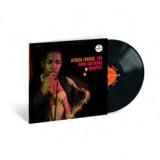
VERVE ACOUSTIC SOUNDS SERIE: komplett analog von Ryan K. Smith bei Sterling Sound von den
Originalbändern gemastert, QPR-Pressung (180 g), stabiles Tip-On-Gatefold (Stoughton Printing), wattierte Innenhülle.
“Africa/Brass”, im September 1961 veröffentlicht, war Coltranes erstes Album für das noch junge Label Impulse! Records. Das Werk markierte einen Wendepunkt in der Karriere des Saxofonisten und gilt laut dem
“AllMusic Guide to Jazz” als “Schlüsselwerk für das Verständnis des Weges, den John Coltrane in seiner
letzten Schaffensphase mit seiner Musik einschlug”. Für das im Studio von Rudy Van Gelder aufgenommene
und von Creed Taylor produzierte Album erweiterte Coltrane sein Quartett zu einem großen Ensemble mit
bis zu sechzehn Musikern. Coltranes leidenschaftliche, freie Improvisationen auf dem Tenor- und Sopransaxofon stehen dabei in reizvollem Kontrast zu dem kompakten, rhythmischen Sound des Blechbläser-lastigen
Orchesters unter der Leitung von Cal Massey. Die Arrangements für die Big Band wurden von Eric Dolphy
und McCoy Tyner erst während der Proben im Studio angefertigt
Search:sterling ensemble
- 1
- A1: Cloud Nine
- A2: I Heard It Through The Grapevine
- B1: Run Away Child, Running Wild
- C1: Love Is A Hurtin’ Thing
- C2: Hey Girl
- C3: Why Did She Have To Leave Me (Why Did She Have To Go)
- C4: I Need Your Lovin’
- D1: Don’t Let Him Take Your Love From Me
- D2: I Gotta Find A Way (To Get You Back)
- D3: Gonna Keep On Tryin’ Till I Win Your Love
The Temptations Get High on Psychedelic Soul: Cloud Nine Soars with Ambitious Arrangements and Production, Features Standout Vocal Performances and Instrumentation by the Funk Brothers
The Temptations’ Cloud Nine announced that Motown — and “The Sound of Young America” — would never be the same. Influenced by the emergence of cutting-edge rock and pop currents, as well as increasing sociopolitical turmoil, the album broke down barriers between rock, psychedelia, and soul while heralding the arrival of visionary arrangements and production techniques. Bookended by traditional R&B numbers, the 1969 record sent the Temptations in bold new directions and signaled the advent of psychedelic soul.
Sourced from the original master tapes, strictly limited to 3,000 numbered copies, pressed at Fidelity Record Pressing, and housed in a Stoughton gatefold jacket, Mobile Fidelity’s 180g 45PM 2LP set presents Cloud Nine in audiophile sound for the first time on a domestic pressing. This collectible reissue bestows Norman Whitfield’s extraordinary production with the grand-scale dynamics, natural tonality, expansive openness, and low-end weight it deserves. The timbre of each of the five members’ voices is readily identifiable — even within the group harmonies — bestowing a realism never experienced outside the recording studio.
Making its debut on 45RPM, the album further benefits from the wide groove space by playing with greater separation and more realistic presence than prior editions. Everything from the brassiness of the horns to the dry snap of the snare comes across with reference-grade clarity and positioning. And since Motown’s renowned Funk Brothers backing band plays on many of the cuts, you’ll want to savor every note. The imaging, soundstaging, and organic bloom-and-decay of the notes make that possible.
Amid Cloud Nine, the instrumentation and architecture stand out as much as any element. Never before had a Motown album contained such ambitious patterns and complex passages. Seemingly conscientious of the departure from their past methods, the Temptations and Whitfield bunched together the tracks that mark a deep dive into psychedelic territory and counterbalance them with seven sterling soul cuts that dovetail with Motown tradition drenched with heartfelt vocals, swelling strings, and finger-snapping beats.
On the original 33RPM release, traditional Motown soul — laden with heartfelt vocals, swelling strings, and finger-snapping beats — occupies Side Two. These songs reveal an ensemble still very much on top of delivering pristine pop-soul material graced with romantic sweetness, persuasive insistent, and soaring highs. Re-energized after the departure of lead singer David Ruffin, who was fired for a variety of reasons in June 1968, the Temptations seamlessly meld with his replacement, Dennis Edwards, on one melodic gem after another.
The collective tackles five songs co-written by the legendary Motown team of Barrett Strong and Whitfield. Not the least of which are the smooth, shuffling “Why Did She Have to Leave Me (Why Did She Have to Go)” and deceptively simple, horn-spiked “Gonna Keep on Tryin’ till I Win Your Love.” On these tracks, as well as on a lush rendition of the ballad “Love Is a Hurtin’ Thing” and pleading, tender send-up of the Gerry Goffin-Carole King classic “Hey Girl,” Edwards and Paul Williams take turns on the lead with the estimable Eddie Kendricks, Melvin Franklin, and Otis Williams providing backing support.
All five vocalists trade-off leads on the simmering title track, a groundbreaking composition shot through with wah-wah-pedal effects, liquid funk, deep bass lines, Cuban percussion, saturated reverb, and gang choruses. Whitfield mines each member’s natural vocal range with spectacular results, keeps time with cymbals, and channels both the heated temperatures and escapist desires of a society embroiled in war, conflict, and experimental drugs.
Amazingly, the Temptations top themselves on the similarly revealing “Run Away Child, Running Wild.” Nearly 10 minutes in length, the song explodes R&B parameters and harbors a cinematic scope. Urgent pianos, distorted guitars, stripped-down percussion, steamy Hammond organs, minimal bass motifs, five distinct voices narrating the tale of a boy who fled home and now finds himself amid the scary, unforgiving external world: They combine to give the urgent tune a walls-closing-in atmosphere where fear and desperation reign. Bolstered by an extended instrumental section that precedes a climactic return of the singers’ voices, “Run Away Child, Running Wild” equaled the success of the record’s title track, with both reaching No. 6 on the pop charts.
- 1: This Music
- 2: Endless Summer
- 3: Abe’s Flamenco (Ft. Franco Franco)
- 4: The Urban Solitude
- 5: E-System (Ft. Manonmars)
- 6: A Feeling
- 7: Close Ur Eyes (Ft. Birthmark)
- 8: Overdrive
- 9: Walking Home (Ft. D. Ham)
- 10: Sunday Morning
Love in the time of collectively assured techno-capitalist-nuclear holocaust! It’s the endless summer the Brits have been harping on about since they think they won the World Cup. The soundtrack is the debut album of the Content Provider; where Octatrack illbient and industrial chanson mesh in a singed postcard addressed to the UK Border Force and co-signed by aliens plucked from the petri dishes of Young Echo, Cold Light and Avon Terror Corps.
It’s a name she tried to keep anonymous, but Drowned By Locals and Bokeh Versions are breaking contract to reveal that the Content Provider is in fact the shock production alias of DALI DE SAINT PAUL. Patron saint of Bristol’s self-destructive improv idols EP/64 as well as post-feminist chamber collective Viridian Ensemble, avant-terror duo Harrga and constant collaborator with the likes of *breathe* Moor Mother, Valentina Magaletti, Mariam Rezaei, Vincent Moon, Maxwell Sterling, Ossia, Ben Vince.
And isn’t it such a strange release? And won’t people be surprised? Endless Summer is grubby and heartfelt, defiant and hopeful, with flecks of warped reggae on E-System nudging the freeform dream balladry of A Feeling and Sunday Morning, Kode9 & Spaceape-worthy dread poetry of Close Ur Eyes next to anthemic electro-crush of Overdrive. Even to those that know her well, and EVERYONE with their belly in the Bristol underground knows her, Endless Summer is a revelation. Perhaps the apex of the known Dali-verse……where her live gigs have boiled with an experimental volcanic vocal force, Endless Summer is twisted, syrupy, sultry, POP.
There's something spellbinding about Rhythm Rhyme Revolution’s seductive intensity and it’s all cleverly wrapped up in this rather sterling EP.
Summertime (nuacidfunk) slowly builds and changes tempo into a disco crescendo, in the style of Love Hangover, with Dan Lipman’s glorious jazz flute/sax weaving in and out of Gareth Tasker’s fantastic coral sitar riff that wouldn’t sound out of place on a Stylistics record.
The flipside - Sunshine Girl’s slinky Afro percussive groove builds pace as DJ Tabu merrily coos about making love in the sunshine and Barrie Sharpe’s vocal hooks chime in agreement:
bolstered by crisp guitar and Kenny Wellington’s jazzy mute trumpet darting around the sonic pool like a magnificent dragonfly. The arrangement has first class interplay and ensemble work too and the funky clavinet and bluesy electric piano really add to this slick
vibe.
Also on the flipside is the already established original version of Summertime from RRR LP #1 - which I can only compare to the Motown classics.
Sharpe is the master tease who builds a grand mood and positively revels in it. You will too,suffice to say, find this record is a real touch of class.
Emrys Baird (Blues & Soul)
- 1: Night In Tunisia
- 2: You're My Thrill
- 3: My Reverie
- 4: Stella My Starlight
- 5: Round Midnite
- 6: Jersey Bounce
- 7: Signing Off
- 8: Cry Me A River
- 9: This Year's Kisses
- 10: Good Morning Heartache
- 11: (I Was) Born To Be Blue
- 12: Clap Hands, Here Comes Charlie!
- 13: Spring Can Really Hang You Up The Most
- 14: Music Goes 'Round And 'Round
"Back in the 1990s original Verve pressings of this record were hot items pushed into prominence in great part by write-ups in The Absolute Sound, particularly by my friend Frank Doris. I found a few, and even a few in pretty good condition, but none of them begin to compare to this double 45 RPM set that offers more of everything, particularly transparency and instrumental separation. ...Ella's on a microphone with a slightly rising high end but if it sounds icy, don't blame the recording or the mastering. It's your system. If it's well-balanced and your cartridge is a good tracker, the vocal transparency and clarity are spooky and the sibilant articulation is precise. These double LPs cut at Sterling Sound use the original tapes, not copies of the original tapes and the clarity and transparency coupled with QRP's drop-dead silent pressings are remarkable. The original pre-MGM buyout LP has a pleasingly nostalgic quality and the added warmth produces a bit more room sound, but in my opinion it can't compare to this reissue unless you like hearing things through rose-tinted loudspeakers. Elegantly produced, arranged and recorded and easy to recommend ..." Music = 9/11; Sound = 9/11 - Michael Fremer, February 15, 2013.
Fourteen numbers from the heyday of swing, composed sometime between 1930 and 1945 - played and sung time and time again in ballrooms, or on the radio to advertise biscuits or war bonds, were recorded by Ella in completely new and personal interpretations in 1961. No one should be put off by the rather unfortunate cover. Clap Hands... is absolutely top notch as regards musicality, perfect recording quality, superb accompaniment by a small ensemble, with room for improvisations; it offers a wonderful opportunity to discover something new in these evergreens, despite the occasionally banal lyrics. The songs of this recording conjure up bygone days, with listeners in the 21st century being offered a highly personal homage to one of the most successful periods in the 100-year history of jazz.
VERVE ACOUSTIC SOUNDS SERIE: Stereo, komplett analog von Ryan K. Smith bei Sterling Sound von den Originalbändern gemastert, QPR Pressung (180 g), stabiles Tip-On-Gatefold (Stoughton Printing), wattierte Innenhülle.
Für das Album “Pre-Bird”, das später auch eine Zeit lang unter dem Titel “Mingus Revisited” zirkulierte, hatte Charles Mingus ausschließlich Musik aufgenommen, die komponiert worden war, bevor er das erste Mal Charlie Parker gehört hatte. Die Aufnahmen entstanden im Mai 1960 bei Sessions mit zwei Ensembles, die mit Stars gespickt waren: einem bunt schillernden 25-köpfigen Orchester und einem wendigeren Tentett.
Neben sechs älteren Kompositionen von Mingus standen zwei kontrapunktische Arrangements von Stücken aus der Swing-Ära auf dem Programm.
LP comes with a Side D etching in triple gatefold jacket + full album download. The Will to Live was produced by Titus Andronicus singer-songwriter Patrick Stickles and Canadian icon Howard Bilerman (Arcade Fire, Leonard Cohen, The Whole Nine Yards) at the latter’s Hotel 2 Tango recording studio in Montreal. Drawing on maximalist rock epics from Who’s Next to Hysteria, Bilerman and Stickles have crafted the richest, densest, and hardest hitting sound for Titus Andronicus yet. All at once, the record matches the sprawl and scope of the band’s most celebrated work, while also honing their ambitious attack to greater effect than ever before. “It may strike some as ironic we had to go to Canada to record our equivalent to Born in the USA,” quips Stickles, “but the pursuit of Ultimate Rock knows no borders. ”For his recent stretch of personal stability, he credits a newfound domestic bliss and steadfast mental health regimen (“Lamictal is a hell of a drug”) as well as the endurance of what has become the longest-running consistent lineup of Titus Andronicus—Liam Betson on guitar, R.J. Gordon on bass, and Chris Wilson on drums. On the crueler side of the coin, however, The Will to Live was created in large part as an attempt to process the untimely 2021 death of Matt “Money” Miller, the founding keyboardist of the band and Stickles’ closest cousin. Stickles explains: “The passing of my dearest friend forced me to recognize not only the precious and fragile nature of life, but also the interconnectivity of all life. Loved ones we have lost are really not lost at all, as they, and we still living, are all component pieces of a far larger continuous organism, which both precedes and succeeds our illusory individual selves, united through time by (you guessed it) the will to live.” “Naturally, though, our long-suffering narrator can only arrive at this conclusion through a painful and arduous odyssey through Hell itself,” he qualifies. “This is a Titus Andronicus record, after all.” When Titus Andronicus made their long-awaited return to the stage in 2021, it was to celebrate the anniversary of their landmark breakthrough The Monitor, and the act of playing that material before an ecstatic audience left the band determined to deliver an album that would reach for those same lofty heights, relying this time less on the reckless fire of youth and more on the experience and perspective at which a band only arrives with a thousand shows under their belt. Through this golden ratio, Titus Andronicus have arrived at the peak of their creative powers. From its adrenalizing opening instrumental “My Mother Is Going to Kill Me” to its wistful closing benediction “69 Stones,” The Will to Live conjures a vast landscape and sends the listener on a rocket ride from peak to vertiginous peak. Rock fans will find themselves a feast, whether they crave barn-burning rock anthems such as “(I’m) Screwed” and “All Through the Night,” rapid-fire lyrical gymnastics (“Baby Crazy”), symphonic punk throwdowns (“Dead Meat”), or an adventurous excursion into the darkness that delivers thrills as it breezes boldly past the 7 minute mark, “An Anomaly.” As if that wasn’t enough gas for the tank, The Will to Live features sterling contributions from members of the Hold Steady, Arcade Fire, and the E Street Band, as well as duets with the aforementioned Betson, former Titus Andronicus drummer Eric Harm, and Josée Caron of the Canadian rock band Partner. The album comes packaged with gorgeous triple-gatefold artwork by illustrious illustrator Nicole Rifkin, a Hieronymus Bosch–inspired triptych which mirrors the three-part structure of the narrator’s perilous voyage across the corresponding three sides of vinyl. All together, this esteemed ensemble, with Stickles and Bilerman determined and defiant at the helm, have found The Will to Live—now, the question is… will you?
SIDE A 1. My Mother is Going to Kill Me 2. (I’m) Screwed 3. I Can Not Be Satisfied 4. Bridge and Tunnel SIDE B 5. Grey Goo 6. Dead Meat 7. An Anomaly SIDE C 8. Give Me Grief 9. Baby Crazy 10. All Through the Night 11. We’re Coming Back 12. 69 Stones SIDE D Etching
- 1



