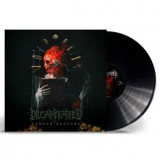
Across eight studio albums, DECAPITATED grew from the adolescent dream of teenagers from a small Central European town to one of the leaders of the metal genre. Each successive album further expands the band’s sound with genre-bending authenticity and integrity. As Metal Injection rightfully observed, “any self-respecting death metalhead knows the name well.”
DECAPITATED’s music is a weapon forged by four young men from a historic medieval-fortified town in Poland, which catapulted them to the top of a worldwide subculture. Like a rose in the devil’s garden, the DECAPITATED story builds triumph from tragedy. The gleeful grotesquery of extreme metal imagery and rifftastic bludgeoning beckons listeners to uncover broader truths.Upon the release of 2017’s Anticult, Metal Hammer declared DECAPITATED “a serious successor to the likes of Pantera and Lamb Of God – a band who can draw new legions into the metal world as its new champions.” Their diverse follow-up, 2022’s Cancer Culture, delivers on that promise.
Instantly recognizable devastation and deceptively sinister hooks abound. Freshly minted DECAPITATED anthems like “Last Supper,” “Hello Death,” “Just Cigarette,” “No Cure,” “Iconoclast,” and “Cancer Culture” shimmer with sonically sharp production and unrelenting bombast. There’s also a newly increased emphasis on melody, even venturing into darkly romantic territory. Wacław "Vogg" Kiełtyka (guitar), Rafał "Rasta" Piotrowski (vocals), Paweł Pasek (bass), and James Stewart (drums) are at the top of their game, delivering the goods at peak performance. Jinjer vocalist Tatiana Shmayluk and Machine Head frontman Robb Flynn make guest appearances.
Set on the descending plains of a mountain range amid a dense forest, Krosno boasts a 14th-century Gothic church, a Subcarpathian museum, and stunning artisan glassware. In this Polish town, teenage music student Wacław "Vogg" Kiełtyka discovered records from bands like Morbid Angel, Cannibal Corpse, Metallica, and Machine Head. The guitarist and his younger brother, drummer Witold “Vitek” Kiełtyka, cofounded DECAPITATED in 1996, inspired by a wide range of technical death, blackened thrash, and local heroes, like KAT and the world-renowned Vader. Death and black metal reigned supreme in the Polish scene of the 1990s, where Behemoth originated as well. In fact, a Vader song called “Decapitated Saints” inspired the band’s moniker.
The organic musical chemistry between the Kiełtykas was akin to the brotherly connectivity and vibe driving Pantera, Gojira, and the classic era of Sepultura. In 2006, Kerrang! praised the first three DECAPITATED albums - Winds of Creation (2000), Nihility (2002), and The Negation (2004) – as “superbly conceived and executed eruptions of technical brilliance and razor-sharp songwriting that turned these youthful Poles into one of the genre’s most widely respected bands.” That year’s Organic Hallucinosis further perfected Vogg’s penchant for blending extremity with catchy hooks.
The rule-breaking ferocity and invention of the first four albums reinvigorated death metal, as DECAPITATED inspired a new generation of bands who followed suit. Sadly, this era came to a shocking end in late 2007. While touring Russia, the band’s bus collided with a large truck near the border with Belarus. Both Vitak and then-singer Adrian “Covan” Kowanek sustained severe head injuries. Tragically, Vitak passed away in a Russian hospital a few days later. He was just 23.Vogg summoned the courage to continue, in honor of his brother and what they created, and returned with a new incarnation of DECAPITATED and the fiercely adventurous comeback album, Carnival is Forever (2011) featuring new vocalist Rafał "Rasta" Piotrowski. Blood Mantra (2014) introduced bassist, Paweł Pasek. Blabbermouth declared it “perhaps the most poised and gutsy” DECAPITATED album, adding “its courageous bends make it a turbulent but pleasurable ride.”
Cancer Culture sounds brilliant, modern, and tasty. “There is no place for any fake, plastic, bullshit drum machine or anything like that,” Vogg insists. “It’s all organic, pure, and clear, showing the true face of the band. Vogg and company entrusted the Cancer Culture mix to David Castillo at Sweden’s Fascination Street Studios / Studio Gröndahl (Sepultura, Carcass, Opeth, Katatonia), and legendary American producer Ted Jensen (Metallica, Slipknot, Pantera, Machine Head, Korn).
The devoted supporters who traveled to see DECAPITATED on international tours with the likes of Lamb Of God, Meshuggah, Soulfly, Fear Factory, and Suffocation over the years will recognize the ever-present pummeling backbone. Longtime fans and newcomers alike will connect to the variety of atmospheric depth throughout Cancer Culture’s ten boundlessly energetic and creative tracks.
“If you told me 25 years ago, in my neighborhood in the South of Poland, that I would be in Machine Head, sharing riffs with Robb Flynn,” Vogg marvels. “It’s simply incredible. It means that everything is possible in your life. That gives me the faith to believe that I can achieve even more in my career. The dreams we have when we are kids, things we can barely imagine, can happen.” Flynn contributes a hauntingly beautiful vocal to the Cancer Culture track “Iconoclast.” “Clean vocal singing is a really new thing in DECAPITATED,” Vogg notes. “It’s really unique and amazing.”
Driven by Vogg’s passion and integrity, the dual emphasis on creative invention and technical prowess maintains DECAPITATED’s stature as genre-leaders in 2022 and beyond. The band’s supporters continually demonstrate confidence and absolute certainty DECAPITATED will deliver.
Поиск:subculture
Все
While Bobby Oroza puts the finishing touches on his next album, he treats us to this killer two-sider to end out 2021 and hold us over until the new record is finished. Bobby's debut album "This Love" made big waves around the world and amassed him a cult following from the US to Japan and everywhere in between. He found big love in the sweet soul scene early, but has since made fans in a myriad of circles and subcultures globally. It has by now become clear that his music is not just one thing, analog soul textured for sure, but also with an array of influences that span far beyond the soul ballad world. It is that inability to really nail down his sound that has become the biggest charm, an esoteric and profound passion permeate the lyrics and vibe of everything about Mr. Oroza. This new 7" shows off two sides of Bobby's song writing, an upbeat number on the "plug" side and a heavy duty ballad on the flip. The A side "The Otherside" is an optimistic tune that Bobby humbly shares his story about the troubles we can create for ourselves and the possibility of having a change of mind that frees us from them. The track is equally encouraging with its sunny energy that carries an important message from Bobby to anyone who is struggling and can't see a way out. The B side "Make Me Believe" is another instant classic for the slowie enthusiasts. A moody, soul bearing, cry for help that comes off with a sweet- ness.
The underground music scene in Asia has experimented a notorious rise in the last years, Taiwan, Indonesia, Thailand or South Korea are more inside the radar than ever, contributing actively with amazing djs and super talented producers; creating an effervescence subculture where to keep an eye on.
Multifaceted producer Mogwaa is not an stranger anymore, awarded in 2021 with best electronic album of the year in South Korea, his versatility and skills have found a place in labels as "Klasse Records", "Spring Theory" or Sound Metaphors' "Bless You" among others.
We are glad to present one of the most awaited records on MM Discos; “Del Mar” is a bliss of fresh air, a story about all this little things that make us dream everyday. “The Sea” as the main actor of the movie orchested by Mogwaa and supported by crackles, waves and little islands where to get lost in.
Dutch symphonic metal band Delain released their third studio album We Are the Others in 2012 to positive reviews from music critics. The album title was inspired by the murder of 20-year-old Sophie Lancaster, whose murder was likely a hate crime due to her being part of the goth subculture. The album spawned two single releases: “Get The Devil Out of Me” and the title track, for which the band shot a music video that included many well-known people from the metal scene, including George Oosthoek, Sharon den Adel, Robert Westerholt and Rob van der Loo. The album features guest contributions by the likes of Burton C. Bell (Fear Factory) and Marko Hietala (Nightwish) and was produced by Jacob Hellner (aka Tripod), who is best known for producing most of Rammstein’s albums.
Summer at Land’s End is not an interlude or tangent for The Reds, Pinks & Purples but rather a perfect fourth movement following the albums Anxiety Art, You Might Be Happy Someday, and Uncommon Weather. As with these self-recorded records (the primary work of songwriter Glenn Donaldson), the songs on Summer at Land’s End were crafted slowly and then drawn together to make a unified statement. But here, and more than before, Summer at Land’s End combines Donaldson’s rueful pop sensibility with a parallel musical universe, one composed of pictures, dreams, and feelings without words. Even if the underlying theme of this collection is one of conflict or unhappiness, the vision of the music presents an escape to a new world, always fading in and out of sight.
For listeners who may not be familiar with Donaldson’s corner of San Francisco––the Richmond district––or the current wave of hazy, melodic DIY pop groups performing in the city, Summer at Land’s End pulls in images and scenes that feel like a collision of the mundane and the sublime of this present landscape. But settings such as these are the backdrop for personal narratives, expressed as a struggle with love, with companionship and the conflicts of home. With this record, The Reds, Pinks & Purples give less focus to the vanities of a subculture and more to the challenge of connecting with someone, to the ordinary goals of being human and finding harmony with others.
This deliberate saturation in drama and ambiance, along with some of Donaldson’s best songwriting to date, is what gives Summer at Land’s End its special class in the project’s discography. Of the album’s cinematic mood, Donaldson refers to films like Summer of ‘42 and the influence of the classic 4AD catalogue of the 1990s. This style informs much of Donaldson’s prior and current ventures of course (The Ivytree, Vacant Gardens, and a dozen projects in between) but now The Reds, Pinks & Purples have taken the mantle, embracing this instinct for instrumental or dreamier modes of pop songwriting. It’s a pleasure to experience Summer at Land’s End, as this record finds a thrilling balance between songs and sounds, instruments and voices, and the ironic twin poles of art and life.
“Thunderous, and yet somehow also reflective, this album offers a haunting dialogue between the musicians. Betamax drives the music with motoric rhythm, while Bell is seemingly searching for something more sophisticated.”
London’s avant-garde, attempted to master in his youth the delicate art of the Shakuhachi - the infamously difficult-to-play bamboo flute that whiffs of a certain Japanese Zen aroma. After many years of travelling south east Asia in the 70s, seeking out the teachings of many flute and reed traditions, Clive Bell eventually gave up his quest and returned to London exhausted and confused. Horrified by the omnipresent egos of popular music, he was drawn back towards the dark currents of London’s free-improv gutter, where upon he was encouraged by his peers to live in a squat, and participate in abrasive noise experiments typical of the London improvising epidemic that persisted throughout the 80s.
Whilst immersed by this subculture, Bell was to bear his only child that we know of to this day - Maxwell Hallett, later to be known as ‘Betamax’. Bell immediately refused to teach any music to Betamax, hoping greater things and opportunities might lead Max away to a more financially comfortable and spiritually rewarding occupation. Alas Clive was unable to protect his son from the strong seductive forces of London’s prevalent musical subcultures.
For RE:WARM 007 We present Lucky Mereki - You Got Me Dancing. Originally released on Accord Music back in 1991 officially licenced via Gallo Music, remastered & presented in its original sleeve design for RE:WARM records.
Now here’s a record we felt had been criminally overlooked until now, despite Lucky still being an active musician of over 30 years and still producing music in his home country of South Africa. This is sadly so often the case for many artists of the time. Thankfully the resurgence in Bubblegum Pop, Afro Boogie, Kwaito, House & Pantsula over the last decade or so has given a new lease of life to some overlooked music from the late 80s & 90s Township subcultures from S.A. We think this one fits that Pre-Kwaito bill nicely, the genre that led a township subculture into the mainstream. Its sweet, its sensitive, its hopeful with very infectious rhythms and synth lines throughout, reflecting better times ahead as a new future starts to emerge from a post-apartheid South Africa.
Constructed from the brains and limbs of Wayne Adams and Henri Grimes, Big Lad is difficult to frame in words and perhaps much better served by their actions. Their live show having been continually captured, cropped and chopped over the years since their formation in 2015.
The project was rather appropriately founded off the back of a chance email, when Drummer Grimes (formerly Shield Your Eyes) suggested that the duo collaborate on a crossover project, having heard Adams’ vast Breakcore back catalogue. Adams had, somewhat serendipitously, been busy writing a Drum Trigger programme shortly before the email had hit his inbox and he jumped at
the chance to test the creation in a practice room. With Grimes strapped into this new system, songs started to appear thick and fast, and Big Lad was swiftly born.
2015’s recorded debut announced their collaboration, consciously marrying the collective excitement of both underground Punk and Electronic subcultures. 2018’s Pro Rock saw Big Lad extend the euphoria of their live show, using primal energy as an antidote against the jargonistic culture of our present.
After a year away from the heat of the stage lights, 2021 sees the triumphant return of the duo, announcing a brand new LP titled Power Tools. It’s a collection that sits as an unashamed monument, chiselled and stripped back to present the raw strength of what Big Lad has become. The results range from more familiar high octane tracks that nod to history of the rave community, to more brooding moments that appear (and vanish) like the ghosts of warehouses long since vacated.
Don Tiki, the leaders of exotica's turn-of-the-21st-century revival, bring their soundtrack for a Technicolor Polynesian pop paradise to Aloha Got Soul in 2021.
Each LP includes a pair of custom Don Tiki 3D glasses.
Don Tiki debuted from Honolulu in 1997 with the album, 'The Forbidden Sounds of Don Tiki', featuring the legendary Martin Denny in what would become one of his final recordings before his passing. The group, led by Fluid Floyd (Lloyd Kandell) and Perry Coma (Kit Ebersbach), draws inspiration from the original masters of the exotica sound, Denny, Arthur Lyman and Les Baxter, to bring such evocative music into the 21st century.
Following 'The Forbidden Sound', Don Tiki's recordings further deepened the group's reverence for and exploration of the poly-rhythmic, mid-century sounds pioneered by Denny, Baxter, and Lyman. Those albums, originally available on compact disc, include 'Skinny Dip with Don Tiki' (2001), 'South of the Boudoir' (2009), 'Don Tiki's Hot Lava Holiday Songs' (2012), and a remix album entitled 'Adulterated' (2004).
'Hot Like Lava' collects the group's top instrumentals for an exhilarating, paradisiacal ride through the world of tiki subculture on lava-colored vinyl.
About Don Tiki:
"Tiki supergroup Don Tiki knows the world, the subculture of tiki…it really doesn’t get much better than this!” ~ Anthony Bourdain, No Reservations
"Don Tiki is providing the soundtrack for this Technicolor projection of a Polynesian pop paradise." ~ Sven Kirsten/The Book of Tiki
"A great band from Hawaii, friends of ours...keeping the spirit of Martin Denny alive." ~ Jimmy Buffett
Don Tiki is:
Kit Ebersbach – keyboards, bandleader
Lloyd Kandell – producer, congenial host
Lopaka Colon - congas, bongo, bird calls
Hai Jung - bass, vocals
Sherry Shaoling – vocals, dancer
Abe Lagrimas, Jr. – vibraphone, percussion
Ryoko Oka - keyboards
Bonny B. - drums
Tim Mayer – reeds
Violetta Beretta – dancer, costumer, vocals
First-ever vinyl issue of this killer comp from 94 (Cherry Red)
Side A/B oxblood, Side C/D milky clear. Comes with 18x24 folded poster. Spanning 4 sides of vinyl you'll hear one of the finest deathrock/goth/new wave bands of all time with songs from EPs/12"s/demos from 1983-1985. It's a release not to miss.
Formed in Keighley, West Yorkshire, during the Post Punk of early 1980’s out of the band ‘The Elements”, took their name from the title of the song “Chant of the Ever Circling Skeletal Family” from the 1974 David Bowie album, Diamond Dogs.
Something unique was brewing up a dark and broody storm in West Yorkshire at the time with bands like The Sisters Of Mercy, The March Violets, Red Lorry Yellow Lorry, Southern Death Cult (later became The Cult) forming the basis of what became the soundtracks to the Goth Subculture.
Skeletal Family soon gained popularity in the UK Independent Charts and furiously gigged the length and breadth of the UK and Europe, recorded tracks for the John Peels Sessions, supported The Sisters of Mercy during their 1984 Black October tour, released 2 studio albums ‘Burning Oil’ (1984) and ‘Futile Combat’ (1985) of which saw the release of Skeletal Family’s most successful single ‘Promised Land’ on Red Rhino record label.
Anne-Marie left Skeletal Family in 1985 to form Ghost Dance with Gary Marx, former guitarist of The Sisters Of Mercy.
One can’t overstate the size of the Fear Factory boot print on the neck of heavy metal. Unleashing influential albums with devastating anthems for over 30 years, Fear Factory is widely recognized as both crucial and innovative in extreme metal circles. Fear Factory manufactured, demanufactured, and remanufactured a sound that reverberates across several subgenres. They perfected an explosive blend of staccato paint-stripping riffs, industrial-tinged drums, electronic flourishes, and a scream/sing dichotomy, all of which became staples in heavy music, ever since the group first emerged in L.A.
Fear Factory headline major festivals; earned several awards from the international sales charts; toured with Black Sabbath, Slayer, Iron Maiden, and Metallica; and influenced generations of bands. But it’s the group’s commitment to unrelenting extremity and creative authenticity which ensured its place in heavy metal history, from the highly-revered Demanufacture to the similarly dominating Genexus. Songs like “Zero Signal,” “Shock,” and “Fear Campaign” are instantly recognizable anthems, as much a part of the musical DNA of modern metal subculture as the riffs and scream/sing style within them.
Fear Factory records are cinematic in scope; sonic landscapes, echoing the dystopian post-apocalyptic futures found in classic sci-fi literature and films, from Ray Bradbury to Blade Runner. Aggression Continuum, the tenth studio album, is the culmination of three decades of unforgettable songs, performances, and forward-thinking storytelling concepts, while simultaneously rebooting Fear Factory onto a brilliant and excitingly unpredictable new path. Like the liquid metal T-1000 in the Terminator franchise or the Academy-Award winning reboot of Mad Max, Aggression Continuum is a turning point where what “was” transforms into what will be. It’s Fear Factory’s own Fury Road.
Aggression Continuum boasts the definitive attack of songs like “Recode,” “Distruptor,” and “Purity.” The riffs, concepts, and passion remain strong, as Fear Factory celebrates its past, present, and future. Whatever may come, Fear Factory will be there, a soundtrack to humankind’s uncertain times ahead.
Dutch symphonic metal band Delain released their third studio album We Are the Others in 2012 to positive reviews from music critics. The album title was inspired by the murder of 20-year-old Sophie Lancaster, whose murder was likely a hate crime due to her being part of the goth subculture. The album spawned two single releases: “Get The Devil Out of Me” and the title track, for which the band shot a music video that included many well-known people from the metal scene, including George Oosthoek, Sharon den Adel, Robert Westerholt and Rob van der Loo. The album features guest contributions by the likes of Burton C. Bell (Fear Factory) and Marko Hietala (Nightwish) and was produced by Jacob Hellner (aka Tripod), who is best known for producing most of Rammstein’s albums.
LTD. BLUE SEAGLASS WAVE TRANSLUCENT VINYL
Last spring, Devendra Banhart and Noah Georgeson started to make a record that was like nothing they had made before _ an ambient album that would be both a haven from a suddenly terrified world and a heartfelt musical dialogue between two artists who have been friends and collaborators for over two decades. Refuge is an album of profound meditative beauty which offers the listener a much-needed sense of peace and renewal. But while it was recorded in 2020 its roots go back much further _ all the way to the start of their friendship and, beyond that, to the shared sounds and ethics of their childhoods. Devendra grew up in Venezuela while Noah, six years older, is a native of Nevada City, California. But as they got to know each other, they realised that they had a similar history in the New Age subculture of the 1980s: a world of meditation, Eastern music, the Bhagavad Gita and The Whole Earth Catalog. Childhood memories were coloured by the aromas of health food stores and the sound of New Age labels like Windham Hill Records. Noah, whose production and mixing credits include Joanna Newsom and the Strokes, came on board as co-producer of Devendra's 2005 album Cripple Crow and they have been working together ever since. It was while making Devendra's 2019 album Ma that the pair finally decided to make their ambient record. Despite complicating logistics, 2020 created an emotional craving for music with this contemplative, therapeutic quality. Inspired by both memories of the past and the needs of the present, Refuge is an act of companionship and generosity which gives the listener room to breathe. "We're hoping to create a sense of comfort and coming back to the moment," Devendra says. "It's really important to have a little bit of space between us and our anxieties and impulses. What you do with that space is up to you." Dorian Lynskey May 2021
LTD. BLUE SEAGLASS WAVE TRANSLUCENT VINYL
Last spring, Devendra Banhart and Noah Georgeson started to make a record that was like nothing they had made before _ an ambient album that would be both a haven from a suddenly terrified world and a heartfelt musical dialogue between two artists who have been friends and collaborators for over two decades. Refuge is an album of profound meditative beauty which offers the listener a much-needed sense of peace and renewal. But while it was recorded in 2020 its roots go back much further _ all the way to the start of their friendship and, beyond that, to the shared sounds and ethics of their childhoods. Devendra grew up in Venezuela while Noah, six years older, is a native of Nevada City, California. But as they got to know each other, they realised that they had a similar history in the New Age subculture of the 1980s: a world of meditation, Eastern music, the Bhagavad Gita and The Whole Earth Catalog. Childhood memories were coloured by the aromas of health food stores and the sound of New Age labels like Windham Hill Records. Noah, whose production and mixing credits include Joanna Newsom and the Strokes, came on board as co-producer of Devendra's 2005 album Cripple Crow and they have been working together ever since. It was while making Devendra's 2019 album Ma that the pair finally decided to make their ambient record. Despite complicating logistics, 2020 created an emotional craving for music with this contemplative, therapeutic quality. Inspired by both memories of the past and the needs of the present, Refuge is an act of companionship and generosity which gives the listener room to breathe. "We're hoping to create a sense of comfort and coming back to the moment," Devendra says. "It's really important to have a little bit of space between us and our anxieties and impulses. What you do with that space is up to you." Dorian Lynskey May 2021
- 1: Don’t Ever Pray In The Church On My Street (02:46)
- 2: I Hope I Never Fall In Love (0:56)
- 3: The Biggest Fan (02:47)
- 4: Uncommon Weather (01:5)
- 5: A Kick In The Face (That’s Life) (02:01)
- 6: I Wouldn’t Die For Anyone (02:35)
- 7: I’m Sorry About Your Life (02:05)
- 8: The Record Player And The Damage Done (02:22)
- 9: Pictures Of The World (03:11)
- 10: Life At Parties (02:52)
- 11: Sing Red Roses For Me (03:54)
- 12: The Songs You Used To Write (02:49)
- 13: Sympathetic (03:11)
From the many musical lives of artist Glenn Donaldson emerges The Reds, Pinks and Purples, a project that sifts out the purest elements of pop music and in the process chronicles the point of view of an assiduous San Francisco-based songwriter. The Reds, Pinks and Purples’ third album, called Uncommon Weather, is both an elusive portrait of San Francisco––during one of its fluctuations as an untenable place for musicians and artists––and also a self-portrait, however inverted, of a songwriter who has dispatched another treasured collection of timeless sounding DIY-pop songs.
How The Reds, Pinks and Purples arrived here is a story with many roots, the most consequential of which is perhaps the musical aftermath of his earlier band, The Art Museums, whose brief tenure in the late ’00s coincided with an explosive period of the Bay Area rock scene and was followed by a hermetic musical period of Donaldson’s. Disenchanted with the dissolution of his band, Donaldson averted the DIY-pop sound with an instrumental, conceptual project called FWY! but meanwhile started a habitual songwriting practice, sharing nascent songs with friends in an email exchange. In 2013–2014, The Reds, Pinks and Purples took shape as the moniker for Glenn’s most direct expressions in the DIY-pop mode, enabled by this new disciplined output. By then, San Francisco was already a changed place. The tragic loss of his former bandmate in Art Museums was another source of discontinuity and rupture. You can hear in The Reds, Pinks and Purples’ earliest songs this grappling with life, anxiety, and atrophying subcultures. For an artist with an overriding interest in the aesthetic principles of discrete musical genres, this turn toward his immediate world for subject matter was a major shift, setting The Reds, Pinks and Purples apart from Donaldson’s other musical ventures.
Preceding the release of Uncommon Weather was the Reds, Pinks and Purples’ 2nd album, one of the record buying joys of 2020, You Might Be Happy Someday, and, earlier, their first proper full length Anxiety Art, a title that might nod to the classic Television Personalities song “Anxiety Block.” Donaldson’s music continuously reckons with the influence of Dan Treacy, whose own forays into drum-machines, echo, and reverb in the early 1990s is an important reference point for The Reds, Pinks and Purples’ musical template. Paul Weller, Robert Smith, and Sarah Records also come to mind. But, as important, Donaldson sees his projects as visual expressions too, often blurring the lines of records and physical art objects. They could just as well be “art multiples” as well as records. The pattern for Reds, Pinks and Purples’ records is to document San Francisco’s Inner Richmond district in photographs: the muted, pastel colours and unpeopled compositions unfold in a series of images that read like counter-melodies to Donaldson’s distinctive voice, a vocal tone that always complements the colours.
Self-recorded and mostly self-performed, Uncommon Weather features pinnacle versions of songs Donaldson has honed since the beginning of the project. The album arrives with grateful timing, quick on the heels of You Might Be Happy Someday, and alleviating, for a brief window at least, whatever it is that keeps us coming back to this elemental music. Donaldson imagines his listeners are just like himself: fascinated and addicted to the spiritual power of uncomplicated pop classics. Anthony Atlas
Land of the Free? with revered classic songs like the incendiary “F*ck
Authority,” was a wake -up call from Pennywise, aimed at the slumbering
masses of America, an attempt to shake people out of their lethargy and
prod them into thinking about the world.
Originally released in June 2001, the band’s six studio album tackled the political and social issues of the day, from police corruption and mass shootings to
elections, topics that 20 years later are just as relevant.
Pennywise have made a name for themselves over the past 33 years as a politically minded, melodic hardcore /punk band that has sold millions of albums
and become one of the most successful independent acts of all time.
Formed in 1988, the band played backyard parties in their hometown of Hermosa Beach, California, without having any aspirations other than playing as
many songs as they could before the police showed up. Hermosa Beach and
the surrounding neighborhoods are a prominent place in popular culture, with
groups like Black Flag, The Circle Jerks and Descendents merging a fast rebellious sound with the surrounding aggressive surf and skate culture.
Inspired by their predecessors, Pennywise were at the forefront of a second
wave of American punk rock that would catapult the movement from a tightknit subculture into a worldwide movement.
How would Roc Marciano and MF Doom sound if they were born in Athens to immigrant parents?
MC Yinka & DJ Booker provide an answer by teaming up to bring us their first LP “Night Lights”.
MC Yinka finds inspiration in blighted areas, urban struggles and multicultural subcultures. With a unique and characteristic voice, he touches on various social and spiritual matters and concerns.
Night Lights is fully produced by DJ Booker who surprises with his sample selection and the overall approach on the production. He balances between trippy and minimal sounds with dark and abstract samples. The beats vary from broken to “J Dilla – inspired” rhythms to discreet patterns that trigger the imagination and the expectations of the audience.
Not to mention the scratching skills of DJ Booker which spice up the music production and established him as one of the best scratch DJs in Europe according to British magazine “Undercover Hip-Hop”.
The album features one of the most “conscious” MCs, Mr. Lif, well known for his collaboration with the Thievery Corporation, and the hip-hop street performers Twinsanity who call our attention to the raw reality from Athens to Boston.
Night Lights will be released on vinyl by the label Mind The Wax in February 26th, 2021 and includes 10 tracks.
Cormac is pleased to announce the second release on his new record label Polari, the label he curates and through which he shares music from artists that he champions in his muchrevered DJ sets.
The name “Polari” references the slang used by the gay subculture in the 19th century.
The sophomore release is from Philadelphia based duo Zillas on Acid.
2019 was the year Zillas made the transition from DJs to break-out producers. Having honed their DJ skills at Philadelphia’s revered MAKING TIME clubbing institution, Thomas Roland and James Weissinger have released two EPs on Optimo Music and also on Ivan Smagghe’s Les Disques de la Mort in the past 12 months.
Cormac has also opted to showcase different LGBTQI+ visual artists' work for the sleeve art.
Artwork on this release is from SHREK 666; an Artist, Performer, Maker & DJ also known as Sorcha Clelland. Creator of Ministry of Pound, a Glasgow based Fetish Party & Mag and resident performer at Scotland’s most loved Queer party Shoot Your Shot. Combining
monstrosity, trans*ness & hypersexuality through the embodiment of an ogre creating new queer worlds.
- A1: Miami - Chicken Yellow
- A2: The Sunshine Band - Black Water Gold
- A3: Freedom - Get Up And Dance
- B1: Joe Thomas - Polarizer
- B2: Herman Kelly & Life - Dance To The Drummer's Beat
- C1: T-Connection - Groove To Get Down
- C2: George Mccrae - I Get Lifted
- C3: Queen Samantha - Take A Chance
- D1: Ralph Macdonald - Jam On The Groove
- D2: Blowfly - Rapp Dirty
Presenting a collection of stone-cold classic breakbeats and b-boy jams from the sunkissed vaults of Miami's legendary TK Disco label!
NYC in the late 70's and early 80's saw a nascent street subculture fully evolve, a movement with it's own language, art, aesthetics, dances, fashion and way of living.
What would become what is now globally known as 'hip-hop' was in its infancy, with it's own legends and history being forged on an almost daily basis across the city's Black and Hispanic neighbourhoods. Music was central to hip-hop, the DJ was king and at the hands of people like Kool Herc, Grandmaster Flash, Grandmaster Flowers, Mean Gene, Jazzy Jay, Afrika Bambaataa, Charlie Chase and numerous other groundbreaking DJ's of the era, music took on a whole new meaning that would reverberate through popular culture for the rest of time.
The breaks - minute sections or breakdowns of a record where we get to the unadulterated groove and the band on the record cut loose - is what it was all about! Unlike the discotheque DJ's who favoured the long mixes and blends in their club scenarios, hip-hop DJ's were amassing huge collections of records that had these magical sections on them, often x 2 copies of each, so that they could elongate the best part of the record ad infinitum by cutting them up live - all killer no filler! These special on the fly mixes and edits were then unleashed in the local parks of their neighbourhoods, on gargantuan DIY sound systems for all of their friends and neighbours to party on down until the wee small hours. These breakbeat segments also gave the MC's space to address the gathered masses without their voices colliding with lavish string arrangements or vocals underneath. A clear, concise, stripped back slab of funk on which to put forth their ideas, feelings and rhymes for all to enjoy.
Collected here are some of those most infamous breakbeats, all from the TK vaults. These records were studied by these young DJ's, coveted, covered up, hunted down, whispered about in darkened corners by those who needed and obsessed over the freshest of beats. There's a good chance you will have heard these records in some form or another as they have been covered, sampled, recreated and spun in clubs across the galaxy for over 4 decades. These are the very building blocks upon which popular culture and club music have been built, and here they are all in one place for your listening enjoyment!
Released with love and respect by: Above Board and TK Disco, Miami FL. 2020.
- A1: Berserk In A Hayfield - After Dusk
- A2: The Lord - Controversial
- A3: Silicon Valley - Electro Switch
- A4: Neutron Scientists - Cabaret Futurama
- A5: Lives Of Angels - Artificial Ignorance
- B1: Modern Art - Golden Corridor
- B2: The Lord - Gonna Dream My Life Away
- B3: Echophase - Controlled Experiment
- B4: Disintegrators - Radioactive
- B5: Mystery Plane - Burning Desire
- B6: Modern Art - Dimension 2
Here is the highly anticipated sixth volume of the well received electronic compilation series from the relaunched 1980's color tapes label. As with the other volumes you can find great examples of cold wave, minimal wave and synth electronics and pro to EDM made by obscure British bands in the 1980's such as: Berserk In A Hayfield, Lives of Angels, Silicon Valley, Modern Art, Disintegrators, Echophase, The Lord and Mystery Plane
"Up there with V-O-D selections, the Color Tapes series so far has provided invaluable insight to hidden or much lesser-known currents of the ‘80s cassette subculture which gave birth to myriad artists, styles and industry conventions whose influence can still be felt over 30 years later. " - Boomkat
“Electronic work that’s way different from mainstream pop of the period - often forgedout of the same instrumentation as the hits - but in a stripped down way - with lots of dark and moody corners!” Dusty Groove
“Evil Synths and evil beats” - Norman Records
“Gary Ramon’s re-born Color Tapes imprint is every bit as essential as it’s Minimal Wave and electro-focused predecessors” - Juno
Limited edition of 500 copies comes with poster insert


