The Last Question is the first album by electronics master Tim Clark. It collects his early works, when he was the Music Director of the Strasenburgh Planetarium in Rochester, N.Y. These tunes were the soundtrack to the planetarium’s adaptation of Isaac Asimov’s The Last Question short stoy. The idea was conceived by Von Del Chamberlain, director of teh Abrams Planetarium, and was taken to fruition in a joint venture bewtween the Abrams and Strasenbergh Planetariums, were the shows were premiered in 1972.
Clark composed and produced the works in the Strasenberg Planetarium’s own sound studio, equipped with three Ampex 440 recorders, a 4-channel mixing board with 18 inputs and a Moog Synthesizer. The album was released as a private pressing in 1973 and it has since become an elusive collector’s piece among electronic music afficionados. Comes with remastered sound and straight reproduction of the original artwork.
ULTRA RARE OUTER SPACE PRIVATE PRESS!
RIYL : Tonto’s Expanding Head Band, Iasos, Peter Davidson, Michael Stearns, Steve Roach...
Buscar:t quest
The Last Question is the first album by electronics master Tim Clark. It collects his early works, when he was the Music Director of the Strasenburgh Planetarium in Rochester, N.Y. These tunes were the soundtrack to the planetarium’s adaptation of Isaac Asimov’s The Last Question short stoy. The idea was conceived by Von Del Chamberlain, director of teh Abrams Planetarium, and was taken to fruition in a joint venture bewtween the Abrams and Strasenbergh Planetariums, were the shows were premiered in 1972.
Clark composed and produced the works in the Strasenberg Planetarium’s own sound studio, equipped with three Ampex 440 recorders, a 4-channel mixing board with 18 inputs and a Moog Synthesizer. The album was released as a private pressing in 1973 and it has since become an elusive collector’s piece among electronic music afficionados. Comes with remastered sound and straight reproduction of the original artwork.
ULTRA RARE OUTER SPACE PRIVATE PRESS!
RIYL : Tonto’s Expanding Head Band, Iasos, Peter Davidson, Michael Stearns, Steve Roach...
- A1: Live Fast Die Free
- A2: Old Friends
- A3: Julie Ann
- A4: Side By Side
- A5: Something Different
- B 1: Big Questions
- B2: Can’t Let Go
- B3: Sunday Morning
- B4: Hard We Fall
- B5: I Am Free
"• Brand new act formed and fronted by Cormac Neeson of The Answer.
• Neeson gathered together a stellar cast of Northern Irish musicians steeped in the alternative folk, Americana, blues and rock scenes to form California Irish.
• Recorded using analogue techniques straight to tape in just four days, ‘The Mountains Are My Friends’ is a love letter to the Laurel Canyon-era West Coast of the 60s and 70s.
• Debut single ‘Big Questions’ leads the campaign and is released on March 28th. Two more singles to follow.
• The band recently made their live debut and will headline Belfast Empire on May 16th
• Neeson has enjoyed global success with The Answer, including world tours supporting AC/DC, UK Top 30 albums, UK No.1 Rock Albums and appearances at major festivals across Europe.
• Full press and radio campaign for the UK in place, with dedicated Irish promo team in addition.
• Full digital marketing campaign has been underway since the turn of the year, gathering over 2000 people onto the California Irish mailing list even before any music has been released
"
- Bells
- Disappears
- The Slide
- Answer
- Love Or Worship
- So Far (Feat. Leng Bian)
- Brick Or Stone
- New Flavor
- The Letter
- The Staircase
A lush, energizing contemporary pop record, built on heart-swelling minimal/maximal electronic production + deep feels. Reality"s breaking and rebirth is happening, one day at a time - essential asks deconstructed and refitted in new ways. Unconventional songwriting/performance duo Sharpie Smile ride inspired waves of futurist sound art, a dreamy, ethereal vision-quest through serpentine soul-terrain. RIYL: SOPHIE, 100 gecs, Ouklou
Corbin (FKA Spooky Black) makes captivating, honest, and raw music that harkens back to the days when the singer-songwriter’s artistic vision prioritized vulnerability over image. The St. Paul, Minnesota native came to prominence during the rise of the SoundCloud gold rush, helping to influence the new generation of Gen Z songwriters. Songs such as the haunting portrait of addiction “Diazepam”, and his battle with insecurity and instability in relationships “ICE BOY”, showed off his ability to connect with the plight of modern adolescence. But it was the internet-breaking, classic ballad of yearning “Without You”, that inspired a generation of disaffected and abandoned adolescents, serving as a soundtrack to make the alienated feel a little less alone. He’s attracted some of the biggest names in music, featuring on songs with Chief Keef, Trippie Redd, and The Kid Laroi, among others. With his latest record, Crisis Kid, Corbin dials back the angst in favor of an intimate vocal style that sounds like he’s reading his diary from a candlelit cabin. A more polished and refined version of Corbin resurfaces as he contemplates collective suffering, generational trauma, and the quest to find hope during the bleakest timeline, offering a voice for the voiceless.
TAMTEN, the master storyteller behind the synthesizers, extends his invitation to every curious listener to ponder the same questions that haunt him throughout his peculiar career: what impacts the sound of an era? How are we shaped by what we hear and see? Do we channel our collective feelings of longing and desire for higher purpose in accord or in opposition to major historical and political forces?
On "Wschodnia Fala: The Reimagined Vision of Eastern-European Wave Music" TAMTEN takes us on a kaleidoscopic voyage through a parallel universe where the symbols and echoes of days gone by are so much more than just archived exhibits of nostalgia. Through an array of meticulous, cut & paste rearrangements, the Warsaw-based artist manages to animate yet another fantastic world of "what could be", following his more apocalyptical take on the previous LP.
There is boldness in every aspect of the release. The saga-like story unfolds evoking the excitement of seashore autobahn ride, thrills of long-forgotten discotheque nights, rush of obsessive romance and intriguing, noir-inspired drama of introspection. The analogies between Polish wave music (with nods to Aya RL, Republika, Klaus Mittfoch, Papa Dance or even Bajm) and global disco-era top chart phenomenons like Kraftwerk, Grace Jones, Giorgio Moroder and Duran Duran, could spark hour-long musicology debates. The melodies and harmonies heard on the album resemble compositions everybody knows but also sound completely new and exhilarating, just as western music clips experienced for the first time behind the Iron Curtain and then collected compulsively on VHS tapes. The feeling of the author's frenetic attempt to capture sensations, memories, artifacts and ideas never escapes the listener till the very last minute of the recording.
"Wschodnia Fala" could pass for an eerie, anonymous late 80s lost-and-found cassette mixtape unearthed on any of the Berlin Wall's sides, if it wasn't for its crystal-clear, contemporary production value and the fluent, educated use of samples ranging from bizarre and opaque to deliberately retro-pop-influenced. Those elaborate winks of the eye for those in the know are already TAMTEN's trademark and they reflect his long-standing fascination with the dancefloor anthropology rather than just the dancefloor itself. Even though never leaning towards formulaic, easy-to-mix, club-ready stompers, his ideas are still groovy enough to make anyone move.
The album strives for some sort of unattainable totality - it's a ticket to a seance, an experience, a rite. It is a chance to time travel and dance with your ancestors in a glass labyrinth on acid or to watch an 80s teenage adventure, coming-of-age, road cruising film in the cinema of your imagination with only a soundtrack provided. A "the best of" CD compilation of hits from a childhood we remember from a different timeline. A comic book sketch, a diary of an archivist, an elegy for the times that never were and a party you wish you could go to right now. The adventure is always different with another listen.
Step in. Close your eyes. Reimagine.
Embrace the wave
- Osmium 0
- Osmium 1
- Osmium 2
- Osmium 3
- Osmium 4
- Osmium 5
- Osmium 6
- Osmium 7
Limited edition white vinyl (800 copies) The self-styled ritualistic electro-mechanical ensemble OSMIUM is a veritable supergroup. Made up of Oscar-winning composer and instrumentalist Hildur Gudnadóttir, veteran engineer and producer James Ginzburg, Senyawa's idiosyncratic vocalist Rully Shabara and Grammy-winning sound designer / producer Sam Slater, while each member brings along a laundry list of accolades, the project is far greater than the sum of its parts. Alloying burnished electroacoustic soundscapes with dense, metallic drones, barbed rhythms and buckled, bio-mechanical vocalizations, OSMIUM's eagerly awaited debut album doesn't try to cast a rigid future. Rather, it tempers a viscous flow of unorthodox speculations that smolders through the distant past, blazing a trail all the way to the frontier of fate. Absorbed by questions about the relationship between humans and technology, tradition and progression, the individual and the group, OSMIUM channel their experience and expertise into a set of forward-thinking sonic interrogations that skewer established cultural preconceptions. And although genre is acknowledged - the album draws from folk, doom metal, 20th century minimalism, industrial music and extreme noise - there's never a sense that it's riveted firmly in place. Widely known for her soundtrack work (including `Joker' and `Chernobyl') Gudnadóttir plays the halldorophone, a unique cello-like electroacoustic instrument designed by Halldór Ulfarsson that allows the performer to harness unstable feedback loops. Taking his cues from this process, Slater (who has worked alongside Jóhann Jóhannsson, Ben Frost and others) generates rhythms using a self-oscillating drum he designed with KOMA Elektronik and Subtext boss and Emptyset member Ginzburg responds in kind, producing booming tambura-like sonorities from a device he developed himself based on the monocord, an ancient single- stringed resonator. OSMIUM synchronize the three unique instruments using a custom system of robotics to generate basic rhythms that underpin their improvisations and experiments, and Shabara's alien tones supply the band with their conceptual fulcrum. The vocalist is one of South Asia's most recognizable underground artists, and the sounds he's able to create using exhaustively rehearsed extended techniques are so distinctive that he's been studied by scientists back home in Indonesia. Never weighed down by needless sound design or modish ornamentation, it's music that feels authentically experimental; OSMIUM have figured out an awkward symmetry between their discrete approaches, concentrating their gaze on the outcome rather than the process. The result is a work of science fiction that's driven by interaction, conversation and sensation.
- A1: Shelter Song; Lyrics By – Bagshaw*; Mixed By – James Bagshaw*
- A2: Sun Structures; Lyrics By – Warmsley*
- A3: The Golden Throne; Lyrics By – Bagshaw*
- B1: Keep In The Dark; Lyrics By – Warmsley*
- B2: Mesmerise; Lyrics By – Bagshaw*
- B3: Move With The Season; Lyrics By – Bagshaw*, Warmsley*
- C1: Colours To Life; Lyrics By – Bagshaw*, Warmsley*
- C2: A Question Isn't Answered; Lyrics By – Bagshaw*, Warmsley*
- C3: The Guesser; Lyrics By – Bagshaw*
- D1: Test Of Time; Lyrics By – Bagshaw*
- D2: Sand Dance; Lyrics By – Warmsley*
- D3: Fragment's Light; Lyrics By – Bagshaw*, Warmsley*; Mixed By – James Bagshaw*
- A1: Sweet Adeline
- A2: Tomorrow Tomorrow
- A3: Waltz #2 (Xo)
- A4: Baby Britain; Guitar – Rob Schnapf
- A5: Pitseleh
- A6: Independence Day; Drum Programming
- A7: Bled White; Drums – Joey Waronker
- B1: Waltz #1; Vibraphone
- B2: Amity
- B3: Oh Well, Okay
- B4: Bottle Up And Explode!; Drums – Joey Waronker; Vibraphone
- B5: A Question Mark
- B6: Everybody Cares, Everybody Understands; Vibraphone
- B7: I Didn't Understand
[f] A6 Independence Day; Drum Programming [Drum Loop] – Tom Rothrock
[h] B1 Waltz #1; Vibraphone [Vibes], Keyboards [Chamberlain] – Jon Brion
[k] B4 Bottle Up And Explode!; Drums – Joey Waronker; Vibraphone [Vibes], Keyboards [Chamberlain] – Jon Brion
[m] B6 Everybody Cares, Everybody Understands; Vibraphone [Vibes], Keyboards [Chamberlain] – Jon Brion
- A1: Elvis Presley– Don't Be Cruel (Take 28, Master)
- A2: Elvis Presley– Paralyzed (Spliced Take, Master)
- A3: Elvis Presley– All Shook Up (Take 10, Master)
- A4: Elvis Presley– Make Me Know It (Take 18)
- A5: Elvis Presley– Fever (Take 1)
- A6: Elvis Presley– (Such An) Easy Question (Take 3)
- A7: Elvis Presley– One Broken Heart For Sale (Take 1, Movie)
- A8: Elvis Presley– We're Comin' In Loaded (Take 6, Master)
- A9: Elvis Presley– Return To Sender (Take 2, Master)
- A10: Otis Blackwell, Winfield Scott– One Broken Heart For Sale (Demo)
- B1: Elvis Presley– I'm Counting On You (Take 13)
- B2: Elvis Presley– There's Always Me (Take 4)
- B3: Elvis Presley– No More (Take 7)
- B4: Elvis Presley– Starting Today (Take 21)
- B5: Elvis Presley– I'm Yours (Take 5)
- B6: Elvis Presley– Anything That's Part Of You (Take 2)
- B7: Elvis Presley– I Met Her Today (Take 16)
- B8: Elvis Presley– I'm Falling In Love Tonight (Take 6)
- B9: Elvis Presley– They Remind Me To Much Of You (Take 4)
- B10: Don Robertson (2)– There's Always Me (Demo)
- A1: Prologue -Determination
- A2: Let's Play A Game God
- A3: If, I Win
- A4: A Cruel Question
- A5: Fallen Confession
- A6: Oh!!!
- A7: A Sign Of The Great War
- A8: Now, Let The Games Begin
- A9: Please Let Me Stay With You Forever
- B1: The True Target
- B2: Good Evening, Scrap
- B3: Really, I Love You
- B4: Stale Mate -Final Battle
- B5: Let's Play Again ~The Light Of A New World
Welcome to the ancient Disboard where the 10 rules of the game did not yet exist. War consumes the world, splits the heavens, destroys the stars and even threatens the human race. In the midst of this chaos, a young man named Riku tries to lead humanity towards a tomorrow he firmly believes in. One day, in the ruins of an Elven city, he finds Schwi, an "ex-machina" android who wishes to understand the heart of Man. Their meeting will change the course of history...
Music composed by Yoshiaki Fujisawa, arranger and composer. He is a member of the group Franz Maxwell I. He worked on the anime of LoveLive!, Issekai Cheat Magician and GATE.
He knew, through his music, to transport us in the universe at the origin of this "Issekai" to make us feel all the emotion of a meeting between two completely different beings.
- A1: In The Shadows Of The Sunbeams
- A2: Wandering Thoughts
- A3: You Can Stay The Way You Are
- A4: Sunrise
- A5: A Couple Of Sighs
- A6: About To Be Trifled With
- A7: Embrace
- A8: I Don't Understand The Meaning Of "Special“
- A9: Never Fall In Love With Me
- B1: Touko Nanami's Confusion
- B2: Expectations And Anxiety
- B3: Repressed Memories
- B4: Wavering Night
- B5: Earnest Wish
- B6: Embracing Loneliness
- B7: Festering Thoughts
- B8: I Want To See You
- B9: Eye-Catch 1
- B10: Eye-Catch2
- B11: Eye-Catch 3
Yû enters high school hoping to finally discover love. But nothing happens, even when a boy makes a declaration...
She then meets Tôko, the perfect girl of the high school, in charge of the Students' Office and who seems to be like her because she rejects all her suitors.
Michiru OSHIMA is a prolific composer, arranger, conductor and lyricist, she started her career in background music for NHK (Japanese television) and movies. Her career is punctuated with participations and arrangements for major video games such as Ico (Playstation) or The Legend of Zelda: Twilight Princess (Nintendo). But it is in animation that she writes her most emblematic compositions. She is at the origin of the music of the famous series Full Metal Alchemist, of 2 parts of Star Wars: Visions (The Elder, The Twins) among others.
With "Bloom into you", she signs a dreamlike ode that beautifully accompanies the two students in their quest for themselves
- A1: Love Letters In The Sand
- A2: Moody River
- A3: Ain't That A Shame
- A4: Why Baby
- A5: Sugar Moon
- A6: Long Tall Sally
- A7: It's Too Soon To Know
- A8: I'll Be Home
- B1: April Love
- B2: Speedy Gonzales
- B3: Don't Forbid Me
- B4: Tutti Frutti
- B5: Friendly Persuasion (Thee I Love)
- B6: Remember You're Mine
- B7: I Almost Lost My Mind
- B8: A Wonderful Time Up There
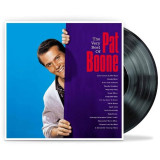
Pat Boone or Elvis Presley? That was the burning question on
the lips of Fifties teen America. Certainly, the two were the most
successful solo artists of rock’s breakthrough years. But while
Presley was the good-looking ‘white kid who sang black’, Boone
was married, God-fearing and covered hits by African-American
artists to chart-topping if unthreatening effect. Elvis, of course, is
no longer with us though his image and influence will never fade.
Pat Boone is still alive and there’s no doubting he was
responsible for some of the best-remembered classic pop of the
era.
On its tenth anniversary outing, Sofia Records doesn’t just mark a milestone - it distills its essence in a four track EP. The compilation reunites the original, 25 year strong, pBPM crew and the fresh talent of Impe´rieux.
KiNK delivers a dancefloor juggernaut “Let The Bass Kink” - raw, kinetic and unmistakably his.
KEi counters with “Killing God Theme“ - a deep, hypnotic slow-burner, rich in emotion that evolves with patient intensity. Then we have the debut of Tegav - a new alias from the pBPM forming member Kalin Baychev with “Stomper“ - an edgy melody on top of a percussive backroom swagger. Impe´rieux, ever the outlier, continues his quest for dance music’s future with “Jarka”, a leftfield yet playful groove that breaks convention while rattling the floor.
With a smiling family snapshot, framed in smoke, strobe light and sweat, Sofia shows how to throw the needle where it matters - squarely pointed to the future.
- A1: So Many Miles Away
- B1: Groovy Thang
Chicago recording artist Reggie Soul (real name Reginald Stone) recording career consisted of three 45singles spread over 3 separate labels. Firstly, the funk outing “I Got Jody” backed with the soulful “I Feel So Bad” for the Red Balloon label. “I Feel So Bad” was a Lee Sain composition which Lee himself recorded under the title of “Baby Don’t Leave Me” for the Broach label. Reggie’s “I Got Jody” also came out a second time on Nation Time Records as the flipside to “Soul Walkin’” a cover version of the James Brown song but mis-credited as the performing artist Reggie Smith?
Reggie’s third release “My World of Ecstasy/Mighty Good Loving” was released on the Scott Brothers owned Capri Records label in 1968. The fledgling Capri Records Company having been set up in premises at 409, East 47TH Street in Chicago’s Southside, used the front of the building as a record store with the rehearsal studios situated at the rear, the final recording sessions took place initially at some of the smaller independent studios across the city before using the major Columbia and RCA Recording Studios as Capri Productions grew. Reggie co-wrote both sides of his Capri 45 with Charles and Walter Scott respectively. The arrangements were provided by John Jackson and Bill McFarland who alongside Claude Williams provided the horn section to many of the Scott’s future productions. The Scott Brothers were also the house band at one of the Southside’s most popular night clubs ‘The Bonanza Lounge on 7641, South Halsted. Besides performing, they used the club to scout for potential artists for their label and it is believed that’s where their business relationship with Reggie Soul initially began.
Surviving witness accounts always cite Reggie as a solo performer which begs the question who are the credited ‘The Soul Swingers’ on the Capri 45? Well, it transpires that this was a pseudonym used by the Scott Brothers present on the recording, Charles (Chuck) drums, Tommy (bass guitar) and Walter (Rhythm guitar).
At the beginning of Soul Junction’s working relationship with Scot-Tees a further Reggie Soul unissued session was mentioned and sure enough two tape boxes arrived one containing “My World Of Ecstasy/Mighty Good Loving”, great, but disappointingly the second named tape had been reused as a rehearsal tape of several recognizable riffs of later Scott-Tees productions, doh!
Then months later lady luck intervened, a box containing two unmarked acetates held together with a nut and bolt was found. After considerable investigation, it transpires that they are the missing Reggie Soul tracks which we now present to you. Both songs are A.C Carson compositions, The A-side “So Many Miles Away” is a wonderful crossover song that shares some lyrical similarities to fellow Capri stablemate Judson Moore’s released Chicago Music Bag 45 “Lisa” while the flipside of our release features Reggie’s interpretation of Judson’s “Groovy Thang”. So, at long last Soul Junction are able to present to the lost Reggie Soul sessions that several veteran soul scribes who known their onions have likened to another great Chicago recording artist, the mighty, Tyrone Davis.
- Through The Heat Waves
- Eight Miles High Alone 07:46
- In Motion
- Inhale
- Crystalline 06:38
- Exhale
- One More Rush
- Silence Is Gliding 05:56
- Cloud Surfing
Marconi Union, one of the most influential names in contemporary ambient and electronic music, announce their twelfth studio album, The Fear of Never Landing, set for release 6th June via Just Music. The news is paired with the release of first single Eight Miles High Alone, out 20th March on all major streaming platforms.
Known for their ability to craft cinematic, immersive soundscapes that blur the lines between ambient, electronic, and experimental music, the Manchester-based duo once again push the boundaries of sonic exploration. The Fear of Never Landing takes us on a dynamic journey that’s atmospheric, diaphanous and never short of mesmerising. While the new record is certainly infused with a sense of hope, there’s more than a soupçon of anxiety too, as the title suggests.
A 55-minute odyssey presented as one seamless piece divided into nine movements, they transcribe the nexus of modern living into a mostly wordless odyssey. The album encapsulates Marconi Union’s ability to translate the complexities of the human experience into sound, all while maintaining a stunning sense of cohesion.
While the music feels effortless, the creative process was anything but. During the two years it took to complete the album, members Jamie Crossley and Duncan Meadows faced creative struggles that even led them to briefly question the band’s future. A pivotal moment came when they performed a live soundtrack to the 1975 skateboarding film Downhill Motion, rekindling their connection to atmospheric composition. By testing new material live and returning to their roots, Marconi Union redefined their creative process, leading to some of their most emotionally impactful work to date.
“We’ve always made atmospheric music but we had started to lose that aspect. Other than some rough ideas, we had no sense of what we were doing anymore, a kind of musical wilderness. Eventually a couple of things fell into place, and it was like, ‘Ah, okay.”
With a foundation to build upon, they went back to basics and decided to take their time going forwards. “We tried out a few new tracks live which gave us the opportunity to see what worked and what didn’t. We've never given ourselves that luxury before.”
The first track to be shared, Eight Miles High Alone, is a mesmerizing sequencer-driven track that builds an immersive, atmospheric soundscape. Its hypnotic pulses and intricate layers evoke a sense of solitude and weightlessness, perfectly capturing the album’s blend of tension and introspection. “Eight Miles High Alone was the first piece that we managed to complete and helped to inform our approach to the rest of the album.”
Formed in Manchester in 2003, their debut album, Under Wires and Searchlights (2003), introduced their signature sound, but it was their 2011 release of Weightless that brought international acclaim. Developed in collaboration with a sound therapist, Weightless was scientifically recognised as “the world’s most relaxing song”, praised for its ability to reduce anxiety and heart rates. With over 900 million streams and widespread coverage across media, the track remains a cultural phenomenon.
Over the years, Marconi Union has continued to evolve, producing critically acclaimed albums such as Signals (2021), Ghost Stations (2016), and Tokyo+ (2017). Their work has been hailed for its emotional resonance and sonic depth, with The Quietus noting their ability to find “beauty in the bleakest places” and The Sunday Times describing them as “amongst today’s most talented musicians.”
Beyond their studio albums, Marconi Union has collaborated with visual artists, provided soundtracks for installations, and remixed notable acts like Max Richter and Vök. Their invitation by Brian Eno to perform at Norway’s Punkt Festival further cemented their reputation as innovators in the ambient music sphere.
With The Fear of Never Landing, Marconi Union once again showcases their unmatched ability to create immersive soundscapes that resonate deeply. The album reaffirms their position as masters of atmosphere and emotional storytelling, making it an essential addition to their storied catalog.
- 1: Overture
- 2: Illusions Of Polyphony
- 3: Echos Et Fantasies
- 4: In Simplicity We Trust
- 5: Octus
- 6: Volatiles
- 7: Resonances
- 8: 224 Steps
- 9: Subtracting The Superflous
Crafted entirely on an analog monophonic synthesizer with no overdubs, Pièces Monophoniques is a tribute to simplicity in an era of limitless digital possibilities. Since his debut album, Music For Prophet (Les Disques du Festival Permanent, 2017), Majorca-born composer Marc Melià, now a long-time resident of Brussels, has been redefining the contours of electronic music through a minimalist, reductionist approach. Much like a solitary hike through the vastness of mountains, where one carries only the essentials, Melià’s work invites listeners on a journey stripped of excess, focusing instead on the purity of sound and intention.
While some have dismissed monophonic music as overly simplistic, others have embraced its distinct charm. Historical records, such as those by Johannes Quasten, reveal that early Church leaders were drawn to monophonic music because it resonated with the era's cosmological beliefs, highlighting the harmony and unity of all creation. In an age of digital abundance, Marc Melià deliberately embraces constraint, crafting an album that thrives within a limited palette of choices. Yet, from these self-imposed boundaries emerges a stunning universe, brimming with rich textures and elegant harmonies. For his debut album, Melià worked exclusively with a Sequential Prophet. With Pièces Monophoniques, his third LP, he returns armed solely with an analog monophonic synthesizer and handcrafted MIDI sequences etched directly onto a single stereo track. These recordings seek to uncover beauty within the boundaries of limitations and simplicity, rejecting any embellishments that are not essential. Melià presents the bare skeleton of music, highlighting the power of absence and silence as creative forces. Like the hidden mass of an iceberg, what is not heard becomes as significant as what is heard.
The album navigates the boundary where the quest for an uninhibited emotional response intersects with the mechanical sounds generated by synthesizer circuitry. Despite being a collection of beatless tracks, a pulse occasionally surfaces, like in the closing piece, "224 Steps. A sharp sequence blended with multiple delays and reverbs creates the vaporous celestial specter of multiple voices in "Illusions of Polyphony", while "Échoes et Fantasies" conjures the illusion of dual harmony. The expansive reverbs and silences between the euphoric synth phrases in "Overture" transport us to an imaginary magestic landscape shaped out of an electric field. "Resonances," a one-note drone-like sequence, embodies the album's aims as a series of resonances created with the synth filter emerge from the fundamental note.
"Pièces Monophoniques," aims to contribute to a tradition that dates back to the dawn of humanity. After all, there is no denying that the earliest music crafted by humanity was monophonic, from the soothing lullabies sung to newborns to Gregorian chants, traditional labor songs, and the repertoire of solo compositions by countless composers.