Spoken word recordings from Gregory Corso, Tina May Hall, Sam Lipsyte, Christine Schutt, Gary Lutz, Allen Ginsberg, Dawn Raffel, Jason Schwartz, Kathryn Scanlan, Scott McClanahan, & Terry Southern. About 40 years ago, in a record shop on Long Island during a weekend visit there to see my parents, i found a double-LP that looked like something i should definitely buy. It was called "BIG EGO", by the The DIAL-a-POEM POETS. On the cover was a picture of John Giorno (a great poet Ed Sanders had turned me on to) on a NYC rooftop with Philip Glass, Meredith Monk, and two kids. It cost $2. I bought it and rushed back to my parents house, where i still had my old turntable in the basement, not far from my Jimi Hendrix and Zappa Crappa posters, and my framed portrait of John Cage. My copy of Eno's "Discreet Music" was still on the turntable, having been left there years before, when i'd fled Long Island for good. I lifted it from the platter, gently slid it back into its sleeve, like a priceless religious artifact, and put Side A of the Dial-a-Poem LP on. I almost lost my mind while listening to it. The next day i went back to the same record shop looking for more DIAL-A-POEM LP's. i found two. One had a long list of names on the back, some famous, and some i'd never heard of before. I bought both LP's, and an hour later, for the first time in my life, i was exposed to the art of Laurie Anderson, whom i'd never heard of before. This was 1978. Her contribution was a piece called "Time To Go". It changed my life. Or at least, that’s how I remember it. I was just a kid, so there were a lot of moments like that, around then. Nowadays, these moments can be had in seconds, with a click of the cursor. That evening, as i sat alone by my imaginary campfire (ie; that record player in my parents basement), i promised myself that someday, somehow, i would embark upon a WORDS & MUSIC project that might move people the same way i was moved when i first heard Laurie, and Robert Wilson & Christopher Knowles, and Burroughs, and Ginsberg, and Corso, and Anne Waldman, and John Ashbery, and the great Charles Olson, and so many others. Words, for the very first time, had wielded the same power as music. And it was visceral. Just like music. It ran deep. It was a FEELING. John Giorno died in 2019, but he kept poetry alive like nobody's business. I was lucky enough to have spent some time with him in the early 1980's, when i was briefly a member of The Fugs, and often found myself surrounded by those Ginsberg called, "...the greatest minds of my generation". Ed Sanders (who'd ushered me into that scene) once told me that when he came to NYC, it was easy to go to a cafe, or to St Marks Church, and hear Burroughs, Corso, Ginsberg, and all the greats, reading their poetry. He said that even if you were just a bum on the street, you could just walk right up to them, and start a conversation. They were totally accessible, if they were in the right mood at that particular moment. So i was shocked when Sanders told me he didn't approach any of them, not even once, til he'd been going to their readings for nearly ten years. "For almost a decade, I went to every reading, every lecture, every panel discussion. But I never went near them. Never approached them. Not even once", Sanders told me. "For ten years, all I did, was listen." It took me four decades, but ... better late than never. I finally made WORDS & MUSIC, Book One.
quête:t s monk
- A1: Soul Flipsta
- A10: Sincere Moon
- A11: Live & Direct
- A12: Dramatic Rain
- A13: Air Man
- A14: Ghetto Moments
- A15: The Villain
- A16: Scary Moon
- A17: Great Scotts
- A18: Fever Dance
- A19: A Monks Perception
- A2: Golden Arches
- A20: Jack The People
- A21: Lou's Love
- A22: Tarzan
- A23: Jordans Zoo
- A24: Sparrow
- A25: Mirrored Stream
- A26: A Merry Story
- A3: Tailored Living
- A4: On The Rise
- A5: Aux Jacka
- A6: Jam Jars
- A7: Paradise Man
- B1: Naughty Daze
- B10: 28 Days Later
- B11: Dream
- B12: Marty's Roll
- B13: Mclovin
- B14: Standing Baby
- B15: Mt Rossmore
- B16: Effect Change
- B17: Tensions
- B18: Thoro Jesus
- B19: Light Tears
- B2: Titos Heaven
- B20: John's Life
- B21: The Amazon
- B22: Bobby Love
- B23: Touch A Rainbow
- B24: Jewels
- B25: Minas Disco
- B26: Goodbye
- B3: Black Space
- B4: Why Love?
- B5: Love Press
- B6: Play Mean
- B7: Huh?
- B8: Zanzibob
- B9: You Listenin?
- A8: Gimme A Mint
- A9: Lee Motors
52 Beats is project initially started on Bandcamp with Snips uploading 1 beat per week over the course of a year with an accompanying behind the scenes video. This is the final release of the entire project as a limited run cassette. Musically Snips stays true to his Hip Hop roots chopping samples and keeping the sound rooted in traditonal Boom Bap which birthed his style
Stephan Bodzin proves once again why he is one of the most innovative techno artists in the world with new album Boavista. The expressive 17 track full length lands on Herzblut Recordings on October 8th 2021 and is proceeded by lead single 'Boavista' on the Afterlife label.
German icon Stephan Bodzin is globally recognised on a number of fronts - his live show is one of techno's most celebrated, his productions constantly push the genre forward with his own trademark sound. He has put out well-received solo long players Liebe Ist and Powers of Ten as well as worked on many other iconic projects under a range of aliases.
In the last year, Stephan had the chance to look back on the vast archives of music he has recorded but never finished. While spending time in Brazil, he picked his 25 favourites and finished them properly, with the best 17 making up Boavista. His simple aim was to tell stories with each track, to paint musical pictures that conjure up very real emotions in the listener. As always, playing the album live was in the back of Bodzin's mind throughout the creative process. This means each track is a powerful piece that is both emotional and honest, physical and straightforward, but also true to the authentic Bodzin sound. The lack of DJ gigs and club experienceshad no impact on the music: Stephan has long since done his own thing and has never tried to conform to expectations.
And so it proves. The album kicks off with the lush 'Earth' which pays homage to all the elements of life - water, fire, wind, as well as time, light and the rotation of the planet. 'LLL' is an electronic lullaby track defined by a sense of love for the people in Stephan's life and 'Astronautin' has a lead synth that came about after Stephan's daughter said she would like to be an astronaut when she grows up. It truly takes you to the stars before the simple but effective melodic patterns of the title track light up a night sky with real hope.
Elsewhere there 'Infinite Monkey' which was a freeform jam that was led by the music itself, the epic pads of 'Dune' and interstellar explorations of the more thoughtful and melancholic 'Cooper Station’. 'Nothing Like You' was written in a hotel room before Stephan's last pre-lockdown gig, then 'Isaac' is another powerful journey through space and time, different worlds and alternative realities.
Further hypnotising highlights come from the soft melodies but powerful basslines of 'Collider', the expansive synths of 'Trancoso' and the delicate beauty of 'Ataraxia', which references German composer Klaus Doldinger who was a huge influence on Stephan's understanding of melodies and harmonics. 'Breathe' is a second spindling vocal track featuring Luna Semara next to 'Nothing Like You' and closer 'Rose' isa heartbreaking piano piece.
Boavista is another exquisitely crafted album of rich, synth-heavy electronic music that takes you into new worlds of emotion and leaves you in awe
Multi award-winning composer Shepherd’s seventh album and first on vinyl, with sleeve notes from Percy Mabandu.
Compositions explored on this long-awaited release include new articulations of well-liked familiar melodies like ‘For Keith’, ‘Desert Monk’, ‘Sweet Zim Suite’ and ‘Cry of the Lonely’, along with improvised pieces ‘Zikr’, and ‘Desert Monk’.
Mastered and cut for vinyl by Frank Merritt at The Carvery with heavyweight 180g vinyl pressed at Pallas in Germany.
Shepherd embodies much of South Africa’s piano tradition with visionary clarity. More than his own ingenuity, he holds up an appreciation of the richness of a shared musical inheritance. This must be underscored by an understanding that all pianists, in fact all artists of real commitment, have a wish to be distinctive, along with a real rootedness. The selection of tunes treated here, shores this up about Shepherd. It also points to a deeper, loftier revelation: jazz, and creativity as the ultimate articulations of human hope.
Percy Mabandu, from sleeve notes
In the words of Jerzy Mączyński, Sariani is a musical meditation exploring Indian musical culture and the widely understood concept of trance. The album has its roots in Mączyński’s growing friendship with Waclaw Zimpel, a fellow Polish avant-garde musician with experience in both experimental jazz and meditative ambient music. The pair first connected online during the early stages of the COVID-19 pandemic, with Mączyński suggesting they join forces on an album-length collaborative project a few months later.
Sariani was recorded over the course of eight months at two different studios in their home city of Warsaw (one of which included access to an empty swimming pool, whose unique acoustics were utilised during the recording). Both composers recorded electronic textures, loops, and rhythms, onto which they added saxophone (Mączyński) and voice textures courtesy of fellow Polish musicians Wiktoria Jakubowska and Olga Koziel.
The album comprises six separate musical stories, each of which was inspired either by a specific “empirical experience” from Mączyński’s travels in India, or wider cultural themes relevant to the country in the 21st century. These include Mączyński’s first encounter with the Book of Rag (‘Raga or Raga’); the essence of spirituality within temple buildings (‘Temple of Jetsu’); a vivid dream featuring a superhero who calls for reflection on equality and freedom (‘Sariani’); and a life-changing trip to Mount Everest with guitarist Szymon Wójcik (‘Everest Inn’, which features recordings made by the pair at the Monkey Temple in Kathmandu).
- A1: Drilling (Live)
- A3: Lemurs, Man, Lemurs (Live)
- A4: Absinthe Party At The Fly Honey Warehouse (Live)
- A5: Thanks For The Killer Game Of Crisco Twister (Live)
- A6: Diamond Lightning (Live)
- A7: My Time (Live)
- A8: Summer Angel (Live)
- A9: Cold Company (Live)
- A10: Fair Enough (Live)
- A11: The Fix (Live)
- A12: Fine + 2 Its (Live)
- A13: I'm Totally Not Down With Rob's Alien (Live)
- A14: This Ain't A Surn' Movie (Live)
- A15: The Game Needed Me (Live)
- A16: Invisible (Live)
- A17: Monkey!!! Knife!!! Fight!!! (Live)
- A18: White Mystery (Live)
- A19: Spritz!!! Spritz!!! (Live)
- A2: Last Kiss (Live)
- A20: Knights (Live)
- A21: Let's Play Guitar In A Five Guitar Band (Live)
- A22: Hey, Wanna Throw Up? (Live)
- A23: Get Me Naked 2: Electric Boogaloo (Live)
- A24: Into The Mirror (Live)
- A25: Throwin' Shapes (Live)
- A26: Pachuca Sunrise (Live)
Farewell covers a lot of ground across the span of its 26 songs and two-hour run time. Yet every moment is a reminder of why Minus the Bear were such an experiential live band. They were always pushing forward, evolving their sound, and finding new ways to balance brainy musicianship, pop worship, meditative sentimentality, and adrenalized fervor into their own signature concoction. Further bolstered by the mix of Matt Bayles and master job by Ed Brooks at Resonant Mastering, the album sounds like a fully immersive live experience. + RECORDED DURING MINUS THE BEAR'S 2018 FAREWELL TOUR + 2021 MARKS THE 20TH ANNIVERSARY OF THE FORMATION OF MINUS THE BEAR + MIXED BY MATT BAYLES (SOUNDGARDEN, PEARL JAM, MASTODON, THE SWORD) + MASTERED BY ED BROOKS AT RESONANT MASTERING (R.E.M., DEATH CAB FOR CUTIE, FLEET FOXES) + FIRST AND ONLY OFFICIAL LIVE RELEASE FROM MINUS THE BEAR + RETAIL EXCLUSIVE VARIANT ON CUSTOM OPAQUE GREY VINYL LIMITED TO 1,900 COPIES + 3xLP PACKAGE COMES IN TRIPLE GATEFOLD SLEEVE WITH SPOT INKS + 3xLP PACkAGE INCLUDES PRINTED INNER SLEEVES WITH METALLIC SPOT INKS + 3xLP INCLUDES A DOWNLOAD COUPON
First new release from Lizard Music in over two decades Since their hiatus, band members have joined Wilco, become the musical director for Cat Power, been a featured guest on RuPaul’s Drag Race, and worked with artists including Lana Del Rey, Brian Wilson, The Monkees, and more! Available on CD, Digital, and double-LP What Lizard Music says about Arizone! This collection of buzzy, whirly pop songs from a parallel dimension is a testament to Martin Short, Martin Sheen, Sheena Easton, Tina Turner, and Tiny Tim. Arizone! is better than discovering never-before seen discs for a View-Master. Arizone! is the sound of four old friends who spent their formative years playing music, traveling, and learning about the world, reuniting after a 25 year hiatus to compare notes and wound up with a one-way ticket to Arizone! Lizard Music began in Atlantic Highlands, NJ in 1989 when high school friends Mikael Jorgensen and Erik Paparozzi started learning and writing songs with a four-track. They pillaged their parents' record collections and discovered the musical universes of The Beatles, Frank Zappa, Captain Beefheart, XTC, James Brown and The Meters. In the fall of 1990, Lizard Music (named after the book by Daniel Pinkwater) was hired to be the backing band for David Peel and The Lower East Side at the recently-closed Brighton Bar in Long Branch, NJ, which would serve as the unofficial home base for the band for the next five years.
Horace Tapscott's Pan-Afrikan Peoples Arkestra (P.A.P.A.) was one of the most transformative, forward-thinking and straight-up heavy big bands to have played jazz in the 1960s and 1970s. If P.A.P.A. doesn't have the interstellar rep of that other famous Arkestra, and if the name Tapscott doesn't ring bells like Monk or Tyner, there's a reason why: in an industry dominated by record labels, a band that doesn't record doesn't count. And the Pan-Afrikan Peoples Arkestra didn't record for nearly twenty years. But recording success was never their concern -- they weren't about that. First formed as the Underground Musicians Association in the early 1960s, Tapscott always wanted his group to be a community project.
From their base in Watts, UGMA got down at the grassroots. The group was renamed the Pan-Afrikan Peoples Arkestra in 1971, and soon after they established a monthly residency at the Immanuel United Church of Christ which ran for over a decade, while still playing all over LA and beyond. But they never released a note of music. It was the intervention of fan Tom Albach that finally got them on wax. Determined that their work should be documented, Albach founded Nimbus Records specifically to release the music of Tapscott, the Arkestra, and the individuals that comprised it. The first recording sessions in early 1978 yielded enough material for two albums, and the first release was Flight 17. The album commences with the magnificent title track. It is effectively in three parts. It begins with unaccompanied pianos. Then the ensemble embark on a dense, circular and mechanical movement, a platform for horns and pianos to swoop and dive. We return to Earth with a beautiful solitary flute. The second track, the piano-centric, ‘Breeze’ is different to ‘Flight 17’ in intensity and also brevity but it is quietly as daring as the title track. It concludes with a moving lush wash from the full Arkestra, which sound almost like strings only more substantial. These first two tracks take full advantage of the texture of the unusual mix of the various instruments. Next though, it’s a significant change with ‘Horacio’, which is an exuberant Latin infused jingle. It’s unlike anything else on the album. I like to think it was named after the conductor’s Cuban alter-ego! ‘Clarisse’ gracefully switches between slow blues and bop and is bookended with a grand vaguely East Asian theme. The busy bass line introduces ‘Maui’. As with the previous track, it moves between a number of contrasting melody lines and rhythms but there’s still space for a tuneful sax solo.
This is a must-have album. I think the first two tracks on their own make this release essential. Kevin Ward/UK Vibe/Boomkat
She Drew The Gun are today announcing their return with new album Behave Myself. The follow-up to the critically acclaimed Revolution Of Mind, which was named among BBC 6 Music’s Albums Of The Year, is produced by Ross Orton (Arctic Monkeys, The Fall, The Kills, Working Men’s Club). The first music from the record is confirmed to arrive next month.
Under the moniker She Drew The Gun, songwriter Louisa Roach began by playing solo gigs around Liverpool, she quickly caught the attention of The Coral’s James Skelly who she began working with at Skeleton Key Records, recruiting band members along the way.
At first glance Roach’s fuzzy psych-pop may suggest that the Wirral born songwriter is another ‘Cosmic Scouser’ but then you’re drawn into the spirit of rebellion, songs that rally against injustice and food banks and celebrate outsiderdom.
She Drew The Gun are today announcing their return with new album Behave Myself. The follow-up to the critically acclaimed Revolution Of Mind, which was named among BBC 6 Music’s Albums Of The Year, is produced by Ross Orton (Arctic Monkeys, The Fall, The Kills, Working Men’s Club). The first music from the record is confirmed to arrive next month.
Under the moniker She Drew The Gun, songwriter Louisa Roach began by playing solo gigs around Liverpool, she quickly caught the attention of The Coral’s James Skelly who she began working with at Skeleton Key Records, recruiting band members along the way.
At first glance Roach’s fuzzy psych-pop may suggest that the Wirral born songwriter is another ‘Cosmic Scouser’ but then you’re drawn into the spirit of rebellion, songs that rally against injustice and food banks and celebrate outsiderdom.
After spending 6 years on a shitty pop-punk train, and releasing tons of records, THE VAPIDS bunkered down and emerged with CHARM SCHOOL DROPOUTS. A giant kick in the ass to everything that was going on at the time. Originally released on CD in 2001, SKR pressed the first (terrible looking) vinyl version in 2008, and now, a proper and sonically ferocious repress in 2020!
Strut return to the rich archives of Black Fire Records for the Drum Message album by Ghanaian master percussionist Okyerema Asante from1977. After playing a short spell early in his career with Ebo Taylor's Blue Monksband at Tip Toe's in Accra, Asante joined the fledgling Hedzoleh Soundz during the early '70s at their Napoleon Club residency in the city. After playing Fela's Shrine, Fela recommended them to Hugh Masekela as an ideal backing band and Hedzoleh joined Masekela on a US tour in December 1973. Sharing the same management company, Charisma, Asante first met Plunky and Oneness Of Juju during an East coast tou rwith Masekela, starting a relationship with the band that has endured until today. Recorded at Arrest Studios in Washington D.C. in October 1977 and featuring musicians from Oneness alongside Gil Scott Heron cohort Brian Jackson on piano, Drum Message represents an important milestone fo rAsante: "This album really came from my heart. I wanted to project the African spirit in the music and come out with some unique African jazz. To be able to record it on Black Fire was extra special." The album also involved some serious physical graft: "The studio was up on the 14th Floor and the elevator was often broken down. I showed up with a van full of African drums and Jimmy Gray from Black Fire and myself had to carry them all the way up there, each day!" The resultant album was well worth the sweat. 'Adowa' adds jazz arrangements to a traditional Asante rhythm and Oneness classic 'FollowMe' is skilfully re-worked ("I used the bass drum in place of the bass guitar so it was all based on rhythms."). New versions of Asante dancefloor favourite 'Sabi' sit alongside the mellow groove of 'Asante Sana' ("I wantedsomething cool like reggae or highlife on that track, a similar vibe. So, Iwent inbetween.").
“Is the juice worth the squeeze? Is the honey worth the bees? Is the trip
worth the risk? Is the rub worth the fleas?”
These are some of the big questions CHILDCARE find themselves pondering
at the top of their second album ‘Busy Busy People’. It’s a mantra that returns
later in the record but remains in the back of your brain throughout, a playful
enquiry into the purpose of our everyday activities that highlights the South
London-based group’s knack of marrying the surreal with the ordinary; soberly
tripping out during the big shop.
It’s something the group have been refining as part of their identity since their
genesis, when singer Ian Cares spent the time between school runs at his nannying job writing songs. He started adding other musicians to the project gradually until two EPs (2017’s ‘Made Simple’ and 2018’s ‘Luckyucker’) and one
album (2019’s ‘Wabi-Sabi’) later, Ian, male guitarist Rich Le Gate, bassist Emma
Topolski, and male drummer David Dyson have shaped CHILDCARE into one of
the most unique emerging groups in the UK.
They’ve earned themselves a loyal following of fans, sold out their biggest
show (so far) at London’s Scala and gained support from BBC Radio 1 (Annie
Mac, Jack Saunders), Spotify (several New Music Friday slots) and five SXSW
2020 showcases, which of course, never happened.
Busy Busy People was recorded at Somerset’s Distiller Studios with producer
Dom Monks (Laura Marling, Big Thief, White Denim)
Former BBC Radio 1 Track of the Week with key supporters incl. Jack Saunders,
Annie Mac plus BBC 6 Music’s Steve Lamacq & Radio X’s John Kennedy
Performed on the BBC Radio 1 stage at Reading/Leeds 2019 and were slated
for SXSW ‘20 before the pandemic hit.
They also sold out London’s Scala in Christmas ‘19.
UK tour kicks off September ‘21 Bassist Emma Topolski also performs as touring
member with Bombay Bicycle Club, Dua Lipa & Laura Marling
With a career spanning more than 25 years, the award-winning jazz guitarist has become widely acknowledged as one of the hardest working musicians in the business. Musically, Nigel’s blend of flowing bebop lines, deep blues sensibility and his mastery of chording continue to delight audiences and fellow musicians alike. His career highlights include a support show for Gladys Knight at The Royal Albert Hall and an appearance on Van Morrison’s recent album, Keep Me Singing. Starting his professional career in his early 20s, Nigel toured Europe with various reggae and funk bands before settling on a solo guitar career and turning his attention to jazz. Citing early influences as Wes Montgomery, Joe Pass, John McLaughlin and the Mahavishnu Orchestra, Nigel honed his craft by attending gigs and sitting in with the players of the time. He has played on more than 50 albums including seven as a leader, spent 10 years with acid jazz outfit The Filthy Six, was a member of James Taylor’s band, JTQ, for three years (with whom he recorded five albums) and performed with the legendary David Axelrod
Forming off the back of contemporary jazz outfit Zeitgeist, Voronoi take the power and rhythmic complexity of heavier prog-metal and fuse it with the sophistication of classical music and jazz. A passion for science fiction thematically drives the band’s heaving and
chopping style, whereas artists such as Autechre, Car Bomb, Tigran Hamasyan and J.S. Bach help shape the rigid, experimental structure of The Last Three Seconds.
“Compositionally and stylistically we have moved into much heavier territory than our contemporary jazz foundations,” says Keyboardist Aleks Podraza. “It really shows. If you were to put this record against the first tunes we played together as Zeitgeist, it would be like introducing a much capable Thelonious Monk to a less hectic Dillinger Escape Plan.”
As the first single off The Last Three Seconds, Gamma Signals serves as a toe in the water for the depth of things to come. The full-bodied riffwork captures the stop-start format of prog-metal heavyweights without being explicitly metal. Yet beyond this, glitchy, experimental electronics cut through the composition like a knife. The final product is something that captures the magic of the cosmos – a place where worlds orbit worlds, genres orbit genres. Each element remains different and unique, but still intrinsically tied to the other.
“Gamma Signals is about pulsars and how when Jocelyn Bell-Burnell first discovered them, the media thought they were aliens trying to contact us,” says Podraza. “Broadly, this song is about my love for and fascination with cosmology as a whole. That's a theme that runs through the veins of most of the album.”
Those following Vorono’s career will need little convincing on the quality of The Last Three Seconds. Collectively, band members have performed and recorded with groups like The Cinematic Orchestra, KOYO, NJYO, Jenova Collective, The Often Herd, Mik Artistik’s Ego Trip, Wandering Monster and more. This in turn has garnered sizable attention at festivals such as Leeds and Reading Festival, Download Festival, Ronnie Scott’s Jazz Club - not to mention Voronoi’s thrashing set at 2019’s ArcTanGent.
The cool and collected chaos of The Last Three Seconds serves as a snapshot of this live energy, as passion and fury hum at the end of every complex composition. From start to finish, the record is nothing less than executed perfectly, undoubtedly appealing to even the most seasoned of prog-lovers
In February 1964, Eric Dolphy assembled a formidable quintet of modern jazz visionaries with Freddie Hubbard on trumpet, Bobby Hutcherson on vibraphone, Richard Davis on bass, and Tony Williams on drums, and headed into Rudy Van Gelder's studio to record what would stand as his masterwork: 'Out to Lunch!'. A genius artist of startling originality, Dolphy managed to possess the revolutionary spirit of the avant-garde while keeping a foot firmly planted in the feeling of swing, a rare feat that the five original pieces here perfectly captured from the offbeat swagger of the opening Monk tribute 'Hat and Beard' to the careening closer 'Straight Up and Down.'
A Fable is Tigran Hamasyan’s first solo album after having recorded three previous albums as a leader. Released in 2011 it was hailed for the rare maturity of an all young musician to deliver such a landmark recording. At that time the pianist has been identified as one of the most important jazz revelations by critics impressed by his artistry. Well known for the way he fuses potent jazz improvisation with the rich folkloric music of his native Armenia, Tigran once again borrowed from the rich tradition he inherited and made a giant step with A Fable. Hamasyan gives a stunning one-man show with definite nods to Monk and Miles Davis, to Liszt and Debussy, while creating a space that is distinctly his.
The Alice Comedies are a series of Animated/live-action shorts created by Walt Disney in the 1920s, in which a live action little girl named Alice (originally played by Virginia Davis) and an animated cat named Julius have adventures in an animated landscape.
The Magic Clock is a whirlwind mishmash of motifs that 1 draws on an unusually wide range of sources: Hoffman’s The Nutcracker and medieval romances working cheek by jowl with Arabian Nights, Ovid, Midsummer Night’s Dream, Peter Pan, Mallarme’s “Afternoon of a Faun,” and Novalis’ blue flower.
Paul Dessau was a German composer and conductor. He composed operas, scenic plays, incidental music, ballets, symphonies and other works for orchestra, and pieces for solo instruments as well as vocal music.
The music is conducted and produced by Hans E. Zimmer, who conducted an extensive repertoire including Die Zauberflöte, Le Nozze di Figaro, Euryanthe, Jenufa, Ariadne auf Naxos, Salome, Der Rosenkavalier, Der Friedenstag, Die Meister-singer von Nürnberg, Lohengrin.
Un Singe En Hiver (“A Monkey in Winter”) starred the greatest name of the
time in French Cinema, Jean Gabin and a “rising newcomer”,
Jean-Paul Belmondo.
This is popular early 60s mainstream French cinema, with a certain ‘quality’
that would not be to the taste of the nouvelle vague aficionados. In fact this
film is nothing less than the reflection of a certain Gaullist spirit of rebellion,
fiercely individualistic and disabused of all ideologies.
The music of Michel Magne outlines the nostalgic wanders of Albert Quentin
(Jean Gabin) who after an adventurous youth on the Yang-Tse-Kiang now lives
a quiet life with Suzanne (Suzanne Flon) whom he met at the Bourboule and
manages the Stella hotel at Tigreville (actually Villerville in the Normand Calvados) and takes care of Gabriel Fouquet (Jean-Paul Belmondo), a young adman
whose heart was broken in Madrid.
The genius of Magne is found in his evocations of Spain and China not as they
were at the time but as the two main characters picture them with the help
of not just a few drinks. Here is a jolly good record you will want to go back to
every time the right-minded ones try to mess with your basic rights.
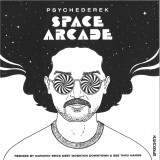
From the cosmos of Stretford on the outer realms of Manchester comes the kaleidoscope view of the world according to Psychederek and it's an explosive trip of shoe gaze soaked balearica.
Lead track Screamadereka heads straight into orbit from the get go with a stop off to thank the likes of The Cocteau Twins & Death In Vegas for their influence along the way. Huge drums, spaced out synths, warped guitars & a fully charged love in style vocal all wrapped up in a mushroom flavoured microdot with a pretty empowering finale.
I'm Alright steps up the ante a bit more and goes all Tomorrow Never Knows on us but with added warehouse acid squelch & rasps throbbing out from a beat that is broken (but not break beat!) whilst still retaining the psychedelic tendencies of its predecessor.
Sean Johnston steps off the ALFOS rocket ship and joins forces with Duncan Gray for their Hardway Bros Meet Monkton Disco Dub take of Screamadereka and the result is a hive of cosmic mutant disco brilliance whilst Manchester's finest 6 piece See Thru Hands turn I'm Alright into bombastic focused UKG style wig out duet complete with new vocal takes by DNCN for seriously wonky floors & like minded souls.
Includes beautiful insert artwork by Emma Evans