Making this album was an absolute joy. We used Rothko’s artwork as a major influence. His use of colour fields, blending, mood and scale really helped us build an album of tracks that could stand on their own and also work together as a coherent whole across all the tones we had been working with. It was also a chance to fall back in love with our 909, 808 and 707.
While working on music for several other projects, the “Rothko” project got renamed Loud Ambient because it did not really sit right with the My Brutal Life series. We often talked about what people make of The Black Dog and whether they think we only make ambient music. We do not. Over the last year or so, one of us would be working on something and someone else would say, “That is a Loud Ambient track.” The name stuck. We liked the funny side of it.
With Loud Ambient, everything just fell into place creatively. Surprisingly for us, the tracklisting never changed, just small tweaks here and there. That rarely happens. It marks a first for us as a band. All the stars aligned and the confidence in this album is the strongest we have ever had.
Loud Ambient was made to dance to, something we have not done in a while. We welcome the return to the dancefloor with both hands. Will you join us?
Cerca:t scale
Hiroki Tamaki (vocals, violin, mandolin, A.Piano, strings ensemble, Oberheim, vocoder) / Eiji Shimamura (drums) / Yuichi Tokashiki (drums) / Akira Okazawa (bass) /
Kenji Takamizu (bass) / Ken Watanabe (bass) / Ken Yajima (E.Guitar) / Fujimaru Yoshino (E.Guitar) / Toshiaki Fuefuki (A.Guitar) / Koichi Tani (A.Guitar) / Yonosuke Segami (percussion) /
Fumitaka Anzai (A&E.Piano, synthesizer) / Keiko Yamakawa (Harp)
A psychedelic spiritual trip led by multiple vocals and synthesizers
A musical picture scroll of ecstasy depicting a world of harmony on a celestial scale
Violinist, composer and arranger Hiroki Tamaki was inspired by the lectures of Indian religious philosopher Bakwan Shree Rajneesh to create a magnificent musical picture scroll.
Tamaki's own vocals are layered on top of each other, and the music is mysterious and harmonious, woven together by synthesizers by Fumitaka Anzai (TPO, Urusei Yatsura music director).
Includes the progressive rock approach of "Poem of Mahamudra" and "Meditation," as well as "River" and "Beautiful Song," which were selected for "Nippon Acid Folk 1970-1980"
(Time Capsule) and are being re-evaluated as hidden gems of acid folk.
- A1: Illusion
- A2: Ephemeral
- A3: I Cant Wait
- A4: Apology
- A5: Green Meadow
- B1: In It
- B2: Sink
- B3: Volcano
- B4: Silent Seed
- B5: Stimulants
rhi·zome
/ˈrīˌzōm/ • RIGH-zohm • noun
a somewhat elongated usually horizontal subterranean plant stem that is often thickened by deposits of reserve food material, produces shoots above and roots below, and is distinguished from a true root in possessing buds, nodes, and usually scalelike leaves a network that connects any point to any other point
- A1-: Mirror House
- A2-: Djinn Dance
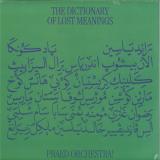
- B1-: The Dictionary Of Lost Meanings
- B2-: The Spell
- C1-: Fragmented Realities
- C2-: Three Dimensional Spirits
- D1-: Ila3Sab
PRAED return to Discrepant, after their 2017’s entry Fabrication of Silver Dreams (CREP44)
Known for their signature blend of Egyptian Shaabi, free jazz and improvisation, the Lebanese duo behind PRAED - Raed Yassin and Paed Conca - now assemble a full orchestra for the second time taking the music to a deeper, rooted level.
Following their 2020 release Live in Sharjah, also under the PRAED Orchestra! moniker, the duo now revisit their unique blend of Arabic heritage and free jazz sensibilities with an album that keeps pushing further into strange and unexpected directions.
The Dictionary of Lost Meanings is just that, seven fully composed pieces and large-scale improvisations, performed by an expanded ensemble of musicians from across the globe. The result is dense and playful, unpredictable but familiar, a record where Arabic rhythms and microtonal melodies collide playfully against electronics, warped vocals and orchestral textures.
It’s less about genre than about memory — like tuning into a radio station broadcasting from somewhere between the past and the future.
PRAED continue to blur the line between popular culture and experimental music in ways that feel both grounded and completely their own.
PRAED ORCHESTRA! are
Raed Yassin: Synthesisers, Vocals, Beats
Paed Conca: Clarinet, Electric bass
Alan Bishop: Alto saxophone, Electric bass, Vocals
Andreas Bral: Harmonium, Electronics
Elisabeth Klinck: Violin
Christian Kobi: Soprano and Tenor Saxophones
Hans Koch: Bass Clarinet
Martin Küchen: Alto and Sopranino Saxophones
Maurice Louca: Synthesizer, electronics
Stan Maris: Accordion
Radwan Ghazi Moumneh: Buzuk, Vocals, Modular Synth
Youmna Saba: Electric Oud, Vocals
Sam Shalabi: Oud, Electric Guitar
Els Vandeweyer: Vibraphone
Khaled Yassine: Drums, Percussion
Michael Zerang: Drums, Percussion
Recorded by Jasper Jan Peeters at the Summer Bummer Festival, DE Studio,
Antwerp August 26, 2022
Mixed by Adham Zidan
Mastered by Mark Gergis
Produced by PRAED
Photos by Geert Vandepoele
The Sator Arepo, or Sator Square, is an ancient word puzzle comprising five palindromes that's etched on various historical sites throughout the Western world. Its origins are unknown, but the square has long been thought to hold magical properties, used as a charm against illness and evil, to cure insanity or to determine whether someone was guilty of witchcraft. Self-styled "punk ethnomusicologist", acoustician and musician Julien Hairon uses this mystical symbol as the starting point for his debut Judgitzu album in an attempt to reconnect with his Celtic heritage, exploring how its hallowed messages might harmonize with contemporary Tanzanian dance music.Hairon has been traveling across the world for over a decade, collecting field recordings from countries such as Indonesia, Australia, Cambodia, China and Bangladesh, and presenting them on his Les Cartes Postales Sonores label, re-issuing any curious cassettes and CDs he came across on the PetPets' TAPES imprint. It was during this time that he became fascinated by rituals that involved spirits, prompting him to examine his own ancestry when he returned to Brittany. "Many artifacts in the landscape remain," Hairon explains, "and the power of spirits is still palpable." He represents this Celtic mysticism on 'Sator Arepo' with murky drones and magickal synth tones, using xenharmonic scales (tuning outside of standard 12-tone equal temperament) that reach back to the ancient world. These sounds are augmented with fast-paced, sci-fi rhythms informed by his time in Tanzania; "Singeli has contaminated me," admits the producer.The most astonishing example of this is 'Miracle', a thrusting soundsystem experiment that layers serpentine, bagpipe-esque electronic wails over extravagant clusters of blocky percussion. Driven by the frenetic 175BPM pulse that echoes through the streets of Dar Es Salaam - popularized globally by forward-thinking producers like Sisso, Duke and Jay Mitta - Hairon opens up a rare conversation, seeking to draw parallels between today's most urgent dance forms and the archaic rituals of antiquity. On 'Vitalimetre', Hairon drives his sonic palette into the red, harmonizing with Dutch hardstyle and gabber, and splaying distorted drones over maddeningly blown-out kicks and ratcheting percussion. 'L'or Des Fous' takes a more meditative route, prioritizing Hairon's eccentric tonality with expressive sheets of pitch-warped sound that ghost walk across energized, rattling beats.If you heard Hairon's last Judgitzu release 'Umeme / Kelele', described by Boomkat as "one of 2019's deadliest dancefloor sessions," then you'll know how mindboggling this material can be. And with 'Sator Arepo', the French producer deepens his reach, grasping a world that we've almost forgotten and juxtaposing it with a landscape most of us barely comprehend.
Die Shoegaze-Indie-Rockband Living Hour aus Winnipeg wird im Oktober 2025 ihr neues Album veröffentlichen. Das von Jay Som produzierte Album ,Internal Drone Infinity" zeichnet die Bewegung von Orten und Menschen über die Grenzen des Selbst hinweg nach, die uns zu anderen Menschen machen, und bietet uns die Möglichkeit, uns daran zu erinnern und wiederzufinden, wer wir durch diesen Prozess geworden sind. Living Hour, bekannt für ihre sanften und schwebenden Klanglandschaften, setzt nun durch Momente von verschwommener Intensität härtere Grenzen innerhalb ihres Sounds.
Heavy-weight club tracks! Activity FM launches with a bang. The first V/A EP sets a bold tone: four heavyweight cuts built for serious floors. DJ Hell leads with Scale, a pounding darkside anthem. Truncate follows with Where Do We Go - a peak-time acid weapon. Detroits DJ T-1000 delivers No Victims Only Volunteers, a fierce dose of machine funk mastery. Closing it out, UK legend Mark Broom unearths Nineties - an unreleased time capsule from 92-93, straight from the DAT vaults.
Artwork by Activity Vision.
Full support from Ben Sims, DJ Bone, Detroit In Effect, The Advent, Marcel Dettmann, Jerome Hill, Alienata, Slam, Sol Ortega, Om Unit.
- Fine + 2 Pts
- Let's Play Clowns
- Dog Park
- I'm Totally Not Down With Rob's Alien
- Hey! Is That A Ninja Up There?
- Pony Up!
- Houston, We Have Uh-Oh
"Pop" is a tag that's been assigned to Minus The Bear throughout their career. It's been used to set a distinction between the unique brand of complex indie rock they introduced on their first EP and the more angular and aggravated sounds of their previous bands Botch, Kill Sadie, and Sharks Keep Moving. It's also a tag that was thrown around frequently in the wake of their streamlined fourth album, OMNI. And it's a descriptor that immediately comes to mind within the first few seconds of their classic second formal EP, They Make Beer Commercials Like This. Now celebrating its 10-year anniversary and first time in print since 2011, Beer Commercials is the evolutionary step between Minus The Bear's first two landmark albums, Highly Refined Pirates and Menos El Oso. Opening track "Fine + 2 Points" remains one of the band's strongest opening tracks in their discography,charging out of the gates with a syncopated stomp that comes across as a more agitated take on Kylie Minogue's "Can't Get You Outta My Head". If Minus The Bear were looking to make pop music without any of its major-scale bubblegum trappings, they nailed it here. The band follows it with "Let's Play Clowns" and "Dog Park" - nods to Highly Refined Pirates' formula of frenetic clean guitar work, bombastic choruses, and Jake Snider's lyrics of detached romantic nostalgia. These tracks may represent Minus The Bear's original trademark version of pop, but on songs like "I'm Totally Not Down With Rob's Alien" the band eschews it's restless energy for atmosphere and dynamics, creating a sound that's inspired more than a handful of contemporary melodic post-rock bands. By the time the band belts out "Pony Up!" the listener has watched the three-year sonic transition between Minus The Bear's first two full-lengths transpire within under half-an-hour, with the their earlier math rock predilections yielding to the tightly wound club-banging pedalboard trickery that defined their sophomore album. Even if Beer Commercials doesn't fit within your definition of pop music, the unorthodox energetic charm of this relatively low-profile release serves as an exciting reminder of why Minus The Bear became one of the most important and influential indie rock bands of the new century.
»Chitin« captures Berlin-based duo Narval (Peter Strickmann and Evgenija Wassilew) in a series of recordings made during a 2025 residency in the village of Schöppingen, Münsterland. Known for their use of everyday objects, self-built wind and percussion instruments, feedback systems, and small-scale electronics, Narval treat the performance space itself as a collaborator. In Schöppingen, this meant farmhouses, a parish church, a sculptor’s studio, and surrounding cornfields — each site imprinting its acoustics and atmosphere onto the performances. The result is a set of recordings where birds, insects, and ambient traces of rural life seep into the music, blurring the boundary between intentional gesture and environmental chance.
The title refers to chitin: the hard-yet-flexible material that forms insect shells, fungal walls, and crustacean exoskeletons. Like tape or rural matter, it is at once protective and permeable, tactile and intimate — qualities mirrored in the album’s sound world. By working with a deliberately limited palette of tools, Narval allow small sonic details to accumulate into shifting durations, giving each piece the strange, layered texture of surfaces both organic and mechanical. Chitin offers a portrait of site-specific listening where the line between instrument and environment continually dissolves.
Peter Strickmann – objects, smartphone, ceramophone, cornfield, iron bar Evgenija Wassilew – AM radio, prepared Stylophone, feedback, smartphone, Bastl Kastle, iron bar Recorded by Peter Strickmann and Evgenija Wassilew Mastered by Jacob Calland
Identified Patient returns to Dekmantel for a third time with his Reset EP. The future-facing four tracker is another mutant fusion of bass and techno with low-end power with cerebral sound designs.
Job Veerman debuted on the Dekmantel UFO Series in 2019, returned in 2020 and has lit up the festival several times with transportative sets that balance power with precision. Like his productions on the Nerve Collect label, he co-runs with Gamma Intel, they are leftfield explorations of genre and tempo that find strange sensuality in often abstract ideas. Once again here, the Dutchman draws on eclectic influences to craft music that sounds like no one else but remains anchored by magnetic rhythms.
Opener 'Light' kicks off with a fuzzy synth line that slithers between syncopated drums. Whispered vocals drift through the mix as lurching basslines swell and collapse beneath them. The groove disassembles and reassembles in waves, propelled forward by bursts of glitchy, off-kilter percussion that's unsteady yet seductive. 'Scales' is a slow, menacing descent into rhythmic darkness. It sounds both ancient and futuristic with ghoulish vocalisations and filtered synths flickering like a badly wired circuit. There's a rave tension lurking throughout, but always in the shadows.
'Internal Pace' drives on but rides fluid, wobbly bass while tightly looped hits build the pressure. Layers of static and subtle distortion add grit to this unrelenting heads-down roller. Finally, 'Return' is a kinetic, razor-edged ride where jungle breaks collide serpentine melodies. Ethereal female coos drift in and out, brushing against spat-out vocal fragments so that tension crackles throughout this hallucinogenic trip.
With Reset, Identified Patient reaffirms his status as a singular voice who twists sound into evocative new worlds.
- The Seer Gives Lagertha A Prophecy
- The Vikings Sail For Wessex
- Kwenthrith's Story
- Vikings Battle Brihtwulf's Army
- Torstein Loses An Arm
- A Cloaked Figure Arrives In Kattegat
- Battle For The Hill Of The Ash
- Judith
- Sacrifice For The Crops
- Siggy Sacrifices Herself To Save Ragnar's Sons
- Rollo Learns Of Siggy's Sacrifice
- Bjorn Fights To Save Rollo
- Helga Tells Floki Of Harbard
- The Seer Laughs At Rollo's Misery
- Aethelwulf Attacks
- Ragnar Kills The Messenger
- Athelstan Is Reborn
- Floki Appears To Kill Athelstan
- Ragnar Honors Athelstan's Death
- Ecbert Sends Athelwulf On A Journey
- Aethelwulf Meets With Kwenthrith
- Floki's Siege Towers Revealed
- Vikings Reach Paris
- The Attack Begins
- Vikings Attempt To Rip Open Gates
- Floki Melt Down
- Floki Curses The Gods
- Kalf And Lagertha Make A Pact
- Lagertha's Stealth Assault On The Bridge
- The French Counter - Attack
- Ragnar Hallucinates, Sees Gods
- The Vikings Are Told Of Ragnar's Death
- Vikings Attack Paris
- Ragnar Sets Sail For Home
- The Walls Are Breached; The French Lose Hope
- Ragnar Knows Floki Killed Athelstan
The saga continues with the powerful soundtrack to Vikings Season 3. Composed by Emmy Award-winner Trevor Morris, the score evolves with the growing scale and emotional weight of the series. Season 3 takes viewers deeper into Ragnar's journey, from political ambitions to personal sacrifice, and the music reflects this with rich orchestration, ambient electronics, and haunting Nordic textures. This edition also features musical contributions from Einar Selvik (Wardruna) and Steve Tavaglione, whose unique elements lend an ancient layer to the score. Vikings (Music From Season Three) is available as a limited edition of 750 numbered copies on white coloured vinyl. This 2LP package includes a 4-page booklet with pictures and liner notes by Trevor Morris.
- War Is Coming
- Battle Of Brothers
- Bjorn's Choice
- Vikings Return Home
- Rollo's Trial
- Ragnar Says Goodbye To Gyda
- Rollo Tries To Regain Ragnar's Trust
- Vikings Attacked
- Jarl Borg Attacks Kattegat
- Ragnar Reunites With Family
- Ragnar, Bjorn Sneak Into Kattegat
- Battle For Kattegat
- Jarl Borg And Ragnar Make Peace
- Aslaug In Pain
- Ragnar Describes The Blood Eagle
- Ragnar Meets Ingstad
- Aslaug Gives Birth
- Athelwulf Is Ambushed
- Athelstan Translates Scrolls
- Vikings Retreat
- Vikings Mourn Their Dead
- Porunn's Metaphorical Swim
- Horik Propositions Floki
- Horik Asks Floki To Kill
- Erlendur Shown Sword Of Kings
- Horik's Forces Attack
- Killing Horik - King Ragnar
- Horik Watches Game
- Feeding Rollo Poison Mushrooms
Following the success of the first season’s release, the official soundtrack to Vikings Season 2 returns to vinyl with another immersive chapter in the saga. Composed by Emmy Award-winner Trevor Morris (The Tudors, The Borgias, Dragon Age: Inquisition), this score continues to build the series' signature atmosphere. From pulse-pounding battle themes to introspective, ambient textures, the music reflects the growing scale and complexity of Ragnar's world as alliances shift and empires collide. For this second season of Vikings, Trevor Morris collaborated with Einar Selvik from the band Wardruna. The soundtrack features original music by Einar as well as co-compositions together with Trevor. Vikings (Music From Season Two) is available as a limited edition of 750 numbered copies on red coloured vinyl. This 2LP package includes a 4-page booklet with pictures and liner notes by Trevor Morris.
- A1: Stepping In
- A2: Start A Fire
- A3: Carry Me Home
- A4: Everywhere I Go
- B1: When You Believe
- B2: Quicksand (Don’t Go)
- B3: Bigger Than All Of Us
- B4: Blood From A Stone
- B5: Into The Light
- C1: Letting Go
- C2: Here Before
- C3: Sailing Off The End Of The World
- C4: Ride At Dawn
- D1: Heartland
- D2: ’Til I’m Home
- D3: Lullaby
“This album is us appreciating how amazing this thing we have is. The realization of how lucky we are that we get to be part of something like this for 25 years, and to have built a community that cares for each other in the way it does. It’s not about any of us individually. When we all work together to make something happen, something bigger happens.” - Jono, Paavo and Tony – Above & Beyond.
If much of the mindset and mantra behind Above & Beyond over the last quarter of a century has been born from the idea of connection, then their fifth artist album ‘Bigger Than All Of Us’ is best summed up in one word: reconnection. It’s been seven years since Jono Grant, Paavo Siljamäki and Tony McGuinness released their fourth electronic album, Common Ground. A #3 on the Billboard charts – an achievement that speaks to the British band’s huge, arena-to-amphitheatre scale profile in America, a level of success replicated in pretty much every other corner of the world.
The time since has seen a series of projects come to life both collectively and individually: 2019’s ambient, yoga-and-meditation-friendly album Flow State, streamed over 400 million times worldwide; a series of club ready instrumentals under the Tranquility Base moniker; radio records ‘See The End’, ‘Over Now’ and ‘Crazy Love’. In the meantime, the band embarked on personal projects outside of the Above & Beyond framework. Grant collaborated with long time friend Daren Tate on 2022’s self-titled synthwave JODA album. In 2023 Siljamäki, reprised his P.O.S. alias, releasing dance floor focussed album Deeper Tales. Last year, McGuinness dug in his own crates for Salt, an album based on a studio-freshened selection of emotional singer-songwriter compositions originally written as the ’90s rave and Britpop fever-dreams faded. A worldwide touring schedule, their weekly Group Therapy radio show, and overseeing a family of iconic dance labels, Anjunabeats, Anjunadeep and, most recently, Anjunachill – it’s never quiet in the world of Above & Beyond.
To All That We Lose And All We Fight For is the debut album by Vera Logdanidi - the
culmination of nearly two decades of musical evolution. Her journey began in the world of drum & bass and jungle, gradually expanding into deep explorations of house, dub techno, and techno. Over the years, Vera has performed on leading stages across Ukraine and internationally, while also mentoring a new generation of DJs and producers, hosting radio shows, and supporting the scene through her label and community work.
This album was written during a time of deep upheaval. The outbreak of full-scale war forced Vera to leave behind a well-established life and begin again on the international stage. While the music often feels dreamy and introspective, To All That We Lose And All We Fight For is a profoundly personal record - a sonic refuge shaped by grief, uncertainty, and resilience.
The album doesn't follow formulas; it's driven by intuition, texture, and a genuine connection to sound. It's rich, emotional, and occasionally unexpected. The tracks form the core of Vera's current live set, which has resonated at major festivals such as Draaimolen or Strichka - captivating audiences with its depth and subtle, immersive energy.
The cover art, created in close collaboration with Vera's longtime visual team, is a real
photograph - not a digital effect. It captures the tension between anxiety and hope: a glance back, and a step forward into the unknown. This visual metaphor reflects the emotional landscape of the album - the fragility of what's been lost, and the courage to embrace what lies ahead.
This release also marks a new chapter for Rhythm Buro Records - one that moves towards music that is more personal, intimate, and unconstrained by expectations.
To All That We Lose And All We Fight For is released alongside another important Rhythm Buro release: RB011 - Your Curves EP by Na Nich. Ukrainian producer Oleksandr Pavlenko, formerly known as Sunchase, returns to his roots in broken beats and bass music, blending them with house and techno sensibilities. The four-track EP ranges from deep grooves to melancholic late-night moods - a compelling counterpoint to Vera's album and a testament to the label's evolving identity.
Order RB012 n
Will Johnson und die verbleibenden Mitglieder der beliebten Band Magnolia Electric Co. haben sich für neue Aufnahmen als Magnolia & Johnson Electric Co. zusammengetan. Im September werden Magnolia & Johnson Electric Co. ihrem verstorbenen Kollegen Jason Molina Tribut zollen und vom 18. bis 21. September 2025 vier Konzerte in Texas geben. Will Johnson ist der texanische Songwriter von Centro-matic, South San Gabriel und derzeitiges Mitglied der 400 Unit mit Jason Isbell. Johnson veröffentlichte im April 2025 sein zehntes Soloalbum "Diamond City" und war Teil des 2009 erschienenen Gemeinschaftsalbums "Molina and Johnson", für das eine Tournee aufgrund von Molinas Alkoholproblemen abgesagt werden musste. Die vier Konzerte folgen den ausgetretenen Pfaden von Molina und Magnolia während ihrer sieben Jahre als Magnolia Electric Co. und markieren den 20. Jahrestag einer Texas-Tournee, die 2005 zur Unterstützung der Alben "What Comes After the Blues" und "Trials and Errors" stattfand. Magnolia & Johnson Electric Co. (mit Will Johnson und Mike Brenner, Jason Evans Groth, Michael Kapinus, Mark Rice und Pete Schreiner) trafen sich Anfang des Jahres in Texas, um neue Studioversionen der Songs von Molina und Johnson aufzunehmen, angelehnt an die 2018er Zusammenarbeit "Goshen Electric Company" von Magnolia und Oaks erinnern. Die Sessions wurden von Johnsons langjährigem Kollegen Britton Beisenherz aufgenommen und gemischt und von Magnolia-Mastering-Ingenieur Matthew Barnhart gemastert. Das Cover ziert ein ikonisches Artwork von Will Schaff, dessen Kunstwerke mittlerweile untrennbar mit Jason Molinas Songwriting verbunden sind.
François and Sylvain Rabbath have turned six years of touring into a joint album that patiently and intensely distills a variety of musical flavors gathered from around the world.
Since the early 1960s, François Rabbath's double bass has resonated through enough landmark recordings to fill several shelves in a record collection. As an arranger, composer, and musician, his imprint on music goes far beyond his collaborations with Barbara, Paco Ibáñez, Charles Aznavour, or Édith Piaf. Aspiring double bassists owe him a groundbreaking method for learning the instrument. Born into a lush musical universe that quickly became his own, his son Sylvain first accompanied him on his travels before settling at the piano and sharing stages around the world at his side.
Those years of accumulating visas in their passports were put to good use by father and son. The continents, countries, and cities they passed through became a rich source of inspiration for composing Amall, the album by the Rabbath Electric Orchestra.
Long hours spent in the air or on the road, watching passing landscapes that never stayed the same, were transformed into compositions imbued with the atmospheres of the places they crossed or visited. Inspiration sometimes struck with force, like a green oasis appearing in a desert of stone—unexpectedly, as glowing red rocks suddenly dominated an otherwise open landscape with an endless horizon, while the mind wandered into a state between meditation and introspection.
Born from these travels, the pieces took on their final colors once brought into the studio, refined, and finally arranged to welcome the guitars of Keziah Jones and Matthieu Chedid, the piano of Laurent de Wilde, the bass of Victor Wooten, the saxophone of Raphaël Imbert, and the percussion of Minino Garay. Enhanced by the scale of the jazz-soul orchestrations, by the richness of arrangements bursting from strings, brass, rhythms, or keyboards, the epic breath of vast plains became ingrained. The urban tension of funk, echoing their movements, found its place—alongside more electric expressions or the ambience of a darkened room.
Melancholic and melodious, expressive and edgy, the bowed double bass—played in the high register where few dare to go—emerged as the musical guide. One that draws a path between Seville and Minneapolis, connects François Rabbath's native Syria to France, and bridges South America to Europe. It sets the tone to follow—the emotion that will carry the piece, and if not filled with light, will carry it there nonetheless.
Musical visions packed in luggage, transported in cargo holds, or imprinted in their minds just long enough to cover the distances to the next stop—father and son deepened their bond, beyond family and art. And their hands have never held each other more tightly.
François et Sylvain Rabbath ont fait fructifier six ans de tournées pour un album commun distillant patiemment et intensément la variété de parfums musicaux récoltés autour du monde.
Depuis le début des 60’s, la contrebasse de François Rabbath résonne dans assez de références pour combler plusieurs étagères d’une collection de disques. Arrangeur, compositeur, musicien, l'empreinte laissée dans la musique va bien au-delà de ses collaborations avec Barbara, Paco Ibanez, Charles Aznavour, ou Edith Piaf. C’est à lui que les
apprentis contrebassistes doivent une méthode novatrice pour apprendre l’instrument.
Né dans un univers musical luxuriant qui est vite devenu aussi le sien, c’est d’abord dans ses voyages que son fils Sylvain l’a accompagné, avant de s’installer au piano, et parcourir les scènes du monde à ses côtés. Ces années où les visas se sont entassés sur leurs passeports, père et fils les ont mises à profit. Continents, pays, et villes qui se sont succédés sont devenues un gisement pour composer Amall, l’album du Rabbath Electric Orchestra.
Les longs moments passés dans les airs ou sur la route à contempler un paysage qui défile sans pour autant rester le même, se sont convertis en compositions habitées par les ambiances de ces endroits traversés ou visités. Là où l’inspiration s’est imposée parfois brutalement, sous
la forme d’un oasis de verdure surgissant au milieu d’un désert de pierres. Au hasard d’imposantes roches rougeoyantes s’invitant dans un paysage jusqu’alors dégagé sur un horizon sans fin, quand l’esprit se laisse aller à un mélange de méditation et d'introspection.
Nés de ces pérégrinations, les titres ont pris leurs couleurs définitives une fois ramenés en studio, peaufinés puis, enfin, pensés pour y inviter les guitares de Keziah Jones et de Matthieu Chedid, le piano de Laurent de Wilde, la basse de Victor Wooten, le saxophone de Raphaël Imbert, les percussions de Minino Garay. Sublimé par la dimension des orchestrations jazz-soul, par la richesse des arrangements jaillissant des cordes, des cuivres, des rythmiques ou des claviers, le souffle épique des plaines immenses s’est imprimé.
La nervosité citadine du funk rythmant les déplacements a trouvé sa place, non loin d’une expression plus électrique ou d’une atmosphère de salle obscure.
Mélancolique et mélodieuse, expressive et nerveuse, la contrebasse jouée à l’archet, dans les notes hautes du manche où peu s’aventurent, s’est érigée en guide musical. Celui qui trace le chemin entre Séville et Minneapolis, relie la Syrie natale de François Rabbath à la France,
réduit la distance entre l’Amérique du Sud et l’Europe. Donne la note à suivre, l’émotion qui traversera le morceau qui, s’il n’est pas habité par la lumière, le portera néanmoins jusque là.
Visions musicales mises dans le coffre, transportées en soute ou imprimées dans l’esprit le temps de couvrir les distances qui les mèneront aux prochaines, c’est côte à côte que père et fils ont prolongé leur lien par delà des seules limites familiales et artistiques. Et leurs mains ne se sont jamais serrées aussi fort.
credits
Three sanguine slices of dub techno from Glasgow-based wunder Conna Haraway. And featuring XENIA REAPER providing vibes and synths on the lush long elevation "Redirect" that sits on the record’s A side.
Shifted follows on from Spatial Fix; Conna’s first solo 12” in March ’25 that released on Theory Therapy. Where that EP was a dense and rich web of texture and atmosphere across the two long sides, this one focuses in on forms of propulsion and a patient, silvery endlessness.
A side track "Redirect" was cut from a longer Sunday night session with XENIA REAPER. Two laptops Ableton linked, chilling in the flat in Glasgow. The amazing synth line is all XENIA, everything else is Conna; looping the synth & bass for about an hour and bringing other elements in and out. The final tune is gorgeous, floating in the blissful ether before the sub and pulse kicks through. Eleven and a half minutes of enveloping pressure, refreshment and delight.
"Detach" and "Duration" both turn to a rediscovered love for 4x4 techno and an experiment in a more classic and subtle sound from the perspective of a producer who might be expected to take bigger emotive and experimental swings that follow the patterns of contemporary ambient and bass. The result is beautiful and delicate vectors of music, satisfyingly easy to slide into a set. Swung techno filled with detail and poise. Tunes that can scale and transform and sit in a sort of home listening club track zone. After hours nrg.
After years of friendship and sound fragmentation, Felipe Valenzuela and Federico Molinari have succeeded in capturing and distilling their unique musical perspective into a single frame.Throughout this process, these two minds from across the Andes have developed numerous productions with a broad, multidirectional genre range.This release features four tracks, each with its own distinct identity. The A1 track, FORCED TO THE SCALES, which lends its name to the EP, blends elements of Spanish classical music with a futuristic edge, seamlessly adapting to various moments within a set.The second track on side A, RAPS TIGHT, is an experiment born from the same session, where a subtle sensitivity is expressed through a a slow beat, enveloped in a harmonious world.On side B, 503 emerges from a different creative process, combining two divergent paths that naturally intersect, resulting in a track full of energy and dynamism.The EP closes with DEAD MAN, a one-shot recording that, through its raw spontaneity, encapsulates the conclusion of a fragmented journey within a frame full of versatility.
Teresa Rotschopf, a musician and composer from Vienna, presents her second solo album, »Currents and Orders« – a radical, delicate, yet grandiose sonic journey between experimental pop, new music, and improvised composition. The album will be presented live on August 27 as part of the »Pop-Kultur« festival (silent green, Berlin) and at the »ORF RadioKulturhaus« (Vienna) on 12 September.
»Currents and Orders« was recorded in an unusual location: a stalactite cave in Styria, Austria. Together with a small group of musicians (Maria Gstättner: bassoon, contraforte; Alex Kranabetter: tuba, trumpet, French horn; Patrick Dunst: saxophone, duduk; Florian Klinger: marimba, vibraphone, glockenspiel, cymbals, gong, stalactite; Patrick Pulsinger: gong, stalactite; Ulrich Schleicher: gong) and in co-production with Patrick Pulsinger, Rotschopf recorded the album in June 2023 – deep underground, far from daylight, but all the closer to archaic sounds and resonances.
The cave becomes not only an acoustic stage, but also a symbolic space of memory, retreat, and transformation. The album comprises four pieces – including two large-scale tracks:
- the opening, mantra-like title track »Currents and Orders« (over 10 minutes)
- the final, free-jazz, expressive »I Open My Gates (for You)« (over 20 minutes)
With a minimalist structure, choral voices, vibraphone, percussion, and wind instruments, fragile yet powerful soundscapes emerge, whose spatial depth is also palpable through the cave reverberation.
Rotschopf first developed the desire to record in a cave in the summer of 2022. What began as a visual and sonic image became a concrete project – supported by the Austrian Cave Association. In June 2023, Rotschopf and her musicians spent three days in a cave in the Styrian forest. Almost a kilometer of cable was laid, and equipment and instruments were carried deep underground. Rotschopf describes the recording situation as a kind of return to herself: »I descended into this cave, as if I could descend into myself, into my own womb ... What we did in the cave could just as easily be called ›recording music,‹ but it could also be called ›remembering‹ – remembering the earth, the cave, and humanity.«
»Currents and Orders« is an album like a ritual: haunting, atmospheric, bold in its form, and deeply rooted in both physical and emotional space. Music that takes its time, uses space, and pushes boundaries.
The pre-release single »O Please My Soul (Rest On My Back)« (release: July 17, 2025) is accompanied by a striking music video shot by Antoinette Zwirchmayr on 16mm film: Teresa Rotschopf holds a real owl in her hand – an image that is as magical as it is enigmatic.
Label owner Martin Hossbach read a review of Rotschopf's first solo album, »Messiah,« in 2018 and contacted the artist. Joint releases followed, including a drone album on the sub-label Martin Hossbach Score and a Pet Shop Boys cover version on Martin Hossbach Cover.
Teresa Rotschopf, Musikerin und Komponistin aus Wien, präsentiert mit »Currents and Orders« ihr zweites Soloalbum – eine radikale, zarte und zugleich groß angelegte Klangreise zwischen experimentellem Pop, Neuer Musik und improvisierter Komposition. Das Album wird am 27.8. im Rahmen des Festivals »Pop-Kultur« (silent green, Berlin) und am 12.9. im »ORF RadioKulturhaus« (Wien) live vorgestellt.
»Currents and Orders« entstand an einem ungewöhnlichen Ort: in einer Tropfsteinhöhle in der Steiermark, Österreich. Gemeinsam mit einer kleinen Gruppe von Musiker:innen (Maria Gstättner: Fagott, Kontraforte; Alex Kranabetter: Tuba, Trompete, Waldhorn; Patrick Dunst: Saxophon, Duduk; Florian Klinger: Marimbaphon, Vibraphon, Glockenspiel, Becken, Gong, Stalakmit; Patrick Pulsinger: Gong, Stalakmit; Ulrich Schleicher: Gong) und in Ko-Produktion mit Patrick Pulsinger nahm Rotschopf das Album im Juni 2023 auf – tief unter der Erde, fern von Tageslicht, dafür umso näher an archaischen Klängen und Resonanzen.
Die Höhle wird nicht nur zur akustischen Bühne, sondern auch zum symbolischen Raum der Erinnerung, des Rückzugs, der Transformation. So umfasst das Album vier Stücke – darunter zwei großformatige Tracks: - das eröffnende mantraartige Titelstück »Currents and Orders« (über 10 Minuten) - das finale, free-jazzig-expressive »I Open My Gates (For You)« (über 20 Minuten)
Mit minimalistischer Struktur, Chorstimmen, Vibraphon, Schlag- und Blasinstrumenten entstehen fragile und zugleich mächtige Klangwelten, deren räumliche Tiefe auch durch den Höhlenhall spürbar wird.
Der Wunsch, in einer Höhle aufzunehmen, kam Rotschopf im Sommer 2022. Was als visuelles und klangliches Bild begann, wurde zu einem konkreten Vorhaben – unterstützt vom Österreichischen Höhlenverein. Im Juni 2023 begab sich Rotschopf mit ihren Musiker:innen drei Tage lang in eine Höhle im steirischen Wald. Fast ein Kilometer Kabel wurde verlegt, Equipment und Instrumente tief unter die Erde getragen. Rotschopf beschreibt die Aufnahmesituation als eine Art Rückkehr in sich selbst: »Ich stieg in diese Höhle hinab, so als ob ich in mich selbst hinabsteigen könnte, in meinen eigenen Schoß [...] Was wir in der Höhle taten, könnte man ›Musik aufnehmen‹ nennen, genauso gut aber auch ›Erinnern‹ – Erinnern von Erde, Höhle und Menschsein.«
Currents and Orders ist ein Album wie ein Ritual: eindringlich, atmosphärisch, mutig in der Form und tief verwurzelt im physischen wie emotionalen Raum. Musik, die sich Zeit nimmt, Raum nutzt und Grenzen sprengt.
Die Vorab-Single »O Please My Soul (Rest On My Back)« (VÖ: 17.7.205) wird begleitet von einem eindrücklichen Musikvideo, das Antoinette Zwirchmayr auf 16mm-Film drehte: Teresa Rotschopf hält darin eine echte Eule auf ihrer Hand – ein Bild, das genauso magisch wie rätselhaft wirkt.
Labelbetreiber Martin Hossbach las im Jahr 2018 eine Rezension des ersten Rotschopf-Soloalbums »Messiah« und nahm Kontakt zu der Künstlerin auf. Es folgten gemeinsame Veröffentlichungen – etwa ein Drone-Album auf dem Sub-Label Martin Hossbach Score und eine Pet-Shop-Boys-Coverversion auf Martin Hossbach Cover.