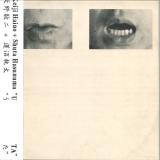
Haino sings. Hasunuma plays. It’s a minimal framework, but what emerges is a boundary-blurring sonic exploration. Across the album, Haino’s voice threads through Hasunuma’s layered soundscapes built from analog synths, electric guitar, piano, field recordings, and more. Haino entered the studio with only lyrics in hand, improvising melodies in response to Hasunuma’s evolving arrangements. The result is a work of deep trust, intuition, and sonic tension.
Keiji Haino and Shuta Hasunuma’’s creative connection began in 2017 with an impromptu performance in Shibuya—Hasunuma on a Buchla modular synthesizer, Haino responding with the Japanese national anthem, “Kimigayo.” That moment sparked their unlikely collaboration.
In 2018 Haino appeared at the Hasunuma-organized event “MUSIC TODAY IN KYOTO” at Rohm Theater, alongside Nobukazu Takemura, Manami Kakudo, Elena Tutatchikova, Kukangendai among others. In September 2021 during the pandemic, the two performed "U TA" for the first time at in Shibuya. They began planning the album soon afterwards.
For the recording of U TA, Haino entered the studio with only the lyrics in hand, with no knowledge of what sounds Hasunuma would produce. Responding to Hasunuma’s music in real time, Haino composed the melodies and layered in his voice on the spot. With additional sessions at Hasunuma’s private studio and Haino’s preferred studio, the album was completed.
All melody and vocals by Keiji Haino
All instrument, written, played, arranged, mixed and produced by Shuta Hasunuma
Recorded by zak at st-robo studio, Shuta Hasunuma at Studio i.M.O and windandwindows
Mastered by Rashad Becker at clunk
Production Management: Eishin Yoshida, Kento Ono (windandwindows)
For Temporal Drift: Yosuke Kitazawa, Patrick McCarthy
Art Direction: Aiko Koike
Special Thanks to Toshihiko Kasai, Ryoichi Kiyomiya, zAk, Yumiko Ohno
license
quête:ta
- A1: Xhe Ocean Blew
- A2: Laps On Jupiter
- A3: Left Xhe Water Running
- A4: Space Shuttle Landon
- A5: Moon Boots
- A6: Beans In Xhe Kitchen
- A7: Ainda Xhe 8Th
- A8: Pomona Knights
- A9: Rite As Reign
- A10: Shadow Boxin
- A11: Encounters
- A12: With Pleasure
- A13: Xhe Ocean Blew (Vocals)
- A14: Moon Boots (Hemmit Version)
- A15: Shadow Boxin (Instrumental)
- 1: Eating Etiquette
- 2: Golden Rules
- 3: Takes A Ten
- 4: The Outfit (Feat. Roc Marciano)
- 5: Magic & Kareem
- 6: Addicted To Danger
- 7: Ride Wit A P
- 8: Food For Thought
- 9: Forks And Knives
- 10: Gut Feeling
- 11: 1 On Me
- 12: Young Thugs
- 13: Servitude
- 14: Receipts
Knowledge The Pirate returns with a powerful new statement with his new album, The Round Table, which is now available. The Round Table is produced in its entirety by longtime collaborator and legend Roc Marciano through his Pimpire International imprint.
With roots in New York’s revered ‘90s hip-hop scene, Knowledge The Pirate has steadily built a reputation as one of the genre’s most consistent and authentic voices. A frequent Roc Marci collaborator and key figure in the modern un-derground renaissance, Knowledge fuses golden-age grit with new wave innovation—bridging generations while stay-ing firmly rooted in New York’s timeless sound.
Since his 2018 debut Flintlock, Knowledge has carved a lane entirely his own through his label Treasure Chest Enter-tainment, Inc. With five acclaimed projects under his belt, including the recent 5lbs of Pressure, he continues to deliver unfiltered street wisdom and personal reflection in every bar.
The Round Table stands as a testament to his evolution—an uncompromising body of work laced with Roc Marciano’s signature production and Knowledge’s lived-in lyricism. It’s not just a record—it’s a meeting of the minds, an audio council of kings.
“The Round Table is cinematic storytelling, teaching street knowledge, eating etiquette that will save your life” Knowledge professes. “This album is like an Honorable Elijah Muhammad book; How To Eat To Live. Produced fully by the true creator of the new wave sound, Roc Marciano, you are all invited to a seat at The Round Table; and break bread with the true Godfathers of this new wave rap renaissance.”
Ta Kish Kan is an explosion of color, a defiant rush of life. Over three tracks, aka-Sol has turned their psychedelic approach to sound toward the punk roots of electronic music, employing modular synthesizers and analog sonics to recapture the energy from before dance became homogenized and hard genre lines were drawn, challenging the conventions of modern club music and embracing a wider and more dynamic spectrum of human emotion.
A fearless debut, Ta Kish Kan is an offering exploding with heart and dripping with lust, a love letter and a provocation, a rare invitation to hair whip and headbang in the club. The release is rounded out with a remix from Osare! Editions head Elena Colombi who further explores the space between experimental, post-punk and club music, dispensing with comfort and bidding us to embrace what lies beyond.
Long Gone (Are The Old Traditions) is a label out of London.
A label focused on DIY electronics, post punk, dub and techno from now and before.
The first release is from West London artist, singer and songwriter Tutu Ta. A mini LP of out there, dubbed up, post punk mutations meeting old sounding industrial electronics following from his highly acclaimed debut album last year.
Its already seen the light of day on soundsystems across the city and further afield as well as stations like NTS, Rinse & Tom Ravenscroft's BBC 6 New Music Fix.
FUJI||||||||||TA returns to Hallow Ground with his second full-length for the label after we had released his international breakthrough album »iki« in early 2020. Active since 2006, the Japanese composer and sound artist has become prolific since the release of »iki,« releasing a slew of records while also touring the world. His new album »MMM« is Yosuke Fujita’s most complex so far. Changing the set-up of his pipe organ by switching to an electric air pump allowed him to activate new sonic and compositional potentials of the instrument, while he also expanded upon his experiments with his own voice. »MMM« is a masterpiece of conceptual and formal rigour—a testament to how multi-layered and versatile the music of FUJI||||||||||TA can be.
Previous releases had already showcased Fujita's interest in working with the rhythmic potentials of the organ he built himself in 2009. Replacing its hand-operated air pump with an electric one allowed him to work with it more freely and simultaneously record its sounds. This marked the starting point for the opener »M-1,« for which he recorded the pipes by waving a gun microphone close to it, thus creating shifting rhythmic patterns. The piece engages in a perpetual play of repetition and difference, balancing sonic intensity with compositional dramaturgy. For »M-2,« the artist uses his voice and works with a singing technique he has developed over more than a decade: constantly exhaling and inhaling, he puts a strain on his internal organs in order to create what he calls a »third voice.« The resulting piece is built on a throbbing rhythmic foundation topped by wordless melodies.
»M-3« closes the album as a synthesis of these two pieces, but is far more than the mere sum of its parts. The subtle tonal shifts of the organ take on a more subdued role this time, and Fujita’s scat growling and singing reappears in processed form. »M-3« combines the rhythms and melodies of the previous pieces to let something entirely new emerge out of them, much like the album is based on perpetual changes and recombinatory strategies. In fact, Fujita explains, the acronymic title can be read in many ways: this album is minimalistic, but freely mixes and mingles different materials in magical and even metaphorical ways while also paying its dues to his wife and daughter—M. and M. Just like its title can mean a lot of different things, »MMM« itself is ever-evolving, traversing different moods and opening itself up to a plethora of interpretations at each of its many turns.
With remixes from three infinitely creative producers, “Flight 99” – a Ta-ku, matt mcwaters, and Masego fan favorite – is given new life. Sourced from the Hopes & Dreams Club, Your Cousin Avi, moirèsun, and Toru entirely reimagine the track, creating something brand new.
As a nod to the song title, the EP will be available as a 7” strictly limited to ONLY 99 copies, hand assembled and hand numbered with love by the Jakarta crew
Remarkably marking the twenty-sixth addition to his illustrious discography, the
album blends introspective tunes with spirited tracks, all infused with Daltrey's
signature flair. It stands as a testament to his enduring adaptability and artistry,
seamlessly melding the nostalgic vibes of the 60s with contemporary nuances
and inviting listeners on a poignant voyage through time and sentiment. CD
pressing includes 3 additional tracks.
Here is another mystery from the universe comming straight out from London! Popping up from nowhere, don’t expect any infos about the person behind, it’s a very well kept secret… actually Tutu Ta reached us by telepathy to propose this sensationnal album for Macadam Mambo.
A concentrate of punkish dubby tunes combining ruffness, deepness, darkness, light, humour and serious vocals on very heavy beats and supa loud basslines. It’s raw but so gracefull in the meantime, 12 tracks, 47 min of pure bliss that won’t leave you on your knees, grab it fast it’s high demands style of music
Stomu Yamash'ta's ultra-rare cult 1971 LP is reissued for the first time, it is a deep, cosmic, at time ambient performance recorded live and
featuring two other Japanese legends: Takehisa Kosugi from the TajMahal Travellers and jazz pianist Masahiko Satoh
Remastered from the master tapes with original gatefold artwork, obi and newintroduction by Paul Bowler. Recorded live at Yamaha Hall in Tokyo on April 18, 1971, the all- night concert was recorded in front of an invite- only audience consisting of friends and musicians. Yamash'ta had Satoh on keyboards along with Fluxus master and leader of the Taj Mahal Travellers Takehisa Kosugi on violin and Hideakira Sakurai on electric shamisen.
Edited down to fit two sides of an album that will become 'Sunrise From West
Sea', the performance is both hypnotic and ethereal. It starts with Kosugi's
distinctive electric violin and develops into a deep, spiritual free form
conversation between the four musicians, giving them all the space, they need to
freely improvise and interact with each other, mixing electronics, percussion,
electric organ and shamizen without ever clashing. The interaction alternates
between quiet, tranquil Eastern meditations and more paced parts, fuelled by
Yamash'ta's extraordinary percussion playing.
Yamash'ta never reached the creativity heard in 'Sunrise From West Sea' again.
The album was recorded during one of the most fertile periods in Japan where
such groups as Les Rallizes Denudes and Taj Mahal Travellers and jazz
musicians like Masahiko Satoh and Yamash'ta were revolutionising the Japanese
music scene.
- 1: Orange And Blue
- 2: Lithium
- 3: Stone In The Water
- 4: As Long As I Can See You
- 5: Lost In Space
- 6: Busy Man
- 7: What Are We Gonna Do Now?
- 8: Do You Dream?
- 9: My Little Red Book
- 10: Allison Smith
- 11: The Face At The Window3:35
- 12: Our Love Is The Sea3:06
- 13: Orange And Blue (Early Instrumental Version)4:24
- 14: Lost In Space (Early Instrumental Version)3:56
- 15: Do You Dream? (Original Single Mix)3:17
- 16: The Face At The Window (Original Single Mix)
Welcome reissue/remaster of British Nirvana's surprise 1996 album, which revived songs written back in the Sixties but never released.
Taking its title from one of those songs, Orange And Blue has all the idiosyncrasies you'd expect from the minds of Patrick Lyons-Campbell and Alex Spyropoulos but done with a nineteen-nineties spin.
And its story of how it all came to be, as with all things Nirvana ? is not so straightforward and detailed inside the liner notes.
Repress incoming...
Number 94 in the Brazil45 series is one for the Brazilian boogie lovers out there.
The vocal and instrumental group Os Carbonos from São Paulo had a long career that straddled the 60s, 70s and 80s. 'Pássaro Selvagem' is taken from the latter years of their career. Its a bass driven, boogie-funk groove (with a bassline not too dissimilar to Queen 'Another One Bites The Dust') that is Brazilian boogie at its finest. Taken from the B-side to a 7" campacto released in 1981 on Copacabana records, its proven to be a favourite of Luke Una and we foresee it becoming a staple in your DJ box for years to come too.
The B-side comes from one of our all-time favourite artists, the mighty Sandra Sa. Sandra is a wonderful vocalist, her intense and recognisable style is one of THE voices of the Brazilian boogie golden era. Check out her classic album 'Vale Tudo' (MRBLP230) on Mr Bongo for further proof of her credentials here. 'Palco Azul' is also taken off a 7" single from 1981 and is a feel-good dancefloor groover with punchy brass stabs, warm keys and uplifting chord changes. It contains all the right elements that we have come to associate with that knockout late 70s / early 80s Brazilian sound.
“Please Wait“ (Ta-ku & matt mcwaters) releasing their EP „Black & White“ featuring soon to be mega star Masego and others via 823 & Jakarta Records. After releasing last year’s very successful tribute-record “25 Nights for Nujabes” (almost 13 mio. plays on Spotify to this day), Perth-based artist Ta-ku finally returns with brand new music!
... Please Wait is the culmination of numerous online exchanges and years of sharing voice memos, stems, musical ideas & TikTok links between Ta-ku and Canadian producer matt mcwaters. Their cathartic approach to this body of work has been more about self-expression than anything else and has culminated in an EP that covers a range of issues and experiences from different times in their lives.
While the 1st single features Jamaican-American multi-talent Masego and will also have a video, the 2nd single features up & coming singer/songwriter Alayna. Ta-ku’s 823 label represents the appreciation for the people/ideas/places that inspire and push us forward.
The artwork is shot by the artists themselves and each release has an accompanying photo zine that acts as a visual story to compliment the music being showcased.
“Ta Da” is the debut full length from J. McFarlane Reality Guest, the collective name for the trio headed by the eponymous McFarlane. As a member of the group Twerps, McFarlane has traversed guitar-centric, melodic pop music for some years while honing a highly unique, personal musical language. Ta Da is the first recorded unveiling of McFarlane’s affecting, oblique songwriting panache. Originally released in her native Australia on Hobbies Galore, Ta Da will be released worldwide by Night School in June 2019.
Wheezing into view with a troubled reed instrument set against a s of whoozy synth lines, Human Tissue Act is a foggy curtain the listener is invited to peel back. The dissonant notes are left to dance entwined, with clarinet heralding a Harry Partch-esque mallet percussion interlude. It’s a mood. With no resolution in sight, an audience dragged closer into uncertainty is suddenly drenched with the light of inter-weaving wah wah synth and saxophone. I Am A Toy introduces us to McFarlane’s vocal, an effortless and matter-of-fact, accented statement that quietly takes the reins. While McFarlane’s previous work in Twerps might reference 80s UK and antipodean guitar pop, Ta Da showcases a different influences immersed in psychedelic music and synths. It’s a brilliant, deft concoction swimming in Young Marble Giants-type minimalism washed with bare pop and harmony similar to Kevin Ayers making sense of a Melbourne suburb full of faces half-recognised in the blanching sun.
What Has He Bought begins with a Casio-keyboard rhythm pattern, palm-muted guitars and immaculately enunciated vocal give way to a burnt melodica part that elevates the spirits. Simple patterns repeated, like a well-tempered pop song that does what it needs to do and no more, build into the sound of summer leaking orange juice. They’re moments of joy, layered on top of each other like a melting cake. Do You Like What I’m Sayin’ recalls Marine Girls covering a classic ‘66 Garage nugget, organ lines fighting funk with guitar chords played just behind the percussion. “In a talking world, meanings are the same. Words want to hold on to the people they contain. Do you like what I’m sayin’?” We’re in a Beckett play perhaps, obtuse absurdities rendered pretty. Alien Ceremony is a heart-melter, given a melancholic timbre by bowed double bass it’s a tragi-comic piece that almost reeks of Robert Wyatt at his mid-whimsical twisting a fugue completely out of shape. Beneath the layers of harmony and twinkling instrumentation you sense there’s a genuine sadness somewhere even if it remains veiled.
Through out Ta Da, McFarlane plays with counterpoint and contrast to sometimes delirious effect. On Your Torturer, a simple, upbeat chord progression is hard panned, underpinning a flute solo which seems out of place, hence making it completely in place on this warmly surreal album. My Enemy is a slowly swinging eulogy to a failed relationship punctuated by analogue synth burbles, with our protagonist simply asking, in the aftermath, “can we be nice?” Here McFarlane’s vocal is straight forward, lyrically conversational but still not completely in focus, a surreal kitchen sink drama filtered through a dream where everything is in the wrong place. It’s a fine precursor to Heartburn, which similarly borrows BBC Radiophonic Workshop-style noise synths and the use of space to carve up the simple “You Will Make My Heart Burn” line. At this point, the listener has been in such close proximity to McFarlane’s show, the reality guest in a performance where they’re the sole audience member, that when Where Are You My Love rises on the horizon as a sleepy, psychedelic send off it’s uplifting. The vocal drifts away into the sunset, simple and direct. It leaves the listener slightly confused, perhaps, but grateful for the gentle surprise.