John Dikeman – saxophone
Jaimie Branch – trumpet
Luke Stewart – bass
Aleksandar Škorić – drums
A powerful collision of musical personalities - American saxophonist (and Dutch resident) John Dikeman invited avantgarde trumpeter Jaimie Branch, bassist Luke Stewart (Irreversible Entanglements) and drummer Aleksandar Škorić to form a new band project! This quartet presents its own definition of contemporary improvised jazz -with no distinct leader and with tight and supportive interplay, they demonstrate the independent musical voice of each own. Album cover by Jaimie Branch.
Cerca:the bassist
Dave Pike Quartet Featuring Bill Evans: Pikes Peak. 180g. Limited Edition High-Definition Premium Vinyl Pressing
“This LP was vibraphonist DAVE PIKE’s second recording as a leader. Pike is joined by bassist Herbie Lewis, drummer Walter Perkins, and most notably pianist BILL EVANS. It was one of the pianist’s first sessions after the tragic death of his bassist, Scott LaFaro, and gives listeners a rare opportunity to hear Evans this late in his career as a sideman. The music is fairly spontaneous. An excellent if generally overlooked straight-ahead set.” (Scott Yanow) “
The Great Alternative Boom of the early ’90s had begun to wither on corporate FM barely halfway through the decade, but the ever-changing underground had almost entirely regenerated after two major-label thrifting trips. In the ever-in-flux city of Boston, Karate positioned themselves as a crucial tendril in a sprawling nationwide community. They did so largely by refusing to stick to any single formula from the myriad of styles at their root—slowcore, post-hardcore, and jazz. As if to make a point, Karate’s lineup went through its own shift too. In the lead up to 1997’s In Place of Real Insight, Eamonn Vitt took up the guitar, and Karate compatriot Jeff Goddard entered the fold to become the band’s bassist. Armed with two guitarists, the band got significantly louder, and they smeared punk fury all over their second LP.
- A1: I Can't Believe That You're In Love With Me
- A2: Broadway
- A3: Almost Like Being In Love
- A4: Sextet
- A5: Lady Be Good
- B1: Too Marvelous For Words
- B2: Lover Man
- B3: I'll Remember April
- B4: These Foolish Things
- B5: All The Things You Are
"Three giants of West Coast Jazz came together in this deeply swinging session recorded for the Pacific Jazz/World Pacific label in 1953. Alto saxophone master Lee Konitz joins with the great Gerry Mulligan on baritone saxophone and legendary trumpeter Chet Baker on a half-live, half-studio program of standards along with one Mulligan original.
The group is supported by bassists Carson Smith and Joe Mondragon with Larry Bunker on drums for this spontaneous and inventive jazz treasure.
Blue Note Records’ Tone Poet Audiophile Vinyl Reissue Series is produced by Joe Harley and features all-analog, mastered-from-the-original-master-tapes, 180g audiophile vinyl reissues in deluxe packaging. Mastering is by Kevin Gray (Cohearent Audio) and vinyl is manufactured at Record Technology Incorporated (RTI)."
Jazz Sahara is the debut album by double bassist and oud player Ahmed Abdul-Malik featuring performances recorded in late 1958 and originally released on the Riverside label.
Spirits Having Fun records are ones made from and for shows and spaces—arrangements rooted in a deeply collaborative process, that come to life through intuitive and locked-in live improvisation. Following their 2019 debut Auto-Portrait, Two finds the New York and Chicago based four-piece continuing to challenge ideas of what a rock band can be, pulling apart their musical experiences and reimagining them as kinetic compositions, equally studied but palpably organic.
Two is constructed around gut feelings and strong grooves, elastic rhythms and playful pacing. Its twelve songs expand, contract, and make sharp turns between melodies under singer-guitarist Katie McShane’s meditative lyrics. “Broken Cloud,” which was also released last year on a compilation in support of Chicago Community Jail Support, offers a glimpse into her reflections on the natural world: "A city grew out of the ground / to a mountain it's only a blur."
True to its name, the internal logic of the band is also just a lot of fun, built on trust and deep-rooted musical relationships. Before there was Spirits Having Fun, McShane, bassist Jesse Heasly, guitarist-vocalist Andrew Clinkman, and drummer Phil Sudderberg had performed together in various arrangements over the years. McShane, Heasly and Clinkman met in a specific corner of the Boston underground in 2013, a time when a scene had coalesced around students from local music conservatories frequently collaborating with punk bands and noise artists, exchanging ideas and warping musical worldviews. Heasly and Clinkman played together in Cowboy Band, making mutant, free jazz-inspired takes on old country tunes. When Clinkman moved to Chicago, Heasly and McShane played in experimental groups like EKP and Listening Woman; in Chicago, Clinkman met Sudderberg playing in projects like jazz scene fixture Ken Vandermark’s high-powered band Marker.
Spirits first came together as an attempt at a long-distance collaboration among friends in 2016, driven by the simple feeling of missing each other; they’d meet up for marathon weekends here and there to practice, playing small loops through dive bars and art spaces around the Midwest—just enough for McShane and Heasly to afford plane tickets back home. Being split between Chicago and New York forced the project into a deliberate pace. “We tried to take it slow and let it be what it was,” said McShane. That sense of patience unexpectedly prepared them for March of 2020, when their planned tours and the release of Two were indefinitely delayed.
Two was mostly recorded in the summer of 2019 with the help of omnipresent Chicago engineer Dave Vettraino and DPCD’s Alec Watson, whose contributions on organ, synths, and piano are laced throughout the record. The album reflects a synthesis of solitary and communal songwriting processes—each song drawing on fragments written by individuals, which McShane threaded together and shaped through her distinct compositional lens, making the songs whole before returning to them to the band to mature collectively. When composing, McShane writes first on the keyboard before adapting parts for guitars played by herself and Clinkman. Their dueling approaches to guitar are complementary: McShane, being a newer guitarist, brings a freshness to the project (“I'm just discovering the whole time,” she says) while Clinkman has been playing since childhood.
“There's a lot more collaboration on this record,” says Clinkman, “in terms of all of us letting stuff bloom a little bit more.” The record’s first single, “Hold The Phone” is a good example of this process—it started with a playful intro riff from Clinkman, a melody and bridge added by McShane, a wobbly outro groove added by Heasly, which Sudderberg brought to life. Another single, the dynamic “See a Sky,” written primarily by Heasly, underscores the rhythm section chemistry at play across the record, the song ebbing and flowing around Heasly and Sudderberg’s eclectic percussive palettes.
“Entropy Transfer Partners” is the only song on the record with lyrics by Clinkman, and the album’s most politically direct—a call for solidarity in the face of systemic failures, an acknowledgment of the shared material devastation caused by our country’s ongoing healthcare and housing crises: “These are not things we're experiencing individually. We struggle through them collectively. And we could actually declare, all of us, that it doesn't have to be this way, and fight and organize to ameliorate some of those conditions.” (“We won't work to create the shit you monetize, to run our lives,” they sing.)
From front to back, Two is an absorbing listen simply for its impressive range. But as the members explain themselves, the complexity of the record is about more than its intricate riffs, or how often they count out an odd time signature, but how they reject the notion of boxing the songs in, letting the melodies take on lives of their own. “Making music that feels alive is important to us,” says Clinkman. “Music feels most powerful to me when it deepens our sensation of feeling alive and connected to other humans. It’s so easy to feel worn down and isolated; that your life’s value is fixed to your productivity at your job, or the things that you have or don’t have. Making music that feels joyful and fun seems like one effective antidote to that feeling.”
Power punks, Hot Milk, have announced their second EP, ‘I JUST WANNA KNOW WHAT HAPPENS WHEN I’M DEAD” via Music For Nations.
It follows the success of the band’s first EP, 2019’s ‘Are You Feeling Alive?’, a fizzy collection of gutsy emo-pop which established them as one of the most exciting new bands in the UK. Their 2019 was a whirlwind year that saw them tour with Foo Fighters, Deaf Havana and You Me At Six, as well as playing some of the UK’s biggest festival stages.
The band were formed in 2018 by vocalist and guitarist duo, Han Mee and Jim Shaw, two friends who met working behind the scenes in the Manchester music scene. Yet they yearned to be in a band themselves. “We got to the point where we were why not? What else have you got to lose?” says Jim. “We thought, we can go for this or we can get to 60 and know we didn’t do right by ourselves.”
Debut EP, ‘Are You Feeling Alive?’, which was penned during a drunken songwriting session, was an effervescent refusal to settle for second best in life. “We’ve both realised that life you don’t get another face,” Han continues. “You get one face and then you’re done, and you will never exist ever again.”
That sense of not letting life slip through your fingers is at the core of Hot Milk’s punk-indebted ethos. And having taken a leap of faith to grasp their platform, the band, completed by bassist Tom Paton and drummer Harry Deller, aren’t about to let it go to waste. “Art is about your interpretation of your own experience,” adds Jim. “The first EP was written five years ago. We’ve grown up and realised who we are and what the world is like right now.”
‘I JUST WANNA KNOW WHAT HAPPENS WHEN I’M DEAD’, which was produced by Jim Shaw, is another vivacious call to arms, rammed with sharp hooks and huge, catchy choruses, to encourage everyone, everywhere, to follow their dreams. But elsewhere, the lyrics are more personal, with the band bottling the anxieties and frustrations of their everyday lives. ‘Woozy’ openly tackles depression, ‘Good Life’ takes on societal corruption and the distribution of wealth, while elsewhere the band address the pursuit of happiness in a modern world.
“These songs are honest,” says Han. “I have nothing to hide. Everyone’s on antidepressants these days. It’s the world we live in, it makes people sad. Capitalism. Is it broken? 100 per cent. I’m angry that the fact that we’re sold a world that actually doesn’t make your inner peace happy. Humans need love and community and a lot of the time, there is no love and the community has dissolved.”
“The anger resides in us at the unfairness of the world,” adds Jim. “Online communities are all about flexing and battling your peers to look or sound a certain way that is better than everyone else. It’s constant and it’s dangerous. You’re teaching kids that to be content, you have to be best. It’s a question again. Are you really living?”
“We’re angry, both politically and existentially in terms of the system we now live in. But also, we’re angry at the fact that we’re sad quite a lot,” continues Han. “But we’re trying to not just sit there and take it. We’re trying to fix it, by building a family through this band.”
Walk into any Hot Milk show and you will feel that sense of community. Through their honest lyrics and inclusive approach, the band say their aim is to create an “aggressively space safe” where fans are empowered to be themselves, “authentically and unapologetically”, as well as opening up a dialogue for people to talk. That will become clear later this year when the band get their chance to air the new material. This summer, they will return to Reading and Leeds Festivals, this time to play the main stage, as well as embarking on a headline UK tour in September. And believe, when the times comes to finally get back into those sweaty pits, these new songs will provide the perfect, life-affirming soundtrack.
“Life is fragile,” says Jim. “You can’t take things with you, but you can make the best memories. That’s the most important thing in life. Your currency is your memory.” “What you can take with you is something that absolutely makes the blood pump round your veins and gives you goosebumps,” agrees Han. “That’s what this band is to us. It’s our passion. That’s what this EP is about.”
Deluxe Edition[33,57 €]
Portuguese experimental trio 10 000 Russos are gearing up for the release of their fifth album ‘Superinertia’, which is due out September 10th on Fuzz Club Records. Following on from 2019’s ‘Kompromat’ LP and tour dates around the UK, Europe and Mexico in support, the Porto-based band describe ‘Superinertia’ as a record addressing the “state of inertia that humans live in the West nowadays. It isn’t a record about the past or future. It’s about now.” For all that ‘Superinertia’ might take aim at a world without motion, however, the same cannot be said of 10 000 Russos themselves.
On the one hand, since their 2013 debut LP and the three that have followed on Fuzz Club since (2015’s self-titled, 2017’s ‘Distress Distress’ and ‘Kompromat’), 10 000 Russos’ music has always been about as kinetic as it gets: a truly unrelenting and motorik sonic force. On the other hand, ‘Superinertia’ also sees the band itself move into whole new musical territories – aided especially by the recent addition of synth player Nils Meisel to the line-up (who replaces former bassist André Couto.)
“The synths really opened up the sound of the band and gave more routes for the music to journey down. The most important thing on this album was to not repeat ourselves. A new arc in our sound is coming to life”, drummer and vocalist João Pimenta explains. On said arc, the Russos sound is expanded to include moments that invoke Ry Cooder’s ‘Paris, Texas’ soundtrack (‘Mexicali/Calexico’), dancey outbursts that transport you to the 90s Summer of Love (‘Super Inertia’), the closest thing Russos have ever done to a pop song (‘A House Full of Garbage’) and even a touch of banjo (albeit one that sounds like a country band on amphetamines playing over a feedback-blasted Stooges beat.)
“10 000 Russos are bizarre and excellent in equal measure.” - The Quietus
“Songs drip with heavy echo, relentless beats and bass and a sense of charging into the ultimate infinite.” - Bandcamp Daily
“Something unholy has indeed been summoned out of the ground, and it is a power trio from the Iberian Peninsula.” - Clash Magazine
Blue vinyl[26,43 €]
Portuguese experimental trio 10 000 Russos are gearing up for the release of their fifth album ‘Superinertia’, which is due out September 10th on Fuzz Club Records. Following on from 2019’s ‘Kompromat’ LP and tour dates around the UK, Europe and Mexico in support, the Porto-based band describe ‘Superinertia’ as a record addressing the “state of inertia that humans live in the West nowadays. It isn’t a record about the past or future. It’s about now.” For all that ‘Superinertia’ might take aim at a world without motion, however, the same cannot be said of 10 000 Russos themselves.
On the one hand, since their 2013 debut LP and the three that have followed on Fuzz Club since (2015’s self-titled, 2017’s ‘Distress Distress’ and ‘Kompromat’), 10 000 Russos’ music has always been about as kinetic as it gets: a truly unrelenting and motorik sonic force. On the other hand, ‘Superinertia’ also sees the band itself move into whole new musical territories – aided especially by the recent addition of synth player Nils Meisel to the line-up (who replaces former bassist André Couto.)
“The synths really opened up the sound of the band and gave more routes for the music to journey down. The most important thing on this album was to not repeat ourselves. A new arc in our sound is coming to life”, drummer and vocalist João Pimenta explains. On said arc, the Russos sound is expanded to include moments that invoke Ry Cooder’s ‘Paris, Texas’ soundtrack (‘Mexicali/Calexico’), dancey outbursts that transport you to the 90s Summer of Love (‘Super Inertia’), the closest thing Russos have ever done to a pop song (‘A House Full of Garbage’) and even a touch of banjo (albeit one that sounds like a country band on amphetamines playing over a feedback-blasted Stooges beat.)
“10 000 Russos are bizarre and excellent in equal measure.” - The Quietus
“Songs drip with heavy echo, relentless beats and bass and a sense of charging into the ultimate infinite.” - Bandcamp Daily
“Something unholy has indeed been summoned out of the ground, and it is a power trio from the Iberian Peninsula.” - Clash Magazine
Following their critically acclaimed eponymous debut in 2018, international
jazz quartet SCOPES bring their blend of accessibility and adventure to
Whirlwind Recordings for their second album, ‘Age of Reason’.
Led by Austrian drummer Mathias Ruppnig, German bassist Tom Berkmann
and French pianist Tony Tixier, American altoist Matt Chalk makes his debut
with the quartet on this their second full-length release.
The group’s second release is a personal and philosophical reflection on the
pressing matters of a time, when all generations need to come closer together
and become more aware of their surroundings. That feeling of maturity emerges on Age of Reason too - it’s the first SCOPES recording to feature the compositional skills of each member, delivering some thrilling results.
Age of Reason opens with ‘Deep Water’, a Tixier composition that carefully balances drive and expansion in a “dive into the depths of our biggest unacknowledged dreams.” For Ruppnig, the album’s aims are encapsulated by this tune
“the songs have an easy feel, and they’re not too specific - every musician has
the space to have his own voice speak.”
The title track follows with its combination of melodic ease and structural
space, whilst other tracks include ‘Gift of Time’, a tune born from the idea of
how precious time is. Unable to tour or perform, SCOPES used that time constructively to create and explore the new sounds heard on Age of Reason.
Summarising, Ruppnig describes Age of Reason as a “transportation of feelings.
“It’s a very emotional album, and I hope listeners will find their own stories
when listening to it.” SCOPES make that task a pleasant one for audiences of
all dispositions.
In the wake of Bitch Magnet and current of Superchunk, Sooyoung Park and Mac McCaughan formed a raw version of Seam in the summer of ’91. With bassist Lexi Mitchell, the trio banged out an album and two singles worth of shambolic dream pop in the sweltering Chapel Hill heat. Ten songs of talk-whispered vocals, sloshing guitar solos, scattered snare rolls, Velocity Girl’s Sarah Shannon, and the original version of Codeine’s slowcore classic “New Year’s,” on LP for the first time in 30 years.
This live set from the 1971 Montreux Jazz Festival was co-led by tenor saxophonist King Curtis (who tragically would be killed three months later) and veteran blues pianist/vocalist Champion Jack Dupree. With guitarist Cornell Dupree (in excellent form), bassist Jerry Jemmott and drummer Oliver Jackson laying down the foundation, Curtis and Dupree find a great deal of common musical ground. Dupree has quite a few witty vocals (particularly the near-classic "Junker's Blues") while taking choruses of irregular length that keep his sidemen continually guessing. Curtis' distinctive tenor is also heard from, making one truly regret that this was his final recording. (All music)
First time on LP: Praised by NPR for their “upbeat, poppy vibe; energetic,
driving rhythms; and virtuosic solos,” Twisted Pine released their
second full- length Right Now on August 14, 2020 (Signature Sounds).
Exploring a sound they call Americana funk, Twisted Pine takes traditional music in exhilarating directions. Bassist Chris Sartori writes, “This album is easier
to feel than describe. We’re rooted in bluegrass, continually inspired by explorers like Bela Fleck, Jerry Douglas, and Sierra Hull. Right Now takes this heritage into a new dimension. Our bluegrass is jazzy, our indie folk is poppy, our
grooves are funky.”
Twisted Pine (Kathleen Parks, fiddle; Dan Bui, mandolin; Chris Sartori, bass; Anh
Phung, flute) grooves with fearless improvisation and intricate arrangements.
“They were once bluegrass,” wrote The Boston Globe, “but ... this Boston band
has become something else, a wider version of stringband, boundary jumpers
akin to outfits like Punch Brothers and Nickel Creek.”
This year Music On Vinyl in cooperation with Sony Music and Alex Callier are releasing 4 Hooverphonic remix Eps. Each EP represents a Hooverphonic album; A New Stereophonic Sound Spectacular, Blue Wonder Power Milk, The Magnificent Tree and Presents Jackie Cane. Alex Callier selected the best remixes of their songs for each remix EP. All 4 remix EP’s are scheduled for release in 2021 and are cut on 45 RPM and pressed on 180 gram audiophile vinyl.
Hooverphonic are a Belgian band that formed in October 1995. Though originally categorized as a trip hop group, they quickly expanded their sound to the point where they could no longer be described as a lone genre, but rather encompass alternative, electronica, electropop, rock, and a mixture of others. The band originally called themselves Hoover, but later changed their name to Hooverphonic after discovering other groups were already using the Hoover name and to avoid any legal issues with the vacuum cleaner company.
Since their formation, Hooverphonic’s lineup consisted of bassist Alex Callier, guitarist Raymond Geerts, and various lead singers. Geike Arnaert (1997–2008, 2020-present) has recently re-joined the band. Hooverphonic represented Belgium in the Eurovision Song Contest 2021.
The band achieved international recognition through the inclusion of the Stereophonic track “2Wicky” on the 2000 individually numbered copies of Blue Wonder Power Milk remixes are available on on solid blue vinyl.
Blending screamo and metalcore seamlessly, the three-piece drop their debut full length filled with blistering hardcore as well as slower, expansive and epic post-hardcore. Misery Never Forgets is a crimson slice of emotional violence, whose attack is both frenetic and draining, a maelstrom of vulnerability frought with pain and aggression that calls to mind such stalwarts as Pg. 99, Majority Rule and Zao. Born as an outlet for trauma, Wristmeetrazor toes the duplicitous line of suffering and salvation. This paradigm flickers brighter than ever through the cloak of darkness that is the band’s debut LP “Misery Never Forgets”, nine tracks of blinding, chaotic emotion. Conceived in the bedroom of guitarist and vocalist, Jonah Thorne, Wristmeetrazor started as a solo project influenced by the likes of screamo bands Neil Perry and Kodan Armada in Spring of 2017. Shortly after releasing a demo, Thorne enlisted help from bassist and vocalist, Justin Fornof. After releasing two EPs in the Fall of 2017, and touring across the southeast, the band rounded out their line up by adding drummer and vocalist, Bryan Prosser.
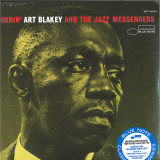
More than any other album in the canon of Art Blakey & The Jazz Messengers, 1958’s Moanin’ — featuring the great drummer with trumpeter Lee Morgan, tenor saxophonist Benny Golson, pianist Bobby Timmons, and bassist Jymie Merritt —was the perfect crystallization of the band’s bluesy, soulful sound, and it still stands today as perhaps the most quintessential hard bop recording of all-time.
Originally self-titled, the album was later renamed Moanin’ due to the popularity of Timmons’ unforgettable opening track. The album also introduced several indelible Golson compositions that would become standards of the jazz songbook including “Along Came Betty” and “Blues March.”
This Blue Note Classic Vinyl Edition is all-analog, mastered by Kevin Gray from the original master tapes, and pressed on 180g vinyl at Optimal.
Tenor saxophonist Hank Mobley had already led nine dates for Blue Note Records by the time he arrived at Rudy Van Gelder’s studio on February 7, 1960 with pianist Wynton Kelly, bassist Paul Chambers, and drummer Art Blakey, but on that day the quartet laid down what would become his masterpiece: Soul Station.
The crystalline six-song set was a showcase for Mobley’s lyrical flow from the breezy opening take on Irving Berlin’s “Remember” through bluesy originals like “Dig Dis” and the title track, and the swinging up-tempo numbers “This I Dig of You” and “Split Feelin’s.” Soul Station endures as a jazz classic for the ages..
This Blue Note Classic Vinyl Edition is all-analog, mastered by Kevin Gray from the original master tapes, and pressed on 180g vinyl at Optimal.
Re-mastering by: Kevin Gray
This is a reissue of a now out-of-print album from live trio date by the legendary LA-based pianist, composer and multi-bandleader, Horace Tapscott. Pianist Horace Tapscott is always at his best when he is leading a trio. Born in 1934 in Houston, Texas, Horace came from a musical family centered around his mother, Mary Malone Tapscott, who worked professionally as a singer and pianist. When Horace was nine, the family moved to Los Angeles. As a teenager in the late 1940's, Horace was surrounded by the music of Central Avenue: Art Tatum, Charlie Parker, Coleman Hawkins, Dexter Gordon, were among the many cats on the set. Around this time, Horace also began to take music lessons from teachers Dr. Samuel R. Browne and Lloyd Reese, whose other students included Eric Dolphy and Frank Morgan. Horace's musical studies included trombone in addition to piano.
In 1952, Horace graduated from Jefferson High, got married to Cecilia Payne and went into the Air Force. Horace played in an Air Force Band while he was stationed in Wyoming for his term of duty. After mustering out, he returned to Los Angeles where he worked around on various gigs until he joined the Lionel Hampton Big Band as a trombonist.
In 1959, Horace finally went with the Hampton Big Band to New York, where his friend Eric Dolphy introduced him to John Coltrane. A tough winter, a lack of gigs, and too many nights on the floor of a friend's art gallery finally sent Horace packing for sunny Southern California, where a life with wife and family awaited his return.
The sixties saw Horace emerge as a die-hard leader of the Avant Garde. Horace began to gain public notice playing with his own group, that included alto saxophonist Arthur Blythe, bassist David Bryant, and drummer Everett Brown II. Horace also appeared on records for the first time.
Horace was always outspoken about racism, politics, stereotypes, and social ethics. His forward-minded vocal presence on and off the microphone is as much a part of his art as his piano playing. As a result, he was labeled a "dissident," categorized as an "employment risk," and black-listed from the music industry establishment in the early 1970's. None of this slowed Horace down. He began gigging sporadically at Parks and Recreation events and for churches around Watts. This "dark period," with his only regular gig at his friend Doug Weston's Troubadour on Los Angeles' "Restaurant Row", was also a time of intense creativity.
Around 1977, Horace reorganized the Pan-Afrikan Peoples Arkestra with the help of several old friends and many new faces. The Arkestra performances involve singing, dancing, and poetry in addition to the music. Soon after the new group's debut, Horace came to the attention of producer Tom Albach who contracted Horace to record a number of albums for Nimbus Records. Albach also helped introduce Horace to an international audience by arranging several European tours.
The 80's saw Horace emerge as one of jazz's premiere solo pianists. He recorded several solo piano albums for Nimbus.
Southern Avenue Announces New Album, ‘Be The Love You Want’. Out August 27 via Renew Records/BMG, produced by Multi-Grammy Winner Steve Berlin
(Memphis, TN) – Memphis soul powerhouse Southern Avenue has announced the release of their third full-length album. BE THE LOVE YOU WANT was produced by multi-GRAMMY® winner, Steve Berlin (Los Lobos, Deer Tick, Susan Tedeschi, Jackie Greene), and co-produced by Ori Naftaly. The album, arriving via Renew Records/BMG on August 27, 2021, is preceded by today’s release of the sultry first single, “Push Now,” available at all DSPs and streaming services.
BE THE LOVE YOU WANT is Southern Avenue’s most ingenious and personal effort thus far. Since their inception, the band has produced a wide-ranging collection of original music – predominantly co-written by Israeli-born guitarist Ori Naftaly and powerhouse lead vocalist Tierinii Jackson – that links them to their home city’s glorious past while at the same time, demonstrates their ambitious intent to evolve Memphis music to contemporary effect.
BE THE LOVE YOU WANT sees Southern Avenue teaming up with artists like multi-GRAMMY® award-winning pop superstar Jason Mraz and certified Platinum producer Michael Goldwasser from Easy Star All-Stars on “Move Into The Light” for a churning, funk-blasted burner. Besides writing with him on the first single, the band also collaborated with Cody Dickinson from North Mississippi Allstars for the song “Heathen Hearts.” The songwriting core grew within the band as well, as drummer Tikyra Jackson and bassist Evan Sarver collaborated to co-write “Let’s Get It Together” and “Pressure.”
The band brilliantly bridges the power of Memphis soul with jamband liberation, gospel blues, and R&B to craft their own timeless brand of American music. The ambitious sonic approach expertly complements BE THE LOVE YOU WANT’s rich themes of self-love, self-empowerment, personal accountability and the desire to push through towards something greater in life.