Patric Catani's E-De-Cologne new mini album !
First release from Catani's was under this name, in 1993... The sound of it all is a melt of tunes from the past (Eradicator, Test Tube Kid...) and some more recent deliriums on his old machines...
The 9th release of the label is planned since years, as I always dreamed pressing some Catani's Hardcore music...
And this is maybe not the last ?
The sleeve is by Artcoton.
Enjoy this record as much as you can for its various aspects from Industrial Breaks to pityless Speedcore !!!
Поиск:the cat lab session
Все
Special Guests on the record include: Mark Cisneros, Joe Lally, Derrick Decker, Bob Berberich, Clint Walsh, Dave Grohl, Onam Emmett, John Goetchius, Jerry Busher, Amy Pickering, Ian MacKaye, Amanda MacKaye, Brian Baker, Randy Austin, Martha Hull, Michael Reidy, Nate Bergman, Bobby Madden.
Scream formed in 1979. Drummer Kent Stacks, bassist Skeeter Enoch Thompson and the brothers Pete and Franz Stahl attended school together in Bailey’s Crossroads, Virginia, when they began to discover the punk and new wave scene in DC and the provocative power of making music.
Like most of the punk bands in DC, they were influenced by the Bad Brains, but their rock and roll sensibilities set them apart. In 1982, they went into Inner Ear Studio with Ian MacKaye and Eddie Janney to record Dischord's first full length album, Still Screaming.
Scream followed this with a second full length album, This Side Up, in 1984. The band toured throughout the US and were one of the first US hardcore bands to tour Europe and the UK. In 1987, they released Banging the Drum, which was recorded at both Southern Studios in London and Inner Ear. In 1988, No More Censorship was released on reggae label RAS records. Scream returned to Dischord to release Fumble in 1993.
They made a few line-up changes along the way, including the addition of their friend Harley Davidson on second guitar, and, when Kent Stacks (RIP) left the band to start a family, they asked a young local drummer, Dave Grohl, to take over. After a number of years with "the Scream team," Dave went on to join Nirvana and form The Foo Fighters.
In 1996, at a Christmas reunion show, Kent Stacks returned as Scream’s drummer; the show was recorded and released as the CD “Live at the Black Cat.” Over the next few years, everyone branched out in different directions – Franz joined the Foos for a short period and Pete played with Goatsnake and earthlings? The band returned as a unit, with Clint Walsh on second guitar, in 2011 to record the Complete Control Sessions, which was released as an EP on Side One Dummy and was, until now, the band’s most recent release.
Scream’s newest album, DC Special, will be released in the fall of 2023 on Dischord Records. For this record, Scream invited their extensive music community to help create a unique project that weaves the history of music in Washington DC into the story of the band. Recorded by Don Zientara just weeks before his studio was evicted from its longtime location, the record is rich with both the sounds of Inner Ear and those of friends and musicians who influenced Scream and who shaped DC music over the past six decades. DC Special embodies the same sense of community and politics that inspired Scream from the start and is a truly special collection of new music that speaks to the present and also tells the story of DC music, Scream, and the influences that shaped them.
Bonus Download Tracks
Faces
Politics is Entertainment
Black and White
Lifeline Redux
Smile and Bleed
I Saw Ya (Wanna Be Like Captain)
Mint Condition - A record label focused on excavating the outer fringes of classic House and Techno. Unreleased mixes, classics, overlooked gems and never heard before material, mined from the last 30+ years of contemporary dance music are the order of the day. From Chicago, Detroit and New York to London, San Francisco and beyond. Mint Condition have got their digging hats on to bring you exclusive heat and those rarer than rare jams that have been in your wants list for years. Dig in!
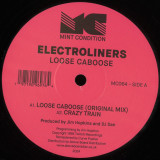
A serendipitous encounter at an SF record store in the early 90s brought together local music aficionados DJ Dan and Jim Hopkins. Their collaboration birthed the legendary Electroliners project, channeling their shared passion for underground and funky sounds into the iconic left-coast rave anthem, 'Loose Caboose', now firmly nestled in your hands. Pooling their musical prowess, Dan and Jim embarked on a journey of sonic exploration, meticulously crafting their signature sound by dissecting samples and breakbeats, infusing the musical landscape with a revitalizing energy. As their reputation grew within the local scene, they found themselves tasked with supplying a track for a promotional CD-ROM by a burgeoning software company.
Through marathon sessions of digging, slicing, sequencing, and exchanging snippets over phone calls, Electroliners hit their creative stride. It was only natural to unveil their creation in the raw intensity of a live rave setting. Thanks to a connection with DJ DRC, they seized the opportunity, and the rest is history. Copies of the record flew off the shelves by the thousands locally, and its overseas acclaim, spearheaded by licensing through XL Recordings in the UK, cemented its status as a bona fide underground classic. But what exactly is an Electroliner you might ask? Jim sheds light on the inspiration: “I delved into books on trains at the public library,” he reveals. “Among them, 'Electroliner' caught my eye, a train line in the Midwest. Given the track's pulsating train horn, 'Electroliner' and 'Loose Caboose' simply clicked.”
'Loose Caboose' is an all-time classic, and still causes much damage on the dancefloor today. Yet another unmissable addition to the MC reissue catalogue, fully licensed from the artists, mastered and cut by Curve Pusher, and available once again available for purchase. Do not sleep.
The second in our Mr Bongo series opening the vault on classic recordings from the fabled Groove Merchant Records catalogue. This time the spotlight turns to the Hammond B3 organ maestro Lonnie Smith, as we proudly present a reissue of his cosmic jazz-funk journey, ‘Afro-Desia’.
Originally released in 1975, this much-loved album was produced by Groove Merchant label owner Sonny Lester and features the mysterious 'Compliments Of A Friend' on guitar. Considering Smith was part of George Benson’s quartet in the ‘60s, that not so discreet veil appears to have been lifted on who this ‘friend’ might be. However, presumably due to contractual reasons, Benson had to remain covert for this recording. The lineup doesn’t stop there though, with the likes of legendary bassist Ron Carter and Grammy award winning saxophonist Joe Lavano joining the outfit.
An album of two parts, the first side sees Lonnie Smith in a spaced-out, cosmic jazz funk setting. The opener 'Afrodesia' is a funk flexing, steamy groover. Greg Hopkins and Lavano trading off on trumpet and sax respectively, as that bassline walks its way over fluttering jazz percussion and off-kilter electronics. 'Spirits Free' is an epic 15-minute free-wheeling jazz-funk workout. A mind melting trip that rises and falls, in parts spacey and serene, with Smith’s organ playing complimented by stretched out horns. Before long it opens out into unconstrained fluid sections that do its title proud. Pure ‘70s jazz-funk at its most stellar.
Side B takes a more classic soul-jazz flavour, with touches of Latin spice. 'Straight To The Point' kicks off with a carnival zing, full-frontal horn and organ lines providing a fiery party punch. It’s a swinging jazz cut that used to receive spins by DJs at Russ Dewbury's Jazz Room's sessions in Brighton in the ‘90s.
Finally, 'Favors' and 'The Awakening' close out the release. Two sure shot, quintessential Lonnie Smith firing Hammond grooves. Each conjuring up images of packed out, smokey jazz bar jams, every player letting loose with masterful improv sections to whip the crowd up into a frenzy.
A truly wonderful album, and an archetypal release showcasing the height of jazz musician excellence from this era.
The eagerly awaited debut album from the London-based four-piece * At the forefront of the new generation of Black British guitar music with Big Joanie and Bob Vylan * Supporting Slowdive on their UK tour in February * Singles playlisted by BBC Radio 6 Music, Spotify and others Whitelands are Etienne, Jagun, Vanessa and Michael and they are ostensibly a shoegaze band ever since Etienne stumbled across Slowdive's KEXP session in his recommended videos on YouTube a few years ago. However, they come at the resurgent, Gen Z-soundtracking genre from a refreshingly different angle thanks to their mishmash of musical backgrounds. There's also the fact that their line-up is fully PoC in what is traditionally seen as a predominantly white genre. "There's an underlying narrative that it's OK for white men to be romantic, sensitive, emotional and make dreamy music and, by contrast, young Black men should be making angry music," says Vanessa. "We've all grown up with these stereotypes and therefore I think people are mystified when they see Whitelands." "I consume a lot of media," says Etienne of his wide range of influences. "Videogames, music, news, paintings, manga, animations and film are my go-to, especially anime. There is this drive to want to understand and feel the whole weight of an expression. So, the songs are based on other songs, pictures, aesthetics, 'vibes', an emotion someone else felt. Fundamentally, you are what you eat." As a result of this diet, the lyrics are stunning, dealing with everything from unbalanced relationships and vulnerability to depression, being diagnosed with ADHD and, on the new single 'Tell Me About It' (featuring vocals by Dottie from the band's Sonic Cathedral labelmates deary), trying to navigate love following that diagnosis. The album is bookended by two poetically political songs - 'Setting Sun' and 'Now Here's The Weather' - that deal with imperialism, racism and performative ignorance. "We've experienced tokenism, micro-behaviours, envy and resentment," concludes Vanessa. "So we feel we have to continually prove ourselves. We know we're making a positive impact, but I want Whitelands to really break some barriers."
Proudly presenting a new series of Mr Bongo reissues exploring the incredible back catalogue of Sonny Lester’s iconic Groove Merchant record label. First up, the spellbinding funk-fuelled, soul jazz album ‘Simba’, by guitar maestro O'Donel Levy.
Baltimore-born, Levy was already well regarded as one of the best up-and-coming jazz guitarists at the time of Simba’s release. Having toured with George Benson and Jimmy McGriff, as well as featuring on McGriff’s Black Pearl album on Blue Note, he went on to sign with Sonny Lester’s Groove Merchant. Produced by Lester himself and recorded over two back-to-back days of sessions in 1973, Simba features a who's who of ‘70s session players. The album features the legendary studio drummer Steve Gadd, Cecil Bridgewater on Flugelhorn, bass by Tony Levin and arrangements by Manny Albam.
A masterclass in tight yet effortlessly funk-driven rhythms, the tracks showcase these musicians at their zenith. Album opener 'Bad, Bad, Simba' wouldn’t have been out of place on a Lalo Schifrin ‘70s car chase soundtrack. Levy's playing is brilliant, bright and slick, with an infectiously exuberant energy that is complimented perfectly by Gadd's supreme drumming. ‘Playhouse' serves up another vibrant offering, Wah Wah guitars, horns and flutes duelling it out in a fast-paced fashion.
The cinematic thread continues throughout, yet with the tempo taken down a notch. 'Sierra Lonely' and ‘Sad, Sad, Simba’ head into lush ballad territory, with superb arrangements by Albam and beautiful playing by Collins and Bridgewater on Flugelhorn. Here Levy shines without taking any limelight, as the players synergize to a relaxed perfection. ‘Nigerian Knights’ closes the album flawlessly, showcasing once more Levy’s understated yet magnetic flow on the guitar.
Every track on ‘Simba’ is a winner. As with CTI Recordings of the same era, the feel and textures of Sonny Lester's productions have that pre-emptive, hip-hop aesthetic, which later producers would rework and reimagine. This album is expertly balanced, deftly arranged and magically executed, ebbing and flowing with a cool buoyancy that just grooves and grooves.
- A1: Time Continuum (Intro) 0 58
- A2: Knowledge Of Self 2 57
- A3: Keep Your Kids In School 1 49
- A4: Wire Fraud 5 04
- A5: Take Me Back 3 47
- A6: Player's Groove 2 13
- A7: Sunday Morning Dj 1 51
- B1: Ezekial's Vistion (Interlude) 0 32
- B2: Battle Chariot 3 00
- B3: No Natural Explanation 1 16
- B4: Cocktail Break 4 26
- B5: My Century 2 37
- B6: Environmental Condition 3 08
- B7: Cosmic Eyes (Interlude) 0 32
- B8: Between The Lines 2 17
- B9: Pass The Threshold (Outro)
For Fans Of... El Michels Affair, Adnan Younge, Roy Ayers, Karnem Riggins, The Roots, Khruangbin. Producer "Grimez"” has been making music for 20 years deep, Grimez has ghost produced tracks for 50 cent, Hi-Tek, Kool Keith, Stick man (DEAD PREZ), Killah Priest, Sadat X, MOOD & Talib Kweli, and Mighty Diamonds to name a few. Gritty & raw analogue instrumentals. Very limited black vinyl LP. Genre: Hip Hop. Doctor Bionic is back on the airwaves. The newest album from Cincnnati based executive producer Jason Grimez is an instrumental collection of classic soul, jazz, and hip-hop sounds. The first instalment of a three-part series, Terrestrial Radio offers 37 minutes of carefully curated jams. Tune in to catch the vibe on 1/26/2024. Jason Grimez is an engineer, executive producer, and the owner of Chiefdom Records. Growing up in the 90s, he fell in love with hip hop at an early age. He started scratching on a pair of 1200s and sampling records with an MPC 3000 in high school Years of sampling, mixing, producing, and sharing his own music led him to where he is today. His independent label Chiefdom Records has released close to 30 albums in the last seven years. His studio persona Doctor Bionic was one of the first to see a release on the new implant. The project features a rotating cast of incredibly talented session musicians. Jason is responsible for writing, recording, producing, mixing, and releasing the records. Grimez sets the scene on track one of Terrestrial Radio, aptly titled “Time Continuum.” The listener is greeted with the scrubbing sound of a radio dial We pause for a few seconds when the signal is strong enough to catch an ad-read from an old cereal commercial, or to gather an update from a sports announcer. Grimez takes the listener to a new era each time he spins the dial. Our search comes to an end on the channel where we’ll cruise through the next six songs, hand-picked by the Doctor himself. Terrestrial Radio features some of Cincnnati's best session musicians. “Keep Your Kids in School” highlights a killer rhythm section. Brian Batchelar-Glader recorded the organ over an effortlessly funky foundation formulated by Manan Havéans (drums) and Aaron Jacobs (bass). With an equally punchy bass line, funky guitar jabs , and thoughtful trumpet arrangements (Michael Mawnidoglou), “Wire Fraud” s the perfect soundtrack for your next bank heist. The remainder of the record offers everything from shuffling gospel grooves to head-nodding drum breaks. As Doctor Bionic, Jason Grimez has carved out a niche for a community of musicians to thrive in and build upon. Grab a copy of Terrestrial Radio on 1/26/2024 and stay tuned for the second instalment in the series.
Janis Joplin wouldn't be denied on Pearl. The powerhouse vocalist had kicked her addictions, teamed with a stupendous band, and partnered with a producer that knew how to best showcase her voice on record. She came to the sessions with an armload of astonishing songs, and a burst of creative energy that mirrored her rejuvenated emotional state and undeniable spirit. You can hear it on every note of the 1971 record. Ranked #135 on Rolling Stone's 500 Greatest Albums of All Time list, Pearl sold more than four million copies and stands as the first female rock superstar's definitive studio work.
Mastered from the original master tapes, cut at 45RPM, and pressed on dead-quiet vinyl at RTI, the iconic audiophile label's reissue takes Joplin and Co.'s stupendous performances to newly transcendent levels. Boasting a fidelity that further magnifies the singer's passion and producer Paul A. Rothchild's clear production, this pressing benefits from increased spaciousness, dynamics, and openness afforded by the wider grooves. Joplin's husky, strong, and penetrating singing has never sounded so vibrant or made deeper connections. Warm, organic, and free of any artificial ceilings, this version lets you step into Sunset Sound Recorders with the performers, such is the degree of realism and authenticity. Indeed, few, if any words, describe Joplin better than "authentic," and her spirit comes to life on this 2LP set in positively transcendent fashion. Like its headliner, this pressing leaves it all on the floor.
While Joplin's electrifying vocal prowess is universally lauded – she's recognized as the greatest white female blues singer the world has ever seen – her mix of compassion, confidence, and charm play as large a role in attracting listeners and keeping them ensnared more than four decades after her tragic death. And on Pearl, she burrows into deeper stylistic veins, teasing out sides of her persona and craft she'd never previously displayed. Her signature desperation, sadness, and vulnerability remain – the harrowing, lonely wail that begins her soul-ravishing take on Jerry Ragovoy's "Cry Baby," underlined with a Wall of Sound-like piano accompaniment, could only come from a person severely scarred by loss and disappointment – yet Joplin also reveals a sense of humour and beatnik innocence that helped propel the album to the top of the charts for nine straight weeks.
Playfully introduced as "a song of great social and political import," the acapella "Mercedes Benz" reflects Joplin's throaty timbre as well as her enhanced, sunnier mood. Similarly, her definitive read of Kris Kristofferson's "Me and Bobby McGee" signals a laidback demeanour and a move into country strains, with the delivery as natural, carefree, and loving as any in the rock canon. As she does throughout the record, Joplin invests her all in the narrative so that there's no line between the performer and the song. She makes everything on Pearl feel autobiographical, and by extension, gut-wrenchingly honest, and devastatingly intimate. Joplin achieved these feats often during her brief career, yet there are differences on Pearl, chiefly among them her balance of impeccable timing and raw emotion. Heart-aching anthems such as "A Woman Left Lonely" offer both grit and control, subtlety and attack, resulting in cathartic releases distinguished with originality, personality, and instinctual passion.
Pearl remains Joplin's finest hour, with credit also owed to the Full Tilt Boogie Band – the only group she ever considered to be her own – as well as the Doors alum that sat behind the boards. Joplin and Rothchild both admitted to sharing a common bond and understanding, with the latter inheriting the role of teacher and Joplin, a willing student ready to discover how she could use her voice in new, more expressive ways. The fruits of the pair's labours fill Pearl, be it the guardedly optimistic "Get It While You Can" or assertive, fleet-footed "Move Over."
Experienced in the new light brought to fore by this definitive Mobile Fidelity edition, Joplin's swan song is no longer about a masterpiece that its creator never lived to see finished. Rather, it's about a once-in-a-lifetime vocalist realizing mammoth potential and wringing passion out of every note. It's not a tragedy, but a triumph. Get it while you can.
« Lush Life » (1958) is among John Coltrane’s best endeavours on the Prestige (and Music) label. One reason can easily be attributed to the interesting personnel and the
subsequent lack of a keyboard player for the August 16, 1957, session that yielded the majority of the material. Coltrane (tenor sax) had to essentially lead the compact trio of himself,
Earl May (bass) and Art Taylor (drums). The intimate setting is perfect for ballads such as the opener ‘Like Someone in Love ». John Coltrane doesn’t have to supplement the frequent
redundancy inherent in pianists, so he has plenty of room to express himself through simple and ornate passages.
May provides a platform for Coltrane’s even keeled runs before the tenor drops out, allowing both Earl May and then Art Taylor a chance to shine.
The fun cat-and-mouse-like antics continue as Taylor can be heard encouraging the tenor player to raise the stakes and the tempo – which he does to great effect.
Mr Lee Perry who in no uncertain terms defines the words musical genius, recorded some of the most inspiring, soulful, funny and weird / wild reggae music ever put down on tape. Working through all the manifestations of reggae from Ska to Roots and Dub, where his ground breaking 1973 ‘Blackboard Jungle’ LP, set the standards, he was an innovator. If this was not enough his recordings of THE WAILERS, many believe to be their finest work. Born Rainford Hugh Perry, 28 March 1936, Hanover, Jamaica. He began his career at the grand age of 16, working for Clement ‘Coxone’ Dodd’s sound system, rising quickly to the position of record scout and organising recording sessions during his 3 year period 1963-1966. Restlessness and unsatisfied with credit he felt due to him he moved on to work with Producers J.J. Johnson and Clancy Eccles, the later of which would help him set up his ‘Upsetter’ label in 1968,which would see his first of many recordings telling the injustices done to him by previous employees. ‘The Upsetter’ track itself pointed at Mr Dodd but reflected back to Perry when he inherited it as a nick name along side many others during the coarse of his career, including ‘Scratch’, again taken from one of his recordings ‘Chicken Scratch’ recorded in 1965/1966. Perry’s work in 1968 with producer Joe Gibbs was fruitful and resulted in many successfulreleases, but again lack of credit and itchy feet, it was time to move on. But not without leaving his trademark recording summing up his feelings at the time ‘People Funny Boy’ this time aimed at Mr Gibbs. Still not having a studio of his own, Perry recorded at the various Kingston establishments of the time, Randy’s Studio 17 on North Parade, Dynamics on Bell Road and Harry J’s on Roosevelt Avenue where the bulk of the aforementioned recordings with The Wailers were carried out. During this time and the years that followed Perry has built up a vast catalogue of backing tracks / instrumentals, he had cut over a 100 releases on his ‘Upsetter’ label alone. A library of music that he has an uncanny knack of reutilising to work into something new when put against a new song / singer. This collection of rare and unreleased dubs stems from his 1971-1974 period. We can here on tracks like ‘Perry’s Jump Up’ Ska-ish up tempo chopping guitar cuts leading through to organ laden tracks like ‘Roots Rock Dub’. The sound moving to a slowed down rhythm on ‘Perry in Dub’ which would predominate his sound, when in mid 1974 he’d open his own studio at his home in the Washington Gardens district of Kingston. We hope this selection of lost treasures will add to the jigsaw that makes Mr Perry’s output now spanning over 5 decades so remarkable.
RESPECT.... JAH FLOYD.
- Mar Vista - Visions Part 1 Her Eyes Are Closed
- Kennlisch - Kennlisch
- Crystal Eyes - Crystalzed
- Warlus - Girl Like You
- Gerard Alfonsi - Fana Stickle
- Geoffroy - Viking
- Amphyrite - Symphonie Pour 3 Oeufs Brouilles
- Eole - Friendship
- Capucine - Les Elephants
- Rictus - Flashes
- Inscir Transit Express
- Polaris - Polaris
- Joel Boutolleau - Force
- Spotch Forcey - Frustre
- Demon Wizard - Black Witch
- Temple Sun - Voyage Sans Retour
- Chantal Weber - Ballade Aux Chataignes Tombees
- Jean-Claude Zemour - X Kmh
- Rhodes Co - Baoum
- Guidon Edmond Et Clafoutis - Stormy Sunday
"For a long time, I'd come across these discs without really understanding what connected them, apart from a button and that famous logo designed by René Dessirier. Then, with a little more digging, I discovered the "self-production" link. For choirs, schools, folk singers, young pop groups, popular homes and even great composers who engraved unique copies of certain recording sessions...
The French equivalent of the English "Derby Service", the Kiosque d'Orphée, formerly at 7 Rue Grégoire de Tours in the 6th arrondissement, was taken over by Georges Batard in 1967 and moved to 20 Rue des Tournelles in the 4th arrondissement of Paris. The adventure lasted until 1991. Georges Batard was a sound engineer who used a Neumann tube engraver to engrave acetates from the tapes he received, before printing the precious vinyls in the press factories of the day, where he was able to produce very small runs of between 50 and 500 copies.
Of course, there were other structures for releasing his records, such as Voxigrave or, later, FLVM, but none of them had so many records in their catalog. Le Kiosque d'Orphée was neither a label nor a publisher, but a structure that allowed you to press your own vinyl, at a time when it was quite an adventure to get your first 45 rpm or 33 rpm album released!
Georges Batard was described as passionate and conscientious. His son, bassist Didier Batard, wrote of him:
"Georges was passionate about recording and reproducing the stereo sound of his great passion, music. He paid close attention to distortion rates, signal-to-noise ratios, response curves, rise times and other damping factors in audio equipment. He was looking for the exact reproduction of concert hall sound in his living room (with the same sound level, if possible...). In the late '50s/early '60s, he found other sound enthusiasts in AFDERS (Association Française pour le Développement de l'Enregistrement et de la Reproduction Sonores). He became its honorary president. Every Saturday afternoon, its members met to test au- dio equipment. Their opinions were published in the monthly Revue du Son.
All you had to do was send in your tapes and choose the number of record copies you'd like to take home with you, so you could finally share your creations and, in a way, exist. You could opt for a generic sleeve, available in several colors, directly customizable with your name and credits, or you could design your dream sleeve yourself in your living room or at a printer's.
This "Do It Yourself" temple gave birth to some superb pouches. Stencilled, hand-written, illustrated with paintings, drawings, illustrations by friends or girlfriends of the time, photo prints hastily stuck in the middle of a blank, white sleeve, on which the traces of time would leave their imprints, so that collectors and the curious would come and buy them decades later, with the promise of a musical discovery, unfortunately not always fulfilled...
What most of these records have in common is the youth of their songwriters, whether or not they've had a career. Stories of buddies, of getting by and dreams of glory made up this catalog. Most of them were amateur productions, both in terms of the level of the musicians and the quality of the recordings, made on a two-track or, the ultimate luxury, a 4-track in a teenager's bedroom or parents' living room.
It was the beginning of the home studio, thanks to the advent of the Revox portable tape recorder. A bit of a shaky DIY system, but, in return, the luxury of setting no limits: one-sided tracks, no outside censorship, no artistic director, no manager, no Barclay or EMI/Pathé Marconi logos...
When you finally had your own record, you could give it away or sell it to friends, family or after concerts. You could also drop it off at the nearest record shop, with undisguised pride.
It was also a calling card that could be sent to radio stations or music labels, in the hope of launching a career...
Many of the protagonists in this story tried to sign with labels, but in those days, bridges were not so easy to build between one's hometown, or even one's village, and the major or more specialized label that might have released these records. At the time, the advertisements published in the press by the Kiosque d'Orphée opened up the field of possibilities for provincial composers. It was now possible to make their own record, without having to go through the process of signing with a label.
Some of the composers who have gone on to make a career have used this channel to release their first record or parallel projects (Claude Engel, Dominique A, Andy Emler, Michel Deneuve, Claude Mairet, Mick Piellard, Tristan Mu- rail...) and sometimes even single or very limited pressings of work or promotional copies (Bernard Parmegiani, Jef Gilson...).
This album is the conclusion of a long investigation, begun six years ago. It took a long time to find the records, scattered all over the place, in the homes of collectors and sometimes the musicians themselves, and then to listen to them, sometimes painstakingly, to unearth these moments of grace.
From this work, 23 tracks remain, but there are dozens of others that could have been included, so we had to choose, and the choice had to be as universal as possible. This selection is obviously not objective, but I hope you'll like it.
Today's music is raw, touching and powerful. "
Jean-Baptiste Guillot - Born Bad Records
Exactly two years after their debut album, the project formerly known as Weltschmerzen returns as Pain Palace. The project's new moniker resolves potential confusion with the eponymous record label, but it is a change in name only // the music remains ambiguous in genre but emotionally resolute, an amalgam of approaches bound by an awareness of the remorseful nature of the world.
This is a continuity in creed rather than sound. Apart from the occasional drums // peculiarly captivating in tempo and rhythm // Pain Palace do little to invoke their first album. Despite the similar setting of an intensive week-long recording session in rural Slovakia, the trio arrives at a place that is distinct even from all their earlier projects. From a viewpoint where the world's indifference is recognised as a landscape, the tracks are presented as seven distinct perspectives that range from brutalist chaos to tenderness but always remain compassionate.
This is best revealed in On the Height of Despair // the album's nearly ten-minute-long climax that seemingly borders on collage only to become an engulfing suite of severe movements. The music of Pain Palace stands apart from what Tomáš Pristiak, Matus Mordavsky and Dominik Suchy create either solo or in their respective bands (Tante Elze, Tittingur), and it is the 13th release by the wistful label Weltschmerzen.
Dire Straits never made a big to-do about its final run. In classic understated British fashion, the band simply let its music speak for itself. And how. Originally released in September 1991, On Every Street became the group's swan song – a lasting testament to the influence, musicianship, and integrity of an ensemble whose merit has never been tainted by cash-grab reunions or farewell treks. It remains an essential part of the Dire Straits catalog and a blueprint of the distinctive U.K. roots rock the collective played for its 15-year career.
Sourced from the original master tapes, housed in gatefold packaging, and pressed at RTI, Mobile Fidelity's 180g 45RPM 2LP set of On Every Street presents the album like it has always been meant to be experienced: in reference-grade audiophile sound. Recorded at AIR Studios in London and produced by Dire Straits leader Mark Knopfler, it features all of the band's sonic hallmarks – wide instrumental separation, visceral textures, seemingly limitless air, broad soundstages, atmospherics that you can almost reach out and feel. Each element is made more vibrant, physical, and lifelike on this collectible reissue, which marks the first time this 60-minute work has been available at 45RPM speed.
Afforded generous groove space and black backgrounds, the songs from On Every Street burst with nuanced details and vibrant colors. Dire Straits' playing appears to float, their intricate performances organized amid hypnotic, fluid, three-dimensional arrangements. Mobile Fidelity's definitive-sounding set also brings into transparent view Knopfler's finely sculpted guitar lines, expressive tones, and laid-back vocals – as well as the balanced accompaniment from his band mates. Here's a record on which you can hear the full blossom and decay of individual notes, and imagine the size and shape of the studio. It is in every regard a demonstration disc. And it happens to be filled with timeless fare.
Remarkably, On Every Street almost never came to light. Dire Straits initially dissolved in September 1988 after touring behind its blockbuster Brothers in Arms and suffering the departure of two members. At the time, Knopfler professed his desire to work on solo material; bassist John Illsley also explored side projects. But Knopfler's decision in 1989 to form the country-leaning Notting Hillbillies reignited a spark to reconvene his primary band and craft a fresh batch of songs. Six years removed from Brothers in Arms, Knopfler, Illsley, keyboardist Alan Clark, and keyboardist Guy Fletcher teamed with A-list session pros – steel guitarist Paul Franklin, percussionist Danny Cummings, saxophonist Chris White, guitarist Phil Palmer included – to create what still stands as an unforgettable farewell.
The platinum record brings the band full circle in that it returns Dire Straits to a quartet formation; finds the group refreshingly out of step with the era's prevailing trends; and sees Knopfler and Co. knocking out song after song with the deceptive ease of a punter tossing back a pint at a pub. That subtle cool, clever poise, and innate control – signature traits that no other band ever matched – dominate On Every Street. Knopfler's clean, virtuosic six-string escapades unfurl with dizzying melodicism and economical efficiency. Led by his winding fills and focused solos, Dire Straits traverse a hybrid landscape of rock, jazz, country, boogie, blues, and pop strains with near-faultless prowess.
More than any other entry in the group's oeuvre, On Every Street welcomes quick detours down back alleys and into the depths of human souls. What makes it more brilliant is its staunch refusal to cater to commercial expectations or take advantage of prior successes; every passage feels true, every measure echoed in the service of song. It's evident in the humorous satire of "Heavy Fuel," closeted desperation of the witty "Calling Elvis," and shake-and-bake bounce of "The Bug." It pours from the album's darker corners, as on the high-and-lonesome melancholy of the title track and bruised emotionalism of "When It Comes to You."
Hinting at the open-minded approaches and boundless curiosity he'd embrace as a solo artist, Knopfler doesn't limit himself when it comes to style or subject matter. Look no further than "You and Your Friend," a shuffle whose all-inclusive lyrics encourage an array of interpretative meanings. Another of the album's deep cuts, "Iron Hand," comes on as one of the band's most memorable moments – the narrative addressing the abuses of power at the 1984 Battle of Orgreave during the U.K. miners' strike. Given cinematic heft by the expert production, the true-fiction account puts into perspective the richness, poetry, and depth of On Every Street.
"Every victory has a taste that's bittersweet," sings Knopfler on the title track. At least that bittersweetness seldom sounded so damn good on record.
The eagerly awaited debut album from the London-based four-piece * At the forefront of the new generation of Black British guitar music with Big Joanie and Bob Vylan * Supporting Slowdive on their UK tour in February * Singles playlisted by BBC Radio 6 Music, Spotify and others Whitelands are Etienne, Jagun, Vanessa and Michael and they are ostensibly a shoegaze band ever since Etienne stumbled across Slowdive's KEXP session in his recommended videos on YouTube a few years ago. However, they come at the resurgent, Gen Z-soundtracking genre from a refreshingly different angle thanks to their mishmash of musical backgrounds. There's also the fact that their line-up is fully PoC in what is traditionally seen as a predominantly white genre. "There's an underlying narrative that it's OK for white men to be romantic, sensitive, emotional and make dreamy music and, by contrast, young Black men should be making angry music," says Vanessa. "We've all grown up with these stereotypes and therefore I think people are mystified when they see Whitelands." "I consume a lot of media," says Etienne of his wide range of influences. "Videogames, music, news, paintings, manga, animations and film are my go-to, especially anime. There is this drive to want to understand and feel the whole weight of an expression. So, the songs are based on other songs, pictures, aesthetics, 'vibes', an emotion someone else felt. Fundamentally, you are what you eat." As a result of this diet, the lyrics are stunning, dealing with everything from unbalanced relationships and vulnerability to depression, being diagnosed with ADHD and, on the new single 'Tell Me About It' (featuring vocals by Dottie from the band's Sonic Cathedral labelmates deary), trying to navigate love following that diagnosis. The album is bookended by two poetically political songs - 'Setting Sun' and 'Now Here's The Weather' - that deal with imperialism, racism and performative ignorance. "We've experienced tokenism, micro-behaviours, envy and resentment," concludes Vanessa. "So we feel we have to continually prove ourselves. We know we're making a positive impact, but I want Whitelands to really break some barriers."
Autumn 1904 is a post-punk indie-rock band formed in 1982 in Edinburgh, Scotland by Allan Dumbreck (keyboards) and Ross Thom (guitar). The band originally became a five-piece (Billy Bowie – bass, Keith Falconer – drums, Billy Leslie – vocals) but grew to a seven piece in early 1983 (taking on two female backing vocalists, Indira Sharma and Lisa Cameron). Autumn 1904 were part of the DIY indie-rock movement in Edinburgh in the early to mid 1980’s kicked off by The Shop Assistants, they worked alongside The Wild Indians, Finitribe (originally Gallery Macabre) and Goodbye Mr MacKenzie, often performing together or attending each other’s shows.
In February 1984 the band performed at the John Peel Roadshow at Edinburgh University and afterwards were invited to record a BBC Radio 1 session which was broadcast three times on the Peel show. They were immediately courted by 11 major record and publishing companies. In March 1984 their song “I heard Catherine Sing” featured on the Deadbeat magazine compilation album “Deadbeat 1”. Internal tensions and health issues over the summer of 1984 held up development and caused Sharma and Cameron to leave the band.
The band first split in January 1985 with Thom, Bowie and Falconer going on to form The Crows with former members of First Priority, including future Glasgow Cathouse / Garage promoter Donald McLeod MBE. Dumbreck and Leslie reformed the band and performed throughout 1985 sometimes including Shirley Manson, then working with Goodbye Mr MacKenzie and later with Garbage. This line-up lasted until November 1985 when the band split again. Dumbreck went on to work with Scottish groups The Big Dish, Horse and Thrum. Later working extensively in music education setting up the music department at UWS where Jim Prime (Deacon Blue) and Paul McGeechan (Love and Money) became lecturing staff.
The line-up at the time of the Peel session was Dumbreck, Thom, Bowie, Falconer, Leslie and backing vocalists Indira Sharma and Lisa Cameron.
In May 2021, the original five members agreed to re-master / re-record the original material from their studio recordings for release. Work began with producer Liam McCluskey (Gun, King King, Twin Atlantic). Approaching Ian Smith in 2022 at independent record label Last Night from Glasgow for advice, he offered to release the album on the label. The final masters include Tippi from label-mates The Hedrons on vocals and a number of fresh recordings of material written in 1982-83 but never previously recorded.
It’s a family affair. One formed almost thirty years ago, back in the mid-nineties, when the pair joined seminal French jazz combo Olympic Grammofon. For twenty-four years they have worked together as Bumcello, each complementing the other, echoing polar opposites. The Boom in Bumcello is none other than Cyril Atef, incisive drummer, relentlessly pushing beats towards new horizons. The Cello is Vincent Ségal, cellist without blinkers and extraordinary musical alchemist. Since 1999, these two die-hard music fans, coming together for mercurial results, have released one record after the other whilst conquering the hearts of their live audiences, old regulars as well as new recruits. We have all been seduced by the way their music leapfrogs categories - these two experts are much more interested in kindred spirits than pigeonholing, and this very spirit is celebrated on more than one track of this ninth record, whose concept is original to say the least.
Everything began with an idea by Cyril Atef - a soundtrack based upon drawings penned by Marin, Vincent’s son, architect and visual artist. The musicians involved then coached their reaction to these images on a score, and the pair were charged with collating and adjusting the results. These thirteen ink drawings, in a heroic fantasy vein, constituted a matrix which was then to serve as a guide, like a roadmap through a singular and multi-faceted labyrinth. The key to this sonic fresco is in Bumcello’s image – an eclectic aesthetic twinned with a great sense of contrast. Herein lies the trademark of this entity animated by the gift of musical ubiquity, gorged on scales and rhythms, capable of a slap as much as a gentle caress. From classical music to electronics, from improvised music to sophisti-pop, everything is allowed with no preconceived ideas. They can even reclaim the traditions of others, all the better to propel them towards new horizons - this is how the very history of music has always panned out.
If you listen between the lines and look at the details, more than one piece bears witness to the moments and individuals that have impacted the criss-crossing lives of Vincent and Cyril. The track Crash is the perfect excuse to create a Jamaican-style jam with New York inflections, and we can see, in capital letters, the name Hilaire Penda, playing alongside Bumcello at the Apollo Theater in the associated drawing. This bass player from Cameroon, who died on 5th November 2018, was more than just a friend for the two Frenchmen. He was one of the family. Similarly, they give a nod to another Cameroonian, and another departed friend - singer of rock band les Têtes brûlées, Zanzibar, through the vocals of fellow countryman Zanzi. The ghost of Rémi Kolpa Kopul, emblematic voice of Radio Nova, haunts the margins of Spark Av, in a vocal sample with a smattering of effects. As for I Remember Tim, it directly honours the memory of Timothy Jerome Parker, aka The Gift Of Gab, another friend who left us in 2021. Tim is depicted in a drawing with the docks of Oakland in the background, and it’s his alter ego within Blackalicious, Chief Xcel, who remotely added his signature to the track, notably by adding the words of Lateef The Truthspeaker to brass and woodwind sounds.
These are the only additions to Bumcello’s original nucleus, all the better to create a genuine musical concoction where Vincent Taurelle is in charge of production and mixing sessions recorded live and direct. He is also invited for a twinkle on the keys (piano, synths, Wurlitzer, organ), on a handful of tracks. Already at the commands of previous opus Monster Talk, always taking care over the slightest detail, the one that makes all the difference, this pianist is now also part of the family. “Everything he brings is perfect, whether added though slight touches or through very important choices”, say the two members of a combo which today, appears to us under the guise of a trio, adding an extra dimension to a far-reaching mix, in the image of the veiled or more explicit tributes making up the cornerstones of this release.
Booker, a drawing where we see the musicians enter a club, honours James Booker, great pianist from New Orleans who has always fascinated Vincent, in a genre that is off-beat and gender defying. Her Story was created by Cyril in support of the Iranian women’s movement. Aysyen Kampe evokes, even in the original drawing, a tradition that remains impactful for Bumcello – Haitian mysticism, and Ouï Khouïette Ouï conjures up the beats of the Allaoui, a war dance from Western Algeria, one they have taken part in in the past with the help of Cheikha Rabia. They deliver a metal version, original and surprising, especially as Marin Ségal’s drawing features the Nicholas Brothers, those iconic dancers of the 30s jazz scene!
Resolutely hard to pin down, Bumcello’s beats can initially take on the structure of disjointed house, though Sangre begins like a film soundtrack, “in a Mexican style” adds Vincent, who was at the origin of this track. A delicate alap on the cello can open up onto afrobeat rhythms, a well-pitched voice can enchant, like on the amazing The City Has Eyes which has everything of a hummable pop hit. Emblematic of this manner of encompassing all music without being exclusive, Le Grand Sommeil, a direct reference to the Howard Hawks movie inspired by Raymond Chandler, a precursor of David Lynch, begins nice and smooth but ends on a wild tempo, on a drum’n’bass tip, as in the good old days of Cithéa, when this Party story began in the other century.
The acclaimed Cleveland-born saxophonist Joe Lovano came to Blue Note Records in 1990 and over the next 25 years became one of the most recorded artists in the label’s history, building a formidable and far-ranging catalog that explored the full breadth of his artistry. Recorded in September 1997, Trio Fascination: Edition One stands out as one of the more remarkable sessions in Lovano’s discography with the saxophonist joining forces with two all-time legends—bassist Dave Holland and drummer Elvin Jones—in a spare trio setting that finds these three masters conversing freely. Throughout Lovano can be heard on tenor, soprano, alto, and straight alto saxophones, as well as alto clarinet, and the set consists of nine creative Lovano originals including the pulsing opener “New York Fascination,” the spacious “Sanctuary Park,” the Sam Rivers tribute “Studio Rivbea,” and a stunning rendition of the lone standard “Ghost of a Chance.” This Tone Poet Vinyl Edition marks the album’s first-ever release on vinyl.
The Tone Poet Audiophile Vinyl Reissue Series was born out of Blue Note President Don Was’ admiration for the exceptional audiophile Blue Note LP reissues presented by Music Matters. Was brought Joe Harley, a.k.a. the “Tone Poet,” on board to curate and supervise a series of reissues from the Blue Note family of labels.
Extreme attention to detail has been paid to getting these right in every conceivable way, from the jacket graphics and printing quality to superior LP mastering (direct from the master tapes) by Kevin Gray to superb 180g audiophile LP pressings by Record Technology Inc. Every aspect of these Tone Poet releases is done to the highest possible standard. It means that you will never find a superior version. This is IT.
This stereo Tone Poet Vinyl Edition was produced by Joe Harley, mastered by Kevin Gray (Cohearent Audio) from the original analog master tapes, pressed on 180g vinyl at Record Technology Inc. (RTI), and packaged in a deluxe gatefold tip-on jacket.
Boukou Groove – the soul-funk band from New Orleans – consisting of the charismatic singer/keyboardist/songwriter Donnie Sundal and the virtuoso guitarist/songwriter Derwin 'Big D' Perkins, is the best-kept American soul secret of the moment. Donnie, the frontman of Boukou Groove, is rightly considered one of the best white soul singers of the past fifty years. His soulful and funky voice evokes comparisons with greats such as Curtis Mayfield and Ronald Isley.
But let's not forget Big D, who is celebrated as one of the best guitarists in New Orleans. As a regular session musician, Big D regularly showcases his unique mix of jazzy and funky guitar playing on albums by icons such as Maceo Parker, Dr. John and Snarky Puppy. The latest album, 'Groovin'', released for the first time on vinyl under the 'Juicy Records' label, is a collection of their best work to date. After two successful tours in Japan with performances at the Live Magic! Festival and at the Blue Note in Tokyo, the album serves as a wonderful introduction before the European tour begins. While Donnie controls the vocals and bass role with his funky Moog Bass, Big D enchants with catchy guitar riffs and sublime guitar solos. Together with a talented drummer and sometimes horn players, they create an irresistible mix of New Orleans Funk, Southern Soul and Rhythm 'n' Blues. Boukou Groove has delivered one of the most enchanting modern funky soul records of this decade with 'Groovin''.
A real soul gem from 1970 on the James Brown affiliated Deluxe label, the first and only album by this mysterious singer: Marie Queenie Lyons.
It is perhaps apropos that Queenie Marie Lyons’s best known song is titled ‘See And Don’t See.’ For all the acclaim that song has accrued, and all the times it has been compiled, reissued and, yes, bootlegged — for all the times it has been seen — Queenie herself has somehow remained unseen. How did a singer from Ashtabula, Ohio record one of the great female-led soul albums and then simply fall off the map, never to record or perform again? Queenie was a natural performer and a gifted singer. At the age of fifteen, she was doing three shows a week at a local venue. In early 1962, Queenie moved to Queens and was soon playing gigs across the city — an early engagement was with Gene Krupa at the famous Metropole Café in Times Square — as well as touring with established acts like Fats Domino and Ray Charles. The following year, Queenie made her debut recording, for a subsidiary of RCA called Groove, credited to an entirely fictitious “Shelley Shoop and the Shakers.” It remained Queenie’s only presence on wax until early 1968, when a Nashville-based label called Sims gave her her first accurately attributed single, “A Minute Of His Goodtime / Good Soul Lovin’.” Although the 45 is now a highly collectible part of the Northern Soul and Lowrider Oldies pantheons, it made no impact at the time, as Sims was focused on more typical Nashville sounds. A few months later Queenie was back in New York City, performing R&B and pop covers with her band when a man passed her his business card at a performance. The card read James Brown Enterprises. James Brown “was my idol,” she says, and someone whose business acumen and stage presence she strove to emulate. Although Queenie ended up on tour with James Brown for only a month or so, when the group reached Cincinnati in mid-’68 she entered the King Records studio there to record what would become the
album you hold in your hands. The songs were a combination of covers, some of which she’d been doing in her live shows, like ‘Fever’ and ‘Try Me,’ and originals written by producer Henry Glover and pianist Don Pullen, who was the bandleader on the session. The album opener, ‘See And Don’t See,’ was also recorded by the veteran R&B singer Maxine Brown, but Queenie’s version blows hers away. “Soul Fever” is a supremely funky and soulful affair, with Queenie’s powerful and captivating voice magnetically attractive, with an urgency that is impossible to ignore. ‘Your Thing Ain’t No Good Without My Thing,’ ‘Your Key Don’t Fit It Anymore,’ and ‘I Don’t Want Nobody To Have It But You’ are as funky and soulful as the best of Tina Turner and Aretha — a statement not to be made lightly!
The album was critically acclaimed — the October 10, 1970, issue of Billboard listed it as their sole “four star” pick in the Soul category — but perhaps due to the tumult at Starday-King, whose stewardship had turned over several times in only a few years, it never seemed to be able to break through to a larger audience.
Silver Biplanes are Tim Vass (one half of Razorcuts - the Creation-signed indie pop darlings) and Vanessa Vass (singer of Radcliffe jangle pop favourites The Melons. "A Moment In The Sun" is the debut long player by silver biplanes, a melodic indie band based in Bedfordshire, England. The band features wife-and-husband team Vanessa Vass and Tim Vass alongside drummer Rob Scott and the album is the pinnacle of a musical career which has previously seen Vanessa and Tim release songs on no fewer than 30 different labels between them! The band are lifelong fans of the highways and bi-ways of music and the album draws upon a wide range of influences. It's a heady mix of choruses, hooks and catchy tunes in which you'll hear traces of psychedelia, post-punk, krautrock and more. Tim was bassist and lyricist in cult indie band Razorcuts, co-writing all of their songs. Razorcuts releases regularly featured in the higher reaches of the independent charts throughout the late 80s, and included two top five albums recorded for the famous Creation label. Both albums were reissued in sellout deluxe vinyl editions in 2020. Razorcuts continue to appear on numerous compilations and their influence is often cited in books and internet articles. Tim has also played in Red Chair Fadeaway, Dandelion Wine and the Forever People. Vanessa was the singer in 90's indie band The Melons who are probably best remembered for their two legendary live sessions on Mark Radcliffe's Radio 1 show. The Melons released 6 singles and were regularly featured in the British music press.