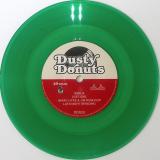
Once again the mighty Dusty Donuts take a trip to Queensbridge, where they bump
into a Lost Girl that once appeared on an infamous mixtape of one of QBs finest.
This bouncy and choppy rework is guaranteed to get the party going.
On the flipside we move from QB to Staten Island to rock you with the special
technique.
The heavy soul classic comes in a true shaolin fashion and makes all true hip hop
heads turn!
In stores early April 2025
quête:the earl
Teal’s debut LP, Original Watercolour, is an album that feels like a canvas come to life. A sonic blend of street-soul, digi-dub, and downtempo. Original Watercolour explores the complexities of love, oneness, and intuition — themes that resonate deeply within the context of the history women have shared with what was once known as the “ladies’ medium.”
The bi-coastal family trio—Ashleigh and Melissa Ball, better known as the Ball Sisters, alongside producer N1_SOUND—bring a fresh, genre-defying sound to the table with their latest 6-track album. Running just under 30 minutes, this immersive collection weaves together skipping beats, addictive bass lines, three-dimensional flute textures & emotional vocal melodies. This musical portrait is as ethereal as it is powerful, inviting the listener to get lost in its depths while celebrating the beauty of self-expression.
The opening track, “Original Watercolour,” takes you on a psychedelic trip-hop journey. From the first reverberous snare hit, you’re whisked away to a sonic wetland — lush and euphoric. The soft yet poignant soundscapes set the tone for the album, inviting us into a world where the boundaries between earth and music, reality and imagination, automatically seem to blur.
“Locked In 2 Love” offers a boogie-fueled bassline that pushes Teal into dance-floor territory with soaring flutes and rhythmic intricacies that make it impossible not to move — it’s a track that exemplifies the magic of Teal’s ability to craft both intimate and expansive musical landscapes. And then, there’s the hypnotic flow of “One In The Same,” where stacked vocal harmonies and mantra-esque lyrics transport you to a place that could easily be mistaken for a lost Soulquarians demo. It’s gentle yet unrelenting in its depth.
The second side of the album opens with “Sleep on It,” a track that immediately grabs attention with its dancehall-driven rhythm. Ashleigh Ball's vocals set the stage for a song that’s both introspective and emotionally charged, yet unmistakably rooted in groove. The phased-out bassline creates an almost hypnotic atmosphere. Pulling the listener into a mood of contemplation—matching the restless, sleepless night that Ball describes. As the song progresses, this groove builds in intensity, culminating in an explosive ending that mirrors the emotional release of a long-held frustration.
Original Watercolour is more than just an album — it’s a meditation on the interconnectedness of life and art. “Frog Kingdom,” the longest and only instrumental track creates a contemplative space that builds upon the themes introduced earlier. It feels like a sequel to their earlier work, Frog Legacy from their debut Bluish Green 2024 12”, expanding on the familiar sound with even more complex layers.
Yet the real emotional power of the record lies in its closing track, “Can’t Shake the Feeling.” Simple in structure but profound in impact, this song captures a deep yearning and understanding — that everything, from the ecosystems we inhabit to the relationships we nurture and the art we create, is fundamentally interconnected. As the track crescendos in a falsetto peak, it becomes clear that the album is a reflection of both the world around us and the personal journey each member of the band has embarked upon to get to this point.
Just as the medium of watercolor has been traditionally linked to women artists, Teal carries this legacy into the modern musical landscape, blending the richness of history with a unique forward-thinking perspective. The album feels like both a celebration of the past and a bold declaration of a path forward — one that welcomes anyone ready to join in and shape the future of the art form.
The beauty of Teal’s work is that it feels familiar, while simultaneously offering something new and refreshing. Original Watercolour doesn’t just push musical boundaries; it redefines them, offering a lush and textured soundtrack for those willing to listen closely.
In a world that often feels over-saturated, Original Watercolour stands as a reminder of the power of simplicity, intuition, and connection. Teal’s debut album invites you to experience something both deeply personal and universally understood. The landscapes they create are vivid, yet soft, grounding yet expansive. With each track, Teal’s music reflects the interconnectedness of all things — a truly unique piece of work in the world of experimental soul and dub adjacent electronic music.
Rising and falling. We all live in the same pond. Peace to all.
For us, this is a top five all time tune in the soul reggae canon and maybe Leroy Smart's best ever. An early one for Mr. Smart, this is the first cut of one of his most classic tunes, recorded in 1972 for producer Gussie Clarke and originally released on the early Tuff Gong label via Wailers' associate Alan 'Skill' Cole. If you're like me and you've listened to the original Tuff Gong 45 a million times, you may have noticed that the dub version was mixed from a different vocal take, with some lyrics not on the A side coming in to the dub mix. This alternate vocal take is also the one partially used for the 1979 remix cut on a heavily overdubbed rhythm. We had always desired to hear this other take in its original form, so naturally then we had to get the great Mr. Clarke to dig this one out of his archives to hear it as it should be. In comparison to the original released cut, it's a more spare take sans the opening harmonizing, and the lyrical changes give the tune a more pleading and less stubbornly declarative mood. For the B-side version we have an alternate mix again, which is actually the one Big Youth deejays over for his tune "Pride & Joy Rock." Consider this release a prime example of DKR's "never too much of a great thing" philosophy.
Previously unreleased; four track 12" with two different vocal takes, each w/ dub. Comes in Bond Export company sleeve.
Another cold case solved! One of DKR's early victories was finding a tape of the drum & bass cut of the legendary dubplate 'Rocks & Mountains.' Rumor had said the artist was the Mighty Travellers, but this didn't really add up chronologically or audibly. More astute listeners mostly agreed the artist was likely the Majesterians, a little recorded group who had made a couple other records for Taxi circa 1980. When we first issued the song on a 10" back in 2011, even Sly himself couldn't recall for sure who sang the tune. Like with other 'mystery' projects which we eventually came to realize, we never gave up digging on this one. There were two mysteries at work here - one, confirming the identity of the group, and two - finding the other cut of the tune, which features fuller instrumentation and a different vocal take. Both cuts were around on dubplate circa '80/'81, and the latter cut can be heard ever so briefly in the infamous UK "Sound Business" documentary film from '81. In the course of a mere 13 years, both questions came to be solved - we obtained a pretty clean plate cut of the fuller mix, and we confirmed the identity of the group. The Majesterians were a vocal trio consisting of Everton Dacres, Roderick Perkins and Paul Mitchell. While the latter two gentlemen don't seem to have done much otherwise, we are sure the roots heads and hopefully all DKR followers know Everton Dacres, who made some fine roots music in the 1970s prior to fronting the Majesterians. We spoke to Everton and he confirmed 'Rocks & Mountains' was their tune, cut in Channel 1 at a Taxi session featuring a host of other artists. Indeed, these were the heady days of 1980 with Channel 1 booked round the clock for locked-in sessions, with the Taxi Gang and the Roots Radics laying down future classic after future classic. All that said, we're happy to re-present this tune now with not only proper accreditation, but also both known mixes and the drum & bass mix in improved fidelity over its previous issue.
Brand new Manchester imprint, 160 Street Recordings is excited to announce its first vinyl release, Evolutions EP, by the dynamic production duo of Response and Buda. With a reputation for carving out a distinctive uncompromising sound, the pair return with a gritty, dark collection of tracks that channel the deep, raw energy of early 90s Jungle and Jungle Techno.
Drawing influences from the breakbeat-driven sub-bass and atmospheric elements of that era, the Evolutions EP fuses heavy basslines, classic breaks, and dark, rave-inspired energy.
A1. Evolutions
The EP opens with the title track, ‘Evolutions’—a driving, atmospheric tune full of breakbeat intensity and underpinned by weighty sub bass. Kicking off with a memorable rave stab melody, the track builds with powerful percussion and a haunting, evolving soundscape that moves between light and dark.
A2. Fintons Dub
“Break, show ‘em something, but not too much….” ‘Fintons Dub’ brings a laid-back dubbed out groove, with a selection of classic breaks and a deep sub-bass foundation. An atmospheric pad and cinematic Kung Fu movie sample add depth to this cut, the breaks building gradually with delays as the track rolls out..
B1. Fintons Dub (Double 0 Remix)
No introduction is needed for Double 0, co-founder of legendary London club night Rupture and one of the pioneering figures of the original Hardcore Jungle Techno sound. His remix of ‘Fintons Dub’ takes the track back to his Doncaster warehouse roots, unleashing thunderous bass and breakbeat energy, a twisted mentasm and techno infused stabs. A true dancefloor weapon that embodies the true spirit of Jungle Techno.
B2. Acid Vein
Rounding off the e.p. is ‘Acid Vein’ a 303 led breakbeat bomb that infuses rolling breaks with a pounding sub bass and haunting jazz samples. Slower in tempo than the previous tracks and more reminiscent of the more formative years of rave, Acid Vein will also appeal to the wider breakbeat community.
- A1: Future Sand (Feat. David Lackner)
- A2: Soft Power (Feat. David Lackner)
- A3: Pose Beams (Feat. Jefre Cantu-Ledesma, Robbie Lee)
- A4: Flutter Intensity (Feat. Russell Greenberg)
- B1: The Big Clock (Feat. David Moore, Britt Hewitt)
- B2: There Was Somebody There (Feat. David Moore, Jefre Cantu-Ledesma)
- B3: Get Some Rest (Feat. Mary Lattimore)
Ezra Feinberg's third album Soft Power sees the composer-guitarist enlist an impressive array of fellow musicians including Mary Lattimore, David Moore (Bing & Ruth), Jefre Cantu-Ledesma, Robbie Lee and share the life affirming lead single 'Future Sand'.
Defined by its abundance of melodies, repeating figures and ecstatic improvisations, Soft Power exudes an enlightened and transformative spirit to empower the listener. Feinberg, a practising psychoanalyst and former founding member of the San Francisco psychedelic collective Citay (Dead Oceans / Important Records) resides in the artistic enclave of upstate New York's Hudson River valley. Initial recordings emerged in the late summer of 2020, before added synthesis with collaborator John Thayer (Arp, Sunwatchers) during early 2021. Soft Power follows previous albums 'Recumbent Speech' (2020) and 'Pentimento and Others' (2018).
Feinberg artfully transcends the listener to an enriched place, his compositions distinguished by the deep humanity that lies at their core, plugging the listener into a state of wide eyed being, open and alive. Soft Power then is Ezra's own mantra but also one of power giving - a colourful catharsis translated into music.
Feinberg's music always speaks to the listener, but Soft Power, in whispering, speaks loudest.
"Much like everyday life, I wanted to convey these very plain, simple, tranquil, nearly quotidian aspects, but each piece contains this arc in which that form expands, is broken out of, so what starts out like a painting of flowers in a seaside motel turns into a riot of color and sound, or you feel slipped into a dream that feels like it could go on forever"
Killer previously unreleased mid '80s Tetrack tune finally out on road. Astute dubplate fiends may have heard this played by Rodigan back in the day, and others may know the Mighty Diamonds' later recording of the song. But the original cut is this one, written by Carlton Hines and performed by his group, the great Tetrack. Here it is in pristine quality straight from Gussie Clarke's master tapes, and mixed faithfully in style to the original dubplate cut, by Music Works' associate Curtis Lynch. Comes on the lovely "Dubwise Made in Jamaica" version of the Music Works label, which was used exclusively for dubplates cut at Gussie's original studio back in the early to mid '80s.
The world of item expands. Small or significant, material, immaterial, items define much of our daily life. We are in the era of itemisation.
Itemise yourself
The first item in the catalogue, hardware evangelist and live performer Otis.
Presenting sounds for the higher self: Red Flags written and produced by Otis. Built for dark rooms and soggy limbs. A devout purveyor of hardware and analogue, Otis’ revered live performances are greedy with drive and dance. Machine-led but felt in toes and gut. His live act craft can be traced through this EP garnering influence from industrial, early 2000s electro and progressive trance. Sweat as currency the common thread.
This, another item for your dance directory. Trinket thing piece music. A keepsake.
Part 2 of our 1980 Taxi showcase, and it's heavier than the first. Here is one of Sly & Robbie's most loved productions, in its initial raw dubplate form. In August 1980, this raw cut of the haunting lovelorn classic first started to make its way out there on dubplate, in this spare, cavernous heavy mix without the synthesizer and syndrum sounds that would eventually adorn the final released mix. As tapes of these type of early mixes made for sound systems more often than not were not saved or archived, we're overjoyed to have located this one and brought it out. Like our previous Viceroys Taxi releases, this is some of the heaviest music of its day, in its pure initial form like you would have heard Shaka or other serious sounds playing thru the end of 1980.
- Nasty Sex
- Melynda
- Quiero Saber (I Wanna Know)
- Si Tu Lo Quieres (If You Want It)
- Ciudad Perdida (Shit City)
- Platicas De Un Rey (A King's Talks)
- Todavia Nada (Still Don't) (Not Yet)
- Al Pie De La Montaña (At The Foot Of The Mountain)
- Bajo Los Cielos (Under Heavens)
La Revolución de Emiliano Zapata was the Mexican psychedelic rock band that achieved the most commercial success internationally in the early 70s. Their self-titled and much sought-after debut LP (1971) is considered one of the best acid rock albums in Mexico, recorded under the influence of groups like Credence Clearwater Revival or the Who but also adding their own style featuring an original and stunning guitar sound. Remastered from the original tapes. Includes poster. 180g vinyl. Despite not participating in the legendary Avándaro festival, La Revolución de Emiliano Zapata was the Mexican psychedelic rock band that achieved the most commercial success internationally in the early 70s. Their fantastic 'Nasty Sex', along with other songs like 'If You Want It' or 'Melynda' boosted their first album at the top of the sales charts worldwide. Although their sound changed over time, their debut LP (1971) is considered one of the best acid rock albums in Mexico, recorded under the influence of groups like Credence Clearwater Revival or the Who but also adding their own style featuring an original and stunning guitar sound. Sadly, Mexican record labels lost interest in local rock bands due to the repression of La Onda movement by the Mexican Government, resulting in rock bands being banned. This, in addition to internal disagreements between members of the group, eventually led to the end of their relationship with Polydor in 1973. La Revolución de Emiliano Zapata entered a new artistic phase in their career, focusing on ballads and adopting different new musical trends over the years.
- My Last Star
- My Last Star - Dub Version
- My Last Star - Instrumental Version
"My Last Star" began as a dream that Greg Lee of Hepcat had the week before his death in March of 2024. Greg dreamed of a Slackers song. The Slackers have completed this song, and now the world can hear this truly one of a kind collaboration. In Greg's dream, an old neighbor picked him up in a classic car, turned on the stereo, and played a Slackers song that - at the time - did not exist on our plane of reality. It sounds like the stuff of myth, but the song was so crystal clear in the dream that when he awoke around 2 or 3 in the morning, he immediately wrote down the lyrics he had heard, still humming the tune. "I hadn't seen Greg so excited about a new song in a very long time," says Lee's longtime partner, Mandie Becker. "I found the lyrics when I was organizing his things. I knew he had a voice recording on his phone, too. I decided the best situation was to offer it to The Slackers so we could all hear the song on the stereo from Greg's dream." "I was floored when I received Greg's vocal demo with the lyrics and I vowed to finish the song and make the dream a reality," says Slackers saxophonist Dave Hillyard. "I took the vocal demo to The Slackers, Vic Ruggiero harmonized it, and we wrote music around the words. With this song we came full circle. Greg had given us a gift and we needed to give it back to his family, friends, and musical community. We are the medium for his message." The longer history behind this collaboration is a story of decades of friendship, collaboration, artistry, and mutual respect between LA's Hepcat and NYC's The Slackers, who although from opposite coasts, have both been leading lights and creative forces in the underground ska scene since the early 1990s. Both Hepcat and The Slackers concerned themselves with timeless songwriting that paid homage to the longstanding roots of the music. It is an extraordinary final work envisioned by a beloved and thoughtful musician of the highest caliber and completed by longtime friends and collaborators he knew from the moment of inspiration were the ones that would play it. It is literally a dream come true. "My Last Star" is available as a 12" UV Printed Vinyl Single from Pirates Press Records, with art by The Slackers' in-house artist Catt Gould. The 12" also includes instrumental and dub versions of the song. As a matter of fact, snippets of Greg's original vocal demo from his phone are subtly mixed in toward the end of the instrumental version, underscoring his posthumous presence on the record. Greg's songwriting royalties, as well as a portion of the proceeds from the sales of "My Last Star," will be passed on to his four daughters.
- Be The Snake
- Actress
- Outliers
- See The Shine
- The Starkers
- Wired Corpse
- Godskin
- Hanging Sun
Scorpion Child wields a sound that hearkens back to when guitar rock ruled the airwaves and going to concerts was the ultimate main event. The Austin, TX quintet released its self-titled debut in 2013 via Nuclear Blast Records. The album landed at #26 on the Billboard Heatseekers Chart and #99 on the Billboard Hard Music Albums chart. Following its premiere by Eddie Trunk, iTunes named "Polygon Of Eyes" its "Single of the Week," and Scorpion Child earned a nomination for "Best New Band" at the Classic Rock Magazine presented "Classic Rock Awards." The group's second album, 2016's 'Acid Roulette' was recorded with GRAMMYr Award-nominated producer Chris "Frenchie" Smith Meat Puppets, _And You Will Know Us By The Trail of Dead and featured the fan-favourite tracks "Reaper's Danse", and "My Woman in Black". The band's new album, 'I Saw The End as it Passed Right Through Me', is set for release on February 14 '25. Austin, Texas band, Scorpion Child, plays dark rock and roll that blends haunting themes and atmospheric melodies; the group's unique fusion of post-punk, hard rock, and brooding aesthetic has garnered it a dedicated fanbase. On the heels of a multi-year reinvigoration, the unit returns in 2024, galvanized with a fortified lineup and renewed dedication. The first taste of what the strengthened Scorpion Child delivers lies in wait with the new single, "Outliers", a powerful punch of a song, filled with introspective lyrics, that perfectly encapsulates the band's distinct style. "Outliers" was recorded at Austin's Point West Recording with Charles Godfrey (Black Angels, The Mountain Goats) and represents the first official new music from Scorpion Child since the 2016 release of its full-length LP, 'Acid Roulette' (Nuclear Blast Records). "Outliers" will appear on Scorpion Child's impending new album, 'I Saw The End as it Passed Right Through Me', slated for an early 2025 release date via Noize In The Attic. With the drop of "Outliers" comes the track's accompanying music video; stream Scorpion Child's "Outliers" now at this location. "Outliers" deep dives into the organizational use of fear tactics and the related, unknown forces that we are supposed to run from, or conform to," offers Scorpion Child vocalist Aryn Jonathan Black. "The song is a look into the thought that "they" are always watching us and that we should play the same game from our POV in the shadows." The vinyl LP is milky clear.
- A1: The Impossible Soul
- A2: This Much Remains
- A3: The Collusion Exclusion
- A4: Outside The Box
- A5: Masters Of The Race?
- A6: That Other Song
- A7: Echoes
- A8: Cut The Crap
- A9: Shut The Fuck Up
- B1: Rebellion's In Session (Again)
- B2: A Mother's Milk
- B3: When The Lights Go Out
- B4: Statement Of Intent
- B5: A Message To Them
- B6: Inferno
- B7: Concluded
Conflict formed in 1981 in Eltham, Southeast London, when frontman Colin Jerwood, inspired by early encounters with the Pistols 'Spunk' bootleg and following The Clash on tour, struck up a friendship with Crass and set about crafting a whole new kind of punk that totally upped the ante in terms anger and confrontation. Crass, the renowned anarchist punk collective, having got Conflict started by releasing their debut single 'The House That Man Bult' in 1982 on Crass Records, ended in 1984 as they had always intended. Now it was up to Conflict to pick up the baton and run with it. And they did, charging into the battle lines of authority.
The years that followed saw Conflict go from strength to strength, peaking on the 18th of April in 1987 at the London Brixton Academy for the 'Gathering of the 5,000' concert. A climax and explosion of rage and rebellion that inevitably ended up in a police provoked full-scale riot with police injuries, arrests, and with the band hopelessly in debt and banned from the majority of major London and UK venues.
Undeterred, Conflict continued into the 90s with their acclaimed 'Conclusion' album and remained a mainstay of the live punk circuit throughout. However, after more than two decades since the release of their (2003) 'There's No Power Without Control' album, the band are back with 'This Much Remains'. Featuring sixteen brand new Conflict creations, the album sees the band keeping one eye on their eventful past, and the other firmly on moving forward, both musically and politically. Animal Rights are still at the forefront of Conflict’s collective minds, giving a voice to the voiceless on songs such as 'A Mother's Milk' and 'Shut The Fuck Up', whilst their anger at world governments will never dissipate.
Also featuring an appearance by the late Benjamin Zephaniah on the track 'Cut The Crap', 'This Much Remains' is the sound of a band that continues to surprise and progress, decades after it first began. Conflict are Colin Jerwood - vocals; Fiona Friel - vocals; Gav King - guitars, melodica & Hammond; Fran Fearon - bass; Stoo Meadows - drums. With Benjamin Zephaniah - vocals on 'Cut The Crap'; Mitsuko Sonoda - voice on 'The Impossible Soul'.
- Zen And The Art Of Nonsense
- Fun On The Floor
- The Blessed West
- Taken For Granted
- Looks Can Kill
- Sacred Measure
- Flare
- Black Five
- Vigilante
- Zor Gabor
- Tightrope
The Scream, Siouxsie & the Banshees' first album, was released late enough in the punk era to bear some claim as the first post-punk album, with only a minor traces of 'punk' (one lingering early song, "Carcass" comes to mind) and enough hints of what had come even earlier, Andy MacKay-like saxophone flourishes - to feel utterly new. Not to mention the effort producer Steve Lillywhite must have put into the album, his first fully-credited major label production. Siouxsie was clearly the focus of the band, with her unique vocal style and lyrics, but the real star, we've always known, was John McKay, who wrote most of the album's music (as well as singles like "Hong Kong Garden"), creating a wholly new guitar sound - harsh and brittle, yet melodically intoxicating . . . best articulated by a somewhat confounded Steve Albini years later ". . . only now people are trying to copy it, and even now nobody understands how that guitar player got all that pointless noise to stick together as songs". McKay's influence lives on; many of the most influential guitarists of the past four decades credit him as a major influence - Geordie from Killing Joke, Jim Reid of The Jesus And Mary Chain, U2's The Edge, Thurston Moore, Johnny Marr and even the two guitarists - The Cure's Robert Smith and Magazine's John McGeoch - who followed him in The Banshees. McKay's burgeoning status as the anti-guitar hero was halted when he and Banshees drummer Kenny Morris - at odds with Siouxsie and bassist Steve Severin - fled the band just after the start of a tour supporting the group's second album, Join Hands. It was a weekly music paper scandal, later the subject of a BBC documentary, and Siouxsie's vitriol working its way into the lyrics of a later Banshees b-side, "Drop Dead / Celebration". Aside from a solitary single on Marc Riley's In Tape label nearly a decade later, no music was heard from McKay again. So it comes as a major surprise to learn of a pile of excellent recordings made in the years just after he left The Banshees, unheard by all but a very few, some of which feature drummer Kenny Morris, plus Mick Allen from Rema Rema, Matthew Seligman of the Soft Boys and longer-term collaborator Graham Dowdall and John's wife Linda . . . the latter three of whom now all sadly deceased. Sixes And Sevens is an historic lost album. Brazenly genius and bearing fair claim as the lost treasure of the post-punk era, the album collects eleven studio tracks, carefully mastered from original tapes. It's a masterpiece which best speaks for itself.
The Scream, Siouxsie & the Banshees' first album, was released late enough in the punk era to bear some claim as the first post-punk album, with only a minor traces of 'punk' (one lingering early song, "Carcass" comes to mind) and enough hints of what had come even earlier, Andy MacKay-like saxophone flourishes - to feel utterly new. Not to mention the effort producer Steve Lillywhite must have put into the album, his first fully-credited major label production.
Siouxsie was clearly the focus of the band, with her unique vocal style and lyrics, but the real star, we've always known, was John McKay, who wrote most of the album's music (as well as singles like "Hong Kong Garden"), creating a wholly new guitar sound - harsh and brittle, yet melodically intoxicating . . . best articulated by a somewhat confounded Steve Albini years later ". . . only now people are trying to copy it, and even now nobody understands how that guitar player got all that pointless noise to stick together as songs". McKay's influence lives on; many of the most influential guitarists of the past four decades credit him as a major influence - Geordie from Killing Joke, Jim Reid of The Jesus And Mary Chain, U2's The Edge, Thurston Moore, Johnny Marr and even the two guitarists - The Cure's Robert Smith and Magazine's John McGeoch - who followed him in The Banshees.
McKay's burgeoning status as the anti-guitar hero was halted when he and Banshees drummer Kenny Morris - at odds with Siouxsie and bassist Steve Severin - fled the band just after the start of a tour supporting the group's second album, Join Hands. It was a weekly music paper scandal, later the subject of a BBC documentary, and Siouxsie's vitriol working its way into the lyrics of a later Banshees b-side, "Drop Dead / Celebration". Aside from a solitary single on Marc Riley's In Tape label nearly a decade later, no music was heard from McKay again. So it comes as a major surprise to learn of a pile of excellent recordings made in the years just after he left The Banshees, unheard by all but a very few, some of which feature drummer Kenny Morris, plus Mick Allen from Rema Rema, Matthew Seligman of the Soft Boys and longer-term collaborator Graham Dowdall and John's wife Linda . . . the latter three of whom now all sadly deceased.
Sixes And Sevens is an historic lost album. Brazenly genius and bearing fair claim as the lost treasure of the post-punk era, the album collects eleven studio tracks, carefully mastered from original tapes. It's a masterpiece which best speaks for itself. John McKay will be made available for a limited number of interviews . . . and yes, there are surprises in store.
Ground-breaking afro-rock and jazz with Memphis soul roots on this lost 1972 gem. Lovingly restored and reissued by Matsuli Music
'Black Soul' from 1972 is the third and last known album by The Anchors, a soul group originally formed in Johannesburg's Alexandra township in 1968. Their first two albums, 'Soul Upstairs' from 1969 and 'Everything' from 1971, were issued on Teal's City Special label alongside other prominent South African soul groups of the era like The Beaters, The Movers and The Flaming Souls.
On 'Black Soul', The Anchors undergo a notable shift, moving away from their early Memphis soul influences towards a pioneering African-driven sound. These changes laid the foundations for an emerging afro-fusion scene in the years to come from groups like Batsumi, The Drive and Harari.
'Black Soul' features a who's who of intergenerational musicians from great South African bands over the decades. In addition to Zacks Nkosi, the renowned bandleader of the Jazz Maniacs and long-time member of the African Swingsters in the 1940s and 50s, this album includes kwela star Little Kid Lex Hendricks, known for his Columbia recordings of the late 1950s; as well as Zack's son Jabu Nkosi who would go on to play with The Drive, Roots and Sakhile; and Banza Kgasoane later a member of The Beaters, Harari and then Mango Groove.
Now remastered for its first release since the original 1972 pressing, this lost gem offers a revealing glimpse into the evolution of South African music during a transformative era.
Zacks Nkosi (Sax), Patrick Jabu Nkosi (Organ and Flute), Anderson Nkosi (Lead Guitar), Given Sabela (Bass Guitar), Kid Lex Hendrix (Sax), Banza Kgasoane (Trumpet), Peter Morake (Drums), Hamilton Nzimande (Musical Director).
Original LP issued in South Africa on GRC’s CBS label (LAB 4037) in 1972.
Produced for reissue by Chris Albertyn and Matt Temple at Matsuli Music, and Siemon Allen at Flatinternational.
Original vinyl sourced from the Flatinternational Archive.
Artwork restoration and design by Siemon Allen.
Audio restoration, mastering and lacquers by Frank Merritt at The Carvery.
Manufactured at Pallas, Germany.
- The Stars' Shelter
- Light's Blood
- Shores Of Otherness
- The Stars' Shelter (Ii)
- 9: Th Episode
- Darkness In Movement
- A Flowery Dream
'Atmospheric death metal'. Three simple words to describe one's music, chosen by JADE mainman J. himself, although they don't seem to quite pay justice to the gigantic scope of their music. Because ever since the release of their debut demo back in 2018 they've proven again and again to be more. Much more. Historically speaking, the word 'jade' referred to a rare but valuable mineral in ancient times all over the world. From Mesoamerican cultures to Chinese and Southern Asian ones, the greenstone was conferred with deep spiritual symbolism and used to connect the earthly level to the unknown. The history of countless traditions, legends and cults remain as an endless source of topics in terms of lyrics for the band, with a rich historical narrative also poetized. JADE's music is described by J. as "a tribute to the timeless obscure metal language, from early death/doom manifestations to later atmospheric black acts, in a really heavy, intense and epic form which transcends ages, as the greenstone cult has endured." The sophomore album, and second full-length after last year split LP with SANCTUARIUM, Mysteries Of A Flowery Dream carries an ominous wave of darkness, redefining heaviness with new levels of musical production and arrangements, compared by J. to "a journey into the dialogue between conscious and subconscious dreaming states and the mysteries around." The album's lyrics are in direct line of those themes, echoing the celestial world and how it can help us overcoming ominous times ("The Stars' Shelter"), how dreams can be interpreted as omens ("Light's Blood") and how they allow us to travel the Mayan cosmovision and its various worlds for guidance, healing and messages ("Shores Of Otherness"), among others. You can even find on the cover artwork elements of the ancient Mesoamerican cosmovision, mainly the powerful moon goddess Ixchel, a creative yet destructive entity, portrayed here as the Spider and threading human fate like an umbilical cord, determined to give life but also to destroy it if needed. A frightening, fragile yet utterly fascinating balance perfectly illustrated by Mysteries Of A Flowery Dream.
Since 2020, and from coast to coast, indie-rockers Fib have been rewiring brains with their singular, jangly sound and furiously tight live performances. Fib's members connected in Portland through their love of punk, friendship, and their shared exceptional musical abilities. After releasing their debut self-titled tape in 2021 and touring the US, the band picked up and moved across the country after falling in love with Philadelphia. The city quickly warmed to Fib's controlled mania- the band putting on the tightest show imaginable, and then, at the end of the set, destroying their instruments in total chaos mode. They matched Philadelphia's freak- fitting like a fingerless glove. Now, connecting with Philly label Julia's War, the group is releasing their debut full-length record Heavy Lifting- a musical odyssey exploring arty pop, punk and progressive rock- while simultaneously breaking free from genre and giving the listener a vividly surreal auditory experience. With Heavy Lifting, Fib shed their early, scrappy, lofi limitations, and embraced a new, expansive and warm recording capture. This bigger sound allows the group to put their technical skill, harmonious vocals, and hyper-infectious songwriting on full display. Songs like 'Mutuals' and 'Say' are frenetic and bouncy- shifting through virtuosic arrangements held together with intermittent, powerful hooks. With tunes like 'Dotted Line' and 'PS,' the band settles deeper into the grooves and songwriting allowing the listener to zone in and bob their head a bit more. While the nine tracks that comprise Heavy Lifting are equally unique and invigorating showcasing the members' intricate guitar tangles and polyrhythms, the album is holistically composed- a greater sum than its parts. The release would easily sit well for fans of new bands like Palm, TAGABOW, and Water From Your Eyes, but would just as easily be a welcome addition for record heads who love bands like This Heat, Television, and Psychic TV. While this might all be hard to believe, and their name is Fib- it's no lie. Fib's Heavy Lifting is a vibrant, moving and endless sonic rainbow. Pick it up and step into their wild and ecstatic void.
“Underground” is a relative term. One could argue that all the ‘60s San Francisco psychedelic bands were underground, because the music they made was so far removed from the pop and rock sounds that came before them. But of all the bands in the scene, Lamb was perhaps the most underground of them all. It wasn’t just that their blend of rock, folk, classical, country, blues, and gospel was as hard to classify as any of the era. It was also their vibe. Along with classically trained guitarist and songwriting partner Bob Swanson, Barbara Mauritz’s versatile vocals paced material often imbued with a haunting, mystical aura. Yet they could also be earthy and rootsy, occasionally drifting into spacey psychedelia with hints of raga-rock. Released in the early ‘70s, Lamb’s first two albums, A Sign of Change and Cross Between, did indeed offer some of the most intriguing and eclectic music of any San Francisco rock band on the psychedelic scene. But Lamb’s history predated the release of those records by a good couple of years or so. So prolific were Mauritz and Swanson that quite a few of their original compositions didn’t make it onto their albums, though these were often on par with the songs that did find official release. Unlike many bands of the time who had a bounty of surplus quality tunes, Lamb often taped these in studios and studio-like rehearsal conditions, as well as making some professional tapes of their live performances. Fortunately, many of those tapes survive, including a good number of songs that didn’t find a place on their LPs, as well as substantially different versions of some that did. The best of these from the late 1960s find release for the first time on An Extension of Now: Unreleased Recordings 1968-1969. This collection not only rounds out our picture of one of San Francisco rock’s finest underappreciated acts, but also serves as a first-class document of Lamb as they made their transition from a more standard rock outfit to a group not easily comparable to any other in the region, or indeed any other anywhere. Our black vinyl and CD (with extra tracks, limited to 500) releases feature liner notes by Richie Unterberger drawn from an interview with Bob Swanson, who has also contributed photos and memorabilia from his private archive. Produced by noted Bay Area archivist Alec Palao…if you’re a fan of late-‘60s S.F. psych, you have to hear this!
- A1: Voices Inside (Everything Is Everything)
- A2: Je Vous Aime (I Love You)
- A3: I Believe To My Soul
- B1: Misty
- B2: Sugar Lee
- B3: Tryin' Times
- C1: Thank You Master (For My Soul)
- C2: The Ghetto
- D1: To Be Young, Gifted And Black
Donny Hathaway's first studio album Everything is Everything is a significant work in the realm of soul and R&B music, released in 1970. It marked an important point in Hathaway's career and showcased his exceptional talent as a singer, songwriter, and pianist.
The album was Hathaway's first release after being signed to Atlantic in 1969. Hathaway had already built a reputation early in his life, first as a gospel singer as a child under the name Donny Pitts. Raised in St. Louis, with religious influences, his grandmother Martha Crumwell was herself an accomplished gospel singer and guitarist. After dropping out of Howard University in 1967, Hathaway moved to Chicago, his birthplace, and started working on music for Curtis Mayfield's Curtom Records label where he was a songwriter, producer, arranger, composer, conductor and session player.
Everything Is Everything was produced by Hathaway and Ric Powell, who plays drums and percussion on the album; Hathaway wrote or co-wrote five of the album's nine songs. Hathaway had met Powell while at Howard University, as well as the future Impressions lead singer, Leroy Hutson, who jointly wrote the hit song that would eventually make it on the album, "The Ghetto."
The track was mostly an instrumental, except for Hathaway's vocal ad-libs and his singing of the chorus. Hathaway and Hutson composed another socially conscious song for the album, titled "Tryin' Times." Other songs were split between covers (Ray Charles's "I Believe to My Soul" and Nina Simone's "To Be Young, Gifted and Black"), spiritual affairs ("Thank You Master for My Soul") and love songs ("Je Vous Aime (I Love You)").
Released in July 1970, the album peaked at No. 73 on the Billboard Top 200 Albums chart and No. 33 on the Billboard R&B Albums chart.
This timeless classic is now reissued in the definitive deluxe 180-gram 45 RPM 2LP Analogue Productions (Atlantic 75 Series) format.


