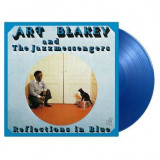
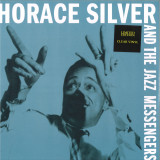
Als Art Blakey im Jahr 1964 das Album “‘S Make It” für Limelight einspielte, befand er sich mit seiner
Band The Jazz Messengers in einer Umbruchphase. In dieser Zeit änderte der Schlagzeuger von einem
Album zu anderen immer wieder die Besetzung. “‘S Make It” wird von vielen Kritikern als eines der
sträflich unterbewerten Alben der Jazz Messengers bezeichnet, auf dem Blakey zu einem gefühlvolleren
Sound zurückkehrte.
quête:the messengers
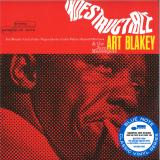
“Free For All” gilt vielen Kritikern als das beste Album, das Art Blakey mit seinen Jazz Messengers in der
legendären Sextett-Besetzung aufgenommen hat. Die Band spielte bereits seit 1961 in dieser Formation
zusammen, war aber für Blue Note über zwei Jahre lang nicht mehr im Studio gewesen. Die Musik des im
Februar 1964 entstandenen Albums (das ursprünglich den Titel “Free Fall” erhalten sollte) ist deutlich von
der Bürgerrechtsbewegung jener Zeit geprägt und strotzt nur so vor Energie.
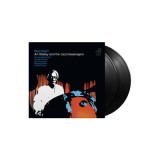
Blue Night is the expanded edition of Art Blakey and The Jazz Messengers recording released in 1985. Art Blakey led the Jazz Messengers
for 35 years, mentoring countless musicians and encouraging their growth into influential bandleaders. By 1984-85, his band included five
prodigious talents: Terence Blanchard (trumpet), Donald Harrison (alto/soprano sax), Jean Toussaint (tenor sax), Lonnie Plaxico (bass), and Mulgrew Miller (piano). Despite being 65, Blakey remained as vibrant as his young bandmates, inspiring and pushing them to develop their distinct musical voices. Blue Night showcases the Art Blakey and The Jazz Messengers hard bop excellence, featuring originals by Blanchard, Harrison, Toussaint alongside the classic “Body An Soul”. The 2LP expanded edition of Blue Night features alternate takes of “Two Of Kind”, “Blue
Minor” and “Mr. Combinated”, includes liner notes by Scott Yanow and is available on vinyl for the first time.
- A1: Like Someone In Love
- A2: Johnny's Blue
- B1: Noise In The Attic
- B2: Sleeping Dancer Sleep On
- B3: Giantis
The 1960 edition of the Art Blakey & The Jazz Messengers was one of the band’s greatest line-ups with the drummer joined by trumpeter Lee Morgan, saxophonist Wayne Shorter, pianist Bobby Timmons and bassist Jymie Merritt. Opening with a sublimely swinging version of the title track, the rest of Like Someone In Love presented originals by Morgan and Shorter. This Blue Note Classic Vinyl Edition is stereo, all-analog, mastered by Kevin Gray from the original master tapes, and pressed on 180g vinyl at Optimal.
- A1: Cheryl
- A2: Ms. B.c
- A3: In Case You Missed It
- B1: Little Man
- B2: Witch Hunt
- B3: Soulful Mister Timmons
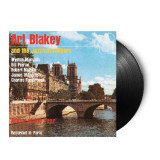
Art Blakey, whose career spanned nearly 50 years of Black music history, exemplifies the timeless role of the drums in jazz. This Album of the Year LP, originally released in 1981, features the Jazz Messengers: trumpeter Wynton Marsalis, saxophonists Robert Watson and Bill Pierce, pianist James Williams, and bassist Charles Fambrough, alongside drummer and bandleader Art Blakey.
The album was recorded in Paris, and tracks include “Cheryl” (written by Charlie Parker), “Soulful Mister Timmons,” and “Little Man,” among others. The accompanying liner notes were written by Ted Panken.
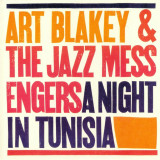
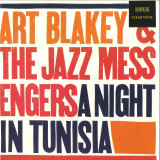
Art Blakey & The Jazz Messengers - A Night In Tunisia
Dieser Albumklassiker ist ein Paradebeispiel dafür, wie Art Blakey den jungen Talenten in seiner Band eine
Plattform zur eigenen Entfaltung bot. Er lässt sie nicht nur ausführlich in ihren Soli zu Wort kommen,
sondern vertraut auch blind auf ihr Können als Komponisten. Einzige Ausnahme im Repertoire ist der
Bebop-Klassiker von Dizzy Gillespie, der diesem Album aus dem Jahr 1960 seinen Titel verlieh.
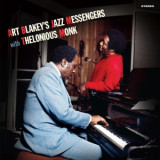
This album marks Thelonious Monk's sole recording as a member of Art Blakey's celebrated Jazz Messengers. The pianist and drummer were very close friends who understood each other well on both a personal and musical level. In fact, Blakey was present on both Monk's first and last studio sessions, spanning a period of 24 years from the 1947 quintet and trio recordings to the last sets taped in London in 1971, when Blakey and Monk were touring with the group called the "Giants of Jazz" (which also included Sonny Stitt, Dizzy Gillespie, Kai Winding and Al McKibbon). With the exception of Johnny Griffin's "Purple Shades", all of the compositions on this album are classic Thelonious Monk tunes.
[d] In Walked Bud [First Version]
[h] Evidence [Solo Piano Version]
From the first bars of the immediately recognizable ‘Alamode’, this album is an explosion of beauty. This first sextet iteration of Art Blakey’s Jazz Messengers includes a young Wayne Shorter (tenor saxophone), Lee Morgan (trumpet), Curtis Fuller (trombone), Bobby Timmons (piano) and Jymie Merritt (bass). The band ferociously pushes the pace with each track, leaving no prisoners in their wake. This Verve By Request title is pressed on 180-gram vinyl at Third Man in Detroit.
- Politely
- Whisper Not
- Now's The Time
- The First Theme
- Moanin' With Hazel
- We Named It Justice
- Blue March For Europe, N* 1
- Like Someone In Love
- Along Came Manon
- Out Of The Past
- A Night In Tunisia
- Ending With The Theme
Art Blakey and the Jazz Messengers' tremendous concert at Club Saint Germain in Paris on December 21, 1958. This record presents the complete set and is produced as a three LP gatefold album with each vinyl one of three different colours: blue, white and red, representing the French flag. Au Club Saint Germain it's a memorable record and winner of numerous awards including the prestigious Grand Prix du Disque in 1959 from the Academie Charles Cros. Art Blakey and his Jazz Messengers are here with Lee Morgan on trumpet, Benny Golson on saxophone, Bobby Timmons on piano and Jymie Merrit on double bass. Drummer Kenny Clarke was living in Paris at the time and joined the group for the songs "A Night in Tunisia" and "Ending with the Theme" resulting in a session that will go down in jazz history!
On the jazz standard "A Night in Tunisia" composed by Dizzy Gillespie in 1942, Art Blakey and the Jazz Messengers, realised this album with a legendary ensemble the lineup includes Lee Morgan on trumpet, Wayne Shorter on tenor saxophone, Bobby Timmons on piano, and Jymie Merritt on bass. Recorded on August 7 and 14, 1960 this album is one of the most celebrated for the powerful solos and intricate arrangements, epitomizing the hard bop style. Blakey's versions of "A Night in Tunisia" are renowned for their intense energy and complexity, the piece itself features a distinctive Afro-Cuban rhythm in the introduction and the main theme, transitioning into straight-ahead swing for the improvisational sections. In summary, Art Blakey and the Jazz Messengers' renditions of "A Night in Tunisia" are celebrated for their dynamic interpretation, technical proficiency, and influential impact on the jazz genre.
We Are Messengers embraces gratitude and the simplicity of the Gospel on 'Where The Joy Is', radiating as much exuberance as the title suggests
Their fourth studio effort boasts ten pristine, arena- ready pop selections co- written by frontman Darren Mulligan and includes the lead track "God Be The Glory" and faith-affirming "A Thousand Times," plus collaborations with Ben Fuller and Blanca.
"Originally released in 1963, “Caravan” was Art Blakey and the Jazz Messengers' first album for Riverside Records. Featured in addition to Blakey are Freddie Hubbard (trumpet), Curtis Fuller (trombone), Wayne Shorter (sax), Cedar Walton (piano) and Reggie Workman (bass). This new edition is released as part of the Original Jazz Classics Series and is pressed on 180-gram vinyl at RTI with all-analogue mastering from the original tapes by Kevin Gray at Cohearent Audio and presented in a Tip-On Jacket. "
One of the inventors of the modern bebop style of drumming, Blakey is known as a powerful musician and a vital groover; his brand of bluesy, funky hard bop was and continues to be profoundly influential on mainstream jazz.
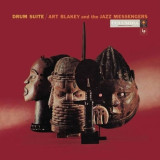
For more than 30 years his band, Art Blakey & The Jazz Messengers included many young musicians who went on to become prominent names in jazz. Recorded in 1956, Art Blakey's Drum Suite is a wonderful hybrid of African, Latin, and hard bop rhythms that prefigures the concept of Afro-beat by at least a decade. The sheer energy, not to mention its very special and fresh-sounding intimacy, make it especially astounding.
Even more amazing is that the three parts of the suite -- Blakey's "The Sacrifice," Ray Bryant's "Cubano Chant," and Oscar Pettiford's "Oscalypso" -- were recorded straight through live, and were only intended to be a pre-take run-through. As is obvious here, Blakey and company nailed the whole thing right out of the box.
Groundbreaking for its time, and still sounding vital, powerful, and visionary, the Drum Suite album is somewhat of a lost masterpiece that deserves a fresh audience.
"Art Blakey's first release for Columbia Records is essentially two records. Side one is a percussion ensemble playing what would, ten years later, be called Afro-Cuban drumming. Side two is the mid-fifties version of the Jazz Messengers featuring Jackie McLean on saxophone. Side one features Blakey, Jo Jones and Charles Wright on drums, Candido and Sabu on bongos, and Oscar Pettiford and bass and cello. The group plays three compositions, one by Blakey, one by Pettiford and one by Ray Bryant, fusing African, Cuban, and calypso percussion into a well-integrated suite.
"The group recorded a run through and it was so perfectly executed that they used the practice run for the release, unedited except to add some Swahili chants by the percussionists during a few passages. One cannot help but think of Olantunji's Drums of Passion, another Afro drumming landmark, here. Blakey's drum suite was recorded at Columbia's 30th Street studios in New York in 1957 and is in mono. The almost stereoscopic image is truly remarkable. Mastered by Kevin Gray and pressed at RTI, Drum Suite is a valuable record of one of the most important figures in jazz history. Recording: 9/10. Music 9/10." - Dennis Davis, Hifi+
"...The three-part suite was laid down in one take with no arrangements, and begins with a few tympani thwacks followed by an African chant. Soon the ensemble kicks in and the group takes off an a sweaty Afro-Cuban-bop journey that will leave you breathless, as the thing crackles with terrific energy. Side Two is more conventional hard bop, but given this group's mastery of if not invention of the style, these tracks are extremely satisfying. Kevin Gray's remastering is detailed and immediate, with plenty of bit and air, if not the widest dynamic range. For anyone interested in percussion of this genre, this is not to be missed." - Wayne Garcia, The Absolute Sound
2 LPs-set (3 sides)
Recorded in Paris, November 22 and December 17, 1958.
Original issues: LP Fontana 680.202 ML & EP Fontana 460.642 MR.
”I’ve never played for such an audience” declared Art Blakey in tears. lt was November 22nd, 1958, and he’d just come offstage after one of the “Jazz Wednesdays” concerts at the Paris Olympia. For a first appearance by the “Jazz Messengers”, they’d made quite an impression. Not content with pulling a huge crowd off the Boulevard des Capucines (the demand was so great that a second concert had to be staged on December 17th), they’d converted everybody to the “Hard Bop” religion in two sets where, united in a kind of exultant communion, jazzmen, jazzophiles and curious bystanders alike had been crushed together in high spirits, paying no attention to the presence of Brigitte Bardot escorted by Sacha Distel. That night Blues March had almost replaced the Marseillaise anthem (and Moanin’ the Oignons). Yet none of the Messengers had ever been to Paris. They’d get to that later, and then some, but for the moment they were perfect strangers. Not only strangers to the public, but unknown even to a sizeable group of jazz fans : the next issue of “Jazz Hot” magazine (most of it devoted to them) arrived like an invasion by the carabimeri… the blaze lit at the Olympia had gone out, of course, and Blakey had moved into the “Club St. Germain” to light others; there, each of his gigs could have been a remake of the famous cabin scene in the Marx Brothers’ “A Night At The Opera”…
Among the Messengers’ “greatest hits”, only Moanin’ came close to Blues March. Constructed in the manner of a gospel, with the piano in the role of the preacher, and the orchestra that of the congregation, punctuating the sermon with shouts of approval, the theme was by pianist Bobby Timmons, whose fiery spirit can be explained by his educayion: “… the fact I played rhythm ‘n’ blues had a great influence on my style, and for me, it’s the foundation of jazz.” Moanin’ had sent the Olympia fans Into transports of delight, and even excited the curiosity of Hugues Panassié, who chanced to be passing by (“Bop”, in any form, being hardly his cup of tea) : he was prompted to go backstage and ask what it was he’d heard… Decidedly, in 1958, the Jazz Messengers were miracle-workers!
Some of the greatest jazz musicians of all time have passed through Art Blakey's Jazz Messengers: Horace Silver, Hank Mobley, Kenny Dorham, Wayne Shorter and Donald Byrd, among many others. However brief their stay, working with the demanding and full-throttle drummer not only increased their visibility, but also their chops and interpretive capacity. Blakey's ability to drum up the best players in the game may have even eclipsed his superhuman ability to play drums.
Altoist Jackie McLean, trumpeter Bill Hardman, bassist Spanky deBrest, and pianist Sam Dockery deliver whole-bop goodness on five propulsive, fiery tracks. True to its title, this LP bops hard, with a ferocious swing, boundless energy and telepathic communication between players - especially Blakey and Hardman. Considering the rhythmic demands of Blakey's locomotive playing style, this was an incredible achievement.
Impex Records has cut this gorgeous 180-gram LP with the original analogue mono master tapes and without computer processing of any kind. You hear all the vivacious interplay that occurred on that weekend in 1957 when Blakey and crew forged a bold new vision of muscular, funky jazz. This is music that still resonates over 50 years later. Not to be missed!
Art Blakey’s 1960 hard bop classic The Big Beat introduced one of the greatest line-ups of The Jazz Messengers with the legendary drummer joined by trumpeter Lee Morgan, tenor saxophonist Wayne Shorter, pianist Bobby Timmons, and bassist Jymie Merritt. Three of the six tunes here were composed by Shorter including “Lester Left Town,” but the album is best-known for an unforgettable version of Timmons’ enduring hit “Dat Dere”. This Blue Note Classic Vinyl Edition is all-analog, mastered by Kevin Gray from the original master tapes, and pressed on 180g vinyl at Optimal.
Originally released on Colpix Records in 1963, this striking release consists of Art Blakey and the Jazz Messengers performing selected music from the Broadway musical Golden Boy. Arranged by three master musicians, Wayne Shorter, Curtis Fuller and Cedar Walton, the music is performed by an amazing all-star line up featuring Freddie Hubbard and Lee Morgan - trumpet, Curtis Fuller - trombone, Julius Watkins - French horn, Bill Barber - tuba, James Spaulding - alto sax, Wayne Shorter - tenor sax, Charles Davis - baritone sax, Cedar Walton - piano, Reggie Workman - bass, and of course Blakey "the Boss" on drums.
Comet Records presents the Tony Allen & Afrika 70 reissue series with the classic late seventies first four solo albums of Tony Allen remastered and restored: Jealousy, Progress, No Accomodation for Lagos & No Discrimination, all coming in an heavy Deluxe Tip-On Jacket.
Tony's solo album, No Discrimination, marks an important turning point in Tony Allen's musical life. Tony had recently left Fela's band, which was clearly an emotional yet necessary change as Allen sings of love and brotherhood throughout his fourth solo album. No Discrimination, both in composition and sound, is a blueprint for the future of Afrobeat, decades ahead of its time. The songs are a mixture of old and new - fusing the classic Afrobeat compositional style with modern production and ideas. Classic tunes like "No Discrimination" and "Ariya" pushed boundaries for what Afrobeat could be, which a wave of Afrobeat bands would pick up on decades later.
With No Discrimination, Tony begins to move Afrobeat into the future, which he would continue doing for the rest of his career.
Tony Allen was a musical and compositional visionary, and this album finds him beginning to explore that vision outside of Fela's immense gravitational pull. They are the start of a new era in Tony's fruitful career as a solo artist, opening the floodgates for his distinctive Afro-Funk sound and laying the foundation for the next generation of Afrobeat musicians to come.
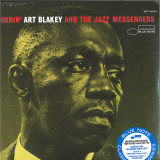
More than any other album in the canon of Art Blakey & The Jazz Messengers, 1958’s Moanin’ — featuring the great drummer with trumpeter Lee Morgan, tenor saxophonist Benny Golson, pianist Bobby Timmons, and bassist Jymie Merritt —was the perfect crystallization of the band’s bluesy, soulful sound, and it still stands today as perhaps the most quintessential hard bop recording of all-time.
Originally self-titled, the album was later renamed Moanin’ due to the popularity of Timmons’ unforgettable opening track. The album also introduced several indelible Golson compositions that would become standards of the jazz songbook including “Along Came Betty” and “Blues March.”
This Blue Note Classic Vinyl Edition is all-analog, mastered by Kevin Gray from the original master tapes, and pressed on 180g vinyl at Optimal.
180g vinyl 2LP set in deluxe gatefold sleeve with iconic pictures by jazz
photographer Francis Wolff. Originally released as The Jazz Messengers at
the Caf Bohemia Vol.1 (Blue Note BLP 1507 and BLP 1508.
One of the definitive bands of the hard bop genre, The Jazz Messengers’ soulful and hard driving sound set the benchmark of excellence in jazz. The present
set, recorded live at the celebrated Caf Bohemia in New York, was one of the
best from their early years.
This music originally appeared divided into two 12” volumes, whose contents
are included in their entireties on this 2-LP set.
“There’s excellent, cohesive trumpet by Kenny Dorham and piano by Horace
Silver that leaps into the emotions. Doug Watkins is equal to the never-coasting
rhythmic demands of Silver and the omni-cooking Art Blakey.”
Recorded in 1961, but not released until 1967, The Witch Doctor features one of Art Blakey & The Jazz Messengers’ all-time great line-ups: Wayne Shorter on tenor saxophone, Lee Morgan on trumpet, Bobby Timmons on piano, and Jymie Merritt on bass. Shorter and Morgan each contribute two tunes, with Timmons penning one. Highlights include Morgan’s spectacular 6/8 modal piece “Afrique” and Shorter’s minor masterpiece “Those Who Sit And Wait.” Bobby Timmons brings the deep soul goods on his composition “A Little Busy,” and the album closes with a fleet-footed romp through Clifford Jordan’s tune “Lost and Found.” Blue Note Records’ Tone Poet Audiophile Vinyl Reissue Series is produced by Joe Harley and features all-analog, mastered-from-the-original-master-tapes, 180g audiophile vinyl reissues in deluxe gatefold packaging. Mastering is by Kevin Gray (Cohearent Audio) and vinyl is manufactured at Record Technology Incorporated (RTI).
'How is it that one of Art Blakey’s greatest albums with the Jazz Messengers is so little known? The 1961 edition of the Messengers included Lee Morgan on trumpet, Wayne Shorter on tenor saxophone, Bobby Timmons on piano, and Jymie Merritt on bass. In February and May of 1961, this group (with pianist Walter Davis Jr sitting in on two tracks) entered Rudy Van Gelder’s studio in New Jersey and proceeded to lay down Roots & Herbs, a brilliant set of six Shorter compositions including the driving hard bop of the title track, the playful “Ping Pong,” and the clever “United.” The album was eventually released in 1970 and deserves a place among Blakey’s finest recordings.
"Next up in Mr Bongo's Groove Merchant Records reissue series, we present the only solo album saxophonist Ramon Morris recorded as a bandleader. Having cut his teeth playing with the iconic band Art Blakey & The Jazz Messengers and working with other jazz greats, including Reuben Wilson, Shirley Scott, Rashied Ali Quintet, and Woody Shaw, 1973 saw Ramon take the step into solo territory. The resulting album Sweet Sister Funk became a certified classic and a landmark showcase of the cherished ‘70s jazz-funk sound, later sampled by the likes of DJ Premier, The Alchemist and DJ Shadow.
Originally released on Sonny Lester's iconic Groove Merchant record label and produced by Lester himself, Sweet Sister Funk is a jazz-funk masterclass. It features a slick line-up including Cecil Bridgewater on trumpet, Mickey Roker on drums, and Albert Dailey on electric piano. Rich and beautiful, the seven songs ebb and flow in energy, fusing jazz funk and soul jazz with style and swagger. There are bags of groove with Ramon and Cecil trading off on sax and trumpet in an effortless conversation throughout the LP, supplemented by brilliant solos from the rest of the players.
A gold mine of sampling material, the album includes a sublime cover version of The Stylistics' much-loved 'People Make The World Go Round', which was sampled by DJ Shadow on Blackalicious's 'Swan Lake' in 1994. Elsewhere, the percussion and bass intro of the opening track 'First Come, First Serve' is a sampler's delight - a deep, heavy groove with a fine saxophone workout by Ramon. Head to 'Don't Ask Me' and you’ll find the swinging horn intro that formed the basis of 'You Came Up' by Big Pun featuring Noreaga from 1998, whilst 'Wijinia' has echoes of ‘70s indie jazz by labels such as Strata East & Black Jazz.
Here at Mr Bongo, we are proud to be delving into the vaults of Groove Merchant Records once again, reissuing this iconic LP from Ramon Morris."
This is the story of an artist in search of sound and breath: an artist who dares to question the rhythm of silence—an invitation to rethink music, sound, and musical collaboration. This is the story of a journey that, after opening countless paths, has finally found its vessel—and its messengers. Three artists of profound musical truth and radical freedom, merging into an exceptional trio that crosses genres and transcends words in a journey toward pure emotion.
Le Rythme du Silence is the culmination of this long search. Yom delivers it here with violinist Théo Ceccaldi and cellist Valentin Ceccaldi—kindred spirits in sound. “I’ve been working on this idea of the ‘rhythm of silence’ for years,” Yom explains. “I first heard the phrase from a Sufi master, describing the foundation of meditation. It struck something deep in me. I’ve practiced meditation for a long time, and we often think of it as a kind of stillness—opposed to noise and life. But in truth, the rhythm of silence enables meditation. It means accepting that the world continues to move and live around you, even as you try to be still. I wanted to compose from that place. To imagine sound as vibratory matter—the primal substance of creation. That required letting go of fixed structures: forgetting melodies, abandoning the idea of a constructed solo. I needed to leave behind music as a system, and touch sound as a living, breathing entity. It took years. Many projects led me elsewhere. But with the Ceccaldi brothers, I finally found the right resonance. Working with them was simply obvious—it was indredibly powerful.”
Yom first rose to prominence reimagining Jewish traditional music with his 2008 debut New King of Klezmer Clarinet. Since then, his path has led through rock (With Love, 2011; You Will Never Die, 2018), electronic utopias (The Empire of Love, 2013), meditative and sacred soundscapes (Prière, 2018), and countless unclassifiable hybrids (Unue, 2009; Green Apocalypse, 2010). It was inevitable that he would eventually cross paths with the free-spirited Théo and Valentin Ceccaldi—two artists who also place collaboration and genre-blurring at the heart of their artistic development. Their projects are always bold, demanding, and full of life (Kutu, Tricollectif, ONJ, Velvet Revolution, Grand Orchestre du Tricot, Lagon Noir, Constantine, etc.). And so, when the three met within the iXi string quartet, something clicked.
“I was seated between the two of them in the quartet,” Yom recalls, “and I could feel their energy flowing from both sides—it was wild! They’re so tuned into each other, they don’t need words. It’s like they’re connected by musical Wi-Fi. The groove happens instantly. They’re precise when they want to be—thanks to their experience in pop-influenced projects —but they can also let go completely, diving into pure sound. That’s exactly what this project needed.”
Without a single rehearsal, the trio formed instinctively. They began performing Yom’s compositions live, unfolding them into a single continuous piece, where clarinet and strings stretch the limits of sound and breath.
Bowed, plucked, or prepared with clothespins, the Ceccaldi strings engage in a playful and intense dialogue with Yom’s custom B-flat clarinet. Through their imaginative listening and fearless invention, air and space open into a vast new soundscape—one that lies somewhere between meditation and healing music.
“When Yom shared the concept of the rhythm of silence, we were immediately drawn in,” says cellist Valentin Ceccaldi. “There’s a deep intensity and spiritual commitment in his music that really spoke to me. With this trio, we’re trying to dive into the core of sound—but also to create a kind of communion with the audience. It’s like gradually turning up the volume on silence, and realizing it’s made of countless tiny sounds—the music of particles in motion" This stripped-down intensity demands full presence—body and mind—of these three musicians, vibrationally connected in a state close to trance. With them, we enter a journey - not religious, but sacred nonetheless.
The Rhythm of Silence becomes an echo of our most intimate, most distant inner landscapes.
An album—and a trio—to return to without end.