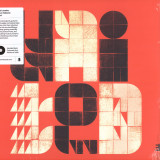
Two musical giants, guitarist Lionel Loueke and bassist Dave Holland, unite their individual talents into one harmonious recording,igniting creativity, honouring cultural roots, and showcasing music's powerful role in fostering unity amidst societal division.
United is an inspiring testament to the power of collaboration, blending Loueke's masterful guitar work with Holland's deep,resonant bass. Both musicians have profoundly impacted the global jazz scene—Loueke, known for his innovative fusion of WestAfrican traditions with modern jazz, has played with a who’s who of virtuosic and celebrated artists, most notably serving asHerbie Hancock’s guitarist for over 15 years, and collaborating with legends like Wayne Shorter, Sting, Terence Blanchard, MarcusMiller, and Esperanza Spalding. Holland, one of the most influential bassists and composers in jazz, has shaped contemporaryjazz since the late 1960s, performing with icons like Miles Davis, Chick Corea, John McLaughlin, Pat Metheny, Sam Rivers, andJack DeJohnette. Though Loueke and Holland have worked together many times in various groups, this album marks their firstcollaboration as a duo. The result is nothing short of extraordinary.
Cerca:the pat metheny group
- 1
- A1: In On It
- A2: Don't Look Down
- B1: Make A New World
- B2: Urban | & Western
- C1: Se-O
- C2: Our Old Street
- D1: Risk & Reward
- D2: So Far, So Good
Celebrated guitar virtuoso and composer Pat Metheny returns with Side-Eye III+, a new 8 song jazz project with his latest group, featuring Chris Fishman on piano and keyboards, Joe Dyson on drums, and Jermaine Paul on bass. In partnership with Green Hill Music, the 20-time Grammy award winner launches his own label imprint, Uniquity Music, and embarks on an extensive world tour with his new ensemble. The all-original album includes “In On It”, “Don’t Look Down”, and “Make a New World”.
- 1: Obbakoso
- 2: Caminando
- 3: Variant
- 4: Mi Tambor
- 5: Suuru
- 6: Tarpon
Elipsis is the convergence of three musical personalities deeply rooted with one foot in the tradition and one foot in the future. Pedrito Martínez (Eric Clapton, Paul Simon, Sting, Wynton Marsalis), master percussionist, Yoruba priest, and one of the iconic voices of Cuba, seamlessly weaves Afro-Cuban tradition with an innovative approach to every project he touches. Mexico City-bred Antonio Sánchez is equally admired for his work as a solo artist (with guest appearances by people like Thom Yorke, Trent Reznor, and Dave Matthews), sideman (Michael Brecker, Chris Potter, Avishai Cohen), drummer for the Pat Metheny Group for almost two decades, and Oscar-nominated film scorer (Birdman). Michael League is best known as the founder of the 5-time Grammy-winning, Texas-born instrumental music ensemble Snarky Puppy, but has spent the majority of his career producing records by artists like David Crosby, Youssou N’Dour, Susana Baca, Silvana Estrada, and Los Muñequitos de Matanzas. The result of these three musicians is future folklore- a delicate balance of each member’s roots and the insatiable desire to push the tradition into places one can only imagine.
- Neon Demon
- Mine—Sweet Tempest
- Demon Dance—Julian Winding
- What Are You
- Don T Forget Me When You Re Famous
- Gold Paint Shot
- Take Off Your Shoes
- Ruby At The Morgue
- Jesse Sneaks Into Her Room
- Real Lolita Rides Again
- Messenger Walks Among Us
- Runway
- Take Her To Measurements
- Who Wants Sour Milk
- I Would Never Say You Re Fat
- Thank God You Re Awake Remix
- Kinky
- Ruby S Close Up
- Lipstick Drawing
- Something S In My Room
- Are We Having A Party
- Get Her Out Of Me
- Waving Goodbye
The late, great Calvin Keys’1971 debut album for the Black Jazz Records label announced the arrival of a new star in the jazz guitar firmament. Keys had spent the ‘60s backing up the crème de la crème of jazz organists—Jimmy Smith, Jimmy McGriff, Jack McDuff, Richard “Groove” Holmes—but for his first record as a leader, he was eager to play with a piano player instead. So he recruited one of the best—Larry Nash, who, besides being a member of the L.A. Express, played with everybody from Eddie Harris to Bill Withers to Etta James. Bassist Lawrence Evans, drummer Bob Braye, and flautist-songwriter Owen Marshall rounded out the group on Shawn-Neeq, which might remind some of Pat Metheny’s early work (Metheny acknowledges Keys as an influence), or Grant Green.
But what gives Shawn-Neeq extra depth is that it comes from the heart; as Keys says in Pat Thomas’ liner notes, which feature an interview with the artist: “My thing was, I write about some of the experiences that I’ve had in my life.” Keys became a fixture in the Bay Area jazz scene before he passed in April 2024; this is the album that started his journey. Another gem from the celebrated Black Jazz catalog, pressed in blue with black swirl vinyl limited to 750 copies!
The late, great Calvin Keys’1971 debut album for the Black Jazz Records label announced the arrival of a new star in the jazz guitar firmament. Keys had spent the ‘60s backing up the crème de la crème of jazz organists—Jimmy Smith, Jimmy McGriff, Jack McDuff, Richard “Groove” Holmes—but for his first record as a leader, he was eager to play with a piano player instead. So he recruited one of the best—Larry Nash, who, besides being a member of the L.A. Express, played with everybody from Eddie Harris to Bill Withers to Etta James. Bassist Lawrence Evans, drummer Bob Braye, and flautist-songwriter Owen Marshall rounded out the group on Shawn-Neeq, which might remind some of Pat Metheny’s early work (Metheny acknowledges Keys as an influence), or Grant Green.
But what gives Shawn-Neeq extra depth is that it comes from the heart; as Keys says in Pat Thomas’ liner notes, which feature an interview with the artist: “My thing was, I write about some of the experiences that I’ve had in my life.” Keys became a fixture in the Bay Area jazz scene before he passed in April 2024; this is the album that started his journey. Another gem from the celebrated Black Jazz catalog, pressed in blue with black swirl vinyl limited to 750 copies!
- A1: Introduction
- A2: In France They Kiss On Main Street
- A3: Edith And The Kingpin
- A4: Coyote
- A5: Goodbye Pork Pie Hat
- B1: The Dry Cleaner From Des Moines
- B2: Amelia
- B3: Pat’s Solo
- B4: Hejira
- C1: Black Crow
- C2: Don’s Solo
- C3: Dreamland
- C4: Free Man In Paris
- C5: Band Introduction
- C6: Furry Sings The Blues
- D1: Why Do Fools Fall In Love
- D2: Shadows And Light
- D3: God Must Be A Boogie Man
- D4: Woodstock
Shadows and Light is the second live album by Canadian musician Joni Mitchell. It was released in September 1980 through Asylum Records, her last release for the label. It was recorded in September 1979 at the Santa Barbara Bowl in Santa Barbara, California.3
For the album, Mitchell was backed by a band of acclaimed jazz and fusion musicians consisting of guitarist Pat Metheny, bassist Jaco Pastorius, drummer Don Alias, keyboardist Lyle Mays, and saxophonist Michael Brecker. Additionally, vocal group the Persuasions appear on the title track and a cover of Frankie Lymon & the Teenagers' "Why Do Fools Fall in Love".
[a] a1. INTRODUCTION [1:51]
[b] a2. IN FRANCE THEY KISS ON MAIN STREET [4:14]
[c] a3. EDITH AND THE KINGPIN [4:10]
[d] a4. COYOTE [4:58]
[e] a5. GOODBYE PORK PIE HAT [6:02]
[f] b1. THE DRY CLEANER FROM DES MOINES [4:37]
[g] b2. AMELIA [6:40]
[h] b3. PAT’S SOLO [3:09]
[i] b4. HEJIRA [7:42]
[j] c1. BLACK CROW [3:52]
[k] c2. DON’S SOLO [4:04]
[l] c3. DREAMLAND [4:40]
[m] c4. FREE MAN IN PARIS [3:23]
[n] c5. BAND INTRODUCTION [0:52]
[o] c6. FURRY SINGS THE BLUES [5:14]
[p] d1. WHY DO FOOLS FALL IN LOVE [2:53]
[q] d2. SHADOWS AND LIGHT [5:23]
[r] d3. GOD MUST BE A BOOGIE MAN [5:02]
[s] d4. WOODSTOCK [5:08]
Black Truffle is pleased to announce The Leisure Principle, a new solo LP from London-based bassist and sound artist Otto Willberg. A key player in the London underground, Willberg is often heard on acoustic and electric bass in free improv settings and bands with Laurie Tompkins (Yes Indeed) and Charles Hayward (Abstract Concrete), as well as the fractured No Wave unit Historically Fucked. His previous solo releases have ranged from extended technique double bass to explorations of the acoustics of a 19th century artillery fort. But nothing Willberg has committed to wax so far prepares a listener for The Leisure Principle, six unashamedly melodic improvisational workouts created almost entirely with heavily filtered bass harmonica and electric bass. On the opening ‘Reap What Thou Sow’, a single-note bass harmonica loop pulses along underneath a roaming bass solo, the side-chained envelope filtering (where the dynamic behaviour of the bass determines the filter for both bass and harmonica) fusing the two instruments into a single stream of burbling shifts in resonance. After several minutes of patient exploration of this low-end landscape, the music suddenly opens up in widescreen with the entrance of Sam Andreae’s graceful melodica chords, spreading out across the stereo field. From this epic opener, each of the remaining pieces goes on to explore a slightly different aspect of the terrain. On ‘Shadow Came into the Eyes as Earth Turned on its Axis’, a similarly buoyant harmonica bass line provides the foundation, but this time playing a soulful descending riff, its almost R&B feel abstracted and half-obscured by the filtering. On ‘Mollusk’, echoed bass arpeggios skitter between elegiac chords somewhat reminiscent of the opening of John Abercrombie’s ‘Timeless’, before settling into a hypnotic groove. On the record’s second half, Willberg pushes further into the possibilities of his idiosyncratic instrumentation. On ‘Wetter’, bass and harmonica come together into a monstrous, growling jaw harp; on ‘Had we but world enough and more time’, the subtly shifting pulsating patterns start to feel almost like a kind of evaporated, drum-less dub techno until an eruption of wheezing bass harmonica gives the piece a comically folkish turn. Willberg’s melodically inventive and virtuosic bass performance calls to mind any number of fusion touchstones, from Jaco Pastorius to Mark Egan’s singing tone in the early Pat Metheny Group—even Anthony Jackson’s work with Steve Kahn. But with its radically reduced instrumentation, The Leisure Principle is also an exercise in minimalism, and the absence of percussion gives even its funkiest moments a strangely abstracted quality. At times, its uncanny blend of the abstruse and the immediate suggests the fried pop experiments of David Rosenboom or the skewed but deeply musical DIY of 80s underground groups like De Fabriek. Both easy on the ear and profoundly strange, The Leisure Principle proudly takes its place among the most eccentric offerings on the Black Truffle menu.
180g audiophile pressing of guitar great Larry Coryell's 2003 album
'Tricycles', which includes 2 bonus tracks and has been remixed and
remastered from the original tapes
On 'Tricycles', we hear the one-time associate of Miles Davis, Sonny Rollins and
Dizzy Gillespie and many other superstars in an intimate jazz setting. For the In
+Out recording he teamed up with two very special companions. The merits of
bass player Mark Egan, a pupil of the late Jaco Pastorius, cannot be overstated.
Paul Wertico, praised as an "impressionist painter" among jazz drummers, not
only participated in many Pat Metheny Group records, but is also a much soughtafter session musician and producer who has worked with avant-garde trios and
popular artists like Terry Callier and Special EFX. The abilities of this exceptional
troika are impressively captured on this album.
Rare Groove Spectrum Vol. 2 is another solid collection of re-works and re-imaginings taking in a broad range of classic tracks, traversing jazz funk rarities, balearic digs, latin groovers and more. Backed by a stellar group of Melbourne musicians including members of The Bamboos & Menagerie, Lance continues the tradition of creating "live re-edits" demonstrated on the initial volume - all pulled off with an inimitable style and playfulness, though always with an obvious love for the foundations.
As Lance says: "Some of these versions can almost be looked at as DJ re-edits, sometimes we're extending what may be a really short track into something longer, or teasing out the elements in a song that really make it work on a dance-floor. It's essentially what someone does with a club re-edit, except we went the extra step and re-recorded the whole thing with a live band"
From Carly Simon through to Mongo Santamaria via Marcos Valle and Pat Metheny - and following the championing of Rare Groove Spectrum Vol. 1 by the likes of Gilles Peterson, Craig Charles, Jazz FM and more - this second volume of Lance Ferguson's Rare Groove Spectrum is sure to hit the sweet spot.
Guitarist and composer PAT METHENY has won 20 Grammy Awards in 12 different categories including Best Rock Instrumental, Best Contemporary Jazz Recording, Best Jazz Instrumental Solo, Best Instrumental Composition. The Pat Metheny Group won an unprecedented seven consecutive Grammies for seven consecutive albums.
Pat Metheny is one of the few artists in the world who can lay claim to such a description. On his latest album, Road To The Sun, Pat Metheny surprises us once again with his seemingly endless ability to harvest new vistas while retaining the instantly recognizable Metheny sound.
With two major new works, performed by five of the world´s leading guitarists, Metheny charts a new way of obliterating boundaries between genres while simultaneously unveiling new facets of an already expansive personal language.
Grammy-winner Jason Vieaux, described by NPR as “perhaps the most precise and soulful classical guitarist of his generation” was tapped by Metheny to perform his four-movement solo guitar suite Four Paths Of Light.
The centerpiece of this landmark recording is Road To The Sun, a six-movement piece for fellow Grammy-award winning Los Angeles Guitar Quartet LAGQ – Metheny describes them as “one of the best bands in the world”.
Calvin Keys’s 1971 debut album for the Black Jazz Records label announced the arrival of a new star in the jazz guitar firmament. Keys had spent the ‘60s backing up the crème de la crème of jazz organists— Jimmy Smith, Jimmy McGriff, Jack McDuff, Richard “Groove” Holmes—but for his first record as a leader, he was eager to play with a piano player instead. So he recruited one of the best—Larry Nash,
who, besides being a member of the L.A. Express, played with everybody from Eddie Harris to Bill Withers to Etta James. Bassist Lawrence Evans, drummer Bob Braye, and flautist-songwriter Owen Marshall rounded out the group on Shawn-Neeq, which might remind some of Pat Metheny’s early work (Metheny acknowledges Keys as an influence), or Grant Green. But what gives Shawn-Neeq extra depth is that it comes from the heart; as Keys says in Pat Thomas’ liner notes, which feature an interview with the artist: “My thing was, I write about some of the experiences that I’ve had in my life.” Keys has since become a fixture in the Bay Area jazz scene; this is the album that started his journey. Another gem from the celebrated Black Jazz catalog!
- 1


