* Debut LP from a UK based band
* Simiah on MPC, Dan Somers on Keys, Craig Crofton on Sax
* Lacquer cut by Pete Norman, mastered by Strype Audio
* Design by Rolling Drums Studio
* 300 copies. LP in PVC sleeve with sticker
* For fans of jazz, instrumental hip hop
The band was formed in Bristol, England and consists of 3 members; Simiah (MPC), Dan Somers (keys), & Craig Crofton (tenor & soprano sax).
The album is a collection of jazz inspired, hip hop instrumentals with MPC drums and live instrumentation. Simiah is well known for his live double MPC show cases and has performed alongside other live musicians so this new project is like a studio album of what he does naturally on stage. The unique sound has been developed through a monthly residency at Bristol's Gallimaufry bar where the band has improvised new material and fine-tuned ongoing compositions while welcoming special guests from the local jazz scene to sit in.
Поиск:the phantom ensemble
Все
- 1
- A1: Iron Butterfly - Iron Butterfly Theme
- A2: Rare Bird - Devil's High Concern
- A3: Paul St. John - Flying Saucers Have Landed
- A4: Chris Hodge - We're On Our Way (2010 Remaster)
- B1: Juantrip - Shadows
- B2: 62 Miles From Space - Time Shifts
- B3: White Trash - Road To Nowhere
- C1: Blue Phantom - Diodo
- C2: The Mannheim Rock Ensemble - Hungarian Dances
- C3: Limousine - Barriers
- D1: Ugo Busoni - Rullio
- D2: Bernard Estardy - Cha Tatch Ka
- D3: Kate - Shout It
- D4: Dyna-Might - Need You
- D5: La Metamorfosi - Scusa, Eh!
"Throughout all my time as a musician and producer, ever since Jack the Tab, I've been focused on developing a single idea: Blending psychedelic sounds and effects with rhythm." Richard Norris, Strange Things Are Happening White Rabbit 2024
Over the past few years Eskimo Recordings have invited some of thebest crate diggers around to curate compilations that don't just reveal the hidden contents of their record bags but something about themselves too. Now, following in the footsteps of the likes of Bill Brewster and Psychemagik, producer, musician, DJ, writer and more, Richard Norris, takes us on a globetrotting psychedelic journey with the epic 42 track collection, Mr Norris Changes Brains.
For over forty years Richard has played a part in many of the UK's most important music subcultures. Whether sharing stages with the likes of Tracey Thorn as a pubescent punk in St. Albans, or running freakbeat nights in Liverpool and working at the pioneering psychedelic label Bam Caruso, co-producing the UK's first acid house inspired LP with Throbbing Gristle's Genesis P. Orridge or riding the wave of creativity that the second summer of love unleashed all the way to the Top of the Pop studios as The Grid, Richard's career has continually seen him work to expand both his own and the public's musical horizons.
With Mr Norris Changes Brains it's the most recent part of his mercurial career that he's focused on. Drawing inspiration from his post 2006 adventures as one half of Beyond the Wizard's Sleeve, alongside Trash's Erol Alkan, this compilation shows how a more connected world has blown the dust off a paradoxically sometimes straightjacketed scene. The result is a dizzyingly wide-ranging collection that explores the further out there reaches of worldwide psychedelia and dancefloor mayhem.
"A lot of these tracks are fairly recent discoveries, things that I've discovered from around the time I started working with Erol and going right up to today," Richard explains. "Whether that's from going out to play and finding new records in places like Istanbul or just connecting with people online from all around the world. Psych can sometimes be a sort of narrow-minded field, with everything having to sit in its specific niche, but more and more people are open to new sounds and that's allowed for a much broader selection."
Despite their disparate origins what does unite these tracks is that they aren't just there to zone out to on a bean bag as projections of swirling coloured oils and psychedelic patterns wash over you. Mr Norris may change brains but his DJ sets also move feet, and whether it's their killer guitar riffs, oscillating synths floor shaking drums or soulful Hammond organs these are all cuts that from festival tents to underground clubs have proven time and time again to get people dancing.
"With a lot of these tracks there's a kind of fun element in them," says Richard. "It's still psychedelia, but they've also got these solid, funky grooves. They sound phenomenal on the dancefloor and as much as these records might excite old psych heads, this compilation is also for a new generation out there who might have never heard anything like this before and, just like when I was 18 and heard The 13th Floor Elevators for the first time, think 'Oh, my God, what on earth is this and more importantly what else is out there?'"
Introducing the first volume on the “Aquapelagos" series - a collection of split LPs where selected artists offer their own take into water surrounded cultures and communities. After the initial release of the Anthology compilation Aquapelago in 2022 (Discrepant ,CREP91) this first volume opens up the series with a sound journey inspired by the majestic and sometimes furious Atlantic Ocean. The music was recorded throughout special artists residencies held during the Keroxen Festival in 2020 in Santa Cruz de Tenerife where throughout a week each band recorded their own free vision of an aquapelagic Atlantic culture. Philip Hayward, the Australian researcher who coined the term Aquapelago also joins the proceedings with extensive sleeve notes.
Side 1 is provided by LAGOSS – a band comprised of Tenerife based veteran producers, Gonçalo F. Cardoso, Mladen Kurajica and Daniel García while Side 2 is provided by Banha da Cobra, comprising Lisbon-based musicians Mestre André and Carlos Godinho. Both ensembles have addressed aquatic themes in their prior work, LAGOSS having represented phantom islands on a series of vivid cameo tracks released as Imaginary Island Music Volume 1 (Discrepant, 2020) and Banha da Cobra having staged a performance within the Mãe D'Água reservoir in Lisbon in 2018, drawing on recordings of place and objects within it to conjure the liquid history of the city.
KIK is the new project of two core strategists of sonic enigma HHY & The Macumbas: Jonathan Uliel Saldanha & João Pais Filipe. Ditching acoustic instruments in favour of drum synthetics & tightly controlled sound design, the duo's debut album NIGHTSHIFT focuses on off-kilter club tracks that thwart 4-on-the-floor flavours whilst maintaining trance-inducing extended cycles. If the devil is in the details, this is all about the spectromophology of the details.
Beginning with moving morse code blips in an odd time signature We Can't Dance announces the characteristic unlife of the album's pulse. Once the kick enters, syncopations progressively accumulate into a weave of interacting rhythmic lines. Smoke Machine's groove is reminiscent of the riddims Saldanha explores in his HHY & The Kampala Unit, adding scintillating pads and snippets of blitzed out laughter.
The album's third track, Proff, hearkens back to the initial pulse, displaced and pitched down in register. Here's a more meditative temperament on display, where the regular geometries of the club have been moved into higher-order structures. Segments rise & fall into earshot. Deepening the meditative mood, Back Room explores a short melodic leitmotif anchoring the track's wander- lust.
The rhythmic assault continues in Tactical Gear, bringing further experiments into polyrhythmic contours exacerbated by preci- sion movements of echo & delay. Limping can be heard as a what-if sonic fiction taking Autechre-inspired abstractions through Durbanoid Gqom terrains. The album closes with its longest track, Night Shift, that segments into shifting sound worlds.
Drawing from industrial grit, cybernetic percussion and the eerie fluorescence of after-hours energy, NIGHTSHIFT exists in the liminal space between body music and abstraction——a soundtrack for phantom warehouses and malfunctioning machines. This isn’t just music; it’s an immersive sonic environment, a journey into the heart of deconstructed dancefloors.
For fans of Rian Treanor, Proc Fiskal, Jlin and Lorenzo Senni.
Most recently, HHY has been collaborating with Nyege Nyege through projects such as Kampala Unit and Arsenal Mikebe, performing live with the ensemble alongside Valentina Magaletti, and producing records for artists like Fulu Miziki, as well as collaborations with Phelimucasi, Rey Sapiens, Kingdom Choir and others. He also released Camouflage Vector: Edits From Live Actions 2017–2019 on the label, a live album featuring two tracks with Adrian Sherwood.
Previous collaborations include Tunnel Vision with Badawi (released on Tzadik), the HHY & The Macumbas album Beheaded Totem on House of Mythology, and Fujako (Wordsound, with MC Sensational), along with double-bill shows with acts such as Clipping and Death Grips.
- Opening Intro
- Emotional Weather Report
- Intro
- On A Foggy Night
- Intro
- Eggs And Sausageside B
- Intro
- Better Off Without A Wife
- Nighthawk Postcardsside C
- Intro
- Warm Beer And Cold Women
- Intro
- Putnam County
- Spare Parts Iside D
- Nobody
- Intro
- Big Joe And Phantom
- Spare Parts Ii And Closing
50th Anniversary Reissue on limited edition 180g Yellow Marble. Recorded in front of a live audience at the Record Plant Recording Studio in Los Angeles in 1975, Nighthawks at the Diner debuts some of Waits" greatest classics like "Warm Beer, Cold Women" and "Eggs and Sausage" with a crack jazz ensemble backing him up and some of the greatest stage patter ever committed to record.
Germany's iconic deep funk collective digs into a new soundscape: "A Higher Frequency" was recorded with a nine-piece live to tape at legendary MPS studio in the Black Forest, adding an airy, jazzy flavour to their trademark raw and breaks-heavy funk. Ten tracks full of spiritual grooves, soulful themes, loose funkiness and organic interplay, captured with state-of-the-art 1960s gear in a super-vibey room - but the title A Higher Frequency is not just about the pristine analogue sound quality of the recording, it is also a reference to a trancendant wavelength where minds meet and music connects.
Together with long-time friends and collaborators Daniel Kimaz on flute and Guillame Métenier, who worked his magic on the studio's historic Bösendörfer grand piano and Hammond organ, the group spent a week in the Black Forest, with full focus on the mission to capture the live energy and togetherness of the ensemble.
The result is an album bursting with positive energy and power, rooted in a universal funk groove with excursions into many colourful branches like outernational, cinematic, soulful jazz, psychedelic & disco.
The common thread is a propulsive, driving-forward feel: "Open The Gate" welcomes us with hard-hitting breakbeats and dramatic crime brass, followed by the cool groovin' piano-led soul jazz of "Get Loose", while "Spinning" takes us on a ride through cinematic horn choruses and folky-psych flute and guitars. "Back And Better" is Nichola Richards' time to shine, laying her sweet vocals over the sparse hiphop-infused soul beat to tell a comeback story. "Sweet Company" is a lighthearted uptempo tune inspired by TV and library themes of the 1960s. The swampy groove of "Sparks Of Joy" best reflects the fun of the band playing together and "Phantom Power" combines a trademark Mocambo breakin' theme with an unusual instrument, an electric phin from Thailand – a nod to the many so-called "world music jazz" recordings that the MPS studio gave birth to. On "Can't Stop This Fire", soul singer Carlton Jumel Smith from New York City takes over the mic as a special guest and brings the house down with a heavy funk delivery. "When We Roll" builds another highlight where bouncy drums play off disco-jazz horn themes and finally, the gospel-flavoured cine-soul epic "Homebound" drives it all home.
The vinyl record comes in a limited first edition in hand-made tip-on sleeve.
crys cole returns to Black Truffle with Making Conversation, her third solo release for the label. After the intimate song-like constructions of Other Meetings (BT096), Making Conversation documents a different facet of cole’s work, presenting three rigorously conceptualised commissioned pieces, each of which extend her signature approach to highly amplified small sounds into new directions.
The side-long title piece is a stereo version of an 8-channel sound installation exhibited in 2023 at the Tabakalera Art Center in Donostia / San Sebastian, Spain. The piece uses a multitude of instrumental, vocal, concrete and electronic sounds to evoke the soundscapes cole encountered during nocturnal listening session in Bali, Indonesia in 2018 and 2019. In this world of night sounds, she explains, she ‘observed the complex interplay between amphibian, lizard, bird and insect communication, domestic animals (roosters, dogs), man-made sounds (airplanes, vehicles, conversations and evening activities) and sounds that were difficult to place’. Drawing on field recordings as memory aids (but including none in the finished piece), cole’s piece uncannily reproduces the spatiality and pacing of environmental sound without attempting strictly to replicate it. We hear insect-like twittering and birdsong fragments, resonant thuds and distant roars, furtive crunches and taps, muffled breath and metallic scrapes. While at times it can be difficult to imagine the source of these sounds, at other points they are clearly instrumental or electronic in origin; in its placement and layering, though, the whole assemblage suggests the glorious, unthinking richness of a non-musical sound environment. Suggesting at once the electronic gardens of Rolf Julius and the little instrument expanses of classic AACM, the piece is a brilliant enactment of the Cagean drive to ‘imitate nature in her manner of operation’.
‘Valid ForeverrRrrRRrrr… (pt. 1)’ began as cole’s contribution to an Issue Project Room commission to realise a score from Alison Knowles and Annea Lockwood’s Women's Work, a 1975 collection of text and conceptual scores by women artists and composers. cole’s piece begins from Beth Anderson’s Valid for Life, a complex arrangement of the letter R in various typefaces. Where the composer suggests a realisation on a trio of acoustic instruments (playing rolls with velvet beaters), cole translates the piece into her characteristic sound and object language as a trio of rolling sounds on ‘two large similar paper things and one 5-pin bowling ball’. Rolling from one side of the stereo field to the other, the bowling ball’s uneven movement is the heart of this immersive textural array, created with the simplest materials, which generates phantom sensations of pitch and phasing effects solely through amplified friction.
On ‘Valid ForeverrRrrRRrrr… (pt. 2)’, cole makes a first foray in translating her signature approach into conventional instrumental sounds, here in the form of a transcription for MIDI percussion ensemble. The result is refreshingly puzzling, comparable perhaps only to the sparsest moments of Keiji Haino’s classic “C’est parfait…” Accompanied with extensive liner notes, photographic documentation and a download code, Making Conversation is an exciting next step in cole’s work, extending her signature concerns in new sonic and conceptual directions.
Dewa Alit, Bali’s master of contemporary Gamelan composition, returns to Black Truffle with Chasing the Phantom, presenting two recent works played by the composer’s Gamelan Salukat, a large ensemble that performs on instruments specially built to his designs, using a unique tuning system that combines notes from two traditional Balinese Gamelan scales. Alit explains that the ensemble’s name suggests “a place to fuse creative ideas to generate new, innovative works” and both compositions demonstrate the composer’s ability to wring stunning new possibilities from variations on the traditional Gamelan ensemble. While using familiar elements of Balinese Gamelan music, such as unison scalar melodies and stop-start dynamics, Alit’s music is overflowing with harmonic, rhythmic, and timbral inventions, the latter often facilitated by unorthodox playing techniques.
“Ngejuk Memedi”, an English translation of which gives the LP its title, results from Alit’s reflection on the complex relationship between tradition and modernity in Balinese culture, particularly in the way that belief in the phantoms or spirits known as ‘memedi’ are shared through social media using digital technologies. Embodying this uncanny co-existence, the opening passages of the piece are at once immediately recognisable in their use of the metallophones of the Gamelan ensemble and strikingly reminiscent of electronics in their timbre and movement. At points, what we hear seems to have been fragmented with digital tools, or even to originate in some incessantly glitching DX7. Short melodic figures loop irregularly, with the ensemble splintering into polyrhythmic shards before unexpectedly recombining for intricate unison passages. After several minutes of this manically tinkling metallic sound world, the metallophones are joined by drums for a meditative passage of lower dynamics, as the uniformly high pitch range explored in the opening sections gradually opens up to include resonant low gong hits. Recovering some of the manic energy of the opening, but now enhanced with the full range of percussion, the piece weaves through a series of tempo changes to a stunning passage of rapid-fire melodies and ringing chords that sweep across the metallophones, their unorthodox tuning creating complex clouds of wavering harmonies.
“Likad”, written during Covid-19 lockdowns, channels anxiety and uncertainty into musical form, resulting in a piece that, even by Alit’s standards, is stunning in its complexity and the virtuosity it demands of Gamelan Salukat. Its opening section is perhaps most remarkable for its mastery of texture, with rapid transitions between dry, muted strikes and metallic shimmers calling to mind the use of filters in electronic music. At points, the complex irregular repetitions of short melodic patterns, where the music seems to get stuck or be suddenly interrupted by a skip, recall the mad sampler works of Alvin Curran or the skittering surface of prime period Oval more than anything familiar from acoustic percussion music. Moving through a dizzying series of twists and turns, the piece ends with a majestic sequence of chords possessing an almost hieratic power. A major statement from a radical contemporary composer, one cannot help but agree with Alit when he sees Chasing the Phantom as an answer to the “question of the future of Gamelan music”.
- A1: Seventh Mirror
- A2: Ionization
- A3: Cloud Chamber
- A4: Harmonic Oscillator
- A5: Transfiguration
- A6: Urzeit
- A7: Cybernetic Dreams
- B1: Interference
- B2: Computer Garden
- B3: Pyramid
- B4: Halide Crystals
- B5: Integratron
- B6: Imaginary Forces
- B7: Phantom Lfo
- B8: Opticks
- C1: Mannequin
- C2: Mind In Light
- C3: Palantir
- C4: Vertigo Of Flaws
- C5: Exit Syndrome
- C6: Stasi
- D1: Atomic Voyage
- D2: Ultraviolet
- D3: Violence Cascades
- D4: Traumsprache
- D5: Zeitgeber
- D6: Prism
- D7: Threnody
- D8: Mind Oscillation
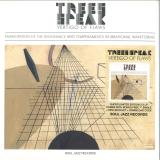
Trees Speak are back!
Speak’s new album, “Vertigo of Flaws: Emancipation of the Dissonance and Temperaments in
Irrational Waveforms” comes as a double-vinyl edition, single CD and digital release. The limitededition first pressing only of the vinyl includes a bonus 45 enclosed in an 8-page 7”x7” booklet
insert housed within the gatefold sleeve with cover artwork created by Soviet Union propaganda
artist Lazar Markovich Lissitzky in 1911.
Trees Speak are back!
This new release is a vast leap into an ocean of space and sound, a quantum leap into cybernetics, biology, anti-gravity,
time travel, dream speech and transfiguration. A seriously next step release!
Showing no signs of slowing down their rapid creative pace – incredibly this is their fourth album in the space of just over
one year – ‘Vertigo of Flaws’ is a mighty 29 tracks, one and a half hours of music across one double album that is surely
going to be a defining point in their musical career, a giant leap into the sonic unknown, an epic exploration of intensity
and sound.
Alongside their now trademark German krautrock motoric-beat rhythms, angular New York post-punk attitude, tripped-out
60s spy soundtrack, psyche-rock, and 70s synthesizers and vocoders, here you will also hear a new cosmic spacial
awareness (both personal inner space and galactic outer space) and a truly wilful pushing of sonic boundaries - as police
sirens, static noise, alarms, radio signals, avant-garde voices, and orchestral string quartets, all collide to add beautiful
dissonance to uber-powerful, intense, addictive and propulsive rhythms - in the process creating a truly unique
soundscape that Trees Speak have made wholly their own.
If you ever wanted to hear Can, Hawkwind, Destroy All Monsters, Pere Ubu, electric eels, John Cage, Liquid Liquid,
Tangerine Dream, Suicide, Neu!, Laurie Spiegel, Art Ensemble of Chicago, John Barry, Mother Mallard’s Portable
Masterpiece Company, Sun Ra, Stockhausen, John Carpenter, Electro-Acoustic and Musique Concrete and Mars in one
band - then this is it!
Trees Speak are Daniel Martin Diaz and Damian Diaz from Tucson, Arizona and their music often draws on the cosmic nighttime magic of Arizona’s natural desert landscapes. ‘Trees Speak’ relates to the idea of future technologies storing
information and data in trees and plants - using them as hard drives - and the idea that Trees communicate collectively.
Special guests from the hyper-creative hub of the Tucson music scene on this release are Gabriel Sullivan, Ben Nisbet, Saul
Millan, Stephani Guilmette, and Davis Jones.
The album Vertigo of Flaws was recorded in Brooklyn, New York, and Tucson, Arizona during the plague of 2021.
Extract from Vertigo of Flaws sleevenotes:
‘As we travel through space and time, avoiding the discarded remains of the industrial period, the
deconstruction of social norms through the expression of art, music, and philosophy guide the human
experience towards the unknown.
All that remains are musical echoes scattered throughout the universe, like ancient vibrations that now
populate the cosmos. These waves now show signs of decay. Melody, beauty, tonality have all but fallen
away as dissonance blossoms. As John Cage wrote in 1937,
“Whereas, in the past, the point of disagreement has been between dissonance and consonance, it will be,
in the immediate future, between noise and so-called musical sounds. New methods will be discovered,
bearing a definite relation to Schoenberg’s twelve-tone system and present methods of writing percussion
music and any other methods which are
free from the concept of a fundamental tone”.
Similarly, George Van Tassel claimed the Integratron as capable of
rejuvenation, anti-gravity, and time travel. So, what remains of the
“people”? We have adopted from them our own Zeitgeber: their pulses
now guide our sun, our planets, our earths, and are the new circadian,
diurnal, and ultradian rhythms of the galaxy. Traumsprache, dream
speech, is now the internal language of trees.
Decaying metal and machines liberated the note unto nature’s table,
and we sip the delicious nectar of music once more irrational, elaborate,
violent, vast. The past is the future, musical disintegration its own rebirth.
We are nature, once more the computer of the Universe.’
Until Now, Jilala has been a much sought-after phantom in relation to their better-known musical and spiritual contemporaries, The Master Musicians of Jajouka. Culled from three and a half hours of 1965 recordings by writers/artists/poets Brion Gysin and Paul Bowles, the first batch of Jilala recordings were released on a 1965 LP that was scarce even upon its initial release. The second batch of Recordings, which this LP has drawn from, came in the form of a CD by Baraka Foundation in 1998, which is also now long out of print. The Jilala brotherhood -- like the better-known Jajouka culture -- has pre-Islamic roots in Sufi mysticism that span across northern Africa from Morocco to India. Jilala shares the kinds of small, portable instruments historically favored by nomadic cultures. Even among the more ardent aficianados of "world music" these recordings have seldom been heard. In the original liner notes Ira Cohen provides a breakdown of the Jilala ensemble: "The instruments used are the shebaba, a long transversal cane flute, which leads the way; the bendir, a handheld drum resembling a tambourine without cymbals; and the karkabat which is a double castanet made of metal. On this record there are usually three flutes, six drums and one pair of castanets." In conjunction with the qraqaba -- an iron analog to the wooden castanets featured heavily in the Flamenco music of the Roma people that also flourished over the centuries mere miles to the north in southern Spain. These bendir drums provide a range very similar to that covered in contemporary popular music by the bass drum, snare, and cymbals that make up standard drum kit. The Trance-inducing grooves were major influences on such bands as Led Zeppelin, Agitation Free, Can and the Rolling Stones. The collective rhythms are often reminiscent early hip hop. oFirst time these tracks appear on vinyl - Pressed on 180 Gram Black Vinyl o Recorded by Brion Gysin & Paul Bowles in Morocco 1965 o Limited Edition of 300 Copies - DMM: Direct Metal Mastering o New Liner Notes by Peter Wetherbee o Contains insert of original liner notes from 1965 Jilala LP o Long out of print in any format for over 20 years.
An exploratory record that dances across time and genre, guided by fidgety miniatures and jazz inflected collage. Throughout, the band pool together their instrumental chops, moving from fluid and serpentine R&B to meditative, minimalistic piano, evoking a contrast of virtuosity and self-surrender.
While constructed from the inspiration of soul, funk and film music, BÉE mediate those influences having first digested them through the productions of Madlib & the RZA.
A sticker on the sleeve tells us Self Help “combines jazz-funk and mysticism,” a signpost to where its musical and spiritual concerns align. The jazz-funk component translates to arresting hooks in sideways song forms: echoes of Gainsbourg spooled through Azymuth-style Brazilian jazz and punctuated by the whip and snap of Steely Dan. “The Sound Where My Head Was,” the instrumental centrepiece, exemplifies present-wave jazz but also ancient sounds, giving off the mothballed air of a Hiroshi Yoshimura record in a library-music archive.
Self Help’s mysticism emerges in broad and specific ways, denoting not only a search beyond cliché and intellect but also an inquiry into the beat, the spirit, the one will. This isn’t new territory for them: Turnbull—the artist formerly known as Slim Twig, who writes and performs with U.S. Girls and various other Toronto concerns—named the group’s Nature, Man & Woman EP after the Alan Watts book. Building these songs from his drafts over three weekends at Toronto’s Palace Sound studio, the ensemble was free to tap out of the city and into some other place, taking up residence in a collective mind maze. The album produces, in equal measure, familiar surprises and the surprisingly familiar. Intoxicated jazz riffs swerve left at phantom intersections. Rhythms cut loose and tie you in knots. But wired in to each song is a sense of gentle accumulation, making every featherlight flourish weigh a ton. U.S. Girls’ Meg Remy brings serenity to “Sing a Silent Gospel,” and wears its antic melodies lightly. The soul shimmer of “Unity (It’s Up to You)” lets the players pool their R&B chops into something fluid and serpentine while, on guest vocals, the musical performance artist James Baley issues urgent declaratives: “Water must pool, as a rule, before tasted/Or else the water is wasted.” The words throughout the record complement the ensemble music while riffing on the precarious nature of unity itself. Then, closer “Extinct Commune” finds Turnbull deserted at the piano, playing phrases of meditative minimalism taking after the composer Joanna Brouk.
For all the record’s reach, it is these contrasting quiet moments that bring Self Help’s communal spirit into focus. A note on personnel: Badge Époque Ensemble now has a seventh member in Karen Ng, the saxophonist and sometime collaborator of Do Make Say Think, Feist, and others. In BÉE, Ng joins Chris Bezant and Giosuè Rosati, her bandmates in the Andy Shauf live band, as well as U.S. Girls co-conspirators Turnbull and Ed Squires, and other Torontonian cross-pollinators listed below. Guest vocalists across Self Help include Meg Remy, who sings with Dorothea Paas on the opener, James Baley, and Toronto singer-songwriter Jennifer Castle on the remarkable “Just Space for Light.” Words by: Jazz Monroe
‘The Other Side’ sees musical styles woven together into a lyrical tapestry of sound, blending improvisation with co-created original compositions. A truly unique ensemble in compositional process and performance style. On 5th June, Quest Ensemble will release their sophomore album ‘The Other Side’. With nods to influences as broad as the contemporary minimalism of John Adams and Steve Reich, the experimental melancholic textures of Radiohead to the progressive jazz precision of Brad Mehldau, ‘The Other Side’ inhabits its own soundworld somewhere in the gaps between chamber, jazz, folk and contemporary classical music. From the emotive ‘Moments’, the elasticated melodies of ‘Pendulum’, to the fluid lines and compelling urgency of ‘The Boatman’ and ‘Pedal Down’, Quest Ensemble’s compositions fuse layered melodies and rhythmic patterns to create contrapuntal webs of sound. The process involves sharing improvised ideas, building up layers of music on each instrument to create a patchwork of musical themes with a rich vein of surging Reichian rhythms underpinning each. Fusing their backgrounds in western classical, Indian classical, jazz and improvisational technique, Filipe Sousa (piano), Tara Franks (cello) and Preetha Narayanan (violin) are all graduates of the Guildhall School of Music Leadership Programme. In May 2014, Quest Ensemble released their much-lauded debut album ‘Footfall’, a collection of part-composed and part-improvised original compositions, steeped in the sense of place that inspired the sound and imagination of their stories.
Comic book artist, graphic designer and free jazz improviser are only some of the many talents from Beirut born Mazen Kerbaj. After appearing as part of various ensembles on the label, Ariha Brass Quartet (CREP46) and Johnny Kafta Anti-Vegetarian Orchestra (CREP22), Kerbaj finally lands a solo outfit of his own onto the Discrepant dancefloor of insubordination.
14 years after his first (and only) solo album "Brt Vrt Zrt Krt" (Al Maslakh, 2005) Mazen returns with a series of subtle compositions of his own with not one but two(!) solo albums of prepared trumpet that further cement his international position as a serial trumpet botherer.
Whilst Vol. 2.1 showcases his (almost) (un)familiar arsenal of squawks, cackles, howls and squeals, Vol. 2.2 goes deep into the nether regions of waltzing drones and bell tweaks so deep that would make most cetaceans loose their concentration. The notion of being transported to a luring mutant underwater alien community is still present on these long(er) trips with the added meditative pieces being occasionally pierced by noise creepers, nothing is what you want or expect and that’s the way it should be.
If Vol. 2.1 is the classic follow up LP, this one is the beast from the deep, it comes surging and screeching from a deep oceanic sink hole, only to hypnotize you with perverted dance moves before diving back into the sinking, wettest and darkest cave in the world. Vol. 2.2 is a summons album; it shatters any bar there was with its intentional use of everything Vol. 2.1 was denied. It grabs you by wherever available way and it only releases you when you’re ready to listen to it again. Listen to both albums back to back, in no particular order and you’ll know that there’s nothing you can do but come back to it like a doped up seal stranded in a phantom island – appearing and disappearing as the music dictates it to.
- 1