Much time has passed since the Queer Australian/Italian-Armenian, multifaceted artist, Kristian Bahoudian aka Kris Baha, swapped the parched red earth and searing midday sun of the Australian landscape for the brutalist communist-era apartment blocks and slate-grey skies of former East Berlin. Kris is now a fixture in Berlin’s club scene and has toured most of the world as a DJ & live artist with his own unique production style of cyber industrial, EBM, wave, post punk, and early ‘90s IDM mutations. Remixing some of the scene’s most notable artists such as Boy Harsher and techno pop lord Boys Noize, Kris has garnered respect and trust in the electronic music scene for the last 13 years. To respond to the current AI revolution, Kris uploads himself to the cyber ether through his latest project: GHOSTS IN THE MACHIИE.
Across Dual Timelines —
” GHOSTS IN THE MACHIИE ” unfolds as a sci-fi cyberpunk concept project inhabiting dual timelines. In one, we glimpse a trans-humanist future where human consciousness exists as intricate sequences of binary code, entwined and controlled by omnipresent AI systems. In this coded future, a profound awakening stirs among a select few who manage to mutate the code they were governed by, unlocking memories of their history that was erased by the AI. Through this discovery they realize they can traverse temporal boundaries and utilize this power to send warning messages back in time to their former fully human selves. These eerie missives carry a dire warning for humanity, urging them to rectify the course of society before the relentless march of artificial intelligence deprives humanity of its essence. In this terrifying future, humans are rendered mere specters within the digital expanse, stripped of their souls, to become Ghosts In The Machine.
Collaboration with the future self —
The cyber odyssey unfolds from a unique perspective— Kris’s very own future self (his future ghost): a spectral entity endeavoring to caution its present incarnation against the ominous path it treads, attempting to avert a dystopian future.Sonic Alchemy —
A fuse of cybernetic synth waves, hyper-punk, and pulsating drum and bass laid out against the dystopian, industrial sonic landscape of this grim future “civilization”. Each track recounts a new chapter in the gripping narrative, drawing listeners deeper into their own story and the role we all play as a collective society with the future possibilities of unregulated AI.Recorded in Berlin with software and hardware synthesisers. AI was used to assist me with lyric themes, concepts and ideas. I also used a trained AI model of my own voice as backing vocals in ‘Haunting Me’.ll music, words & concepts by Kristian Bahoudian aka Kris Baha and his future ghost,
GHOSTS IN THE MACHIИE
Поиск:the real
Все
- A1: Came Up (Feat. Tye Harris)
- A2: Ar (Feat. Bigxthaplug & That Mexican Ot)
- A3: Tidal Wave
- A4: Blood Money (Feat. Finesse2Tymes)
- A5: Time & Time Again (Feat. Money Man & Fredo Bang)
- A6: For Real
- A7: Cake Up (Feat. Ralo)
- B1: Body
- B2: Yeah Yeah
- B3 3: 00 Am
- B4: Shottaz (Feat. Nocap)
- B5: Middle Of The Night
- B6: I Cried
- B7: They Don't Know (Feat. Tory Lanez)
Legend is the second posthumous album from revered Dallas rapper, singer & songwriter, MO3, and follow up to the 2021 posthumous release, Shottaz 4Eva, which peaked at #36 on the Billboard 200. Dropping on what would have been his 32nd birthday, Legend features previously unheard music from MO3 himself, and sees appearances by Tye Harris, BigXthaPlug, That Mexican OT, Money Man, Fredo Bang, Ralo, NoCap & Tory Lanez. The 14 track album includes the previously released singles “AR (Feat. BigXthaPlug & That Mexican OT),” “Blood Money (Feat. Finesse2Tymes),” “Tidal Wave,” & “They Don't Know (Feat. Tory Lanez).” While the loss of MO3 is still being felt, fans continue to celebrate his life and honor his legacy by keeping his music alive. MO3 will forever be a Legend.
Konerytmi's upcoming release is a captivating blend of retro charm and futuristic allure. Each track resonates with the spirit of the 80s, where the pulsating rhythms of old-school drum machines intertwine with the evocative tones of vintage synthesizers.
Drawing inspiration from the hooks and melodies that defined a generation, Konerytmi skillfully weaves a tapestry of sound that is both timeless and contemporary. These tracks are not just made for dancefloors, they are crafted to evoke emotions and stir memories, inviting listeners into a realm where past and present converge seamlessly.
MRAK unveils a six-track collection of new material. “This is a snapshot of my reality. It is a composition, a challenge, that I took not knowing the outcome and its price - the amount of logical mazes I had to overcome and I still am. The biggest honour and most humble experience is the possibility to feel any sparkle of emotion, providing fragments of the music and the reality that I’ve developed as an artist over the years. My imprint soul and commitment to melody are adamant, as is the pledge to deliver and be loyal to this abstract entity called music; that gently accompanies our lives.” MRAK As one of the founders of Afterlife, MRAK is now reshaping the afterlife paradigma. Introducing a sharp and elegant but distinctive musical equation. On The Pledge, he presents six compositions, all bound to the Afterlife ethos. ‘The World‘ featuring vocalist braev. Sombre piano keys and urgent strings accompany energetic synth layers. ‘The Process works from a hypnotic low end, supporting a solid melody that increases in intensity as the track develops. For ‘Their Law ’MRAK teams up with David Lindmer, crafting an undulating track with captivating melodies and harmonies. With ‘Portal ’the realm of consciousness beckons us in, with a female vocal reverberating intermittently, complementing the dark bassline and bright synth lines. Penultimate track ‘The Flame features braev and Canadian vocalist Wasiu for a three-way collaboration steeped in emotion. It utilises a heartfelt vocal alongside a spoken-word segment, striking the balance between emotion and high energy. Lastly, MRAK collaborates with Omnya on the remix of ‘Never Ends’. The main melody provides an uplifting vibration, juxtaposed with the darker elements of this journey to the close of the EP…
10 years after its release, Lydia Loveless sits down at the piano for an intimate reimagining of her landmark album, Somewhere Else. Title track featuring guest vocals by Jason Isbell. “Over the last 10 years I’ve been told by countless people, emotional and earnest, that their favorite record of mine is Something Else. I love that, and I nod in amused reverence to it here. The me of 2012-2013 was drowning in pain and insecurity and my own press, pissed off that nobody could see me for who I really was, what I had really been through, and how hard it was to be me. I was walled in by fears and worries that I would never be good enough. I was struggling with my voice after a debilitating virus and a six week tour. I had rented a little room in the Grandview neighborhood of Columbus and was plugging away on my splintered acoustic guitar with a tape recorder.
I was frustrated as could be, not coming up with anything that I felt was 'me' or even remotely song like. One day, when I finally thought I had a nugget of something, I read the lyrics aloud to my then husband and he looked at me confused and said, 'what are you even trying to say in this, though? Who is the narrator?' I don’t remember what I said to that but I’m sure it wasn’t kind. When I went back into the studio with my friend Caeleigh Featherstone recording me this go round, she looked at me at one point and said, 'Were you singing these songs in front of old dudes? Like, your husband?' Yes, I was, I told her. We both shook our heads and laughed at the hubris on 22-year-old Lydia Loveless.” - Lydia Loveless
Gregory T.S. Walker’s Minstrels & Minimoogs was self-published by a young, nomadic composer and virtuoso in 1988 to accompany an immersive multimedia performance at the University of Colorado Boulder’s Fiske Planetarium. Created with this outer, and other, world setting in mind, the four tracks find Walker stretching toward an ancient-to-future vision where Egyptian myths and Hieronymus Bosch-ian tableaus are rendered in a screaming three dimensional circuitry of electronic drums, synth guitars, and, of course, Minimoog. Given the musical terrains and outmoded topics traversed, and that this entirely DIY effort was originally released as a micro one-sided 12” edition, Minstrels & Minimoogs is as perplexing and euphoric a document lost-to-time as it is now found.
Born in 1961 into an intensely musical family spanning four generations, Gregory’s mother Helen Walker-Hill was a noted musicologist specializing in the rediscovery and work of historical Black female composers, while his father, George Walker, was the first African American composer to win the Pulitzer Prize for music. Both parents studied with the famed (and famously strict) Nadia Boulanger in Paris in the 1950s, and held to lofty aesthetic standards in their home life. Walker began studying the violin as a child, but when a burgeoning interest in the electric guitar and rock music as a teen manifested, it was largely verboten in the household. The rule was that the music played in the home was to be acoustic and classical. Although the elder Walkers eventually relented and allowed Gregory’s guitar to be plugged in for a brief interval on the weekends, the remaining days he settled for strumming it sans amplification.
Gregory, conditioned and eager for a life in music but looking to get out from under the influence and yoke of his famous composer father, ultimately chose to study computer music at the University of California at San Diego, where he earned a Master of Arts. This was followed by another MA in electronic music composition at that hotbed of West Coast experimental music, Mills College. Intermedia and multimedia in the arts was the rage in the 1980s, and Mills was one of the centers for it; audacious spectacle meeting visionary performance, such as one of the realizations for Anthony Braxton’s music for multiple orchestras a young Gregory performed in with his violin.
After a series of solo synthesizer concerts around California, Gregory followed a girlfriend on a mid-country move to Boulder, Colorado. After picking up yet another composition degree at University of Colorado Boulder, his life as a composer really started, writing a piece for extended technique for guitar, a passacaglia for vocoder and orchestra, as well as Minstrels & Minimoogs.
Envisioned as a multimedia performance such as the kind he’d experienced at Mills (which was all but unknown in Boulder at the time), Gregory roped in a number of college going or aged friends of varying skill levels and musical sympathies to accompany him with distorted sax or oblique spoken interludes. Confronted with a lack of finances, but driven to get his ideas captured in a complete musical package, the album was recorded in his brother’s apartment. If not every player assembled was on Gregory’s virtuosic level, so be it; it was more about capturing the spirit of his intentions and embracing the serendipity of mistakes.
An inspired attempt at world building, Minstrels & Minimoogs draws on the deep well of musical knowledge Gregory gathered from his parents and teachers, but all the while subverting that historical basis by incorporating mutant strains of prog and pop music. The work accumulated is not unlike the playful 1980s work of Gregorio Paniagua, where medieval estampies and rondeaus are wrenched into an anachronistic present where Hildegard Von Bingen and Kate Bush are contemporaries. Ars nova, new art, a 20th century minimalist jester and troubadour.
A one sided LP was the cheapest option Gregory found to have Minstrels & Minimoogs memorialized on vinyl, so somewhere between 50 to 100 copies were pressed. There was no distribution, outside of copies that were handed out to friends or sold at the performances at the planetarium. Gregory T.S. Walker’s cosmic-futuristic forays into oblique pop and baroque subversion could forever reside perfectly in both the domed simulacrum of our universe for which it was composed, in the formats it is being reintoduced now, and our own biblical firmament. For in the words of Gregory, straight from the original liner notes: “God Is A Minimoog”
Gregory T.S. Walker’s Minstrels & Minimoogs arrives again August 23, 2024 on vinyl and digitally as part of uncommon¢ (“uncommon sense”), an open-ended, serialized endeavor from Freedom to Spend that provides new meaning for rarefied recordings from music's outermost fringe.
Limited pressing of 300 LPs ! 180gm VINYL LPS w/ INSERT & DOWNLOAD FILE UNDER : GARAGE ROCK / PUB ROCK "I wanted to make a very NOW album, our past was fantastic at the time but it was exactly that.the past. We've learned a lot since then and with the combination of influences and personal tastes we've concocted a combination of Raw Power guitar grunt, a touch of The Cars' pop sensibilities and Bad Seeds brood." Dave Butterworth Veteran rockers The Double Agents return with their third album New Motion a powerful new recording evoking directness and immediacy and marking their first release of new material in nearly two decades. The Double Agents' initial incarnation circa 2000 saw the fiercely independent quintet rise from humble stages to becoming one of Melbourne's most revered pub rock bands. They twice toured Europe and eventually shared the stage with iconic luminaries Dead Moon, Mudhoney, The Dirtbombs, Celibate Rifles, The White Stripes and The Black Keys before an amicable hiatus in 2008. New Motion is a modern Australian rock record and marks a departure from their garage rock roots, as best exemplified in their self released 2023 anthology compilation Best Bits. So Far spanning their first three releases. The familiar twin vocals remain, Kim and Dave summoning that deep Dead Moon energy, as does Ryan Tandy's singular lead guitar playing and the rock solid backbeat of Myles Gallagher, but the band's scope seems to have widened on this record, with the inclusion of longtime cohort Mick Stylianou (Saint Jude) adding style and harmonic punch on bass guitar and backing vocals. ..The New Motion sessions were tracked to analog tape by Finn Keane at Head Gap and Julian McKenzie at Newmarket with vocal post production by Dave Larkin (Dallas Crane), mixing by Callum Barter (Courtney Barnett, Kurt Vile), mastering by Mikey Young. Dave Butterworth also produced the album.
Last Summer, Daniel Foggin, guitarist, writer and chief architect of Smote, uprooted himself from his usual home in Newcastle to live and work in a farmhouse in Kelso, near the Scottish border. “Through the summer when I was working up there, myself and Rob (Smote drummer) would finish work and go sit by a small river and have a couple of beers in the sun, and it was the best thing ever” he relates “So I guess the philosophy is that to some people it looks like any other stream, but to us it was supreme happiness.” Hence came the title of the fourth Smote album proper, one largely recorded in this same farmhouse – A Grand Stream. It’s an album that’s the truest incarnation thus far of his vision for this band – a full-scale psychic voyage into the ether and a drone-and-repetition-fuelled series of incantations that takes simple, primal ingredients and utilises them for the purposes of aural sorcery, summoning spectres and revelations aplenty in its wake. Whilst the folk-tinged, ceremonial ambience that Smote have made their trademark is present and correct here, utilising Swedish classic psych heaviness and Swans textures as fuel for the ominous rhythms of ‘Coming Out Of A Hedge Backwards’ and the uplifting cadences of opener ‘Sitting Stone Part 1’, Foggin and his cohorts also waste little time exploring new more eerie and ethereal textures and dimensions. The meditative ‘Chantry’ in particular sees them gravitate towards a headspace akin to the drone-based epiphanies of Kali Malone’s ‘Does Spring Hide Its Joy’ filtered through the transcendent amplifier worship of ‘Earth 2’. A Grand Steam takes this band – one who’ve always eschewed the cliches and stumbling blocks of all contemporary psych rock in favour of their own unique and wyrd vision – into a realm in which they transcend through willpower and skill alike into something preternaturally thrilling, mapping out their own crepuscular new territory Question is; dare you step over the threshold?
There are ghosts all across AVANTI, the debut album from Malice K. At points it's howling and unhinged, a grungy layer atop a lush foundation of melodic capital-s Songwriting, but in other moments it dissolves into a gentle, wistful haunting. Malice K's songs are blunt, uncomplicated and unflinching as he probes the interiority of memories, of mistakes - saturated with an innate intensity that sucks you into his gnarled and visceral world, so barbed it could draw blood. Malice K is helmed by visual artist and songwriter Alex Konschuh, New York-based but born and raised in Olympia, Washington. Following a stint living in Los Angeles, where he became a member of the artist collective Death Proof Inc., a trip to New York resulted in him simply never leaving the city. A period of chaos ensued, Malice K exhausted and unmoored and ultimately, unwell. The record is unpredictable across its 11 songs. The album opens with a jarring scream on "Halloween," Malice K's breathless vocals buried beneath a grungy, roving Nineties riff. The track emanates a manic energy, enveloping. It's a fitting entrypoint for the record, and for the vividness of Malice K. The snarling and obsessive "You're My Girl" has a swaggering paranoia: "I got so high I thought my hand touching my hand was your hand." But AVANTI exists in quieter moments too; "Radio," with its fluttering morose cello, moves at an almost glacial pace comparatively. The aching wistfulness of "The Old House" is an album stand-out, anchored in an acoustic guitar, an uneasy lullaby that never quite settles into itself: "I think to myself I got the things that I wanted, but I can't help think there's something else that I forgot to do." A recent press interview called Malice K a shapeshifter, but he's not amorphous in that way. He's decisive and intense, more concerned with carving his own path, and building his own world. Every part of Malice K is distinctly himself: from his sweaty high-octane shows to the high-flash high-contrast photos; from his gnarled and unsettling illustrations to the studio recordings that vacillate between grief and tenderness, there's an exceptional ferocity across everything Malice K touches. AVANTI feels lived in, like peering into an abandoned house through a window smeared with grimy fingerprints, relics of a life well-lived scattered inside - despite being a debut, there's the sense that Malice K arrived fully-realized, imperfections and all.
BBsitters Club is a rock band based in Chicago that features Doug Kaplan and Charlie Olvera on guitar and vocals, Max Allison on bass, and Paul Birhanu on drums. As the label’s de-facto in-haus band, BBsitters Club satisfies Hausu Mountain co-founders Allison and Kaplan’s urge to remain connected to the rock and roll music they grew up loving and playing — far across the spectrum from the experimental electronics featured on the lion’s share of HausMo releases.
A solid four years after the one-two-punch releases of BBsitters Club & Party, the band’s 2020 debut studio album, and Joel’s Pick’s Vol. 1, the first volume in a series of audience-recorded live takes from shows around Chicago, we find the BBs reviving the Joel’s Pick’s series with Vol. 2. Charged with the energy of a close-knit group of friends willing to follow along with each other’s most outlandish ideas both in composition and live performance, JPV2 offers us a bewildering yet always tongue-in-cheek palette of ideas cherry-picked and mashed together into amalgams that both embrace “rock traditions” and defy them with a cherubic grin.
BBsitters Club’s amorphous compositions land somewhere between the world’s most baked prog band and a jamband that’s never content to lapse into wheel-spinning complacency. On JPV2, BBsitters Club cartwheel between eras and styles of rock music with abandon — a TV stuck flipping channels after your dad falls asleep with one leg on the remote. We encounter the elliptical dueling guitars and autumnal atmospheres of midwest emo / math rock, the gregarious stomp of electrified country rock, blues rock that has melted from ingesting one too many hallucinogens, and fried Devo-style art punk that breaches into the realms of ska before melting into free-form noise rock flecked with the bizarro imitative instrument tones of Kaplan’s MIDI guitar.
Kompakt is proud to announce, finally, a reissue of the first, self-titled GAS album. Originally released on electronica imprint Mille Plateaux back in 1996, it’s been unavailable in its original form ever since – the version of GAS included in 2008’s Nah Und Fern box featured several different tracks. Here, however, GAS is restored in all its glory, the debut full-length from Wolfgang Voigt’s most enigmatic, quixotic project.
There had, of course, been signs of what was to come. Back in 1995, Voigt essayed the first GAS release, a slender, yet remarkable four-track EP, Modern. Its centre label featured a reduced symbol – an overhead or lamp light, switched on, its glow radiating outwards in four bold black lines – a perfect representation of the tight, stylised ambient electronic pop contained on that 12”. A few curious compilation tracks were floating around, too, for Mille Plateaux’s Modulation & Transformation and Electric Ladyland series. If you were attentive enough, you could tell something was up.
But nothing quite prepared us for the languorous, effervescing loops and regular-like-clockwork beats that Voigt folded together on GAS. Its six long tracks, all untitled, neither begin nor end but hazily fade into earshot, vibrate majestically in your cochlea for fifteen-or-so minutes – some a bit shorter, some longer – and then meander away, reading the mise-en-scène for the next example of Voigt’s drift and dream logic to unfold. The material is referential in the most distant way, and you can sense only the most evanescent of ghostly presences, haunting these six compositions.
GAS feels, also, like a more pliable hint at what’s to come, as the GAS concept really solidified on its successor, 1997’s Zauberberg, and reach its apotheosis on Königsforst and Pop. Those three albums share a very similar palette – blurred, hazy samples, often of classical music, stacked and cross-thatched across a muted 4/4 thud. GAS, then, is an outlier of sorts: it’s more expansive in its remit, lighter in its mood, perhaps more fleet of foot. This, of course, is part of its charm.
In clearing space for Voigt, by preparing the terrain, GAS sits both at the edge of the forest, and at the verge of an expansive, wide-eyed future; one where GAS would become truly eternal.
Text by Jonathan Dale
Kompakt ist stolz, endlich eine Neuauflage des ersten, selbstbetitelten GAS-Albums ankündigen zu können. Ursprünglich im Jahr 1996 auf dem Electronica-Label Mille Plateaux veröffentlicht, ist es seitdem nicht mehr in seiner ursprünglichen Form erhältlich – die gleichnamige Version von GAS, die 2008 in der Nah Und Fern Box enthalten war, enthielt verschiedene andere Titel. Nun liegt das 3er Album in seinem naturbelassenen Originalzustand wieder vor.
Bereits 1995 zeichnete sich mit der Maxi GAS - Modern auf Profan, sowie einigen Kompilation-Beiträgen auf Modulation & Transformation und Electric Ladyland auf Mille Plateaux dieser frühe, weltentrückte, rätselhafte GAS Sound ab, der sich erst in den sechs scheinbar endlosen, majestätisch-sprudelnden Tracks des Albums voll entfaltete. Die Musik ist von ätherischer Leichtigkeit, in der wie aus einer anderen Sphäre abstrakte Referenzen aus weiter Ferne nur andeutungsweise herüberzuwehen scheinen.
Dieser frühe, eher sphärisch-leichte, gleich einer sonnendurchfluteten (Wald-)Lichtung anmutende GAS Sound, stellt gewissermaßen den Ausgangspunkt der audiovisuellen „Welt“-Reise in den düster-romantischen Acid-Wald dar, in den sich GAS ab 1997 mit den Alben Zauberberg, Königsforst, Oktember und ab 2000 mit Pop an anderer Stelle wieder hinaus und in seine ganz eigene Ewigkeit begeben hat.
In these uncertain times marked by doubt and fear, hope is born in the hearts of those who believe that one day, humanity will resurface from the ashes of history to shed light on the dark territories.
To revive the spirit of resistance through sound, Detroit’s enigmatic SCAN 7 used its rethinkable frequencies to connect with a few chosen producers and craft an antidote to our orchestrated reality.
After months in their lab, SCAN 7 is happy to present Hallowed Ground, a six-track vinyl compilation freshly released on their new SCAN label. The compilation pays tribute to the epicenter of artistic, physical, and intellectual movement: Detroit.
The musical journey features the legendary AUX88, The Man With No Name, eMICee, Inohs Sivad, Charles Prophet Jr., Demiån Monét, Dre Brown, and of course, SCAN 7. This project also includes Scott Avery’s “Low-Key Seduction Mix” of SXERANADE on the digital release.
Hallowed Ground is a testament to the richness and depth of Motor City’s musical background. It encapsulates a diverse range of genres, from the soulful rhythms of Soul and Funk to the pulsating beats of Techno and beyond.
"Symphony for the Lost" is a live album by British gothic metal band Paradise Lost, released in 2015. It was recorded at the Plovdiv Theater in Bulgaria, accompanied by the Plovdiv Philharmonic Orchestra. This album features an epic performance of the band's hits, fusing dark metal with the majesty of a symphony orchestra. The unique atmosphere and powerful performance make "Symphony for the Lost" a memorable listening experience for fans of metal and classical music. It's a fantastic LP Gatefold Picture Disc edition limited to 475 copies!!
- A1: She Looked Like Me! (3 16)
- A2: Killing Time (3 52)
- A3: True Blue Interlude (1 46)
- A4: Image (3 34)
- B1: Death & Romance (5 19)
- B2: Fear, Sex (2 28)
- B3: Vampire In The Corner (3 21)
- B4: Watching Tv (4 11)
- C1: Tunnel Vision (5 07)
- C2: Love Is Everywhere (3 12)
- C3: Feeling Diskinserted? (0 56)
- C4: That's My Floor (3 31)
- D1: Cry For Me (5 12)
- D2: Angel On A Satellite (4 01)
- D3: The Ballad Of Matt & Mica (4 19)
"Magdalena Bay, the Los Angeles-based duo of Mica Tenenbaum and Matthew Lewin, create magical pop music that floats in the ether of our collective social cosmos. While they call California home, their essence lies in the clouds, emitting unique yet familiar frequencies of synthesized nostalgia, kitschy catchiness, and warped neo-hooks. Suited for the times, Magdalena Bay blends the known and felt with innovative sonic landscapes.
Tenenbaum and Lewin met as teenagers in a Miami high school music program. Tenenbaum, who moved from Buenos Aires to Florida at age one, and Lewin, a guitar shredder influenced by his dad’s prog and concept rock records, quickly recognized their kindred spirits. They formed a prog band called Tabula Rasa and began a romance. Both were skilled musicians; Tenenbaum a pianist and singer, and Lewin self-taught in production and music theory. Despite attending different colleges, they maintained their band, traveling hours to rehearse before realizing two things: their relationship was undeniable, and prog rock wasn’t resonating with young audiences.
Shifting their focus to pop, they explored its craft, leading to the creation of Magdalena Bay. They learned the complexities of pop writing and production, striving to create something interesting within the genre. Describing their music broadly as ""pop,"" they released several EPs and singles before debuting their album, ""Mercurial World,"" in 2021. Praised for its melodic hooks and meticulous production, it was often labeled as ""synth-pop.""
Their success is reflected in streaming numbers, social media followers, and festival appearances. Magdalena Bay's stylized online aesthetic complements their music, creating a cohesive artistic vision. Tenenbaum says, “We love extending the world of our music past sound into videos or graphics.” Lewin adds, “We’re trying to create an atmosphere or an emotional quality with it.” This integrated approach, termed ""world-building,"" is central to their artistry."
The Norwegian underground black metal band Kirkebrann has ventured from the early days of 2004 to now with increasingly more aggressive, misanthropic and epic themes of real-world tragedy as they unfold before our very eyes. Their frosty, rough and harsh black metal is equal to the classic early Norwegian black metal of the early ‘90s. The second full length has been in the making for almost a decade with some of those songs performed live for the same amount of time through blasphemy, blood and existential dread; featuring multiple guests on vocals of madness and triumph.
This album marks the beginning of a new era in Kirkebrann's twenty years of existence with its unrestrained force - full of blastbeats - in conveying dreadful, atmospheric and melancholic harmonies and sound of inspiration from the dark forces that are enclosing upon humanity's imminent downfall. “Mot Trellenes Forfal” was recorded by Kirkebrann with Draug on vocals, Hrafn on lead guitar, jK on guitar, Januz Skroemt Kvirinus Bifronsson on bass and Nødset on drums. The album also features guest vocals by Dødsherre (Djevelkult), Nasreten (Carpathian Forest), Cornu (Svikt), Lianne Krossburner (Edenkaiser) and Skrotmunn Blåskrott (Likfunn). It's time to release this curse upon humanity and release us from its limbo!
Thrasher is the soundtrack to a virtual reality video game about a creature that has a life cycle that traverses different psychedelic realities. Thrasher was composed and performed by Brian Gibson, bassist of Lightning Bolt. It is the follow up to the acclaimed best-selling game and soundtrack Thumper. The central character in Thrasher is a giant centipede like creature, so Gibson employed a lot of melodic sequences that resonated well with its segments moving through space. The soundtrack has the drive you might expect knowing Gibson"s work in Lightning Bolt combined with complex melodic structures that are absolutely irresistible. In addition to bucking the hyperreality trend in gameplay, Gibson"s DIY ethos and warehouse culture roots permeate the entire soundtrack. He says it best: "Thumper has that combination of psychedelic and iconic that takes me back to the Fort Thunder days. Thrasher is a further exploration into some of those motifs." We recommend that you play this record VERY loudly.
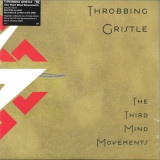
Mute veröffentlichen am 23. August das Album 'The Third Mind Movements' der britischen Avantgarde-Helden Throbbing Gristle erstmals offiziell auf CD und LP.
Die 1975 gegründete Band Throbbing Gristle, bestehend aus Chris Carter, Peter 'Sleazy' Christopherson (1955-2010), Cosey Fanni Tutti und Genesis Breyer P-Orridge (1950-2020), löste das gescheiterte Versprechen des Punk ein, extreme Kultur als Mittel zur Sabotage von Kontrollsystemen zu erforschen. Ihr Einfluss auf Musik, Kultur und Kunst ist unermesslich und bis heute spürbar.
'The Third Mind Movements' von Throbbing Gristle erschien zunächst als exklusive Veröffentlichung, die nur auf der letzten Amerikatournee der Band im Jahr 2009 erhältlich war, bevor sich die Band 2010 wieder trennte. Das Album ist eine Reise durch manipulierte, zeitlich gestreckte und verzerrte Samples, mit rhythmischen Breakbeats und hypnotischen Elektronikschwingungen.
Fåntratt’s “Ångerstupa” navigates the mystical expanse of Nordic folklore and seafaring legends, casting an experimental sound that intertwines the haunting melodies of dungeon synth with avant-garde innovation. With contributions from talents like Jovana Ćuk, the album transcends traditional genre boundaries. Fåntratt’s unique sound pays homage to influences like Bo Hansson, Örnatorpet, Paysage d'Hiver and Ildjarn while charting a new course in the realm of esoteric music.