Pt. 4 of the 'Dub me crazy' series by Mad Professor.
Reggae meets twisted electronics for wild dub trips!
Originally released in 1985 on the same Ariwa imprint.
True D.I.Y. business from this UK dub pioneer.
debe ser publicado en 15.03.2024
Pt. 4 of the 'Dub me crazy' series by Mad Professor.
Reggae meets twisted electronics for wild dub trips!
Originally released in 1985 on the same Ariwa imprint.
True D.I.Y. business from this UK dub pioneer.
debe ser publicado en 15.03.2024
Pt. 6 of the 'Dub me crazy' series by Mad Professor.
Reggae meets twisted electronics for wild dub trips!
Originally released in 1986 on the same Ariwa imprint.
True D.I.Y. business from this UK dub pioneer.
debe ser publicado en 15.03.2024
HJirok is a mythical figure, conceived as a fictional character by Iranian-born Kurdish singer and artist Hani Mojahedy. Together with versatile music producer And Toma of Mouse On Mars, she combined a variety of sounds collected during their joint travels to Iraqi Kurdistan and elsewhere with heavily processed recordings of Sufi drum rhythms and setar melodies. The result is a driving, dubbed-out, and deeply intricate soundscape that perfectly sets the stage for Mojahedy's extended, unconventional vocal techniques and polyglot lyrics. Both informed by tradition and rigorously forward-looking, »Hjirok« (with a lowercase J) is at once a profoundly personal album and a universal utopian promise. As a ghost from the past, HJirok draws on Mojtahedy's memories to mould a new future out of them.
The foundation for »Hjirok« was laid in the city of Erbil in the Kurdish part of Iraq. During one of their stays in the region, Mojahedy and Toma recorded the three percussionists Hadi Alizadeh, Jawad Salkhordeh and Serdar Saydan as well as setar player Ali Choolaei from Motahedy's backing band while they were playingthe rhythms and notes that she had grown up with in the house of her grandfather in the Iranian city of Sanandaj. Her memories of that place revolve around hypnotic Sufi music, dervishes in deep trance, and ecstatic singing. Much like this music seemed to open a portal to other dimensions, the inhabitants of the house lived in a sort of alternative reality: It provided them with a hideaway from political circumstances. Following the Iranian revolution in 1979, a Kurdish rebellion ensued but was met with the utmost brutality by the new regime, which resulted in the death of thousands.
It is no coincidence that the music on »Hirok« would draw on rhythmic patterns that were passed on from one generation to the next for hundreds of years. »The project is rooted in the figures of the Sufi dervishes and thus a culture that precedes today's political, social, cultural, and religious systems,« explains Mohtahedy. »The Sufi sound travelled around the entire world. I like to think of it as a dialogue between peoples-one based on the rhythms of the drums and the sound of their voices.« Toma adds that by electronically transforming the recordings and enriching them with field recordings from both rural and urban spaces, they were able to use the stories told by the drums and the setar to create an entirely new narrative.
The story told by these eight pieces is hence a deeply personal, but also inherently political one. Moitahedy herself left Iran in 2004 and relocated to Berlin in 2010. Having continued to use her art as a platform to tirelessly advocate for the rights of the Kurdish people and women under oppressive regimes, she has not been allowed to return to her country of origin ever since. »Hani is singing for equality and there are people who are afraid of that-her femininity, her strength.« Toma says. Much like earlier Hirok sound installations addressed human-made climate change and other systemic ills, also »Hjirok« can hardly be disconnected from far-reaching struggles for liberation and equality.
This is also true on a thematic and even linguistic level. »The lyrics are about a promise,« Mojahedy says, citing Kurdish writer Ebdulla Pesêw as an inspiration. »At their core, these are about that day on which violence and fear become a thing of the past; what they tell you is ot not give up, to keep hoping,« she adds. The promise embedded in them is an emancipatory one. These contents are mirrored on a linguistic level: The lyrics were written in both Kurdish and Farsi, blurring the lines between the two languages and thus, Kurdish and Persian cultures.
Mojahedy, or rather HJirok, conveys these philosophical themes with elegance. Herversatile vocal performance is only loosely basedo n established styles. »Of course everything started with traditional rhythms, but we kept pushing things further and further, so Idid the same with my voice,« Mojahedy explains. »There were no boundaries.« The same can be said of the field recordings that she and Toma used. Whether it's conversations between members of the Pesmerge, the Kurdish armed forces, having a chat in meadow full of bunnies or the humming and buzzing of metropolises like Tehran: »Hirok« paints a sonic picture that is quite literally autopian one; that of a non-place in which different soundscapes, cultures and ways of life coexist peacefully.
What the album conjures up from Mojahedy's memory is not only a very specific place during a unique time in history as experienced by a single person. It is also ametaphorical home open to anyone who wishes to enter - promise of a better, more egalitarian future for everyone. Hence, HJirok will bring it on tour, presenting the material as an audio-visual live show that makes use of the photo and video material that Mojahedy and Toma have collected during their travels through Kurdistan.ja
Haga su pedido ahora y le encargaremos el artículo en nuestro proveedor.
Idriss D officially launches the brand new label Nedjma with his own 2-vinyl, 8-track album as first release. The imprint will serve as a platform for up and coming talents from the Arabic world who are not represented in the current musical landscape. A very bold statement from Idriss himself, this record sees the Franco-Algerian dj and producer infuse his personal history into what he loves the most and share it with the rest of the world.
First track Tsakhbira works as the perfect opener for the album with a melodic ambient-like mood and Arabic chants, with second track Beld el fen following in the same vein with raditional instruments interspersed with synth stabs and eerie atmos.
Chazil’s upbeat rhythm spices up the vibe, a mix of ethereal
singalongs and bouncy percussions. Mohamed is the first foray into Electronic territory, a downtempo piece featuring French vocals and plenty of analog industrial clanks that lead into subsequent Hey Galbi, an exquisite melodic house number with acid synth melodies and piano keys.
Electro (Leila Moon Remix) delves into more experimental landscapes, with darker tones, blurred vocals and pulsating beats, while Elf Leila is quintessential Electroclash Arabic music, blending these two genres together, with a syncopated super catchy bassline. Closing track Harramt is a whirlwind of snare rolls, 303 arpeggios and nods to North African heritage sounds.
Haga su pedido ahora y le encargaremos el artículo en nuestro proveedor.
Experiences Limited, now 3XL, with a new LP from Exael on a highly atmospheric ambient jungle tip, deploying 30 mins of percussive spasms seeping into smoked-out zoners - highly tipped if yr into anything from Lee Gamble to Malibu.
Clearing their cache of stray bullets, Exael returns with a gyring plunge into percussive wormholes and low-lit mood enhancers .The tracks are broadly cleft along schisms of dark/light and demonic/angelic, switching from restive propellers to more sublime sensations in a fine testament to their practice - making for prob our favourite Exael release thus far.
On the “darker” side, they commit the convulsive, fractious footwork pulses and warped tones of ‘Circle (Squishy Mix)’ in a sort of parallel to 33EMYBW’s insectoid rhythms and combustion systems, while ‘Ice That melts The Tips’ trades in rapid, ice-skating thizz and ‘Ghoul Search (Demonic Attachment Mix)’ fires up the junglist particle accelerator for a proper gauntlet of hyper techstep dynamics.
The contrast is epitomised by ’Composure’, arranging flinty breaks on a luscious waterbed of floating pads, before ‘Eidolon’ renders a sort of airborne dembow pressure in the vicinity of Ben Bondy & special guest dj’s xphresh works. ‘L-theanine’ closes the session on a fine tread inside emo ambient styles and flurries on the same spectrum between DJ Lostboi and Teresa Winter, complete with a reverberating, half-buried vocal.
Haga su pedido ahora y le encargaremos el artículo en nuestro proveedor.
Desert Dictionary navigates sonic territories oscillating between language and landscape, between notation and noise. Voices responding and contributing to a complementary narrative, connecting personal memories, political considerations and psychological effects of a landscape seemingly empty and quiet. Adjacent, beneath and intertwined a modular synthesizer score based on field notes – a synthesized soundscape appearing as imaginary field recordings, at the same time resembling and unalike the place in question.
The twelve contributions presented on the LP were recorded in South Africa over a period of three months in 2020 and 2021. These recordings occurred in various locations in Kimberley, Bloemfontein, Richmond / Northern Cape, Cape Town, Grassy Park, Krugersdorp and Johannesburg.
The Desert Dictionary appears in four iterations – a situation as part of Modern Art Projects South Africa’s collection, a radio play (commissioned by Deutschlandfunk Kultur), a book edition (published by MAPSA), and the present LP.
The LP version is based on the radio play and features the voices of Richard John Forbes, Maja Marx, Phala Ookeditse Phala, Victoria Wigzell, Tubatsi Mpochmoloi, Liza Grobler, Nkosinathi Gumede, Karlien van Rooyen, Mongezi Ncombo, Ivan Messelaar, Gerhard Marx and Lindiwe Matshikiza.
The synthesized field recordings – translations of fieldnotes taken in the desert – were recorded in Johannesburg and Berlin.
Written and produced by Boris Baltschun, 2021-2022. Mastered and cut by Kassian Troyer at D&M, Berlin. Photo & map by Boris Baltschun. Graphic design by Joe Gilmore.
Haga su pedido ahora y le encargaremos el artículo en nuestro proveedor.
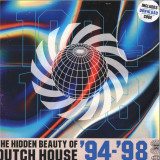
Chicago? Absolutely! Detroit? Definitely! For many, however, a significant chapter in the coming-of-age story of House music was also written in The Netherlands.
This 8-track compilation is the result of a nationwide search for lost Digital Audio Tapes (DAT’s), dusty home-studio recordings, and other relics from those early days. The distinctive "House" sound eventually evolved into a rainbow of local styles and grooves. Back then, DJ’s played their heart out and didn’t limit themselves to any particular musical genre. Following that spirit, this compilation contains everything that makes the Dutch sound so special, from energetic Breaks to atmospheric Deep House.
These are not your usual suspects, not even the most revered diggers have this collection at their fingertips. It's raw, pure material from the time when house parties were fresh and dirty at the same time. Back when the only dress code was a wide smile from ear to ear. Four sides with two tracks each, ensuring maximum DJ enjoyment. Now get out there and spread the Dutch 90's House vibes!
Haga su pedido ahora y le encargaremos el artículo en nuestro proveedor.
The fresh-faced folk pop band Stornoway seem promising: They play with guileless vigor, have a light-stepping chemistry as a unit, harmonize well. Their lead singer Brian Briggs has a lovely, pure high tenor, the kind of voice that effortlessly conveys simple longing. And yet, on their second album, Tales from Terra Firma, they continue to be almost crushingly dull, making well-appointed and cheerfully empty music that successfully communicates next to nothing.
Their Achilles Heel is a simple and unfortunate one, the same on Tales as it was on 2010's Beachcombers Windowsill. Stornoway are clearly in love with Celtic and British folk, and yet they can't write a memorable melody to save their lives. Try to sing along to the verse melody of "Zorbing", their most well-known tune, and pay attention to what your face muscles are doing; most likely furrowing with the effort of recall. Each of Tales' painstakingly arranged nine songs sinks underneath the weight of this insurmountable problem, which is a shame.
If you're making folk-pop, an inability to write a catchy melody is a difficult deficiency to overcome. Stornoway try valiantly with their complex arrangements, which quickly grow exhausting. “You Take Me as I Am” is cluttered with horn charts and pointlessly banging piano. “(A Belated) Invite to Eternity” builds to a full Explosions in the Sky crescendo, with glimmering tremolo guitar and a “Tonight, Tonight”-style sweeping string section, but having built zero momentum and generated zero heat until that point, their planned fireworks display fizzles.
“Farewell Appalachia” follows the same pattern, with celesta, finger-picked acoustic and electric guitar all tracing an emptily pretty circle with nothing in the center. The melody of "The Great Procrastinator" is almost cleanly written enough to be memorable-- and then the ersatz Dixieland jazz interlude crashes in. Stornoway are deft players, and the transitions are tightly managed, but this is praise on the same order as praising the brushwork in a hotel-room painting.
Briggs’ lyrics are filled with uncomplicated images of the good old British countryside, but his lyrics trample over all these dew-covered fields with wordy, awkward phrasing: "And in the gathering dew, I was lucid as a floodlight,” goes a line from “(A Belated) Invitation to Eternity”. “There's a hunger in the air/ A lemon swollen in the trees" he bleats on “Knock Me on the Head”. On “The Great Procrastinator”, he sings that he is “a scientist with far too many metaphors and far too little data to conclude in time.” They don’t read particularly well, and they don’t sound much more natural when sung.
Tales From Terra Firma is a peculiar record-- carefree music that feels leaden; tuneful-sounding songs that offer no tunes to hold onto. They seem an odd fit for 4AD, a label mostly home to singular voices. They may be a mercenary signing, an attempt to ride the coattails of Mumford and Sons' success. But Mumford and Sons, as head-smack simple and pandering as they are, have a pretty crucial ingredient in their arsenal: they write anthems. In that regard, they have Stornoway pretty thoroughly beat.
Haga su pedido ahora y le encargaremos el artículo en nuestro proveedor.
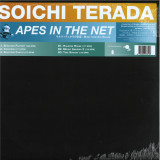
6-track EP compilation with Terada's work for the Ape Escape games, tip!
Outside of the international house underground, where his early ‘90s works for the Far East Recording label he co-founded with Shinichiro Yokota are rightly celebrated as bona-fide classics, Soichi Terada is best-known for his work composing music for video games. Yet until now, few of his productions for video games have been released outside of Japan, especially on vinyl.
Apes In The Net, a six-track EP featuring music composed for the popular PlayStation 1 series Ape Escape, sets the record straight. It not only showcases Terada’s quality as a composer and producer, but also his versatility. Like much of Terada’s work on the Ape Escape series, the tracks featured don’t explore deep, New York and New Jersey influenced house sounds, but rather his lesser-celebrated love of jungle and drum & bass – a sound he fully explored on 1996 album Sumo Jungle.
“The producer of the Ape Escape games heard that and got in touch,” Soichi remembers. “They asked me to make the soundtrack, and then work on the music for the sequels after that. I used to love making music with AKAI hardware samplers, synthesisers, and computers, so I played and recorded the tracks using almost the same methods as I did when I made house music. Using breakbeats and audio samples with a sampler was the most useful way to make the soundtracks.”
The six tracks on show, which were originally recorded in the ‘90s but reconstructed and remastered for Japan-only CD and digital releases over a decade ago, mix elements of Terada’s familiar deep house style – think warming chords and pads, memorable melodies, and emotive musical motifs – with blistering D&B breakbeats, 16-bit synth sounds, electronic bleeps and undeniably weighty basslines. They’ve stood the test of time and arguably sound just as fresh now as they did at the turn of the millennium.
For proof, check the soaring, spellbinding ‘Spectors Castle’, where uplifting lead lines and sumptuous chords dance atop punchy beats and growling bass, the jazzy and saucer-eyed rush of ‘Mount Amazing’ (all twinkling piano motifs, alien synth sounds, squelchy bass and skittish drums) and the intergalactic, liquid D&B excellence of ‘Time Station’, whose whistling melodies and stargazing chords are undeniably alluring.
There are plenty of other delights to be found across the EP, too, from the bustling, race-to-the-finish breathlessness of D&B/bleep techno fusion workout ‘Spectors Factory In’, and the rumbling sub-bass, creepy pads and suspenseful melodies of ‘Haunted House’, to the bombastic, all-out-assault on the senses that is ‘Coaster’, the set’s most “purist” jungle workout – albeit one that also doffs a cap to the pulsating world of big room techno.
Apes In The Net, then, celebrates Soichi Terada’s mastery as a video games composer and early Japanese junglist. Props are well and truly overdue.
Haga su pedido ahora y le encargaremos el artículo en nuestro proveedor.
Randy Rice mixed accoustic singer-songwriter songs with electrifying acid guitar in his marvellous privately pressed double album from 1974.
Offered here in a much needed reissue so you do not have to spend over a grand for an original copy.
Housed in it's original minimalist hand made artwork with the little upgrade twist of silk-screen printing.
· First ever vinyl reissue of ultra rare privately pressed double LP!
· Remastered sound!
· Reproductions of the two original inserts!
· Plus a new one with liner notes by Randy Rice himself sharing his memories of the recording!
I was between the ages of 18 and 20 when I wrote the 22 songs found on To Anyone Who Ever Laughed at Someone Else. They express the thoughts and frustrations, hopes and fears of a young man coming of age in a world that was full of upheaval and transformation. I was a product of that period in America we call the sixties—those years between the assassination of President John F. Kennedy in November 1963 and the resignation of President Richard Nixon in August 1974. In fact, this record was released that same month Nixon resigned. Over the next five years, I toured the country as an acoustic artist performing at clubs, coffeehouses and colleges. During that time, I watched the idealism and social consciousness of the sixties slowly fade away. In its place emerged a cynicism and materialism that still seems to be with us so many years later. More than anything else, I think To Anyone Who Ever Laughed at Someone Else is a time capsule that speaks to us from a past era. A period when, above all other things, we asked questions. We questioned our country, we questioned our faith, we questioned the very purpose of life itself. I am very excited to bring those questions and these songs to a new generation on a new continent. Special thanks to my friends Jordi Segura of Wah Wah Records who took the initiative to release this 50th Anniversary Re-issue of To Anyone Who Ever Laughed at Someone Else and Michel Veenstra Klinkhamer, who introduced us.
A1.Hello
A2. Mr. Dumpty, Before The Fall
A3.The Song
A4.Mrs.Bitch
A5.Students From Marian Catholic High School
A6.Will You Still Love Me When You're Twenty-One
A7.To Anyone Who's Ever Laughed At Someone Else
B1.The Other Day
B2.SPQR Part 1 - I Wish That Fly Would Land So I Could Swat Him
B3.SPQR Part 2 - Sorry
B4.SPQR Part 3 - My Last Question
B5.SPQR Part 4 - Gosh, Darn, Golly Gee, or Those Canadians Can Sure Tell It Like It Is
B6.SPQR Part 5 - All American Girl
B7.SPQR Part 6 - Let Me Grow
C1.For Me, For You
C2.The New Testament, Or A Good Samaritan Will Never Jew You · Matthew: Love Means Never
Having To Say You're Happy
C3.The New Testament, Or A Good Samaritan Will Never Jew You · Mark: Jesus Was A Capricorn, But
Then So Am I
C4.The New Testament, Or A Good Samaritan Will Never Jew You · Luke: Morning Meditation
C5.The New Testament, Or A Good Samaritan Will Never Jew You · John: Mother Mary, Let Me Be
C6.The New Testament, Or A Good Samaritan Will Never Jew You · Fred: Post-Mortem Dirge
D1.Everyday People Revisited
D2.Filler Song
Out Of Here
D5.The Continuing Story Of A Square Peg In A Round Hole Part 3: Footnote To The Preceding Nineteen Songs, And Is It Really Necessary
D6.The Continuing Story Of A Square Peg In A Round Hole Part 4: I Hope I Always See You
Smiling
D7.The Continuing Story Of A Square Peg In A Round Hole Part 5: My Song
D3.The Continuing Story Of A Square Peg In A Round Hole Part 1: The Ballad Of Uthage
D4. The Continuing Story Of A Square Peg In A Round Hole Part 2: I Think It's Time For Me To Get
Haga su pedido ahora y le encargaremos el artículo en nuestro proveedor.
“But into my miserable brain, always concerned with looking for noon at two o’clock" - Charles Baudelaire (1869)
The Foreign Department is the second album by Astrel K, the solo project helmed by Stockholm-based British ex-pat, Rhys Edwards. Those already familiar with Edwards’ work will likely know him for fronting the cultishly great Ulrika Spacek, and given he operates as the principal songwriter in both projects, much of the same hallmarks of his cathartic, elliptical songwriting are present in Astrel K. Nonetheless, The Foreign Department feels like a rubicon moment of sorts, and the album that Edwards has unconsciously been working towards his entire creative life.
As a title, The Foreign Department offers an instructive guide for the listener, framing a life-in-transition/artist-in-exile document that maps two impromptu moves in twelve months for its songwriter: the first from London in pursuit of a relationship, the second between homes in Stockholm as that decade long relationship then suddenly dissolved. Indeed, diffusion, dissolution and reconstitution feel like appropriate touchstones for its recurring themes. Written amidst the flux of two states, at once isolated from home and then any established emotional anchor, the resulting eleven tracks came to represent a precognitive search for shifting identity and with it forming an unwittingly biographical record. It's commendable and somewhat telling that during this shake up, Edwards somehow landed upon his most realised and original work.
With a former life stripped away, there emerged an opportunity to reinvent a sense of self through art, now not just as a writer, but a composer also. Developing the confidence to arrange songs in ways he'd previously considered off-limits, while also taking cues from the opulent string and brass arrangements of records like Mercury Rev's Deserters' Songs and Death of A Ladies Man by Leonard Cohen, Edwards enlisted a range of performers to bring to life the mini-symphonies forming in his head. Perhaps it's inevitable that an album written while facing the consequences of being alone would eventually ossify around the process of bringing people together.
For all its troubled origins, The Foreign Department is a remarkably warm sounding collection. Edwards' lyrics are typically knotty and neurotic, dancing around the poetry of quarter-life anxiety, but the music itself is often joyous and even uplifting, the combination expressing that neat duality of melancholic euphoria. Edwards sings variously of crises, "torrid pieces of art", of "houses on fire" and not "having the guts for it", yet these troubling sentiments are framed by seemingly incongruous swelling strings, chirping horns or motorik percussion, creating that sense of pushing forward or floating above, of wrapping your troubles in dreams, a salve for the moments when you get a bit too much for yourself.
Lead single, 'Darkness At Noon', likely captures this all best. Named for the French idiom "midi a quatorze heures", the maddening idea of attempting the impossible for the sake of some greater possibly pointless cause, it directly grapples with the opposing notions of wanting and not wanting, of being here and being there at the same time. The conflicting and impossible self. It’s something Edwards addresses in the song at perhaps his most open, opining, “I know I want to be seen, but I hate most of what comes out of me”. And yet here is, putting it all out in the open and on the line, the dialectics of his enlightenment up on show.
debe ser publicado en 08.03.2024
The Trip is the first solo album by N'Zeng, better known as Sébastien Blanchon. It has to be said that he hid behind his (hollow) nose to sniff out the right projects (ex Le Peuple de l'Herbe, member of Entourloop). His nose is hollow, but not for the trumpet, and yet it's with this instrument that he started out. And he reinvents it, giving it a subtle place on this musical road trip we call The Trip.
A journey open to all, with no tolls and no filters, apart from the cinematic filter of this lover of original soundtracks and trip hop. Beautiful images flash before our eyes, and in our ears, the smooth voice of Charlotte Savary (Wax Tailor). An album, a very good trip for lovers of Portishead, Gorillaz, and well-felt scratches in the form of controlled skids.
He's making a name for himself as N'Zeng, with his smooth arrangements.
N'Zeng's father played trumpet with his grandfather in the Feurs brass band in the Loire department. When he arrived in Saint Etienne, young Sébastien started out with a cornet à pistons at the Conservatoire. His teacher at the time, Marcel Heyte, had won a prize in Paris at the same time as a certain Maurice André.
His father took lessons in orchestral conducting, accompanying the offspring's budding musical career, which included a course at the Festival de Cuivre in Monastier-sur-Gazeille, where he met the soloists of the Radio France orchestra. A new awareness, a new confidence: off to Lyon, not for a soccer derby, but to "beef up his game". In 1997, he was awarded a gold medal for trumpet by a unanimous jury at the Conservatoire National de Lyon.
Lyon, capital of the Gauls, was the starting point for N'Zeng, who went on to become a member of the group Le Peuple de l'Herbe. 15 years later, with several successful records to his credit, a concert in 2003 at the Transmusicales with Beth Gibbons (Portishead), and a Victoire de la Musique award, it was time for N'Zeng to move on to other things.
Arrival in the City of Light, the place where dreams come true. Nzeng's dreams are not only sonic, but also visual, for Sébastien is not only a friendly presence and a talented musician, but also a cinephile. His knowledge of music theory, acquired during his years at the conservatory, enables him to tackle music for pictures.
He created a soundtrack for the cult film Alien - The 8th Passenger, and worked with musician Rone (collaborating with Baxter Dury) and his bandmates from Le Peuple de l'Herbe, composing 2 tracks for the soundtrack of Virginie Despentes's hard-hitting film "Baise-moi". On the album "Hollywood Hustlers", with the group "Mustang Force", he pays tribute to the soundtracks of Lalo Shiffrin, Ennio Morricone... The album is also well received by the critics. He conducts the arrangements and orchestrations for the Degiheuga Orchestra, and composes the original music for the Hôtel Bellevue dance show, another success!
2019 sees the birth of "The Trip" project. On this record, no masks, but a female voice, that of Charlotte Savary (Wax Taylor), laid on a carpet of strings. With this musical voyage, trip hop takes pride of place, with a balance between the body of the instruments and the mechanics of beatmaking.
There's no getting off track on this well-balanced record, with its silky orchestrations. N'Zeng accompanies us elegantly, with his trusty trumpet as GPS, here used subtly. The album cover is a photograph taken by Sébastien Blanchon's mother, in 1973, a year when Saint Etienne was about to become French champion for the 7th time.
debe ser publicado en 08.03.2024
It all started with a crashed computer and it certainly didn’t end there. »Cinnte le Dia« is the third collaborative album by Hanno Leichtmann and Valerio Tricoli, their first entry into Ni Vu Ni Connu’s duo series that focuses on Berlin’s Echtzeitmusik scene and beyond. Having already released two joint records on the now-defunct Entr'acte label, the two musicians wanted to document a 2018 concert in Berlin, but technology failed them. Undeterred, the sound artist and percussionist and the electroacoustic composer went to the former’s Static Music Studio to record six of the eight tracks on this record straight to tape, with two additional ones being recorded during a performance at Eupen’s Meakusma festival in 2019.
After 2016’s »The Future of Discipline« saw the duo enter the studio for a one-take session with added synth-bass overdubs and 2018’s »La Casa delle Chimere« documented a live gig in Kyiv, »Cinnte le Dia« presents a synthesis of the two approaches. Mixing the album together and adding overdubs—Leichtmann with his synth-bass again, Tricoli with his trusted Revox B77—the duo combined the special energy of their performance in front of a live audience with the intimate atmosphere of a studio session between two exceptional improvisers and composers. The pieces are accordingly marked by their sonic density, but also a rhythmic intricacy that makes the album as a whole negotiate its place in music history between bass-heavy, dubbed-out club music and electroacoustic as well as musique concrète techniques.
Leichtmann worked with a mix of acoustic percussion routed through a modified looper and a granular live sampler as well as electronic drums consisting of three modular sampleplayers, a Syncussion drum synth and a bass drum module. Depending on the current set-up, the two fed this input through Tricoli’s B77 either individually or collectively to further manipulate single elements or the entire sound. What might look complicated on a tech rider sounds intuitive on record: these are two versatile musicians engaging in a play of difference and repetition, acting and reacting to each other in real-time, but also creating additional layers by inserting new elements after the fact. In a very literal way, »Cinnte le Dia« is the duo’s most refined album, yet at the same time a testament to the uncanny energy they unleash during their improvisations. It’s solemn and moody, spontaneous and driving at once. Of course a computer couldn’t handle that.
debe ser publicado en 08.03.2024
"All Quiet on the Western Front (Im Westen nichts Neues) is a 2022 German epic anti-war film based on the 1929 novel of the same name by Erich Maria Remarque. All Quiet on the Western Front received positive reviews from critics, with praise directed towards its tone and faithfulness to the source material's anti-war message. Set during World War I, it follows the life of an idealistic young German soldier named Paul Bäumer. After enlisting in the German Army with his friends, Bäumer finds himself exposed to the realities of war, shattering his early hopes of becoming a hero as he does his best to survive. The film adds a parallel storyline not found in the book, which follows the armistice negotiations to end the war. All Quiet on the Western Front received a leading 14 nominations at the 76th British Academy Film Awards (winning seven, including Best Film and Best Original Score) and 9 at the 95th Academy Awards, including Best Picture, Best Adapted Screenplay, and Best International Feature, and Best Original Score. The score of All Quiet on the Western Front is available as a limited edition of 1000 individually numbered copies on flaming coloured vinyl. The package includes a 4-page booklet with movie stills."
All Quiet On The Western Front by Volker Bertelmann, released 8 March 2024, includes the following tracks: "Rain & Night ", "Burried & Found", "Ludwig ", "Search Party" and more.
This version of All Quiet On The Western Front comes as a 1xLP. This release comes with (a) Insert(s).
The vinyl is pressed as a flame red disc.
debe ser publicado en 08.03.2024
DOODSESKADER (Dutch for “Death Squad”) is a merging of the minds of Tim De Gieter (Amenra, Much Luv Studio) and Sigfried Burroughs (Kapitan Korsakov, Paard).
Throughout their three years of existence, DOODSESKADER has been relentlessly pushing the envelope of what it means to be a “heavy” band. From the grunge-infused sludge on their EP “MMXX : Year Zero” to the punishing blend of hiphop and hardcore of their debut album “Year One” and the sonic onslaught of relentless rapping on standalone singles such as “FLF” and “Still Haven’t Killed Myself”, they’re breaking free of any form of categorization.
The duo has been compared to genre-defying trailblazers such as Ghostemane, Show Me The Body, and Ho99o9, however, they clearly bring their own sonic palette to the table.
The red thread in all of this has been their brutally honest and introspective lyrics. Far from your run-of-the mill type of band, DOODSESKADER uses their instrumentation as a sonic backdrop for the emotion and message they try to convey; their music serves as a mirror for life itself. Sometimes brutal, sometimes fragile, sometimes energizing, but always unexpected.
Now, on March 8th, with the arrival of their sophomore album “Year Two”, DOODSESKADER takes things up another couple of notches. From silky-soft “Pastel Prison” to the absolute carnage of “The Sheer Horror Of The Human Condition”, this record is a testament to both their creativity and their will to leave their mark on this world. It’s a trip in every sense of the word, tapping into even more genres such as R&B, techno, hardcore punk, and moody ballads reminiscent of the 90s, all blended seamlessly in their musical vocabulary and making for a sonic journey unlike anything you’ve heard before.
Where their last record “Year One” saw the duo struggling with their inner demons both past and present, “Year Two” is an undeniable display of progress; not only introspectively, but also musically. De Gieter and Burroughs sound outright bloodthirsty, ready to take on anyone in their way. Tracks like “Bone Pipe” or “I Ask With My Mouth, I’ll Take With My Fist” paint a vivid picture of the band’s will to plot their own their path through this world, while at the same time slowly coming to terms with their pasts on tracks like “Peine” or “People Have Poisoned My Mind To A Point Where I Can No Longer Function”. “Year Two” undeniably sees DOODSESKADER’s promise fulfilled: it’s both a complete teardown of genres and boundaries, a sonic wrecking ball wielded by two people trying to get better.
Live, DOODSESKADER proves to be an absolute must see, translating into their sold out AB-release and a sleuth shows over Europe playing with acts such as Brutus and Amenra and on the stages of festivals such as Hellfest (FR), Mystic Fest (PL), Lokerse Feesten (BE), Fluff Fest (CZ) and much more.
debe ser publicado en 08.03.2024
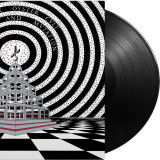
Tyranny and Mutation is the second studio album by American hard rock band Blue Öyster Cult, released on February 11, 1973, by Columbia Records. The album was recorded at the Columbia Studios in New York City during the year before and was produced by Murray Krugman and Sandy Pearlman. On May 12, 1973, the album peaked at #122 on the Billboard 200.
The song “Baby Ice Dog” features lyrics by singer/poet Patti Smith (who was keyboardist Allen Lanier’s girlfriend at the time), who would make several lyrical contributions to the band’s repertoire during its career. The song “The Red & The Black”, with lyrics referencing the Royal Canadian Mounted Police, is a renamed, re-recorded version of “I’m on the Lamb But I Ain’t No Sheep” from the same-titled debut album. The song was later covered by the Minutemen and Band of Susans.
Celebrating its 50th anniversary, Tyranny and Mutation is available as a limited edition of 2000 individually numbered copies on translucent blue coloured vinyl.
debe ser publicado en 08.03.2024
Aquasky are a trio that formed in Bournemouth in 1995, inspired by the likes of LTJ Bukem, DJ Krust and Roni Size. They were signed to Moving Shadow for a three-single deal by the strength of the first two tracks that they made together. But the label had a heavy release schedule back then, so it took 2 years for the 3 releases to come out. During that time though they wrote more music for R&S and Reinforced as well as untold remixes.
These two tracks were written whilst signed to Moving Shadow but were not released at the time as drum and bass was progressing in style and tempo. So, they were put to DAT and forgotten about until 2015 when the band put out a 20 year compilation, finding the tracks on one of their many DAT tapes.
The music will take you right back to the mid-90’s when the music was deep and rolling and there were no hard and fat rules on how to make drum & bass.
This release has a close connection to Vinyl Fanatiks as the label is run by Brent from Aquasky.
Pressed by the mighty Phil ‘The Vinylman’ East on 180g heavyweight vinyl. This release is a bespoke product as no one record is the same. Designed to look like the planet Mars and part of a 4 vinyl Cosmik series.
Keep em rollin’
Haga su pedido ahora y le encargaremos el artículo en nuestro proveedor.
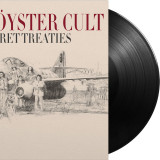
"Secret Treaties is the third studio album by American rock band Blue Öyster Cult, released in 197It features the same band members and production team as their previous album Tyranny & Mutation, but also the only BÖC album that does not feature a track with lead vocals sung by guitarist Donald ""Buck Dharma"" Roeser. Lyrics to the lead-off track ""Career of Evil"" were written by future punk poet Patti Smith, a longtime contributor to the band (and, at the time, girlfriend of BÖC keyboardist and rhythm guitarist Allen Lanier). The album spent 14 weeks in the US album charts, peaking at No. 5It was certified Gold by the RIAA. In 1975, a poll of readers of the British magazine Melody Maker voted Secret Treaties the ""Top Rock Album of All Time"". In 2010, Rhapsody called it one of the all-time best ""proto-metal"" albums. Secret Treaties is available on black vinyl and includes an insert."
Secret Treaties by Blue Oyster Cult, released 8 March 2024, includes the following tracks: "Dominance and Submission", "Cagey Cretins", "Flaming Telepaths" and more.
This version of Secret Treaties comes as a 1xLP. This release comes with (a) Insert(s).
debe ser publicado en 08.03.2024
The king of Colombian Bass is back on another low-end adventure!
In the vein of his previous work "Colombian Party", "Sendero" is another homage to the diversity of Colombia’s musical cultures and the artist's all-time favorite genres such as bass music, Hip-Hop and Dancehall. The album was entirely recorded between Bogotá and Sunka’s countryside farm, where the artist has been living for the past few years, growing all kinds of fruits and vegetables, Sunka’s new album “Sendero”, featuring Medellin-based hip-hop and reggae singer Raspapulaman, rising stars La Bembera and Zam El Caribean, Bogotá-based hip-hop and punk singer Jacob DMC, hip-hop maestros Kontent Thug and Santacruz Medina of Kartel Pacifico, is not your typical tropical album.
As accustomed , Sunka delivers a perfect blend of sub frequencies, heavy electronic drums and organic elements. Sweet and sharp at the same time,"Sendero" will make you
whine your waist at home and in the club, and will certainly go heavy on your speakers!
Haga su pedido ahora y le encargaremos el artículo en nuestro proveedor.
Love Is Yes is the first album by Sander van der Toorn and Dax Niesten, an audio-visual duo de force of the same name.
This heady debut is rooted equally in the worlds of fine art and experimental music. Sound and image meld wonderfully across 10 tracks, with shifting movements of music accompanied by a wealth of paintings and animations.
Niesten's work summons the likes of Philip Guston and Maurice Sendak - with its crestfallen, cartoonish voids and cockle-warming grotesquery. Serenely contorted creatures are rendered on large canvases, and brought to fuzzy, maudlin life through a full-length animation that can be viewed alongside the record.
Musically, the pair cite influences ranging from Vashti Bunyan to Morton Feldman. There is an ornate fragility, smeared by zero gravity focus shifts. Some glimpses suggest a corroded grail of Boards of Canada samples; motorik guitar, whispered messages, euphoric vistas and tangled memories all bathing in atomic glow.
debe ser publicado en 08.03.2024