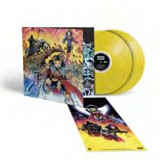
The forthcoming latest edition of the popular compilation series featuring long-lost vintage 60s-70s proto-metal and stoner rock singles, Brown Acid: The Thirteenth Trip will be available on Halloween 2021. Check out the first single "Run Run", released in 1970 by Montreal hard rockers Max is available to hear & share via Metal Injection HERE. (And, direct YouTube and Bandcamp)
The Brown Acid series is curated by L.A. label RidingEasy Records and retailer/label Permanent Records. Read interviews with the series curators via Paste Magazine HERE and LA Weekly HERE.
About The Thirteenth Trip:
Max, from Montreal, QC — originally known as Dawn, before Tony Orlando & Dawn forced a name change — kick things off with “Run Run” from their lone 1970 single. It’s a hard-hitting rocker with scale climbing crunching guitars and powerful Bonham-esque drumming. Sadly, the band didn’t last long due to poor management and various other factors, so this is the only surviving document according to guitarist Gerry Markman. And what a document it is, paired with the A-side “The Flying Dutchman.”
You might remember Ralph Williams and the Wright Brothers from their track “Never Again” on Brown Acid: The Tenth Trip. Here they make their return to the series with the A-side of their 1972 Hour Glass Records 45, which sounds like Blue Cheer mangling Roy Orbison’s “Pretty Woman” (that’s right, several years before Van Halen actually did so.) Alas, Ralph and these Wright Brothers soon disappeared from terrestrial airspace.
“Feelin’ Dead” is extremely heavy blues from this also extremely rare 1974 single by Detroit, MI’s Master Danse, which was only released as a promo 45. Think Led Zeppelin’s “Since I’ve Been Loving You” and you’re on the right track. A little dose of Hendrix acid blues and a heartfelt groove, and you’ll wonder why this single never even made it to official release. The unavoidable tell in the lyric, “help me get this damn thing out of my arm” hints at the post-Vietnam heroin epidemic as a potential clue why we never heard more from Master Danse.
Folks, Gary Del Vecchio is “Buzzin’” hard on this one, and from what sounds like an in-studio party of yelps and chatter at the start of the song, it seems that the whole band was in on the festivities. The funky blues riff, reminiscent of Led Zeppelin’s “Heartbreaker” and rollicking rhythmic changes certainly keep the buzz a rollin’.The recording is technically credited as Gary Del Vecchio with Max, though not the same band as the one that kicks off this Trip.
John Kitko’s 1973 heavy psychedelic rager “Indecision” is the only recording known to exist by the mysterious artist. The Twin Record Productions release features a different artist, Tom Poff on the B-side, which is truly a shame, considering the smoldering ashes Kitko leaves of the turntable by song’s end. It starts out more like a late 60s Acid Rock jam before leaping into a blazing double-time gallop, whipped into a frenzy by wailing, neck-pickup guitar squeals and Kitko’s barely audible howls.
Tampa, FL’s Bacchus made their Brown Acid debut way back on the very first Trip with “Carry My Load.” This 1972 B-side, “Hope” is a huge sounding swinging rocker replete with roadhouse piano bolstering the chunky riffs and confident vocals. After relocating to Southern California a few years later, the band morphed into Fortress, an 80s melodic metal act whose Hands In The Till album of Pomp Rock on Atlantic Records still draws chatter today.
Orchid’s “Go Big Red” is perhaps the most garage-y sounding offering here, with loose rhythms and straightforward stop-and-start riffing. Nonetheless, the stomping energy and fried-amp guitar tone make this one a charming skull thwack. The band’s 1973 single on American records, backed with a cover of Johnny Russell and Voni Morrison’s “Act Naturally” (popularized by Buck Owens and the Buckaroos) is their only release, so the world never did see this Orchid fully blossom.
By the title alone of Dry Ice’s “Don’t Munkey with the Funky Skunky” you know you’re in for a good time. The 1974 barnstormer seems aimed to the novelty tunes crowd, with its kooky lyrics and silly-voiced spoken catchphrase break, “peeyew, you’ll be sorry if you do.” But, the Ohio band’s maniacal drumming, crunching guitars and, of course, drug euphemistic lyrics make it a shoo-in for the Brown Acid series of erudite rock’n’roll.
Good Humore’s swaggering 1976 rocker “Detroit” is a slick and smooth paen to the Motor City. It most likely doesn’t predate “Detroit Rock City” by Kiss, also released in 1976, and it has more rock’n’roll swing, but it could fit comfortably alongside the era’s arena anthems. Not much else is known about the one-off release on P.V. Records, but songwriter Mike Moats is noted to also have been a recording engineer in later years and this well produced track sounds like a labor of love.
Search:the skull
In 1994 Come responded to the difficult-second-album stereotype with the hypnotic, intense and emotional masterpiece 'Don't Ask Don't Tell'. Featuring the original line-up of Thalia Zedek, Chris Brokaw, Sean O' Brien and Arthur Johnson, the Boston band broadened their sound by slowing down the tempos and creating a dense urban stream of consciousness that mixes noise, city blues and_ catharsis. The album hits you immediately as one of the greatest dissident records ever made. Lovingly remastered, this expanded edition includes 'Wrong Sides', an additional albums worth of b-sides and unreleased tracks, including the band's very first single 'Car' and their last recorded song, 'Cimarron', featuring this core line-up. These gems showcase the rawness and incredible growth of a band completely in command of their songwriting and at the same time paying homage to some of their punk roots with beautiful renditions of Swell Maps 'Loin Of The Surf' and X's 'Adult Books'. Also Includes new artwork with unearthed photos and fresh liner notes by the band. Dissident from traditional rock this is a band playing music that thematically and structurally seems to pull from old Europa, from Eastern folk and modernist classical music as much as US and UK rock. Dissident from traditional ideas about singing and songwriting Thalia's (ex of Live Skull) presence on songs like 'Yr Reign' and the astonishing closer 'Arrive' isn't the pushy self-aggrandizement of a lead singer but the internal voice of the eternal migrant, someone who knows about survival, hiding, how living between multiple worlds can become its own refuge of distance, its own sanctuary of unbelonging Don't Ask Don't Tell emerged from a period of cohesion, a break from the tight and hectic touring schedule Come had been plunged into after the acclaim accorded 11:11, and you can hear that increased focus in every moment the layers of guitars and feedback are even more precise, the structuring of songs takes on a new openness and ambition, and the whole narrative arc of the record from 'Finish Line' to 'Arrive' is more exquisitely realised and sequenced. "The songs on Don't Ask Don't Tell . . . had a kind of magic we didn't necessarily control ourselves." Chris Brokaw - interview with Neil Kulkarni, 2013. "Devastating, with slow, burning songs that shudder and wince" NY Times
Imagine Andrew Weatherall producing Pere Ubu. The 7” Taki Chrome / Strummer Maxxx single by Pink Skull released on Höga Nord Rekords give a hint of how such a collaboration would sound. Mid seventies kraut rock á la “Neu 75” meet leftfield and sophisticated punk. The record has an organic warmth to it yet the excessive use of electronics: most instruments on the tracks are synthesizers and drum machines – all Moog, Korg and whatnot.
In the warmth of the Pink Skull-sound you suddenly get a wash of cold, hard rain from all directions. These elements of surprise create edges in the round soundscape and brings chaos to the mix. This is of course all part of Julian Grefes (founder of Pink Skull) plan.
Pink Skull propels you out of the quarantine like a shiny metal free bird released from its rusty cage.
Kansas City trio BUMMER mirror the absurdity of
modern life with a balance of dark humour, dejected
nihilism and righteous fury. Their music spills out in
torrents of skull-crushing riffs, gargantuan bass and
caustic howls delivered at breakneck speed with
gleeful abandon.
Following their split 7” with long-time friends The Body,
which teased a more focused, lean sound for the
group, ‘Dead Horse’ hones BUMMER’s auditory
desolation and scathing gaze to laser-point precision.
In eleven short vignettes the quartet lay waste to
everything in their path, penning a vitriolic overview of
life in the American Midwest, a surprising blend of onestar Trip Advisor review and insightful cultural critique.
“BUMMER puts the ‘power’ in power trio as they play
a raw and primal form of aggressive music that splits
the difference between ‘Bleach’-era Nirvana and the
early, primitive thrash of Slayer. It’s aggressive and inyour-face, but doesn’t skimp on melody, making their
songs memorable. So, there is power and a bit of
precision to what they do. A whole lot of volume, too.” -
New Noise Magazine
CD in gatefold packaging with lyrics.
LP packaged with download code.
Available to independent retailers on grey / blue vinyl.
Artwork by painter Joan Lalucat Vehil.
Runnner's Always Repeating yearns for a sense of place. The project of the now LA-based songwriter/multi-instrumentalist Noah Weinman, Runnner's poignant reflections on the isolation and anxiety caused by a sense of rootlessness radiate with wit and charm. Self-produced and recorded wherever he called home at the time, Always Repeating documents this cycle of looking back and moving forward, of alienation changing to reconciliation. For Weinman, Runnner is primarily a solo endeavor with an ever - expanding musical community of musicians collaborating on his albums and shows, which at times have been known to feature up to a 7-piece live band (he also has a burgeoning career as a producer, notably working on Skullcrusher's critically-acclaimed debut EP for Secretly Canadian). Weinman completed Always Repeating last fall in Western Massachusetts and Woodstock using a mobile studio set-up. He played the majority of the instruments himself, including guitar, bass, trumpet, banjo, piano and synth. The goal was to create the perfect balance of intimate and melancholy songwriting through the lens of hi-fi/lo-fi dynamics, inspired by his favorite artists like Bon Iver, the Microphones, and Julien Baker. The 10-track collection is composed of five re-recorded versions of songs that appeared on Runnner's 2017 debut, Awash, and 2020's One of One EP. Although the songs were written over the course of three years, all find Weinman grappling with the same thing: feelings of uncertainty about his life. Always Repeating ultimately tells the start of Weinman's journey as Runnner, and his cyclical feelings of being connected and then disconnected from the world over and over again.
Runnner’s Always Repeating yearns for a sense of place. The project of the now LA-based songwriter/multi-instrumentalist Noah Weinman, Runnner’s poignant reflections on the isolation and anxiety caused by a sense of rootlessness radiate with wit and charm. Self-produced and recorded wherever he called home at the time, Always Repeating documents this cycle of looking back and moving forward, of alienation changing to reconciliation.
For Weinman, Runnner is primarily a solo endeavor with an ever-expanding musical community of musicians collaborating on his albums and shows, which at times have been known to feature up to a 7-piece live band (he also has a burgeoning career as a
producer, notably working on Skullcrusher’s critically-acclaimed debut EP for Secretly Canadian). Weinman completed Always Repeating last fall in Western Massachusetts and Woodstock using a mobile studio set-up. He played the majority of the instruments himself, including guitar, bass, trumpet, banjo, piano and synth. The goal was to create the perfect balance of intimate and melancholy songwriting through the lens of hi-fi/lo-fi dynamics, inspired by his favorite artists like Bon Iver, the Microphones, and Julien Baker.
The 10-track collection is composed of five re-recorded versions of songs that appeared on Runnner’s 2017 debut, Awash, and 2020’s One of One EP. Although the songs were written over the course of three years, all find Weinman grappling with the same thing: feelings of uncertainty about his life. Always Repeating ultimately tells the start of Weinman’s journey as Runnner, and his cyclical feelings of being connected and then disconnected from the world over and over again.
- A1: Dub Them Under Manners
- A2: Go In A It Dub Stylee
- A3: This Is A Natural Dub Stylee
- A4: Ragga Muffin Dub Stylee
- A5: Bad Boys Dub Stylee
- B1: The Best Dub In The Business
- B2: Majestic Dub Stylee
- B3: Brighter Shade Of Dub Stylee
- B4: Dubbers Delight Stylee
- B5: Back Out A This Dub Stylee
• King Tubby was the legendary producer and engineer who pioneered remixing and developed dub as an art form in the late 1960s and early 1970s. Today, he is considered to be one of the most important figures in Jamaican music and his influence can be heard in hip-hop, jungle, garage and dubstep.
• ‘Majestic Dub’ was first released in 1983 on the British reggae label Star. Recorded at King Tubby’s famous Kingston studio, it features performances by legendary reggae session musicians including Sly & Robbie, Noel “Skully” Simms, Uziah “Sticky” Thompson, Jackie Mittoo, Winston Wright, Earl "Chinna" Smith and Willie Lindo
• Demon Records is proud to present the first vinyl reissue of ‘Majestic Dub’, pressed on 140g black vinyl.
The fourth full length album of Orchestra of Constants Distress Concerns marks the end of a quadruple suite of intense, dissonant, reluctant improvisation.
Looking back on five years of musical summits, which also has resulted in a couple of cassette releases and a live LP from Roadburn festival, one might wonder if these musicians have come to some form of insight.
Riffs seems to have deepened into complete compulsiveness as the rhythm from drummer Anders Bryngelsson (Brainbombs, No Balls) deliver both frustration and caution at the same time. Between the dissonant sounds of Henrik Rylander (Union Carbide Productions, Skull Defekts) and the choleric play style by guitarist Joachim Nordwall (Idealist, Skull Defekts) a way of emotional vacuity is spreading. With the phlegmatic and elemental bass of Henrik Andersson (visual artist) the music of OOCD is a montage of sound-scapes rather than the uniform of compositions.
Rather than seeking a musical presence through improvisation they seem to perform absence and void.
ORCHESTRA OF CONSTANT DISTRESS Are
Joachim Nordwall (The Skull Defekts, iDEAL Recordings) Anders Bryngelsson (Brainbombs, No Balls)
Henrik Rylander (The Skull Defekts, Union Carbide Productions) Henrik Andersson
In celebration of the 20th anniversary of the release legendary singer/ guitarist Thalia Zedek's Been Here and Gone, Thrill Jockey is proud to present the album unlike it has ever been heard before: on vinyl, re-mastered by Sarah Register. Thalia Zedek has been one of the most enduring rock musicians of the past four decades. From her auspicious beginnings in bands Uzi, Live Skull, and Dangerous Birds to her wider recognition in Come, Zedek established herself as a singular voice accruing accolades from critics and contemporaries including J. Mascis, Kurt Cobain, and Bob Mould. Been Here and Gone, her debut solo release originally released on Matador in 2001 on CD, marked a turning point in Zedek's music. As Come was coming to a close, Zedek began exploring writing and performing as a solo artist, eventually backed by violist David Curry, pianist Mel Lederman (both of which went on to perform with Zedek for two decades), as well as former Come bandmates Chris Brokaw and Daniel Coughlin. The idiosyncrasies of her voice were laid bare for the first time, revealing an even greater depth to her unique songwriting. The more spacious and rich arrangements sprawl and whisper with powerful vulnerability. "There was definitely something magical about the making of Been Here and Gone," says Zedek. "I'm not sure if it was because it was made at a studio called Higher Power in a recently desanctified church in Stuyvesant, NY, or if it was because it was the end of a century, not to mention a millennium, the end of a decade of being in Come, the longest running band I'd had up to that point, and the end of 5 years of unhappy breakups and tumultuous relationships in my personal life." The eleven tracks that comprise Been Here and Gone embody that tension of uncertainty with a hopeful edge of renewal. Zedek's indelible resilience lifts even the somberest laments into triumphs. Even on the album's three cover tunes, including a haunting rendition of Leonard Cohen's "Dance Me to the End of Love," Zedek's voice and guitar color every note with raw emotion, making each passing gesture personal. Been Here and Gone channels the thunder and roar of Zedek's past into a fragile magnificence.
In celebration of the 20th Anniversary of the release of
legendary singer / guitarist Thalia Zedek’s ‘Been Here
and Gone’, Thrill Jockey are proud to present the
album on vinyl for the very first time, remastered by
Sarah Register.
Thalia Zedek has been one of the most enduring rock
musicians of the past four decades. From her
auspicious beginnings in bands Uzi, Live Skull and
Dangerous Birds to her wider recognition in Come,
Zedek established herself as a singular voice accruing
accolades from critics and contemporaries including J.
Mascis, Kurt Cobain and Bob Mould.
‘Been Here and Gone’, her debut solo release,
originally released on Matador in 2001 on CD, marked
a turning point in Zedek’s music. As Come were
coming to a close, Zedek began exploring writing and
performing as a solo artist, eventually backed by violist
David Curry, pianist Mel Lederman (both went on to
perform with Zedek for two decades), as well as former
Come bandmates Chris Brokaw and Daniel Coughlin.
The idiosyncrasies of her voice were laid bare for the
first time, revealing an even greater depth to her
unique songwriting. The more spacious and rich
arrangements sprawl and whisper with powerful
vulnerability.
Deluxe packaging featuring photos of the recording
session on the inner sleeve. Includes digital download
card.
- A1: Fleetwood
- A2: Something
- A3: Crumbs (Feat. Evidence & Muja Messiah)
- A4: Woes
- A5: Strung (Feat. Musab)
- A6: Clocked
- A7: Sleepless (Feat. Nino Bless)
- A8: Distances
- A9: Carousel (Feat. Nikki Jean)
- A10: Vanish
- A11: Pressed (Feat. Anwar Highsign, Blackliq, Sa-Roc, Haphduzn, Lateef Truthspeaker)
- A12: Skull
- A13: Nekst
- A14: Barcade (Feat. Aesop Rock & Mf Doom)
Following their last release, The Day Before Halloween_an imaginative, distorted-synth-driven concept album_Atmosphere returns with a refreshing new project, simply titled WORD? Steering back toward their signature sound, the album further highlights producer Ant's undeniable talents as the project leans into the classic boom-bap aesthetic, bringing a unique energy out of Slug's wisdom, wit and delivery. From onset, WORD? proves to be every bit an exercise in refining and advancing their craft as it is a harkening to earlier work. That is, while their releases have grown more broodingly cinematic, and increasingly concerned with the human condition and mortality, WORD? manages to reintroduce moments of levity and lightheartedness throughout, an approach seldom heard on their albums of late. From album opener "Fleetwood," with its razor-sharp snares and warm fleshy bassline, to the resonant melody of "Clocked", there are strong hints of Atmosphere's nascent years within the sound. Meanwhile, songs like "Woes", "Strung" and "Vanish" cheerfully make light of daily hardships, but they're more likely to be remembered for making listeners want to bob their heads and sing along. With Slug and Ant directing the course, the album plays like a joyride through a range of experiences and emotions, with an extensive cast of special guests hopping in and out along the way, including Evidence, Muja Messiah, Musab, Nino Bless, Nikki Jean, Anwar HighSign, BlackLiq, Sa-Roc, Haphduzn, Lateef the Truthspeaker, Aesop Rock, and the late MF DOOM (RIP). The result is a project that feels like it came from the era or, perhaps more fittingly, the mindset that created albums like God Loves Ugly, Seven's Travels, or the popular Sad Clown series, while sounding as polished and perfected as more recent albums like Mi Vida Local or Whenever. Ultimately, WORD? pairs the breadth of Atmosphere's talents with the beauty of their growth, all while showing they still have a lot of fun in the process and don't mind letting the listener in on the fun as well.
Dark Nights: Death Metal war eine siebenteilige DC-Comicserie mit einer Erstauslieferung von 250k Einheiten, die an über 1,2 Tausend Graphic Novel- und Fachgeschäfte verteilt wurde. Um die hemmungslose
Ehrfurcht vor der Comic-Serie zu untermalen, präsentieren Tyler Bates und Loma Vista Recordings den ”Dark Nights: Death Metal-Soundtrack” mit Beiträgen von u.a. Rise Against, HEALTH, Denzel Curry, Soccer Mommy oder Manchester Orchestra.
Tyler Bates ist nicht nur ein Meister im Entwerfen von Musik für Film, Fernsehen und Videospiele, sondern auch ein gefragter Multiinstrumentalist, Autor und Produzent. Zu seinen Filmen zählen Dawn of
the Dead (2004), 300 (2007), Watchmen (2009), mehrere Kollaborationen mit Rob Zombie, darunter The
Devil’s Rejects (2005), Halloween (2007) und Halloween II (2009), die Guardians of the Galaxy-Saga (2014,
2017), die John Wick-Serie (2014, 2017, 2019), Atomic Blonde (2017), Deadpool 2 (2018), Fast & Furious
Presents: Hobbs & Shaw (2019 ), und viele mehr.
Dark Nights: Death Metal war eine siebenteilige DC-Comicserie mit einer Erstauslieferung von 250k Einheiten, die an über 1,2 Tausend Graphic Novel- und Fachgeschäfte verteilt wurde. Um die hemmungslose
Ehrfurcht vor der Comic-Serie zu untermalen, präsentieren Tyler Bates und Loma Vista Recordings den ”Dark Nights: Death Metal-Soundtrack” mit Beiträgen von u.a. Rise Against, HEALTH, Denzel Curry, Soccer Mommy oder Manchester Orchestra.
Tyler Bates ist nicht nur ein Meister im Entwerfen von Musik für Film, Fernsehen und Videospiele, sondern auch ein gefragter Multiinstrumentalist, Autor und Produzent. Zu seinen Filmen zählen Dawn of
the Dead (2004), 300 (2007), Watchmen (2009), mehrere Kollaborationen mit Rob Zombie, darunter The
Devil’s Rejects (2005), Halloween (2007) und Halloween II (2009), die Guardians of the Galaxy-Saga (2014,
2017), die John Wick-Serie (2014, 2017, 2019), Atomic Blonde (2017), Deadpool 2 (2018), Fast & Furious
Presents: Hobbs & Shaw (2019 ), und viele mehr.
Dark Nights: Death Metal war eine siebenteilige DC-Comicserie mit einer Erstauslieferung von 250k Einheiten, die an über 1,2 Tausend Graphic Novel- und Fachgeschäfte verteilt wurde. Um die hemmungslose
Ehrfurcht vor der Comic-Serie zu untermalen, präsentieren Tyler Bates und Loma Vista Recordings den ”Dark Nights: Death Metal-Soundtrack” mit Beiträgen von u.a. Rise Against, HEALTH, Denzel Curry, Soccer Mommy oder Manchester Orchestra.
Tyler Bates ist nicht nur ein Meister im Entwerfen von Musik für Film, Fernsehen und Videospiele, sondern auch ein gefragter Multiinstrumentalist, Autor und Produzent. Zu seinen Filmen zählen Dawn of
the Dead (2004), 300 (2007), Watchmen (2009), mehrere Kollaborationen mit Rob Zombie, darunter The
Devil’s Rejects (2005), Halloween (2007) und Halloween II (2009), die Guardians of the Galaxy-Saga (2014,
2017), die John Wick-Serie (2014, 2017, 2019), Atomic Blonde (2017), Deadpool 2 (2018), Fast & Furious
Presents: Hobbs & Shaw (2019 ), und viele mehr.
Book + CD
In the year 2018 visual artist Ken Verhoeven (1991, lives and works in Antwerp) presented his Friendship Paintings, a collection best described as “deconstructed designs for friendship bracelets”, at Trampoline gallery in Antwerp.
The subject: the friendship bracelet. A wristband infused with meaningful (?) symbols. Symbols crafted thread after thread. One pulls a string, and ... friendship happens. Or ... friendship is being manipulated by symbolism. Not unlike a fetish.
Ken Verhoeven upcycled this vulgar object and brought it inside the art gallery. Where he showed not only the designs, but also the schematics for how to craft each bracelet. Like exposing the crystals of friendship.
It is a recurring storyline in Ken Verhoeven’s work. In the words of gallerist Stella Lohaus “he constantly interprets curiosities that casually present themselves in the world around him.”
Friendship Songs For this book, Ken Verhoeven structured ten works as a dramatic narrative.
He invited me to translate these works to music. To treat them as sheet music. Graphic scores. From here on, the Friendship Paintings become Friendship Songs.
On the accompanying CD, i recorded 10 arrangements of the 10 scores. Not unlike how Ken Verhoeven only used an existing DIY online generator to create the designs – i stuck to very limited tools while arranging the music. Namely one Roland Sound Canvas module for the sounds, Christian Schubart’s seminal book about the aesthetics of the tonal arts – to determine the tonality of each score, and the Spectrotone Instrumental Tone-Colour Chart for the instrumentation. The latter being a system invented a century ago in Hollywood, to apply different colours to the various instruments and registers of an orchestra.
We arrive at objective musical interpretation. However, since we are not dealing with heartless content here, the arranger does need to take subjective decisions, to bring the arrangements home. These small musics can / should (who is the manipulator now?) be played as a friendship bracelet. Thus: as endless loops. Every song repeats itself as long as you wish for. Like the symbol on the bracelet is being repeated until the circular object is finalized. Once, twice, 10, 20, 100, ?? times. Enjoy, Friend!
Lieven Martens, Deurne 28 june 2021
Something wicked this way comes. Following singles 'Know The Future' b/w 'Digital Warfare' in 2019 and 'Hypersocial' b/w 'Safety Test' in 2020, ESP’s own Patrick Conway has now teamed up with the illustrious Appleblim (of Skull Disco and Apple Pips fame) for a meaty self-titled debut 2xLP under the new collaborative moniker, Trinity Carbon. There is something to be said for art created in the face of global unraveling, while mass transgression and the friction of culture shifting produce poignant commentary, but more often than not, it’s the personal coping mechanisms within our work that have the power to speak directly to the receiver. After a number of sessions resulting in wild imaginative beginnings, it was the untimely passing of Andrew Weatherall and a coming to terms with that loss that moved the two Brits-via-Berlin to herd their roaming sketches into a more narrative statement. In the uphill struggle to retain some sense of individualism, it’s always outsiders like Weatherall whose risks illuminate the roads of creativity less traveled, and when those beacons go dark there is a disorientation felt far and wide. Conway and Blim concede to the internal inquiry, “What would Weatherall do?” bringing to mind the man’s pervading morale, always soldiering onward through mediocrity, as it was undoubtedly an impetus for the duo growing steadfast and chiseling 'Trinity Carbon' into completion. While employing trusted machines in the bass department, they established a warm euphonic home base from which they could stray in a variety of tonal and rhythmic directions without straining a tether to the album’s core. However, as soon as any hint of familiarity may arise, or listeners begin to mentally assign stylistic epithets, the duo boldly change course to remind us that while the banal stay safely defined, it’s the iconoclasts, the outsiders who make us feel.
- A1: Bertha (Live At The Fillmore East, New York, Ny, April 27, 1971)
- A2: Mama Tried (Live At The Fillmore East, New York, Ny, April 26, 1971)
- A3: Big Railroad Blues (Live At The Fillmore East, New York, Ny, April 5, 1971)
- A4: Playing In The Band (Live At The Fillmore East, New York, Ny, April 6, 1971)
- B1: The Other One (Live At The Fillmore East, New York, Ny, April 28, 1971)
- C1: Me & My Uncle (Live At The Fillmore East, New York, Ny, April 29, 1971)
- C2: Big Boss Man (Live At The Fillmore East, New York, Ny, April 26, 1971)
- C3: Me & Bobby Mcgee (Live At The Fillmore East, New York, Ny, April 27, 1971)
- C4: Johnny B. Goode (Live At The Fillmore East, New York, Ny, March 24, 1971)
- D1: Wharf Rat (Live At The Fillmore East, New York, Ny, April 26, 1971)
- D2: Not Fade Away / Goin’ Down The Road Feeling Bad (Live At The Fillmore East, New York, Ny, April 5, 1971)
Celebrating the 50th Anniversary of Grateful Dead’s first album to be certified Gold, this 2021 Remaster pressed onto 180g Black vinyl features all newly remastered tracks, remastered by GRAMMY ® Award winning engineer, David Glasser with Plangent Process Speed Correction.
Originally released in 1971, this is the American rock band’s second live album, known by fans as Skull and Roses due to the iconic cover art. The album was originally released without a title after the band initially submitted the album name “Skull Fuck”, but the band, fans and almost everyone who knows the Grateful Dead fondly refers to the album as Skull and Roses.
The album was their first album to be certified Gold in the US by the RIAA and is their second best-selling album. Pressed here onto 180g black vinyl, this remaster transports the listener back to the Dead’s residency at The Fillmore East, New York and, as with the first release, features three tracks previously unreleased on the studio album, “Bertha, “Playing In The Band” and “Wharf Rat”.
[a] a1. Bertha (Live at The Fillmore East, New York, NY, April 27, 1971) [2021 Remaster]
[b] a2. Mama Tried (Live at The Fillmore East, New York, NY, April 26, 1971) [2021 Remaster]
[c] a3. Big Railroad Blues (Live at The Fillmore East, New York, NY, April 5, 1971) [2021 Remaster]
[d] a4. Playing in the Band (Live at The Fillmore East, New York, NY, April 6, 1971) [2021 Remaster]
[e] b1. The Other One (Live at The Fillmore East, New York, NY, April 28, 1971) [2021 Remaster]
[f] c1. Me & My Uncle (Live at The Fillmore East, New York, NY, April 29, 1971) [2021 Remaster]
[g] c2. Big Boss Man (Live at The Fillmore East, New York, NY, April 26, 1971) [2021 Remaster]
[h] c3. Me & Bobby McGee (Live at The Fillmore East, New York, NY, April 27, 1971) [2021 Remaster]
[i] c4. Johnny B. Goode (Live at The Fillmore East, New York, NY, March 24, 1971) [2021 Remaster]
[j] d1. Wharf Rat (Live at The Fillmore East, New York, NY, April 26, 1971) [2021 Remaster]
[k] d2. Not Fade Away / Goin’ Down the Road Feeling Bad (Live at The Fillmore East, New York, NY, April 5, 1971) [2021 Remaster]
It’s testament to the man they call Medlar, that you never quite know what you might get with one of his releases. WOLF Music family since the early days, his latest mini-LP on the label is no exception. Seven cuts that prove this man can do anything, taking you on an otherworldly, island tour.
First stop, ‘Aerial’, channelling that inner Wally Badarou for a cosmic, sand-stomping chuggathon, heavy on the juiced-up basslines, tripped out synth wizardry and space delay goodness. Your pace quickens, ‘Iguanadon’ rattles the world around you, shamanic echoes swirling through your skull as that acidic stab hypnotises you into a stupor.
Out the other side, you stumble across an ‘Elephant Bingo’. Cup of tea, track three. Slap bass, bongos and synth stabs lifting the spirits.
Back on the beach you drift off into a slice of sleazed up Balearic business, turning the funk dial all the way up to 11 via ‘ELV’. Suddenly things take a trippier turn. Are you dreaming? ‘CR78-108’ booms in the background, pure jungle-tinged, digi dubwise movements.
A few stiff drinks and you’re on your feet again. ‘Phoenix Lights’ New York house stylings pump you with life, even if your hazy brain is still hearing wild echoes all over the place.
How did you end up here, 10 hours later? One too many ‘Sin Prisa’ homebrews no doubt, yet you’re still stompin through, granted it’s of the slow-mo, acid-laced variety though.
What was in that welcome drink Medlar handed you at the start? Who knows, who cares when you get that kinda bang for your buck.
This journey, this slowly drifting sonic meditation, is an 'inner soundscape', a dialogue between the senses, the conscience and the world, inside / outside, interconnected. Like waking up from a long dream, and being stuck into its echo. The April Sessions immerges the listener into a drone-ish universe, full of random acousmatic events, inner monologues and a vast and unwritten subjective map to be drawn.
The April Sessions has been living in a seedy hotel in Brussels for a few months. She listens to the sparse traffic outside her window, locked in and locked down. 'Everything is constructed', she says to herself, 'even the sound of a solitary aircraft at 25,000 feet traverses the sky no further out than the inside of my skull'. Other weird sonic phenomena criss-cross the inner cosmos of her brain and streak across her private sky like comets. And then there is the unshakeable presence of that inner monologue, known to her variously as the Tacit Dictator, the Subvocaliser and, nightmarishly enough, the voice of the Merlucid Hake. (Anthony Moore, St Leonards, 10th of March 2021)
Anthony Moore, Dirk Specht and Tobias Grewenig have known each other and worked together since the early 2000s. They have collectively participated in a number of projects including live performances and recordings. In 2016, as part of The Missing Present Band, they released the live LP 'The Present Is Missing' on A-Musik. The following year they released 'Ore Talks', a double LP, realised in collaboration with Therapeutische Hörgruppe Köln.
Anthony Moore was born in 1948, founded the band Slapp Happy (circa 1972) with Peter Blegvad and Dagmar Krause, then worked alongside a.o. Fred Frith and Tim Hodgkinson in the unclassifiable band Henry Cow. He released several solo albums, composed soundtracks for experimental movies. His path also crossed Kevin Ayers's, Pink Floyd's, Richard Wright's. He was appointed professor for research into sound and music in the context of new media at the Academy of Media Arts in Cologne, Germany. He still continues to write and perform.
Dirk Specht is a sound artist, musician and curator. He studied architecture and media art and is active in the fields of sound works for choreography, radio drama, sound art, film and video art soundtracks. He published releases with several bands and projects. He has been an assistant for research into sound from 2011 to 2016 at the Academy of Media Arts in Cologne, and is a founding member of Therapeutische Hörgruppe Köln.
Tobias Grewenig studied at the Academy of Media Arts in Cologne. He primarily deals with non-linearity in his audiovisual installative works and performances, including projects with the artist group 'Therapeutische Hörgruppe Köln', the ensemble 'The Knob, The Finger & The It' and the improvisation collective "Frequenzwechsel". The conception and development of electronic instruments and code is a key component of his artistic work. He lives and works in Cologne.
- A1: C C.c.c
- A2: Moscow Does Not Believe In Tears
- A3: A Nation Of Rats, Ruled By Wolves, Owned By Pigs
- A4: One Rat Short Of A Plague
- B1: I Feel Like A Cigarette Burn
- B2: Life Is A Horizontal Fall
- B3: Attention, Potion Magique!
- B4: Life's True Face Is The Skull
- B5: The Rats Have Gone, The Bottles Drunk, The Ship Has Sunk
- B6: The Tide Rolls Out And Only The Rats Remain
Tape / Cassette
Canaan Balsam is an electronic composer and musician based in Edinburgh. He uses field recordings, found sounds, hardware and a range of software to create immersive soundscapes. His work explores the dead space between ambient and new age music; the liminal zone between the harshness of industrial and the beatific serenity of devotional music.
Responding to the context where ever-expanding modes of communication seem only to blur the line between connectivity and solitude, Canaan often returns to the theme of loneliness in his work - how it can grow and metasta- size, until it becomes incommunicable, resistant to empathy; an alien host overtaking the body. Cruise Utopia was recorded over the last 3 years and it's his first solo work.
Balsam has collaborated with several contemporary artists including Cosima Cobley Carr and Calvin Z Laing, as well as experimental musician Dan Mutsch, and has performed in an iteration of Damo Suzuki's Sound Carriers. Canaan's sound work has featured at the Radiophrenia Festival at CCA in Glasgow. His audiovisual work has been exhibited at the Embassy Gallery in Edinburgh. He is also part of the Scottish sound art and collective Optic Nerve.


![Grateful Dead - Grateful Dead (Skull & Roses) [Live] [2021 Remaster]](https://www.deejay.de/images/l/3/1/977131.jpg)